Showing posts with label Food. Show all posts

Tuesday, September 19, 2017

Does anyone remember Watch Your Head?

Over at the Korea Times, Jon Dunbar wrote about the changes to the Hongdae Playground and his memories of it over the years (it's officially known as the 홍익 어린이 공원 or Hongik Children's Park). I imagine I would have visited it back in 2001, though my earliest definite memory of it was in the summer of 2002, a month or so after the World Cup. I didn't take any photos of it, but did capture this closer to Hapjeong Station:


Apparently it was in June that year that the first "HongDaeAp Artmarket Freemarket" (as their site refers to it in English) appeared. I remember its quick growth, and according to their site it was "newly renovated into its current form in 2003" (though that form is no longer current since a more recent renovation, as Jon points out). I remember more trees and benches in 2002, and when the construction fences went up for the renovation later that year or in early 2003.

I can't say I spent much time there, though. I can remember hanging out at club Issey (with its cheap bottles of local beer and 1500 won tequila shots) and in the little places with "soju beer hof" written simply on the wall next to the door in the buildings that now house all the little clothing shops (on the 'parking lot street') - that entire area gentrified during 2003, and I remember my shock at the difference upon returning to Korea after 6 months away in October that year. It was while going through old Korea Herald articles that I clipped during my first two years in Korea that I found an article on my favourite place from that time - "Watch Your Head":


I can't help but wonder if the Canadians he speaks of included myself and my friends. Besides its small size (particularly in the owner's 'personal room,' which had a section raised a foot or more off the floor), it stood out for being a makgeolli jip in Hongdae, which was not so common then in that part of the neighbourhood. If I remember correctly it closed in 2003.

Of course, when it comes to makgeolli in Hongdae, my biggest association will always be the 'makgeolli man,' who Jon also wrote about a few months ago.

Monday, September 26, 2016

Bits and Pieces

Over at the Grand Narrative, James posted about a newspaper cartoon from the 1930s which reveals how certain attitudes toward women have persisted.

At Zen Kimchi, Joe posted an interesting chapter from an unpublished book about marketing Korean food abroad - it's well worth reading.

And on the music side of things, Mark Russell's guest appearance on Shawn Despres's radio show is worth a listen if you're a fan of classic Korean rock (or 90s Korean indie rock).

As reported a couple weeks ago, the Korean government is asking you to help it fight inaccuracies about Korea:
On Sept. 1, the Korean Culture and Information Service (KOCIS), part of the Ministry of Culture, Sports and Tourism, launched the Facts:Korea website, a new website designed to help correct inaccurate information that is out there about Korea.

The site receives and deals with reports about inaccurate statements or errors made online about Korea, as well as incorrect statements or statistics used by smartphone apps. Through this website, people from around the world will be able to report false statements made about Korea, anywhere and at any time.

Inaccurate information about Korea covers all sorts of incorrect facts that might exist in content produced outside Korea. For example, the national Taegeukgi flag might be upside down, or Korea's traditional Hanbok attire might be mistranslated into English as "kimono." Once, South Korea was even referred to as being in Southeast Asia.
That last sentence is certainly not an indignant response to a geographical mistake, as perhaps made clearer by this sentence:
“We will continue to work to make right any misinformation about Korea, so as to improve the national image,” said KOCIS Director Kim Kabsoo.
The site can be found here (or "download the app directly to your smartphone"), but to make a report you need to download lots of active x junk, as is par for the course on any government website.

Perhaps someone will report as misinformation this article, titled "The boozy, narcissistic culture shock of working in South Korea," which is about the book "Seoul Man" by Frank Ahrens, who lived in Seoul for three years working as director of global p.r. for Hyundai. The book jacket urges readers to "Take a wild ride into the formal-by-day, crazy-by-night Asian business world" (oh, those wacky Asians!) and chapter titles like "At Work: Alien Planet." To be fair, these may reflect the choices of the publisher rather than the author. The article, in between highlighting the drinking and plastic surgery in Korea, describes a few scenes from the book:
Ahrens tried to bust through the culture, including throwing a party at his house with people from work and others. But his employees viewed it as an obligation. They spoke to no one there but their fellow co-workers, and spent the night serving drinks to their superiors.

When Ahrens asked his team leader about this, the reply was, “Sir, we don’t go to parties where we don’t know everyone.” Ahrens said that parties in America were often for meeting people but was told that Koreans “make their friends for life in school.”

“How do you make friends as an adult?” Ahrens asked.

“We don’t,” was the reply.
This is likely more about 'telling foreigners what we want them to think about Korea'; some men seem to have no trouble making friends after high school (sarcasm off). Still, the author's anecdotes about the culture of hierarchy at work can be amusing:
Ahrens got a taste of this extreme hierarchy while representing the company at a car show.

The chairman of Hyundai dropped by, throwing employees into a panic. When he decided to walk the convention floor, Confucian custom declared that his top aides follow along behind him. But it also meant that their top aides had to follow them — leading to a ridiculous trail of people that left onlookers stunned.

“I climbed to the second floor of our booth,” writes Ahrens. “There was the chairman making his way through a parting motor-show crowd, at least 20 dark-suited men following, some taking notes. The effect was that of a long, black eel snaking its way through a crowd of startled media.”
On the topic of foreigners working in Korea, Gi-Wook Shin and Rennie J. Moon's article, "A way to bridge aging societies," points out the need for foreign workers in the Japanese and Korean economies as their populations age. But there are problems...
Maria, a Guatemalan professional, decided to leave South Korea after working for six years in the overseas marketing department of a large Korean corporation. "Some Koreans complain that foreigners leave after a few years, but we leave because we're never included in the first place. Korean companies pay a lot to bring foreigners here. And then they don't even ask these people about their opinion."[...]

In South Korea, with a shorter history of foreign student intake, a Study-Work framework has yet to emerge. While 64.3% of South Korean companies say they need and want to hire foreign students, only a very small portion of foreign students work in South Korean companies after graduation, perhaps as low as 1%. South Korea's immigration laws for foreign students have eased slightly in recent years, but there is an urgent need to develop solid, institutionalized support for responding to the substantial demand by foreign students who wish to find employment after their studies.
One of the recommendations the article makes is that "Universities and corporations should establish diversity offices, as seen in the U.S. and elsewhere, to promote a culture of tolerance and non-discrimination." A problem with this is that various kinds of discrimination are built into the hiring process for many companies, as this study reveals:
Among undisclosed qualifications at companies, age was most often cited at 44.8 percent (multiple responses were possible). 33 was the average age limit for men imposed by firms, whereas it was 31 for women.

Second in rank was gender (31.9 percent), with companies typically maintaining a male to female ratio of 67 – 33.

Other qualifications not revealed to applicants included place of residence (29.3 percent), college major (25 percent), certificates and licenses (23.3 percent), marital status (18.5 percent), educational background (15.9 percent), internship or job experience (15.9 percent), military service status (13.8 percent), and religion (7.3 percent).

What was most significant on the survey, however, was that 89.2 percent of the companies said they had rejected candidates because they did not fit their confidential standards.
And these are just for Korean applicants.

Wednesday, March 19, 2014

Bits and pieces

Via the Marmot's Hole, this report on the possible horrible fate awaiting space rocks in Korea is an amusing read:
According to Kopri [Korea Polar Research Institute] and local residents, an American meteorite hunter who introduced himself as Robert had distributed business cards and asked people to sell him any meteorite fragments that are found. That has raised fears of precious space rocks that rained down on Korea being spirited overseas.

“We are considering measures to prevent such leaks by designating them as ‘monuments,’ a kind of cultural asset recognized by relevant law,” said an official of the Cultural Heritage Administration of Korea. [...]

According to cases in foreign countries, ownership goes to a person who finds meteorites on his or her own land - which means strangers should keep their hands off of Jinju’s space debris.
Nice to see the Cultural Heritage Administration claiming alien geology as a monument of the minjok.

I found the headline of this Chosun Ilbo article to be amusing: "Seoul Braces for Disruptions for Filming of 'Avengers' Sequel." It makes it sound like a typhoon is about to hit.
Commuters and Seoul residents may experience some inconvenience traveling around the city from March 30 to April 14 due to the filming of the sequel to the Hollywood blockbuster "The Avengers."

Traffic will be blocked in several downtown areas such as Mapo Bridge and Gangnam areas to facilitate the filming of car chase and battle scenes, the Seoul Metropolitan Government said on Tuesday.[...]

"Avengers: Age of Ultron" follows the exploits of a team of superheroes as they do battle with a villainous robot. Major battle and chase scenes set in Seoul will take up about 15 to 20 minutes of the two-hour film. About W10 billion (US$1=W1,071) will be spent on shooting in Seoul. [...]

Seoul will be portrayed as a city featuring cutting-edge technology and ultramodern buildings. The headquarters of a Korean IT institute on a small islet on the Han River will also play a central role as villainous robot Ultron tries to acquire state-of-the-art technology. The superheroes are tasked with protecting the institute and keeping the world safe. [...]

The core scene set in Seoul involves Ultron laying parts of the city to waste. It will be shot partly at densely populated areas near Gangnam Subway Station.[...]
Gangnam Style, indeed.
"We expect that filming the sequel of 'The Avengers' in Seoul will help promote the city," said Kang Ki-hong, vice president of the Korea Tourism Organization.
While there has been criticism of the 'idiots' chorus' of those overselling the benefits of the movie being filmed here, somehow I don't think it's a bad thing that the sequel to one of the highest-grossing movies of all time (as in, 1.5 billion dollars worldwide) is going to feature 15-20 minutes showcasing Seoul "as a city featuring cutting-edge technology and ultramodern buildings."


It's got to be better way of drawing attention to Seoul, at least, than sticking a bizarre ad in the New York times for bulgogi, the latest in a long line of ill-advised ads or billboards, some of the latter of which have apparently not been paid for.

Speaking of food, zenkimchi's posts on 12 myths about Korean food and the gentrification of Itaewon (or its restaurants, at least) are worth reading.

Thursday, February 06, 2014

Bits and pieces

Comedian Jeong Chan-u got more of a response than he bargained for when he appeared on 'Cult Two's Veranda Show' on MBC on Tuesday wearing the sweater seen below, causing controversy. Netizens weren't impressed, saying they were reminded of Japanese war crimes, and that even if it was unintentional he should have seen such a response coming, and so he apologized on twitter yesterday for causing offense.

(Also regarding MBC, someone decided to have some fun when an MBC program censored the breasts in Botticelli's The Birth of Venus.)

Speaking of controversy, a week ago it was reported that a restaurant in Itaewon had caused controversy by naming a fried chicken dish 'Heukhyeong,' or 'black big brother.' Mike Hurt dug to the bottom of this and found that it had been blown out of proportion by an irresponsible media outlet. It's nice to see Mike back to regular blogging.

On the topi of restaurants and eating, Gord Sellar has written a post placing the 먹방, or 'broadcast eating' in context, as well as another looking at why good restaurants so often go bad in the Seoul area.

As well, this interview with the elderly Chae Hyun-gook, a fascinating, if mostly unknown, figure who financially supported aspects of the democracy movement in the 1970s and 1980s is well worth reading. I liked this:
The worst of all is politicians who are desperate for strife. Ideologies and any other things are not important. They just can’t stand amicable relationships and are in need of discord to be influential.
Exactly.

At the other end of the age scale, I also found these personal looks by a young woman at the influence of her father on her decision to become a journalist and on his work with the Korea Center for Investigative Journalism worth reading.

Monday, October 28, 2013

Makgeolli!

Someone - a farmer? - having makgeolli with Park Chung-hee, presumably in the 1960s. I found this on my computer the other day and don't know where it came from. I couldn't help noting that he's pouring with two hands.


I wondered if it might be someone like his father, but no, his father, Park Seong-bin, who was born in 1871 and took part in the Donghak Uprising, died in 1938. That link does reveal that Park Geun-hye's first cousin once removed was in the 90s band
Sechs Kies. The things you find out through Wikipedia. At any rate, one hopes that his drinking partner didn't imbibe too much, say something dumb, and get himself arrested.

Wednesday, June 12, 2013

Substance-induced chuckles

Last week, a Korea Herald interview with OB CEO Jang In-soo included this:
Jang also commented on another controversial issue: The taste of South Korean beer.

He claimed that news reports that South Korean beers taste bad and dull is an ill-intended scheme of minor beer companies that seek a place in the Korean beer market.

“Liquor’s strength and taste follow the cultural code of that country. Vodka is the best-selling drink in Russia, but not in Korea,” he said.

He stressed that Korean beer products are typically mild in taste and scent because they are mostly served with meals.
Oh, you minor beer companies and your ill-intended schemes! Damn you! Damn you all to hell!

(I was surprised to read that an OB-made beer, Blue Girl, is the best-selling beer in Hong Kong.)


The news about ex-Misuda participant Bianca Mobley leaving the country to avoid prosecution for pot use was also amusing. As this article put it a month ago, police
charged boy-band singer Choi Daniel and TV personality Bianca Mobley with smoking and selling marijuana. [...] The singer is accused of selling 3.5 grams of marijuana for 500,000 won ($458.50) as well as smoking the drug.

Mobley, who starred on the KBS talk show “Chatting Beauties,” is charged with helping Choi arrange the purchase and sales as well as smoking the marijuana [three times] with Choi.
The Korea Times article notes that
The prosecution is currently planning to request the cooperation of Interpol and American courts to extradite her to Korea, according to a local prosecutor. The official doubts if this will be successful, because the charges against her are not very severe.
You think?

Wednesday, May 29, 2013

Video English in the classroom

If anyone is curious what video English classes with native speakers from overseas (in this case, the US) look like, Newsis posted photos of Monday's demonstration class at Maetan Middle School in Suwon yesterday. The subject of the class, Newsis tells us, was 'doenjang jjigae.'

 From here.

  From here.

"With your neighbor make a list of your favorite kinds of Kimchi. Can you describe each one?"

  From here.

  From here.

 From here.

"What is one way that makes Doenjang Jjigae healthier? It acts as an anti-cancer agent."

One wonders how these overseas teachers are recruited and whether they even know anything about Korean food. Foreign teachers who are actually present in schools in Korea would at least be familiar with Korean food (via the school lunches, at the very least). That Korean school textbooks have lots of Korea-related content is, of course, unsurprising, but I get the feeling some of the textbooks are aimed at 'educating' the foreign teachers who might be using them. In particular the 천재교육 grade 6 English textbook has a unit titled, I kid you not, 'How do you say it in Korean?' which seems to be aimed at educating the foreign teachers about bulgogi, hanbok, yunnori, ssireum, and  gayageum. Or perhaps that's just a side perk, and the main idea is to teach students how to act as missionaries in order to effectively spread and teach Korean culture to foreigners.

At any rate, I'm just thinking out loud about how these video teachers experience their classes, and in particular what it's like teaching classes that focus on a culture they may know little to nothing about (unlike foreign teachers who are in-country, who, whether they want to or not, get a crash course in the culture). Are there any readers out there who have taught these classes? I get the feeling they're rather scripted, with little margin for improvisation or injecting their own personalities into the lessons.

Wednesday, March 06, 2013

Donga Ilbo reports on the french fry party

The other day I posted about a Korean french fry party that had made waves on the internet overseas. The Donga Ilbo is now on the story, having reported about the photo yesterday (hat tip to Kyle):
Foreign press 'astonished' at 270,000 won 'french fry party'


Around 20 teens ordered french fries at a fast food restaurant worth a whopping 270,000 won, and photos of their party posted on the internet have caused shock. The online editions of foreign newspapers such as the Guardian and Daily Mail have reported astonishment at the photos.

The Busan teens who enjoyed the 'French Fry Party' visited a McDonalds at Pusan National University Station on February 23 and had ordered around 150 medium french fries beforehand the day before and spread them across five tables and ate them. They didn't forget to take commemorative photos of things like what they looked like before they started eating and the empty cases afterward.

According to someone who works at the fast food restaurant, "The day before they called and ordered 150 french fries, but we thought it was a joke. It took seven calls before we officially accepted the order and we prepared the french fries beforehand." "The customers spent about two and a half hours eating without any disturbance and shared the leftovers with other customers in the store or wrapped them up and took them home."

In the photos the 270,000 won worth of french fries appears enormous. The trays piled with french fries turned the tables yellow like a mountain covered with gingko trees in the fall. If you're someone who likes french fries, it's something you can imagine doing once.

However, netizens were concerned that consuming french fries in large amounts at one time can lead to heart problems. How much sodium and how many calories were in the french fries they ate?

According to McDonalds' homepage, one pack of medium fries contains 379Kcal and 291mg of sodium. 150 packs would thus contain 56850Kcal and 43650mg of sodium. If there were 20 people, then each person would have consumed around 2800Kcal and 2182mg of sodium. The recommended daily amounts for teens are 1700~2400kcal and 2000mg of sodium.

The foreign press showed concern about the 'french fry parties' held by Korean and Japanese teens, saying that "Nutritionists would be astonished by the photo" and "Their stomachs would really not be happy."
That second last quotation is from the Daily Mail ("It's the new party craze that will make nutritionists despair"). Most of the photos above are from the party in Busan, but the top right photo isn't; as the Guardian noted, it's from Japan: "a group in Okayama upped the ante with a three-hour-long 60-pack feast, which they ate under a specially printed "60" balloon." The Donga Ilbo article also includes this video, which is from Japan. More about the Japanese parties are described here, though the complaints in Japan were that it difficult to meet such large orders in such a short time didn't seem to apply to the party in Busan, where, according to the Donga Ilbo, they called ahead of time. And unlike the foreign news reports which described the "brats" being told to get out by store staff, they apparently didn't cause problems and shared with other customers. Where exactly the 'kicked out' part of the story comes from, I don't know. The earliest source I can find is this one, which doesn't mention anything like that. Odd.

Oh, and I guess I was wrong about it taking place in Gangnam...

Thursday, December 06, 2012

The state of beer in Korea

The other day, the Marmot's Hole posted about an article by the Economist which criticized [South] Korea's boring beer and stated that North Korea's Taeddonggang beer was better (something I said 6 years ago, though it's not easily available here now). As noted in the Marmot's Hole post and comments, the Donga Ilbo took issue with the Economist (because, of course, a tenet of the nationalist religion here is that all Economist articles dealing with Korea must be criticized), though netizens seemed to agree with the Economist. In the end, much like control of [pick an industry] by just a handful of jaebeol, Korea's beer remains bland due to Hite and OB dominating the industry. To be sure, in Canada things aren't so different when looking at domination of the industry by two companies (according to this article, Molson Coors and Labatt Breweries (owned by A-B InBev) control around 80% of the market), but a trip to the Beer Store, even in a small town of 1,300 people, offers at least 60 beers, most of them from smaller Canadian breweries.
It's too bad the Economist article chose not to focus on the new kid on the block, beer company-wise, in Korea: 7brau. As a Korea Herald headline in October, read, "Korea’s first production-licensed craft beer company launches its canned IPA in Homeplus."
Until now, ale in the can or bottle was a niche market restricted to imported brews. India pale ale ― that hopped-up brew hailing from 18th and 19th century England ― even more so. Then one South Korean brewery changed the course of history last Thursday with the launch of its very own IPA in cans.
It goes on to note that ales in general, and IPAs in particular, are not so popular in Korea, which is ironic, considering the first beer ever tasted in Korea may have been IPA, as reported by Cyprian Bridge when the Audacious, the flagship of Britain's China Fleet, visited Geomundo in 1875.
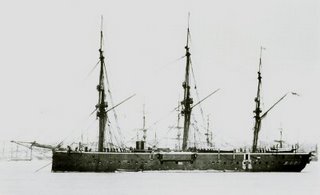
HMS Audacious

Some of the Korean officials on the island boarded the ship:
Hospitality was thrust upon them in the English manner by the offer of the national beverage. They expected their hosts to taste first, and then they themselves took long sips of the ale. The glasses were put down, and no sign of pleasure or of disgust appeared upon the face of either; but, after a decent interval, the tall Korean called again for paper and pencil, and this time wrote a request that the pale-ale — not, it is true, improved by a voyage half round the world — might be given to his low-born countrymen who worked the boat in which he came on board.
It's nice to see an IPA finally being made here. As the Herald continued,
7brau (also known as Sevenbrau) ― a craft beer company that first made a name for itself with draft beers sold throughout bars in Seoul ― is a pioneer in more ways than one.

Not only did has it released its domestically-produced IPA in Homeplus stores throughout Seoul and Gyeonggi Province, it is the nation’s first mid-to-small-sized beer company to nab a standard beer production license that allows it to brew beer that can be sold in more than one establishment. From a larger perspective that essentially means domestic craft beer is no longer a brew that can only be primarily enjoyed at a microbrewery or brewpub.

7brau launched its India pale ale canned last Thursday. [...] The IPA is currently sold in 30 Homeplus outlets throughout Seoul and Gyeonggi Province, with plans for expansion to stores nationwide by next year.
The article also notes that 7brau is only the "third beer company to come into being in Korea," with the other two being "domestic beer goliaths Oriental Brewery and Hite Jinro, whose history goes as far back as the 1920s and 1930s."

The Korea Times, Joongang Daily, 10, Groove, and Homebrew Korea have also spilled ink on 7brau's IPA. At the latter link I learned that 7brau has been, under its new guise as a brewery, distributing a few draft beers:
They offer a porter, pilsner, and pale ale. The beers are unpasteurized. If you go to Hollywood you can get the unfiltered pale ale, at all the other bars its filtered. I strongly recommend going for the unfiltered version, there really is no comparison. They don't use any adjuncts and import all their ingredients from Europe and the US.
I haven't tried any of the draft beers the brewery has been distributing, but I have tried the canned IPA. While it's certainly not as favourful as Indica or Alley Kat, it's not bad, and a step above other Korean beers. It's not surprising it's not as bitter as imported IPAs - Koreans generally don't like their beer bitter. A friend ordered Alley Kat for a bar he was working at a few years ago and had to mix it with Cass (creating Alley Cass - the horror) in order to sell it off. The canned IPA, at any rate, is distributed more widely; a list of the
Homeplus locations in Seoul is here and countrywide, here. The one downside is that it certainly isn't placed with other Korean beer at the Homeplus locations I've been to - it's set off on its own.

I've actually been drinking 7brau's beer for awhile; the company is associated with the Carib brewpubs, the first of which opened in Balsan in 1998. A handful more followed (I went to the one in Bucheon back in 2001) before it opened two '7brau' brew pubs, the second of which opened in Balsan, which is pretty close to where I live, in 2005. To attract customers, they spent their first year running a daily buffet, open 6-10 weekdays and 6-9 weekends, which gave you all you could eat - and drink of the house beer - for 15,000 won. Which was pretty sweet. The beer at Balsan is the typical triumvirate of pilsner, wheat, and dark, but it's usually pretty good. Anyways, it's nice to see something good come out of the Balsan area (other than Lim Soo-jung, who went to high school nearby). Hopefully 7brau finds success and paves the way for other small companies to find a niche.

Wednesday, November 16, 2011

More Korea references in the Simpsons

The hotties that he chills with...

On this week's Simpsons, Marge and the kids end up in an Ethiopian restaurant* after their car breaks down, and though skeptical, they love the food and, after meeting foodies, become food bloggers themselves. The foodies don't come off too well:

Foodie 1: "We discovered Korean barbeque in this town."
Lisa: "Uhhh... before the Koreans?"
Foodie 2: "Oh sure, they cook it, but they don't get it."

Of course, the Simpsons has taken on hipsters for a couple decades now, and that conversation pales in comparison to (and takes as a blueprint):
[Sarcastically] "That's cool."
"Are you being sarcastic?"
"I don't even know anymore."

It also pales in comparison to this evisceration of foodies (the responses are just as much fun).

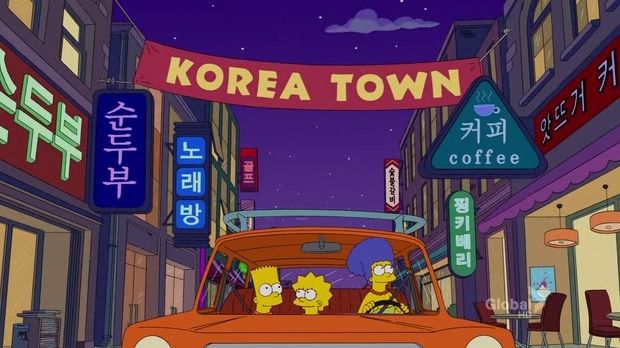
At any rate, they end up hitting all kinds of restaurants, and make a trip to "K-town":

(I guess the coffee is hot...)


There's quite a bit of detail - comics, noraebang, video, pharmacy, galbi and even a golf place:

(Not being American, I knew nothing about Pinkberry)

One more step in the globalization of bibimbap and bulgogi, I guess....


*I've never come across an Ethiopian restaurant in Seoul. Has anyone ever seen/ been to one?

Tuesday, November 01, 2011

An in-depth look at the reaction to 'The True Origins of Pizza'

For those who would like to delve into the various reactions to 'The True Origins of Pizza' video by western, Korean, and Japanese netizens, I recommend the article The True Origins of Pizza: Irony, the Internet and East Asian Nationalisms by Stephen Epstein and Rumi Sakamoto published today at Japan Focus. I had been unaware of the Japanese reaction to the video - and I now realize I missed some of the references in the video, such as zig zag man. Seriously, though, some of the different interpretations of the video depending on the positions of the viewers are quite interesting; do give it a read.

(I should also thank them for mentioning this blog!)

Tuesday, October 11, 2011

Directions to Maple Tree House

[Update:
It was great to meet readers last night, and in such a setting. Thanks again to Mr. Devolin and Senator Martin for hosting the event.]

A bit late, I realize, but anyone going to the dinner at the Maple Tree House tonight can catch bus 종로 11 (Jongno 11 - it comes every 5-8 minutes) from the bus stop near exit 2 of Gwanghwamun Station or from in front of the Press center (from exit 4 of City Hall Station) and go six or seven stops, respectively, and get off at 한국교육과정평가원 (Korea Institute of Curriculum & Evaluation), and then walk back a bit to the restaurant. In the photo below, the restaurant is at far right, and the bus stop would be at far left.

Saturday, October 08, 2011

The true origin of pizza

This is probably the best pizza commercial ever:


More videos related to this can be found here (and more commentary is here). There are lots of comments at youtube written by Koreans who clearly 'get it,' but there are also some from those who obviously don't understand that it's satire. Having recently read Hyung-il Pai's 'Constructing "Korean" Origins,' the bit about the archeological evidence made me laugh (as she argues that the use of archeology in Korean historiography has at times involved putting square pegs into round holes). At any rate, kudos to Mr. Pizza - it would be nice to see more like this.

Thursday, October 06, 2011

Dinner Hosted by Maple Tree House and Canadian Parliamentarians

Next week, Canadian parliamentarians BC Senator Yonah Martin and the Honourable Barry Devolin, Assistant Deputy Speaker of the House of Commons, who are co-chairs of the Canada-Korea Parliamentary Friendship Group, will visit Korea.

On the evening of Tuesday October 11, 1at 7:00 pm, Mr. Devolin and Senator Martin will host a dinner reception for Canadian English teachers in Seoul at Maple Tree House, Jongno-gu, Samcheong-dong 31-1 (02-730-7461) for a casual exchange of ideas and open discussion on a range of issues over Korean BBQ. If you are a Canadian English teachers interested in the idea of having a meaningful discussion on Korea-related topics or issues of concern to English teachers in Korea, contact information is below:

RSVP: eslreception@gmail.com
Attendees: First 50 to reply
Cost: Free
Time: Tuesday, October 11, 19:00-21:00
Location: Maple Tree House (Samcheong-dong)

I can post more detailed directions to the restaurant next week.

Monday, June 13, 2011

Punning on 'Seoul food' in 1981

While looking for information about McDonald's early attempts to break into the Korean market, I came across this March 18, 1981 story from Miami News:


I wonder if the part about there being no cattle industry in Korea is true? It would certainly put the 2008 Mad Cow protests and the promotion of Hanwoo in a different light. Also, the hubbub about Burger King introducing fast food hamburgers to Korea doesn't seem to be true, at least according to Lotteria's website, which says that its first store in Korea opened in Sogong-dong, Seoul, in October 1979.

According to the Burger King website their plans for a 1981 opening did not bear fruit. In fact, the first Korean outlet (in Jongno) didn't open until 1984, the same year Wendy's opened:

(Still from the 1985 film Queen Bee showing the Itaewon location;
a photo of another location with a 'traditional' roof is here)

McDonald's wouldn't open until 1988, a year before the first foreign convenience stores arrived in Korea, and two years before the first Korean convenience store, LG25, opened. Convenience stores have threatened to overtake mom and pop stores for years, and continue to expand.

I liked the hamburger map that accompanied the Miami News article:


A shame they couldn't find a map of Korea more recent than one made between 1945 and 1950, though - you start to wonder why there's no hamburger next to Kaesong...

Wednesday, March 02, 2011

The first night of freedom


The scene above may seem unremarkable, but a 1982 Stars and Stripes article I came across reminds us that for more than half of South Korea's post-WWII history, a midnight to 4am curfew confined people to their homes.
South Korean curfew passes away, quietly

Thursday, January 7, 1982
By SSgt. Steve Davis
PS&S Korea Bureau Chief

SEOUL — South Korea's 36-year-old curfew passed away unceremoniously Tuesday night. Except along coastal regions and security-sensitive areas along the demilitarized zone, the nightly four-hour custom slipped quietly away with few mourners.

It passed simply and as suddenly as President Chun Doo Hwan's New Year's resolutions which promise a year of sweeping changes in South Korea.

Chun not only abolished the curfew declared by the U.S. military government on Sept. 8, 1945, in Seoul and the port city of Inchon, he followed that New Year's edict with a proposed liberalization on Jan. 2 of the hair and dress codes that gave South Korean secondary schools a military flair.

Then came a major Cabinet reshuffle on Sunday to add what a presidential spokesman termed "new vigor and vitality" to the fifth five year economic and social development plan which gets under way in South Korea this year. Six high level officials were replaced.

The presidential pronouncements took most South Koreans and foreigners by surprise.[...]

Some gates at Yongsan Army Installation in Seoul remained open as USFK personnel ventured out on the first official night without curfew. Col. Robert C. Lewis, the Yongsan Garrison and Area III commander, said the installation will comply with the ROK government directives on the curfew.[...]

He said he will make decisions on such matters as shuttle bus schedule and club operation changes after the community expresses their preferences.

Basically, he said, it's a wait-and-see situation.

Many off-post businesses were taking the same tack as Maj. Michael J. Amidei, the deputy area clubs general manager for Yongsan and Area III.

"We are evaluating now the potential impact on the club system and will follow the directives of the installation commander," Amidei said when asked about schedule changes.

Tom Casey, the owner of the Sportsman's Club in the popular Itaewon-Hannamdong club district near Yongsan, predicted a gradual adjustment to the curfew ease.

"I don't even know if anyone will even be here at 11:30," Casey said early in the evening. "Basically, I feel that most people have adapted to the curfew and that they will leave early."

Casey was right. Around 1 a.m. most of the district's clubs had closed. A few customers continued to dance at the Sportsman's Club. Other club owners said they expected more activity on the weekend, but none expected an immediate business boom.

Intracity bus and subway schedules were extended an extra 30 minutes for late homegoers and taxis continued throughout the night. Gas station hours were lengthened and flight schedules amended. Warnings went out to potential night prowlers, and the possibility of night tours in Seoul were contemplated.
As it turns out, however, the curfew was still in effect in coastal areas.
At Kunsan AB, the curfew lift was not so simple. Though a base spokesman announced that "effective midnight tonight the curfew in Kunsan City is lifted," the air base, some ll/2 miles away, is in the coastal restricted zone.

The spokesman added: "We're talking about Kunsan City as determined by the Korea National Government," which exempted the city as one of 14 specially exempted from the remaining curfew of coastal areas.

"Areas around the base," the spokesman said, "still require clarification."

Easier lifestyle

According to some, the curfew lift entails the change to an easier lifestyle.

"I always got nervous around midnight," said Kim Shin Hea, a 28-year-old Seoul resident. "I'm glad it's over. It's fantastic."

Army Staff Sgt. Jim Coughlin, a 27-year-old infantryman from Everett, Wash., agreed. "I think it will cut down on tension," Coughlin said. "Police won't have to rush people off the streets now. It will just be a more relaxed atmosphere."
South Korea's 36-year-old curfew was quietly lifted at midnight Tuesday and, while some ventured out into the streets of Seoul (below) after midnight, a more typical scene was a lone pedestrian (above) strolling along an empty sidewalk. ' (AP)

The Donga Ilbo had numerous photos on pages 1, 10 and 11 on January 6:


The photo above shows cars, buses and taxis out near city hall; below the gas stations are open late.


For the first time in a long time, people were able to enjoy haejangguk after midnight. I find it interesting that there seemed to be so many digital clocks in public, but then Seoul's city hall used to have a digital clock on it, as the last photo on this page about the 1988 Olympics reveals.

Saturday, July 24, 2010

The landscapes of Danyang

The other day I posted about the caves I visited in Danyang. I thought I'd follow up by posting about the rest of the trip.


Above is a view of the town itself. The water wasn't high enough to take the boat to Chungju, but perhaps later in the summer it will be. The bus station where I arrived at is along the water front at the far right. The photo above was taken from this bridge:


At the far end of the bridge is the tourist office and just beyond that, Gosu Cave. There's lots of good restaurants along the street in town that continues across the bridge. Danyang is known for its garlic, so garlic galbi and other such dishes are to be found there. I randomly chose Doljib Sikdang, as the maneul ssam jeongsik sounded interesting.


It was amazing, actually. Bossam, make-your-own bibimbap, loads of side dishes, etc. These little roast garlic cloves were tasty, and none of the garlic was particularly strong tasting.


As it turned out, I'd chosen wisely. The restaurant is well known, and another customer told me he'd driven with his family for an hour from Gangwon-do just to eat there.

The next day I headed across the bridge to the cave.


Typically, the restaurants in front of Gosu cave, which is a popular tourist spot, all served the exact same food, so after visiting Cheondong cave, I headed back into town to eat. One thing worth noting is that if you see a bus stop on only one side of the road, it means you can catch a bus going in the other direction there as well (simply wait on the other side of the road). In town you can generally just say the name of the place you want to go and the bus driver will either welcome you aboard or tell you to wait across the street for one going in the other direction.

At any rate, I ate lunch at the Danyang Jeontong Sundubu, which had the best dotori-muk I'd ever tasted. Too bad I didn't stay in town longer; I would have loved to have ordered a full dish of it.


A short bus ride to the north of town is the Doddam Sambong, or three peaks, which have been written about since the Joseon dynasty, lauded by Toegye Yi Hwang and painted Kim Hong-do.


With crowds milling about, speedboats zipping around, and music from the speedboat 'terminal' blaring, it wasn't exactly peaceful. Seongmun, or 'stone gate,' supposedly the largest stone arch in Asia, was worth short but steep hike up the adjacent hill.


Those previous two sites are part of the Danyang Palgyeong, or 'eight views of Danyang.' Five of them are reachable by bus, but three others are for those who have their own wheels. Two can be seen by taking a half hour bus ride to Janghoe ferry where you can take an hour-long cruise along Chungju Lake (made by damming up the Namhangang in the 80s). (It's also possible to go all the way to Chungju sometimes - it's best to check with the tourist office.) Due to the spectacular scenery, it's well worth the trip (even if the boats threaten to become floating noraebangs). It's also nice to be on a boat again, especially considering I grew up on a lake.


Here's Oksunbong, one of the eight views, which Toegye Yi Hwang (he of the 1000 won bill) described as the gate of Danyang when he was a magistrate there:


Gudambong is said to look like a turtle's shell when reflected in the water:


I didn't get to see any of the other eight views, but a man I chatted with on the boat (who was working for KBS installing digital TV transmitters on the tops of mountains, and who was nice enough to give me a ride back to Danyang) just sent me this photo of Sainam (it should be clear he had a much nicer camera than mine).


He also visited Dodam Sambong at a time which was much more conducive to taking photos:


Danyang is well worth visiting if you get the chance, both for its natural beauty and the food. There are lots of motels along the waterfront in town, and buses run hourly on the hour from Dong Seoul Bus Terminal (near Gangbyeong station on line 2).

Tuesday, July 20, 2010

The long history of fusion food in Korea

The first chapter of Robert Neff's book Korea Through Western Eyes tells the story of how Paul Georg von Mollendorff first came to Korea in December 1882 on board the steamship Hingshing. Upon arriving at Chemulpo, it anchored out in the harbor, where the passengers were greeted by different sets of visitors:
Later that evening, the steamship was again visited, this time by the local magistrate who came to pay his respects to the Korean officials. After a private dinner and a meeting with the Korean officials, it was determined that it was impossible for him to return to shore. The winds had increased in force and the strong current prevented boats from approaching the steamer.

For four days the magistrate and his entourage were all confined to the steamer. One observer noted that the Koreans were in no hurry to leave the ship and “in fact they enjoyed heartily our fare, and disposed of beefsteaks, mutton-chops, plum pudding, beer, claret, champagne and coffee with as much relish as any foreigner.” The crew feared running short of mustard because the Koreans ate it on everything.
I had what I thought was not sweet potato pizza but which turned out to indeed be sweet potato pizza the other day (the sweet potato was well hidden under the cheese) and got another nasty surprise: there was an unseen coating of mustard on the pizza. Another time in a hof I ordered nachos and they arrived dripping with mustard.

I think one of the best ways to explain the yuck factor involved in those examples to Korean friends is to whip out a packet or two of ketchup and suggest drizzling it over the kimchi.

Thursday, March 04, 2010

Ramen in Fukuoka

The first time I had ramen in Japan was in Oita (where my sister lived for two years) in 2002,
but at the time I really didn't think much of it (though I enjoyed a lot of the other food, and drinking Kirin on tap). I'd had another chance to try Hakata (Fukuoka) style ramen at a place in Hongdae last year (Hakata Bunko, maybe? It's down the alley north of the broadcaster there (극동방송국)) and enjoyed it, so when I had a chance to go to Fukuoka on a visa run last week (I'd flown into it twice before, but had never explored it), and walked all over the city during my two days there (around 14km - my feet were pretty sore at the end of each day), I finally had a chance to try it at the source. With Kirin draft, of course. It made for a very filling lunch.


The one above was at a place I stumbled upon near Canal City (a shopping center worth visiting just for the architecture, i thought), while the one below was from Ippudo, which I saw advertised on the Fukuoka Now tourist map, and which also offered (non powder-based) take home packs.


I think I preferred the first place better, but Ippudo had this:


That's right - a sesame seed grinder. Very cool. (In second place was the automatic pint-pouring machine at a restaurant I went to for dinner).

Oh, and I had to listen to a lecture on Korean history this week which mentioned that the Japanese deny Korea's ancient influence on their culture (other than the Emperor mentioning several years ago that his great, great (x 67) grandmother was a Baekje princess). I guess he didn't see the several exhibits at the Fukuoka city museum mentioning Korea's influence on the area.

Anyways, sometime soon I'll try one of those take home packs of ramen...

Wednesday, October 14, 2009

Mushroom burgers


According to the Kookmin Ilbo, Japanese burger chain 'Freshness Burger' is going to sell giant mushroom burgers made from portobello mushrooms, which can grow to 8-10 cm in diameter and are high in dietary fibre and in vitamin B2. We're also told that Portobello (or 'Portabella' as it's spelled in the article) means 'beautiful giant umbrella' in Italian, though this video says that's not true at all, and if I have to decide between trusting the Kookmin Ilbo or the girl from hotforwords.com, I don't think I have to tell you which one I'd choose.


Only 420 yen - which seems pretty reasonable considering prices in Japan - or in Korea as well, I imagine, though I've never eaten a burger at a fast food place in Korea, so I can't be too sure (I've occasionally eaten hotcakes and apple pies, though the latter are no longer served, meaning I'd have no objection to people going all José Bové over their local golden arches at all).

Of course, had this burger come out in Japan more than seven years ago, another species of mushroom could have been used...