Showing posts with label Urbanism. Show all posts
Sunday, November 13, 2016
Seoul's colonial-era 'Defense-of-the-Nation Shrine'
Korea Expose published an interesting article about the forgotten history of the above set of steps in Haebangchon. Especially interesting was the interview with a local woman who remembers going to the Shinto shrine which used to be at the top of these stairs. The article risks confusing this shrine with another, however.
The actual Gyeongseong [Keijo, or Seoul] Shrine was built on the slopes of Namsan south of what is now Myeongdong Station in 1898; a few stone remains can be seen behind Sungui Women's University. It stood not so far from the original Government General Building (built in 1907 before moving, famously, to the large building that stood behind Gwanghwamun until 1996). Also nearby was the Japanese ambassador's residence (built in 1893, before another was built on what is now Yongsan Garrison in 1909, before the final one was built in 1937 on the location of today's Blue House). Photos of all of these can be seen here.
The more famous Chosen Shrine was built in 1925 and almost became the location of a new national assembly in the early 1960s; it now has an Ahn Jung-geun museum and other monuments to Korean independence fighters. There was also a military-related shrine on what is now Yongsan Garrison (I've never seen any photos of it) as well as other smaller ones throughout the Japanese parts of the city and throughout the country. These did not survive past 1945.
The shrine in the Korea Expose article was the 경성호국신사 (more photos can be seen here). If we follow Norma Field's translation of 호국신사 (in In the Realm of a Dying Emperor: A Portrait of Japan at Century's End), this would be the Gyeongseong Defense-of-the-Nation Shrine. She writes that in 1939 a directive stated that each prefecture in Japan was to have one official such shrine. The souls of dead soldiers were to be enshrined there, and if this sounds familiar, it might be because these were essentially local branches of Yasukuni Shrine. Seoul's was built in 1943, and I'm not sure if Korea had only one such shrine in Seoul, or more than one (though I'd lean towards just one). They would have been used not just for enshrinement of Koreans (who were only being used by the Japanese military in small numbers as volunteers or POW guards up until 1944) but for Japanese who were living in Korea.
At any rate, it would be a shame to see those stairs disappear, which the article states is a possibility. Surely if some of the secondary stairways related to the main shrine on Namsan (now standing near memorials to independence fighters) can be allowed to remain, these can as well.
Wednesday, June 15, 2016
On Cheonggyecheon
Apologies to readers for the absence - but with classes done for the summer (other than a month of language study in Seoul) I'll try to post here more often.
A couple weeks ago the Guardian published a story about Cheonggyecheon 10+ years later by Colin Marshal which he interviewed me for - thanks to Colin for including me. Also worth reading by Colin is his article about 'English Cancer' (rather than English fever) in Korea.
On the topic of redevelopment the Joongang Daily published an article awhile back about Seoul's plans to "protect old districts" - but the map in the article makes clear just how much is still slated to be redeveloped...
(I've written about Cheonggyecheon here before, including about Time Magazine's glowing 2006 feature on then Seoul Mayor Lee Myung-bak, following mayor Oh Se-hoon's redevelopment plans (2MB 2.0), then initially controversial 'Spring' sculpture at Cheongyecheon's source, the dislocation of former Cheonggyecheon merchants, and the appearance of Cheonggyecheon in old films.)
A couple weeks ago the Guardian published a story about Cheonggyecheon 10+ years later by Colin Marshal which he interviewed me for - thanks to Colin for including me. Also worth reading by Colin is his article about 'English Cancer' (rather than English fever) in Korea.
On the topic of redevelopment the Joongang Daily published an article awhile back about Seoul's plans to "protect old districts" - but the map in the article makes clear just how much is still slated to be redeveloped...
(I've written about Cheonggyecheon here before, including about Time Magazine's glowing 2006 feature on then Seoul Mayor Lee Myung-bak, following mayor Oh Se-hoon's redevelopment plans (2MB 2.0), then initially controversial 'Spring' sculpture at Cheongyecheon's source, the dislocation of former Cheonggyecheon merchants, and the appearance of Cheonggyecheon in old films.)
Sunday, February 21, 2016
Colonial era Seoul and Jinhae
Here's an interesting map of Seoul - and all of Korea, in its own way - from 1929, when a colonial exhibition was held in Seoul. It was given away at an exhibition of colonial era photos and artifacts at the Cheonggyecheon Museum in 2011. Thanks to Jacco Zwetsloot for his help in stitching this together.
A full-size copy can be downloaded here.
Anyone interested in colonial (or early-modern) era buildings absolutely must check out the site Colonial Korea, which is full of not just detailed information and incredible photos, but also maps showing how to find the buildings in 10 different cities / towns in southern South Korea. (Hat tip to Robert Koehler for pointing this site out.)
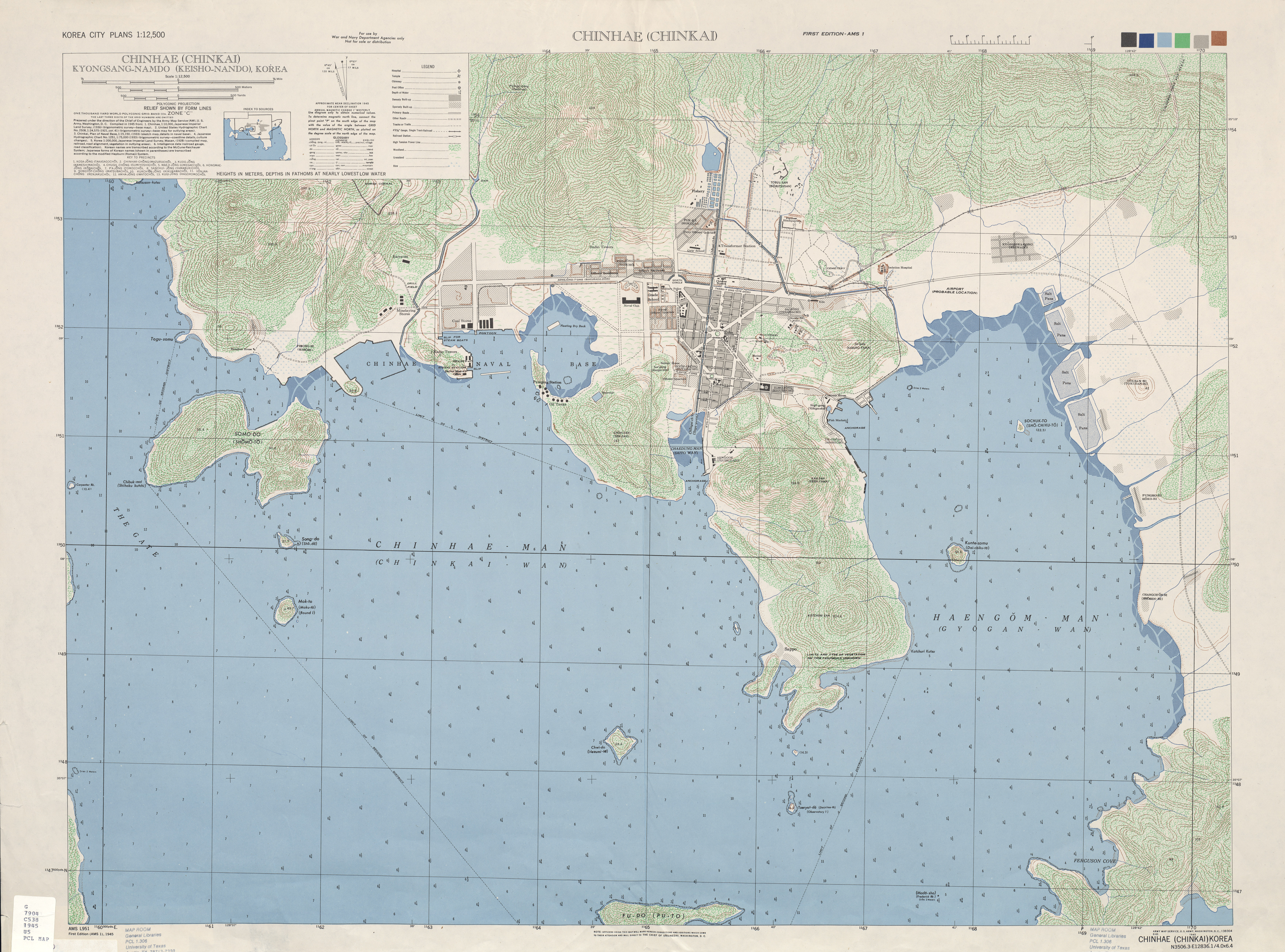
On a related note, there are several colonial-era photos and maps of Jinhae here and here, respectively. Included in the first link is this incredible panorama of Jinhae from the early 1920s, about 15 years after the Japanese built a naval base and city there. Since they were able to build the city from scratch, they could create the 'hub and spoke' street system the wanted for Seoul but were unable to accomplish (see Todd Henry's book Assimilating Seoul or his chapter "Respatializing Chosôn’s Royal Capital: The Politics of Japanese Urban Reforms in Early Colonial Seoul, 1905-1919" in Sitings: Critical Approaches to Korean Geography, which can be found here). A 1946 map of Jinhae can be found here. Also, photos of a colonial-era air raid shelter can be found here. A similar tunnel can be found on the U.S. base in Jinhae, as can remains of underground stockades and a Koi fish pond.
A full-size copy can be downloaded here.
Anyone interested in colonial (or early-modern) era buildings absolutely must check out the site Colonial Korea, which is full of not just detailed information and incredible photos, but also maps showing how to find the buildings in 10 different cities / towns in southern South Korea. (Hat tip to Robert Koehler for pointing this site out.)
On a related note, there are several colonial-era photos and maps of Jinhae here and here, respectively. Included in the first link is this incredible panorama of Jinhae from the early 1920s, about 15 years after the Japanese built a naval base and city there. Since they were able to build the city from scratch, they could create the 'hub and spoke' street system the wanted for Seoul but were unable to accomplish (see Todd Henry's book Assimilating Seoul or his chapter "Respatializing Chosôn’s Royal Capital: The Politics of Japanese Urban Reforms in Early Colonial Seoul, 1905-1919" in Sitings: Critical Approaches to Korean Geography, which can be found here). A 1946 map of Jinhae can be found here. Also, photos of a colonial-era air raid shelter can be found here. A similar tunnel can be found on the U.S. base in Jinhae, as can remains of underground stockades and a Koi fish pond.
Friday, February 19, 2016
Recovering a stone wall walkway around Deoksu Palace that never existed
A few weeks ago articles appeared in the Korea Times about a plan to "restore" a walkway around Deoksugung Palace (here and here):
As if such "tree-lined sidewalks" even existed then! There's much more to say about this, but it has already been written by Jacco Zwetsloot in a letter to the editor published a few days ago, which can be found here. Actually, the letter that appears there was rather heavily edited and differs from the one Jacco sent to the Times, so I asked him for permission to reprint his entire letter, which he graciously granted.
Here is a photo of Deoksugung Palace in 1961 after the wall had been torn down and replaced with a fence (also seen in the last photo here), with a gate standing in the northeast corner; this was before Taepyeongno was widened.
Here is a photo of Daehanmun orphaned in the middle of the road after the wall was rebuilt in 1968 but before it was moved westward to its current location in 1970:
Here is Dondeokjeon, which was built in 1901 and destroyed around 1926 to allow the Japanese to punch a road through between the U.S. consulate and Deoksu Palace:
Here it is in relation to Seokjojeon, which still stands today; it likely wasn't necessary to tear it down, but the fact that Sunjeong, the last Korean monarch, was crowned there may have have made its demolition more tempting.
It can also be seen in the background of this photo of Samil protesters in 1919 walking around Deoksu palace (most likely to the US Consulate), which should make clear that one could not walk around the palace back then. (Originally from this post.)

Jacco managed to find a column by Nam Jeong-ho in the Joongang Ilbo which dealt with this issue and in which the UK Embassy was actually contacted, and the Embassy said that due to a number of issues the cost quoted by the city (2.8 billion won) is likely far too low, and it may be closer to 10 billion won. Nam suggests that a way around this would be simply to allow people to walk through the back gate (Podeokmun) of the palace and open the north gate near the British Embassy entrance to allow people to walk "around" the palace. Needless to say, it would certainly be a lot cheaper.
A narrow walkway along Deoksu Palace in downtown Seoul will be restored 132 years after it was cut off by the construction of the British Embassy in Korea, a Seoul City Council member said Monday.
The council member said the Seoul Metropolitan Government will restore the 170-meter-long sidewalk along the stonewall of the Joseon Dynasty (1392-1910) palace at the embassy compound at the expense of 2.8 billion won (US$2.34 million).
The capital city will finish the 3- to 6-meter-wide walkway, commonly called "doldam-gil" in Korean, by the end of the year after compensating the British Embassy, according to council member Choe Pan-sul.
In 1884, the British Embassy purchased the land site for the soon-to-be restored walkway, cutting it off from the present tree-lined sidewalks, famed for their seasonal beauty.
As if such "tree-lined sidewalks" even existed then! There's much more to say about this, but it has already been written by Jacco Zwetsloot in a letter to the editor published a few days ago, which can be found here. Actually, the letter that appears there was rather heavily edited and differs from the one Jacco sent to the Times, so I asked him for permission to reprint his entire letter, which he graciously granted.
Last Tuesday (26th January, 2016), the Korea Times carried a story titled “Seoul city to restore palace walkway.” It showed a map with a proposed 1.1-kilometer long walkway around Deoksu Palace, following the palace wall. It is apparently the plan of Seoul Metropolitan Government to gain access to a 170-meter-long section of wall that abuts the British Embassy. This would involve pedestrian access through embassy property. The article raised a number of interesting questions: about historical accuracy, “authenticity” of heritage, and journalistic practices.Many thanks to Jacco for permitting me to reprint the full letter. He covers a great deal of history there, and I thought I'd add a few photos to illustrate some of what he wrote about.
The article states that the proposed walkway is “interrupted by the British Embassy […] and has been since 1884 when the mission purchased land near the palace.” This idea, and, by extension, that the British and U.S. embassies purchased land around the palace, thereby encroaching upon it, is one I have seen repeatedly over the years. However, it is misleading. Deoksu Palace was not a fully-fledged “beop-gung” (a palace where a monarch resides) before King Gojong issued orders from the Russian Legation in 1896 to construct his new palace.
Why did he choose this area? The answer lies in the history of Jeongdong neighborhood. It was once owned by the Joseon Dynasty’s ruling Yi family. Prince Wolsan (1454-1488), older brother of King Seongjong, 9th king of Joseon, once had his official residence there. Although called Deoksu Palace, it was humbler and smaller than a kingly residence, having no throne hall for instance. During the Imjin Wars (Hideyoshi Invasion) of the 1590s, after King Seonjo had fled to the far north and then returned to the capital, he lived temporarily at this old residence, becoming the first king to do so. This is because Gyeongbok and Changdeok Palaces had been destroyed or made unlivable by the population of Seoul, who were angry at his having deserted them.
Once Changdeok Palace was rebuilt in 1618, King Gwanghaegun moved there, Deoksu was renamed Gyeongun, though it was also known as the “Western Palace”; it served as a lesser auxiliary palace until King Gojong’s time. During the intervening centuries, parts of the land around this residence were sold or given to the powerful Min family, and they sold parcels of it to the first Western legations, whose arrival, beginning with the Americans in 1883, marked the opening of Korea to the non-Chinese world.
In 1894-5, the waxing Japanese and waning Chinese empires fought a war in, and for control of, the Korean peninsula; Japan won. Barely 6 months later, Japanese agents and their Korean henchmen infiltrated Gyeongbok Palace to assassinate Queen Min (later given the posthumous title Empress Myeongseong). This caused King Gojong to flee with Crown Prince Sunjong, never to return again.
By 1896, the year that King Gojong spent boarding with the Russians atop Jeongdong’s highest hill, there were also British, American, French, Austro-Hungarian and German legations nearby. A permanent “safe haven” from both Japanese and Chinese influence would have been attractive, and having a palace in Jeongdong was a very visible way to moved Joseon closer to Western powers. It was at this time that Gojong ordered Deoksu Palace to be expanded, rebuilt, and upgraded. Except for Jeukjo-dang and Seogeo-dang, which had long stood there, all buildings and structures date from that feverish period of construction. Upon King Gojong’s move here in early 1897, he proclaimed the Great Han Empire, had himself crowned Emperor, and Deoksu Palace became Gyeongun again -- now as the first imperial palace in Korean history.
It should be clear, then, that the legations in Jeongdong predate the existence of Deoksu Palace as a fully-fledged royal palace. There can be no sense in which the palace was spoiled by the arrival of Western powers in the late Joseon Dynasty. Indeed, the palace became what it did because of the presence of the legations.
Moving on to look at the question of authenticity of heritage, I note also that last Tuesday’s article used the words “restoration” and “recovery” to talk about the proposed new walkway. It is a common theme of historical sites around the world to claim authenticity and genuineness as virtues, but this is often a fraught and deeply contested idea.
A quick look at the signboard map beside the Deoksu Palace ticket window shows that the original palace perimeter looked very different than it does today. In fact, the complex is today about one third its size in 1897, and most people will be surprised to learn that much of the present wall was built no earlier than the late 1960s.
Construction of the original wall was still ongoing when Gojong moved to the palace, and was not completed until 1900, his fourth year as emperor. During his reign, the palace wall had gates to the British, American and Russian legations, perhaps in case the king needed to flee again. After his abdication in 1907, forced by the Japanese unhappy with his attempts to have Joseon represented at The Hague Peace Conference, Gojong remained in Gyeongun Palace, and the name reverted to Deoksu Palace for the last time. Seonwonjeon, a network of buildings where the sacred portraits of past kings were stored in the northern part of the palace, was dismantled and removed to Changdeok Palace; the site was sold. In 1915, Jungmyeongjeon, once the imperial library and Gojong’s temporary residence after a massive fire in 1904, became the headquarters of the Seoul Club.
Gojong’s death in 1919 led to the March 1st Independence Movement, but also provided the opportunity for the Japanese colonial government to tear down even more palace buildings and sections of wall. Dondeokjeon, a western-style building, was torn down, and the western wall of the palace was moved inwards, in order to build a two-lane road between the palace and the US legation. The eastern palace wall was later also moved inwards for the widening of Taepyeong-ro.
Sadly, destruction did not end with Korea’s Liberation. In the 1960s, the entire eastern wall facing City Hall was demolished and replaced with an iron fence. Taepyeong-ro was widened once more, leaving the Daehan Gate of the palace orphaned in the middle of a busy road, until its removal to its present location in 1970. The iron fence was once more replaced with a stone wall in 1968, except for the north east corner, where a police sub-station was built that stood until 1994. A diplomat formerly stationed in Seoul remembers that the gate between the British Embassy and the palace still stood there in the 1980s, but it was removed sometime later by either Seoul Metropolitan or the Korean Government. Perhaps the only section of wall that is in its original location and (more or less) original condition is the western end of the south wall, where the abutments of a pedestrian bridge that once connected the palace to the Uijeongbu (or State Council of Joseon).
Therefore, the idea of “restoring” the palace wall to its former glory and then putting a walkway all the way around it is a very difficult one, since so much of former palace land is now something else, and most of the wall was built in its current location and form after King Gojong’s death. The erstwhile existence of gates connecting the palace to at least three foreign legations shows further that there never was a pathway for ordinary citizens to walk around the entire palace wall. The authentic historic experience that the city wants to re-create through the construction of the circumferential walkway is in fact a new creation, and a very modern invention, connected to ideas of heritage tourism and universal ownership of national history. Nevertheless, the idea is an appealing one that, if it succeeds, would doubtless attract many visitors to the area and grow the interest in Korea’s early modern history.
The final point I would like to raise is a brief but important one. It was surprising that last Tuesday’s article contained quotations from both Seoul Metropolitan Government’s plan and a current City Council member, but no word from the British Embassy. Most embassies have staff that handle public affairs and media relations, and given that the proposed walkway would enter and exit embassy gates and traverse embassy property, one would imagine that the British government would be keen to have a voice in discussing any such plan, especially given modern-day concerns about diplomatic security, personal safety and privacy, but there was no mention of it in the article. Normally in such circumstances, one would at least expect to see a sentence like, "The embassy was not available for comment," or, "We reached out to the embassy, but did not receive a response by time of press," or even, "The embassy declined to comment for this story." The absence of any such statement could leave a newspaper open to the criticism that not enough had been done to get all sides of the story. I think this is a regrettable editorial decision from your otherwise fine newspaper, to which I have subscribed for over 10 years.
Jacco Zwetsloot
Here is a photo of Deoksugung Palace in 1961 after the wall had been torn down and replaced with a fence (also seen in the last photo here), with a gate standing in the northeast corner; this was before Taepyeongno was widened.
(From here.)
Here is a photo of Daehanmun orphaned in the middle of the road after the wall was rebuilt in 1968 but before it was moved westward to its current location in 1970:
From here (where lots of photos can be seen).
Here is Dondeokjeon, which was built in 1901 and destroyed around 1926 to allow the Japanese to punch a road through between the U.S. consulate and Deoksu Palace:
(From here.)
Here it is in relation to Seokjojeon, which still stands today; it likely wasn't necessary to tear it down, but the fact that Sunjeong, the last Korean monarch, was crowned there may have have made its demolition more tempting.
(From here.)
It can also be seen in the background of this photo of Samil protesters in 1919 walking around Deoksu palace (most likely to the US Consulate), which should make clear that one could not walk around the palace back then. (Originally from this post.)

Wednesday, February 17, 2016
From an elementary school in Daehangno to a temple bell in Deoksu Palace via Tapgol Park and 560 years of history
If you walk along Daehangno about halfway between Jongno 5-ga Station and Hyehwa Station you'll come upon the gates to Seoul Sadae Buseol Elementary and Girls Middle School.
These gate pillars originally stood at the entrance to Pagoda (now Tapgol) Park, Seoul's first modern park, built under the direction of John McLeavy Brown in 1897. [Hat tip to JiHoon for showing this to me.] About the only photo of the gates I've ever seen is this one from the time of the Samil Uprising in 1919:

I originally posted that photo in this post, which includes photos taken from this page, which has scans of a 1919 Korean Red Cross pamphlet about the suppression of the Samil independence movement. It includes the declaration of Korean independence, 34 photos (taken by Francis Schofield), and a statement from the Korean Red Cross. It was in this park, of course, that the declaration of independence was read on March 1, 1919.
Before the park was built, the ten-story pagoda it is named after stood surrounded by houses, as captured by Percival Lowell in 1884:
Many more photos of the pagoda from both before and after the area became a park can be found here, while Brother Anthony has posted a detailed history of the pagoda (and another that it was modeled after) here.
I hadn't realized the fate of Wongaksa, the temple it was built to be a part of. As Wikipedia reveals, King Sejo had Wongak-sa temple built in 1465, followed by the pagoda 2 years later. on the site of an older Goryeo-period temple, Heungbok-sa. The temple was closed and turned into a kisaeng house by Joseon's most notorious king, Yeonsan-gun (who ruled from 1494 to 1506), and his successor, King Jungjong (ruled 1506–1544) turned the site into government offices.
This was actually part of a spate of temple building / improvements by King Sejo, as Gregory Henderson explained in his 1959 article for Transactions of the Royal Asiatic Society, "A History of the Chŏng Dong Area and the American Embassy Residence" (available as a .docx file here - more Transactions articles can be found here). He made a specific addition to Hŭngchŏn-sa, a temple which stood near present day Deoksu Palace:
I'll save the story of one of the architects of Yeonsan-gun's overthrow, and his tomb behind where I used to live in Banghwa-dong, for another day.
These gate pillars originally stood at the entrance to Pagoda (now Tapgol) Park, Seoul's first modern park, built under the direction of John McLeavy Brown in 1897. [Hat tip to JiHoon for showing this to me.] About the only photo of the gates I've ever seen is this one from the time of the Samil Uprising in 1919:

I originally posted that photo in this post, which includes photos taken from this page, which has scans of a 1919 Korean Red Cross pamphlet about the suppression of the Samil independence movement. It includes the declaration of Korean independence, 34 photos (taken by Francis Schofield), and a statement from the Korean Red Cross. It was in this park, of course, that the declaration of independence was read on March 1, 1919.
Before the park was built, the ten-story pagoda it is named after stood surrounded by houses, as captured by Percival Lowell in 1884:
Many more photos of the pagoda from both before and after the area became a park can be found here, while Brother Anthony has posted a detailed history of the pagoda (and another that it was modeled after) here.
I hadn't realized the fate of Wongaksa, the temple it was built to be a part of. As Wikipedia reveals, King Sejo had Wongak-sa temple built in 1465, followed by the pagoda 2 years later. on the site of an older Goryeo-period temple, Heungbok-sa. The temple was closed and turned into a kisaeng house by Joseon's most notorious king, Yeonsan-gun (who ruled from 1494 to 1506), and his successor, King Jungjong (ruled 1506–1544) turned the site into government offices.
This was actually part of a spate of temple building / improvements by King Sejo, as Gregory Henderson explained in his 1959 article for Transactions of the Royal Asiatic Society, "A History of the Chŏng Dong Area and the American Embassy Residence" (available as a .docx file here - more Transactions articles can be found here). He made a specific addition to Hŭngchŏn-sa, a temple which stood near present day Deoksu Palace:
In 1462, King Sejo, a devout Buddhist, deeply conscience-stricken over his murder of his own nephew Tanjong to attain the throne, repaired and built many temples, notably Wŏngak-sa in Pagoda Park with its pagoda; with these repairs he had a great new bell made for Hŭngch’ŏn-sa in the seventh year of his reign. For more than thirty years the temple continued with this embellishment and with its high tower. In 1495, however, there came to the Korean throne one of the most notorious tyrants of Korean history, Yŏnsan-gun, a man dedicated to sybaritic personal habits, malice and impetuousness. In July, 1504, he ordered the temple razed and built in its place an extra office for the care of his royal horses and their accoutrements. The next monarch, Chung-jong, after overthrowing Yŏnsan-gun, abolished this extravagance and built a public office here. Of the temple, only the five-story shari hall remained.Of that five-story hall, Henderson tells us that on
the night of March 28, 1510, the students of th[e] central Confucian college, firmly convinced by their instructors that Buddhism was heresy, marched on the shari hall and enthusiastically set fire to it. [...] The bell now alone remained and this, after many perigrinations through Seoul’s palaces, finally came to the grounds of the Tŏksu (Duksoo) Palace where it hangs today, the only remaining reminder of this temple’s colorful history.And that's the history of the bell (this one, from this page) that you can see in Deoksugung Palace today, which was cast around the same time as the Wongagksa Pagoda in Tapgol Park was built, the park which saw its original gate pillars moved to an elementary school on Daehangno. A bit of a detour, but hopefully the ride was worth it.
I'll save the story of one of the architects of Yeonsan-gun's overthrow, and his tomb behind where I used to live in Banghwa-dong, for another day.
Monday, February 15, 2016
The transformation of Gindeung Maeul, 2008-2015
Exploring Gindeung Maeul
The Disappearance of Gindeung Maeul
It was initially torn down to make way for part of the Banghwa New Town. It can be seen jutting out on the right below:

This new town plan, however - like most of them - never was carried out. Here's what the area looked like from above in early 2006, with the first phase, meant to be a part of the Banghwa New Town and carried out in 2008, marked in yellow; the area marked in red was the second phase, carried out in 2010, and intended to make way for a much larger project.

The area after the first phase of demolition:
The second phase of demolition was to make way for the Magok development, about 3 square kilometers including a lake park (since converted to "Seoul Botanic Gardens"). I looked at the the completion of the the first phase of apartment building for the Magok development back in 2014. Below is a map of the planned apartments (most of those in the bottom left corner are not yet completed (mainly due to the need to move a school (since demolished) and because there's still a small military base there. As can be seen, the red shape marks the Gindeung redevelopment,
Here are panoramic shots of the changes to the neighbourhood between 2008 and 2015:

The area after the first phase of demolition:
The second phase of demolition was to make way for the Magok development, about 3 square kilometers including a lake park (since converted to "Seoul Botanic Gardens"). I looked at the the completion of the the first phase of apartment building for the Magok development back in 2014. Below is a map of the planned apartments (most of those in the bottom left corner are not yet completed (mainly due to the need to move a school (since demolished) and because there's still a small military base there. As can be seen, the red shape marks the Gindeung redevelopment,
Here are panoramic shots of the changes to the neighbourhood between 2008 and 2015:

August 2008

November 2008.

January 2010
October 2011
May 2012
February 2013
May 2013
August 2013
November 2013
May 2014
September 2014
October 2014
January 2015
March 2015
July 2015
(From here.)
Here are views from above of Gindeung Maeul and Magok in early 2008 and mid 2015:
That's quite the change from mid-2008:
Here are the schematics and plans for the Magok Hillstate Apartments:
(From here.)
A view from the side:
Needless to say, the area has changed quite a bit.
Wednesday, February 10, 2016
Bando Hall Station Plaza
There's an issue of the British illustrated magazine The Sphere from 1945 posted at Ebay which has an interesting image of Seoul (click on the third image here - hat tip to Hamel):
One gets the idea it's supposed to be at what is now Seoul Plaza in front of City Hall, but the building at center appears to look like the Bando Hotel (which stood where the Lotte Hotel is now, and was certainly taller than City Hall), but on top of it is City Hall's tower, and the building at left is topped by Seoul Station's dome. An odd choice, especially considering the artist must have based the painting on actual photos.
On the other hand, It's not like the Seoul Metropolitan Government hasn't done the same thing, in a manner of speaking (Coex - among others - next to Cheonggyecheon?)...

One gets the idea it's supposed to be at what is now Seoul Plaza in front of City Hall, but the building at center appears to look like the Bando Hotel (which stood where the Lotte Hotel is now, and was certainly taller than City Hall), but on top of it is City Hall's tower, and the building at left is topped by Seoul Station's dome. An odd choice, especially considering the artist must have based the painting on actual photos.
On the other hand, It's not like the Seoul Metropolitan Government hasn't done the same thing, in a manner of speaking (Coex - among others - next to Cheonggyecheon?)...

(From 2006)
Monday, February 08, 2016
Lost landscape redux
Years ago I posted about Kim Ki-chan's book "Lost Landscape," in which this photo, taken in modern-day Bucheon, was published:
Jung-dong, Bucheon, 1976.3.21
In the spring of 2015 I noticed her on the wall of the rail underpass east of Yonsei's main gate, amid the other graffiti:
As can be seen, the person who painted next to, and slightly over her, chose to leave her intact. But not the person after that. It was a lovely addition while it lasted, and made me smile every time I passed it.
Saturday, March 28, 2015
Line 9 extension to Sports Complex on Line 2 opens today
Line 9's extension from Sinnonhyeon Station to Sports Complex Station on line 2 officially opens today (they seemed to be doing trial runs to the latter station in recent weeks; last week I got on at Gimpo Airport and the announcement and on-train information screens both said it was heading to Sports Complex). In late January they changed the schedule to prepare for this opening, going from one express train for every two all-stop trains to a one to one ratio. While this meant more express trains, it also resulted, as Kojects tells us, in there being 60 less train tripss per day, and intense overcrowding at rush hour, as this JTBC report on the 'hell train' - translated at Korea Bang - tells us.
This all looks rather familiar. While I was lucky enough to be able to take the express train towards the tail end of morning rush hour (catching it between 8:10 and 8:25), I used Line 9 to commute to work for five years, and it was still quite crowded at that time of day. The report notes that the most crowded stretch is between Yeomchang and Dangsan, and that doesn't surprise me; my commute ended at Yeomchang, and I was always amazed at how crowded it got, sometimes having to fight my way off the train (much more aggressively after once being pushed back onto the train and having my foot drop into the gap). Another memory that stands out is seeing people cram on at Gayang Station (the express stop between Yeomchang and Gimpo Airport) and seeing a man leaning at a 45 degree angle as he pushed the people ahead of him onto the train. The only way to ensure I could get off was to stand next to the door when I got on, otherwise it would likely have been impossible.
One problem leading to overcrowding is that there are only four cars in each train, while every subway platform has room for at least eight cars. At this point, the solution won't be more trains running, but more cars on each train. Unfortunately, as Kojects notes, 20 new cars won't be added until late next year, with more to follow the following year. Since the new schedule with more express trains was implemented in January, the number of people using line 9 has increased by an average of 2,700 daily, and the projected number of people using it after the extension opens will be 610,000 daily (compared to 250,000 in 2011, when more trains were added). For now, one rush-hour measure by Metro 9 has been to operate express buses, but I hardly see how useful they'll be in rush hour traffic.
Wednesday, March 18, 2015
Foreign graffiti artists deface Seoul's subway trains
The Joongang Daily reported the other day that... well, here's the title: "Graffiti punks from abroad target Seoul’s subway."
And yeah, judging by the noses, they do seem to have been foreigners:
I found this to be a bit spooky:
The Joongang Ilbo has been on a bit of a crusade here, translating another article today, as well as publishing a CBS radio interview with a Korean graffiti artist. I'm not sure that publishing the exact locations of the incidents was the best idea if they wanted to stop it from happening, but then I'm not an editor there.
Wet Casements also has a post about this here.
On Feb. 2, four Australians in baseball caps and hoodies appeared around Wangsimni Station, eastern Seoul, at three in the morning. They carefully scoped out the area and then stopped in front of a ventilation window behind a bus stop. They cut the bars of the window and swung down to a temporary garage where a car for the Line No. 5 subway was idle. Using spraypaint, they covered the car with graffiti art and then moved on.They then tagged two more trains, one two days later at Anam Station, and another at Sinnonhyeon Station on Feb. 5. The Joongang Ilbo's Korean-language article includes this graphic (click to enlarge):
And yeah, judging by the noses, they do seem to have been foreigners:
I found this to be a bit spooky:
It was only after they flew back to their home country on Feb. 7 that the police identified the four Australians with security camera footage. They matched their faces on security footage from the airport and then checked immigration records.We're then told that police are baffled by foreigners who "knew so expertly the subway stations' structures" and that "We believe most of them were painted by foreigners." In fact, they "discovered that most of them are from Australia or Canada based on the style of graffiti paintings." That's some impressive sleuthing. The Joongang Ilbo then goes on to interview a Korean graffiti artist, which begs the question why the police are saying it must have been done by foreigners.
Lim Hun-il, a pioneering Korean graffiti artist better known as Hudini, explained that “seeing a train running around the city with their graffiti art on it is like the biggest honor.”Actually, though, that's not what the Korean-language article by the Joongang Ilbo reported. In it, after that comment by Lim Hun-il, the journalist adds that "The fact that Korea's subways are so clean may have inspired such 'graffiti expeditions.'" This is followed by a quote from "a graffiti artist" who says, "foreigners who used to practice graffiti art and worked as foreign language instructors after entering the country may have let their friends know about Seoul's subway." One assumes, in the context of talking about how foreigners could have known about the subways, that these "friends" they let know about Seoul's subway were overseas. The article notes that:
Another graffiti artist conjectured, “It is likely that foreigners who used to practice graffiti art are working as English teachers during the day and painting at night.”
No foreigner has been caught by police for defacing the trains, possibly because they have left the country quickly like the Australian group. Property damage is not a serious enough crime to try to extradite them.Apparently that's not the case in Singapore. The article also notes that incidents of graffiti on trains have been increasing, and lists the locations of each incident:
The Joongang Ilbo has been on a bit of a crusade here, translating another article today, as well as publishing a CBS radio interview with a Korean graffiti artist. I'm not sure that publishing the exact locations of the incidents was the best idea if they wanted to stop it from happening, but then I'm not an editor there.
Wet Casements also has a post about this here.
Subscribe to:
Posts (Atom)