A year before Japan’s annexation of Korea, while climbing the eastern slope of Mt. Toham in Gyeongju, a Japanese mailman made a great discovery. Near the summit he chanced upon what looked to be a cave. Inside he encountered a Buddhist statue of astonishing beauty. Following this “discovery” of the Seokguram, constructed in the mid-eighth century, Japanese authorities began an extensive restoration and pedagogic effort. Today the Seokguram is a major tourist destination in South Korea, a national treasure that is also recognized by UNESO as a World Heritage Site. The restoration effort began in 1913, and it was the Japanese colonial state that first brought Seokguram to the attention of the world. Why would the Japanese colonial state spend money and resources to restore Seokguram and sing odes to the beauty of not just Seokguram but also Bulguksa and the Silla capital of Gyeongju? In contrast to the 1884 unveiling of the Guze Kannon, a seventh-century gilt-wood sculpture at Hōryūji temple in Nara Prefecture – Ernest Fenollosa’s immediate comment was, “Korean of course” – a sculpture that was said to confirm Japan’s status as “the spiritual repository of Asia,” Professor Em will explain how the restoration of Seokguram was crucial to assigning meaning and legitimacy to Japanese colonization of Korea.
I've enjoyed reading Professor Em's work, including his chapter on Shin Chae-ho's historiography in Colonial Modernity in Korea and his book The Great Enterprise: Sovereignty and Historiography in Modern Korea, where he looks at how Japan was happy to highlight Korea's brilliant ancient past so that it could make a negative comparison to its present and make a case for why Japan's tutelage was necessary to help Korea regain the civilization it once possessed. I'm certainly looking forward to this lecture.
The lecture will be held at 7:30 pm tomorrow night (Tuesday) in the Residents' Lounge on the 2nd floor of the Somerset Palace in Seoul, which is behind Jogyesa Temple, and is 7,000 won for non-members and free for members. More information can be found here.
It was over five years ago when a man angered over lack of compensation for his property set Namdaemun on fire, severely damaging it. It's set to reopen this Saturday after years of restoration work:
The Cultural Heritage Administration said it will hold a ceremony to mark the completion of the restoration of Sungnyemun, also known as Namdaemun meaning "south gate" in Korean, at 2 p.m. on Saturday at the site in central Seoul.
Severely damaged in the arson attack by an elderly man in January 2010, the gate underwent restoration with the participation of the nation's top-notch master carpenters and craftsmen, including those named intangible cultural treasures.
The administration said the gate made of stone and wood was restored to resemble its original form when it was first built in the late 14th century.[...]
The team also broadened the width of the stairway on its east side and lowered the ground around it by 30 to 50 centimeters in an effort to restore the gate to its original shape, officials said.
One of the good things to come out of the reconstruction was the excavations which took place around the gate, which revealed that the streets around the gate had risen by 1.4 meters during the past 500 years. It's nice to see that the restored gate will take that discovery into account.
Despite the restoration, the gate's value as a national treasure remains intact, according to experts.
"Many people think Sungnyemun was totally burnt down in the fire, but that's a misunderstanding," said Park Eon-kon, architecture professor at Seoul's Hongik University who headed the advisory group for the project. "Only part of it was destroyed."[...]
Lee Eui-sang, a 72-year-old mason who participated in the project, said the government's plan to restore Sungnyemun in a traditional way perplexed him at first.
"I didn't know what to do because all the tools used by the nation's traditional masons disappeared in the middle of 1970s," he said. So, he had to travel around the country in search of old tools.
Hopefully those tools and his knowledge get passed on.
The walls on both sides of the gate, which were demolished during the 1910-1945 Japanese colonial rule over Korea, have been rebuilt as well.
Actually, the walls were demolished in 1908, ostensibly at the behest of Korean government ministers, though the Japanese did have control of much of Korea's internal affairs by that point. Mentioned in the linked post is the assertion by the city that when Namdaemun's doors were opened in 2006, it was for the first time in 99 years, something which turned out not to be true at all. Here are photos of the restored gate:
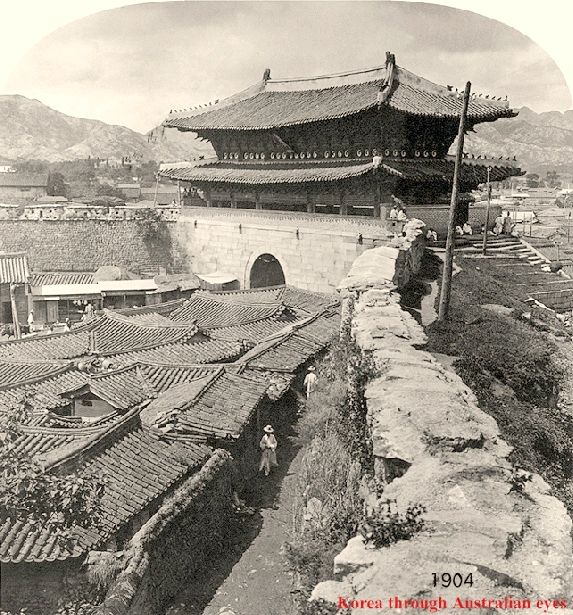
When I saw the above photo, I thought it nice to see the walls restored, especially since they recall the image of Namdaemun from over 100 years ago:
On the other hand, I also regretted the loss of its iconic shape. As it turns out, however, the 'inside' part of the gate does still keep that shape, which is a pretty inspired compromise, I think.
After the ceremony [this Saturday], the restored gate will be open to the public every day from 9 a.m. to 6 p.m., except Mondays. The hours will be extended by one hour till 7 p.m. in May, the month it reopens.
On May 4, all four royal palaces -- Gyeongbok, Changdeok, Changgyeong and Deoksu -- and Jongmyo Shrine will be opened for free admission in celebration of Sungnyemun's reopening, the office said.
Robert Neff has posted more photos of his trip to the site at the Marmot's Hole.
Original Post:
In the Korea Times yesterday was an article by Robert Neff about one of the stranger tales of foreigners visiting Korea - the tale of Ernest Oppert:
Oppert was not the only foreigner in Shanghai interested in opening Korea. In the early spring of 1868, Oppert met Father Stanislas Feron. Feron was one of three French priests who managed to get out of Korea alive during the religious persecution in 1866 — the same persecution that resulted in a short war between France and Korea.
Feron told Oppert that he had a plan to open Korea to the West. According to Feron, the average Korean desired relations with the West, but it was Daewongun, the regent, who was violently anti-foreigners. If Daewongun could be removed or coerced, Korea could then be opened up.[...]
Feron stressed the reverence Koreans held for their ancestors before he proposed something that was completely unacceptable to Westerners and Koreans alike — to dig up the bones of Daewongun’s father and hold them hostage.[...]
Once Daewongun agreed to open Korea the bones would be immediately returned. He also indicated that it was the Korean Christians who had devised the plan.
Things didn't quite go according to plan (they never do). For more information about this trip, a good place to look is Oppert's own book A Forbidden Land: Voyages to the Corea, which was translated into English in 1880 and is available here.
I have to say, though, that I'm not sure if the article was as well placed as it could have been on the Korea Times' webpage today:
Perhaps they have a different idea of "diverse foreign students" than I do...
For months much of the Pimatgol/Cheongjin-dong area north of Jongno between Gwanghwamun and Jonggak Station has been shrouded by steel and blanket fences in preparation for demolition.
Over the last month or so most of the cordoned-off area has been demolished.
There have been a number of articles about the doomed neighborhood over the past year. In English we can find:
If you have time to read only one article, read the unedited version of Scott Burgeson's "Annyong, P'imat-gol" (Newsweek Korea, 2009.06.24). Go read it now.
It's the best informed, and, seeing as a couple of the visits to the area documented below were with Scott, it's the article most related to this post. Scott has also posted photos of the neighborhood in happier days. This photo is of the Seoul Hotel, the interior of which (along with the surrounding area) was photographed by Jon Dunbar.
This map shows where redevelopment is supposed to take place in Cheongjin-dong.
In fact, more of the area is being demolished than what is seen here, including the area just north of '1', and a section of the area between '1' and '2.' The area may end up looking like what is shown here, or it may not. I have another post in mind which will look at what the previous destruction of another section of Pimatgol in 2005 (to build the lovely 'Jongno Town' building) has meant for the preservation of Pimatgol, but I'll leave that to another time, and for today mostly just post photos of the area.
The most picturesque part of Pimatgol was the section right next to the Kyobo building.
“I’ve been cooking fish here for more than 30 years,” said Seok Song-ja, 65. [...] She runs a small restaurant called Daelim, and warmly welcomes anyone who shows an interest in the neighborhood.[...]
“I’ve seen it all,” she said. “Back in the old days, when customers were young and had little money, they promised to pay later,” she said. “Some paid, but it didn’t really matter that much if they didn’t,” she went on. “In the past there seemed to be a lot more jeong [affection] and it was a lot more fun. Today people are all about economics. Kids today aren’t as romantic as they used to be.”
Seok said many of her more frequent customers return to Pimatgol because they spent time here in their youth. “They’re mainly in their 40s and 50s and have children of their own now,” Seok said. Relationships are tight and the shared history creates a bond. Seok’s even been invited to some of her customers’ weddings. “They may not be as handsome as they used to be, but they are always welcome in my house,” she added.
What does Pimatgol mean to her?
“It’s where common people live their daily lives and where life is full and cheap,” she said.
Scott spends some time talking about her in his article (and has a great photo of her), and back in February he and I had dinner there together.
Actually, that day I had been in Hyehwa-dong trying to get a good photo of Hyehwamun (and trying to find the way up to the city wall) and discovered this demolished lot next to the city wall. I had to slip in through the 'blanket fence', and ended up getting fibers from the blanket all over my backpack (which were pretty difficult to remove).
As we went up to pay, she noted my backpack and asked what was all over it, and Scott joked that I was homeless. When we got the change back, Scott noticed that there was too much and asked why. Mrs. Seok's response was, "It's a homeless discount." Somehow I doubt those working in the shops in the office tower that replaces the neighborhood will be quite so friendly.
In mid-May I stopped by to take a look at the area (Jon Dunbar has photos of the area taken at the end of April). This was the view coming out of Kyobo Bookstore.
It was nice to see that Yeolcha-jip and Daerim were still open (and were as of last weekend). The buildings facing Jongno were being destroyed (interesting how you can see the outline of the formerly adjacent building against the remaining one).
Here was the view of the area from above, taken from the 'Bikini University' building nearby.
It was possible, from Pimat-gil, walk out into the demolished area seen above.
At the end of May, I returned to the area with my friend Blaz, who's been teaching urban studies in Seoul. This was the overview of the area then.
The same view from the ground:
Next to Jongno, the destruction continued.
(Note the people walking by at bottom right.)
Last Sunday night I took a photo from almost the same vantage point; the buildings along Jongno are all gone now.
As I mentioned, the map above does not show this redevelopment, in the northern section of the same block next to the Kyobo Building. Here it is looking north from the Bikini University building.
The only positive development to come from this would be the results of archeological digs on the site after the buildings were cleared.
Photo from here (note the Kyobo Building at left).
To see what these looked like when they were found, see here. Other pottery was found as well (and there is more here).
As redevelopment or restoration projects have proceeded in the downtown area over the past few years, the discovery of ruins and pottery has become morefrequent.
We headed over to the other block of Cheongjin-dong being destroyed; or perhaps I should say, "that has been destroyeed."
At bottom right used to stand the restaurant Hanilgwan, which had almost 70 years of history and served former presidents.
Hanilkwan, a traditional Korean restaurant located in Jongno, Seoul, will suspend its 70-year service for a reconstruction project in the area in May.
The famed restaurant will move to Gangnam, southern Seoul. ``We are moving, not completely closing. Still, the staff and our customers feel sad that we have to leave where we established so much so long ago,'' said Kim Jung-ok, the restaurant's executive manager.
Founded in 1939 by Shin Woo-gyoung, the restaurant gained popularity for its traditional food and welcoming atmosphere. It is a family-owned and operated business covering three generations and is currently operated by Shin's granddaughters
Here's what it looked like in September.
As of the end of May, there were only two buildings left: a hotel, and a still-operating restaurant with a partly demolished hanok behind it, which can be seen below. It also appears that archeological excavations have started in this former neighborhood as well.
Here's what the entrance to the hotel once looked like.
As of the end of May, the area was tightly sealed shut, but two weeks earlier it was possible to pop in for a look around after workers left.
Easily noticeable was this partly demolished hanok.
I wondered if I had actually been there before, but dismissed it as unlikely. I took a few photos with the flash on.
It wasn't until I got home and looked carefully at the photo above and the one below that I realized I had indeed been here before - I described the visit in this post two and a half years ago. I went with Scott Burgeson, and he mentions this place, named Si-in Tongshin, in his article. Here's the photo I took at the time, of the poet who befriended us and Scott. A close look at the writing on the wall reveals it to be the same place as the partly demolished hanok above.
This is where I was introduced to Lee Jang-hee's 'Geugeonneo,' which is a really cool song, but very unlike the rest of Lee's folk-oriented music from that time.
Here's the entrance to and sign for Si-in Tongshin.
Over in the direction of these ruins was once Cheongjin-ok, the haejangguk restaurant which dates back to 1937.
Here is how it once looked.
Here is how it looks now after moving into the north end of the Jongno Town building.
The inside the building there is a photo of the old restaurant.
[M]ost restaurant owners say everything is different from the way it used to be. Some restaurants had to raise prices due to the high rent and hike in prices of food supplies. Cheongjinok, a blood soup restaurant, was a fixture of Pimatgol established in 1937. The restaurant has moved to the first floor of the Le Meilleur building last August and raised the price of main dish "ttaro gukbap'' (rice served with blood soup) to 6,000 won, a 500 won increase.
Mijin, a buckwheat noodles specialty eatery, also moved to the first floor of Le Meilleur, and raised the price of the noodle by 1,000 won to 6,000 won, the only price hike in eight years.
"I serve fewer guests here than I did at the previous location,'' said Lee Young-soo, 71, the owner. "Steady customers come to the new place as well, but they say the taste is different.''
As the redevelopment plan is carried out, more restaurants are expected to move to the building. "If the owner wants to keep running the eatery in this area, there is no other option than the Le Meilleur building for the present,'' a real estate agent in Jongno said.
"[N]o other option than the Le Meilleur building"? That's one way to rub salt in the wound. But there's more, of course.
The building requires a 100 million won deposit and 5-7 million won monthly rental fee for a first floor unit, the most expensive in the building and two to four times costlier than restaurants' previous locations.
I guess that's the price of progress.
I'll save my thoughts on what this means for downtown Seoul for another day.