Showing posts with label Film. Show all posts

Saturday, August 12, 2017

'A Taxi Driver' depicts the Gwangju Uprising

Over the years I've written quite a bit about the Gwangju Uprising, the way it has been remembered, and the movies and literature which have depicted it (an older summary of posts is here). It has been depicted in movies such as A Petal (꽃잎, 1996), Peppermint Candy (박하사탕, 1999), The Old Garden (오래된 정원, 2006), May 18 (화려한 휴가, 2007), 26 Years (26년, 2012) and now a new film, A Taxi Driver (택시운전사) has just been released.

As the New York Times has reported, the film stars Song Kang-ho and tells the story of the taxi driver known as 'Kim Sa-bok' who drove German reporter Jurgen Hinzpeter to Gwangju twice during the uprising, first on May 21 and 22, when he filmed the aftermath of the mass shootings on May 21, and the second time when he returned for the final days and suppression of the uprising. (His footage of the suppression's aftermath can be seen at the beginning of A Petal.) The taxi driver has never been found or positively identified, however.

In an article published yesterday (in which the wife of Hinzpeter (who died last year) gave a positive review of the film), it was reported that the film has surpassed 6 million viewers in 9 days - which means it's doing rather well. I certainly hope it's better than 'May 18.' Taxi drivers played an incredibly important role in the uprising, particularly when they mounted a protest by driving en masse downtown which allowed protesters to occupy space and turn the tables on the paratroopers, but though the main character in May 18 was a taxi driver, that event wasn't depicted at all. (I examined that film at the time here, here, and here.)

Here's a shot of Jurgen Hinzpeter  (which I first posted here) when he revisited Kwangju in the mid 2000s; he's in the gymnasium across from the provincial hall in Kwangju.


It was there that he shot the footage captured below of the coffins of the identified dead in 1980 (far more were still in hospitals at that time).


He was later severely beaten by plainclothes police in 1986 while covering a rally, possibly in revenge for the footage he filmed in Kwangju. His injuries ended his career. One hopes the taxi driver, whoever he was, fared better.

Friday, April 29, 2016

First joint Korean-U.S. film "Northeast of Seoul" aka "Seoul Affair" aka "Katherine's Escape" to screen Saturday

On  October 3, 1970, James Wade's Korea Times column "Scouting the City" (written under the pen name Alf Racketts) revealed that an international film production - Korea's first - was about to start filming under the name "Seoul Affair" (or "Northeast of Seoul"):


Alan Heyman (more about whom is here) wrote a score for the film, but it was never used.

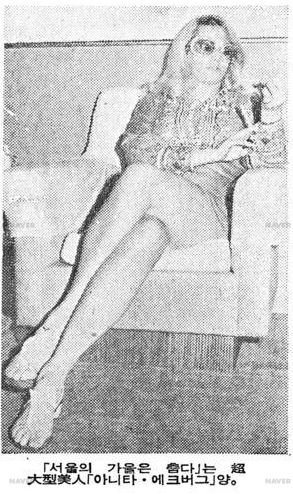
On October 6, 1970, the Donga Ilbo reported that actress (or, as they put it, "glamour fox") Anita Ekberg, best known for her role in the Federico Fellini film "La Dolce Vita" (not yet released in Korea), was in Seoul for a joint American-Korean production titled "The Seoul Affair," set to start filming with director David Rich and actors John Ireland, Jon Buono, and Sin Yeong-gyun and Choe Ji-hui on October 15.

The Kyunghyang Sinmun, on the same day, in an article titled "Seoul’s autumn is very cold," also reported on Anita Ekberg (a 39 year-old "sexy fox" with the measurements 42-28-40 wearing a skirt that ended 30cm above the knees), saying that she was best known to Korean fans for the omnibus film "Boccaccio '70."

On October 10 the Joongang Ilbo published an article about the production. On October 24, in an article titled "Film like water...", the Maeil Gyeongje reported that local directors seeing the progress of David Rich's film "Seoul Affair" were astonished at his unconventional way of directing the film. While local directors would use 9000자 of film (I'm not sure what that measures) to make a movie, David Rich wanted to use 70,000자, which made his staff turn pale in shock. From their point of view, the director was using too much film, doing seven takes and only using one shot, and wasting precious film like water.

On November 7, the Donga Ilbo reported on possible other joint projects with an Italian director but nothing seems to have come of these (perhaps not a bad thing - did we really need a "Nazi gold hidden in Korea" story? Well, maybe...).

On December 21 the Kyunghyang Sinmun showed this photo of Anita Ekberg with co-star Sin Yeong-gyun:


But then that was that. At least in Korea. IMDB has '1972' written next to it, and posters such as the one below can be found, but it's not clear if it was released in the U.S. or not (only a 1990 German release is recorded).


In Korea, however, years went by with no mention of this film, as James Wade notes in this March 16, 1974 column:


Two weeks later, however, on April 2, 1974, the Maeil Gyeongje announced that a joint Korean-American production titled "캐서린의 탈출" ("Katherine’s Escape"), was to open soon. This was, indeed, a renamed "Seoul Affair," as this poster from the April 4, 1974 Donga Ilbo reveals:


On April 9, 1974, the Maeil Gyeongje stated the nation’s first American-Korean joint production had been playing at the Scala Theater since April 5.

On April 13, James Wade weighed in with a review of the film:


Though he wasn't impressed, a week later, on April 16, the Maeil Gyeongje reported that it had brought in 34,000 viewers in the ten days between April 5 and April 14. Just to compare, it reports that a movie titled "Yu Kwan-sun" (about the national heroine of the Samil Protests in 1919 had brought in only 7,676 people in the same time period, while over 46 days the "Poseidon Adventure" had attracted 120,000 viewers. One wonders if this is correct, considering the Korean Film archive records there having been 31,291 viewers. Unfortunately, the Maeil Gyeongje's film listings section doesn't seem to be a regular feature, so nothing more is said about it.

Should you be curious to see the film, this Saturday, April 30, at 3pm, the Royal Asiatic Society Cinema Club and Seoul Film Society will have a free screening of the film at Seoul Global Center's Haechi Hall, on the 5th Floor of M Plaza in Myeong-dong.

Directions to Seoul Global Center's Haechi Hall can be found here and here, and more information about the film and screening is here.

Sunday, February 28, 2016

Colonial-era films discovered and will be screened next week (and a few other links)

The Joongang Daily reported the other day about the discovery and screening of colonial-era documentary films about Korea:
The [Korean Film Archive] announced Thursday during a press conference that the seven short films, found in Russia and Germany, expand upon cultural aspects of the time as well as Japan’s economic plan to breed sheep in the north of the country and plant cotton in the south - part of efforts by Tokyo at the time to produce industrial raw materials via cheap labor.[...]

The seven short films will be screened publicly in commemoration of the Independence Movement Day on March 1 in the Cinematheque KOFA, located in Sangam-dong, Mapo District, western Seoul.
Those films would appear to be the untitled films at the top of this schedule page.

Speaking of films, here are hundreds of Korean movie posters from the 1960s and 1970s (hat tip to Hamel).

And speaking of the colonial period, here are a couple dozen colorized photos from that time.

As well, the Seoul Metropolitan Government, the Ministry of Strategy and Finance, the Cultural Heritage Administration and Jongno-gu Office signed a memorandum of understanding for the restoration of Dilkusha on February 26 (hat tip to Robert Koehler). It was built by Albert Taylor, a gold miner who first reported the Samil Independence Movement to the world as a reporter for AP; more on the house and its history can be found at Brother Anthony's site here. It's to be opened in 1919 on the 100th anniversary of the Samil Movement (though the house itself was built in 1923). Mary Taylor's memoir 'Chain of Amber' is a fascinating read about her time in Korea from around 1916 to WWII. I think there may be reprints of it available at the RAS Office.

Thursday, June 11, 2015

Part 3 of my interview with The Korea File about the 1975 marijuana crackdown

Last week I posted links to the first two parts of an interview with myself by Andre Goulet for his podcast, The Korea File (Part 1: "A History of Korean Social Movements"  Part 2: "Korean Identity and Anti-Americanism"), and yesterday he posted the third and final part, titled "Weed, Counterculture and Dictatorship," about how rock music and the counterculture were suppressed under the guise of a marijuana crackdown in 1975.

The propaganda film I mentioned (found at ehistory.kr) was found and posted by Mark Russell here.

Thanks again to Andre inviting me to do this interview; have a look under "Episodes" here to look through the other interviews about Korean music, culture, and society he's done.

Thursday, April 02, 2015

Screening of "A Single Spark" with English subtitles and interview with director Park Kwang-su this Saturday

This Saturday, April 4, at 2pm, the Royal Asiatic Society Cinema Club and Seoul Film Society will have a free screening of the 1995 Park Kwang-su film "A Single Spark" (아름다운  청년  전태일) with English subtitles at Seoul Global Center's Haechi Hall, on the 5th Floor of M Plaza in Myeong-dong. The screening will be followed by an interview and question and answer period with director Park Kwang-su.

The film is based on the life of Jeon Tae-il, who tried to improve the conditions of workers in the garment factories of Pyeonghwa Sijang near Dongdaemun, where he worked in the late 1960s; I've written about him here. Though he was only able to attend school up to middle school, he eventually came to understand that the Labour Standards Act offered workers protections, but when media attention (by the Kyungyang Shinmun and Donga Ilbo) failed to make any difference he and his coworkers held a protest on November 13, 1970 in which Jeon suddenly set himself on fire. This led politicians to take up the cause of labour standards and inspired the rise of unions, particularly by female workers, throughout the 1970s. An anonymous biography of Jeon was pubished in 1983, written by law student Jo Yeong-rae, who spent six years on the run, wanted by the government for student activism. The film weaves the stories of Jeon and Jo's lives together, with Jeon's life filmed in black and white, and Jo's (set in 1975) filmed in colour. It won the Best Film Award at the 1995 Blue Dragon Film Awards.

After the screening, the film's director, Park Kwang-su will take part in a 90-minute Interview and Question and Answer session after the screening.

While the screening is free, the there will be an admission fee of 7,000 won (5000 won for students) for the interview with the director to cover the cost of the interpreter, etc.

1. 2pm to 2:10pm – My introduction
2. 2:10pm to 4pm – Film screening
3. 4pm to 4:10pm – Interval
4. 4:10pm to 5:40pm – Interview and Question and Answer with Director Park Kwang-su.

Directions to Seoul Global Center's Haechi Hall can be found here and here, and more information about the film is here , and the screening, here.

Wednesday, March 04, 2015

Screening this Saturday of Jeong Jae-eun's 2001 film "Take Care of My Cat"

This Saturday, March 7, at 2pm, the Royal Asiatic Society Cinema Club and Seoul Film Society will have a free screening of the 2001 Jeong Jae-eun film "Take Care of My Cat" (고양이를 부탁해) with English subtitles at Seoul Global Center's Haechi Hall, on the 5th Floor of M Plaza in Myeong-dong.

When readers of Koreanfilm.org were asked years ago which film they thought best captured the ‘feel’ of South Korea, the film that repeatedly came up was ‘Take Care of My Cat.’ Set in Incheon and Seoul, the film chronicles the lives of a group of friends — five young women from different economic backgrounds and family situations — a year after they graduate from high school, showing the changes and difficulties they face in both their friendships and the working world. Though the film did not do well at the box office and was soon pulled from screens, a letter-writing campaign by its fans managed to get it back into theaters, and the film won many awards.

After the screening, the film's director, Jeong Jae-eun, will take part in a 90-minute Interview and Question and Answer session after the screening. After directing two features and several shorts, director Jeong moved to directing documentaries, including "Talking Architect" (2012), about celebrated maverick Korean architect Chung Guyon (a trailer is here) and "City:Hall" (2013), which examined the creative and political pressures that affected the controversial design of Seoul's new City Hall (a review is here).

While the screening is free, the there will be an admission fee (of perhaps 7,000 won) for the interview with the director to cover the cost of the interpreter, etc.

1. 2pm to 2:10pm – My introduction
2. 2:10pm to 4pm – Film screening
3. 4pm to 4:10pm – Interval
4. 4:10pm to 5:40pm – Interview and Question and Answer with Director Jeong Jae-eun.

Directions to Seoul Global Center's Haechi Hall can be found here and here, and more information about the film is here , and the screening, here.

Tuesday, February 03, 2015

'Ode to My Father' with English subtitles tomorrow

For those wanting to see 'Ode to my Father,' which I reviewed here (and looked at the history it depicts here), it will play with English subtitles at two CGV locations tomorrow (perhaps for the last time?):

Yeouido CGV, Feb 4, 7pm
Sinchon Artreon CGV, Feb 4, 7:55 pm

Tuesday, January 20, 2015

The history depicted in "Ode To My Father"

In my previous post, I reviewed and offered an interpretation of the recent film "Ode To My Father (국제시장)." Along the way to writing the post I did quite a bit of reading about the events portrayed in the film, so below I will look at how the film followed (or didn't) the historical facts.

While the scene of a Korean begging the American general to save the refugees at Hungnam is not really what happened, it accords with the basic facts. Several accounts point to Dr. Hyun Bong-hak as being in great part responsible for the evacuation of almost 100,000 refugees from Hungnam. As this brief biographical entry about him describes it, he was from Hamheung and studied medicine at Severance Medical School before studying in the U.S. in the late 1940s. When the Korean War broke out, he headed south, treated wounded civilians, and volunteered his services as a translator for the U.S. Military, who asked him to work for the commander of the US X Army Corps in Hamheung. As his children described him in a recent Korea Herald article:
During the Korean War, our father served as a civil affairs Adviser to Maj. Gen. Edward M. Almond to help rebuild Hamheung, North Korea. Christianity had a strong foothold in Hamheung, so when the Americans liberated Hamheung from the communists, they were embraced by the locals.

Shortly thereafter, the U.N. forces began to retreat. This was disastrous for the Christians, local government leaders and anyone working for the U.N. Forces, as all would be tortured and massacred by the communists. Our father advocated for a civilian evacuation, stating, “It didn’t seem fair to me that those who had risked communist retaliation by cooperating with the Americans should be abandoned so readily.”

He received constant encouragement from Col. Edward R. Forney, the foremost amphibious expert at the time who masterfully plotted out how the evacuation would be implemented; and together, they met with Gen. Almond several times. Gen. Almond approved of the mission with a planned evacuation of 4,000-5,000 civilians from Hamheung to Heungnam by train.

The Hamheung railroad station was flooded with more than 50,000 people. Over 100,000 arrived at Heungnam Port circumventing the roads, which were reserved for military personnel and closely monitored by MPs. Blankets and rice were given to the refugees who remained at the port in minus 10 degrees Celsius weather.

The Meredith Victory was the last ship to leave the Heungnam Harbor, which was rife with mines. Designed to carry 12 passengers with a 47-person crew, it brought 14,000 refugees to safety and ultimately made it into the Guinness World Records as “the largest evacuation from land by a single ship.” The port was blown up to render it useless to the communist forces. Many civilians who should have been evacuated were left behind.
It's interesting that this account refers to many being left behind, while American accounts I've read describe getting all of the refugees out. For statistics, as this article notes,
At the finish a total of 105,000 US and ROK military personnel had been embarked and 91,000 civilian refugees. The statistics of supplies and equipment were equally impressive—17,500 vehicles and 350,000 measurement tons of cargo loaded out of Hungnam on 6 APA, 6 AKA, 12 TAP, 76 time-charter ships, 81 LST, and 11 LSD loads.
As for the aforementioned Meredith Victory, it appears in the movie as the ship they escape on. As it turns out, there is not only a book about this voyage - during which 5 babies were born - there is also a documentary that can be watched here, and a monument to the Hungnam evacuation which features a model of the Meredith Victory was unveiled in 2005 on Geoje-do, where the ship unloaded the refugees. This article also points to Maryknoll Father Patrick H. Cleary, a missionary in Korea who joined X Corps as a chaplain, as someone who contributed to the refugee rescue effort. What should be clear is that yes, there was a Korean who asked an American general to evacuate the refugees, but it certainly didn't happen at the last minute once the Americans were aboard and ready to leave, which makes them appear more callous than they were. This contributes to a social Darwinist view of the world as a harsh place in which Korea was the 'shrimp among [Chinese and American] whales' and had to beg the (initially cold and unwilling) Americans for help in order to survive.

Years after the war, once Deok-su had grown into a young man who worked as a labourer to support his family, he is convinced by his friend Dal-gu to apply to work in West Germany as miners, where they could make lots of money. These "workers sent to Germany" (padok nodongja) are examined in an article by Kim Won titled "Memories of Migrant Labor : Stories of Two Korean Nurses Dispatched to West Germany" [The Review of Korean Studies, 12(4), 2009.12, 111-151]. As the article notes,
In the case of mine workers, padok started in 1963 and continued until 1978. Until 1980, the Deutchemarks that a total of 7,936 padok miners and 10,032 padok nurses remitted to Korea were an important means of “foreign exchange earnings” (oehwa beori) and for solving the domestic labor surplus problem before the advent of a loan economy (cha-gwan gyeongje). At present [2009], about 5,000 out of the over 20,000 padok workers continue to live in Germany, and some 5,000 padok workers eventually chose to immigrate to the Americas. Among Korean residents in Germany, the number of nurses is said to be about 500 today. The last Korean miner retired in 2003.
The article also adds that in 1967, "padok workers’ remittances to Korea represented 36 percent of the total foreign exchange holdings of the country." It wasn't only men working as coal miners who worked in West Germany, however. Deok-su soon meets and falls in love with Yeong-ja, who is working as a nurse there. As the above article notes, Korean women were initially, in 1959, sent to Germany to study nursing for three years and then could work as nurses there. Then in 1966 a new phase began with the sending of nurses already trained in Korea to Germany, which was initially organized by a medical organization and coordinated by the Korean Foreign Development Corporation. These were all organized through civilian, medical, or Christian organizations, however and it wasn't until August 1969 that an agreement between South Korea and West Germany on the hiring of nurses was signed, and a quota was set. Prior to this agreement, 2,080 nurses had worked in Germany, and numbers increased a great deal in the ensuing years, as per the article:

In the end, some 18,000 Koreans worked as coal miners or nurses in West Germany and their earnings in foreign currency contributed a great deal to the growth of the Korean economy.

Another very large contribution to the Korean economy's growth was the Vietnam war, and Deok-su is depicted going to Vietnam with his friend Dal-gu to work as contractors and make lots of money. Over 300,000 Korean soldiers fought in the war, leaving behind a legacy, literally, of Korean-Vietnamese children abandoned by their fathers, as well as a reputation for brutality. In addition to these soldiers being paid in U,S. dollars, South Korea also benefited in many other ways from the Vietnam War (much as Japan did from the Korean War), as pointed out in "America's rented troops: South Koreans in Vietnam," by Frank Baldwin, which was published in the Bulletin of Concerned Asian Scholars Volume 7 Number 4, and is available as a pdf here (pages 33-40):
The major forms of U.S. commercial assistance were procurement of war supplies in South Korea and construction/service contracts for R.O.K. firms in Vietnam. Among the major South Korean exports to Vietnam were military uniforms, jungle boots, corrugated metal roofing and cement. In the construction and service field, at one point more than eighty South Korean companies held contracts with the U.S. government in Vietnam. Their activities included construction and engineering, transportation of goods, and operating service facilities such as laundry shops and entertainment clubs. South Korean civilian workers in Vietnam were especially well rewarded. According to U.S. government estimates, there were sixteen thousand South Korean foreign contract workers in Vietnam (of a total of twenty-five thousand). Their annual earnings were $8,400-compared to an average of about $200 in South Korea.

ROK troops pulled out in March 1973, though the Korean military did send a ship to rescue South Koreans from Vietnam in 1975 as Saigon fell to the North Vietnamese. As described in "The Pursuit of State Status and the Shift toward International Norms: South Korea’s Evolution as a Host Country for Refugees," by Hans Schattle and Jennifer McCann, published in Journal of Refugee Studies (2014) 27 (3) (pgs 317-337):
The influx of Indochinese asylum seekers into South Korea began with the April 30, 1975 evacuation from Vietnam of a group of South Korean nationals, their non-South Korean family members, and a number of primarily Indochinese refugees by a South Korean military vessel (Korean Red Cross Busan Chapter 1993). In the absence of appropriate domestic legislation, the government treated arrivals on an ad hoc basis, setting up a temporary shelter in the port city of Busan. By the end of 1975, officials had managed to settle the 1,562 Indochinese refugees by encouraging female Indochinese refugees married to or in a common-law relationship with a South Korean national at the time of their arrival, to become naturalized citizens or by granting them a continuous permission of sojourn as a stateless person (South Korea did not officially recognize Vietnam at this time) (I. Chung 2009). By contrast, the 977 refugees without such ties to Korean nationals were quickly resettled in third countries (Korean Red Cross Busan Chapter 1993). Then in 1977 a new wave of Indochinese refugees poured into the South China Sea. However, unlike the refugees evacuated in 1975, the government perceived arrivals less as victims of political persecution than as so-called economic migrants (I. Chung 2009), and therefore responded by securitizing arrivals.
It goes on to explain that the ROK went out of its way to stop its ships from picking up Indochinese "boat people," firing a captain who did so and confining those boat people who did arrive to a newly built 'Vietnamese people’s relief center'. "Although criticized for such an approach (Koh 2011), officials pressed hard for third-country resettlement, and as a result, not a single Indochinese refugee who arrived between 1977 and 1989 was permitted to settle in South Korea."

I first became aware of the presence of Vietnamese refugees a few years ago when reading through Korea Herald articles from late 1975 and early 1976. Here is one from December 17, 1975:


Here is another from January 31, 1976:


As mentioned in the previous post, in 1983 KBS broadcast the TV show, "Reuniting Separated Families," planning only to do a single broadcast, but when it proved successful it continued for over four months and led to the reunion of over 10,000 separated families (episodes can be watched here).
The Korea Bang post linked to above says that the reason it took so long for such a reunion show to happen was that the government was too busy developing the country to care much about divided families, and that it was only by the 1980s that enough people had televisions for such a show to be effective. This misses an important factor, I think. Under the anti-communist governments of Syngman Rhee and Park Chung-hee, admitting that you had relatives that might be in North Korea was likely enough to make the authorities suspect your loyalty.

Hopefully the above information proves helpful for those who have seen "Ode To My Father" and wanted to learn more about the history it depicts.

Monday, January 19, 2015

A review of "Ode To My Father"

Youn Je-Kyoun's film "Ode to My Father" [국제시장, or 'International Market'] has become the first film this year to top ten million admissions after its release on December 17. I saw the film new year's eve, and it didn't exactly leave viewers in a cheerful mood afterwards. It's a sad film that depicts several events in Korea's modern history through the eyes of one man who sacrifices to take care of his family after the loss of his father during the Korean War. Despite melodramatic excess and some other flaws, it's an interesting film for many reasons, and is well worth watching. (The following review is full of spoilers.)


The film begins in the present and introduces three elderly characters: Deok-su, his wife Yeong-ja, and his best friend Dal-gu. Deok-su runs a store in the international market in Busan, and we follow him as he interacts with: developers who want him to sell his store (he refuses); his adult children (who seem entitled and dump the grandchildren on him and his wife so they can travel); and his memories of the past. These flashbacks reveal that he has participated in some of the more dramatic touchstones of Korea's modern history, starting with the evacuation of UN forces and North Korean refugees from Hungnam during the Korean War, the dispatch to West Germany of Koreans to work as nurses and coal miners, the large role played by Korean civilian contractors and soldiers during the Vietnam War, and the 1983 KBS TV show "Reuniting Separated Families," which was so successful in its first live broadcast that it continued for over four months and led to the reunion of over 10,000 separated families, most of whom had been living in South Korea since the war. In many ways it is like Forrest Gump, in that Deoksu takes part in these historical events and interacts with a number of famous Koreans during these flashbacks.

Director Youn has a flair for integrating the smaller, personal stories with the large scale of some of these historical events, and the actors do an admirable job of portraying characters who age over a 50 year period, though this is definitely a tale of men - after their romance leads to marriage, Yeong-ja fades into the background, and we're left with the tale of the sacrifices made for his family by a son, a brother, and a father. Still, for all these strengths the film doesn't have a lot of narrative depth; the film proceeds by repeatedly presenting a scene in the present which triggers a flashback. The audience does have certain pieces of information withheld from it, and certain flashbacks serve to explain why he acts in inexplicable ways in the present. We also see Deok-su change after reflecting on the past, and the film at times implicitly criticizes the younger generations of today for being too self-centered and unappreciative of the sacrifices their elders made. As the Korea Times noted, "One critic caused controversy by calling Youn's latest film a 'conservative' movie that 'glorifies the sacrifices of the older generation.'" "Glorifies" seems too strong a word, partly since the criticisms it makes - often through juxtaposition of past and present, seem fair enough. The film does lay on the melodrama pretty thickly, in the way only a Korean movie can, though the reunion scene on the KBS TV show set in 1983 was guaranteed to bring the audience to tears regardless of the way it was presented. I was reminded of when I saw the 2004 documentary 'Repatriation' and a fellow audience member said to me, "It really does remind you that we're sitting on an open wound."

For all of its blockbuster and melodramatic elements, there is a lot to unpack with this film, and I thought I'd look at its depiction of history and the way in which the film imagines how Korea's role in the world has changed during fifty years of economic development.

The aforementioned Korea Times article mentions that director "Youn also became the first director with two films to top 10 million. 'Haeundae,' a disaster film released in 2009, attracted 11.45 million viewers the same year." A few years ago I looked at Youn's film Haeundae, which I hadn't realized did so well at the box office. I didn't like it, but thought its crashing wave provided an excellent metaphor for the way in which Korean films of the 2000s have dealt with Korean history, portraying people as blamelessly going about their lives when suddenly history crashes into them and sweeps them off their feet. Some of these films have blamed outsiders (such as when South Korean and North Koreans team up to shoot down American aircraft at the end of Welcome to Dongmakgol), and have rarely attempted to explain why the events portrayed occurred - a far cry from the history films of the 1990s. Haeundae's wave inadvertently provided a useful metaphor for these kinds of films (and one could profitably make 'Korean wave' references here, since it's the fact that Korean films (and TV dramas) are so slickly (and expensively) produced now that a larger box office is needed to recoup costs, which encourages simplistic films which appeal to a broader demographic).

It could be argued that 'Ode to my father' also follows the 'wave pattern' in certain ways. While the main character, Deok-su, works to keep a promise to his father to take care of his family (and makes sacrifices in the hope of meeting his father again), the moments in modern Korean history he takes part in occur when he follows others. He (obviously!) follows his parents when they attempt to flee Hungnam, while its his friend Dal-gu who suggests going to Germany and Vietnam. It's also made clear that the 'decision' to have a child and get married was essentially thrust upon him by his soon-to-be wife, so much of his life is shaped by others' decisions.

One thing I noted was the similarity with 'Welcome to Dongmakgol' of having a lone Korean officer beg the Americans to save Korean lives. In 'Dongmakgol' the officer protests the bombing of a village, while in 'Ode to my Father' an officer begs a general to take refugees aboard at Hungnam. In 'Ode' the general relents at the last second and the soldiers are ordered to take the tanks they just loaded aboard the ship off again, much to the anger of one profanity-shouting soldier, and refugees are put on instead. Unlike the 2004 Korean War film 'Taegukki,' in which American soldiers were not even shown, 'Ode' depicts refugees waiting by the ocean while American soldiers retreat and we're told that behind them "The Chinese are coming!" I don't remember the South or North Korean army being mentioned.

What this leaves out, however, is why these refugees were fleeing, and why filmmakers might want to gloss over the actions of the ROK military in North Korea between October and December 1950. Callum MacDonald, in his 1991 Bulletin of Concerned Asian Scholars article "So Terrible a Liberation - The UN Occupation of North Korea" (which can be downloaded here, and is on pages 3-19) points out how, though the ROK was not given legal sovereignty over liberated North Korea, ROK troops often were the first to arrive in the north and were followed by police and bands of paramilitaries such as the Northwest Youth League (which had carried out much of the repression in Jeju, for example; the dissertation I recently linked to also looks at the use of paramilitaries by the ROK before and during the Korean War). These paramilitaries and police were known to have killed thousands of suspected communist sympathizers after the Incheon Landing in South Korea, so one can only imagine the horror they visited upon North Koreans. As MacDonald notes,
Just before [Syngman Rhee] returned to Seoul [after the Incheon Landing] he informed Hugh Baillie, president of the U.S.-based United Press, that he planned to extirpate communism throughout Korea: "I can handle the Communists. The Reds can bury their guns and bum their uniforms, but we know how to find them. With bulldozers we will dig huge excavations and trenches, and fill them with Communists. Then cover them over. And they will really be underground."
General MacArthur offered his own take on the situation in October 1950 in a conversation with the tutor of the Japanese crown prince, Elizabeth Gray Vining:
"Each house has a North Korean flag and a South Korean flag, and most of the time they don't know which to wave. Both sides line them up and shoot them down. The country was poor to begin with. They will be destroyed, utterly destroyed."
So when the tide of the war turned, it might be easy to understand why those who championed the arrival of the UN forces - or who simply feared being caught in the middle - would want to flee. While starting the story in the middle as the family flees can be explained as wanting to get the story started quickly or due to lack of time, the lack of context, or even reference to the DPRK army or the ROK army, puts the beginning of the film squarely in the "history washed over us" camp of recent Korean films.

As well, while the 'begging for help' scene is not really what happened, it accords with the basic facts,  (to be elaborated on in my next post) which are that Dr. Hyun Bong-hak, an assistant to Maj. Gen. Edward M. Almond, commander of the US X Army Corps in Hamheung, convinced General Almond to evacuate tens of thousands of refugees along with the soldiers and equipment; when there turned out to be 100,000 refugees, attempts were made to evacuate all of them, with one ship, the Meredith Victory (which is depicted in the movie), taking 14,000 aboard, a world record.

In the film, during the evacuation, Deok-su's family is separated from his sister and father, and they go to their aunt's house in Busan, where she runs a store in the international market. In the next flashback, years after the war, Deok-su has grown into a young man who works as a labourer to support his family, and who puts off his own dreams to support his younger brother's university education. He is convinced by his friend Dal-gu to apply to work in West Germany as miners, where they can make lots of money. Germany, however, proves to be a struggle for Deok-su and Dal-gu, and the miners are all depicted as being homesick. They all cry in their bunks as they read letters from home, while Yeong-ja, a nurse Deok-su meets and falls in love with, is also depicted as having a difficult time, washing corpses and studying when she's not working. Again, this appears to be different from the memories of the nurses interviewed in the Kim Won article I cite in my next post, who saw their time in Germany as an opportunity. In fact, as the article notes, "At present [2009], about 5,000 out of the over 20,000 padok workers continue to live in Germany, and some 5,000 padok workers eventually chose to immigrate to the Americas." That over half of the 18.000 Koreans who went to work in Germany didn't return home seems to stand against this portrayal of suffering Koreans who made so many sacrifices (more sacrifices, it's implied, than those who remained in Korea).

However, I would argue that what we're being presented with in 'Ode to My Father' is in fact a national coming of age story. The presentation of Korean refugees at Hungnam as 'shrimp among whales' caught between their powerful neighbours -  Chinese and Americans - and the depiction of a Korean begging an American general to save their lives, along with a last minute decision by the general to do so, contributes to a social Darwinist view of the world as a harsh place in which a weak Korea, beset by poverty and war, must beg the (initially cold and unwilling) Americans for help in order to survive.

Once in Germany, this happens again. Koreans, forced to work hard, often shown in tears, missing home, once again beg the powerful - in this case the German head of the mine - to let them save their missing Korean compatriots who have been caught in a mine shaft collapse. Yeong-ja, in tears, begs for their mercy, switching from German to Korean - just to hammer it home for the audience - that the missing are Korean and they should at least be the ones to find their bodies. The request is denied; it's a harsh world out there. But then, in a moment of self confidence, the Korean miners eschew such dependency; they stop their crying, pick up their tools, and, taking matters into their own hands, they defy the mine owners and rescue their compatriots.

After returning from Germany, the newly married Deok-su goes to Vietnam with Dal-gu to make more money (for reasons we find out later). In Vietnam, Korea is still growing and sits between the US (Dal-gu tries to go into a club for American soldiers, and is told by Deok-su, "You can't go in there - that's for Americans!") and Vietnam, which is poorer than Korea and is going through its own civil war that Korea went through twenty years earlier. After seeing a child die in a bombing by the Vietcong, Deok-su writes to his wife, saying that he's glad it's their generation that had to go through this suffering, and not that of their children. At the end of their time in Vietnam, Deok-su and Dal-gu are rescued from the Vietcong by an ROK military unit which is about to blow up a pier and leave, only to find several dozen Vietnamese villagers asking to be taken with them, Deok-su initially refuses to step up and help them, however, only reluctantly agreeing as the Vietcong close in. Clearly this rescue of the Vietnamese refugees is meant to mirror the evacuation at Hungnam that Deok-su went through as a child. This time, however, Korea has grown up enough that it's no longer the victim, but is the one doing the rescuing.

As a result of this rescue, Dal-gu returns home and marries one of the Vietnamese refugees in what is touted as the "first Korean-Vietnamese marriage." While this isn't true, and the story of the relationship between Vietnam and South Korea is a complicated one (as I'll discuss in my next post), it does mirror the way in which Vietnam is seen today. In "The Bride(s) From Hanoi: South Korean Popular Culture, Vietnam and 'Asia' in the New Millennium"(available as a pdf here), Stephen Epstein looks at this relationship through the lens of the reality show "Meet the In-Laws," which inadvertently compares the poor rural life Vietnamese marriage migrants left behind to their new life with a higher standard of living in Korea. As these migrants are always depicted as female, "Meet the In-Laws both mirrors, and further encourages, Korean attitudes of superiority to an Asian hinterland, which are then coded in gendered terms." As well, the requests by these women's families in Vietnam that they be dutiful daughters-in-law or wives "subsumes Vietnam within a traditional Confucian patrilocal framework and acknowledges a position within that hierarchy that reinforces the gendering of Korea as male and leader." Epstein adds that
Since the turn of the millennium one finds increasing evidence of a radical shift in Korea’s gendering of its encounters with the foreign away from the aggressive male intruder, whose presence in Korea has often been symbolized in tropes of rape and violation, as in gijichon (camptown) fiction, to the foreign as the female to be dominated and domesticated within the national fabric.
This accords, I believe, with the depiction in the film of Korea 'growing up,' moving from a state of dependency to a mature member of the world of nations. The final step in this process is healing the psychological wounds of past trauma, in Deok-su's case the loss of family members during the evacuation of Hungnam. As previously mentioned, in 1983 KBS broadcast the TV show, "Reuniting Separated Families," planning only to do a single broadcast, but when it proved successful it continued for over four months and led to the reunion of over 10,000 separated families (episodes can be watched here). In an incredibly emotional scene, Deok-su is finally reunited with a lost family member, and in the present, remembering this event as presented in a flashback, he is finally able to let go of the past and move on.

Near the end of the film, there's a birthday party where it's learned that Deok-su had taught his five-year-old granddaughter to sing "굳세어라 금순아 (Be Strong, Geumsun)," a trot song about the evacuation of Heungnam, which horrifies her parents, who wonder why he would teach her such a sad song. Deok-su retreats to his room to be alone, and the shot of his apartment from outside, showing two windows, one in which his wife, children, and grandchildren celebrate happily, and the other in which Deok-su weeps alone, remembering the past, visually summarizes the divide between generations. Korea has grown into an adult, developed into a modern nation, but the film admonishes the younger generation for forgetting the struggles along the way. At the same time, however, the way in which Deok-su "moves on" and lets go of the past involves him giving in to a redevelopment project, so the film both criticizes the materialism of the present and gives in to it.

Interestingly, criticisms of the film for being conservative miss the fact that it presents Korea as being cosmopolitan. While it portrays Korea's relationship with different nations, it also portrays how those relations (and others) have changed the make-up of Korean society. When teenagers make fun of a South Asian migrant worker, Deok-su defends him and criticizes the teens, precisely because he himself was once a migrant worker, in Germany. Not only that, the Migrant worker says that because he's lived in Korea for some time, he's Korean too, which is certainly not a conservative statement. Deok-su's best friend marries a Vietnamese woman, echoing the marriage migration occurring in Korea today. And his lost and rediscovered sibling is married to a white American man, and, in a montage of the years passing, is shown present at a family dinner, with no fuss made about his presence.

In my next post I'll look more closely at the historical events the film depicted and at how the film followed or strayed from the facts. Despite certain omissions, and despite its melodramatic excess, and narrative shortcomings, "Ode To My Father" is well acted, and portrays often-forgotten historical moments as stepping stones to Korea's emergence as a modern, confident, and inclusive nation, though perhaps one which could stand to remember the difficult path taken along the way.

Thursday, December 04, 2014

Screening of Kim Ki-deok's 1964 film 'The Barefooted Youth' this Saturday

This Saturday, December 6, at 3pm, the Royal Asiatic Society Cinema Club and Seoul Film Society will have a free screening of the 1964 Kim Ki-deok film 'The Barefooted Youth' (맨발의 청춘) with English subtitles at Seoul Global Center's Haechi Hall in Myeongdong. As it's described here,
So-called "adolescent films" first gained widespread popularity in Korea during the 1960s, and of these, Kim Ki-deok's Barefooted Youth is the best known. Doo-soo lives in a poor neighborhood and makes his living doing odd jobs for a local gang. One day he comes across some thugs harassing two young women, and he intervenes, saving the women but getting himself injured in the process. Later when one of the women, an ambassador's daughter named Johanna, comes to thank him in person, the two strike up a friendship that will eventually lead them into trouble.

Barefooted YouthBarefooted Youth features an enjoyable mix of humor and drama in highlighting the vast gap between Doo-soo's lower class world and the aristocratic circles inhabited by Johanna. For audiences of the 1960s, the film highlights not only Korea's stark class divisions, but also the generation gap that was opening ever wider in that time period, with increasingly wild youth and ever more alarmed parents. The film features an interesting mix of optimism -- highlighted by the younger generation's willingness to fight and overcome barriers -- and pessimism marked by economic struggles and the harsh social dictates of the era
Directions to Seoul Global Center's Haechi Hall can be found here, and more information about the film is here, and the screening, here.


Sunday, October 12, 2014

Being wary of foreign men - since 1876!

(Photos from here and here.)


As covered over at the Marmot's Hole, the Donga Ilbo published an article warning women to be wary of foreigners offering them drinks. As the headline and subheadline put it: "Beware of foreign men who offer you drinks in clubs," and "A rise in sex crimes abusing 'curiosity about the exotic.'" The article offers examples of what is purported to be a trend of foreigners sexually assaulting women in clubs, especially by drugging them. A favourite quote:
In Konkuk University police science professor Lee Ung-hyeok's analysis, "Women who see foreigners who appear in overseas movies and develop romantic ideas about foreigners or a curiosity about the exotic may let their guard down easily, putting them in great danger of being exposed to sex crimes."
Hmmm. It would appear, as the Donga Ilbo reported in 1984, "Koreans have a weakness for foreigners." More than the trope of the well-treated white male, this article is more the latest in a series of articles and TV programs from over the years warning Korean women about the dangers of foreign, particularly white, men. It should be noted that the photos accompanying the online article either feature file photos of drugs (scourge of the white man) or statistics showing how many repeat offenders who've committed one of the four great crimes haven't yet been found (nothing about foreigners at all). The other photos, meanwhile, are... interesting:


That's right: Little girls being victimized. Not grown women, but little girls with teddy bears who must be protected from from big bad foreign wolves. I was reminded of a display I saw at the Korean Literature Museum in Incheon back in April about the comfort women, in this case comic strips showing their victimization:


Papers can be (and have been) written about the role of the suffering, sexually exploited, female as the symbol of the nation victimized by the 20th century. While the photos in the Donga Ilbo article were likely not chosen with much care, it's still an interesting juxtaposition.

Of course, warning against the dangers posed by (male) Westerners in Korea has quite a pedigree. For example, Choe Ik-hyeon opposed King Gojong's plans to negotiate what would be known as the Ganghwa Treaty with the Japanese in early 1876 and (as translated in this book) wrote that "Although they call themselves Japanese, they are really Western bandits," and he feared that Korea would be "defiled" and "reduced to the level of wild animals" by their presence, which would be allowed by the treaty and would permit them to "build dwellings and reside within our borders." Due to the agreement, he said, the Korean government would have "no grounds to stop them," and so they would be able to "plunder our property and violate women at will, and no one will be able to restrain them.[...] There will be countless cases of this nature."

In 1946 a book written by the wife of an American officer serving in the US Military Government in Korea described the "warnings," "beatings" and "scorn" that awaited Korean women seen with foreign men, and stated that at least 52 babies were born from unions that occurred during the first 3 months of the US occupation. A look at articles from Stars and Stripes (and other sources) from 1948 and 1949 looking at relations between Korean women and US soldiers uncover a distinct dislike for these relations in some quarters. Ann Chai-hong [안재홍], a member of the government and future presidential candidate, said "the fact that there are too many Korean women married to foreigners shows their adoration of the foreigners," and that these women "had better keep their self-respect since we cannot prohibit their marriages." A secretary working for the US military received a pamphlet warning that "any one of you who shows the following scandalous actions beware that you will be insulted right in front of public."

Moving ahead a few decades (past a catastrophic war which led to bases and camp towns filled with prostitutes dotted across the peninsula, most obviously in Itaewon), in July of 1984, a lengthy Kyunghyang Sinmun article on foreigners in Itaewon looks at shopping, nightlife, foreigner only clubs, population stats, illegal overstayers, foreign crime, vagabonds who teach English, and shook its finger at girls who pay for everything for foreign men and who have 'no self respect.' The next year, after a Le Monde article on young French men teaching languages in Seoul - one of whom married a Korean women (gasp!) - led to a media uproar and new visa regulations for foreign teachers (as well as a TV show in which a French teacher  is beaten in an alley), the film Queen Bee depicted foreigners in Itaewon as rapists...


...who force others to watch...


... but one of the foreigners is murdered in revenge, so it all works out well enough.

In 1988 fear of contact between foreigners and Korean women during the Olympics led to a great deal of hand wringing and calls for HIV testing all visitors; unable to do this, as this post explains,
the government focused its efforts on discouraging sex between Koreans and foreigners. A special police force was to be set up to stand guard at tourist hotels throughout the city in order to prevent foreign guests from entering with Korean sex workers, and even pornographic magazines were removed from hotel bookstores. Olympic hostesses acting as interpreters and assistants for foreign delegates were warned not to have sex with them or risk contracting AIDS. On the eve of the Olympics, the city of Seoul distributed pamphlets to “all households in the city” which stated that "It's a horrible disease that cannot be stopped by any method except preventative measures," warned citizens to take every precaution against it, mentioned that the first diagnosed AIDS case in Korea was an American, and stressed the high number of AIDS cases overseas. 
Another result of the Olympics was heightened anti-Americanism due to US media coverage and highlighted cases of disrespectful male athletes (particularly in Itaewon). Soon the media began to focus on GI crime, with the 1995 subway incident - caused by a young Korean man taking offense at a GI touching his wife's behind on the subway - becoming one focal point of anti-US protests and calls for SOFA to be changed. The incident was reported with headlines like "Sexual harassment by drunken U.S. soldiers on subway; group assault of passenger who protested," and "U.S. army molesters are barbarians," an early example of an article based entirely on netizen opinion, Below is part of a now-faded anti-American mural painted onto the pavement of a traffic roundabout at Chung-ang University in 1999. Note that the woman being dragged by her hair by the GI is wearing a hanbok, pointing to it likely being somewhat symbolic as well of America dominating Korea geopolitically, in addition to it depicting sexual victimization:


Moving into the late 1990s and early 2000s, foreign English teachers began to appear in Korea in greater numbers, and their dalliances with the local ladies were not always appreciated, as the New York Times noted. Rep. Kim Han-gil (very recently leader of the opposition) wrote in a column in 1997 (after discussing a Korean American Playboy model who was "proud of herself for being found sexy by tall white men who speak English well") that it was a 'big deal' that foreign teachers were "personally penetrating each home of our society's middle class under the pretext of English conversation study," especially since "the reason white men really like Korea is to chase after Korean women."

The rest of the media, and society, caught up with Rep. Kim in 2005 during the English Spectrum Incident, after photos of a 'sexy costume party' involving foreign teachers and Korean women became the focus of netizen and media attention (and resulted in the founding of Anti-English Spectrum), causing enough of a furor that the US embassy warned its citizens of "potential threats" in the Hongdae area, and an SBS report made foreign teachers look like drug-using child molesters.

Hongdae was soon painted as a 'haven of desire,' full of temptation for one night stands with foreigners, with the Herald Gyeongje lamenting that "The clubs in front of the Hongik University, known as the birthplace of Korea’s indie culture, are transforming in a foreigner's 'paradise for hunting women.'" The Chosun Ilbo complained about "Rumors about Hongdae by Foreigners [as a] 'Street of pleasures,'" calling it "a bitter distortion" (and featuring one of my favourite cartoons).

"The Girls of Hongdae..."

Anti-English Spectrum teamed up with several media outlets to smear foreign teachers, such as Break News in 2006 (resulting in articles such as "Affairs with High School Students, Spreading Nude Photos on the Internet", as well as another titled "Tracking [down] blacklisted foreign teachers suspected of having AIDS," which links foreign teachers to AIDS for the first time, calls for HIV tests for E-2 visa holders, and is cited in petitions to the Ministry of Justice by AES members. Following up on the AIDS link, they would get the Chosun Ilbo in mid-2007 to publish articles such as "From molestation to AIDS threats - Shocking perversion of some English teachers; Beware the 'Ugly White Teacher.'" [in the Sports Chosun] and "White English Teacher Threatens Korean Woman with AIDS."[in Korean and English].

On TV, a 2007 episode of Pandora's Box (which thanks AES for providing tips) made some fun claims:

"Illegal foreign instructors are violating Korean women!!!"

Anti-English Spectrum's success in getting HIV and drug testing included in new E-2 visa regulations in late 2007 led to a year of relative quiet, but in the summer of 2009 things really began to pick up again, with five negative articles about foreign teachers published at Chosun.com with some help from AES (Korea Beat translated them all: 1 2 3 4 5 ) which featured this lovely quote from AES leader Lee Eun-ung:

"Foreign instructors of low character frequently toss women away without compunction after attaining their goal of meeting them for money and sexual relations, so many of the women have their lives ruined by abortion or, of course, sexually transmitted diseases."

KBS followed up with lengthy news report titled "'Out of Control Foreign English Teacher' Teaches Class while High and Commits Sexual Molestation," another AES-influenced report (which truly is awesome!). By 2010 a former member of AES would contribute to a New Daily article which painted Itaewon as a 'Paradise for losers', but by early 2011 AES would cease to exist following the exit of its leader, Lee Eun-ung, making it clear he'd pretty much single-handedly run a campaign in the media and through petitioning lawmakers to get articles demonizing (white, male) foreign teachers published and get E-2 regulations passed, That he was so successful probably says a lot of unpleasant things about how acceptable such demonization of westerners is, to say noting of the acceptability of misogyny directed toward their Korean partners.

That AES wasn't needed for this was made clear by MBC's May, 2012 broadcast of a xenophobic "news" report warning Korean women of the dangers of relationships with white males. When confronted about anger among foreigners about this, MBC retorted by suggesting that these people have a guilty conscience, among other things. (On the other hand, the responses of some foreigners weren't exactly helpful either.)

Not to be outdone by this, in July 2012 NoCut News published 12 articles criticizing first a foreign instructor who allegedly secretly videoed sex with Korean women, and then, with its series, "The Reality and Twisted Values of Some White Men," white men and foreign instructors in general:

Prologue:
Part A: Foreign instructor lives a double life… Caught red-handed with dozens of ‘Hidden Camera Sex’ tapes
Part B: Yongsan police begin investigation of 'Foreign instructor who secretly filmed sex'
Part C: 'Foreign instructor who secretly filmed sex' 'expelled' from his university

"The Reality and Twisted Values of Some White Men" Series:
Part 1: 'Chris who appeared on Superstar K'... inquiring into what happened [Korean]
Part 2: Internet awash with 'ways to seduce Korean women'
Part 3: What is the reason elementary school native speaking instructors get their hands on drugs?
Part 4: 'Korean women are beautiful, have a drink with me" - the night streets of Itaewon (scroll down)
Part 5: 'Unqualified foreign instructors' can't help but abound.
Part 6: "Charged with a crime, but whatever"... If they look white, it's OK?
Part 7: A foreign English instructor: "Secretly recorded sex? That's really disgusting."
Part 8: After the 'hidden camera sex' report... victim hurt again through 'comment terror'
Part 9: The 'Hidden camera sex video' could spread... anxious police, idle university

A month or so later Ilyo Sisa published a report titled "'Tips for targeting Korean women' spread by foreign English instructor spreads quickly." It featured the helpful subtitle "Treat them as 'sex toys' and throw them away when they're finished," and rehashes (or 'reinvents') scandals going all they way back to 2005 as if they happened yesterday.

Last year, after the Korean Institute of Criminology incorrectly calculated crime statistics, JTBC looked at foreign crime on one of its TV shows:

Part 1: Incorrect statistics portray Americans and Canadians as more prone to criminality
Part 2: Yonhap reports on the KIC foreign crime study
Part 3: Joongang Ilbo: "Get a Korean woman pregnant": Shock over manual for foreign men
Part 4: JTBC's "We are Detectives" looks at foreign crime using the KIC report

Part 5: JTBC's "We are Detectives" looks at xenophobia and foreign crime
Part 6: For JTBC, consensual sex between white men and Korean women is a "sex crime"

That last link features this clip from Youtube:


And this pretty much brings us up to date. It's nice to see the Donga Ilbo has contributed to the greater good of keeping the race pure this season, and we probably won't have to wait long to see the next installment.

(Thanks to Ben and Ami.)

Tuesday, September 30, 2014

Screening of Lee Man-hee's 1975 film 'Road to Sampo' this Saturday

This Saturday, October 4, at 3pm, the Royal Asiatic Society Cinema Club and Seoul Film Society will have a free screening of the 1975 Lee Man-hee film "Road to Sampo" (삼포 가는 길) with English subtitles at Seoul Global Center's Haechi Hall in Myeongdong. As it's described here,
Adapted from Hwang Seok-young's novel, A Road to Sampo is the final and posthumous work of director Lee Man-hee. Young construction worker Young-dal (Baek Il-seop) meets a middle-aged man named Jeong (Kim Jin-kyu), who is on his way back to his hometown after serving time in prison and wandering from one construction site to another. It has been ten years since Jeong has seen his hometown of Sampo. Young-dal and Jeong meet Baek-hwa (Moon Suk), a runaway bar hostess [...] and the group travels to the train station, each reminiscing about his or her past as they go.
This road movie, one of the very few in Korea's earlier film history, was the last film by Lee Man-hee, who died during its post-production. I'll be giving an introduction to the film and short story and looking at the struggles the director went through to make it, and the film will be followed by a discussion of the film for those wishing to take part.

Those wishing to read the short story the film is based on by Hwang Seok-young can download a pdf here (or if it's not cooperating, search for "The Road to Samp'o" at the Korea Journal's site.

Directions to Seoul Global Center's Haechi Hall can be found here, and more information about the film is here, and the screening, here.


Thursday, September 04, 2014

Screening of 'The Aimless Bullet' (1961) with subtitles this Saturday

This Saturday, September 6, at 3pm, the Royal Asiatic Society Cinema Club and Seoul Film Society will have a free screening of the 1961 Yu Hyeon-mok film 'Aimless Bullet' (오발탄) with English subtitles at Seoul Global Center's Haechi Hall in Myeongdong. Based on Lee Beom-seon's 1958 short story of the same name (which can also be translated as 'the misfire' or, 'stray bullet'), which can be downloaded in translation here, 'Aimless Bullet' has been regarded as the 'best Korean film ever made' in numerous critics' polls over the past few decades. Influenced by Italian neo-realism and concentrating on using montage and sound to communicate, Yu tells the story of a family trying to get by in post-war Seoul, which the short story's translator, Marshal Pihl, described in 1967 as "a degraded society where only the mad, corrupt, or infantile seem to survive, where traditional values have given place to money as the only standard." I'll give a brief introduction to the film, which will be followed by a discussion of the film for those wishing to take part.

Directions to Seoul Global Center's Haechi Hall can be found here, and more information about the film is here, and the screening, here.

Friday, August 01, 2014

Screening of Lee Man-hee's 1968 film 'Holiday' tomorrow

Tomorrow, August 2, at 3pm, the Royal Asiatic Society Cinema Club and Seoul Film Society will have a free screening of the 1968 Lee Man-hee film "Holiday" (휴일) with English subtitles at Seoul Global Center's Haechi Hall in Myeongdong. This tale of two penniless lovers wondering the streets of Seoul in search of cash for an abortion was considered too bleak by the powers that be, and when their suggested revisions were rejected by the director and producer, the film was blocked from being shown, and was only rediscovered in 2005. The film is a premier example of Lee's art-film phase, features a great performance by Shin Seong-il, the leading man of the late 60s and early 70s, and is well worth watching. I'll give a brief introduction to the film, and, as it's so short, we'll also show a short documentary about Lee Man-hee's film making, with the film and documentary totaling just over 2 hours. The film will be followed by a discussion of the film for those wishing to take part.

Directions to Seoul Global Center's Haechi Hall can be found here, and more information about the film is here, and the screening, here.


Monday, June 09, 2014

Presentation about director Kim Ki-young

I think about 100 people turned out to see the screening of The Housemaid last Saturday, which was introduced by Kim Dong-yang, son of the film's director, Kim Ki-young. For those who are interested, here is his presentation (on Facebook).