Wednesday, January 18, 2023

Hongdae, degenerating due to foreigners, cheers to see them banned (2005-2007)

The following news reports critical of foreigners in Hongdae - from 2005 and 2007 - are blasts from the past. They were not translated by me but I have permission to post them since they're no longer online.

First up is this article from the Herald Gyeongje, published on August 5, 2005:

[Emergency on-site report, Hongdae, haven of desire] Temptation of 'One night stands'... an abundant market of foreigners

Some Korean women also come to booking clubs looking for 'blue-eyed' men

The number of foreigners walking up and down in front of Hongik University is increasing. Clubs with foreign DJs are enjoying a boom, and there are more and more Korean women visiting these and particular clubs for “booking” (for definition of “booking,” see here). The clubs in front of the Hongik University, known as the birthplace of Korea’s indie culture, are transforming in a foreigner’s “paradise for hunting women.”

As recently as the 2002 incident in which two middle school girls were killed by a U.S. military vehicle, the clubs in front of Hongik University were known as a “no-entry” area for U.S. soldiers. Foreign English teachers and foreign business folk like those who worked for financial firms in Yeouido were also banned from entry. An official with the Hongik University Club Federation said, “I remember the ban on U.S. soldiers as a measure taken out of consideration for public sentiment when the soldiers were found not guilty [in the 2002 armored vehicle incident]… The initial goal was to try to stop unfortunate incidents caused by U.S. soldiers from occurring.”

Afterwards, the flow of foreigners to the Hongik area stopped. Local residents openly complained that the Hongik area had been ruined “because of the U.S. soldiers and foreigners,” and club officials thoroughly put an end to the improper foreign club culture. The situation has changed, however. In 2003, the Hongik clubs began hiring foreign DJs and bands, and foreigners once again began heading to the area.

On official with one club in the area said, “It appears that as Korean women thinking of marrying foreigners and women who studied abroad flock to Hongik area, the number of foreigners is also increasing… We started performances by foreign bands in order to give the place a foreign atmosphere without having to go abroad.”

The reason why these women flock to the place, which seemed to have developed a healthy foreigner culture as foreigners became the norm there, is because the number of foreigners “who want to meet ‘real Koreans’” has increased. Ms. Lee, a 30-year-old who studied abroad, said, “Hongik has now become a ‘meeting place’ to meet with foreigners, with the number of younger women dating foreigners on the rise… There are also countless women coming to the area to engage in booking with foreign men.”

Hongdae is now an area hot with youthful passion that has degenerated from being mixed up with foreigners. As the recent act of indecent exposure by a punk band on live TV showed, the diversity and individuality of the area in front of Hongik University is nowhere to be found. As the number of foreigners with more of an interest in booking and one night stands than in the music increases, there are many women coming to the clubs in search of “blue-eyed men.”

The foreign men and Korean women enjoy heading to Picasso Street and “M” and “A” clubs. One foreign English teacher working in Gangnam said, “The area in front of Hongik University is the only place in Korea where we can meet girlfriends… There’s a general trend for Korean women to come up to you to talk, even if you’re just sitting in a club.”

"Hongdae is now an area hot with youthful passion that has degenerated from being mixed up with foreigners." No, tell us what you really think, Herald Gyeongje.

On January 29, 2007, YTN broadcast this news report (the video is no longer online, unfortunately).

Scandalous behavior of foreigners on weekend nights in Hongdae... police just watch.

It’s Saturday night in front Hongik University

A group of three or four foreigners with short hair ogle a passing girl.

They yell and point…

The girl, who was talking on the phone, flees the area as if she were startled.

In the alleyways, you can easily find foreigners making comments to passing women.

[Interview: local resident]

“Simply put, it’s at a point that you could take it as harassment.”

“Is this a normal scene?”

“Yes.”

It’s common to find foreigners drinking anywhere.

You can even find foreigners drinking by fires they’ve set on the street.

Drunken, some urinate on the sidewalk, while others are making out even on the street.

Outrageous behavior such as this continues straight till dawn.

[Interview: neighborhood merchant]

“Are there many drunk [foreigners]?”

“They’re all drunk. They go around in groups of three or four. Never alone.”

With problems continuing, there are some bars that ban foreigners all together.

[Interview: female college student]

“These days, U.S. soldiers are constantly doing something, so many clubs are banning U.S. soldiers.”

Many residents are particularly worried that young drunk foreigners might go beyond simply outrageous behavior to commit crimes.

In fact, on Jan. 13, many were shocked when a U.S. soldier who was drinking near Hongik University until dawn sexually assaulted a grandmother in her sixties in a neighborhood alley.

Despite the situation being what it is, police aren’t even thinking of cracking down.

[Interview: police]

“USFK has to send MPs to patrol or something. There’s really nothing we can do.”

Amidst the thoughtless behavior of some foreigners and the failure of the authorities to maintain order, the area around Hongik University, limelighted as a street of romance and youth, is becoming a lawless zone.

One has to appreciate YTN highlighting the fact that foreigners "go around in groups of three or four. Never alone,” which is so, so different from Korean social behavior.

On February 3, five days later, YTN issued a follow-up report in which it cheered its victory. (Note that the TV report this translation was based on is no longer online, though a report with a similar opening published the same day, which mentions that Hongdae had been off limits to USFK personal up until the previous June, is here.

U.S.F.K. makes Hongdae off limits to soldiers

In connection to a YTN broadcast that there were frequent acts of outrageous behavior by some USFK soldiers in the entertainment district near Hongik University, USFK command has banned U.S. soldiers from the area in front of Hongik University.

Since U.S. soldiers stopped going to Hongdae, peace has returned to the area.

Reporter Lee Seung-yun took a look at the changed weekend scene in Hongdae, which used to be thronged with U.S. soldiers.

[Report]

A YTN report on Jan. 29 revealed the outrageous behavior of U.S. soldiers frequenting the area in front of Hongik University.

In connect with this, USFK commander Gen. B.B. Bell banned U.S. soldiers from entering the entertainment district in front of Hongik, saying that misbehavior by soldiers and excessive drinking was on the rise.

Accordingly, USFK soldiers cannot enter the Hongik University area between 9:00 p.m. and 5:00 a.m. unless for specific duties.

[Reporter]

This was an entertainment alley that just a few days ago was thronged with U.S. soldiers.

Since the ban, it has become difficult to find U.S. soldiers here.

Police who have stepped up patrols in front of Hongik University following YTN’s broadcast said that since the ban, incidents involving foreigners have greatly decreased.

[Interview: Lt. Park Du-hyeon, Mapo Police Station, Hongik Patrol]

“Since the ban, the area in front of Hongik University has maintained a state of very serene public order. After the YTN report, we’ve been stepping up regular patrols in the high-incident period of midnight to 4:00 a.m.”

The Hongdae businesses that banned U.S. soldiers because of misbehavior by drunk servicemen say that peace has returned, and the mood is a joyous one.

[Interview: An employee of a Hongdae business]

“Since (U.S. soldiers) were getting drunk and fighting, it wasn’t good, so if they can’t come at all, the businesses welcome it.”

Residents hope that with this measure, U.S. soldiers will develop an awareness for public order and come to harmonize with Koreans [Marmot's Note: Between the public drunkenness, peeing on the street and harassment of female clubbers, some might argue that GIs were doing just that before the ban).

[Interview: Lee Jae-uk, office worker]

“I think we’ll see less of drunk foreigners and Koreans fighting and bad scenes on the street.”

[Interview: Kim Min-hee, university student]

“There naturally needs to be discipline taken for causing incidents, but U.S. soldiers, too, have the right and freedom to come here.”

This is Lee Seung-yun [risungyoon@ytn.co.kr], YTN

It's hard not to chuckle at the police officer's comment, "Since the ban, the area in front of Hongik University has maintained a state of very serene public order." So nice of YTN to broadcast such xenophobic tripe, though perhaps it turned out this way in part because of the participation of Anti-English Spectrum, who take credit for contributing to these reports on the page listing their accomplishments:

2007.01 Personally went on location to shoot a report on the problems with Hongdae Club Day, the gathering place of low-quality foreigner English teachers, for the purpose of broadcasts and press exposure. Breaknews, YTN broadcast the report numerous times by the hour. A barrage of civil petitions were sent to Mapo Police Station, and after the news broadcast, the police announced that it would implement a crackdown.

2007.02 After our cafe’s broadcast went out on the atrocious behaviors of foreigners at Hongdae clubs, Commander Bell’s U.S. forces in Korea were completely prohibited from entering Hongdae clubs.

I thought this 'citizen's group' was targeting foreign English teachers. It's almost as if they were not just concerned with "illegal" foreign instructors but rather wanted to expel all Westerners... perhaps because of the goings-on described in the first article above.

Thursday, January 12, 2023

Crackdown on migrant workers, but not Westerners teaching illegally, is 'racial discrimination' (2003)

In my first-ever published long-form piece, "Drag The Illegal Foreign Workers Out Into The Sun," which was published at Znet in December 2003, I examined changes in government policy regarding migrant workers in Korea, as well as the the history of the migrant workers' union and the events leading up to a large-scale crackdown on migrants working illegally in Korea.

Under the Industrial Trainee System (ITS), which had operated since 1991 (though industrial training programs for people from developing countries had existed since at least 1975), conglomerates like Samsung and LG were meant to provide training to employees of their overseas branches, but it instead quickly became a way for small and medium sized businesses to import cheap labor, especially after the Korea Federation of Small Businesses (KFSB) was given the authority to operate the program in 1993. The program was attractive for these companies because they could pay the trainees very little, the Labor Standards Act wasn’t enforced for trainees, and was there no need to provide severance pay or medical insurance. Another aspect of the system was that a) it only lasted two years, and b) applicants had to pay KFSB recruiters in Southeast or South Asian countries “more than $US 8000” to apply, which required the applicants to take out loans which, considering their low pay and short time in Korea, all but necessitated that they leave these low paying ‘trainee’ positions (which often simply threw them into work with little training) for widely-available higher-paying jobs – which then made their immigration status in Korea illegal. This left them with little legal recourse should they be cheated out of their wages. Large numbers of "illegal" migrant workers were not the result of a bug in the system, but a feature of it.

By 2003, 80% of Korea’s 350,000 migrant workers were undocumented, as compared to less than 10% in Taiwan and less than 5% in Singapore. To solve this and other problems associated with the ITS, the government passed a law in July 2003 creating the new Employment Permit System (EPS), which allowed workers to work for three years, but did not allow workers to change jobs; as well, their visa had to be renewed by their employers every year. As I wrote,

Migrant workers (including undocumented workers) in Korea for less than three years could apply to take part in the EPS; those who had stayed in the country between three and four years could apply but would have to endure the expense of leaving the country to be issued a new visa; and those who had stayed over four years would be forced to leave. A period during which the latter group (perhaps 120,000 people) could voluntarily exit the country ended November 16.  After this period ended, the government promised to begin deporting every undocumented worker. 

To aid in the crackdown, the government announced that employers of illegal workers would face fines of 20 million won (US$17,000) or two years in jail, leaving most no choice but to dismiss their workers. […] A total of 400 officers of the Justice Ministry and police officers in 50 different roundup teams nationwide began their crackdown November 17, but were hampered by the fact that the detainment centers nationwide have a capacity of only 1300.

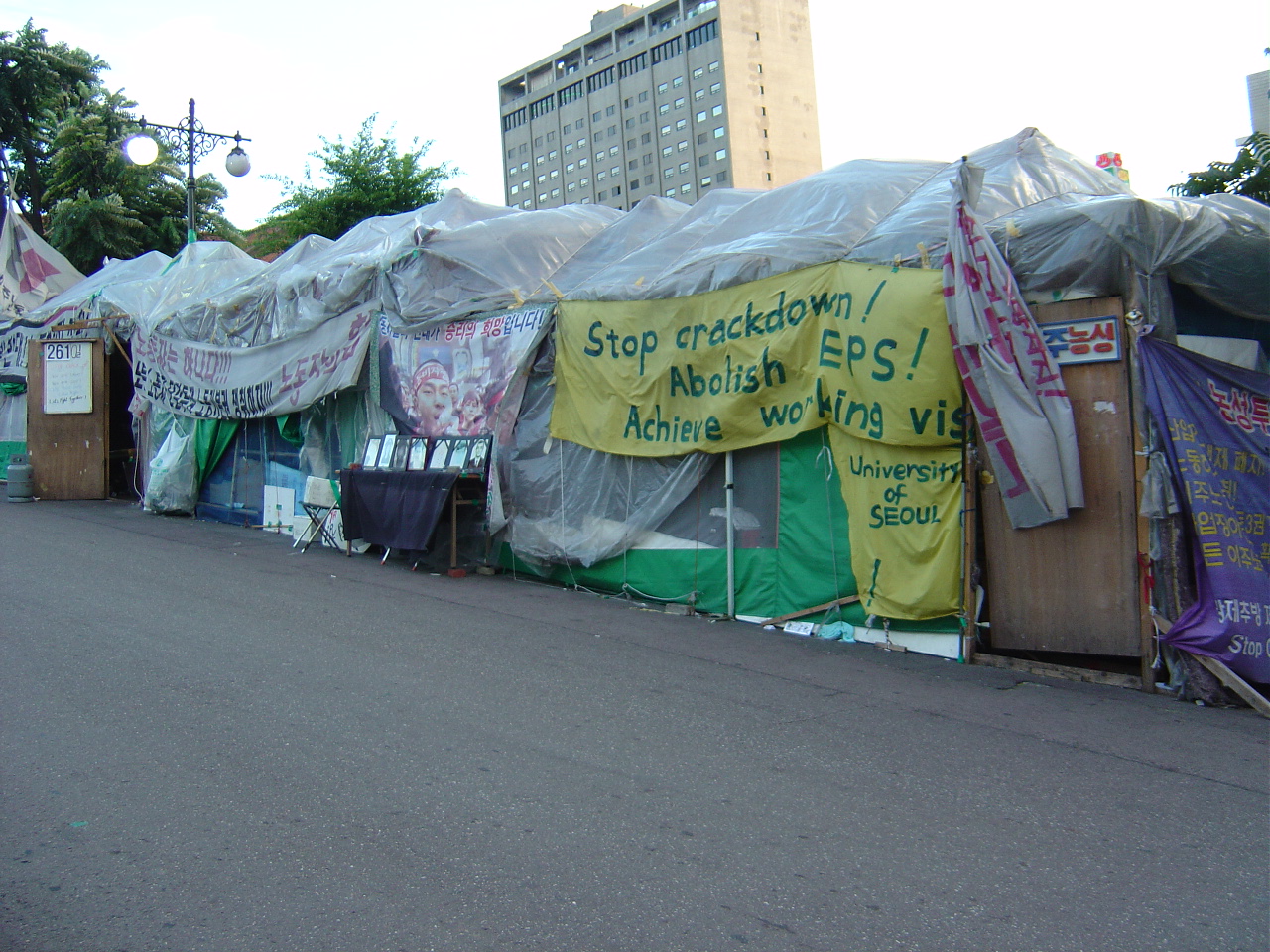
Unlike the seventeen periodic crackdowns that had occurred during the previous thirteen years, this was to be ongoing until all illegal workers had been ‘dragged out into the sun’ and deported, to quote the ROK’s “progressive” Justice Minister, Gang Geum-sil. In response, a number of migrant workers committed suicide rather than be forced to return home. Members of the Equality Trade Union Migrant’s Branch (ETU-MB) held a sit-in at Myeong-dong Cathedral for over a year protesting the EPS and the crackdown.

The tents where those holding the sit-in lived, August 2004. Note the photos of those who had committed suicide, left of center.

The EPS is still in place today, and while it has allowed workers to stay longer and loosened some restrictions over the years, there are still structural problems with it, as well as some horror stories.

On November 28, 2003, eleven days after the crackdown began, the Munhwa Ilbo published the following article.

Crackdown on illegal immigrants is 'racial discrimination'

(Zero crackdown on illegal language instructors from places like the US or UK)

While cracking down on foreign workers staying in Korea illegally, the government only focused on those from China and Southeast Asia, causing controversy over its “racially discriminative crackdown” as it did not act against “illegal immigrants from developed countries” such as the US, the UK, or Canada. In particular, the number of illegal foreign language instructors has been increasing every year due to English fever, but there has been no systematic management of, or crackdown on, them, so it has been argued that they are living in an “extraterritorial area.”

On November 27,  the Ministry of Justice and hagwon industry representatives stated that a total of 880 foreigners working here illegally had been caught by the government's joint crackdown team since November 17. A total of 443 people, or half of them, were deported. By country, Koreans from China accounted for most, with 269, followed by Bangladesh with 23, Thailand with 20, and 131 others. However, not a single one of them was an English instructor working in Korea illegally, of whom there is estimated to be 20,000 throughout the country.

It is estimated that 30,000 foreigners are employed at 5,091 foreign language academies nationwide, but only 10,235 foreigners entered Korea in 2002 with an E-2 visa that allows them to work as a conversation instructor. This means there are 20,000 instructors who did not have the college degree or hagwon employment permit needed to obtain an E-2 visa, meaning they are all illegal aliens.

Some large private academies in Seoul are also reportedly hiring part-time instructors with unclear qualifications in order to cut costs. Moreover, as the demand for foreign instructors has increased due to the recent spread of English fever to elementary school students and kindergartens, employment agencies that supply unqualified foreign instructors to hagwons have even appeared on the Internet, and about 20 such companies nationwide are booming.

These agencies are prospering because their websites are full of inquiries, from companies seeking to hire foreigners whose native language is English to foreign job seekers. There are even websites that provide detailed information on how to enter the country on a tourist visa first and then change over to a conversation instruction working visa. Crackdowns on these illegal conversation instructors are carried out not by the government's joint crackdown team, but by each city and provincial office of education. An official from the Seoul Metropolitan Office of Education said, “There are only two people overseeing the 1,000 hagwons in Seoul, which is not enough staff to check that each one is following the law.” “Moreover, there is virtually no way to prevent foreign language tutoring arranged between individuals.”

Regarding this, Jeong Jin-u, a representative of the Foreign Workers Council, said, “Undocumented foreigners are being arrested by doing random checks on the streets, and these crackdowns are based on skin color.” “Even though [these foreign teachers] are the same illegal immigrants, there is prejudice against people from poor countries and people of color,” he criticized.

Reporter Jeon Yeong-sun 

This article makes a good point about the discriminatory manner in which crackdowns were carried out, a fact that would later contribute to the idea that foreign English instructors were treated "too kindly" (an idea that was not new, mind you). It should be noted, however, that the numbers the article suggests are not necessarily sound. Where the estimate of 30,000 foreigners beingemployed in foreign language academies came from isn't clear, and is likely too high. As well, subtracting the 10,235 foreigners who "entered Korea in 2002 with an E-2 visa" is not helpful because, even if the "30,000" figure were correct, it does not take into consideration the number of F-4 visa holders (gyopo from Western countries) teaching English at that time. 

As for the assertion that "there is virtually no way to prevent foreign language tutoring arranged between individuals," the increase in the number of foreign teachers teaching both legally and illegally in 1997 led Immigration to crack down in the following manner:
Immigration officers began following foreigners on the subway and grabbing them when they went to their jobs at companies or private homes.  Building security guards would contact immigration if they saw the same foreigner repeatedly entering a home or building.  Immigration would actually enter private homes and arrest the foreigner there.  People were dragged out of private students’ apartments, pushed and slapped around by immigration officials in some cases, and deported within the week.

Strangest of all, immigration officers would pose as potential private students and approach foreigners for English lessons (this is called entrapment in the US).  Just admitting that you are doing illegal work to an undercover immigration officer is ground for deportation in Korea. 

If you are doing illegal work, Korean immigration has a hotline that anyone can call and turn you in.  Once you are fingered by someone, immigration will start monitoring you in order to catch you teaching privates or other outside work.  This includes having undercover immigration officials offering you work or grabbing you on the subway, searching you, and then deporting you just for carrying ESL textbooks and not having a work visa. 
Despite these quibbles, the article is correct about the difference in treatment between the two groups of foreigners, and when the 2005 English Spectrum incident blew up, this came up in the media more than once. On January 16, 2005, the Kyunghyang Sinmun published an editorial on the topic:

The case of Thai female laborers paralyzed from the waist down due to occupational illness and the stir over the sexual demeaning of Korean women by white English instructors shows well the 'double standard' Koreans apply to foreigners. White people are very warmly welcomed, while foreigners from Asia couldn't receive more cold-hearted treatment. This racially discriminatory attitude is reflected in government policy as well. This is a slice of "Ugly Korea." [...]

While these are the individual acts of some instructors who have taken advantage of our society's English fever, through the contempt for and disparaging of Korean women, improper sexual ethics and a mentality of envying white people have come to light. Among white instructors are not a few illegal aliens and those unqualified to teach, but they avoid government crackdowns. What kind of country is Korea, unable to free itself from the "two faces" it has toward foreigners?

This criticism truly went mainstream when, in February 2005, the SBS news program "I Want to Know That" broadcast an episode critical of foreign English teachers and, at one point, compared their treatment to that of foreign migrant workers, noting that many migrant workers were manhandled roughly when arrested, and that of 22,826 'illegal' foreigners arrested in 2004, only 123, or 0.5%, were foreign instructors.

It was from that point that there began a shift in the media from focusing equally on unscrupulous hagwon owners and unqualified foreigners riding the English wave to an almost singular focus on unqualified foreigners who were likely also womanizers or drug users or pedophiles taking advantage of Korea's desire for English.

To be sure, in the aftermath of the English Spectrum incident there were more arrests of foreigners teaching illegally in Korea, but, with 240 arrested in one year, these were still rather small numbers in comparison to the number of migrant workers arrested.

Illegal English teachers caught in 2005 by month

Among the foreign teachers caught was an American held at Yeosu's immigration detention center who, in his "Prison Diary of an English Teacher" published by Ohmynews in May of 2005 (Part 1; Part 2), described conditions at the center in less than positive terms. Two years later, a fire at that detention center killed ten detainees, a fact that isn't surprising considering his description of the facility and the working conditions of the guards. The teacher (who was actually a friend of a friend) also made an observation in Part 1 pertinent to the article above:

When I was first brought to the immigration authorities in Busan, I was threatened verbally as well as physically because I refused to show them my passport. It was taken from me by force after at least seven immigration and police officials held me down (one, almost suffocated me by covering my mouth.) Before they knew I was an American they thought I was from some African country. After they learned I was American, their attitudes changed drastically...

For all the negative media attention directed at foreign teachers, however, arrests and deportation of teachers teaching illegally was never comparably as high as arrests of migrant workers, nor were wide-ranging period crackdowns standard in the ESL industry. As well, it's worth noting that practically everyone I knew in the Migrant Workers Union during their sit-in at Myeong-dong Cathedral in 2003 and 2004 was arrested and deported, sometimes after clearly having been surveilled by the government for some time.

As I noted in this post, the news media in Korea between 2005 and 2015 (or so) was quite negative about foreign English instructors, reporting on any infraction large or small, while sometimes overlooking the similar behavior of migrant workers due to journalists' understanding that Korean society treated migrant workers migrant workers so unfairly. As I put it, "The resulting depiction of these groups in the media stands in contrast to, and is a reversal of, lived experience for many." Or that was the case a decade ago. These days the media barely pays attention to foreign teachers, so the balance in media coverage has likely changed quite a bit.

Here are some more of my posts about migrant workers in Korea:

Yeosu: An entirely preventable tragedy (2007)

MTU Leaders Arrested (2007)

Stop Crackdown, or why a quarter of the foreign population in Korea still lives in the Fifth Republic (2009)

More on Minu's deportation; Stealing from deportees (2009)

The 2009 film Bandhobi: The Good, The Bad, and The Minor

Saturday, December 31, 2022

My 2009 Korea Herald articles

While looking through old posts for this series, I realized that my Korea Herald articles from 2009 are no longer online. I decided to post them all here. I've included the original urls, even though they're now dead links. Matt Lamers was then working at the Herald and welcomed these articles (as he did the cover story for this issue - which he cowrote with Ben Wagner and me - when he worked for Groove Magazine). 

Data says it all: E-2s are law abiding
Korea Herald, October 6, 2009

On Sept. 24, Yonhap News reported that National Assembly Representative Lee Gun-hyeon had released crime statistics pertaining to native-speaking English teachers and stated that crime by foreign English teachers was at "serious" levels. I find it curious that he thinks this way, because according to the statistics he released, the foreign English teacher crime rate is actually quite low. 

These statistics say that 114 crimes were committed by foreign English teachers in 2007, and 99 were committed in 2008. According to the Korea Immigration Service, in 2007 there were 17,721 teachers on E-2 visas working in Korea, and in 2008 there were 19,771 teachers. Therefore, in 2007, 114 out of 17,721 teachers were convicted - a crime rate of 0.64 percent. In 2008, 99 out of 19,771 teachers were convicted - a crime rate of 0.50 percent.

According to a July 9, 2008 Chosun Ilbo article, the Korean Institute of Criminology reported that in 2007 the overall crime rate among all foreigners in Korea was 1.4 percent compared with the 3.5 percent rate among Korean citizens. 

In other words, according to Lee Gun-hyeon`s own figures, the foreign English teacher crime rate (0.64 percent) was more than five times less than the crime rate among Koreans (3.5 percent) in 2007 and half the rate of other foreigners living in Korea. 

And yet, for some reason Lee calls this low crime rate "serious" and in need of more measures - beyond the criminal record checks, degree checks, and health checks for illegal drugs and HIV that those who receive E-2 visas must already undergo.

Unfortunately, Lee is not the only member of the National Assembly to make exaggerated statements regarding foreign English teachers. In early June, Representative Choi Young-hee submitted three bills to the National Assembly obliging foreign English teachers to present criminal record and health check documents before they can be hired at public or private schools or academies. 

When she announced these bills, she said that 38,822 foreigners were issued E-2 visas and entered the country in 2008, but 22,202 were not accounted for. That the Korean Immigration Service had lost track of 22,202 foreign English teachers was troubling information, to be sure, but what was even more troubling was that she used the wrong set of immigration statistics to determine this figure. 

The source she used was a document listing those entering and leaving Korea by visa type, which presents a much higher figure than the statistics which list the number of foreigners residing in the country. The correct statistics for 2008 show that at year`s end, there were 19,771 foreigners in Korea on E-2 visas. 

It likely doesn`t need to be pointed out that mistakenly announcing that 22,202 foreign English teachers are missing is likely to cause undue worry and suspicion in Korean society of this group of foreigners, but when the Korean Immigration Service pointed out this mistake to Choi`s office, no correction was ever issued.

Additionally, the purpose statements of the three bills Choi submitted to the National Assembly stated that "the crime rate among native English teachers is rising." Representative Kim`s own crime figures, however, show that 114 teachers were arrested for crimes in 2007, 99 were arrested in 2008, and 61 were arrested in the first eight months of 2009. 

If the trend for 2009 continues for the rest of the year, not only would we see a drop in the crime rate over three years, we would also see a drop in the absolute number of teachers being arrested - hardly indicative of the "rising crime rate" Choi uses as the rationale for introducing these new bills.

Lee said that "recent crimes by foreign English teachers are causing the anxiety of students and parents to grow." It might be suggested that it is instead ill-informed, unfounded, and alarming statements made by public figures like Lee and Choi which are contributing to this rise in "anxiety" students and parents are said to feel towards foreign English teachers.

The opinions expressed by the author are his own and do not necessarily represent those of The Korea Herald. More of his writings can be found at populargusts.blogspot.com - Ed. 

By Matt VanVolkenburg                                           (Here is the related blog post.)


Putting statistics on foreign crime into some context
Korea Herald, November 3, 2009

Public outrage in the wake of a high-profile case of child abuse has led members of the National Assembly to turn a spotlight on possible threats to children and end the lax judicial treatment of sex offenders. While this is to be applauded, the manner in which this has been carried out has at times been careless.

On Oct. 19, National Assembly Representative Woo Yoon-keun said that the number of sexual crimes by foreign nationals had tripled over the past eight years, rising from 83 in 2001 to 242 in 2008. While this information is troubling, it would seem less so if the Rep. Woo had bothered to put any of this information in context. Considering the foreign population at the end of 2008 was 1.15 million, those 242 crimes result in a sex crime rate of 20.8 per 100,000. When compared to statistics from the Supreme Prosecutors Office which show the sex crime rate of Korean citizens in Korea to be 108 per 100,000, we see that the foreign sex-crime rate is five times less.

But this is not an entirely accurate portrayal of these statistics. If it can be agreed that children and the elderly tend not to commit crimes, then it`s worth looking at the demographics of the Korean and foreign populations in Korea. 

According to the CIA, children under 15 and elderly people over 64 make up 27.6 percent of the population of Korea. According to Korean Immigration Service figures, children under 16 and elderly over 60 make up 8.2 percent of the foreign population. If these low crime demographics are removed when making calculations, the foreign sex crime rate is 22.7 per 100,000 foreigners, and 151.7 per 100,000 Koreans - meaning in this case that the foreign sex-crime rate is 6.6 times lower. 

While some news media reports in the past have been responsible in pointing out that the rising crime rate among foreigners in Korea is still much lower than that of Korean citizens, Rep. Woo has not put his worrying figures into context. Unfortunately, Rep. Woo is not the sole political voice guilty of this. On Oct. 22, it was reported that the Ministry of Justice had announced it would "revise immigration rules to ban foreigners found guilty of raping Korean children from re-entering Korea permanently," and that this was "the latest in a series of government measures to keep sexual predators away from society."

It`s unfortunate that this discussion of how to protect Korean society from sex crimes, when discussing foreigners, has focused only on past and possible sex crimes committed by foreigners against Koreans and omitted sex crimes that Koreans commit against foreigners. 

A 2006 study, conducted on the behalf of the National Assembly Committee on Gender Equality, looked at the sexual activities of Korean men visiting Thailand and the Philippines and found that Korean men were known for habitually doing drugs and seeking out underage girls to have sex with. 
The National Youth Commission found in 2005 that Korean fishermen were largely responsible for the existence of a teen prostitution industry in the South Pacific nation of Kiribati. A 2003 survey conducted by the National Human Rights Commission found that 12.5 percent of female foreigners working in Korea said they had been sexually harassed by Korean superiors or colleagues. One wonders why more consideration isn`t being given to such sex crimes against foreigners and the need to prevent and punish them.

While every effort should be taken to protect Korean children from sex crime and punish its perpetrators, it is troubling that the only available role for foreigners in the current debate is as potential criminals. Reading such alarming statements about foreigners being made in the National Assembly, one wonders of Korea`s elected representatives truly want, as Justice Minister Lee Kwi-nam recently put it, "to realize a genuinely mature cosmopolitan nation," or if they see foreigners as a threat in much the same manner as the country north of the 38th parallel. 

The opinions express here are the author`s only and do not necessarily represent those of The Korea Herald. For more of Matt VanVolkenburg`s writings, go to http://populargusts.blogspot.com - Ed.

By Matt VanVolkenburg                                           (Here is the related blog post.)


Systematically stigmatizing foreign English teachers
Korea Herald, November 20, 2009

In January 2005, Korean netizens discovered "dirty dancing" style photos taken at a "sexy costume party" at the foreign English teacher site English Spectrum which led to a scandal as the photos were spread by netizens and reported in the mainstream media. These netizens started an online "Naver Cafe" called "Anti-English Spectrum" to combat what they described as "the degradation of Korean women by English Spectrum," though, according to one of the women who appeared in the widely distributed party photos, "Some online articles and the Anti-English Spectrum cafe said we were prostitutes, western princesses and brothel keepers," suggesting that there were other motives.

Anti-English Spectrum, described on their website as "The Citizen`s Movement to Expel Illegal Teachers of Foreign Languages," attempted to disguise their true nature in 2007 by changing their website banner showing Korean nationalist heroes and the caption "Our homeland is protected by the blood of our ancestors" to one showing a child at a blackboard with the title "The Citizen`s Group for Upright English Education." 

Their day to day activities, which consist of race-based profiling and stalking of foreigners, have not changed, however. Anti-English Spectrum`s website is full of updates about foreign teachers that they are "pursuing" based on tips alleging illegal activity. A post on Oct. 14 about the "stakeout" of a female foreign teacher said, "Drugs have not turned up, only a used condom was found," suggesting they search through teachers` garbage. 

In a recent interview, the cafe`s manager even suggested that, instead of calling the police, people who want to report foreign teacher crime should "go through our cafe members (so) we can advise you and alert police." This behavior, however, has not been condemned, but was officially rewarded by the Seoul Metropolitan Police Agency in 2007. 

Cafe members claim to have contributed to numerous newspaper articles and news broadcasts. To be sure, interviews with the cafe`s manager -- who invariably portrays foreign teachers negatively -- have appeared in articles in most of Korea`s major newspapers.

In the summer of 2006, an innocuous news report about rates of voluntary HIV testing among foreigners which mentioned English teachers led the cafe to begin a campaign to stigmatize foreign English teachers as being an AIDS threat. On Anti-English Spectrum`s site, they posted that "foreigners infected with AIDS have been indiscriminately spreading the AIDS virus" and -- perhaps revealing their true concern -- that "Koreans who have had sexual contact with a foreigner will almost all contract AIDS." 

They then worked with a tabloid newspaper and produced a story about the threat of AIDS-infected foreign English teachers which called for strengthening E-2 visa regulations, which was then used as evidence there was a problem when cafe members sent petitions to the Ministry of Justice. An e-mail sent during a bad breakup was pitched by Anti-English Spectrum as the basis of a story carried by a major newspaper in May 2007 titled "White English Teacher Threatens Korean Woman with AIDS," which in its Sports edition carried the subtitle "Beware the `Ugly White Teacher.`" 

That a major newspaper would publish this was shocking, but not as shocking as the fact that the manager of Anti-English Spectrum was invited to an immigration policy meeting hosted by the Ministry of Justice on Oct. 23, 2007. It was this meeting that decided upon strengthened E-2 visa regulations, including HIV tests, something that Anti-English Spectrum -- who had contributed to all of the past negative news articles equating foreign English teachers with AIDS -- had requested in petitions for the past year. 

That this campaign was designed not to protect children or unsuspecting Korean women, but to stigmatize foreign English teachers is suggested by the fact that when an HIV positive Korean man who had unprotected sex with numerous women for years was arrested in March, it didn`t merit a single word on Anti-English Spectrum`s website. 

The opinions expressed by the author are his own and do not necessarily represent those of The Korea Herald. More of his writings can be found at populargusts.blogspot.com - Ed. 

By Matt VanVolkenburg                                           (Here is the related blog post.)

(Note that the last article was published on the same page as "Blurring line between hate, free speech" by Adam Walsh, which was an in-depth look at Anti-English Spectrum; it initially was to include an interview with Lee Eun-ung, AES's leader, but Lee refused permission to print it, and AES successfully demanded the images taken from AES's site be removed from the online article. It was reposted at the Korea Herald's site in March 2010; this is how the two articles looked on the printed page.)

The Rise and Fall of E-2-visa HIV testing in South Korea, 1988 - 2017

Or, how a "Citizens' Group" worked with news media and police to tar foreign English teachers as AIDS threats and convinced a government ministry to require HIV tests for them, and how these were challenged at the national level (which failed) and then at the international level, which ultimately led to them being rescinded. 

Some of this material exists elsewhere on this blog, scattered about (or as parts of other series), while most of the new posts (parts 5-10, 11-12) expand on previous posts by translating various articles, in particular the TV news reports from July 2007. I translated these almost five years ago but just never got around to posting them. Considering the work I put into it back then, I decided I might as well post it all and gather it all together. (This will also convince me to finish my 1988 Olympics series, the conclusion of which ties directly into HIV testing of foreigners.) Elements of this research appeared in this 2012 Journal of Korean Law article written with Benjamin Wagner: "HIV/AIDS Tests as a Proxy for Racial Discrimination? A Preliminary Investigation of South Korea’s Policy of Mandatory In-Country HIV/AIDS Tests for its Foreign English Teachers".

This (for now) collects the series together; once Part 2 is finished I'll place this 'table of contents' at the top of each post.

  The Rise and Fall of E-2-visa HIV testing in South Korea, 1988 - 2017

Part 1: The 1988 Olympics and Korean fears of AIDS
Part 2: HIV testing for foreigners in the aftermath of the 1988 Olympics (unfinished)
Part 3: Anti-English Spectrum begins to link foreign English teachers to AIDS (2006)Part 5: Using their own articles, Anti English Spectrum petitions for E-2 visa changes (2006)


A selection of related articles and series:

Delinquent foreign instructors, "Freeze!" (NoCut News' Puff Piece about AES) (2009)

Bill 3356 attempts to legislate HIV and drug tests for all foreign workers

  The Rise and Fall of E-2-visa HIV testing in South Korea, 1988 - 2017

Part 1: The 1988 Olympics and Korean fears of AIDS
Part 2: HIV testing for foreigners in the aftermath of the 1988 Olympics (unfinished)
Part 3: Anti-English Spectrum begins to link foreign English teachers to AIDS (2006)Part 5: Using their own articles, Anti English Spectrum petitions for E-2 visa changes (2006)

Part 13: Bill 3356 attempts to legislate HIV and drug tests for all foreign workers 

This post could chronologically have been part 11, but the end of the post will make clear why I've placed it after Anti-English Spectrum's responses to the NHRCK petition. 

On December 30, 2008, the following bill was submitted to the National Assembly:

Bill to Partially Amend the Immigration Act
(Proposed by Shin Hak-yong)

Sponsored by Shin Hak-yong and 17 others

Reason for Proposal

Nowadays, the number of foreigners working in Korea is increasing, but a good many have previous convictions for drug and sexual crimes or carry infectious diseases. As we require measures to deal with the threat they pose to our society’s public order and our people’s health, we herein prepare the legal basis to require that foreigners applying for an employment visa submit a criminal background check and a health certificate.

Main Content

If a foreigner who intends to enter the country for the purpose of employment applies for a visa, the foreigner may be required to submit a criminal record inquiry and a health examination certificate issued by their home country (newly established Article 8 (3)).

Partial Amendment to the Immigration Act

Part of the Immigration Act is amended as follows.

Paragraph 3 of Article 8 shall be changed to Paragraph 4, and Paragraph 3 of the same Article shall be newly established as follows.

③ When a foreigner who wants to enter the country for the purpose of employment applies for a visa, the foreigner may be asked to submit a criminal record inquiry and a health examination certificate issued by the country they to which they belong.

Addenda

This Act shall come into force from the date of promulgation.

The eagle-eyed will notice that this bill has the exact same wording as Bill 7642, which was submitted to the National Assembly by Rep. Shin Hak-yong - the same author - on October 24, 2007, the day after the immigration policy meeting to which Lee Eun-ung was invited. After the National Assembly elections of April 2008, that bill expired on May 29, so clearly Bill 3358 was an attempt to revive it. 

The second set of documents on this page (under μœ„μ›νšŒ 심사 / Committee Review) includes the following review written after the bill was discussed before the National Assembly Legislation and Judiciary Committee on February 24, 2009:

Review Opinions

The amendment, which obligates foreigners who apply for a visa seeking entry for the purpose of employment to submit a criminal record inquiry and health examination certificate, is an effort to solve problems caused by foreigners working in Korea who have a criminal record or carry contagious diseases, and while this is a reasonable purpose, the following matters need to be reviewed. 

First, under the Immigration Act, there is ① a single-entry visa that allows entry only once and ② a multiple entry visa that allows entry two or more times, and there are 37 types of sojourn statuses, of which 10 types of sojourn statuses allow employment ranging from professors to sailors. In this way, rather than requiring criminal and health-related certifications uniformly for all 10 types of employment visas, it is considered appropriate to require relevant certifications limited to certain types of employment visas that fall under “reasonable and clear standards.” 

For reference, since 2007, it has been mandatory for foreign English instructors who are eligible for the 2-year E-2 visa (conversation instruction visa) issued only to nationals of seven countries where English is the official language, including the United States, United Kingdom, and Australia, to submit a criminal record certificate and a health certificate checking for sexually transmitted diseases and drug use. 1)

Second, depending on the specific case, in accordance with the legislative policy of the National Assembly, which entrusts to the Enforcement Decree "Matters related to attached documents of a visa" when flexible operation is required, it is considered reasonable within the legal system to delegate amendment contents to things such as enforcement ordinances.

Third, it is judged that the purpose of the amendment can be maintained according to Article 11 of the 'Immigration Act' which stipulates that the entry of contagious patients and drug addicts can be prohibited.

Footnote:
1) In 2007, 80% of those seeking AIDS-related counseling in Itaewon turned out to be foreign white-collar workers and foreign instructors. About 60 countries around the world conduct AIDS tests for foreigners according to the type of visa.

Interestingly enough, the person submitting the document argues against the passage of the bill, saying that the new amendment is unnecessary because provisions already exist under Article 11 of the the Immigration Act (which allows for immigration regulations), with the E-2 visa regulations given as an example. What's interesting is the footnote to the fact that E-2 visa holders already face HIV tests:

In 2007, 80% of those seeking AIDS-related counseling in Itaewon turned out to be foreign white-collar workers and foreign instructors. About 60 countries around the world conduct AIDS tests for foreigners according to the type of visa.
In an op-ed for the Weekly Kyunghyang dated February 24, 2009, the same day as the committee review meeting, Anti English Spectrum leader Lee Eun-ung wrote,
It was also later revealed that in 2007 80% of the counseled at an AIDS counseling center in Itaewon were foreign white collar workers and English teachers. [...] According to the Korean Alliance to Defeat AIDS, about 60 nations worldwide conduct AIDS tests on foreigners, depending on the visa. 
To see how similar these sentences are in document and the article, let's look at them in Korean. The first sentence is from Lee's article followed by the similar sentence in the Review Opinions document footnote: 

2007λ…„ μ΄νƒœμ› μ—μ΄μ¦ˆ μƒλ‹΄μ†Œμ˜ μ—μ΄μ¦ˆ κ΄€λ ¨ μƒλ‹΄μžμ˜ 80%κ°€ 외ꡭ인 ν™”μ΄νŠΈμΉΌλΌ λ° μ™Έκ΅­μΈ κ°•μ‚¬λΌλŠ” 사싀이 κ³΅κ°œλΌκΈ°λ„ ν–ˆλ‹€. 

2007λ…„ μ΄νƒœμ› μ—μ΄μ¦ˆ κ΄€λ ¨ μƒλ‹΄μžμ˜ 80%κ°€ 외ꡭ인 ν™”μ΄νŠΈ 칼라와 μ™Έκ΅­μΈ κ°•μ‚¬λ‘œ 판λͺ…λ˜μ—ˆ 음. 

The second sentence is almost exactly the same in both (Lee first, footnote second): 

사단법인 μ—μ΄μ¦ˆν˜‘νšŒμ— λ”°λ₯΄λ©΄, μ „ μ„Έκ³„μ μœΌλ‘œ 60μ—¬ 개 κ΅­μ—μ„œ λΉ„μžμ˜ μ’…λ₯˜μ— 따라 μ™Έκ΅­μΈλ“€μ—κ²Œ μ—μ΄μ¦ˆ 검사λ₯Ό μ‹€μ‹œν•˜κ³  μžˆλ‹€. 

μ „μ„Έκ³„μ μœΌλ‘œ 60μ—¬κ°œ κ΅­μ—μ„œ λΉ„μžμ˜ μ’…λ₯˜μ— 따라 μ™Έκ΅­μΈλ“€μ—κ²Œ μ—μ΄μ¦ˆ 검사λ₯Ό μ‹€μ‹œν•˜κ³  μžˆμŒ. 

How do we know for sure that Lee's article was the source for the footnote? The September 18, 2006 Break News article, "Tracking [down] blacklisted foreign teachers suspected of having AIDS", which interviewed Lee, stated that "80% of those frequenting AIDS testing center for foreigners are native speaker teachers." Lee's op-ed, however, stated that "In 2007, 80% of those seeking AIDS-related counseling in Itaewon turned out to be foreign white-collar workers and foreign instructors." Lee, however, got the date wrong. As was reported in an in-depth article in the Korea Herald
Korea AIDS/HIV Prevention & Support Center statistics for [2007] show that the 80 percent statistic is false. Furthermore, KHAP director Yu Sung-chal told Expat Living that the clinic "moved to Seongbuk-gu in 2006, so it makes no sense to say that the Itaewon clinic sent out these statistics."
As well, I searched Naver and Daum for any mention of the 80% figure in 2007 and found nothing except posts referring to the 2006 article. Not only is the almost exact same wording found in the document footnote, but Lee's mistake is found in both - a clear sign that Lee's op-ed was the source for the information found in the Review Opinions document footnote. Once again, Anti-English Spectrum's influence upon the Korean government - this time among legislators - is clear to see.

Ironically, the fact that E-2 visa holders were already being tested for HIV and drugs under existing laws may have helped caused Bill 3356 to expire without being passed in May 2012.

[Note: The latter part of this post originally appeared here.]

Friday, December 30, 2022

Anti-English Spectrum's response to the NHRCK petition

  The Rise and Fall of E-2-visa HIV testing in South Korea, 1988 - 2017


Part 1: The 1988 Olympics and Korean fears of AIDS
Part 2: HIV testing for foreigners in the aftermath of the 1988 Olympics (unfinished)
Part 3: Anti-English Spectrum begins to link foreign English teachers to AIDSPart 5: Using their own articles, Anti English Spectrum petitions for E-2 visa changes

Note: I've updated part 9 by adding in the text of Bill 7642, and repurposed a post from 2009 as part 11.

Anti-English Spectrum's response to the NHRCK petition

After Benjamin Wagner, then a law professor at Kyunghee University, submitted an official petition to the National Human Rights Commission of Korea (NHRCK) regarding the drug and HIV testing of E-2 visa holders on February 4, 2009 (which was supported by ATEK's "Equal checks for all" campaign which encouraged E-2 visa holders to submit their own petitions to the NHRCK), Anti English Spectrum's leader Lee Eun-ung spoke out in the media defending the regulations and criticizing the NHRCK petition.

First, on February 10, 2009, the Seoul Sinmun published an article about HIV testing of foreign instructors which interviewed Lee. It should be noted that two months earlier, on November 14, 2008, the Seoul Sinmun had published a profile of Lee Eun-ung and Anti-English Spectrum and titled "Drug-taking foreign instructors caught after 150-day stakeout" (translated here).

Is HIV testing of foreign instructors discrimination?

When foreign instructors residing in Korea filed a complaint with the Human Rights Commission, saying that HIV tests were “discriminatory,” the “Citizens’ Association for Proper English Education,” which carries out a citizens’ movement to expel illegal foreign language instructors, protested.

Kyunghee University law professor Benjamin Wagner filed a complaint with the Human Rights Commission on the 4th, saying, "To obtain an E-2 visa to work as an English instructor in Korea, drug and AIDS tests are required, and this discriminates against nationality."

The ‘Citizens’ Association for Proper English Education’ refuted this, saying, “In more than 60 countries, AIDS tests are being conducted for foreigners when they enter employment, study, or immigration, so the claim of discrimination is a fabrication.”

Lee Eun-woong (39), who leads the citizen group, said, “There are not many cases where Korean (Gyopo) English instructors have caused drug or AIDS problems like foreign instructors, and it is unreasonable to approach our Korean compatriots in the same way as foreigners. The immigration policy of every country puts its own citizens first, and this is the same overseas as well,” he pointed out.

Mr. Lee added, “More than 80% of those seeking counseling at the Itaewon AIDS Counseling Center in Seoul are foreign English instructors.” The ‘Citizens’ Group for Proper English Education’ is engaged in activities such as reporting English instructors who commit illegal acts such as drug use and sexual harassment to law enforcement agencies.

Since the end of 2007, the Ministry of Justice has made it mandatory for foreign instructors to submit criminal record and health check certificates when applying for an E-2 visa. The Citizens’ Group emphasized during a visit to the Ministry of Justice that “The health certificate is the only legal safeguard that can block in advance drug use by foreign English instructors in Korea.” 

“The Ministry of Justice is moving to strengthen foreign instructors’ submission of health checks from an enforcement ordinance to a legal ordinance, but the submission of the complaint to the Human Rights Commission could delay the policy.,” worried Mr. Lee.

The Human Rights Commission said, “All complaints go through an investigation process of about three months before a decision is made whether to dismiss them or to recommend amendments to relevant institutions because there are concerns about human rights violations.” “Professor Wagner’s complaint is still under investigation,” it explained. In addition to this HIV test, foreign instructors have mainly filed complaints for things such as being discriminated against for not being white when they were hired, the Human Rights Commission added.

Two weeks later, on February 24, 2009, the Weekly Kyonghyang published an op-ed by Lee. (This was originally translated by another blogger, who gave me permission to use it.)
‘Are Drug Tests for Foreign Teachers Discrimination?’

Last March, 2am. An officetel in Ilsan, Gyeonggi-do. The foreign teachers began to gather. This was to smoke pot they’d bought through a broker they met at a bar in Ilsan. This writer and others, having gotten intel that foreign teachers in the area were planning to restart smoking pot as soon as cannabis was excluded from the medical exam they needed to submit to get E-2 visas, followed them for about 150 days in order to secure concrete evidence. Ultimately, the foreigners we caught this day faced the judgment of the law and were deported.

Foreign Teacher Group’s ‘Equal Checks for All’ Campaign
The opportunity to create the “Citizens Movement to Expel Illegal English Teachers” was a January 2005 post at an online foreign teacher community. Many people were outraged not only at the lewd clubs in front of Hongik University that degraded Korean women, but also sexual assaults by foreign teachers on middle school girls. We voluntarily formed our group so that at least our children would not be exposed to such unqualified teachers. Afterwards, we carried out activities to deport these unqualified teachers, such as seeking legislations and providing tip to relevant institutions. As a result of these efforts, more than 90 unqualified teachers have faced justice.

Another fruit is that in 2007, health checks (venereal diseases, drugs) and criminal checks were included in the immigration enforcement ordinance to get E-2 visas.

Recently, foreign English teachers have petitioned the National Human Rights Commission, claiming the drug and AIDS tests are discrimination based on nationality. The petitioning body is the Association for Teachers for English in Korea (ATEK). On their homepage, they are conducting a campaign themed, “Equal Checks for All!” According to media reports, the association’s goal is to improve the quality of all English teachers and to better protect all Korean students, and the best method to accomplish this goal was for equal checks to be carried out. While petitioning the Korean Human Rights Commission, they are also petitioning the UN Committee on the Elimination of Racial Discrimination and encouraging their members to post protests against discrimination to the National Human Rights Commission through the ATEK homepage.

Their claim of discrimination based on nationality appears reasonable at first glance. According to Paragraph 4 of Article 4 of the current National Human Rights Commission Law, section on “discrimination” is stipulated as the following 14: “sex, religion, handicap, age, social status, place of birth (refers to place of birth, place of registration or primary place where one lived prior to reaching the age of majority), nation of birth, ethnicity, psychical conditions such as looks, marriage status (single, married, separated, divorced, widowed, remarried, common-law marriage), pregnancy or birth, family form or family situation, race, skin color, ideology or political opinions, criminal records in which the validity of the sentence has been voided, sexual orientation, education, and medical history.
In particular, concerning employment, the National Human Rights Commission Law defined the act of favoring, excluding, classifying or disadvantaging particular people in employment (including recruiting, hiring, training, deploying, promoting, wages and other articles, wage advances and retirement) as discrimination.

Are AIDS and drug tests for foreign teachers discrimination that run counter to human right? As we’ve conducted activities to expel illegal English teachers, we’ve discovered that it isn’t. According to the Korean Alliance to Defeat AIDS, about 60 nations worldwide conduct AIDS tests on foreigners, depending on the visa. Foreign teachers with AIDS have actually been confirmed, too.

In spring of 2007, our group received a tip from a woman who wanted help. A teacher from Australia threatened her, saying he’d had sex without a condom in southeast Asia and she should be careful of AIDS, too. The tip also said the teacher was loitering around her place, trying to terrify her. After this writer and others pursued him with the cooperation of relevant authorities, he was finally arrested by police in the capital region after living at a guest house in Seoul. It was learned that the teacher had before been fired for molesting a child and had been added to the Korea English Teacher Recruitment Association (KETRA) blacklist.

In early 2007, we got a tip about an American teacher who, while hiding his status as a married man, had approached a woman and had sex with her. This American teacher was teaching children at an educational facility in Gyeongsangnam-do. When we began to pursue him, he fled to the United States; it was later revealed that the female victim had contracted a venereal disease. It was also later revealed that 80% of the counseled at an AIDS counseling center in Itaewon were foreign white collar workers and English teachers. Scandals related to corrupt sexual relations with some unqualified foreign teachers are already widely known.

The same goes for the drug tests. According to the job classification of total drug offenses reported by the Korea Customs Service, 22 of 225 — that is, one in 10 — were foreign teachers. The Supreme Prosecutor’s Office, too, in its white paper on drugs, pointed out that foreign teachers were smuggling in new kinds of drugs. In its white paper, the SPO said the reason for the increase in drug crimes by foreigners from the United States and Canada was the inflow of English teachers. In the case of the foreign teachers caught in southern Gyeonggi-do, they were caught growing and sharing pot in their home, which was equipped with a heater and other equipment. In August 2008, this writer personally witnessed in Itaewon foreign teachers trading cannabis resin for cash, too.

You Must First Take Own Actions Against Unqualified Teachers
In some quarters, they claim that only some teachers are drug offenders or criminals, but making tests of these kinds mandatory could plant stereotypes by making it the problem of all teachers. But when we look at the examples uncovered, statistics, and drug crimes committed by foreign teachers, the National Human Rights Commission petition protesting drug testing will have a tough time earning the agreement of the bulk of Korean citizens.

We are not taking issue with the English teachers’ petition itself. This is because unqualified foreign teachers provided the reason for the execution of AIDS tests and drug tests. More than anything, we have a duty to lessen the insecurity of school parents who entrust their children to foreign teachers. Only if foreign teachers, sensing the stinging glances of Korean citizens, formulate their own measures to eradicate illegal teachers will their petition earn the agreement of many Koreans.

The claim of discrimination also runs counter to the recent domestic opinion calling for foreign teacher credentials to be strictly qualified. Choe Yeong-hui, a Democratic Party lawmaker, said a bill is being prepared to include crimes committed by foreign teachers while in Korea when they seek employment. The petition submitted by ATEK is reportedly being handled by the National Human Rights Commission’s migrant rights team. According to the Commission’s internal regulations, when a petition is raised, an investigation must me competed within three months, and responsible institutions are advised in accordance with decisions by the pertinent committee, such as the Subcommittee on Discrimination. We hope for a prudent decision by the Human Rights Committee.

Lee Eun-ung (Administrator of ‘Citizens Movement to Expel Illegal English Teachers’)
As the next post will make clear, lawmakers were clearly reading Lee's op-ed.

(Lee would later visit Rep. Choi Young-hee, who authored three bills amending laws pertaining to schools, hagwons and kindergartens mandating drug testing of all native-speaking English instructors; the contents of the bill pertaining to hagwons would eventually be applied to amendments to the Hagwon Law in 2011.)

Thursday, December 29, 2022

"Illegal native speaking instructors will no longer be tolerated"

 The Rise and Fall of E-2-visa HIV testing in South Korea, 1988 - 2017

Part 1: The 1988 Olympics and Korean fears of AIDS
Part 2: HIV testing for foreigners in the aftermath of the 1988 Olympics (unfinished)
Part 3: Anti-English Spectrum begins to link foreign English teachers to AIDSPart 5: Using their own articles, Anti English Spectrum petitions for E-2 visa changes

On October 28, 2007, five days after the Immigration policy meeting hosted by the Ministry of Justice to which Anti English Spectrum's leader Lee Eun-ung was invited, the Ministry of Justice released the following statement:
Illegal native speaking instructors will no longer be tolerated
 
The Ministry of Justice has decided to prepare strong measures to eradicate illegal acts by native speaking instructors, which have recently caused social problems such as classes by unqualified instructors, drug use, and sex crimes, and will be implemented from December.

In order to prevent an influx of unfit native speaking instructors, when applying for a visa, it will be mandatory to submit a certificate of criminal record check and a medical certificate, and as a general rule those applying will do so to the Korean diplomatic missions in the country of the applicant and conduct consular interviews, and this will significantly strengthen verification of conversation instructors.

In addition, there will be entry restrictions on conversation instructors who disturb order while in Korea, such as using forged degrees to teach conversation illegally, taking drugs, or committing sex crimes, and punishment for illegal employers will be further strengthened, while information on disorderly conversation instructors will be shared and centrally managed among related organizations, so their entry will be fundamentally prevented by strict screening from the visa application stage.

□ Reinforcing conversation instructor qualification verification

In order to obtain a conversation instruction (E-2) visa in the future, when applying for visa issuance, applicants will have to submit a criminal record certificate issued by their government and a self-health examination for drug use and contagious diseases. After entering Korea, they must obtain a health certificate from a designated hospital and submit it to the immigration office.

In order to prevent forgery and falsification of various application documents such as criminal record certificates, applicants will have to submit them after receiving from their government an ‘Apostille’, a certificate proving that it is an official document issued in the country.

Until now, in the case of native speakers who have been issued a visa issuance certificate by the Immigration Office, there have been limitations in confirming whether they have obtained a degree because they were issued a conversation instructor visa at Korean diplomatic missions in Japan and China.

In principle, from now on, they must apply for a visa at a Korean diplomatic mission in their home country, and a first-time applicant must undergo a consular interview, making the visa issuance screening even more stringent.

In order to prevent the submission of forged documents such as diplomas when applying for a visa issuance certificate to the immigration office, the Seoul Immigration Office will organize and operate a document identification team to fundamentally block the issuance of conversation instructor visas using forged documents. 

□ Support for flexible supply of native speaking instructors at companies

In order to solve the shortage of native speaking instructors that may occur due to the strengthening of qualifications for conversation instructors, there is a plan to utilize as instructors excellent foreign human resources, such as conversation instructors and professionals staying in Korea.

[This will involve] flexible operation of the system under the Immigration Control Act that allows for activities other than the status of sojourn recognized (Article 20) and change or addition of workplace (Article 21).

□ Strengthening conversation instructor residence management and employer management

In order to prevent illegal conversation instruction and illegal acts such as drug use and sexual harassment by conversation instructors, joint crackdowns on illegal conversation instruction will be continuously and systematically implemented, and for foreigners caught, action will be taken to deport them while restricting their entry.

Punishment for illegal employers will be further strengthened by notifying the Ministry of Education and Human Resources Development of violations of the law and imposing administrative sanctions against illegal teaching academies, so the employment of illegal conversation instructors will be blocked at the source.

In order to prevent native speaking instructors who cause social controversy due to drug use, sexual harassment, and alcoholism from staying in Korea, the lists of problematic conversation instructors, which have been separately managed by each institution, is to be shared with related organizations, such as the Ministry of Justice, the Ministry of Education and Human Resources Development, and the Korean Hagwon Association, to be centrally managed, and entry will be fundamentally prevented by strict screening from the visa application stage.

□ Expected effects of the measures to improve the conversation instructor system

Due to these measures taken against conversation instructors by the Ministry of Justice, which will make it possible to block in advance the inflow of illegal conversation instructors with criminal records, drug users, and those who obtain visas through forged degrees, as well as illegal conversation lectures by those entering Korea without a visa, such as those on tourist visas, it is expected that public anxiety caused by unqualified conversation instructors will be largely resolved by blocking the illegal acts of unfit conversation instructors.

The Ministry of Justice will continuously monitor the effectiveness of these measures and devise stronger sanctions if the illegal acts of conversation instructors are not eradicated.
As to how these changes were to be legislated, four days earlier, on October 24, 2007, the day after the immigration policy meeting to which Lee Eun-ung was invited, bill number 7642 had been submitted to the National Assembly by ruling party representative Shin Hak-yong. This bill was not passed, however. As Benjamin Wagner described it in a petition to the National Human Rights Commission of Korea
12 members of the National Assembly introduced Bill No. 7642 to establish “the legal basis to require that foreigners applying for an employment visa submit a criminal background check and a health certificate.” When this bill failed to establish “the legal basis” to implement these requirements, the decision was made to establish an immediate program to carry out, by extra-legal means, what Bill No.7642 had attempted to legislate. This program came in the form of a “policy memo” (without the proper status of law) created by the Residence Policy Division of the Korea Immigration Service in November 2007 and entitled “μ›μ–΄λ―ΌνšŒν™”μ§€λ„ (E-2) μ‚¬μ¦μ œλ„κ°œμ„ μ•ˆλ‚΄.”
On December 10, the new E-2 visa requirements were released in English, which included, along with criminal record checks and drug tests, tests for HIV status. Here is the E-2 Policy Memo:


As it notes, the 'Background of the Change[s] is the "Serious social outcry [caused by] the unqualified E2 teaching visa holders" due to "news media coverage about those unqualified E2 teaching visa holders." As noted previously, all of the negative articles connecting English teachers with AIDS, even, in one case warning "Beware of the Ugly White Teacher," were the result of efforts by Anti-English Spectrum, who fed tips to the media and then police (or vice versa).

While this campaign by AES had succeeded after little over a year (after the Breaknews article appeared in September 2006), the E-2 HIV tests would take a decade to undo, with the first step in that effort being taken almost a year later when it was realized that the legality of the HIV tests thousands of foreign teachers already in the country had been subject to rested on nothing more than a policy memo.