
Tuesday, January 11, 2011


Friday, January 07, 2011
A bountiful harvest
Via Anti English Spectrum (first result), EBS broadcast a report yesterday titled "Weeding out instructors with sex crime records," which the anchor introduces by saying that as one cannot be careless about safety measures after school classes end, hagwons in the Seoul area which hire instructors with sex crimes on their criminal records will be fined up to 10 million won. The report then begins:
It also notes that it might be difficult to distinguish unqualified instructors in small hagwons which mostly hire short term or temporary instructors.
Fact for the day: there are currently 36,000 hagwons and institutes registered in the Seoul area.
Interesting that the hagwon owner mentioned at the start of the article would not have been caught by these new regulations, since he was an owner and not an employee.
Also interesting that the hagwon owner who fails to do a check gets fined more (5 million won) than someone who does the check, but ignores a sex crime on the record (3 million won). I'm also trying to imagine a case where a hagwon owner would refuse to fire a teacher with a sex crime in their background; as if any hagwon owner would want that getting out to the parents.
Also worth noting is that for the example of a Korean teacher committing a sex crime at a hagwon, a reference is made to this story from almost two months ago (which I mentioned near the bottom of this post), but the next example is "A native speaking English instructor who molested an elementary school student." As the next sentence reaffirms that what is being discussed are "sex crimes occurring again and again at hagwons ... in recent years," it's interesting to note that there hasn't been a report of a foreign English teacher committing such a crime in over two and a half years. Here are the three cases that are known to have taken place in hagwons (from this post):
I guess EBS has a longer memory than we might expect, and are thinking of one of those specific cases? Or perhaps they've made an error and mixed up one of the other non-hagwon cases with the three mentioned above? Or have they simply name-checked a foreign group which has been so repeatedly associated with molestation in the media and by national assembly representatives over the past six years that proof or precedent is not necessary?
Offering his opinion on their mention in the article, AES member 'Sky Blue Dream' wrote in a comment that, "Native speaking teachers are reaping what they sow."
Somehow I think this harvest has gotten some outside help.
A rapist boarding hagwon owner who told students their marks would go up if they had sex with him.It goes on to say that overlooking a sex crime committed by a potential employee and hiring them anyway will get a fine of up to 3 million won, while refusing an education office's demand to dismiss someone with a sex crime in their past will get a fine of up to 10 million won. A hagwon which continuously fails to follow a dismissal order could have its registration canceled.
A native speaking English instructor who molested an elementary school student.
In recent years, sex crimes occurring again and again at hagwons have caused parents a great deal of worry. [...]
In the future, regulations for hiring instructors for hagwons in the Seoul area will be greatly strengthened.
When hiring an employee, hagwon owners must without fail confirm with local police that the person has no record of sex crimes. Those who violate this face a fine up to 5 million won.
It also notes that it might be difficult to distinguish unqualified instructors in small hagwons which mostly hire short term or temporary instructors.
Fact for the day: there are currently 36,000 hagwons and institutes registered in the Seoul area.
Interesting that the hagwon owner mentioned at the start of the article would not have been caught by these new regulations, since he was an owner and not an employee.
Also interesting that the hagwon owner who fails to do a check gets fined more (5 million won) than someone who does the check, but ignores a sex crime on the record (3 million won). I'm also trying to imagine a case where a hagwon owner would refuse to fire a teacher with a sex crime in their background; as if any hagwon owner would want that getting out to the parents.
Also worth noting is that for the example of a Korean teacher committing a sex crime at a hagwon, a reference is made to this story from almost two months ago (which I mentioned near the bottom of this post), but the next example is "A native speaking English instructor who molested an elementary school student." As the next sentence reaffirms that what is being discussed are "sex crimes occurring again and again at hagwons ... in recent years," it's interesting to note that there hasn't been a report of a foreign English teacher committing such a crime in over two and a half years. Here are the three cases that are known to have taken place in hagwons (from this post):
On October 12, 2007 the Maeil Gyeongje, Kookmin Ilbo, YTN, NoCut News Newsis, and Kyunghyang Shinmun and two other internet news outlets reported that a 24 year-old American English teacher had been booked but not detained for molesting a six year old student at the Seoul hagwon where he worked on September 19. He strongly denied it, but CCTV video was entered as evidence.Other more recent cases took place in schools, private lessons, or a district office-run foreign language program (the latter had charges dropped).
This January 17, 2008 NoCut News, Segye Ilbo and Yonhap and two other online news outlets reported that a 39 year-old teacher from New Zealand teaching at a hagwon in Haeundae in Busan had been arrested for allegedly regularly putting his hands down the pants of a seven year-old girl during class time. As per the Marmot, "According to police, the Kiwi, identified as “T,” moved the alleged victim’s chair to a corner of the classroom so he could molest her without the other children in the class knowing."
An April 25, 2008 Kyunghyang Shinmun article reported that on March 18 a 32 year-old Canadian teacher at 'S' hagwon in Bupyeong-gu, Incheon molested a 9 year old student in the classroom. He confessed after seeing CCTV footage and, saying he did it accidentally after drinking too much makkeolli, and appealed for mercy. As he was working on a tourist visa, his hagwon was fined 4 million won for hiring him.
I guess EBS has a longer memory than we might expect, and are thinking of one of those specific cases? Or perhaps they've made an error and mixed up one of the other non-hagwon cases with the three mentioned above? Or have they simply name-checked a foreign group which has been so repeatedly associated with molestation in the media and by national assembly representatives over the past six years that proof or precedent is not necessary?
Offering his opinion on their mention in the article, AES member 'Sky Blue Dream' wrote in a comment that, "Native speaking teachers are reaping what they sow."
Somehow I think this harvest has gotten some outside help.
Thursday, January 06, 2011
Yohei Hasegawa on classic Korean rock
I've meant to write about this for awhile but it's slipped my mind. It was a month and a half ago that I was waiting for the subway and saw two pages of the Chosun Ilbo someone had left on the bench; upon flipping through them, I found one of the coolest articles I'd come across in awhile, titled "Do you know 'A Tomorrow Without Tuberculosis' and 'Lee Soo-man and 365 Days'?" It's about Japanese guitarist Yohei Hasegawa, who is currently the guitarist in the Kim Chang-wan Band, and who has been living in Korea since 1997. He previously played with Sato Yukie in the band Gopjang Jeonggol, which plays covers of classic Korean rock songs (I've seen Sato Yukie play solo twice, and he's well worth seeing).

The article focuses on Hasegawa's record collection, and has him introducing some of his favorite albums such as "Lee Soo-man and 365 days," a hard rock album by Lee Soo-man, founder of SM Entertainment (who was part of the folk duo April & May in the early 1970s). Of the 3000 old LPs in his collection, 2000 of them are of Korean music, and range from traditional music to trot to his clear favourite - Korean rock music from the 1960s and 1970s, which he calls 'world class' rock music. Most of the albums he found cheaply, but he has paid 2 million won for a rare album before.
Reporter Han Hyun-woo visited Hasegawa's officetel in Sinchon to check out his record collection, which includes such things as "A Tomorrow Without Tuberculosis", which was recorded by a Peace Corps volunteer in 1969 in cooperation with the Korea Tuberculosis Association and included the title song, 'Jindo Arirang', 'Obongsan Taryeong (traditional ballad)', and 11 other songs.
Curious about this, I did some digging and found this archived blog post about it, which includes the lyrics to the song "A Tomorrow Without Tuberculosis," as well as a photo of the record:

The lyrics include things like "The strength of a country is it's people's health," and urge people to get tested for TB. What I found interesting was what was at the bottom of the page: 작사작곡: 개리.래크타. "Words and Music by Gary Rector," a long-term expat (and Korean citizen) who first came to Korea with the Peace Corps in 1967, and who I remember as the writer of the column 'Hungbo's Gourd' in the Korea Herald about ten yours ago. Oh, and the other thing at the bottom of that blog post? A link to an mp3 of the song. I'm definitely going to have to check out more of that blog.
Back to the article, Hasegawa also has rare albums found along the old markets that used to line Cheonggyecheon, including a 1975 album titled 'Salute the Flag!', and a 1968 LP titled "Citizen's Education Charter," which has the announcement of the charter and Park Chung-hee's statement on it.
What he likes most is rock music from the 1960s and 70s, so when he first came to Korea in 1995 (at the time he was working in a record store in Tokyo) he followed the rumors he heard to the underground market at Hwanghak-dong, where he bought so many records for 1000~2000 won he could barely carry them all.
After that trip he often visited Korea, and settled here in 1997, (taking the Korean name 'Kim Yang-pyeong,' with 'Kim' coming from 'brother' Kim Chang-wan (of Sanullim)'s suggestion).
The article includes Hasegawa's three favorite Korean rock albums:
Shin Jung-hyun and the Yeopjeons first (now rare) 1974 album, due to the inclusion of Mi-in and its famous guitar riff.
Of 'Jang Hyun and The Men' (1972) he notes its importance for having the original version of 'Areumdaun Gangsan,' and using 'thick fog' and 'rising smoke' to describe it, says, "The entire album including the jacket is very dark. It's an album which expresses well what it was like to live in Korea at that time." That album, which I downloaded here (and can be listened to here, and was written about the other day here), has certainly grown on me a lot after I first mentioned it here. There are not a lot of bands using an oboe as a main instrument, so it has a pretty unique sound.
Of Sanullim's first album (1977), he says:
I plan to delve more into the rock music scene of the late 1960s and early 1970s in future posts, especially in its relation to the banning of marijuana and the crackdowns both faced in the mid 1970s.

The article focuses on Hasegawa's record collection, and has him introducing some of his favorite albums such as "Lee Soo-man and 365 days," a hard rock album by Lee Soo-man, founder of SM Entertainment (who was part of the folk duo April & May in the early 1970s). Of the 3000 old LPs in his collection, 2000 of them are of Korean music, and range from traditional music to trot to his clear favourite - Korean rock music from the 1960s and 1970s, which he calls 'world class' rock music. Most of the albums he found cheaply, but he has paid 2 million won for a rare album before.
Reporter Han Hyun-woo visited Hasegawa's officetel in Sinchon to check out his record collection, which includes such things as "A Tomorrow Without Tuberculosis", which was recorded by a Peace Corps volunteer in 1969 in cooperation with the Korea Tuberculosis Association and included the title song, 'Jindo Arirang', 'Obongsan Taryeong (traditional ballad)', and 11 other songs.
Curious about this, I did some digging and found this archived blog post about it, which includes the lyrics to the song "A Tomorrow Without Tuberculosis," as well as a photo of the record:

The lyrics include things like "The strength of a country is it's people's health," and urge people to get tested for TB. What I found interesting was what was at the bottom of the page: 작사작곡: 개리.래크타. "Words and Music by Gary Rector," a long-term expat (and Korean citizen) who first came to Korea with the Peace Corps in 1967, and who I remember as the writer of the column 'Hungbo's Gourd' in the Korea Herald about ten yours ago. Oh, and the other thing at the bottom of that blog post? A link to an mp3 of the song. I'm definitely going to have to check out more of that blog.
Back to the article, Hasegawa also has rare albums found along the old markets that used to line Cheonggyecheon, including a 1975 album titled 'Salute the Flag!', and a 1968 LP titled "Citizen's Education Charter," which has the announcement of the charter and Park Chung-hee's statement on it.
What he likes most is rock music from the 1960s and 70s, so when he first came to Korea in 1995 (at the time he was working in a record store in Tokyo) he followed the rumors he heard to the underground market at Hwanghak-dong, where he bought so many records for 1000~2000 won he could barely carry them all.
After that trip he often visited Korea, and settled here in 1997, (taking the Korean name 'Kim Yang-pyeong,' with 'Kim' coming from 'brother' Kim Chang-wan (of Sanullim)'s suggestion).
Hasegawa, who has been influenced by German bands Neu! and Can as well as American band Television, said, "During the golden age of rock in the 1960s and 1970s, Korea made world class rock music... For political reasons [Koreans] didn't get to hear a lot of music [being made at that time] which actually stimulated their imaginations."I have to wonder if that's the only time Neu! or Can (or any Krautrock band besides Kraftwerk) have been mentioned in a newspaper article in Korean. There's a link to Shin Jung-hyun and the Men's 22 minute version of 거짓말이야 (Lies) here, which is amazing, though there are parts similar enough to Neu! and Can to make me wonder if Shin might have heard them (not impossible, especially considering the fact that U.S. forces served in both West Germany and Korea (and the wackiest pre-Krautrock band in Germany was the Monks, a band made up of former GIs)). On the other hand, it might just be a coincidence, the result of, as Hasegawa put it, imaginations stimulated by isolation.
"In Korea there seems to be a lack of respect for musicians. Especially during broadcasts, if musicians handle the sound equipment they're scolded with 'What do you know about it, why are you touching it?' It's something you can't imagine happening in Japan." He has really enjoyed Korean audiences, saying that "Koreans' passion seems similar to South Americans. They know how to enjoy the moment. When we play rock festivals people are already crowd surfing during our sound check."
Hasegawa plans to continue collecting Korean LPs. "You can buy Led Zeppelin or Rolling Stones albums anywhere. I think I'll continue to collect albums that cannot be found outside of Korea."
The article includes Hasegawa's three favorite Korean rock albums:
Shin Jung-hyun and the Yeopjeons first (now rare) 1974 album, due to the inclusion of Mi-in and its famous guitar riff.

Of 'Jang Hyun and The Men' (1972) he notes its importance for having the original version of 'Areumdaun Gangsan,' and using 'thick fog' and 'rising smoke' to describe it, says, "The entire album including the jacket is very dark. It's an album which expresses well what it was like to live in Korea at that time." That album, which I downloaded here (and can be listened to here, and was written about the other day here), has certainly grown on me a lot after I first mentioned it here. There are not a lot of bands using an oboe as a main instrument, so it has a pretty unique sound.
Of Sanullim's first album (1977), he says:
When you hear this album, you wonder what the use of applied music and composition theory is. This album really is punk. It seems it was made saying, "Whatever, just do it," and was made without lyrics or composition, like a sculpture or invention. In terms of musical personality/individuality, it's the world's best record.High praise. As much as I like that album, I prefer their second LP (1978), which runs the gamut from noise to folk to rock to psychedelia even while creating guitar sounds you'd expect from early Killing Joke - who wouldn't release their first album for another year.
I plan to delve more into the rock music scene of the late 1960s and early 1970s in future posts, especially in its relation to the banning of marijuana and the crackdowns both faced in the mid 1970s.
Tuesday, January 04, 2011
Metro highlights school uniforms and their wearers
From today's Metro subway paper:

To sum up, on this day in 1983 the Culture and Education Ministry announced that standardized school uniforms were to be done away with and students' dress was to be liberalized. (Uniforms originated with the Baejae Hakdang in 1898). Within two or three years, the measure was done away with due to the interests of parents worried that regular clothes harmed the academic atmosphere, school uniform sellers, and the belief that regular clothes reflected the economic gap between students' families.
Maybe it's just me, but this picture in Metro last week which accompanied an article about the ban on corporal punishment in schools just seemed a bit creepy, especially in the way the girl is superimposed over the date and background of the paper, as if she must take precedence.

It reads "
While I'm at it, the paper's front page today had this report:
 According to statistics released by the Korea Institute for Health and Social Affairs (based on 2009 figures), it costs 260,000,000 won to raise a child (the cost of a compact apartment!), with ages 0-2 costing 24.6 million won, ages 3-6 costing 29.4 million won, elementary school years costing 63 million won, middle school years costing 35.3 million won, high school years costing 41.5 million won, and university costing 68.1 million won. Good to know that two children will set you back half a million dollars. According to the institute, 140 million won is spent on private education alone during a child's primary and secondary school years.
The persistence of Time
Or, 'Through a monitor darkly.'

On December 27 Asia Gyeongje published the following article:
"Simply because I am not Korean I was pinpointed as a spreader of sexually transmitted diseases" vs "I was being pinpointed a s [sic] disease carrier simply because I am not of Korean blood." Asia Gyeongje left out 'blood' and added 'sexually transmitted' to disease, but may have been truer in some ways to the source, since Time took Vandom's statement out of context. As she was originally quoted last year in Ohmynews,
The Asia Gyeongje article also states that "foreign instructors and human rights groups are in opposition to this system," and coming after a sentence mentioning that foreign teachers have to undergo "criminal background checks together with HIV checks," a reader might assume that there is opposition to the criminal background checks, which neither ATEK, Vandom, or Wagner have ever opposed.
Other than that, the summary by Asia Gyeongje is serviceable, considering the source material. The Time article begins with this:
The article also includes this:
The paragraph about the cyber harassment the women in the 2005 Hongdae party photos also sounds familiar.
Just nitpicking here:
Not that I haven't had issues with Time's coverage of Korea before - and that's without its idiotic cheerleading for English teaching robots.

On December 27 Asia Gyeongje published the following article:
Harsh criticism of HIV testing for foreign instructors in Time Magazine.The Time article it references is this one, titled "South Korea: Should Foreign Teachers Be Tested for HIV?" Asia Gyeongje's translation is fair enough, though Andrea Vandom's quote is slightly different from the original:
Leads to discrimination, ineffective...Petitions to the NHRCK and the constitutional court are underway.
The American current affairs weekly Time harshly criticized mandatory HIV/AIDS testing for foreign instructors in Korea in an online article on the 24th.
The magazine said that in recent years xenophobia has grown serious in Korea, in particular towards foreign English instructors in a return to the days of King Gojong at the end of the Joseon dynasty.
The article looked at Lee Eun-ung, spokesperson of Anti-English Spectrum (currently the Citizen's group for upright English education), in particular, introducing in detail his negative bias towards Itaewon culture and foreigners through quotations, and after this took into consideration USFK's instigation of the sex industry in Korea, noting however that they are not the only consumers of prostitution.
It also argues that anti-foreign feeling is very serious in Korea, citing examples such as how the Korean women who appeared in photos of a foreign teacher party in Hongdae in 2005 were criticized and called 'yanggongju.'
Such feeling crystallized into policy and since 2007 a mandatory HIV testing system for foreign English instructors has been enforced.
The opportunity to establish this system came as Canadian English teacher Christopher Paul Neil, who had passed through Korea, was arrested for molestation crimes against children in places like Cambodia, Vietnam, and Thailand. Parents of schoolchildren became more worried about the qualifications of native speaking English teachers and authorities made criminal background checks together with HIV checks mandatory for English teachers.
However foreign instructors and human rights groups are in opposition to this system.
It's not just a matter of discrimination against foreigners, it spreads the false prejudice that AIDS is only a 'foreign problem' and as a side effect gives rise to new stigmatization against AIDS patients.
Former English teacher Andrea Vandom said, "Simply because I am not Korean I was pinpointed as a spreader of sexually transmitted diseases," and filed an appeal to the constitutional court.
Benjamin Wagner, a professor at Kyunghee University School of Law, argued that, "You simply cannot discriminate on the basis of race." Wagner and the Association of Teachers of English in Korea each filed petitions with the NHRCK demanding the abolition of the system.
In November UN Secretary General Ban Ki-moon urged that the the system be abolished.
Previously the same month, the HIV test for people applying to enter the country on migrant worker or entertainment visas was abolished.
However, considering the ignorance of authorities, the magazine asserted that the HIV testing system for English teachers will not abolished any time soon, and will require effort to do so.
"Simply because I am not Korean I was pinpointed as a spreader of sexually transmitted diseases" vs "I was being pinpointed a s [sic] disease carrier simply because I am not of Korean blood." Asia Gyeongje left out 'blood' and added 'sexually transmitted' to disease, but may have been truer in some ways to the source, since Time took Vandom's statement out of context. As she was originally quoted last year in Ohmynews,
"Given how long I was in the country already, it was illogical to require me to submit these documents. And I was being pinpointed as disease carrier simply because I am not of Korean blood. Suddenly they saw me as morally suspect and a threat to the community because I was a foreigner."The Time article inserts her quote after a very incorrect statement:
Three years later, the law persists, though ethnic Koreans are exempted, regardless of where they are born or raised. Says Andrea Vandom, a former teacher who is petitioning a constitutional court over the tests: "I was being pinpointed a s disease carrier simply because I am not of Korean blood."It's clear from the original that Vandom was not referring to ethnic Koreans from other countries, who are most certainly not "exempted, regardless of where they are born or raised." Not every ethnic Korean can get an F-4 visa, and those who do have them still must get tested for public school jobs.
The Asia Gyeongje article also states that "foreign instructors and human rights groups are in opposition to this system," and coming after a sentence mentioning that foreign teachers have to undergo "criminal background checks together with HIV checks," a reader might assume that there is opposition to the criminal background checks, which neither ATEK, Vandom, or Wagner have ever opposed.
Other than that, the summary by Asia Gyeongje is serviceable, considering the source material. The Time article begins with this:
King Gojong, Korea's last monarch, didn't think much of foreigners. "Uneducated louts," he called them, driven by "lechery and sensuality." But that was 1882, when American missionaries were knocking at his country's door, and Gojong could do little to stop their evangelical advance. The kingdom, he realized, would have to cope with the outsiders. Learn from them, he told his people, but beware their lustful ways.Actually, the full quotation from King Gojong's 1882 decree, in which he tried to assuage the fears of those who feared Korea would be tainted by foreign religions (from this essay, which I previously quoted from here):
“But as regards entering into treaty relations, of course we shall enter into them, and as regards prohibiting the foreign religion, of course we can prohibit it, and in establishing treaties of amity and commerce, we shall do so in accordance with the principles of international law. According to the rules of propriety, it cannot be permitted that religion shall be promulgated in the interior; besides, how can you . . . suddenly abandon the true and embrace the false and bad? Supposing, for instance, there were to be some stupid fellow, some uneducated lout, secretly attempting to diffuse his teachings [in our country]; then we have the law of our state, by which all such shall be exterminated and destroyed without mercy; what reason, then is there for sorrow on account of our (alleged) inability to deal with such abuses? Moreover, when [these malcontents] see even so little adoption of foreign methods in the direction of mechanism and machinery, they immediately regard that as contamination with foreign heresies. This, indeed, is the ne plus ultra of obtuseness! If the [foreign] doctrine is to be regarded as a doctrine of lechery and sensuality, then it can be kept at a distance; if foreign mechanism is advantageous, then we can reap advantage from it and use it to increase our wealth. . . . Let us repel their doctrines, but learn to use or imitate their machinery; both these courses of policy can be carried out, and thus no outrage will be done to propriety.”Ben Wagner (who found this quote in the first place) helpfully supplies the original Korean version here. Both sentences quoted from in the article are conditional: "Supposing, for instance, there were to be some stupid fellow, some uneducated lout..." and "If the [foreign] doctrine is to be regarded as a doctrine of lechery and sensuality…" The Time article unfairly reduces this to "King Gojong, Korea's last monarch, didn’t think much of foreigners. "Uneducated louts," he called them, driven by "lechery and sensuality."
The article also includes this:
This summer, a Korean newspaper, the New Daily, ran an exposé on Itaewon, a Seoul nightclub district popular with teachers and tourists. The headline called the area a "loser's paradise" where Korean women are "ruined." "Among foreigners in Itaewon clubs, you'll see that there are almost no decent ones," said the story's lone source, Lee Eun-ung, a prominent anti-teacher campaigner.That sounds familiar. Unfortunately, the writer didn't read the update a few days later noting that the 'Lee' in the article wasn't Lee Eun-ung after all. So, so far we have two quotes taken out of context, an incorrect statement about ethnic Koreans being exempt from tests and Lee Eun-ung being responsible for the above statements (seeing as it's been translated for a week now, I'm surprised there's no comment about it at AES).
The paragraph about the cyber harassment the women in the 2005 Hongdae party photos also sounds familiar.
Just nitpicking here:
Though he was never linked to sex crimes in Korea and was not known to carry HIV, his arrest sparked panic among Korean parents, who, understandably, worried about screening criteria for teachers.Let's clarify that:
Though he was never linked to sex crimes in Korea and was not known to carry HIV, [media reports about] his arrest [which talked about the "endless problems with foreign teachers'] sparked panic among Korean parents, who, understandably, worried about screening criteria for teachers.At any rate, while it's nice to see attention brought to the issue by a major American weekly, and nice to know that my work is being read (if not credited), it's hard to get excited when Time gets things just as wrong and is just as sensationalist as the Korean media coverage I regularly decry here.
Not that I haven't had issues with Time's coverage of Korea before - and that's without its idiotic cheerleading for English teaching robots.
Monday, January 03, 2011
Caution: Genius at work
Anti English Spectrum's leader M2 (I wonder if the took the name from the Hongdae club?) was lazing around at home on new years day (due to a 'cold') when he was struck by a brilliant idea. What better way to get fellow citizens familiar with the name Citizens' Group for Upright English Education than to make a song request on the radio using the groups name?
He chose a CBS radio show titled FM Pops with DJ Han Dong-jun hoping that its listeners (people in their 30s and 40s who have school-aged children) would hear the group's name. The DJ introduced his song choice by saying, "___ is sending this out to the Citizens' Group for Upright English Education" and, "The Citizens' Group for Upright English Education is a very good group," which really made M2’s day.

You can listen to it here. Somehow I doubt I'll be running into him at any indie shows in Hongdae anytime soon. Too bad he didn't request the R. Kelly song.
As for his great idea, I think it goes to show that a pretty good comedy could be written about these guys, with a dim-witted new recruit being shown the ropes by one of the veterans, arguing over which garbage bag belongs to the English teacher, etc. Seth Rogen to write and star as M2.
He chose a CBS radio show titled FM Pops with DJ Han Dong-jun hoping that its listeners (people in their 30s and 40s who have school-aged children) would hear the group's name. The DJ introduced his song choice by saying, "___ is sending this out to the Citizens' Group for Upright English Education" and, "The Citizens' Group for Upright English Education is a very good group," which really made M2’s day.
His song request is underlined below:

You can listen to it here. Somehow I doubt I'll be running into him at any indie shows in Hongdae anytime soon. Too bad he didn't request the R. Kelly song.
As for his great idea, I think it goes to show that a pretty good comedy could be written about these guys, with a dim-witted new recruit being shown the ropes by one of the veterans, arguing over which garbage bag belongs to the English teacher, etc. Seth Rogen to write and star as M2.
Friday, December 31, 2010
From a cabinet meeting into your arm
The ROK lifts all HIV testing of foreigners... except for E-2 visa holders
In October 2010 it was announced that the ROK government would cease requiring HIV tests for entertainers on E-6 visas and migrant workers on E-9 visas. This was done in part because Korea was to host the International Congress on AIDS in Asia and the Pacific in 2011, and having widespread HIV testing in place for foreigners (and not allowing HIV positive foreigners to enter the country) was a bit of a bad look. Despite, or perhaps because of, attempts to the contrary, HIV testing requirement were to remain in place for E-2 visa holders, however, making clear how successful AES's campaign had been.
Original Post:
We've all worked hard. The efforts of native speaking teachers who really hate Korea to abolish the E-2 visa AIDS test finally came to nothing at a cabinet meeting on the 28th. A cabinet meeting presided over by the president passed an amendment to the enforcement ordinance abolishing the AIDS test for foreigners on E series visas. The E-2 visa was omitted from [this]. Native speaking teachers on E-2 visas will continue to receive AIDS tests for some time.
Meanwhile, low quality teachers have denounced our group as racist in order to try to abolish the AIDS test. They distort things saying that we are a racist group, that after we influenced public opinion the policy of AIDS tests for [their] ethnic group was made, and so mislead [people into thinking] its a bad policy in order to try to abolish it. Once again their efforts ended in failure.Heartwarming stuff. Remember, if you think AES is racist or criticize them in any way, you are a low quality (저질) teacher. How having a negative opinion of them reflects on one's character or has anything to do with the quality of one's teaching is beyond me. They included this photo in their post, ostensibly of the cabinet meeting (it's obviously fairly recent, as new defense minister Kim Kwan-Jin can be seen on the left).

The post also includes this:

It reads in part "AIDS prevention law enforcement ordinance amendment. Submitted by cabinet member Jin Su-hui (Health and Welfare Deputy Secretary)"
It's obviously not the complete amendment, however, as it only says that people entering Korea and planning to stay longer than 91 days (including people extending for longer than 91 days) and intending to earn income as entertainers or athletes... "(Deletion) E-2 visa subject current [system will be] maintained" [...] The first sentence doesn't finish and it doesn't say anything about the testing being abolished (or about migrant workers) so it's clearly not the complete amendment.
The Ministry of Health and Welfare have made interesting comments about AIDS before, at least according to a post at AES from 2006 which talked about foreigners deliberately trying to infect Koreans with AIDS:
An official at the Ministry of Health and Welfare’s Korea Center for Disease Control and Prevention said, “There is little probability that someone will be infected by AIDS as long as that person does not have sex with a foreigner. However, if the rumors are true, then Koreans who have had sexual contact with a foreigner will almost all contract AIDS.”In the same post as the quote above, M2 posted text and a photo from this article, which quotes Kim Ji-young of the Daegu AIDS Prevention Center talking about a HIV+ foreign teacher she met. The photo (of her and two others) has since been removed from the site, and the reason for this can be found in unpublished interviews for this article by Adam Walsh (thanks to Adam for sharing them with me and allowing me to publish them). In the interview, Kim Ji-young was asked about AES:
I think they are highly nationalistic and they treat foreigners as our enemies. I contacted them in 2006 to delete all the discriminating things they wrote about foreigners (especially those from the third world countries). However, they said “this is just a measure to prevent HIV/AIDS.”For a group so concerned with preventing HIV/AIDS, they've been very quiet when HIV+ Koreans actually have knowingly had unprotected sex with people. Needless to say, considering the fact that the group formed due to the "unendurable humiliation" they felt after seeing photos of western men dancing and cavorting with Korean women (how they punished those women is discussed here), and considering the fake quote above saying "Koreans who have had sexual contact with a foreigner will almost all contract AIDS" (so much for only 'low quality' foreign teachers distorting and misleading), and the fact that AES now has at least eight posts about Quincy Black (with several more mentioning him) at their site, it shouldn't be too hard to see what their real reasons are for wanting to maintain HIV testing for teachers - stigmatization. Especially now that foreign teachers on E-2 visas are apparently the only foreigners being tested, they hope the connection between "foreign teacher" and "AIDS" will be strengthened (it's apparently strong enough, what with 80% or so people voting in an online poll by the prime minister's office to maintain HIV testing for foreign teachers back in July), in the hope that it will scare Korean women away from them.
So, for the foreseeable future, foreign teachers are going to be enjoying more of this:

Happy new year!
NHRCK ruling on native speaking teachers
Not the ruling you might be expecting, however. The National Human Rights Commission announced yesterday (in one of 8 articles on the topic) that it had judged that not acknowledging someone's qualification as a native speaker because they were born in Korea is discrimination, and warned an English Village about this practice. I noticed this yesterday but imagined one of the English dailies would translate it, and both Arirang and the Korea Times obliged. Here's how the KT reported it:
A 30-year-old Korean-American filed a complaint with the National Human Rights Commission (NHRC) last May, claiming Busan Global Village, an English-immersion facility in Busan, paid him less than other native English speakers due to his birthplace, South Korea.It's nice to see the NHRCK speaking out about such discrimination. At the same time, it's hard not to notice that this person filed a complaint with the NHRCK in May - fifteen months after Ben Wagner and ATEK filed complaints with NHRCK over HIV and drug testing for E-2 visa holders - and has already gotten a response. One difference is that the rights commission isn't too worried about taking on an English village, but seems far more reticent to challenge the Ministry of Justice.
The petitioner was adopted by a family in the U.S. when he was 18 months old. He grew up there as a U.S. citizen, using English as his primary language.
He was hired by the institute last year and coerced to sign a contract that treated him like an English-speaking Korean, whose annual pay was roughly 7-10 million won ($6,100-8,700) less than those of native English speakers who were not ethnically Korean. He worked there between July 2009 and April this year.
The NHRC investigated the case and concluded the petitioner should not be differentiated from native speakers when teaching English.
“Considering that he lived nearly his entire his life in the U.S. and speaks English as his primary language, the petitioner should be treated the same as other native speakers in payment,” the NHRC said in a statement.
Death of an foreign English teacher
[Update]
A commenter below says that "There was no gambling problem, nor debt of any kind. The Korean media hassled his friends, family and workmates for 'stories', and when they got none, made up their own." There was a similar post at Dave's ESL Cafe... but I can't find the link.
[Original Post]
On December 24, Yonhap (and 12 other news outlets) reported that on the evening of December 19 a 34 year-old Australian English teacher who worked part time at a university in downtown Seoul was found hanged in his office by his Canadian fiancee.
He’d apparently recently gone to a Casino in Seoul and racked up 8 million won in debt, and after a fight the night before with his fiancee, who he planned to marry in February, he killed himself.
This is the third death of a foreign teacher this year that I'm aware of, after a Korean Canadian teacher hanged himself in Busan in late March, and a teacher died of an apparent brain hemorrhage in Pohang in May.
A commenter below says that "There was no gambling problem, nor debt of any kind. The Korean media hassled his friends, family and workmates for 'stories', and when they got none, made up their own." There was a similar post at Dave's ESL Cafe... but I can't find the link.
[Original Post]
On December 24, Yonhap (and 12 other news outlets) reported that on the evening of December 19 a 34 year-old Australian English teacher who worked part time at a university in downtown Seoul was found hanged in his office by his Canadian fiancee.
He’d apparently recently gone to a Casino in Seoul and racked up 8 million won in debt, and after a fight the night before with his fiancee, who he planned to marry in February, he killed himself.
This is the third death of a foreign teacher this year that I'm aware of, after a Korean Canadian teacher hanged himself in Busan in late March, and a teacher died of an apparent brain hemorrhage in Pohang in May.
Thursday, December 30, 2010
The Incheon Airport Line opens
As the Joongang Ilbo reported, the Seoul Station - Gimpo Airport section of the Incheon Airport Railway opened yesterday:

The Hongdae transfer was listed, and though I didn't get a chance to try it out yesterday, a friend of mine (who I sorely disappointed when I mentioned the Hongdae transfer wouldn't be open for some time) messaged me to tell me it was indeed open, and that the trip from Banghwa Station to Hongdae took 20 minutes. When I tell people I live near Gimpo Airport, I often hear about how 'far' away it is. It started getting closer with Line 9, and it's even closer now with this new line open. It'll be nice to finally take a ride on it, seeing as I've been photographing its construction for the last four years.
The Incheon International Airport Railroad (AREX) linking Seoul Station to Incheon International Airport will whisk travelers to their flights in 43 minutes, roughly 15 minutes shorter than via airport limousine. The fare is 13,300 won ($11.59) and makes no stops. The express train runs every 30 minutes, and operating hours are from 5:30 a.m. to 10 p.m.As I posted back in November, according to a Hankyoreh article I read, the transfers at Hongdae Station and Gongdeok wouldn't open until later. Obviously, I was confused when I saw this sign at Gimpo Airport Station.
A local train with 10 stops runs the same Incheon route in 53 minutes and only costs 3,700 won. The stops include Hongik University, Digital Media City, Gimpo Airport, Gyeyang, Geomam, Unseo and Incheon International Airport Cargo Terminal. (Gongdeok Station will open at the end of next year.) The hours of the commuter line are 5:20 a.m. to 12:00 a.m.
Travelers departing for Gimpo Airport can use the local line from Seoul Station. The trip takes 19 minutes and costs 1,200 won.

The Hongdae transfer was listed, and though I didn't get a chance to try it out yesterday, a friend of mine (who I sorely disappointed when I mentioned the Hongdae transfer wouldn't be open for some time) messaged me to tell me it was indeed open, and that the trip from Banghwa Station to Hongdae took 20 minutes. When I tell people I live near Gimpo Airport, I often hear about how 'far' away it is. It started getting closer with Line 9, and it's even closer now with this new line open. It'll be nice to finally take a ride on it, seeing as I've been photographing its construction for the last four years.
Tuesday, December 28, 2010
Update on the English teaching robots
Today the Joongang Ilbo reported on Daegu's English teaching robots, saying that "the bots strutted their stuff at a demonstration at Hakjung Elementary School yesterday, with about 150 government officials coming to get a look at the technology employed." According to the school's site, winter vacation has begun, so one would imagine those kids were there for the winter camp. The teacher chosen to lead the class must have been thrilled to receive the news.
 (From here - it seems there was more than one.)
Of course it danced. If there's no dancing, it's not English education.
(From here - it seems there was more than one.)
Of course it danced. If there's no dancing, it's not English education.
The 1-meter (3.28 feet) egg-shaped robot, named “Engkey” (an abbreviation of English key), spoke, asked questions and conversed in English with students, and even entertained the crowd by dancing to music.
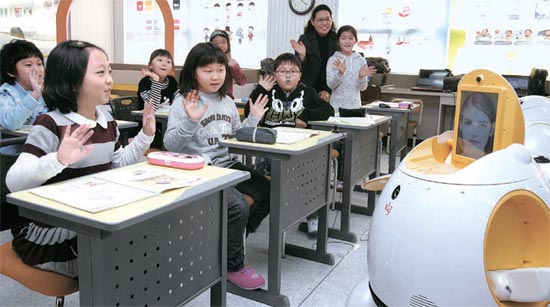 (From here - it seems there was more than one.)
Within each of them, in a sense, is a real human teacher controlling the machine by remote from the Philippines. The teachers in the Philippines have cameras to record their faces - which show up on a flat panel screen that forms the robo-teacher’s face - and they can also see the Korean students through a camera installed in the robot. Basically, the robot is a rolling Internet link between students and teacher, although the human teacher can also command the robot to make human gestures with its arms and wheels.Rolling forwards, backwards and from side to side is what separates humans from other animals, that's for sure. We're then told that “The robots will teach students in after-school programs, not in regular classes,” Kim Mi-yong, an official at the education office, said. “The robot can handle only a small number of students per class, about eight students.” How useful! No wonder they are being considered helpful for children living in rural areas where "foreigners [or anyone else, for that matter] are reluctant to live." Those kinds of schools would be the only ones with class sizes small enough for the robots to be effective. We're also told that
The English-speaking robot has already made headlines in the foreign media. Time magazine dubbed it one of the 50 best inventions of 2010.Time also declared, back in 2006, that then Seoul Mayor Lee Myung-bak was a green warrior dedicated to the environment, and is responsible for this poorly written article, so I don't know how far Koreans should go in listening to Time (the latter article has already gotten attention here). According to the Korean language version of the article, Lee Eun-suk, who is in charge of after school education, said that, "There are no significant differences between this and direct instruction by a native speaking teacher." She also noted that their correct pronunciation would be a big help for English education for children. The English language article ends by saying that, “We will continue to study to improve its teaching ability until it’s very close to that of real human teachers.” Golly, I wonder if that means Korean teachers' jobs will soon disappear?
Robots one step closer to total domination of English learning in Korea
The Maeil Shinmun reported on the 24th that from March next year, the Daegu office of education and the Korean Institute of Science and Technology will put English teaching robots into 21 elementary schools. The robots will cost around 20,000,000 won each, and will be able to be controlled by native speaking teachers remotely. I liked this sentence:

The resemblance is uncanny, to be sure.
It seems this model is a new addition to the robots we've already seen (though those seem to be lacking the codpieces so evident in other photos).
Because students can see the native speaking teacher's expression via the robot's LED video screen, they can feel like they're learning English from a real foreign teacher.

The resemblance is uncanny, to be sure.
It seems this model is a new addition to the robots we've already seen (though those seem to be lacking the codpieces so evident in other photos).
Subscribe to:
Posts (Atom)