Last August, the film
Dasepo Naughty Girls (
Dasepo Sonyeo) hit theatres and within a few weeks was gone. One of my students read a story on the internet of a girl who went to buy tickets for the film but was asked by the employee at the ticket counter, "Are you
sure you want to see that?" She decided on something else instead. Perhaps, as a teen, she made the right decision, as Darcy Paquet over at koreanfilm.org
wrote, "it is basically a non-commercial film being marketed as one." In fact, it was being marketed as a teen sex comedy; to get an idea of the marketing, the trailer can be found
here, and gives some sense of what the viewer is in for.

The film is based on a rather sex-filled internet comic of the same name, which can be found
here (on that page, click on the image of the girl seen at left here to read the comic; the most recent edition is first). The comic is actually rated 19, while the movie is rated 15, which also makes clear that much of the material in the comic was toned down for the movie. Still, despite this, the movie, despite not actually showing much (well,
any) sex, refers to it quite often, in ways that would have likely been outrageously shocking to audiences ten years ago. The film itself loses its steam midway and ends on a less than subversive note, but there is much in the film that pokes fun at (and simultaneously reveals) a great many things many in Korea might rather see swept under the rug. It's not just the references to transsexuals, teen prostitution, nude video chatting, and the like that make the film stand out, but also references to cheating, ridiculous nationalism, and the cultural differences returning international adoptees face - all wrapped in a warped parody of a tacky TV drama which is interrupted by the occasional musical number.
The film not only makes references to things that some would rather be left unsaid, but also stands as a testament to how much things have changed in the last ten years, especially in terms of what is allowed to be represented in the entertainment media. The film basically begins in the classroom above with a substitute teacher who informs the students that
"l'm substituting today because the English teacher has caught an STD. Well, it can happen if we sleep with a teenage hooker. So please understand."
("Sleep with a teenage hooker" is translated from "
wonjo gyoje hada" (about which more will be said)). From there it's learned that the 'teenage hooker' in question is one of the girls in class, and that she got the STD from her boyfriend, who got from another classmate, who... well, you get the idea. Soon the mass exodus pictured above occurs as every student except for two realizes they've slept with someone in the class and may be at risk.
 School's out...
One of the remaining students, a girl, excuses herself, as she has a date with a customer ("
wonjo gyoje yaksok" - just in case you're wondering), as the other, a boy with only one eye, bemoans his fate as the only virgin in the school. This scene is essentially a word for word adaptation of the first Dasepo Sonyeo comic strip, which can be seen
here.
In the course of the movie, we see a gay student, a pre-op transsexual student, and a crossdresser; it's worth mentioning once again that the movie is rated 15, as in, teens 15 and up can see it without their parents. My, how things have changed in a very short period of time. As
this article points out, in 1997 the first Queer Film and Video Festival at Yonsei University was shut down when the authorities cut the power (though it was allowed to proceed the next year), and in September of 2000, when comic actor Hong Seok-chon became South Korea's first openly gay celebrity, he was fired from his job as host of a popular children's show on MBC and fired from a radio show on KBS. Cut to 2006, when one of the highest grossing Korean films of all time -
The King and Clown - was about a gay love triangle set in the Chosun dynasty, and where a film viewable by teens can show gay, transsexual and cross-dressing characters (even if it treats them in a very light way), and it becomes clear how much can change in ten years.
The same year Hong Seok-chon was fired for coming out, Jang Sun-woo's film
Lies, about a sado-masochist relationship between a high school girl and a 38 year-old sculptor, was released only after having, according to
this review, five minutes cut from the film, including having the sound cut during a
conversation about sex between two high school girls. Actually, my Korean-released VCD of
Lies has some 20 minutes cut (compared to the uncut
US dvd), including this scene:

Why, you may ask? Because every reference to the girl being a high school student (at least during the first half of the film), was removed. We wouldn't want anyone thinking that high school girls have sex, or that a man would have sex with an underaged girl, now would we? The fate of the book that the film was based on is rather
interesting as well:
Lies was intended by its producer Shin Chul as a deliberate challenge to Korean censorship; the novel (Jang Jung-Il's fourth) was banned, recalled and pulped less than a month after it was published in 1996, and the author subsequently had to serve two months in jail as a "pornographer". [Jang was the first Korean writer to be so convicted.] Jang Sun-Woo had already filmed an adaptation of Jang Jung-Il's second novel (To You, From Me/Neo-ege Narul Bonenda, 1994, an acid satire of social climbing, creativity and plagiarism in the Korean literary scene) and was initially reluctant to tackle another for fear of repeating himself.
So it was only ten years before the release of
Dasepo Naughty Girls that the writer of the novel on which
Lies was based had to serve two months in prison for publishing 'pornography', and the film itself, released in 2000, had numerous cuts made to it, and was considered 'dangerous' by some (like the UN Commission on Human Rights, who asked the Korean government to ban the film), art by others (like the Venice Film Festival, which screened the film), or prompted reactions like this one: "I have not seen the movie for fear that I might throw up in the theater." This attitude is mentioned in mentioned in an opinion piece in the Korea Herald from January 22, 2000 by Cho Woo-seok, an employee at Incheon Immigration (!):
Son Bong-ho, a well-known professor at Seoul National University and a leader of the civic group which filed suit against the director, has been highly critical of the movie. Son said: "How did Korean's morals drop down to such a low level? How can you accept as art a movie in which a married man in his 30s has sex with a high school girl? How could they make such a nauseating movie just to make money?" Most leading newspapers and media groups have expressed similar criticism of the movie. While reading their attacks, I noted a key irony: most of the writers said they hadn't watched the film because it was too dirty.

Granted, the film is pretty strong stuff, and not to everyone's taste (given that for more than half of the film the two leads are naked) but scenes like the one above, during which yet another beating is to be administered, caused a great deal of consternation. Yet in
Dasepo Naughty Girls, a teacher asks to be punished for his students' lack of knowledge, calling a girl to the front of class to administer a beating with a whip taken from a briefcase full of S&M implements (a likely nod to
Lies). The girl enjoys it as much as he does:

Only six years after
Lies was released, a scene in a movie viewable by 15 year olds has a student beating her teacher in the classroom in what is obviously a sado-masochistic manner and it barely raised an eyebrow. Perhaps it's the fact that it's such an obviously off the wall comedy which saved it from the
controversy that dogged the film
Jenny, Juno, which was released in early 2005:
Yesterday was the press screening of Jenny, Juno, a story about a 15-year old boy and girl who discover that, after having things get a little out of control one night, they are expecting a baby. The Korea Media Ratings Board originally gave it an 18+ rating, despite the complete absence of any onscreen sex, nudity, violence, or foul language (distributor Show East was expecting a 12+ rating). The ratings board instead cited the very idea of the film itself as being potentially damaging to young viewers -- one board member reportedly said, apparently seriously, "If we let this through, soon they'll be making films about elementary school students having sex!" Anyway, common sense prevailed when the distributor re-submitted the film without any changes and it received a 15+ rating.
So then, to keep you updated, pregnant middle schoolers - bad; sado-masochism in the classroom with your teacher - OK (keep in mind, sex between
elderly people also caused the ratings board to throw a hissy fit back in 2002).
As I mentioned earlier, the opening scene of the film ended with one of the students asking to leave because she has a date with a customer ("
wonjo gyoje yaksok"). She's from a poor family, and much is made of the fact that she (literally) wears poverty on her back. The more obvious marker of her poverty is the fact she lives in a
daldongnae, or
hillside neighbourhood, while other markers are a little more subtle (like when her brother complains that he's lonely because all of his friends are at
hakwons (private academies)). On a few occasions in the movie she goes to meet customers:

On every occasion, however, it is played for a joke and turns out not to be a sexual encounter.
Wonjo gyoje is a word and topic that turns up occasionally in the media these days, but it was not always this way, as an opinion piece criticizing
Lies in January, 2000, reveals:
I thought it was unfortunate and unwise for the movie industry to show pictures like "Lies," at a time when the whole country is undertaking a nationwide campaign to root out teenage prostitution.
Another opinion piece by a high school student at the time wrote, "Teenage prostitution. Until lately, hardly anyone in Korea paid attention to it." If you search the Chosun Ilbo's archives using the word 'Prostitution', you'll notice many articles about teenage prostitution in the late 1990s and especially 2000; have a look
here and
here.
There were some other cases prior to this which set the tone for the debate on teens and sex, (which are discussed in greater detail
here). A July 8, 1996 Korea Times article (or the Donga Ilbo,
here) tells us that
The shocking news of a middle school girl who became pregnant after she was raped on her way home from school and went into labor in the classroom last month had pushed the Health and Welfare Ministry to promote better sex education in schools. Afraid that she might be expelled from school, the young girl had kept her condition a secret from her teachers, parents and school mates. She was taking her final exams on June 27 when her water broke and she gave birth to a boy upon being rushed to the hospital.
Wearing an obstetrical binder when she began getting big, the middle school girl hid her pregnancy from her teachers and friends at school. According to her homeroom teacher, because she was always a quiet child, no one thought anything was amiss. And since her working parents spent little time at home, they too did not notice anything was wrong, she added.
It's been 11 years since that happened and there
still aren't decent sex education programs in place within the Korean education system.
Another event that 'shocked the nation' took place in the summer of 1997, when copies of a video tape showing several high school boys having sex with a middle school girl began to turn up in the porn shops in places like the
Seun Sangga. Songpa-gu police
arrested the students in mid July, 1997:

A July 16, 1997 Korea Times article reported on the arrest of 6 high school boys (three for distributing the tape) and the middle school girl:
"This feels like a (bad) dream," said 17-year-old Kim, one of the teenage boys involved. Kim reportedly thought of making the video "for fun" after watching a similar Japanese pornographic movie. "I thought they were going to destroy the tape after it was over," said Choi, 15, the lone girl and middle school dropout, who was videotaped having sex with three of the teenage boys. Asked if any of her friends had ever made similar movies, Choi replied a simple "yes."
Kim reportedly met Choi at a school festival in September 1995. The two had an intimate relationship for sometime, he said. Choi left school in June 1996, to go work at a karaoke bar. She said she did so because of the constant bickering between her parents. A month later she was raped by four men, she said.
I can't remember where I read it, but I do remember the kids saying that they just wanted to make a porn film like adults do, and make some money off of it. Ironically, this event served as the inspiration for the little seen 2001 film
Twenty ["Seu-mu-sal"] directed by Shin Jung-kyun, which depicts the sexual awakening of a girl in junior high school. There is more information about the film
here, though some of the screenshots are probably
not worksafe. Interestingly enough, these stories of the videotape and the girl giving birth in school gave rise to the overeaction found in
this discussion, from 1999.
An October 28, 1998 Korea Herald article noted that community papers or word of mouth from friends were drawing teenage girls into working as hostesses or prostitutes, with 5,048 teenage girls caught in those roles during a one-year crackdown starting in September, 1997. The report said 804 or 16 percent of the teenagers were exploited as prostitutes, 314 of whom were under 16.
In all 2,221 girls or 44 percent were employed by karaoke rooms, 1,040 by room salons, 879 by cafes and beer houses, 480 by brothels and 428 by tea rooms where they worked as prostitutes, according to the report.
A Korea Herald article a month later had this quote:
"Teenagers used to be forced or deceived into the sex trade. But now more girls voluntarily do the job for easy money. Working in karaoke rooms, they can earn in a night half a month's wages which they can earn at supermarkets or coffee shops."
The events described above, as well as the well publicized results of the 1997-98 crackdown, may have given rise to a
new law designed to keep teens away from jobs and areas where prostitution thrived:
Since 1999, the Youth Protection Law has provided for prison terms of up to 10 years and a fine of 10 million won per minor hired for owners of entertainment establishments who hired minors under the age of 19. The Commission on Youth Protection also expanded the definition of "entertainment establishment" to include facilities, such as restaurants and cafes, where children were hired illegally as prostitutes.
What was slightly humorous in all of this was the National Youth Commission's website listed areas in Korea's larger cities which were off limits to youth - in effect, giving the location of most of the larger red light districts in the country, in both Korean and English (it's since been removed).
At any rate, the 'war on teenage prostitution' and the flurry of media attention on the issue began in January 2000 after Korea's first female police chief,
Kim Kang-ja, was appointed to the district in Seoul containing the red light district Miari Texas, where she declared her desire to stamp out teen prostitution. How successful this crackdown was is debatable (most likely it just helped facilitate the shift from teens working in brothels and as hostesses to partaking in
wonjo gyoje). The crackdown and media handwringing did lead to another
new law, however:
In 2000, the Government enacted the Juvenile Sexual Protection Act, which established a maximum sentence of 20 years' imprisonment for the sale of the sexual services of persons younger than 19 years of age. It also established prison terms for persons convicted of the purchase of sexual services of youth under the age of 19. Based on this law, the Commission enforced a decree to publicize the names of those who had committed sex offenses against minors.
And if you thought the lists, released periodically, weren't popular, you'd be
wrong, because the Commission's webpage got millions of hits when the first list of 169 names was released in September, 2000. Since then, "4,112 people in total have been
made known to the public".
While the 1999 law targeted the bars, karaokes and brothels which hired teenagers, those who passed the 2000 law, with its public listing of offenders, were well aware of and taking aim at a new form of prostitution gaining popularity, which a November 26, 1998 Korea Herald article described:
A recently emerging form of child prostitution is "charitable relationship,'' [wonjo gyoje] in which girls receive money from adult males for sex. Last month the Pusan police caught a 16-year-old girl and a middle-aged businessman who were in a six-month-long charitable relationship. The freshmen high school girl was introduced to him by her classmate who was also in a relationship with him. "My friend said that I can get 100,000 won for a casual date, and double for a "special'' date, she told police. Before being arrested, the two had at least seven sexual encounters and her friends sometimes joined for group sex.
As for the growing popularity of wonjo gyoje, or 'compensated dating',
this article from 2004 lists some statistics:
According to a Seoul Socho police officer, two to three students in every middle and high school class, typically consisting of 40 to 50 children, are believed to engage in prostitution. Statistics for 2000 show 222 girls aged 18 or younger were caught by police for engaging in wonjo kyojae, with girls aged under 16 accounting for 62.6% of cases. Most of the arrangements for meetings were made through online chats (53.5%) and phone conversations through ‘phone-tings’ (22%).
Another article, a February 8, 2000 opinion piece from the Korea Herald written by Hazel Lee, a student at Kwacheon Foreign Language High School, gives a teenage girl's view of wonjo gyoje:
I think that all girls go through basically the same problems during their teens. The teachers at school are determined to save us from ourselves and try to make sure we have no time to think of anything else except for studies. Our dads treat us like we're seven instead of 17, and freak out if we come home one second after our curfews. Our moms just don't understand why it's so important to have pants that look tight to breathe in and shoes that make us look like witches. We never have enough money, and the reality we live in is just plain depressing at times. The girls in the comic books we read never have such problems. They never have zits or bad hair days. All of them are pretty, fragile, and have a gorgeous guy at their side who goes to university. And their relationships are anything but platonic.
So what's the difference between the girls that go wrong and the girls that don't? Well, the reason I don't do that kind of stuff is because I know who I am. I have a family that can be corny and annoying but one that loves me and tells me they do. I have friends that I can complain to when things get rough. I have dreams and aspirations. I won't deny that I've never thought about simply packing and hitting the road. Cause let me tell you, teenage prostitution is ugly to the rest of the world, but to teenage girls it holds a sort of twisted romance and sense of adventure. It's not romantic, everyone knows, but to a teenage girl full of stress it can seem better than her present situation. Pleasure and money - the two things many teens live for nowadays. And if no can give her a better reason to live, then who can blame her for what she does?
This article from early 2005 showed that, despite the September 2004 crackdown, teenage prostitution was alive and well; police timed their
crackdown for winter vacation, as many more students had free time.
Police said 42 percent of teenagers sell sex for spending money, 33 percent to earn a living and 3 percent out of sexual curiosity. The remaining 22 percent gave a variety of responses.
A
survey in Busan a year later found similar percentages, and gave another figure: "About 20 percent of teenage prostitutes in the southeastern port city of Pusan began working in the industry when they were under 14 just for money" (actually, that should be "when they were 14 and under).
Speaking of Busan, you may not find many scholarly articles about wonjo gyoje in English, but Mee-hae Kong's
Material Girls: Sexual perceptions of Korean teenaged girls who have experienced 'Compensated Dates', an excellent article from 2003 about wonjo gyoje based on interviews with 12 girls from the Busan area, can be found
here. In it she looks at the backgrounds of the girls, all of whom had run away, and most of whom had experienced sexual abuse before selling sex, writing that
Compared to Japanese teen prostitutes who belong to middle-class families and ordinary students (Ueno, 2001), most Korean teen prostitutes have experienced poverty and have run away from home (Cho and Lee, 2001; Lee, 2001). All girls in this study mentioned that they were suffering from poverty, lack of familial support, and the absence of stable job opportunities when they entered prostitution. Economic deprivation was therefore a major factor.
A February 12, 2003 Korea Herald article makes clear that many are not runaways, however:
About half of Korean teenagers involved in underage prostitution attend school and live with their families, according to a report released by the Commission on Youth Protection yesterday. The report, based on investigation records of 414 teens who trade sex for money, showed that 46.4 percent live at home and 41.8 percent still go to school.
As for what prompted them to sell their bodies for sex, 51.5 percent said they needed money and 27.4 percent answered they had no alternative to meet living costs or had no place to sleep. About 7 percent said they did so out of curiosity, and 3.9 percent said men seduced them.
Asked what medium connected them to the sex trade, 58.7 percent cited the Internet, and 13.2 percent mentioned "phone parlors." A total of 25.4 percent were aged 16, followed by 17-year-olds who accounted for 22 percent and 15-year-olds at 21.7 percent. Nearly 4 percent were aged 13 years old or younger.
In most of these cases, the girls are forced by economic need (or desire for consumer goods like phones and clothing) to make money this way, but are not so often physically coerced or restrained by pimps, though there are exceptions to this, such as mothers
selling their own children into the sex industry or the appearance of
teenage pimps:
"There has been an increase in the number of teenage boys buying sex. And now, we have teenage pimps who force their peers to sell themselves for sex to the same age groups,'' said Kim Hae-kyoung, director of the juvenile crimes unit of the Seoul Metropolitan Police Agency. Police in Koyang, Kyonggi Province, Monday arrested a 14-year-old girl on charges of forcing two of her schoolmates of the same age to have sex with three males, including a 16-year-old middle school student, at her apartment on Jan. 9.
The article also quotes statistics for 2006:
According to the agency, 45 percent of the 505 people nabbed in Seoul last year for buying sex were in their 20s and 40 percent of them were in their 30s. However, 3.4 percent of them were in their teens. The police caught a total of 236 under-aged girls selling sex last year. More than 46 percent of them were between 15 and 16 years old and about 42 percent were between 17 and 18. However, 11.4 percent of them were younger than 14 years old [sic - 14 years old or younger] with the youngest being a 12-year old.
The article relates another story of teen pimps:
[P]olice in Sanggye-dong arrested two 16-year-old girls and a 14-year-old boy for attempting to force a 14-year-old to sell herself for sex. After she refused, the suspects kidnapped the victim for a day, beating her and burning her face with lit cigarettes [...].
Perhaps lit cigarettes are a common method of coercion:

Above is the photo of the cigarette-burned hands of a runaway 14 year-old girl who was
held captive for six months in Gwangju by an acquaintance and forced to have sex with 800 men; her captors can be seen in the background.
The police said they have obtained 800 phone numbers of men suspected of having sex with the girl. About 40 of them have already been questioned and face charges for having sex with a minor. The police said they will expand the investigation to include all suspected customers. The police said the victim’s customers ranged from doctors and teachers to students and soldiers. One of the men questioned is a university professor.
From November 2006 until her escape on May 22, the victim serviced clients found through Internet sites and was forced to engage in sex up to five times a night.
An
MBC news clip shows her guiding reporters around one of the motel rooms where she was held; a computer can be seen in the room.
This article also touches on on the internet's role in facilitating teenage prostitution:
"Since it was found that more than 95 percent of the sex trade involving under-aged girls originated through the Internet, there is a need for police to identify the Web sites where the deals are frequently made and monitor them properly,'' she said.
Apparently, they are trying, according to an article
translated at The Grand Narrative, titled, "
3 out of every 10 dating sites are being used by teenage prostitutes to find clients." Recently, the Government Youth Comission asked Daegu YWCA to invesitigate to what extent teenagers were using 69 adult dating sites that can be found through major internet portals [...]
According to the Commission, 23 sites of the 69 sites (33.3%) allowed teenagers to register. 42 (60.9%) did not allow teenagers to join, but lacked a special warning indicating this; in the end, only 4 (5.8%) both didn’t allow teenagers to join and had the required software to prevent them from doing so [...]
In addition, Daegu YWCA opened a chatroom on one site for 2 hours, and of 48 male users that entered, 25 were blatantly looked for teenage prostitutes, 19 chatted about sexual acts, and only 4 chatted about non-sexual subjects.
It doesn't look like the demand side of the equation is going to change any time soon.
For all of the articles about teen prostitution seen these days, the number of them pale in comparison to the deluge of articles that appeared during the 'popular gust' of 2000, when many articles even turned up in the English language Korean media. Despite the number of articles in English about wonjo gyoje, or teen prostitution, in Korea, it's never gotten the attention from the west that Japan's
Enjo Kosai (the same Chinese characters as wonjo gyoje) has (for example, articles like
this).
One factor that may contribute to this may be that, while references to Enjo Kosai turn up in popular culture relatively often in Japan (off the top of my head I thought of the films
All About Lily Chou-Chou,
Love and Pop,
Bounce Kogals,
Harmful Insect, and
Canary (the latter a film I
highly recommend)), it's not commonly referred to in Korean films.
The obvious example (which many may think is the only example) is Kim Ki-duk's film
Samaritan Girl (Samaria), which is also reviewed
here. As this is a fairly well known film, I'll focus more on the other, lesser known films. Suffice to say that this film angered a number of people (most of whom, like those who condemned
Lies, have likely never seen it), with a standard complaint that Kim had aired out Korea's dirty laundry for the whole world to see.
Perhaps the first film dealing with this topic, however, was the 60 minute film Teenage Hooker Becomes Killing Machine in Daehakro (대학로에서 매춘하다가 토막살해 당한 여고생 아직 대학로에 있다), which was released in late 2000. The translation of the Korean title is even more amusing than the English title: "The High School Student Who Got Chopped Up While Selling Herself in Daehangno is Still in Daehangno." I don't imagine this film was released in any more than a handful of theatres, and as far as I know, it isn't available in Korea (though it was released on video in Japan). A review can be found
here, and some photos can be found
here. It's a low budget film with a terrible plot and acting, but it's not without its charms (the soundtrack features 3rd Line Butterfly and Shin Jung-hyun, for example).
Three weeks later, in January 2001, Im Sang-soo's second film
Tears was released, about street kids in Seoul's Garibong-dong. The girls in the film work in a bar and on one occasion one of them has a wonjo gyoje meeting with a customer in a motel. Though the film didn't do well (it's well worth watching), Im would find more commercial success with his next two films, The Good Lawyers Wife (2003), and President's Last Bang (2005).
Lee Mi-yeon's
L'abri (aka Bus Stop), released in March, 2002, deals with the relationship between a hagwon teacher and his 16 year old student, who had been "having sex for money" with a middle aged man. While the girls in Tears were doing it for money to survive, she was doing it out of boredom (and perhaps for spending money - it's been years since I watched it). All and all, it's a pretty depressing film.
Ahn Byung-gi's Phone, released in July 2002, also deals with wonjo gyoje. As
this review points out, Ha Ji-won's character "is a journalist who has just finished a controversial expose on a ring of older men paying for sex with teenage girls." Also, by the end of the movie we find out that a married male character had been having sex with a school girl (in what looked like a romantic relationship - hard to know for sure though, seeing as the participants don't outlive this revelation by very long).
In this year's "
Wonder Years" (
Yeolse sal, Su-ah), the main character (who is 13) befriends a girl who has become a bully, and who also makes money by singing and dancing with older men in norae-bangs.
Oh, but I was talking about Dasepo Girls, wasn't I?
Something else the film brings up is online video chatting. In the film, a boy disguises himself as a girl and tries to talk another girl into undressing. As it turns out,
truth is stranger than fiction:
On December 2nd [2002], Busanjin police office issued a warrant for the arrest of a 17 year old boy identified by only his family name, Park. Park who has naturally long hair, put on some lipstick, pretended to be a high school girl and used a video chatting site to lure men into arranging sexual liaisons for money. The men would send money to Park's bank account, but he would never show up for the arranged meetings. Police were able to track down Park and arrested him after more than 1.2 million won had already been transferred to his account.
Very little turns up in the media about nude video chatting (or hadn't when I looked quite awhile ago) but
this article from November, 2005, delved into the subject:
A high school boy in Daejeon has been arrested for recording nude images of an online chat partner when she stripped for him and distributing the clip. The boy surprised officers by saying that two or three out of 10 women in online chat rooms agree to take their clothes off within 10 minutes.
 Video chatting scene from Dasepo Girls
I'd actually assumed this was going on a few months earlier when the media reported about elementary school students photoshopping other student's faces onto porn photos.
The Donga Ilbo reported on this quite clearly, but the
Chosun Ilbo went somewhere else with it, focussing on chat sites aimed at children.
The Chosun Ilbo logged on to a site and typed “elementary school student” into the search engine. The server found 146 video clips and image files. Only three of them were not of a pornographic nature.
After reading this, I wondered how true it could be, and did a quick search on the P2P client emule in Korean for ‘elementary’, ‘middle’, and ‘high school student’, and it turned up a list of dozens or hundreds of files for each category, and, judging from their titles, almost
all of them were sexual in nature (when you see “female middle school student” and “cucumber” in the same file name, you can be pretty sure that some of these consist of more than just taking off clothes - though I'm still trying to figure out what they would have been doing with banana milk. Maybe it's best not to ask). Many files had ‘Haduri’ in the file name, which is
a site where people (mostly teen and pre-teen girls, at least when I looked at it a year ago) post their
'eoljjang' photos to meet people or to be voted as the prettiest-looking by others. It also provides
software that allows you to record jpegs, gifs, or video from webcams, which I imagine is the source of all these files. At any rate, judging by the number of filenames that mention nude chatting and haduri it would seem that there are hundreds of recordings of these nude webcam chats out there (even if many of the files are falsely titled, there would still be a sizeable number that aren’t). And if there are hundreds of recordings of these chats, then you might assume that it goes on a lot, and that the story of the high school boy in Daejeon is the tip of the iceberg - especially seeing as nude teen video chatting was lampooned in a mainstream movie.
While the plot is mostly episodic at the beginning, a few plot strands begin to stand out later on, such as a plot by the principle to make the students study by placing 'virgin chips', er, within the girls, which make them studious and pure.

When I saw this, I was immediately reminded of an essay entitled "Popularising Purity: Gender, Sexuality and Nationalism in HIV/AIDS Prevention for South Korean Youths", which can be read as a pdf
here.
The Purity Campaign began with the New Purity Movement in 1995 that targeted middle and high school students. ‘New’ purity suggested that those who have lost their purity through premarital sex can ‘regain’ this purity by joining the movement and abide by the rule of ‘sex-within-marriage-only.’
Who knows if the movie was referring to this or not. It goes on to poke fun at nationalism in education when a teacher asks his students what makes Korea unique. After a long silence, 'four seasons' gets mentioned, as does taekwondo. When a student tells the teacher that "it wouldn't be entirely correct to say that taekwondo is pure Korean", due to its use of Karate moves (all the while reading it from his PSP), the movie then also highlights cheating by students using phones, like what
happened in Kwangju in November of 2004 during the University Entrance Exam.
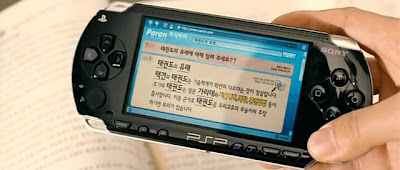
The 2004 cheating incident led to
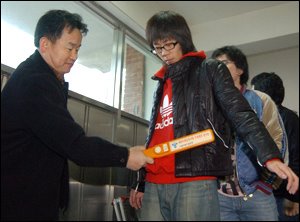
a ban on all cellphones, mp3 players and other electronic devices at the next University Entrance Exam in 2005, leading to photos like this:
At any rate, the teacher is appalled at his student declaring taekwondo to be part Japanese. "You little rascals know nothing about our own history. You must not love your own country." Looking about the room, he enlightens them about Korea's great history: "We went to the semi-finals during the 2002 World Cup." After being told by his students that soccer certainly isn't a part of Korea's heritage, he replies, "l feel so responsible that you all are so ignorant about your own heritage," which is followed by
 Daehan Minguk!
He then takes responsibility for their ignorance by asking them to hit him with a stick, which he took from a briefcase full of S&M implements (a nod to
Lies). When he pulls down his pants, this is the reaction:
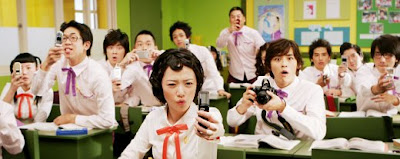
Part of what's funny about this is the speed with which their camera's are flipped open, due of course to the fact that the phones were already in their hands. Anyone who teaches middle or high school aged students knows how important these little devices are to their lives, and how often they're being used despite being told to put them away.
There have been a few occasions where the cellphone video of an assault by a teacher in the classroom has caused an uproar (such as in
this case), though the first thing I thought of was the world of citizen surveillance brought to light in the media after the
dog poop girl incident in June, 2005.
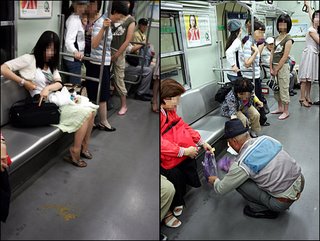
The posting on the internet of these photos of a woman who refused to clean up her dog's crap on the subway led to the media's first recognition of '
cyber terror', as people lined up to hurl abuse at the girl online, and even stalk her in public (as
this page titled "the next day" makes clear)
Of course, cellphone cameras could be used for other reasons as well, as was revealed in December 2004, when it came out that 41 middle and high school boys in Miryang had been gang-raping 5 girls for almost a year. The reason they could get away with this?
The boys allegedly met one of the victims, identified as Choi, 14, through chatting on cell phones, and sexually assaulted her when she visited them in Miryang in January. They then threatened to upload the scene of the assault on the Internet, and lured Choi’s sister and a cousin then raped them as well.
Or as the
Joongang Ilbo put it:
Police said a 14-year-old girl had been raped as many as 10 times by three to 24 high school boys. The boys reportedly blackmailed her to keep quiet unless she wanted pictures of her rape to be spread around her school. Then she was ordered to bring her younger sister and older cousin, aged 13 and 16, to Milyang.
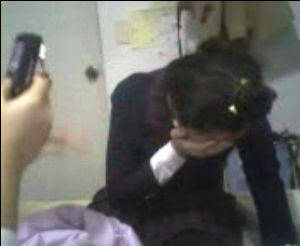
The threat of shameful photos being spread, in this case, was enough to blackmail the girl into not only submitting to being raped by numerous boys over the next year, but also into dragging other family members into the situation. As awareness of the public shaming a cellphone video can cause when shared on the internet has spread, the cellphone camera itself has come to be viewed as a weapon, as the response of
this girl showed when, after stoicly putting up with minutes of beating, broke down when her hair was tied up (fully revealing her face) and a phone camera shoved was in her face.
But I'm off on a tangent, and this is a story for another post. The film goes on to look at adopted Koreans, and one, who was raised by a rich Swiss family, rails at one point against "Fucking Korea, fucking discrimination!" - all while questioning his sexuality after falling for a pre-op transsexual. Another adoptee returns to Korea as a punk rocker with a face full of piercings, bewildering his birth mother.
Amidst these references to sexual topics which were taboo only a few years ago, and satirical takes on nationalism and education, is a good deal of comedy which works, and bits that fall flat. It's too bad the film doesn't remain consistent in the inconsistency it displays at the beginning, but despite this, the film is well worth watching. I've only tried to put some of the film's topics in a social context (and place the film itself in the context of recent Korean films on such topics), but Darcy Paquet's
review suggests that much more could be made from the film: " Ultimately
Dasepo becomes an odd and fascinating sort of utopian vision of modern Korea, though not the utopia that most Koreans would imagine for themselves." Dasepo Girls seems, in its chaotic way, a testament to the struggles everyone from gay rights advocates to those who have stood against censorship have faced and overcome in the past decade - not bad for a film that disguised itself as a summer sex comedy.

 Aug. 15
 Aug. 31
 Sept. 9
 Sept. 22
 Oct. 6
 Oct. 12
 Oct. 23
 Nov. 8
 Aug. 17
 Sept. 17
 Oct. 23
 Nov. 8