Friday, March 04, 2011

An accurate, reliable, impartial news report

As noted in the NHRCK report, "The Korea Broadcasting System (KBS) is a government owned television network [and] the largest television network in Korea." It also links to their website, where we are told the following:
KBS regards it a core duty to reflect the diverse voices of Korea through the distinctiveness of its programs, while bringing the world home to its audience through speedy and impartial news reports.

In today's environment of multi-faceted communication and media with a flood of information and sensationalized commercialism, KBS strives to fully satisfy the people's right to know and quality programming through honest and transparent management. By airing accurate and reliable news as well as high quality programs, KBS leads the way in setting the standard for Koreas journalism and broadcasting culture.

A public opinion poll conducted in 2002 showed KBS to be the most influential among the domestic press and electronic media circles. [...] The Korean people have come to trust in KBS to consistently deliver reliable and straightforward programs.[...]

KBS fully embraces the diversity as well as the cohesion of the various cultures of the world.
It may be worth keeping all of that in mind while watching and reading this KBS report from July 3, 2009 (found through a link on Anti-English Spectrum's site; the video of this 6 minute news report can be watched at the KBS link):
'Out of Control Foreign English Teacher' Molests [someone] while High during Lesson
"Is that my child's native speaking teacher?"
[Anchors]

The number of native speaking English instructors working in Korea is increasing, and so are their crimes.

At school they are sincere teachers, but outside class they constantly go off the rails. We have the story of their two faces.

Choi Seo-hui - have foreign instructors also been caught for habitual gambling and drugs?

[Report]

Yes. Yesterday more than ten English instructors were uncovered. During the day they taught students and at night they lived lives stained by drugs and gambling.

Incidents in which students have been molested have also occurred one after the other. We've covered the truth about how some native speaking instructors go off the rails, making one uncomfortable about entrusting their child's education to them.

[Shot of web profile; under 'Most precious thing' is [untranslated], "Seeing the light glisten off the sweat on the curve of a woman's breast, thigh, back, butt, or almost anywhere on a woman's body."]

This was written on the internet by a foreign English instructor living in Korea. He said he came to Korea for money and the pleasure of women and boldly put up photos of himself.

An English instructor at a hagwon in Seoul who had been in the US army posted nude photos of women on the internet which he said were of his students.


It was revealed he posted nude photos he'd taken of his coworkers and racing models he'd picked up and even posted photos of his students. The deviation of native speaking instructors like this is becoming more serious by the day.

Yesterday in the Itaewon area police caught 13 foreign instructors for habitually smoking hashish (a kind of drug) and gambling.

It's come out that since January they've met 113 times to gamble and smoked hashish 100 times. Most of the suspects work in Seoul or Gyeonggi-do as public school teachers, with some working as instructors at well known English hagwons in Gangnam.

Kim Gi-yong (Detective, Seoul Metropolitan Police Agency Foreign Affairs): "The group was made up of language hagwon instructors, and at home they wagered millions of won habitually gambling and taking drugs. They currently maintain that they are completely innocent."

They put up the gambling time and place on a well known overseas website to recruit accomplices and avoid being caught.
[The only reason foreigners use Facebook is to avoid detection.]
Also, it was revealed that at an ordinary house in Itaewon, they went so far as to set up a poker table and habitually gambled. Every month, a picture of the winner and the amount they won was put on the wall of the gambling house and on the internet site.


We visited the English hagwon in Gangnam where a teacher who was caught works.

Hagwon official: "Our hagwon? This is the first we've heard of this. Please speak clearly. Who is this?"

The hagwon declared there was no such teacher.

We also visited the elementary school in Gyeonggi-do where another teacher worked as an English teacher for the after school program. At the school they were completely unaware of the same facts.

School official: "We confirmed this properly through the embassy and later the visa was issued but it was checked to see if crimes had been committed in New Zealand, and only people with no crimes were given permission to work by the embassy so we know that there was absolutely no problem.

When parents heard the news, they were also shocked.

Parent: Are you serious? That happened? How could it be - really? Your teacher is ____ [the teacher's name], isn't that right?

Child: "Today the English teacher was sick and didn't come to school."

Parent: "I went to an observation class but even then there was nothing that stood out, and it was fine."

However the reaction of people who have encountered native speaking instructors close up is that this kind of thing is nothing new.

English hagwon operator: "When socializing with the teacher, I've heard him talk freely about doing drugs many times. (Do they do drugs and come to class?) He looked spaced out and taught very simple, basic things, which is why I thought he was on drugs while teaching class."

There are also endless sex crimes by foreign instructors.

Recently there was an incident at a well known hagwon in Seoul where parents complained after two native speaking teachers molested female elementary students.

The 'Citizen’s movement to expel illegal foreign language teachers' cafe manager: "At the hagwon that received the complaint, the hagwon and the native speaking teachers said, "It was just a simple misunderstanding due to cultural differences and we did nothing wrong."

Also, in Seoul a native speaking teacher working for a district office-run foreign language program was charged for molesting a grade one elementary school student under his care last December, but last week was cleared for lack of evidence.

Crime by foreign instructors like these is never ending but the fact is that the number of native speaking instructors in Korea is continuously growing.

A parent: "Korean teachers have some limits. There are many cases where they do not know real life vocabulary. This is because they simply learn language in a technical sense, without an appreciation for the connection between language and culture."

Due to the perception that native speaking instructors are unconditionally better, even hagwon owners break rules and are trying as hard as they can to hire native speaking instructors.

English hagwon operator: "Our hagwon instructors said native speakers are 'decorations,' as the saying goes. Because of the strong preference for native speakers by the mothers and parents of students at most hagwons, most have native speakers."

However, in truth, background checks for these native speaking instructors are not being properly carried out.

The 'Citizen's movement to expel illegal foreign language teachers' cafe manager: "A foreign instructor responsible for sex related crimes against children and minors and assault against police in Canada was stripped of his teaching qualification there. This person is now in Korea working as an English instructor at a county office in Gyeongsangsnam-do and participating in a summer camp by teaching young students.

Native speaking instructors themselves say that the native speaking teacher qualification check should be strengthened.

Alex (23, American native speaking instructor): "There are a lot of people who are either not qualified or who, in a sense that they have no teaching experience only a bachelors degree or are not qualified in the sense that this is not something they enjoy doing. Not necessarily ESL but teaching English – teaching in general rather – is not something that they enjoy doing. They're here just sort of passing time."

[Translated as: "There are many cases where native speaking teachers have only a university diploma or are inexperienced. They have no interest in teaching, let alone English education. There are also people who just want to kill some time."]

Under the English education craze, an increasing number of native speaking instructors, who are treated like VIPs, act abnormally and without scruples, and there is an urgent need for strict qualification checks in order to prevent our children from being exposed to this.
-----

The title is a bit misleading, with "환각 수업에 성추행" sounding more like "molestation during stoned lesson," or that the teachers molested students while high.

The personal website shown at the beginning of the report was linked to here and the subject of an AES-aided Breaknews article in August 2006, which shows just how far back KBS was reaching to construct their narrative. As can be seen from the screen shot above, they mistranslated the part about racing models.

The 'poker ring' bust was the subject of several KBS reports at the time of this report, and is covered in more detail here and here.

The Anti English Spectrum-based story about the molestation taking place at a hagwon was never reported as having been investigated by the police and was the subject of this Chosun.com report posted three days before this KBS report (and was the first of five negative articles about foreign English teachers by Chosun.com intern Choi Hui-seon: 1 2 3 4 5 ).

More about the "native speaking teacher working for a district office-run foreign language program" who was charged with molestation can be read here and here (from January and February 2009). This KBS report actually confirms that the charges were dropped for lack of evidence. Between this story and an unconfirmed tip from AES, it seems hard for KBS to justify the statement that "There are also endless sex crimes by foreign instructors."

KBS obviously decided the 'AES manager's story about the Canadian teacher stripped of his credentials back home warranted further scrutiny, as it was the subject of another KBS report less than two months later.

As for this:
By airing accurate and reliable news as well as high quality programs, KBS leads the way in setting the standard for Koreas journalism and broadcasting culture.
If this report is considered "accurate and reliable," then one certainly hopes that KBS is not "setting the standard for Koreas journalism and broadcasting culture."

Thursday, March 03, 2011

Keeping Korea Clean

The Chronicle of Higher Education posted an interesting article Sunday titled "South Korea Brings in Foreign Professors by the Thousands, but Is It Ready for Them?" The article looks at Korea's globalization push, noting that
4,957, or about 7 percent, of South Korea's 77,697 full-time faculty members are foreign, the figure is up threefold in less than a decade, according to the Ministry of Education, Science, and Technology. That already puts it well ahead of neighboring Japan's 5 percent (out of 353,000 full-time professors), despite a much longer history of foreign hires there.
It also notes that "an Education Ministry survey of 288 foreign academics last year found [that foreign professors' stays] averaged just four months." Despite some negatives, the article notes that foreigners are very willing to come to Korea to work due to the job situation in their home countries. It also looks at another familiar topic:
One indication of South Korea's lingering fears about an influx of foreigners can be found at the Korea Institute of Science and Technology, where $100-million in government money has been spent developing robot English teachers. Prototypes of the robot are operated remotely from the Philippines, keeping the "moral problems" associated with non-Koreans at arm's length, says Mun Sang Kim, director of the institute's Advanced Robotics Research Center.

"There are some problems and some accidents in hiring native speakers at the schools right now," he says. "For example, the immigration system in Korea is not good enough to examine whether the foreign visitors are clean or not, or they did some crime," he adds. "That's the reason why the government thinks about such robot systems. They don't have any such social problems, they don't do the drugs."
While I and others have made this point before, I believe this is the first time I've seen someone connected with the robots actually openly state that the "moral problems" of foreign teachers is the reason for the robots (and here I thought it was to "reduce discrimination suffered by the underprivileged [...i]n rural areas or remote islands" by giving them access to 'foreign' English teachers). The government connection - as a source of funding - is also made clear. This shouldn't be surprising, especially considering Lee Myung-bak's cabinet and its concern about the 'cleanliness' of foreign teachers.

Wednesday, March 02, 2011

The first night of freedom


The scene above may seem unremarkable, but a 1982 Stars and Stripes article I came across reminds us that for more than half of South Korea's post-WWII history, a midnight to 4am curfew confined people to their homes.
South Korean curfew passes away, quietly

Thursday, January 7, 1982
By SSgt. Steve Davis
PS&S Korea Bureau Chief

SEOUL — South Korea's 36-year-old curfew passed away unceremoniously Tuesday night. Except along coastal regions and security-sensitive areas along the demilitarized zone, the nightly four-hour custom slipped quietly away with few mourners.

It passed simply and as suddenly as President Chun Doo Hwan's New Year's resolutions which promise a year of sweeping changes in South Korea.

Chun not only abolished the curfew declared by the U.S. military government on Sept. 8, 1945, in Seoul and the port city of Inchon, he followed that New Year's edict with a proposed liberalization on Jan. 2 of the hair and dress codes that gave South Korean secondary schools a military flair.

Then came a major Cabinet reshuffle on Sunday to add what a presidential spokesman termed "new vigor and vitality" to the fifth five year economic and social development plan which gets under way in South Korea this year. Six high level officials were replaced.

The presidential pronouncements took most South Koreans and foreigners by surprise.[...]

Some gates at Yongsan Army Installation in Seoul remained open as USFK personnel ventured out on the first official night without curfew. Col. Robert C. Lewis, the Yongsan Garrison and Area III commander, said the installation will comply with the ROK government directives on the curfew.[...]

He said he will make decisions on such matters as shuttle bus schedule and club operation changes after the community expresses their preferences.

Basically, he said, it's a wait-and-see situation.

Many off-post businesses were taking the same tack as Maj. Michael J. Amidei, the deputy area clubs general manager for Yongsan and Area III.

"We are evaluating now the potential impact on the club system and will follow the directives of the installation commander," Amidei said when asked about schedule changes.

Tom Casey, the owner of the Sportsman's Club in the popular Itaewon-Hannamdong club district near Yongsan, predicted a gradual adjustment to the curfew ease.

"I don't even know if anyone will even be here at 11:30," Casey said early in the evening. "Basically, I feel that most people have adapted to the curfew and that they will leave early."

Casey was right. Around 1 a.m. most of the district's clubs had closed. A few customers continued to dance at the Sportsman's Club. Other club owners said they expected more activity on the weekend, but none expected an immediate business boom.

Intracity bus and subway schedules were extended an extra 30 minutes for late homegoers and taxis continued throughout the night. Gas station hours were lengthened and flight schedules amended. Warnings went out to potential night prowlers, and the possibility of night tours in Seoul were contemplated.
As it turns out, however, the curfew was still in effect in coastal areas.
At Kunsan AB, the curfew lift was not so simple. Though a base spokesman announced that "effective midnight tonight the curfew in Kunsan City is lifted," the air base, some ll/2 miles away, is in the coastal restricted zone.

The spokesman added: "We're talking about Kunsan City as determined by the Korea National Government," which exempted the city as one of 14 specially exempted from the remaining curfew of coastal areas.

"Areas around the base," the spokesman said, "still require clarification."

Easier lifestyle

According to some, the curfew lift entails the change to an easier lifestyle.

"I always got nervous around midnight," said Kim Shin Hea, a 28-year-old Seoul resident. "I'm glad it's over. It's fantastic."

Army Staff Sgt. Jim Coughlin, a 27-year-old infantryman from Everett, Wash., agreed. "I think it will cut down on tension," Coughlin said. "Police won't have to rush people off the streets now. It will just be a more relaxed atmosphere."
South Korea's 36-year-old curfew was quietly lifted at midnight Tuesday and, while some ventured out into the streets of Seoul (below) after midnight, a more typical scene was a lone pedestrian (above) strolling along an empty sidewalk. ' (AP)

The Donga Ilbo had numerous photos on pages 1, 10 and 11 on January 6:


The photo above shows cars, buses and taxis out near city hall; below the gas stations are open late.


For the first time in a long time, people were able to enjoy haejangguk after midnight. I find it interesting that there seemed to be so many digital clocks in public, but then Seoul's city hall used to have a digital clock on it, as the last photo on this page about the 1988 Olympics reveals.

Monday, February 28, 2011

Translation of the KNN report

As Robert posted over at the Marmot's Hole, on Thursday, February 24th, KNN did a report on the death of another English teacher on the same day the teacher jumped to his death in Busan. I just thought I'd translate it for comparison with the other articles:


The death of a native speaking instructor

(Anchor)

On Sunday two Native speaking instructors died one after the other.

It seems they died from excessive drinking, and it's been pointed out that there is a problem with the hiring of native speaking instructors.

Jang Hyun-ju reports.


This is the Busan Donghae Nambu railway line.

At about 5:50 am 40 year old Canadian English instructor A was hit by a Saemaeul train and killed.

A was set to begin teaching teach classes at a university in Daegu when the new semester begins next month.

School official: "He was hired on September 1, 2009. Right now the classes are being put in place and by March 1 the class schedule will be completely organized."

Police said A usually drank a lot and that the accident occurred after laying down on the tracks while drunk.

On the 19th 32 year old native speaking instructor B died after jumping from a hallway on the 14th floor of an apartment building in Millak-dong in Busan.

Police reported that B killed himself while drinking.

Before this it was known that B was a severe alcoholic and caused a scene while drunk at Gimhae Airport.

It's been pointed out that loopholes in the foreign instructor recruiting process have been exposed through the deaths of native speaking teachers like these.

In 2008 mandatory criminal record checks were implemented for the recruitment of foreign instructors.

However, it's not possible to identify mental illness or drug addiction, and problems caused by native speaking teachers are still occurring.
Most of this article references these two articles about the teacher who jumped to his death, including the incorrect assertion that the visa regulations changed in 2008 (it was December 2007). Also, the sentence "Before this it was known that B was a severe alcoholic" most certainly refers to the Busan Ilbo articles, which I had to question as to whether the reporter actually interviewed people who knew him or not. Not mentioned in the written transcript above was the interview with Kim Jeong-suk, policy department head for the Busan branch of the National Association of Parents for True Education, who also appeared in the first Busan Ilbo article.

After the Quincy Black incident there were calls to determine the 'ethical standards' of potential foreign teachers - perhaps these can be added to the inevitable mental health and drug and alcohol addiction screening. Something worth investigating is what kind of screening Korean teachers go through. There would be nothing wrong with applying similar standards to foreign teachers, though you have to wonder what the point would be if it's just a questionnaire where you check a yes or no box, which is what's in place now for public schools.

Thursday, February 24, 2011

"One can only be aghast" that a suicidal drunk was teaching children

As I mentioned, the Busan Ilbo published an editorial yesterday, a day after publishing a tasteful article about how education is being crippled by native speaking instructors who break their contracts by killing themselves.
[Editorial] The victims of native speaking instructor 'luck of the draw recruiting' are only students

On the 19th an American English hagwon instructor took his own life while drunk. It's become known that the dead instructor had received treatment for alcoholism for some years. He also, while drunk and in Korea, behaved indecently in public and caused a disturbance in a public institution. One can only be aghast that such a person was working as a native speaking teacher.

Criminal acts and various scandals by native speaking teachers are nothing new. The various crimes that we know of up to now include assault, child molestation, sexual assault and, of course, taking and selling drugs, Their crime rate has also increased each year. In particular, of 95 foreigners caught for smuggling last year, 28 were native speaking instructors. Among these are also instructors who were deported from the US for gang activity and afterward were arrested for distributing drugs here.

Due to the demand for native speaking teachers, the number of teachers in elementary schools and hagwons increases every day. However, the verifying of qualifications and management and supervision of native speaking instructors are still riddled with loopholes. This is because it's not practical for schools or hagwons to verify qualifications themselves. While instructors do get interviewed by hagwons, it is extremely limited time-wise and indirect, and it's difficult to determine if they have a criminal background. According to a health center, the current employment health exam cannot also determine drug or alcohol addiction. It's become known that the dead instructor's criminal background was clean, and there were no problems on the health center employment health exam.

Every time native speaking instructor crime is exposed, amending relevant laws or strengthening the management and supervision of instructors are suggested, but there have been no improvements. Even with amendments to laws which make it mandatory for native speaking instructor to submit criminal background checks, medical reports including a drug exam and academic degrees, we are still at a loss. In the end, it is our students who suffer due to the haphazard hiring of native speaking instructors. The structural weaknesses of the management and supervision system which allows potential criminals such as fugitives and convicts work as instructors must be fixed at all costs.
Perhaps a better title for the post would have been "Dead foreign teacher returns to work as zombie, eats students' brains; more scrutiny needed during hiring process to prevent potential zombies from working as teachers."

It's interesting that the perpetual studying needed by Koreans to reach a 'native speaker level' of English (perpetual because it can never be reached) is mirrored by a perpetual need to 'improve' the foreign teacher recruitment system due to westerners' unique potential for criminality and moral laxity. I like the bit about the "various crimes that we know of" - there are always more to be uncovered, especially since there are hidden crimes.

It's not surprising that no mention was made of the 'deferment period' suggested yesterday that would allow time (presumably) for psychological evaluations of potential teachers; hagwon owners would fight it tooth and nail. But seeing as it was the policy department head for the Busan branch of the National Association of Parents for True Education who suggested it, it would seem the idea of subjecting foreign teachers to further scrutiny is an attractive one to some people.

It's also ironic that this story came to light at the same time Blackout Korea was discovered by Koreans (leading, unsurprisingly, to this anti-teacher blog, which is at least honest in its url about what it wants). Whatever one thinks of Blackout Korea, it does remind one that Korea is probably one of the last places you'd want to be if you were a recovering alcoholic, considering the availability of cheap alcohol which can be purchased at any time, something which may have played some part in the demise of the teacher.

As always, it's pretty shoddy 'journalism.' The crime rate is climbing; no statistics are needed to prove this, since we 'know' it must be. It's "difficult to determine if they have a criminal background" - especially when criminal record checks are not required for non-E-2 visa holders working in hagwons, but the number of articles dealing with foreign teachers with 'F-2' or 'F-4' in them can likely be counted on one hand. Criminals deported from the US are obviously not US citizens (and Ronald Rhee, the wanted murderer arrested last March, was a Korean citizen) and hence not subject to any foreign criminal record checks. Since the editorial brought Rhee up, here was the Donga Ilbo's depiction of him at that time:


Why hasn't the Busan Ilbo made a similar cartoon for this case? At any rate, the paper continues its tasteful reporting by telling us that the 'dead teacher,' who 'took his own life while drunk,' also "behaved indecently in public." That's their way of describing the fact that he took off most of his clothes in the hallway of the apartment building before leaping to his death. I wonder if a search through their archives will turn up an editorial telling people not to leave trash in parks and forests after Roh Moo-hyun threw himself off a mountain.

Back to Rhee and his ilk. There have been three wanted murderers caught working as foreign teachers in Korea. Each time they were caught, more talk of strengthening the E-2 visa was generated, with nary a mention that two of the three were Korean citizens and another was (likely) on an F-4 visa. The fact remains that neither the media nor authorities suggested doing anything or actually did anything that might actually prevent this in the future, which makes the 'we have to protect the children' mantra sound pretty empty, serving only as a cover for race-based fear-mongering.

Wednesday, February 23, 2011

Speechless

Perhaps I was wrong to suspect ill intentions while reading the sensationalist headlines describing the suicide of the foreign teacher in Busan. Then again, perhaps not, considering this article brought to us yesterday by reporter Gwon Sang-guk at the Busan Ilbo:
[News Follow-up] Severe Alcoholic Openly Teaches Students
Unbelievable Native Speaking Teacher Employment System

At 6pm on the 19th native speaking teacher B (32) was found dead after jumping naked from the waist down from an apartment in Millak-dong in Busan.

Police said that according to the apartment watchman and other sources, B threw off his pants in the hallway on the 14th floor and then threw himself [out of the building]. CCTV also caught him alone in the elevator with a soju bottle.

Before this on the 14th at Gimhae Airport B wanted to go home without a ticket and caused a disturbance. At this time he was also drunk.

Why did the native speaking teacher jump to his death?

American B entered the country in December after receiving a visa to work as a native speaking teacher in Busan. At the apartment he jumped from, he was known to acquaintances who lived there. After receiving his pay at the hagwon on the 15th, he caused problems such as being absent without leave, and left the 'one room' he had lived at until then to stay in a motel. Police said he drank alcohol in the nearby Gwanganni area the day he died and are trying to determine precisely what led to his death.

The hagwon said B already had almost 2 years experience working as a native speaking teacher in Gyeonggi-do and a clean criminal record.

Through the health center it was found that a employment health exam had been completed. The hagwon said, "He was a big person and normally had an outgoing personality so we can't imagine him doing something like this."

But acquaintances in the native speaking teacher community knew B differently. In New York, where he lived for some years, he received treatment for severe alcoholism, and at the time he entered Korea he had not fully recovered. A severe alcoholic who caused a disturbance in a public facility and jumped to his death worked as a teacher and openly taught students in Korea.

Native speaking instructor recruiting is full of loopholes

Due to increased demand for native speaking instructors and economic difficulties in North America, the number of foreigners wanting to come to Korea has grown. Loopholes in the native speaking instructor employment process persist, however.

After frequent incidents, in 2008 there was a trend towards strengthening screening such as instituting criminal record checks, but checking for drug or alcohol addiction is a blind spot that remains neglected. Education is being crippled by native speaking instructors who are frequently absent, or who unilaterally break contracts.

Kim Jeong-suk, policy department head for the Busan branch of the National Association of Parents for True Education said, "At this time in the area of education there are many saying only that native speaking instructors are needed but there is little effort to make real teachers" and, "It's urgent a system be established in which there is a certain deferment period allowing for verification and administration instead of hiring them immediately after registration due to instructor supply and demand, which is said to be an issue."

A hagwon official explained that teachers must go through a phone or video interview, but with such a short and indirect interview the danger of potential incidents by them cannot be completely ruled out. As one hagwon official put it, "When hagwon owners gather, they all complain, "When recruiting native speaking teachers, it's the luck of the draw,"" and, "It's unreal that there are more than 12 kinds of academic and other background documents. Hagwons can take desperate measures like hiring gyopos or hiring directly without going through agencies, but there are no reliable alternatives."

Health authorities also said, "As employment health exams provided by health centers are limited to checking for contagious diseases like AIDS, TB or Hepatitis, it's not possible to determine drug or alcohol addiction."

Meanwhile, due to this incident, Busan's native speaking teacher community is not hiding its troubled mood. There's a worry that instructors who work diligently in hagwons might also be caught up in a witch hunt. On the 21st, ATEK released a statement to its members and the mood is easing. ATEK said, " whoever's fault this situation is, one can not help regret it" and "We want to help foreigners experiencing social adjustment or contractual difficulties at any time."
It's always nice to see articles that cover genuine concerns about foreigners in Korea but are written in such a mature, sensitive way so as to not cause any offense. Or it would be nice to see them, I mean. I'm also impressed by the health center that gave out information about one of its patients, and by the reporter whose English was good enough to interview the acquaintances of the deceased so as to help paint the deceased as a chronic alcoholic and have a jumping off point to criticize the foreign teacher recruitment system (a brave new topic!). Still, considering how messed up his 'quote' of the ATEK release is (compare here), I have some doubts about his English ability. I also like the bit about the foreign teacher community being worried about a backlash. No one has said a word about a backlash as far as I know, because, despite the record of the Korean press, I doubt anyone would have believed a newspaper would sink so low as to use the corpse of a suicide as a soapbox for more (and more!) xenophobia. How wonderful to be disappointed.

I'm starting to get this robot thing, though. I really am. Since it's clear that its expected for foreigners in Korea to have no failings whatsoever - ie. to not be human - robots make a lot of sense. Just think about English teacher robots: no AIDS, no 'crippling education' through absences, and they "won't complain about health insurance, sick leave and severance packages" - the benefits are endless. And why stop at English teachers? Why not make industrial robots that won't complain when they when they don't get paid or lose limbs in machines or when they go blind from being locked in tiny rooms with toxic substances? They'll be legal as well, so no more foreigners who have the nerve to fall to their deaths while running from immigration officers. And what about all these projected problems from wives imported from southeast Asia? I mean, sure, it'll push the Korean robotics industry to the limit to create a viable sexbot that can also cook Korean food correctly, but I'm sure the latter capability can be replaced with the ability to survive ten-story falls. Just imagining such a blissful future is sure to bring tears to the eyes of the editors at the Busan Ilbo. Or maybe those would be due to sandpaper-dildo sodomizing I'm wishing upon them. So hard to tell...

Oh... wait...

The Busan Ilbo has also graced us with an editorial about foreign teachers!

I'll save that for tomorrow.

Tuesday, February 22, 2011

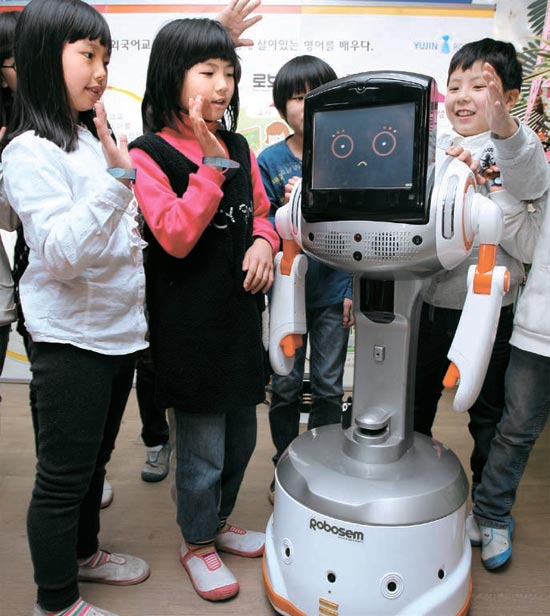
Robosem

These children look rather cheerful considering
they're at school during spring vacation.

According to the Joongang Ilbo, yet another type of robot teacher has been deployed at Howon Elementary school in Ansan Anyang, named 'Robosem,' an incorrect Romanization of '로보샘,' short, of course, for '로봇 선생님.' (By the way, how old is that contraction of 선생님? It seems pretty recent to me, but I may well be wrong.) At any rate, I hope getting rid of foreign teachers by taking their jobs is the only thing they're being designed for... and that the day they're deployed, fully armed, into Haebangchon never comes.

On the prowl


The Joongang Ilbo posted a few photos of a salk (wild cat) in Changwon with a duck. I've still never actually seen one before.

On the topic of animals, national assembly reps have provided statistics that prove wild boar incursions are on the increase:
Members of the National 119 Rescue Service were sent to capture or kill wild boars 103 times in 2006, but the number has gradually increased to reach 384 in 2010, according to Rep. Ahn Hyoung-hwan of the governing Grand National Party. [...]

Gyeonggi Province posted the most reports with 227, followed by South Gyeongsang Province with 175, North Gyeongsang Province with 148 and Seoul with 41.
I've posted on boars a few times before, and as a public service, I'll remind readers that an article five years ago
advised people not to run away or shout when they are faced with a boar on the street, adding that they should look straight into the boar’s eyes and promptly hide behind rocks or trees.

Monday, February 21, 2011

Reports on the suicide of a foreign teacher in Busan

As has been discussed online here and here, on Sunday morning Yonhap published the following report:
Foreign Hagwon Teacher Commits Suicide by Jumping Naked from the Waist Down

At 6pm on February 19th a security guard at an apartment in Millak-dong, Suyeong-gu, Busan informed police that he had discovered the body of American English hagwon teacher K (31), who had jumped from the 14th floor.

K removed his pants (and was naked from the waist down) and threw himself out a window of the apartment building, having covered his face with his shirt/top before jumping.

Police revealed that K had not been to work since receiving his monthly salary on the 15th, after having been handed over to someone connected with the hagwon the day before because he had been drinking and causing a scene at Gimhae Airport.

As there were empty soju bottles in his apartment and the place where he jumped, police are investigating the exact details and whether he might have waited until the soju was finished to jump.
There are 18 Korean-language articles about this online, and all but two mention in the title the fact that he was naked from the waist down, some adding words like 'shocking' or 'why?' to the title. Of the two that didn't mention that detail, one (by Newsis) was titled "Drunk Foreign English Teacher in his 30s Jumps from Apartment Building." Classy. Not to be outdone by Newsis, however, was the Seoul Sinmun, which published two reports. One in its Society section, and the other... well, here's the Naver search result:

외국인 학원강사, 하의 벗고 투신자살
서울신문 연예 2011.02.20 (일) 오후 1:42

Yes indeed... the entertainment section.

Thursday, February 17, 2011

The influence of the Peace Corps on English teaching in Korea

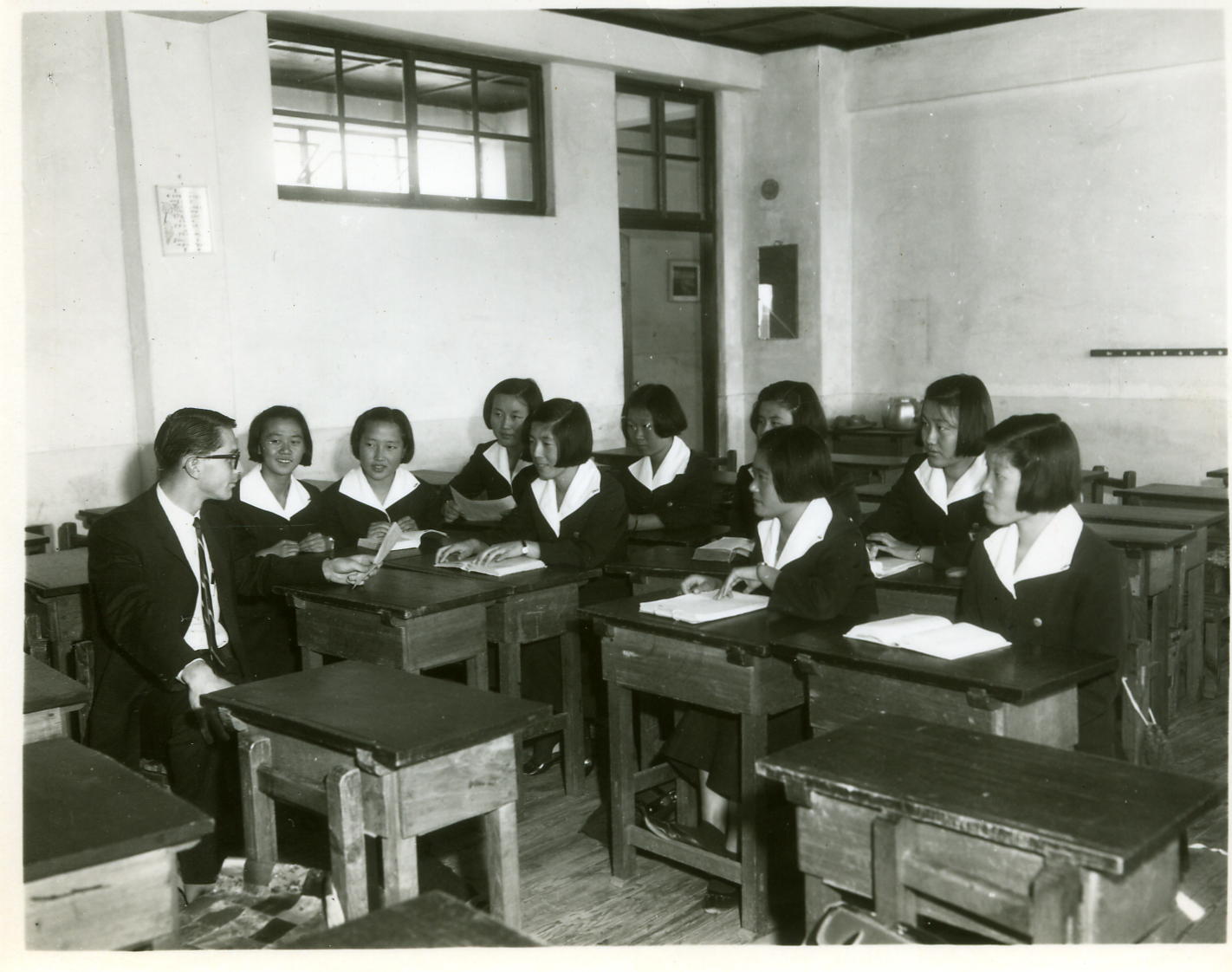
In 1966 the first contingent of over 80 Peace Corps volunteers was sent to Korea to teach English in high schools across the country. On July 20, 1968, Stars and Stripes reflected on their achievements:
Paved Way for Other Volunteers
Hail Peace Corps Work in Korea

By SPEC. 5 CRAIG GARNER
S&S Korea Bureau

SEOUL — The initial group of U.S. Peace Corps men, who cleared the way for other volunteers in Korea two years ago, is now leaving but an indelible mark on the nation's English education etched by their efforts remains.

About 70 are going back to America as their duty tours expire, while 14 have elected to stay on for an extra six months to a year, according to Loren Cox, acting director of South Korea's branch of the Peace Corps.

Peace Corps I — as officials designated the first group to distinguish them from five others that have followed — made its biggest impact by paving paths for future Peace Corps programs and emphasizing other areas where efforts could be made in Korea, Cox said.

"When they arrived here we put them mostly in Korean high schools teaching English," Cox said, "but then we found out they could be far more Valuable in middle schools (junior highs) where the groundwork for the English language is first laid."

Most Peace Corps I members — requested by the Korean Ministry of Education to teach English — went about subtly remolding English teaching in their schools by stressing methodology, English competancy among Korean teachers and the active nature of the language.

Charles Goldberg, of Philadelphia, set up an English language workshop along with 36 other Peace Corps volunteers in two central provinces to assist Korean teachers who, he said, have a tendency to portray English as a "mystic cryptogram" to their students.

Over-all, there are now about 250 Peace Corps members — one-third of them women — scattered throughout the nation, but Cox looks fondly upon the "pioneers" whom he accompanied here two years ago along with the director for Korea, Kevin O'Donnell.

"The first group came in here cold with only marginal training and did an incredibly successful job by our standards," Cox, a former Peace Corps worker in Nigeria, observed.

"Testimony to their success is the Korean Government's continuing request for more volunteers," Cox said. "Their requests simply outstrip our resources."

About 100 Peace Corps workers are now assisting the Bureau of Health and Social Affairs on projects ranging from sanitation and child care to TB and malaria control in small, remote villages hidden in the mountains of South Korea.

Early next year 100 more volunteers are coming to teach English in universities and teachers' colleges, according to Don Mosley, acting deputy director.

As the first group departs, varied reactions were expressed by individuals who had lived as Koreans live for two years.

"Some volunteers remained exuberant even as they left for home," Mosley said, "Others were extremely disappointed. But almost all agreed that it was a profound experience, one which will give them better depth and perspective in the future."

Goldberg, who has extended his work in Korea for another year, admitted he was depressed when communication and accomplishment seemed almost hopeless goals.

"But the job tests you, it makes you use your imagination and gives you a great sense of responsibility and a tremendous insight into another culture," Goldberg said.

Cox added: "The Korean Government and people are very exciting to work with. Their sense of development and potential is very real, yet they are quite willing to recognize their problems and to work with you to solve them."

Most of the Peace Corps I workers are going back to graduate schools in the states, many to study East Asian affairs.
I like the bit about the "mystic cryptogram." Photos taken by David Lassiter, a K-1 Peace Corps volunteer, can be found here - the source of the photo below:

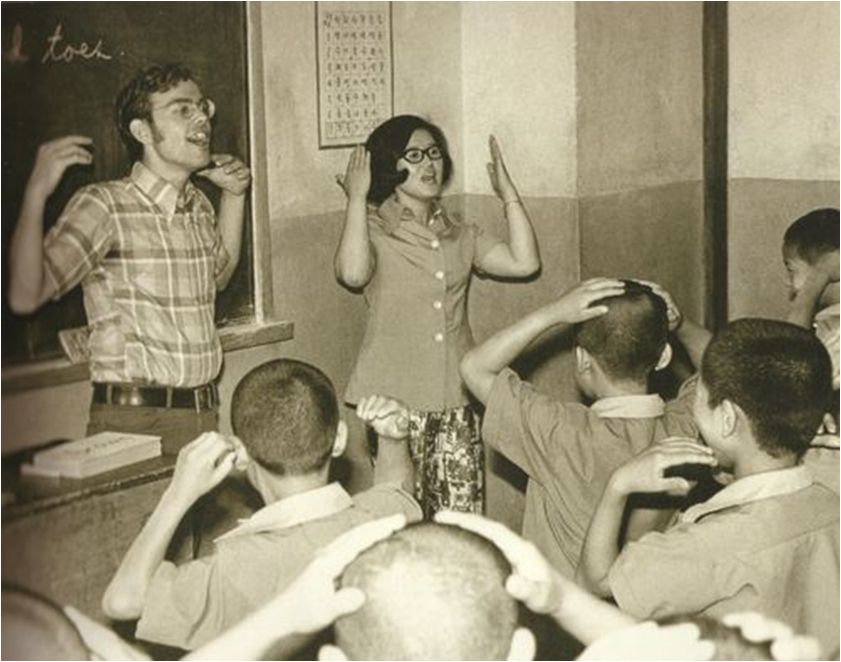
By the early 1970s, the Peace Corps volunteers were not only working in middle schools and teaching Korean teachers, but were also co-teaching with a Korean teacher in the classroom. These aspects of the native speaking teacher system in public schools remain in place today. More about the Peace Corps in Korea can be found in this article about a book (well worth looking at) published two years ago of photos taken by Peace Corps volunteers, such as the one below:


Kathleen Stephens, a former Peace Corps Volunteer who worked as an English teacher in the 1970s and the current US ambassador to Korea, reflects on her experiences here.

Wednesday, February 16, 2011

Newspaper accounts of the 1998 murder of a foreign teacher

Almost two years ago I posted some information I'd found online about the murder of a foreign teacher in Suncheon in 1998. I managed to find two references to his death in contemporary newspapers.

On page 6 of the September 26, 1998 edition of the Korea Herald, the following letter was published in the 'Letters to the Editor' section:
Hate Crime?
To the editor:
On Sept. 7, 1998, a Korean man walked into Sunchon Boys High School and asked if there was an American teacher employed there. Upon locating the American teacher, the man engaged him in a brief conversation, then proceeded to stab him in the back as he was walking away, going down the stairs from the second floor. The victim, Scott James Kennedy, 33, from North Dakota, died upon arrival at a hospital in Sunchon.

When interrogated, the attacker said that he murdered Scott because he didn't want Americans here teaching Korean children. It was also noted that he said foreigners should not be allowed to hold jobs here while many Koreans are unemployed. It should be noted that Scott's murderer had a history of mental instability and was institutionalized in the past.

Although Scott's murderer has a history of being mentally unbalanced, I believe that labeling him a "freak," "psycho" or "lunatic" would be an attempt to comfort and protect ourselves from the horrific crime.

Is this yet another repercussion of the economic crisis sweeping through Korea?

I do believe that most Koreans welcome foreigners here and encourage the teaching of their children by foreigners. If resentment is felt toward foreigners here, let us pray that it is not as deep rooted as it was in the case of Scott Kennedy's murder.

Elizabeth Gunther,
Sunchon
On September 12, 1998, the Grand Forks Herald published the following obituary on page 3:
Scott Kennedy, 33, Bismarck, formerly of Grand Forks, died Sept. 7, 1998, in Korea. Scott James Kennedy was born March 14, 1965, the son of James and Patricia Kennedy, in Crystal, N.D. He moved with his family to Bismarck in July 1966, where he attended and graduated from high school. He graduated from UND, with a degree in aviation administration. He worked in the airline industry until March of 1996. He moved to Sunch'on, South Korea, where he was teaching conversational English in Sunch'on High School.He is survived by his parents, Bismarck; sisters, Molly Kennedy, Bismarck, and Kim (Paul) Soderholm, Fargo; and a grandmother, Eileen Kennedy, Bismarck. Services: 3 p.m. Tuesday in Lutheran Church of the Cross, Bismarck.
As I mentioned previously, a search on KINDS turned up nothing about his death in Korean-language newspapers; nor were there news reports about it in the Korea Times or Korea Herald.

Tuesday, February 15, 2011

Foreign Language Teacher Shortage

The French foreign language teacher scandal of 1984

Prelude 1: The 1983 Law "Limiting Aliens' Residence Period" and banning "unqualified" foreigners from working.

Part 1: Le Monde and what came before
Part 2: Korea is "Ali Baba's" Cave
Part 3: Seoul Should not be a Workplace for Parisians
Part 4: In private foreign language classes, there are a lot of ‘fraud teachers’
Part 5: Jibberish
Part 6: 'I Want to Strike it Rich in Seoul Too' - Continuous Job Inquiries by the French
Part 7: Foreigners Enjoy Better Life With Mother Tongues
Part 8: Foreigners and Foreign Languages
Part 9: Sickening Face

Part 10: Barking Up the Wrong Tree
Part 11: The First Sanctions on Foreigners Working Illegally
Part 12: All Private Lessons by Foreigners Prohibited
Part 13: Institutes Asked to Hire Eligible Foreign Teachers
Part 14: "Seoul Wind"
Part 15: Foreign Language Teacher Shortage
Part 16: Troublemaking vagabond foreigner story finally airs

Part 15:
Foreign Language Teacher Shortage


On October 9, 1984, less than three weeks after the new rules were announced for foreign teachers, the Kyunghyang Shinmun published an article titled "Foreign Language Teacher Shortage." As we will see, however, this was due to the bill passed in late 1983 which came into effect in July 1984. Thanks to David Carruth for completing the translation.


Foreign Language Teacher Shortage

“Hiring Drifters” Blocked
From July Qualifications Strengthened,
Company Employee Training at a Standstill
Contract invitations prohibitively expensive
"Flexible enforcement [needed] for securing exports and the 1988 Olympics"

Foreign language education at trading companies and businesses, various social organizations, and private foreign language hagwons is almost at a standstill or is in danger of being suspended

From July 1 the Ministry of Justice Immigration Office revised related regulations to prevent illegal employment of foreigners, and foreigners who work without permitted residency qualifications face up to three years in prison or a fine of 3,000,000 won, while those who employ such people face a fine of up to 1,000,000 won. Because of this, it is difficult to find foreign teachers.

In addition, the Immigration Office recently flexed its administrative muscles by sending a memorandum to individual businesses instructing them to only hire people with legal work contracts as teachers and even went so far as to issue fines. As a result, it is increasingly hard to find foreign teachers.

As a result, with the 88 Olympics ahead and the more than 5300 members of the Korea Trade Association and general trading companies wanting to expand trade, they are of the opinion there is a growing need for foreign languages at this time and that to halt foreign language education would be a great blow nationally, [and so they want] related authorities to relax teacher employment rules.

Currently only a small minority [of companies] such as the Samsung group sponsor teachers and have signed legal work contracts with foreigners. Most companies and organizations will not be able to follow the Ministry of Justice’s instructions.

In the case of the Daewoo group, which had been implementing a three-month foreign language education program for 30 employees at a time on company wide basis as well as offering English and Japanese instruction in its affiliates, they had previously hired 4-5 foreign instructors. Currently, however, they are at a loss after failing to hire even a single teacher. The Daewoo group had even drawn up plans to offer classes in additional languages but now they are back at the drawing board.

The situation of other leading groups and companies is almost the same.

One person connected with employee training at the Hyosung group said candidly, "Nearly all of the instructors who are currently teaching foreign languages at the various companies are not "vagabond foreigners" but rather people who have come to work either in business or religion/culture and teach in their spare time." He further noted that "following the instructions of the Ministry of Justice would be hugely expensive since it would necessitate going overseas and preparing a legal contract of employment before sponsoring an instructor."

Also, a trade association representative said, “Our country shouldn’t carry the stigma of being a “paradise for vagabond foreigners” but in circumstances where the need for foreign languages gets higher every day, the rules should at least be relaxed so as not to disrupt foreign language education for companies.”

Hagwons teaching foreign languages have also taken a considerable blow.

S Hagwon in Jongno previously employed 4 foreign teachers but now has only one American, and has been forced to drastically reduce the number of classes.

B Hagwon owner Go In-gyeong (39) said, “It’s true that there were some shoddy private hagwons that hired unqualified foreign teachers, but it’s hardly a desirable state of affairs for one hagwon after another to have to shut its doors because they aren’t able to sponsor foreign teachers. The Ministry of Justice should take measures to allow [teachers] to lecture after passing a selective screening to prepare for foreign trade and the Olympics.

Currently there are 220,000 foreigners in Korea, and the number of long-term sojourners staying for more than 3 months (excluding diplomats and the military) has reached 40,000 people, but only 320 foreigners have received work permits.
It shouldn't be surprising that there was a shortage of teachers once the new rules, with their fines and jail time as punishment, came into effect. In fact, there was also a shortage of teachers that followed the changes to the E-2 visa in 2007. What seems surprising is that more changes were implemented before the effects of the previous change could even be measured.

It seems, with only 320 out of 40,000 long term foreigners getting work permits, that the government wasn't as strict back then, but without a breakdown of the different visas (such as we saw here), it's hard to discern much from that last sentence. The statement "Nearly all of the instructors who are currently teaching foreign languages at the various companies are not "vagabond foreigners" but rather people who have come to work either in business or religion/culture and teach in their spare time" is interesting, as it helps to dispel the 'paradise for vagabond foreigners' stereotype the media had been cultivating. Note its absence in the Korea Times article from the following day, which doesn't add much, but which I'll post anyway.


With this the series of 'French teacher scandal' articles is almost complete. I recently managed to dig up another short article, which will be posted soon.