Monday, February 14, 2011

Institutes Asked to Hire Eligible Foreign Teachers

The French foreign language teacher scandal of 1984

Prelude 1: The 1983 Law "Limiting Aliens' Residence Period" and banning "unqualified" foreigners from working.

Part 1: Le Monde and what came before
Part 2: Korea is "Ali Baba's" Cave
Part 3: Seoul Should not be a Workplace for Parisians
Part 4: In private foreign language classes, there are a lot of ‘fraud teachers’
Part 5: Jibberish
Part 6: 'I Want to Strike it Rich in Seoul Too' - Continuous Job Inquiries by the French
Part 7: Foreigners Enjoy Better Life With Mother Tongues
Part 8: Foreigners and Foreign Languages
Part 9: Sickening Face

Part 10: Barking Up the Wrong Tree
Part 11: The First Sanctions on Foreigners Working Illegally
Part 12: All Private Lessons by Foreigners Prohibited
Part 13: Institutes Asked to Hire Eligible Foreign Teachers
Part 14: "Seoul Wind"
Part 15: Foreign Language Teacher Shortage
Part 16: Troublemaking vagabond foreigner story finally airs

Part 13: Institutes Asked to Hire Eligible Foreign Teachers

On September 22, the Korea Times published the following article. For more information about the bill, see part 13.


Some interesting figures there: Of "10,000 learning institutions across the nation," 202 institutes specialized in foreign languages, with 93 of those being in Seoul. It's uncertain what these terms mean, however, considering the Joongang Ilbo had earlier reported that
In Seoul there are around 70 foreign language official institutes, and over 500 private foreign language schools. This present situation of the foreign language craze and especially the rapidly-multiplying foreign language institutes is due to a change in the existing unlicensed school report system in 1980, which led to a sudden increase in the number of schools.
It's uncertain which statistics are correct, or what the difference is between an 'official institute' and a private one. As for this -
Foreigners eligible to teach at private institutes should have at least a junior college education even if they hold valid employment visas.
- the article fails to mention that a new visa had been put in place. I'm not sure what 'junior college education' means, but in 2001 I had coworkers who had 2 year college degrees with a TESOL certificate, which was valid until 2001 or 2002, when the rules changed.

Thursday, February 10, 2011

Worrying about the negative influence of drugged foreign teachers

On the topic of foreign teachers and drugs, here's a letter from a reader posted at the Munhwa Ilbo's site on November 24, 2010 in the "public opinion garden"
Many Native speaking instructor drug crimes [lead to] worry about their bad influence on young students

Gang Myeong-sun, Seoul, Gangseo-gu

These days even households in difficult circumstances send their children to English hagwons. The main reason for sending them to an English hagwon, besides studying for the entrance examination, is because there is a native speaking teacher* at the hagwon. The chance to hear proper English pronunciation is the reason for the importance of English hagwons’ native speaking teachers. However, there have been many cases of native speaking teachers bringing on criticism because of drugs.

Not long ago, police data showed that 30% of foreigners caught for drug offenses were native speaking instructors. Methamphetamine and marijuana are cleverly brought from the US, smoked, and of course sold in entertainment districts. What our students are learning from these people is very worrying. With the sudden increase in drug smuggling by foreign instructors, the possibility that the hand of drugs might affect young students rises. Students are very well disposed towards foreigners, especially white hagwon instructors from the U.S. and Canada who use English. So, because they follow well and have a sense of closeness [with these teachers], circumstances can occur in which they learn about drugs from hagwon instructors who act without restraint.
* She uses the term 교사, or teacher, to describe what should be a 강사, or instructor in a hagwon.

I suppose, when the Donga Ilbo quotes immigration officials as saying things like "Incidents of some native speaking instructors taking drugs during lectures have been never ending," it's easy to understand how she might worry about the influence of foreign teachers upon impressionable students. Just for fun, here's another example of exaggeration from the Supreme Prosecutors office:


On pages 212-213 of the 2007 Supreme Prosecutors Office (SPO) report on Drug Control in Korea, under "Summary of drug trends in 2007," was written
The number of drug-related arrests was 10,649 in 2007, an increase of 38% from 7,709 in 2006, surpassing the 10,000 person mark for the first time in five years since 2002. This rise was mainly due to a surge of small scale internet trafficking for methamphetamine, and marijuana smuggling and abuse by foreign instructors in schools or language academies from English-speaking countries like the U.S. and Canada.
According the the SPO stats in Ben Wagner's NHRCK report, there were 24 teachers caught in 2007 for drug crimes - out of an increase of 2,940 arrests. Obviously, since foreign teachers made up a whole 0.82% of that increase, it was necessary to describe the increase as being "mainly due" to them.

Wednesday, February 09, 2011

More information on the new E-2 drug testing regulations

The Korean media has finally picked up on the new drug testing regulations for E-2 visa holders. The Korea Times reported on it as well:
The government has introduced an up-to-date drug testing kit as part of moves to strengthen drug monitoring of foreign English teachers at schools and private institutes.

The Ministry of Justice said Monday that it revised regulations governing drug testing of foreign English teachers, which went into effect from Feb. 1. [...]

It is said that the TBPE test, employed in December 2007, has fallen short of discerning test-savvy drug users. [...]

Those who test positive will face police investigation and, if confirmed, will be deported and banned from landing on Korean soil for at least the next five years, according to immigration officials.

The employment of the new testing kit was the result from repeated calls from narcotic officers and experts who claim that the TBPE test is not capable of detecting the use of all kinds of sought-after drugs either at home or abroad.

“The new kit proved to correctly detect a wider range of drugs, including marijuana,” said Yoo Byung-gil, deputy director of visa and resident division at the Korea Immigration Service. In fact, TBPE test, based on urine, cannot effectively detect marijuana use, he said.

It also reacts to caffeine and some elements of cold medicine, allowing some test-savvy drug users to capitalize on the shortcomings to avoid being caught, the official said. The new test will be conducted at private and public hospitals proven to be capable of conducting drug tests by the immigration office, starting April 1. [...]

“So far, all medical clinics, including ill-prepared ones, have conducted the test, denting the credibility of the test results,” the official said. “But the new system will significantly improve credibility.”
One wonders if "test-savvy" means "knows to stop smoking a few weeks before the test." Also, the fact that the "TBPE test, based on urine, cannot effectively detect marijuana use" is why there was a separate marijuana test. As far as I can tell, the new tests would also involve urine testing (judging by various tests available in the US), though I suppose the higher cost of other testing methods might not be an issue since the government wouldn't be paying for the test.

Anti English Spectrum also reported on this, and were nice enough to provide the name of the actual government announcement. A Google search for "법무부고시 제2011 - 23호" turns up this page at the Korean Hospital Association, as well as this page at the Korea Law website, which begins:
Immigration Control Act Enforcement Regulation Article 76, Clause 2 Related Attachment 5-2, Announcement of drug testing provision and testing method for those eligible for conversation instruction (E-2), who should submit an employment physical examination when applying for alien registration, and of the requirement that the medical institution be designated by the Justice Minister.
Oddly enough, at that site the above introduction is followed by this note: "[Enforcement [begins] 2011.02.01] [Ministry of Education, Science and Technology Announcement 2011-23, enacted 2011.01.27]" The KHA site does not have an reference to this originating with MEST, but it would be quite interesting if it did, considering the disagreements the MoJ and Education offices have had in the past over HIV testing of foreign teachers.

This was also reported by Maeil Gyeongje, Newsis, YTN and the Donga Ilbo, which all used the title "Drug Testing of Native Speaking Teachers in Korea Strengthened." According to an immigration official quoted in the Donga Ilbo article, "Incidents of some native speaking instructors taking drugs during lectures have been never ending and this is to block this from happening in advance." While I'm sure there are a few idiots out there, I find it hard to believe, considering the prices illegal drugs fetch in Korea, that people would take them in order to get high at work. Is that really likely? Much as AES (and immigration) like to conflate 'foreign teachers went to a free HIV testing clinic' with 'foreign teachers have AIDS,' police (and immigration) like to conflate 'used drugs in their free time' with 'were high at work.' One of the more amusing examples of this was a Yonhap article from 2009 which tried to insinuate teachers who took ecstasy on the weekend might have still been high on Monday by following the word 'weekend' with '(Saturday, Sunday)' in order to suggest that they might have gone out on Sunday night (a prime clubbing night, of course - and as if Yonhap's readers don't realize what nights people go out on the weekend).

At any rate, much as the low crime rate of foreign teachers cannot be trusted due to "undisclosed crimes" "test-savvy" foreign teachers and ill-prepared medical centers are "denting the credibility of the test results," requiring "strengthen[ed] drug monitoring of foreign English teachers."

Tuesday, February 08, 2011

The 1983 Law "Limiting Aliens' Residence Period" and banning "unqualified" foreigners from working.

The French foreign language teacher scandal of 1984

Prelude 1: The 1983 Law "Limiting Aliens' Residence Period" and banning "unqualified" foreigners from working.
Prelude 2: "Koreans have a weakness for Foreigners"
Prelude 3: 10,000 illegal sojourners or immigration cheaters... the days and nights of Itaewon

Part 1: Le Monde and what came before
Part 2: Korea is "Ali Baba's" Cave
Part 3: Seoul Should not be a Workplace for Parisians
Part 4: In private foreign language classes, there are a lot of ‘fraud teachers’
Part 5: Jibberish
Part 6: 'I Want to Strike it Rich in Seoul Too' - Continuous Job Inquiries by the French
Part 7: Foreigners Enjoy Better Life With Mother Tongues
Part 8: Foreigners and Foreign Languages 
Part 9: Sickening Face
 
Part 10: Barking Up the Wrong Tree
Part 11: The First Sanctions on Foreigners Working Illegally
Part 12: All Private Lessons by Foreigners Prohibited
Part 13: Institutes Asked to Hire Eligible Foreign Teachers
Part 14: "Seoul Wind"
Part 15: Foreign Language Teacher Shortage
Part 16: Troublemaking vagabond foreigner story finally airs

Prelude 1: The 1983 Law "Limiting Aliens' Residence Period" and banning "unqualified" foreigners from working.


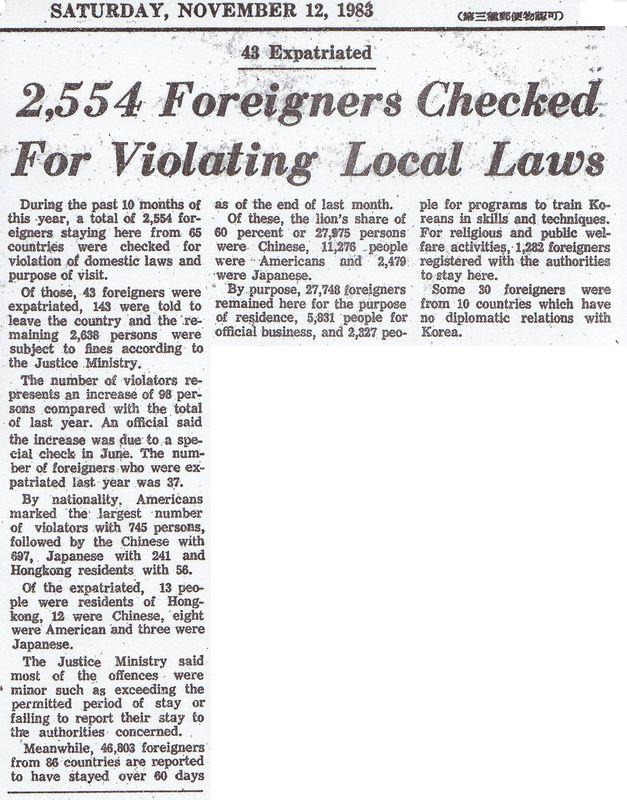
The following article was published by the Joongang Ilbo on November 11, 1983. Many thanks to David Carruth for translating this article.


Ban on Unqualified Foreigners Teaching at Institutes
On November 10th, the Ministry of Justice moved to prevent unqualified foreigners from teaching classes at foreign language academies inside Korea by making changes to the immigration regulations. The bill containing the new regulations was submitted at this session of the National Assembly and is scheduled to go into effect from July 1st of next year.

The bill makes it mandatory for anyone interested in hiring foreigners to work in Korea to select people with qualifications appropriate to the form of employment.

The purpose of the bill is to protect the jobs of Koreans by preventing foreigners from obtaining work as teachers at foreign language academies or employees at international firms. However, the changes would not apply to those coming to Korea for the purpose of engaging in missionary work or traveling.

In addition, the bill enables more efficient administration of the foreign population by limiting the number of times foreigners can extend their residence period in Korea to a maximum of two.
______

This bill, which came into effect in July 1984, does not seem very punitive, and says only that it is "mandatory for anyone interested in hiring foreigners to work in Korea to select people with qualifications appropriate to the form of employment." The report makes it clear that these rules were not limited to only foreign teachers working at language institutes. Here's how the Korea Times reported it on the same day (click to enlarge):


Interesting that foreign teachers were mentioned so prominently in the Joongang Ilbo article the same day, but were not mentioned at all in the Korea Times (a paper foreign teachers might actually be reading). It seems this law also led to the change from a 60 day stay without registering to the 90 day stay which is in place now. The next day, the Times published the following article:


Interesting to look at the breakdown of foreigners in the country at the time: Of 46,803 foreigners from 86 countries staying over 60 days, 27,975 were Chinese, 11,276 were American, and 2,479 were Japanese (though Americans led in the illegal overstayer department). The fact that 2,327 people were there for programs to train Koreans in skills and techniques and 1,282 for religious or public welfare activities also highlights how Korea was almost reaching the point of being 'developed' (hence there were still a number of people there for welfare or training purposes), while the 5,831 there on business point to its growing economy (as do the growing number of language teachers being able to make a living in Korea, as well as more illegal endeavors like smuggling).

These statistics give us some idea of what things were like in Korea prior to the 'Le Monde' scandal which occurred in August 1984 - a month and a half after the law described above came into effect. It would lead to new visa rules for foreign English teachers.

Monday, February 07, 2011

Canadian Embassy panel discussion on perceptions of foreign English teachers

On Sunday, February 20, the Canadian Embassy will host an event for foreign English teachers. I'll be speaking at the session dealing with perceptions of foreign English teachers in Korea, and presentations by several speakers whose names should be familiar will precede a discussion. More information follows below. As space is limited, anyone wanting to go should sign up soon, and keep in mind also that the conference is open to anyone, not just Canadians.


The Embassy of Canada is pleased to host two sessions to which we would like to invite members of the English teaching community in Korea. Please join us for a Sunday afternoon of informative presentations and informed discussion over coffee and sandwiches in our Embassy’s Schofield Hall.

Education in/au Canada
Canadian teachers in Korea are potential sources of information when approached by students seeking to learn more about studying options in Canada.This information session will present the Embassy's education marketing strategy around the Education in/au Canada brand, and how teachers can play a role in its success.

Presenter: Trade Commissioner on education, Embassy of Canada
Time: Doors open at 13:30
Presentation: 14:00 –14:50

English teachers in Korea -Perceptions and Challenges
The Embassy of Canada will host a panel discussion on perceptions of foreign English teachers in Korea. Our invited speakers will address issues such as the portrayal of foreign English teachers in the media, statistics on foreigner criminality, society and stereotypes, in addition to legislation which affects teachers in Korea. With the goal of promoting discussion, the Embassy invites all current and former teachers of English to join us and to actively participate in the discussion.

Time: 15:00-16:30
Speakers:
•Michael Hurt (Member of the Presidential Committee for Nation Branding, author of the blog Scribblings of the Metropolitician)
•Benjamin Wagner (Associate Professor, Kyung-hee University Faculty of Law)
•Matt Van Volkenburg (Author of the blog Gusts of Popular Feeling, English teacher)
•Robert Ouwehand (Former National Communications Director for ATEK, author of the blog Roboseyo)

If you would like to attend this event, please send an email to SEOUL-EDU@international.gc.ca
Please include the following details:
E-mail Subject: Registration Feb 20 2011
Name:
E-mail address:
Current employment (name of institution):
I will attend : Session One / Session Two / or Both
Due to limited space, please be advised that only the first 75 RSVPs for each session will be admitted.
* Please note that there is no public parking space at the Embassy for visitors. There are commercial parking lots near the Embassy, and individuals will need to cover their own parking fee.

Tuesday, February 01, 2011

"The main culprits in drug smuggling are native speaking teachers"

On January 30, Newsis published the following article:
Smuggling of New Kinds of Drugs ↑, Smuggling drugs by plane ↓

[Daejeon] Last year smuggling of new kinds of drugs increased, while smuggling by plane decreased.

On the 30th, the Korea Customs Service announced that last year 200 cases of smuggling were uncovered, totaling 14 kilograms of drugs worth 19.4 billion won.

The number of cases increased 33% over the year before, but the weight and monetary value of the drugs seized decreased by 67% and 68% respectively.

3.3 kg was seized due to smuggling by air travelers in 32 cases, a decrease from last year of 90% and 14% respectively. Sea travelers accounted for 2.4 kg seized in 13 cases, an increase of 15% and 44% respectively.

By type of drug, 6414 grams of methamphetamine was seized in 74 cases, 5451 grams of marijuana in 53 cases, 605 grams of JWH-018 in 31 cases, and 1481 grams of other drugs were seized in 42 other cases.

According to 'An Analysis of drug arrest trends in 2010,' released by the Korea Customs Service that day, the main characteristic of last year's drug smuggling trends was the large increase in arrests of smuggling new kinds of drugs, increasing from 11.1% of total cases in 2009 to 28.1% of cases last year.

The kinds of new drugs being smuggled are becoming more diverse, with 7 kinds in 2009 and 18 kinds in 2010.

The smuggling of new kinds of drugs was mainly by foreigners, and there were 95 foreigners arrested for drug smuggling [in general], an increase of 11.7% from the year before.

Among these, 28 were foreign native speaking teachers, or 29.4% of the total number of foreigners arrested.

In the past foreign native speaking teachers smuggled mostly marijuana, often through the mail, but recently there has been a great increase in cases of smuggling new kinds of drugs such as JWH-018 or Kratom.

Of those foreign native speaking teachers arrested, 18 were Americans, 5 were Canadians, 2 each were from New Zealand and England, and one was from Ireland.

Cases where international mail or courier were used increased 53% and 44% respectively but by weight dropped from 281g in 2009 to 70g last year, indicating an increasing trend towards smuggling drugs for personal use.

Meanwhile, various methods of concealment when smuggling for personal use were discovered such as in clothing (27 cases), envelopes, (23 cases), books, (13 cases), backpacks, (10 cases), CD-DVDs (10 cases), postcards (9 cases), business envelopes (7 cases), and plastic containers (7 cases), indicating that smuggling methods are becoming more clever.
From there it goes on to talk about how the customs service plans to block drug smuggling in the future. The story was reported in the Herald Gyeongje (twice), Money Today, Morning News, and the Kookmin Ilbo (three times). While the Kookmin Ilbo's title in the first two (online) articles focused on a (Korean) female university student who smuggled 400 ecstasy pills from the US, they decided to go with a slightly different title in their hard-copy edition: "The main culprits in drug smuggling are native speaking teachers... responsible for 30% of crimes by foreigners."

While foreign teachers are certainly overrepresented in the 'number of those busted' category, the question to ask might be what amount of drugs they are responsible for bringing in. As noted here (here specifically) foreign teachers usually sent "a few or tens of grams of cannabis [...] via mail or express consignments." On the other hand, last year went a bit beyond this, what with this guy bringing in 3,400 grams of hash from Hongkong in his rectum (over several trips) and this girl having a cake with 388 grams of pot (or was it a 388 gram cake with pot in it?) mailed to her.

At any rate, this announcement is well timed, considering that on January 26, the Donga Ilbo (via Brian in Jeollanam-do) announced that foreign teachers would face even stricter drug screening by the government:
The [justice] ministry will announce a revised law on immigration control that requires those suspected of drug use to undergo two tests before employment as English teachers on the E-2 visa. The law will take effect from Feb. 1.

Under the revised law, a would-be teacher should get tested for immunity with a drug diagnosis reagent authorized by the Korea Food and Drug Administration. If the test is positive, he or she must undergo another test using a mass spectrometer.

The ministry will test for methamphetamine, cocaine, opium and marijuana. If the second test is positive, issuance or extension of a visa will be denied.
A few things to note:

This was only reported in the above Donga Ilbo article. Other than the Korean translation provided by the Donga Ilbo, this hasn't been reported in the Korean-language media. Neither has AES reported on it. Which is a little odd.

It seems a little unclear at first, but after a few readings I think I understand it. The operative word seems to be that it "requires those suspected of drug use to undergo two tests [emphasis added]." Basically, "a would-be teacher should get tested" once with this new kind of test (if it is actually new), and then those who turn up something odd in the first test should get tested further. A bit of reading about testing in the US seems to suggest this is pretty normal protocol there, where a positive reaction should not be taken as the final result, but is just the prelude to further testing to confirm the presence of drugs.

Also, it seems to me that when laws are announced, they usually come into effect months later, not 5 days later. The same thing occurred with the new E-2 regulations earlier this year, with an article on July 9 announcing new regulations to begin 6 days later. Another odd thing was the fact that these new measures were announced 6 months after the most recent news report of a drug arrest of a foreign teacher. Not to say that there haven't been arrests since, but here are the arrests reported this year:

February 7 - An American teacher in Incheon is arrested for mailing himself 171 grams of pot cookies.
March 22 - the three Korean American gangsters (including one wanted for murder) were arrested along with 5 others booked for marijuana.
March 24 - A Korean American teacher in Ulsan was arrested for having a grow op, and two others were booked.
April 13 - four foreign teachers are arrested in Daegu for hash. On May 11 more details become known (one smuggled 3,400 grams of hash from Hongkong in his rectum) and up to four more are arrested.
April 14 - One American teacher is arrested in Seoul for smuggling ecstasy and pot (40 pills and 374g, respectively, in his Taiwanese girlfriend's underwear) , and nine other teachers are booked.
May 10 - Two foreign teachers including a Kiwi are busted in Seoul for importing 700g of JWH-018.
June 10 - An American in Jeju is busted for ordering 44 pot seeds. He later has to pay a fine.
June 16 - In Incheon, two university English teachers, including a Canadian are busted for importing Kratom, and 6 English teachers, including a Canadian, are busted for mailing themselves cookies and snacks made of pot.
June 21 - A female American English teacher in Jeju gets caught for having a 388 gram pot-cake mailed to herself. She later gets a suspended sentence.
July 20 - An American middle school English teacher in Busan is busted for importing some kind of new drug. He later gets a suspended sentence.

So that's a total of 34 - 38 arrests in 11 cases reported in the media. At any rate, while it's likely more arrests occurred, it seems a little odd that new measures have been announced after 6 months of no reported arrests and very light sentences in the three cases where the outcomes were reported.

Monday, January 31, 2011

Queen Bee; or, Return to the Hive

In the comments to this post, seouldout pointed out Korean movies from the mid 80s that dealt with foreign teachers. Today I'm going to look at the 1985 film Queen Bee (여왕벌) (Note: some NSFW images are below.)

A synopsis in English can be found here, while a longer synopsis in Korean is here, and a poster (likely a vhs cover) is here. I was at the Korean Film Archive in Digital Media City this week (which is now very close due to the AREX line being completed) to catch a screening of Declaration of Idiots, and afterward went up to the film library to see if Queen Bee was available. It was (on VHS), and armed with a camera I took shots of some of the more interesting parts of the film. It seems it was shown on TV last year, so there are .avi files floating around on the internet (but to join Korean sites to download it you need all ten fingerprints, a blood sample and a dodo feather, so that might take awhile).

Here's the poster for the film:


I'm sure you'll never guess from the poster what happens in the film or how foreigners are portrayed.

Queen Bee begins with a woman dressed as a traditional dancer and using what looks like a traditional iron, heated in flames, to burn lines into a drawing (of a threesome) on a piece of paper. Then a mostly-unseen black man bursts in and rapes her.

The woman is the mother of Mee-hee (played by Lee Hye-young, who played the principal in Boys over Flowers) and the synopsis of the movie (found on many sites in Korean) says she was with an foreign English teacher and when they broke up, she felt ruined and became an Itaewon girl. I don't remember hearing any mention of English teachers in the film (there were no subtitles, so I may well have missed it, though it would be odd not to pick up those particular words). In fact, many of the foreign men we see - at least at the beginning - speak some Korean.

At any rate, the film then cuts to the present day and we see Mee-hee practicing in her dance studio and teaching young girls traditional dance.


We then meet her sister, Jeong-hee (who's a student, played by then 17 year-old Jo Yong-won (seen here two years earlier)), and they wash each other at the sauna.

(Photo from here.)

From there we move into the hive of scum and villainy known as... Itaewon. Mind you, it's Itaewon in 1984 or 1985, so it looks a bit different than today. The action mostly takes place at the Hippodrome club, where 80s music and fashions abound. Below, Mee-hee verbally fends off a foreign woman who has accused her of taking her guy. It's about the only time in the movie a foreign woman has a speaking part.


We meet a few of her female friends, all 'Itaewon girls,' and then she leaves with the guy below, whose name I forget.


They're confronted by Gyeong-su, a friend of Mee-hee's who has feelings for her and who wants her to change her ways (but whose job - working at a pig farm apparently on the bank of the Jungnangcheon near where the girls live - may not be so appealing). The foreign guy leaves him in the dust and sneers at him.


The foreign guy doesn't end up in much better shape, however. After passing through another club (where a woman is having sex with a foreigner on a chair in the corner), they have a meal at a haejangguk place, where the foreigners speak varying degrees of Korean (and apparently like Korean food; "Where's the kkaktugi?" asks someone). She teaches him to order and after eating they go to his place and Mee-hee whips him and then lets him climb all over her, but before he can do the deed, Mee-hee uses her whip to knock him off of her and walks away. He isn't too happy.


She returns home, and the next day her sister asks about her night ("I didn't hear you come in last night"). Mee-hee meets another bearded American the next night who she admonishes for not speaking Korean to her. He tells her, "I thought I'd practice my English." Also at the restaurant is the guy from last night, who is friendly enough with her.

Mee-hee's sister Jeong-hee goes out with a less-than attractive Korean friend that night to Itaewon (of all places!) and he is apparently affected by the lust in the air, and upon seeing a yeogwan, tries to pull Jeong-hee towards it. She refuses and flees down the steps (the tall ones at Itaewon's east end) and is almost hit by a car. The driver, a foreigner, steps in when her date arrives and she makes it clear she doesn't want to talk to him.


She gets in the car to escape and they drive off. Her date yells, "This is Sadaejuui! Sadaejuui!!" (following the strong, or toadyism).


The guy offers to drive her home and tells her his name is Richard, and that he's a professional photographer. She thanks him and says she's a student. He tells her "I pray for God to see you again" (he sounds German, but is supposed to be American). He gets his wish, meeting her on a bridge while out taking photos a few days later, and he takes her to his studio. On the walls are artistic photos he's taken which seem to have a lot of breasts in them.


Mee-hee is shown teaching and practicing at the dance studio where other dancers rehearse a performance which seems to mix traditional Korean and modern dance. She heads off to Itaewon and bumps into the foreign guy we saw first who tells her, "You tease me - try me! I've got to show you how good I can be in bed!" Jeong-hee, meanwhile finds out what her sister is up to in Itaewon, and follows her. This helps her to feel it's okay to date Richard, who takes her out to dinner and then they head to Itaewon to go clubbing. They walk by Wendys (anyone remember where in Itaewon that was, exactly?).


At Wendy's is the foreign guy from the first night and his friend (who sounds Scottish).


What follows is this conversation:

A: ____ will come from Hong Kong in a few days with the goods.
B: Are you sure nothing will go wrong?
A: Don’t worry about it. I will not let anything happen to spoil your dream life of Itaewon.
B: You can have your three essences of life here: women, liquor and joints. That’s why I like this country so much. I’m gonna make a record of having affairs with a hundred girls.
A: Meehee’s always on her high horse like a queen bee.
B: I’m afraid it’s not that easy for you. She’s not like other Itaewon girls. She chooses her own men, and doesn’t give a damn about the guy when she conquers them.
A: I’ll wait and see. Hey, your visa has expired, hasn’t it?
B: I’ll have to rip off a girl.

Just then a girl sits down, and the guys smile at each other.

Jeong-hee is out dancing with Richard; Mee-hee sees this and walks away in disappointment.


The first foreign guy sees Mee-hee leave and is disappointed, but Mee-hee's friend decides to cheer him up with a little bathroom sex. However, they are disturbed by evil black man, who asks him where the hell Steve is.


Steve was seen at the beginning of the movie with another of Mee-hee's friends.


The film cuts to Steve, who is currently having sex with the girl above, who tells him she loves him and that he belongs to her. Suddenly, evil black man bursts into the room, pulls Steve off of her and throws him to the ground saying, "How can you have fun here while I was in jail!?"


Steve tells him that the girl on the bed is a gift for him, which cheers him up. Evil black man smiles and strips, while the girl looks on in horror. As he rapes her, Steve watches with an amused look on his face.


Just to clarify, this is a South Korean movie.

Jeong-hee and Richard leave Itaewon, but they guy she went on a date with earlier tries to approach them once they're in the car. Richard slams the door into him and knocks him down before driving off.


Mee-hee's friend Gyeong-su (who is trying to save he from this life) finds him and helps him up. They go off drinking makkeolli together. Meanwhile, Steve and evil black man exit the motel they were in (without the girl).


Evil black man says, (with an Australian accent, by the way) "Yeah man, that was a good time. That’s what friends are supposed to be like. She was terrific. In fact, I think we’ll have to do this every night."

The hotel owner splashes water (or soju?) like holy water upon their path after they’ve left and spits after them.

The scene then cuts to Mee-hee walking down the street. Evil black man has obviously met up with the foreign guy from the beginning, who obviously devises a plan for revenge: sic evil black man on Mee-hee. He points her out and says how hot she is, which accomplishes the desired effect:


Evil black man approaches, and the usually calm and cool Mee-hee is scared. He pushes her off the street and up against a wall where he starts pulling off her clothes. Gyeong-su walks by and sees this and intervenes, but is knocked down. Foreign guy grabs him and seems to want to force him to watch:


Instead, evil black man slaps him around until police sirens scare them away. Mee-hee is thankful to Gyeong-su and takes him to a yeogwan where she undresses and offers to sleep with him. He instead covers her up, tells her to get her act together, and leaves.

Meanwhile, after promising to be his model, Jeong-hee poses for Richard. He happily takes photos, which progress to nudes...


...which progress to a happy Richard and... well, I can't tell if Jeong-hee is enjoying herself or in great pain (anyone who has seen Gang Su-yeon in the Surrogate Womb will have seen a similar performance).


The next day we see them embracing in front of Jeong-hee's apartment, where Richard tells her, "I love you baby, I want to marry you." Mee-hee sees this and confronts Jeong-hee, telling her not to make the mistake she did. The argument becomes heated, Mee-hee slaps Jeong-hee, and then the conversation continues as Jeong-hee takes a shower (when I tried to find this movie on Emule, that scene was the only clip that turned up, for some strange reason).

Mee-hee can't make the danger that foreigners pose sink in, though it does for the viewers, who are treated to a flashback of her mother's rape by another evil black man.


Alas, Mee-hee was right. Foreign men are scum. Jeong-hee learns this the hard way, when she goes to Richard's apartment and enters despite Richard not answering the door:


Though Richard is having sex with another girl, he isn't the least bit surprised:


When she stammers that he said he loved her, he replies, "Yes, we loved each other… but love is one thing; marriage is another." Then from nowhere his friend grabs Jeong-hee:


Richard tells her, "He’s my friend. And friends share everything." With no reaction from the Korean woman he was having sex with, he then gets up and, saying, "Come on, let’s have fun together," watches as his friend rapes her (the third time in the film someone has watched another person rape (or attempt to) a woman they're dating).


Cut to Steve's ex-girlfriend walking through the streets of Itaewon, enchanting tourists as she hands out flowers saying, "I love you Steve," and talking about marriage as she flutters about, obviously having lost her mind. Jeong-hee runs along a bridge over the Han River (the 63 building visible in the background) and sees the girl standing at the railing.

Jeong-hee later talks to Mee-hee and tells her what happened, saying, "We’ll be queen bees together." She then goes to the disco club and dances alone. The dance floor fills and suddenly we see this sign:


There were quite a few clubs like this at the time (50 in Itaewon), as I noted last week.

At any rate, the foreigners-only sign suddenly smashes (shades of Fist of Fury?) as a coffin is pushed through it (presumably belonging to Steve's ex-girlfriend). Koreans dressed in traditional clothing enter the club:


West vs East.


While Jeong-hee stands with the confused foreigners, we all know she'll eventually reject the dark side. The Korean friend she went on a date with earlier in the movie is part of the group of mourners, who break into the mix of traditional and modern dance seen being rehearsed earlier in the film. He takes her hand, and though reluctant at first, joins in the dance.


She has rejoined the Korean nation, and has been saved. The Korean mourners, having won this challenge, leave the den of western corruption the way they came. Mee-hee, however, wants more than her sister's redemption - she wants revenge. She dresses up and lingers in front of Richard's apartment, asking for a ride to her dance studio.


He offers to take photos of her dancing. She seduces him and they have sex, while she has flashbacks to her rape by an evil black man.


Finished, she climbs off and reaches for a knife, and Richard's blood splatters over the drawing she was working on when she was raped. We then see her dancing a traditional dance:


She dances in the dark as the camera pulls back from her. Just as she's about to disappear in the distance, still dancing, a shot of the Han River fades in, and she appears to disappear into it. Cut to Jeong-hee and Gyeong-su standing next to the river as part of Mee-hee's costume floats away. Jeong-hee walks away, and the film ends.

The message seems to be: Foreigners who can rape, do; those who can't, watch.

Luckily, as I've noted here and here, things have changed a great deal in the 25 years since this film was released. The portrayal of foreign English teachers in films and TV today is far more positive, right?


Even Min-seo's revenge on her English teacher Haines in Bandhobi is rather similar:


I suppose one thing absent in Queen Bee is foreigners molesting children:


Mind you, I haven't yet gotten to the 1984 film Between The Knees, another that seouldout suggested.


I'll save that for another day, however.

Thursday, January 27, 2011

Foreigner-only clubs in 1984

Here's a Korea Times article from August 17, 1984:


Are they certain those "50 disco clubs in Itaewon" are disco clubs? Does anyone know how long those 'GI-only clubs' existed for? And who knew the King Club was around for that long?

I also like that after seeing "decadent shows" staged in the clubs, juveniles become violent, as if exposure to such a foreign place would taint them. Tomorrow I'll post a closer look at such clubs in the mid 1980s.

Tuesday, January 25, 2011

Fighting!

'Fighting Korea!'

That image is from September 30, 1988, during the Seoul Olympics. Did anyone else know the use of 'fighting' in Korean to mean 'go for it' or 'good luck' dated back that far?