Monday, July 16, 2012

What is the reason elementary school native speaking instructors touch drugs?

NoCut News's July 2012 war on white men and foreign instructors

Prologue:
Part A: Foreign instructor lives a double life… Caught red-handed with dozens of ‘Hidden Camera Sex’ tapes
Part B: Yongsan police begin investigation of 'Foreign instructor who secretly filmed sex'
Part C: 'Foreign instructor who secretly filmed sex' 'expelled' from his university

"The Reality and Twisted Values of Some White Men" Series:
Part 1: 'Chris who appeared on Superstar K'... inquiring into what happened [Korean]
Part 2: Internet awash with 'ways to seduce Korean women'
Part 3: What is the reason elementary school native speaking instructors get their hands on drugs?
Part 4: 'Korean women are beautiful, have a drink with me" - the night streets of Itaewon (scroll down)
Part 5: 'Unqualified foreign instructors' can't help but abound.
Part 6: "Charged with a crime, but whatever"... If they look white, it's OK?
Part 7: A foreign English instructor: "Secretly recorded sex? That's really disgusting."
Part 8: After the 'hidden camera sex' report... victim hurt again through 'comment terror'
Part 9: The 'Hidden camera sex video' could spread... anxious police, idle university

Part 3: What is the reason elementary school native speaking instructors get their hands on drugs?

On Sunday morning, NoCut News published another article, this time about foreign teachers and drugs. As Robert pointed out at the Marmot's Hole today, this and the previous article are part of a series titled, "The Reality and Twisted Values of Some White Men." Yes, indeed. As it turns out, these articles, the article about Chris Golightly and another one titled "'Korean women are beautiful, have a drink with me" - the night streets of Itaewon" have - as of Monday morning - had the subtitle "The Reality and Twisted Values of Some White Men" added to them.

At any rate, I think we can expect calls for random drug tests to be a regular feature of articles about foreign instructors and drugs from now on.
What is the reason elementary school native speaking instructors touch drugs?
[The Reality and Twisted Values of Some White Men, part 3]

CBS NoCut News exclusively reported on the issue of the native speaking English instructor working at a well known private university's language hagwon who secretly filmed sex with Korean women and is keeping around 20 videos.

After the report went out, Police immediately launched an investigation and the school immediately fired the native speaking instructor.

With this incident CBS NoCut News has taken the opportunity to trace back the realities and twisted values of some white men who are representative of native speaking instructors.

On the 15th, the third article in as many days will look into the systematic flaws related to rising native speaking instructor drug crime. [Editor's note]


#1. M, a 31 year old American who entered Korea two years ago and who worked as an English instructor in Yongin. In his hometown, A could not break the habit of smoking marijuana and even in our country he bought and regularly used marijuana. A's crime did not stop there. He also supplied native speaking instructors working in Seoul area kindergarten and elementary schools with marijuana, and eventually was caught.

#2. B, a 34 year-old working as a native speaking instructor in a Haeundae area high school in Busan. When B's contract recently expired, he went to foreign countries like Cambodia and bought marijuana, and then transformed into a drug supplier for foreigners in Korea. In May B bought 264 grams of marijuana in Cambodia, enough to get around 530 people high, and sold it to different foreign instructors for 200,000 won for 5 grams. In the end, B was caught by customs at GImhae Airport bringing marijuana from Cambodia, and his crimes came to an end.

◈ Rising native speaking drug crime... "Due to lax drug testing and lax attitude toward the law."

As of the end of last year, the number of native speaking instructors (those who have been issued E-2 conversation instruction visas) living in Korea was 22,541.

Police and prosecutors do not have accurate tallies of drug crime statistics for these native speaking instructors, but those on the ground agree that they are gradually rising.

A prosecution official said, "As the number of native speaking instructors increase at private hagwons without a verification system in place, we should see an increase in their taking and trafficking of drugs."

Systemic weaknesses can be found which explain why native speaking instructor drug crime like this is gradually increasing.

According to the revised law on the establishment and operation of hagwons and private lessons which came into effect on October 26 last year, when foreign instructors are hired, a health certificate including marijuana and drug test results must be received within one month of [the visa being] issued.

However there is a flaw in that the drug test in that it consists of only a urine and blood test which can only detect drug use within the previous one or two weeks.

In fact, in A's case, the police investigation found that he had used this blind spot to commit his crimes.

Another cause we can see is native speaking instructors’ lax attitude towards the law when it comes to drug use.

One police officer who had investigated native speaking instructor drug crime said, "When most native speaking instructors are arrested, they argue that they 'didn't know it was a crime.'"

As they think of their home countries which have relatively lenient punishment for drugs like marijuana, they approach drugs easily.

The Korean Association Against Drug Abuse planning and P.R. chief Lee Jeong-sam criticized this, saying, "It's necessary to instill awareness about drug use by conducting random urine testing on all native speaking instructors registered with the Ministry of Education, Science and Technology."

The currently used urine test cannot catch regular drug use and the hair test which can detect relatively common drug use should be implemented but in private institutes the fact is that there is not even one place where a hair test is possible.

Accordingly, a sense of awareness can be instilled by conducting random urine tests for drug use which can catch drug use at any time.

Lee Jeong-sam spoke out to say that to raise awareness aimed at the lax feelings towards the law, "Drug related education for native speaking instructors living in Korea should be implemented to make them aware of Korea's drug punishment system."

◈ For solid management of native speaking instructors there is an acute need for a system involving cooperation

But above all, the problem is that the management system for native speaking instructor drug crime is divided between each institution and there is absolutely no well rounded management.

Far from cooperating regarding native speaking instructor drug crime, police and prosecutors don't even release statistics.

A police insider said that internally, the police drug investigation division, which investigates drug crimes, and the international crime investigation division, which investigates crimes by foreigners, each investigate native speaking instructor drug crime but do not easily share information.

In other words, there is no sharing system which would gather the capabilities of each institution.

Korean Association Against Drug Abuse chief Lee Jeong-sam, who is responsible drug prevention education, criticized this, saying, "The immigration office manages the entry and exit of native speaking instructors, the Ministry of Education, Science and Technology registers them, there's enforcement by the prosecutors and police, but these institutions do not have anything linking them together."

Lee said, "It's urgent that a 'control tower' consisting of 'one stop' education in regard to suppressing demand for drugs, enforcement, punishment, and prevention be established."
So, let's begin:
Police and prosecutors do not have accurate tallies of drug crime statistics for these native speaking instructors, but those on the ground agree that they are gradually rising.
We have no proof of this, but they're rising. Why? Because we say so.
A prosecution official said, "As the number of native speaking instructors increase at private hagwons without a verification system in place, we should see an increase in their taking and trafficking of drugs."
Without a verification system in place? Having said that, we can safely ignore everything he has to say, since he has no idea what he's talking about (if he exists, I mean, and the 'journalist' didn't just make up the quote). Ever since an amendment to the hagwon law mandating drug testing of all foreigners working hagwons was passed last June (and came into effect last October), there seems to have been a willful misunderstanding of how these were to be implemented. It's been reported that 90% of the foreign instructors working in hagwons in Korea are on E-2 visas, meaning they were already 'verified,' but since last December there have been cries that most foreign instructors are as yet 'unverified.' Beyond the misunderstanding regarding E-2 visa holders, this was mostly because they hadn't had time to get new criminal record checks and drug tests which the local education offices decided needed to be done again. The new law made it so that these tests had to be re-registered with the education offices, and mandated that F-visa holders should do them as well. Now this confusion in the media (which is either willful or due to ignorance) has led to a prosecution official saying, "As the number of native speaking instructors increase at private hagwons without a verification system in place, we should see an increase in their taking and trafficking of drugs." Nice. Also worth noting is that Rep. Choi Young-hee's original bill that this new hagwon law was based on stated that "the crime rate among native English teachers is getting higher," but when asked about this her office said they had no proof of this. And around and around and around we go.

And again we get calls for random drug testing, without any mention of the fact that drug crimes among foreigners dropped by 60% last year or that there were only nine reported arrests of foreign instructors last year (0.05% of the E-2 population - better get those random tests in place now before Korea's buried under syringes of marijuana!). And this is on top of the drug tests to be implemented for those on E-9 and H-2 work visas, which totals over half a million people. Somehow, I doubt the jump from 23,000 E-2s to 500,000+ E-9s and H-2s is going to go very smoothly. And the blame for that will, of course, fall on those receiving the tests, and not those responsible for carrying them out.

Sunday, July 15, 2012

NoCut News: Korean women need to understand the true nature of western men

NoCut News's July 2012 war on white men and foreign instructors

Prologue:
Part A: Foreign instructor lives a double life… Caught red-handed with dozens of ‘Hidden Camera Sex’ tapes
Part B: Yongsan police begin investigation of 'Foreign instructor who secretly filmed sex'
Part C: 'Foreign instructor who secretly filmed sex' 'expelled' from his university

"The Reality and Twisted Values of Some White Men" Series:
Part 1: 'Chris who appeared on Superstar K'... inquiring into what happened [Korean]
Part 2: Internet awash with 'ways to seduce Korean women'
Part 3: What is the reason elementary school native speaking instructors get their hands on drugs?
Part 4: 'Korean women are beautiful, have a drink with me" - the night streets of Itaewon (scroll down)
Part 5: 'Unqualified foreign instructors' can't help but abound.
Part 6: "Charged with a crime, but whatever"... If they look white, it's OK?
Part 7: A foreign English instructor: "Secretly recorded sex? That's really disgusting."
Part 8: After the 'hidden camera sex' report... victim hurt again through 'comment terror'
Part 9: The 'Hidden camera sex video' could spread... anxious police, idle university

Part 2: Internet awash with 'ways to seduce Korean women'

NoCut News has decided to do the Korean public a favour by letting it know of the evils of foreign instructors. After breaking the story of a foreign instructor who secretly videoed sex with Korean women (that full article is translated at Korea Bang, as are netizen comments, which are mostly of the 'sluts deserve it for spreading their legs for foreign guys' variety), NoCut News reported that they had prompted police to investigate and the instructor's university to fire him.

Now, in another article published yesterday, they've decided to argue that the problem is not only with this foreign instructor, but with 'some' foreign instructors, plural.
Internet awash with 'ways to seduce Korean women'
Most of the information native speaking instructors learn before entering the country encourages a distorted view of women.


CBS NoCut News exclusively reported on the issue of the the native speaking English instructor working at a well known private university's language hagwon who secretly filmed sex with Korean women and is keeping around 20 videos. After the report went out, Police immediately launched an investigation and the school immediately fired the native speaking instructor.

With this incident CBS NoCut News has taken the opportunity to trace back the realities and distorted values of some white men who are representative of native speaking instructors. [Editor's note]

"Compared to western women, Korean women hardly ever complain." "Right, right (everyone laughs)."... "With Korean girlfriends I've met they didn't talk about where to go first. The man leads them where he wishes."

A video recently uploaded to the video site Youtube. In the video a photo of a beautiful Korean woman is posted and four foreigners who have lived in Korea share their experiences with Korean girlfriends.

By discussing the different characteristics of Korean women and western women, it focuses on sharing tips on how to seduce Korean women.


In another YouTube video tells of the method, "If you say '마음에 들어었어요' in Korean and follow them to the end, they will smile and give you their phone number."

An English website which openly promotes 'Korea Dating Tips' classifies Korean women in to five types (Princess, Conservative, Traditional, Foreign-lover, Rebel) and sells lectures which tell how to target each type.


Indeed,'Making out in Korean', a book which already came out in 2004 has had revised versions published and has been a steady seller, rising to the rank of a well-known book.

The book, which can be bought at the foreign online bookseller Amazon and of course domestically at large bookstores, explains step by step how to meet, lure into bed and break up with Korean women and writes out in English phrases and Korean pronunciation. It is a book published which openly sees women as sexual objects.

With English conversation hagwons springing up everywhere, according to the government's recruitment policy for native speaking English instructors, native speakers are put into schools as assistant teachers and the number of foreigners entering the country on the E-2 English conversation teacher visa is greatly increasing.

The number of foreigners on E-2 visas increased from 16,300 in 2007 to 22,500 at the end of last year.

The problem is that, with these foreign instructors pouring into Korea in this way, much of the information they get before coming to Korea is distorted.

In particular, information abounds which instills false stereotypes regarding Korean women such as the idea that you can make a girlfriend on your second day in the country or that in two years you can have sex with 20 women.

For this reason, the fact is that not a few incoming foreign instructors carry the stereotype that Korean women are easy.

A female Korean instructor working at an English conversation hagwon in Seoul said, "Because they can receive an E-2 visa without a teaching certificate and having only graduated from a 4 year university in an English speaking country, there are friends who come to Korea thinking they'll stay for one or two years to pay back student loans and date a Korean girlfriend."

She also said, "I sometimes think its a waste to spend money on native speaking instructors." and pointed out that some unqualified native speaking instructors teach openly.

Of course, most of the foreign teachers who come to Korea learn that what they were thinking is not the reality. However, the reality is that, if we forget this hidden camera incident and other sex crimes by some instructors who have come with distorted stereotypes, they will keep occurring.
I like the use of 'some' in 'some instructors.' One could say, as George Trumbull Ladd did in 1907 after the murder of Durham Stevens, that "Koreans [are] a bloody race," but I think what he wrote should have 'some' added to it to make it a different, more even-handed op-ed piece:
KOREANS A BLOODY RACE [SOME KOREANS ARE MURDEROUS].; Attempted Assassination of Mr. Stevens Not an Isolated Case.
The cowardly and shockingly brutal assaults upon our distinguished citizen, the Hon. Durham White Stevens, furnish an instructive object lesson for the correct estimate of the Korean character [of some Koreans] and the [some] Korean method[s] of self-government. Since his appointment under the protocol of August, 1904, as "Diplomatic Adviser to the Department of Foreign Affairs," this American gentleman has served the Government of Korea faithfully, wisely, and honestly.
There we go - all better! Nothing offensive there with 'some' in the right place.

As for the first Youtube video that is mentioned, I heard nothing in it about 'seducing' Korean women. It was more about tips to keep things going smoothly (after things had begun).

As for Making Out in Korean - this again? Anti English Spectrum moaned about it on their second day of existence (first result here), but the reporter fails to mention that its a series involving several other languages, or that a whole ten pages out of 100 or so is devoted to 'seduction,' as can be seen at Google Books (swearing is also taught). Not that this is the first reporter to do this - SBS's famous character assassination report on foreign instructors from 2005 also looked at Making Out in Korean:


Of course, if you ignore the editions for other countries, then it helps make Korea appear to be a unique victim of lecherous white men. To make this clearer, the 'related articles' section has links to the other articles about the hidden camera case, and two others. One is about Chris Golightly, a white, American male who competed on Superstar K3 and allegedly slept with fans, and the other is this gem from 2007 (translated at Korea Beat). Here's the title and relevant section:
For foreign English instructors, Korea is a 'depraved paradise'
They smoke marijuana and teach class while high, 2 or 3 live-in girlfriends [caught] as well
[...]
Korea is "a land of opportunity" and a "depraved paradise"

A source at the foreign affairs division of the Seoul Police Department said, "American and Canadian English instructors think Korea is a 'land of opportunity.'" They become hagwon instructors not only because there is no country which has much desire to learn English as Korea but because they believe they can make up to 1,000,000 won per month through illegal private lessons.

The source also said, "the majority of them find it easy to seduce Korean women who want to learn English and do drugs with them."

Foreign English instructors see Korea not only as a 'land of opportunity' but also as a 'depraved paradise.'
Golly, I don't know why I've been translating the entire English Spectrum series - that was seven years ago and has nothing to do with how things are today, right? I think we need to make the final paragraph of the first NoCut News article a bit clearer:
However, the reality is that, if we [Korean women] forget this hidden camera incident and other sex crimes by some instructors who have come with distorted stereotypes [and keep sleeping with these western men, not understanding their true nature], they will keep occurring.
Nice to see MBC and NoCut News are fighting the good fight.

Oh, and NoCut News has another article out today, this time on drugs and foreign teachers. I'll try to get a translation up tomorrow...

Friday, July 13, 2012

NoCut News celebrates another victory in battle against foreign instructor

NoCut News's July 2012 war on white men and foreign instructors

Prologue:
Part A: Foreign instructor lives a double life… Caught red-handed with dozens of ‘Hidden Camera Sex’ tapes
Part B: Yongsan police begin investigation of 'Foreign instructor who secretly filmed sex'
Part C: 'Foreign instructor who secretly filmed sex' 'expelled' from his university

"The Reality and Twisted Values of Some White Men" Series:
Part 1: 'Chris who appeared on Superstar K'... inquiring into what happened [Korean]
Part 2: Internet awash with 'ways to seduce Korean women'
Part 3: What is the reason elementary school native speaking instructors get their hands on drugs?
Part 4: 'Korean women are beautiful, have a drink with me" - the night streets of Itaewon (scroll down)
Part 5: 'Unqualified foreign instructors' can't help but abound.
Part 6: "Charged with a crime, but whatever"... If they look white, it's OK?
Part 7: A foreign English instructor: "Secretly recorded sex? That's really disgusting."
Part 8: After the 'hidden camera sex' report... victim hurt again through 'comment terror'
Part 9: The 'Hidden camera sex video' could spread... anxious police, idle university

Part C: 'Foreign instructor who secretly filmed sex' 'expelled' from his university

Yesterday I posted about NoCut News's articles on a foreign instructor working and studying at a well known university in Seoul who was caught by a female acquaintance with hidden camera videos of sex with Korean women. When the police shirked investigating him, she went to NoCut News instead, whose first article prompted police to investigate. Today NoCut News valiantly recorded a new victory in this ongoing battle to avenge the unequal treaties of the 19th century for justice:

'Foreign instructor who secretly filmed sex' 'expelled' from his university
University stops his lectures and assesses the harm done


The foreign instructor working at a well known private university's language hagwon who secretly filmed sex with Korean women has finally been expelled from the classroom.

As the world came to know of the deviance of the university language hagwon instructor through CBS NoCut News's July 11 report, the university removed him from the classroom and assessed the relevant facts.

A university official said, "Once the facts of the sex crime were brought up, the instructor's lectures were stopped." "There is one month left in his contract period, but we can terminate it," he said.

They will also watch the results of the police investigation.

As well, the university will confirm whether the university sex counseling center has received facts of similar victimization.

They said that the instructor is strongly denying the allegations that he secretly took and possesses sex videos.

Meanwhile, the Seoul Yongsan Police, who are investigating the case, are gathering investigatory powers to identify the victimized women.
The photo above has appeared in all three articles on this topic. I'm sure we'd all like to welcome onto the case reporter Park Cho-rong, who appears to have taken over for Jo Tae-im, who must be exhausted from the work done on the first two stories.

In other fun news, the US Embassy recently released a newsletter (pdf) with this warning:
Itaewon and Shinchon are well known entertainment districts in Seoul that are also considered a higher-risk area for crime. Please use caution in all entertainment and nightlife districts throughout Korea. Recently a small number of incidents involving U.S. citizens in these areas have included physical and sexual assaults, theft of purses, wallets, and drugs allegedly slipped into drinks.
ROK Drop posted on a response to this by Korean tourism groups (The embassy "is getting too carried away") which was reported by Stars and Stripes.
Yi Hun-hui, head of the Korea Foreigner Tourist Facility Association, said Americans are more to blame than South Koreans for illicit activities that contribute to the “wild life” in Itaewon and Sinchon.

Yi said Sinchon is becoming more and more popular with soldiers and other Americans — and illicit activities are on the rise — because “South Korean women who are throwing themselves blindly into Americans’ hands … are hanging around on the street. Such a culture is rampant there.”
Mr. Yi, if you ever find yourself out of work, I'm sure MBC is hiring. If we remember, their hit piece on foreign men and the Korean women who date them was intended to portray "Korean women who are out of their sense and get involved in these kinds of affairs."

Thursday, July 12, 2012

Police investigating foreign instructor for hidden camera sex videos

NoCut News's July 2012 war on white men and foreign instructors

Prologue:
Part A: Foreign instructor lives a double life… Caught red-handed with dozens of ‘Hidden Camera Sex’ tapes
Part B: Yongsan police begin investigation of 'Foreign instructor who secretly filmed sex'
Part C: 'Foreign instructor who secretly filmed sex' 'expelled' from his university

"The Reality and Twisted Values of Some White Men" Series:
Part 1: 'Chris who appeared on Superstar K'... inquiring into what happened [Korean]
Part 2: Internet awash with 'ways to seduce Korean women'
Part 3: What is the reason elementary school native speaking instructors get their hands on drugs?
Part 4: 'Korean women are beautiful, have a drink with me" - the night streets of Itaewon (scroll down)
Part 5: 'Unqualified foreign instructors' can't help but abound.
Part 6: "Charged with a crime, but whatever"... If they look white, it's OK?
Part 7: A foreign English instructor: "Secretly recorded sex? That's really disgusting."
Part 8: After the 'hidden camera sex' report... victim hurt again through 'comment terror'
Part 9: The 'Hidden camera sex video' could spread... anxious police, idle university

Part B: Yongsan police begin investigation of 'Foreign instructor who secretly filmed sex'

So yesterday NoCut News posted a report titled "The double life of a foreign instructor... caught with dozens of 'secretly filmed sex' [videos]," and subtitled "Caught with dozens of 'secretly filmed sex' [videos] ... victimized women reluctant to report in fear of the video being spread." The report is summarized at the Marmot's Hole and translated at Koreabang, so go have a look at it there. Basically, B, the Korean friend of an A, an American doing graduate studies at a Korean university (who also teaches English to elementary school and university students there), was using his computer and discovered around twenty videos of him having sex with various Korean (gasp!) women, something which clashed with his 'upright image.' She used his social media to contact one woman in the videos who said she had no idea, but the woman was reluctant to report him for fear of him spreading the video in revenge. The police, apparently, said they couldn't do anything since B was not in any of the videos, so she contacted NoCut News. That NoCut News would be willing to report on this, and to focus on him being a 'foreign [English] instructor' rather than a grad student, is truly shocking. Why they didn't title the report 'Woman rifles through borrowed computer and watches 20 homemade porn films,' I'm not sure.

At any rate, with this media attention, (the Donga Ilbo also summarized the NoCut News article), the police are apparently now acting, or so reports a follow-up NoCut News article published this morning:

Yongsan police begin investigation of 'Foreign instructor who secretly filmed sex'
Women's groups demand stern action against 'hidden camera' perp

On the 11th, CBS reported on an American English instructor working at a the language hagwon of a well-known private university who had a private collection of videos he'd secretly taken of sex with Korean women.

In regard to this, police immediately launched an investigation.

A is a 30 year old American who works as an English instructor at a well known private university language hagwon.

Amid the shock that A, who was popular due to his good looks and good manners, had secretly videoed sex with Korean women and was keeping a collection of the videos, police swiftly investigated.

Immediately after CBS NoCut News report, Seoul Yongsan police station assigned detectives to the incident, and is focusing on identifying the victimized women who appeared in the video.

Police said in the case of a hidden camera, they can investigate without a complaint, and are showing their will to actively investigate.

A police official revealed that, "According to the Special Law on Sexual Violence, cases of using recording devices such as cameras to make without consent a video which causes sexual humiliation are recognized as crime, so punishment is possible."

Women's groups are also demanding from police an active investigation and strong punishment.

Korean Womenlink stressed that "Secretly filming someone is clearly illegal behavior, but the level of punishment is low." "Because it's easy to destroy video evidence, a speedy investigation by the police is needed."

The Sexual Violence Relief Center ordered that there be decisive action on the parts of the police investigation and the school.

Korea Sexual Violence Relief Center activist Choi Jina said, "After confirming the facts, the school should take measures to dismiss and charge the offender."

Women's groups noted that because the perpetrator is a foreign male, the victimized women are reluctant to report it due to the criticism that would be focused on them.

Activist Choi Jina said, "In particular, when sex offenses by white men occur, criticism tends to be aimed at the victimized women." "Though the man caused harm, because he is a foreigner, responsibility for what happened is passed from the man to the women, which clouds the essence of the problem."

She insisted that, because the problem would become even bigger if the the videos are spread, investigative authorities should create an investigation environment in which victims can feel comfortable contacting the police.

As well, she counseled that there is a need for the victims to actively cooperate with the investigation so that there are not more victims in the future.
You can always count on the tabloid media to get the police moving. Also good to hear that Korean women face a special kind of victimization at the hands of white men.

Other cases of this sort include a teacher busted in July 2010 for taking upskirt photos at Gangnam Station, as well as Quincy Black, an English Village teacher in Daejeon who caused a stir after posting videos of himself having sex with Korean women on the internet, and which prompted - who else? - NoCut News to call for verification of teachers' moral standards due to endlessly occurring deviant and criminal behavior.

There are a few other articles asking to be translated that I haven't gotten around to yet. I'll try to get them up before too long.

Tuesday, July 10, 2012

Break-in

The 2005 English Spectrum Incident

Part 1: English Spectrum and 'Ask The Playboy'
Part 2: The Kimchiland where it’s easy to sleep with women and make money
Part 3: English Spectrum shuts down as Anti-English Spectrum is created
Part 4: How to hunt foreign women

Part 5: Did the foreigners who denigrated Korean women throw a secret party?
Part 6: The 'Ask The Playboy' sexy costume party
Part 7: Stir over ‘lewd party’ involving foreigners and Korean women
Part 8: The 2003 post that tarred foreign English teachers as child molesters
Part 9: Netizens shocked by foreign instructor site introducing how to harass Korean children
Part 10: Movement to expel foreign teachers who denigrated Korean women
Part 11: "Middle school girls will do anything"
Part 12: Netizens propose 'Yankee counter strike force'
Part 13: Segye Ilbo interview with the women from the party, part 1

Part 14: Segye Ilbo interview with the women from the party, part 2
Part 15: Web messages draw Koreans’ wrath
Part 16: Thai female laborers and white English instructors
Part 17: 'Regret' over t
he scandal caused by confessions of foreign instructors
Part 18: "Korean men have no excuse"
Part 19: "Unfit foreign instructo
rs should be a 'social issue'"
Part 20: 'Clamor' at foreigner English education site
Part 21: Foreign instructor: "I want to apologize"
Part 22: No putting brakes on 'Internet human rights violations'
Part 23: "They branded us as whores, yanggongju and pimps," part 1
Part 24: "They branded us as whores, yanggongju and pimps," part 2
Part 25: Don't Imagine
Part 26: 'Foreign instructor' takes third place
Part 27: Art From Outsider's Point of View
Part 28: U.S. Embassy warns Americans of threats near colleges
Part 29: Internet real name system debated
Part 30: Dirty Korean women who have brought shame to the country?
Part 31: Foreign instructor: "In two years I slept with 20 Korean women."
Part 32: Invasion of Privacy Degrades Korean Women Twice Over
Part 33: 60 unqualified native speaking instructors hired for English instruction
Part 34: The rising tide of unqualified foreign instructors
Part 35: Warrant for Canadian English instructor who molested hagwon owner
Part 36: Viewers shocked by shameless acts of unqualified foreign instructors.
Part 37: Warrant for the arrest of a man in his 30s for breaking into home of foreign instructors


On February 2, 2005, Yonhap reported the following incident:
Warrant for the arrest of a man in his 30s for breaking into home of foreign instructors

(Ulsan=Yonhap News) Reporter Jang Yeong-eun = Ulsan Seobu Police on the 2nd requested an arrest warrant for a Mr. Kim (33, jobless) who has been charged for theft and breaking into the home of English hagwon foreign instructors and for use of violence (assault) against foreign English instructors.

According to police, at 4am on the 1st, Mr. Kim broke into the housing provided by an Ulsan English hagwon to try to steal money and valuables and choked female foreign English teacher A, who had been woken up, and threw punches at and injured two other foreign instructors before fleeing.

Police collected bloodstains from the scene of the crime and arrested Mr. Kim after it was confirmed by a DNA test that it matched Mr. Kim's.
It sounds like it was rather rough encounter. While it has little to do with the English Spectrum incident, it does go to show that some stories of foreign teachers being victimized at the hands of Koreans did make it into the news.

One question that pops up, though, is how long it takes to do a DNA test, since the suspect was arrested, according to the report, some 24 hours after the crime took place.

Friday, July 06, 2012

More on the recent drug bust and MOJ visa regulations

Regarding the drug bust involving foreign teachers reported Tuesday, there have been 30 articles (in Korean) that I've found via Naver searches for '원어민' and '외국인강사'. Despite only 4 of the 11 arrested being foreign instructors, many of the articles refer to 'a lot' or 'a large number' of native speakers being arrested, mainly through the ambiguous construction (often used in such headlines) '원어민 강사 등 무더기 적발' - 'a lot [of people] including (a) native speaking instructor(s) caught' - with the 등 making it unclear how many are involved. This same construction was used in the recent Spice bust described here, but despite the foreign teacher mentioned prominently in the headline, all you can be sure of is that, out of the 12 people busted, at least one was a foreign teacher (and since not even one was referred to directly, 1 might be a safe assumption).

At any rate, Newsis broke the story Tuesday morning with this article:
"A lot of native speaking instructors and others busted for selling and habitually taking marijuana"

The article adds to what is known by saying that J sold a gram to the American Ms S, who was working as a University professor for 150,000 won at a house in Seoul in May 20 and since last August had sold 90 grams to ten people, pocketing 1.8 million won in illicit profits. It also says he would sell 0.8g as 'a gram' to his customers.

Police also said that the pot was sold to various classes of people, such as elementary school and language hagwon native speaking instructors, foreign university professors, and university students. If only 4 foreign teachers including the dealer were busted, and we know that Ms. S was the foreign university professor, the teacher in the KBS report was the elementary school native speaking instructor, that leaves one more teacher as the language hagwon native speaking instructor, meaning there was actually only one person in each of those 'classes of people' that bought the drugs. Which is rather amusing. At least they can refer to themselves as a 'class of people' while awaiting their trial.

Newsis also clearly attended the police briefing, as they posted four photos (1,2,3,4) with headlines like "A lot of native speaking instructors and others arrested for distributing marijuana" to prove it:


Newsis was the first to print this, in their initial article:
The police official said, "To be hired these people must submit a health certificate and receive a marijuana and drug test from a designated medical institutions, but the hospital urine and blood tests can only detect drugs used one to two weeks before the test, and they exploited this."
Of the 26 articles (not including the four 'photo articles' above) published, 21 mentioned the above statement, and of those perhaps a half dozen went further and called for intensified testing for foreign teachers. Oddly enough, when the new regulations announced in February 2011 mandated that marijuana and drug tests must be carried out at a designated medical institution, this was seen as the final solution to the problem. But then these kinds of solutions, which aim to 'crack down on' or 'eradicate' problems, are pretty common in Korea, and as we are seeing, they are never enough. At any rate, with so many articles repeating it, it can seem like a chorus, when in fact it was one police officer who said it.

At any rate, here are the titles of the other articles:

Herald Gyeongje: "Stoned party by foreign instructors who often cause problems"
[Police official : "Systematic supplemental policies regarding the drug testing NETS have when they are hired should be considered.]

NoCut News: "OMG, a native speaking elementary school instructor... smoked marijuana habitually"
[Police, "The native speaking instructor employment drug test must be strengthened"
A police official said, "There needs to be improvement to the system to catch native speaking instructors' drug use such as random testing or hair testing, which can detect drug use a year before they are hired."]
Kyunghyang Sinmun: "The native speaking elementary school teacher did drugs?"

YTN: "Foreign English instructor arrested for illegally distributing marijuana"

Yonhap: "American English instructor and lots of others arrested for distributing marijuana"

Herald Saengsaeng News: "A lot of native speaking instructors and others arrested for habitually distributing and smoking marijuana and a new kind of drug"

News 1: "Ring which distributed marijuana from overseas in Korea busted"

Money Today: "American English instructor arrested for smuggling marijuana"

Money Today: "English instructor by day, 'pot supplier' by night"
Link
Asia Today: "Foreign English instructors high on drugs, even a new kind of drug"

Munhwa Ilbo, page 8: "Native speaking instructor distributes marijuana and 2C, a new kind of drug"

Seoul Gyeongje: "Acts like these.... the ugly two faces of American English instructors"

Naeil Sinmun: "Native speaking instructor high on drugs"

Hwan'gyeong TV: "A lot of native speaking instructors and others who distributed drugs caught"
[They "used a weakness in the health test foreign instructors receive when they're hired".]

Financial News: "Native speaking instructor and others who supplied drugs smuggled from overseas caught"

Kookmin Ilbo: "American English instructor turned out to be a drug supplier... smuggled from overseas"Link
Segye Ilbo: "Native speaking instructor marijuana dealing"

Hanguk Ilbo: "'Two job' native speaking instructor who smuggled drugs arrested" [Translated here]

OBS: "Native speaking instructor, university instructor and others habitually smoked marijuana"

MBC: "Native speaking instructor caught for distributing marijuana and a new kind of drug"
[With 23,000 native speaking instructors living in Korea, there is a need for police to strengthen the health inspection by using more definite screening such as hair testing to see whether drugs have been taken.]

Chosun Ilbo TV: "[8:00 News] Elementary school native speaking English instructor drug crime"

KBS: "Native speaking instructors who have fallen into drugs... 'weak' supervision" [Translated in my previous post.]
["This is because the drug test instructors must take when they are hired can be passed easily enough if they put their mind to it." [...] Ministry of Justice official: "To have periodic tests without evidence simply because of the risk is an excessive regulation."]

Chosun Ilbo: "Native speaking instructors who habitually take drugs"
["It was found that they can briefly stop taking drugs 2-3 weeks before the drug test."]

The beginning of the above article is pure literature:
30 year-old American Mr. M. In June last year he entered Korea and worked as an instructor in an English academy. Last February he was hired as a native speaking instructor at an elementary school in Seoul, and taught English to elementary school students. He was known to students as the 'friendly foreign teacher.' However, Mr M. habitually took 'hashish,' a drug made from cannabis resin. Mr. M was in a rock band with other foreign teachers, and the band's rehearsal space located near Hongik University in Seoul was a place where they took drugs.
Chosun Ilbo: "11 drug users arrested... 4 are native speaking instructors who work in places like kindergartens"

Medical Today: "A lot of native speaking instructors/university professors and others arrested for distributing marijuana"

If you look hard enough, you may be able to detect a feeling of moral superiority on the part of those writing the headlines ( with "Acts like these.... the ugly two faces of American English instructors" being a standout). Meanwhile, "English instructor by day, 'pot supplier' by night" sounds like the basis of an entertaining short film.

In a comment on my last post, dkinsk reminded me that the Supreme Court recently affirmed a trial court decision and ruled, as one article put it, "that estimating the length of time since a person used an illegal drug from the length of the person’s hair is baseless." That article does answer a question from my last post, as it reported that the case was "based on the results of a test of a 4 to 5 centimeter sample of the defendant’s hair," which is 1-2 cm longer than the 3 cm normally taken in the US. The court seemed to suggest, however that using such tests to determine when, how and where the drug was taken wasn't admissible - not that such tests couldn't detect use in general. And besides, if I wanted to have fun, I'd mention this statement given by the constitutional court's Judge Kim Jong Dae in response to the Vandom case:
"[Under] our Constitution only 'nationals' [kukmin] are entitled to fundamental rights while the legal status of foreigners falls within the range of international law and international treaties . . ."
Mind you, there are precedents which suggest this isn't true at all, but it's probably worth keeping in mind.

I'm also left wondering if the "health checks" the Ministry of Justice plans to impose on foreign workers in Korea starting August 1 - involving tests for "drug addiction, and cases of mental disorders, TB, hepatitis and syphilis" - will include tests for HIV as well. Perhaps not. The process involved, however, sounds familiar. According to this Newsis article, the health checks will involve applicants for non-professional Employment (E-9), ship crew employment (E-10), or Working Visit (H-2) visas to fill out a 'self check' form and then, after entering the country, report to a MOJ-designated hospital for a health and drug tests. This format will be familiar to anyone on an E-2 visa. This is different from the HIV tests E-9 and E-6 visa holders used to take, as those tests were sanctioned by the AIDS Prevention Act of 1987 (which was amended to include E-6s in 1988), which stated that HIV-free certificates were to be issued by a medical center in the sending country of the visa applicant and were to be presented to the Ministry of Health before entering the country, though those who arrived without one could take a test in Korea within three days. What's ironic is that the discourse on drugs (see here for last year's regarding foreign teachers) has apparently reached the point where there's a belief that there's a need drug test all foreign workers, despite the fact that drug arrests for foreigners dropped pretty dramatically last year (according to the Supreme Prosecutor's Office 2011 year-end report) from 858 in 2010 to 295 in 2011. One wonders to what degree the MOJ's experience with the E-2 regulations has shaped these latest ones. To be sure, drug (and HIV) testing by the MOJ has become normalized and expanded for those on E-2 visas over the past five years, and yearly drug and HIV testing of foreign public school teachers has been carried out by the Ministry of Education.

As for why E-2s might have paved the way, perhaps this description of foreign teachers will help: They look just like American soldiers, they speak English just like American soldiers, they have sex with and victimize Korean women just like American soldiers, but they come without the SOFA to protect them. Thus, in 2007 the exercise of unimpeded sovereignty over a group perceived to be the same as the US soldiers who were, up until the 1980s, the largest group of foreigners on the peninsula, was at last in Korea's grasp. And now other foreigners here get to share in the joy.

Those hard feelings towards Americans still run deep, I'm afraid.

A typically anti-American t-shirt worn by South Korean children.

And you wonder why these foreign teachers want to get high...

[Note: The last three sentences should be taken with a gram of spice grain of salt.]

Wednesday, July 04, 2012

Drug testing for foreign teachers to include hair or random testing?

[An update is here.]

A bunch of foreign teachers yesterday were busted for pot and some synthetic drug called 2C. It's mentioned in both the Korea Herald and Joongang Daily, with the former only briefly mentioning what seems like the most interesting part of the media reports on this case (about 15 or so 30, so far). KBS reported on the bust, and the video can be watched at this link:
Native speaking instructors who have fallen into drugs... 'weak' supervision

"Native Speaking Instructors, Again Drugs"
[Nice to see KBS isn't stigmatizing foreign teachers as drug users.]

Police have once again caught a bunch of native speaking instructors who habitually took smuggled drugs.

Are there not fundamental measures which can stop the drug-related crimes of native speaking instructors who [are apt to cause problems]?

Gwak Seon-jeong reports.

Since March, M, an American, has worked at an elementary school in Seoul.

The school was totally unaware of the fact that this instructor habitually took drugs.

School official: "He did a good job, I totally did not expect this."

The person who sold M the drugs is a language hagwon native speaking instructor.

From the end of last year until recently, this instructor often sold marijuana to a group of foreign instructors he met and received money from.

Most are kindergarten or elementary school instructors, and even took the new kind of drug 2C.

JOO (suspect accused of selling marijuana): (In the US) I got a prescription from a doctor and bought (pot), but I didn't know it was wrong to do it here." [He actually says "but that doesn't mean I'm allowed to do it here."]

In March as well a native speaking instructor working at nationally well-known hagwon was arrested for smoking marijuana by prosecutors.

Drug incidents involving native speaking instructors happen again and again but it's not easy to catch them.

This is because the drug test instructors must take when they are hired can be passed easily enough if they put their mind to it.

Urine and blood tests taken at a regular hospital can detect drugs taken within the last two weeks. After first being hired, there is no basis for testing for taking or smoking drugs.

"After 2 weeks, [urine test] [blood test] test negative"


Ministry of Justice official: "To have periodic tests without evidence simply because of the risk is an excessive regulation."

Cracking down on drug smuggling also isn't easy.

Kim Yeon-ho (Seoul Metropolitan Police Agency International Crime Investigations): "It's not easy to catch native speaking instructors and Koreans who have studied overseas who smuggle small amounts."

There are around 22,000 native speaking instructors registered in Korea, and their weak supervision is leading to uneasy classes for some native speaking instructors.
Am I to take it, with that prescriptive final sentence, that parents and students feeling 'uneasy' about classes with native speaking instructors is what KBS wants? Especially with its reiteration of "again", "once again" , "again and again" in reference to foreign instructors doing drugs? At least the Ministry of Justice official is level headed: "To have periodic tests without evidence simply because of the risk is an excessive regulation." Not everyone thinks the same way, however. If we remember, a month ago foreign teachers in Busan were busted for drugs, and a KNN report had this interview:
Byeon U-cheol, head of the drug investigation division of the Busan Metropolitan Police Agency: "At places like the National Institute of Scientific Investigation, hair tests can test for drug compounds up to 3-4 months, but because native speaking teachers have a urine test, they are not [can't be] tested 3-4 days after [drug use]."
I wondered then if this was a hint that hair testing was needed (it was the first time I'd seen it mentioned). It would seem that the media and police are now taking up this idea.

MBC also did a report on the arrests:

"Drug selling native speaking teacher"

It notes that 90 grams were nabbed, a street value of 9 million won (or 100,000 won a gram), and "enough to get 270 people high." It also points out the problem with urine testing.
With 23,000 native speaking instructors living in Korea, there is a need for police to strengthen the health inspection by using more definite screening such as hair testing to see whether drugs have been taken.
Starting to see a pattern here?

NoCut News also published a report:
OMG, a native speaking elementary school instructor... smoked marijuana habitually
Police, "The native speaking instructor employment drug test must be strengthened"

Many native speakers such as kindergarten and elementary school instructors and college professors have been arrested for using a loophole in the recruitment process to smuggle drugs such as marijuana and hashish and using them habitually.
According to NoCut News, J, a 31 year old American instructor was arrested, while American university professor S (28) and 7 others were booked without detention. J got the 90 grams of pot from Ms Baek (26), a Korean American who was also booked without detention, and sold it in Seoul and Gyeonggi-do for a total of 9 million won.

Also, a Mr. Kim who runs a band rehearsal space was arrested without detention for repeatedly sharing the new kind of drug 2C with foreign club members including S.

The investigation found that much of these drugs flowed into the hands of native speaking instructors working in capital area kindergartens and elementary schools. NoCut News explained why this happened and what can be done about it:
To commit their crimes, these native speaking instructors took advantage of the fact that the drug tests they receive during the recruitment process consist only of urine and blood tests which can only detect drugs used within 1-2 weeks from the date they're taken.

A police official said, "There needs to be improvement to the system to catch native speaking instructors' drug use such as random testing or hair testing, which can detect drug use a year before they are hired."
As far as I've heard, hair testing usually only tests 3cm of hair, making it effective for detecting drug use up to three months earlier. One of the videos (can't remember if it was the KBS or MBC one) shows images of loops of hair in vials, however, so perhaps Korea is more hard core about this than in the US.

To be sure, from these three reports, some police and media are calling for further testing, though this most recent Chosun Ilbo article makes clear that of the 9 people caught in this bust, only 4 were actually foreign instructors, which is certainly not the idea you get from the other reports. It also makes MBC's formulation "With 23,000 native speaking instructors living in Korea, there is a need for police to strengthen the health inspection" a bit ridiculous; do you really need enhanced measures to deal with such a small fraction of these instructors? That sentence also seems to suggest that there are 23,000 potential criminals that need to be checked.

At any rate, last February new E-2 drug testing regulations were introduced, which included more intensified (and expensive) testing at specially designated hospitals (chosen to 'accurately determine if E2s are alcoholics or drug addicts'), and then drug testing was codified for all foreign instructors working in hagwons last June when national assembly passed an amendment to the Hagwon Law requiring all foreign instructors working in hagwons to submit criminal record checks, drug tests, and receive cultural training. These calls for even more intensified testing of foreign teachers come as the the Justice Ministry announces it will toughen criminal background checks and health rules for foreigners who want to work in Korea from August 1. It certainly sounds like the health tests are to include drug tests, so what we see now is the Justice Ministry implementing what Bill 3356 (introduced in the National Assembly in 2008, but never passed) essentially called for. At any rate, it's pretty clear that no matter what drug tests are in place, there will always be more called for, and the drug tests introduced by the MOJ in 2007 for foreign teachers - in a mere policy memo no less - have paved the way for widespread testing of foreigners in Korea.

On the bright side, this graphic is awesome...

Tuesday, July 03, 2012

Response(s) to the MBC report

The below video, titled "Shocking Report: Foreigners Dating Koreans Conspiracy! — 충격보기: 외국인과 교제음모!" - a parody of the dreaded MBC report - was posted on Youtube yesterday.


Good fun, and well made, too. I'm not so sure about the Nazi reference, but references to similar home-grown groups (like Yi Pom-sok's Korean Youth Corps of the late 1940s) would probably go over everyone's heads.

Regarding the MBC video (which I looked at here and here), I thought this paragraph from John Ralston Saul 'Reflections of a Siamese Twin: Canada at the End of the Twentieth Century' was interesting:
The professional victim is a professional innocent. As the one to whom things are done, the victim has no responsibility. This is a comfortable position of passivity. And, although it is difficult to give meaning to such a phrase, this is the classic description of a colonial mind-set - that of the passive victim. Not that there is necessarily any catastrophic level of actual victimization. But if this sense of victimization is kept at a level of repressed hysteria, then it becomes impossible to distinguish in any useful way between real cases of injustice and the psychotic state. In both cases it is the mind-set which will determine how each event will be interpreted. And in general it is easier to mobilize a sense of mistreatment over the mythological wrong than over the real.
Perhaps in regard to this I could talk about the belief that Americans were trying to send diseased meat to poison Koreans, the East Sea / Sea of Japan 'dispute,' the way Japanese claims to Dokdo are blown out of proportion, or Corea vs Korea, about which, after debunking the idea, Kushibo said
"If anything, these fabrications diminish what has actually happened to real people at the hands of the Japanese. It is an insult to the Comfort Women and the forced laborers, for example, because it says to those people, "Sorry, but your actual suffering is not enough for us to whip up anger against Japan, so we have to make stuff up."
I also found it interesting how, in the furor over foreigners in China that occurred in May (see here, here and here), CCTV anchor Yang Rui's comments on his blog (translated at Rectified.name) also portrayed China as being the victim:
Philippine soldiers forced Chinese fishermen at gunpoint to take off their shirts under the baking sun. If the [Chinese] maritime patrol boat hadn’t gotten there in time to stop their humiliation of China, these Chinese people who had been fishing near their own country’s territorial waters might have been arrested, fined everything they owned — some of them might even have been killed and thrown into the ocean to hide the evidence. Western media doesn’t report that. I tell the truth, and they accuse me of engaging in monologue, not “Dialogue.”
As I'm not really familiar with the way in which nationalism plays out in China, I found that interesting (considering especially how China is perceived by its neighbours and the west). Not that it should be surprising, of course; the Saul quote above refers to regional feelings of victimization in Canada, and the lack of responsibility which accompanies feelings of victimization certainly make it attractive wherever you are.

But, having mentioned MBC in relation to the quotation above, I should note that I wasn't referring to the portrayal of Korean women in the video. I thought this sentence in Saul's paragraph on feelings of victimization worth considering: "[I]t is the mind-set which will determine how each event will be interpreted."

The foreigners and their Korean significant others at the 반MBC Facebook page - who put up photos of themselves as parts of happy couples or families - mocked the idea put forth in the MBC report that the women making up the Korean half of the equation were 'victims.' Judging by some of the comments there however, it would certainly seem that some people feel victimized:
I got my western foreign friend raped by a Korean man in here...anyway who cares,,, Korean will always treat us as foreign objects...right or wrong the foreigner here, is a trash. There iis no way a foreigner will be treated as a local...
Or from this column:
However, to be accused of coming to Korea to sleep with Korean women, commit acts of fraud, of being a heavy drinker, carouser and spreading AIDS, I feel like MBC has raped my family.
Or "Let them feel the full brunt of the opposition to their vitriolic racist tripe."

These are not statements which encourage reflection or apologies, and I can't help thinking that a "sense of victimization [...] kept at a level of repressed hysteria" might describe the first two examples, while the militant force of the latter conjures up images of Spartacus preparing his slave army for battle, convinced of his moral superiority over the Romans. Some of the posts there had me wondering if I should expect several incidents of self immolation in front of MBC's headquarters.

At any rate, if the comments translated here are any indication, it seems netizens who were aware of the foreign furor over the report were generally critical of it, though as one person said of the 'silent protest' in front of MBC, "They are protesting in Korea, yet what’s up with all those English picket signs? They basically look down on us, so they had it coming." The signs in question can be seen in this article, and certainly left me scratching my head; the couples were made up of both Koreans and foreigners, and yet no one thought to write placards in Korean? It's not difficult to see where the attitude of "They basically look down on us" comes from; even the Japanese person who 'vandalized' the comfort women statue took the time to write 'Takeshima is Japanese land' in Korean.

As for "I feel like MBC has raped my family," that comment was clearly not meant to communicate hurt feelings to MBC (it was in English (again), after all), but to provide to those who already agreed with him an over-the-top, visceral metaphor for the victimization they felt as 'targets' of the MBC piece (despite MBC making it clear they meant to target 'senseless' Korean women). That these readers were mostly male, and that criticism by female readers which described the use of the term 'rape' as being just as offensive as the sentiments in the original MBC video was met with a response which justified its use and ignored their concerns - much as MBC had done in regard to the original video - made for quite a bit of irony.

Sunday, July 01, 2012

Canada Day: An interview with Ambassador Chatterson

Today is Canada Day, and this year marks the 145th anniversary of Confederation. I had a chance to interview Canadian Ambassador to Korea David Chatterson last week and talk to him a bit about the Korea-Canada relationship.

One of the more prominent images - especially keeping this recent story in mind - of the relationship is of Canadian veterans of the Korean War returning to Korea, so I asked him to comment on how the battle of Kapyong and other Canadian contributions are commemorated.

Describing Kapyong as the "iconic battle, the most noted battle for Canadian troops here on the peninsula," he said that Canadian troops were "thrown into the breach, so to speak, against overwhelming odds and managed to hold their ground. It was an important battle, because had our Commonwealth troops not stood, there were tens of thousands of Chinese ready to flood down that valley with nothing between them and Seoul."

"When our veterans come back, many participate [in the commemorations of the battle], and when they go there, you can see it in their eyes, 60 years later, they still remember the heights of land and the valley… So it’s very emotional.

"When we have these revisits, and our veterans come back, they do a variety of things. They go to the national cemetery, to the UN cemetery in Busan, Kapyong, the war museum, and for most of them it’s the first time they’ve back in 60 years, so they’re amazed at what they see, given that 60 years ago the country was in ruins.

I asked about the repatriation of Archibald Hearsey's remains, and he said, "That was really quite dramatic. His dying wish was to buried with his brother, whom he’d been separated from for 60 years."


Commenting on the return of Hearsey's ashes, accompanied by his daughter, grandson and a group of veterans, he said, "His daughter was spectacular, she really did a fantastic job, and the spotlight was very much on her. The Ministry of Patriots and Veterans Affairs did a great job – they very much supported this, in particular the Minister – they received the ashes at Incheon Airport and temporarily laid them to rest at the National Cemetery, which is quite an honour, and then the next day we went down to Busan and interred the ashes."

More on their visit can be found in this speech by Canadian Senator Yonah Martin (she met them during a layover in Vancouver on their way to Korea). The Ambassador also noted that KBS had filmed a documentary about the Hearsey brothers that aired June 24. That documentary can be seen here.

Asked about the number of veterans who return every year, he said that it varies between 50 and 100. "Next year will be the 60 year anniversary of the armistice, we’ll probably see in the neighbourhood of 100. But they’re getting old. [At the time] a great number of them were 18 or 19 years old, very young, first time volunteers. The youngest might be 78. There’s few of them around, and it gets more difficult. In fact one of the veterans who came to visit died just about a week after he returned to Canada."

I was curious if Canadian veterans returned at other times of year to commemorate events other than Kapyong, and he said that at other times of year, such as the anniversary of the outbreak of hostilities or the signing of the armistice, a cross section of veterans from different countries are brought over, so there are usually Canadians veterans who come, not just for Kapyong but for other anniversaries as well. He reiterated that "It’s really with the support of the Ministry of Patriots and Veterans Affairs. They make that possible."

He also described another way the war is remembered which I wasn't familiar with: "November 11 is our Remembrance Day, the armistice day of the First World War, and Korean War veterans came up with the idea of turning towards Busan at 11 am on the 11th. Everyone takes a few minutes and turns toward Busan. It’s a way to keep the memories alive."

I also asked about how Francis Schofield is remembered in Korea.

Scene from the April 1970 state funeral for Dr. Schofield.

"The Schofield Memorial Society has a commemoration, as he’s buried at the National Cemetery as well, and they quite often have readings and they're very committed and have very strong memories, fond memories of Dr. Schofield and his contributions to Korea. Quite often I’ll mention his name and people will go "Oh yeah," and start telling a story they've heard or that they're directly related to."

He also mentioned that former Prime Minister Chung Un-chan was assisted by Dr. Schofield in his middle school studies. "In those days you had to pay money to go to school and Dr. Schofield supported him in his studies, and 40 years later he became prime minister."

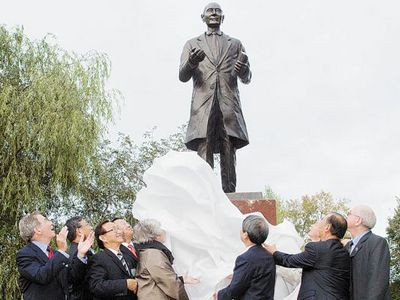
Statue of Francis Schofield at the Toronto Zoo

"He was just back in Canada for the Schofield memorial which was constructed at the Toronto Zoo – it’s huge, it’s quite astounding. He went there for the dedication. He threw out a pitch at a Blue Jays game – it was quite a successful visit."

Former Prime Minster Chung Un-chan after throwing the opening pitch at a Blue Jays game. From the video below.


The former Prime Minister also visited Toronto in 2010 in relation to the statue and the surrounding Korean garden built at the zoo. Senator Yonah Martin also brought up Dr. Schofield in a recent speech (her other speeches, some of which are related to the Korean-Canadian relationship, can be seen here).

Also, with the recent news that negotiations would re-start for the Korea Canada Free Trade Agreement, I asked the Ambassador for his thoughts on this. He noted that the two countries "haven’t actually had discussions for almost three years" but were now committed to "move forward toward a conclusion."

As for what stalled the talks, it was one sticking point: "Beef was the issue. The problem was that in 2009 Korea reopened their market to US beef and not Canadian beef, and there was no basis for that whatsoever, and it just became politically untenable to continue with the negotiations."

Korea was taken to WTO over this by Canada. "The case didn’t progress to a final decision, but we had a very strong case. The Koreans asked to come to an agreement and they reopened their market in January this year. We’ve now had several months of shipments and its going well."

Asked about who would benefit from the FTA, he said, "The benefit first and foremost goes to the consumers more than producers, because you're reducing barriers and increasing competition."

"When you look at our trade and areas of economic activity, I think our economies are pretty complimentary, as opposed to being competitive." Calling it a "win-win situation," he said, "I'm an old trade negotiator - I really do believe in this stuff."

He also laid out another benefit of the FTA:

"It focuses more attention on the relationship and I think both Canada and Korea would benefit from that. When our companies look to the growth area of northeast Asia they see China and Japan – they often don’t see Korea. Korea looks at North America and sees the bright lights of the US, but often doesn't see Canada. So this shines a light on the two countries, and it's a demonstration of a commitment on the part of the governments to that initiative."

Perhaps the agreement will reached by next year, which will mark the 50th anniversary of diplomatic relations between Korea and Canada.

I'd like to thank Ambassador Chatterson for taking time out to talk to me. Another interview with the Ambassador can be read at Busan Haps here.