Sunday, August 12, 2007

Incheon Airport Railway construction

I wandered around my area last week and looked at some of the construction sites for the second phase of the Incheon Airport railway line (which I've looked at here and here). For more photos of the construction, as well as what it's like to ride the completed railway between Incheon and Gimpo airports, Jon at I'm a Seoul Man has numerous posts here (and here).

Below is a map of the route through my area, with the Incheon line being yellow, and line 9 being green.


I biked around the southwest corner of the Magok field, above, many times last summer, and remember riding past some greenhouses one evening after it rained and hearing a chorus of frogs. I knew in a few years they'd be paved over, but I didn't expect that to happen in just a few months...


You certainly can't ride past those greenhouses anymore. Behind that wall is the construction for the railway. The first photo looks northeast:


The next two photos are from the other end, and look southwest:


In the photo below you can see, running across the picture, the (now covered) excavations for line 9, while the Incheon rail line can be seen curving at bottom left.


It eventually runs under Yangcheon-gil and and rises out of the ground. Below is where its ascent will begin:


It then follows a 400-500 meter ramp. Below is a photo taken from the top of the ramp looking at the bottom:


Turning around and looking towards the river (and the Olympic Expressway), you can see steel spans which are supported by concrete piers.


Since the pier below is exposed, it gives a better idea of what the entire pier looks like.


Below, several spans wait to be lifted into place by the crane.


Here, two piers on either side of the expressway stand before the bridge, which is barely visible.


The photo below gives a better idea, as you can just make out the crane and one pier on the otherside of the expressway, as well as the bridge.


Below is a view of the bridge from the west; it appears to be half finished.


Last, from the top of a nearby mountain, looking west, we can see the rail bridge, the Banghwa Bridge, and the Haengju Bridge.

Friday, August 10, 2007

A sky worth looking at

What with the weeks of either rain or haze, it's been a long time since I've seen a sky like this.


Skies like this were so common back in Canada, I didn't realize how much I missed them until today. I also noticed a student showing photos on her cellphone to another student; one was of the sky, taken today. I'm glad I'm not the only person who noticed.

The rain makes it grow

Another month goes by. These are added to the end of this post.

July 15


July 21


July 30


Aug 8

They're working on the fifth floor now, and it's supposed to be a twelve story building, so my guess would be that the outer shell will be done in October.

Oh, and today the ramifications of this sprouting concrete became clearer: A friend who lives across the street from it told me that it's already beginning to block the sunlight in his apartment; as I was walking home, I noticed that it's now poking out from behind the surrounding buildings, which gave me an idea of how the skyline will change over the next two or three months...

Wednesday, August 08, 2007

Excellent articles about 5.18 and 'May 18'


The Joongang Ilbo has a series of excellent articles about two women upon whom the character of Shin-ae (pictured above) in the film May 18 is based. You'll need to use IE to view them.

Two women from Gwangju massacre make movie a hit
The film’s director, Kim Ji-hoon, based his female lead on Jeon Ok-ju and Ahn Sung-ryea, both of whom were involved in the democratization movement. [According to Jeon,] “What’s in the film represents only 10 percent of the brutality that took place".

Ahn agrees that the film diluted the massacre’s cruelty, but both said they are grateful it has been made. “This was a chapter of history that should never be repeated and the film was a reminder of that,” said Ahn.
Another article, titled Pages from history, written in Korean blood adds very little, but the other two are interesting to read.

The voice that galvanized an outraged city

Jeon Ok-ju was 31 in 1980 and had dreams of opening her own dance school. However, within hours she was grabbing a megaphone [...] She started by giving water and kimbab (rolled rice) to injured students and decided to join their protest after seeing the dead body of a high school girl, her breasts slashed open by a bayonet. On the evening of May 19 Jeon heard a voice calling out for volunteers to help get more citizens involved in the resistance. Jeon stepped forward.
She has a number of harrowing stories, such as the one below:
At one point she was in a stationary car. She was eating a strawberry given to her by a middle-aged woman on the street. A bullet flew past her and killed the car’s driver. Jeon has not eaten strawberries since.
Taking part in the uprising was just the beginning, however:
Jeon found herself in the hands of the police after the movement had been suppressed. She was subjected to beatings and water torture for weeks. “Intelligence agents accused me of being a North Korean spy with the secret code name ‘Peony Flower’” Jeon recalled. She was sentenced to 15 years. The following year she was released by special pardon.
She eventually moved near Seoul with her family, but though she was pardoned, the government never forgot or forgave:
“I could not get a decent job. Whenever I did, I would be fired after a few days for no reason” she recalled.
Above is a photo of Jeon testifying at the National Assembly hearings into the Kwangju Uprising on February 8, 1988. It should be noted that the one of the most memorable parts of the film is Shin-ae calling the citizens to join the final stand in the early hours of May 27, 1980, described midway through this article, (which I quoted here). According to Linda Lewis, however, that was another person, namely Park Yeong-sun, a 21 year old college student who had been doing street broadcasts since May 24.

Haunted by the death of a high school girl

I was quite certain, when I saw the title of this article, that I knew who the high school girl would be, and I was right.


On May 21, 1980, Ahn Sung-ryea, 43, a supervising nurse at the Christian Hospital here found herself amid a bloody pile of dead bodies and gunshot victims. She had been at the hospital for three days treating patients who filled almost every inch of space in the building.[...]

“I felt guilty for being alive, instead of fighting to the death as they had,” said Ahn, who is now 70. “The soldiers were on a killing spree out there. You can’t just call it the suppression of a protest.”[...]

Ahn and her fellow nurses, doctors and janitors were forced to take turns drawing blood from their own arms to supply desperately needed transfusions. Ahn was especially glad when a group of citizens arrived at to the hospital to donate blood. Park Geum-hui, then a high school student with braided hair, was one of them.

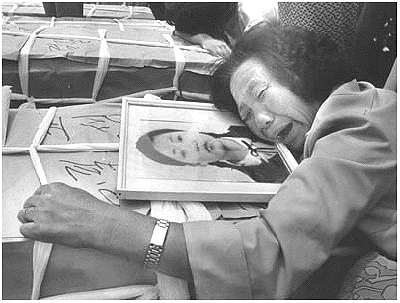
“Geum-hui looked at me and said, ‘Ma’am, I couldn’t just sit at home and study. There’s no use going to college if I cannot do anything about what’s happening in my own town,’ ― then she was gone,” Ahn recalled. About an hour later Park returned to the hospital as a mangled corpse. “Her blouse was soaked in blood and she was covered with dust,” Ahn said, her voice growing hoarse. “I collapsed and burst into tears. I cried out ‘The soldiers are evil!’ over and over. My heart was broken.”
She wasn't the only one.


After seeing this photo, and later finding one with a caption titled "Park Geum-hui's mother" (taken at Mangwol-dong cemetery, May 29, 1980), I became interested in how this student died. An entire post about her, and of how she (and the uprising in general) are remembered in Kwangju, can be found here.

Returning to Ahn, on the day Park Geum-hui died:
When she returned home, her nurse’s uniform soaked in blood, she found that her husband, Myung Ro-geun, an English professor at Chonnam National University, had volunteered to be one of the citizens who would negotiate with the soldiers.
The citizen negotiators would fail (partly due to being taken over by protesters who chose to fight to the end), and after the uprising ended her husband would be arrested. Their four children would also be detained or jailed for protesting against the Chun regime in the 1980s.
Ahn rejoiced in 1988 when the National Assembly began hearings on the Gwangju massacre and then enacted a special law to compensate the victims. Her efforts were rewarded when she was elected to the Gwangju city council in 1991 ― she served until 2003. [...] Ahn now runs a shelter, May Mothers’ House, for women who lost their families in 1980. The shelter sits close to Geumnam Street, the major site of many protests.
It's nice to see, however briefly, that what happened in May, 1980 is getting attention from the media and public. Hopefully, considering how many people still live with the physical and psychological scars of those days (and the following months) , something that is of benefit to them will come of it.

The first article mentions box office numbers:
CJ Entertainment, the controversial film’s distributor, said that 3.4 million tickets for May 18 had been sold as of Sunday, making it the biggest box office hit among Korean films so far this year.
They're able to say that at this very moment, but D-War will soon beat it, though perhaps only in the short run, seeing as May 18 may have better word of mouth. Of course, the cheap 'patriotic marketing' which this editorial bemoans (and provides a history of) may help D-War prevail in the end.

Tuesday, August 07, 2007

New Haengju Bridge Collapse


While most people likely know about the October, 1994 collapse of the Seongsu Bridge (pictured above), which killed 32 people, I imagine few know about the collapse of the New Haengju Bridge on July 31, 1992. A great many details can be found about the collapse here:
When the New Haengju Bridge over the Han-gang River which connects [Gangseo-gu] in Seoul City with the Goyang city, Gyeonggi-do in Korea was under construction, its 10 bridge piers and the bridge girder of 1020m length collapsed. The fault originated in the cable-stayed bridge part in the center just before the completion.
The main reason few know about this is that the collapse occurred at 6:55 pm, 25 minutes after construction workers had finished for the day. As a result, no one was hurt.


Photos taken from here.

Amazingly, mbc will actually let you watch a 3 minute news broadcast from that day (here - in IE only).

The website above describes why the collapse occurred:
In the atmosphere by the rapid economic growth in 1970's in Korea, the bridges constructed in the capital city Seoul were criticized for lacking aesthetic sense in 1980's. The government officials who reacted to this criticism too sensitively applied the PC cable-stayed bridge easily which was the latest method and the appearance was graceful and airy, without grasping the safety and structural characteristics.
The Haengju Bridges today

This collapse predated two much better known collapses - the aforementioned Seongsu Bridge collapse, and the Sampoong Department Store collapse in 1995. One shouldn't think this kind of thing is a relic of the past, of course; it was only two months ago the the building site at Gajwa station collapsed, and it was luck that prevented loss of life there.

Somewhat related to all of this is a short film I saw years ago on tv centered around the Seongsu Bridge collapse (which was how I came to learn of it). I just googled about and found out that it's a 1997 short by Marathon director Jung Yoon-Cheol called 기념촬영 (Memorial Photographing), and that it's available on the Marathon dvd as an extra. X over at twitchfilm describes it as
excellent, expertly blending some of the elements of the 여고괴담 (Whispering Corridors) series (mostly those dealing with the sense of loss and the bond between schoolmates) with the tragedy of the Seongsu Bridge collapse in 1994.
Clips of it appear very briefly here.

Sunday, August 05, 2007

'Splendid Vacation' and the Simplification of History in Recent Korean Films

Several articles and reviews of May 18 (Splendid Vacation) have turned up since I wrote this, so I thought I'd take a look at some of them.

Donald Kirk wrote an article about the film (here - a reposted version with photos is here (hat tip to Mark Russell)) which is worth reading, especially considering the fact that he was present in Kwangju in May, 1980. Unlike many other foreign reporters who covered the Kwangju Uprising, whose accounts can be read here, I've never read an account by Kirk. Besides his account, he considers the impact of the film:
"The general mood of the film was right," says Chi Jung Nam, who is from south of Kwangju and knew people there at the time of the assault. "People will look at Kwangju in a new light. The younger generation will want to learn."

Still, Mr. Chi, a journalist, worries about the action-packed telling of the story.

In the film, the rebels, led by a fictitious former colonel, revel in defiance and mayhem. Troops fire point-blank into a boisterous crowd – minutes of carnage that didn't happen that way. "Too much dramatization," says Chi. The director, Kim Ji Hoon, he says, "may have overdone it."
Perhaps, but I think the reason it is overlong is due to the fact that the director had to show several simultaneous events in sequence, which drew out the scene. As far as the carnage there is concerned, missionary Martha Huntley was working at the Kwangju Christian Hospital, and wrote (as quoted in Laying Claim to the Memory of May), "In two hours our hospital alone received 99 wounded and 14 dead." As I said before, I think the final assault is exaggerated somewhat (in that not everyone who took part in the last stand was killed).

Having seen the same incredibly gruesome photos that Tom over at Seen in Jeonju has, I agree with his observation that
As brutal as the movie is in parts, I was grateful that it was never as gory as it could have been. In fact, the film does a great job at showing enough violence to provide an emotional response while avoiding sensationalizing the violence a la Saving Private Ryan or Taegukgi.
He also notes the reaction of audience members in Jeonju:
Besides the movie itself, I found the people in the theaters interesting to watch as well. Perhaps it was the time that I chose to watch it, but most of the audience were older- Every once in a while when a certain scene appeared or a particular shot struck a cord, their would be a murmer through the audience with people remarking to each other, “that really happened” and similar phrases. Normally, I don’t like any talking during a movie, but this actually hightened the feeling of dread and unease.
Tom's review is a positive one, though others are more mixed in their judgement of the film's relation to the historical event. A review in the Joongang Ilbo states that
The biggest virtue of the movie lies in its emphasis on the “liberated Gwangju.” As film critic Hwang Jin-mi rightly pointed out, it is the first film about Gwangju seen from the point of view of the civilian militia.
It has some criticism, however:
The movie seems to illuminate the 10 days of Gwangju in detail, but in reality, the incident is confined to the traps of typicality and abstraction. For instance, the citizens of Gwangju before the massacre lived a very peaceful life, equaled only by the life of Dongmakgol, the imaginary village of the 1950s that was distanced from the woes of the Korean War as described in the popular Korean film “Welcome to Dongmakgol.” Innocent people who lived in the vacuum of politics suddenly fell victim to soldiers, demonic outsiders against their will.
Actually, it would be interesting to look at recent historical films about Korea's modern history, and see how often the protagonists are happy-go-lucky innocents before events beyond their control tear them apart. That certainly applies to Welcome to Dongmakgol, Taegukgi, May 18, and Hanbando (if 'Korea' can be considered the 'innocent character'), and even perhaps to Silmido (which portrays the commandos as victims). One film that does not fit in this category is President's Last Bang, which may account for its much more meager box-office take in comparison to the other films (as well as a lawsuit against it by Park Chung-hee's son). Double Agent also fits in this category.

It wasn't always this way, of course, especially in the 1990s, where movies like A Single Spark portrayed the life of labor martyr Jeon Tae-il, and films like Taebaek Mountains, Partisans of South Korea, Spring in My Hometown, and To the Starry Island provided a much more complex vision of the Korean war. To the Starry Island and Welcome to Dongmakgol could easily be compared, as they both deal with isolated villages which become involved in the war; in To the Starry Island, however, it's the villagers' petty squabbles, jealousies, and divisions which lead to tragedy, while in Dongmakgol, the big happy family of villagers are saved by Northern and Southern soldiers by killing... Americans. Of course, Dongmakgol is supposed to 'just' be a fairy tale, but it seems the complexity (or just plain honesty) seen in films dealing with the recent past seen in the 1990s (when it was first possible to do so openly) has been abandoned in favor of more slickly produced genre mishmashes with simple messages which hope to draw in as many viewers as possible.

The next history film to be released in Korea will be the movie about Nogunri, titled Jageun Yeonmot (a small pond, likely named after the 70s folk song about two fish who fight each other in a small pond, eventually dying and polluting the pond so that nothing will grow there). Anyone thinking that this would be a complex portrayal of a contentious incident might have second thoughts after seeing the poster:


I'll make the assumption that there will be no scenes of US soldiers blowing a toddler away at point blank range (in slow motion from several different angles, intercut with blood splattering all over the child's already wounded, hysterical mother), and that this is simply designed to create controversy and get people's blood boiling (though I imagine we'll see such scenes as they're killed from a distance). I'll leave it to you to decide if the film will have a simple "we were innocent victims"-style of narrative:


What's even more impressive, if you watch the making of video here (click "메이킹"), is that in the final photo above, the man holding the boy is shouting in English, reminding me of Kim Sun-il pleading for his life in English when he was first captured in Iraq back in 2004 - not a pleasant memory.

Jang Sun-woo's 1995 film about the Kwangju Uprising, A Petal, is as far from this kind of simplistic narrative as possible; as Darcy Paquet writes, the film is not "a simple indictment of the government and the soldiers' actions -- as guilty as they may be, everyone in the film possesses the will and capacity for violence." Unlike many recent films (including May 18 and Silmido) which refuse to point fingers, "A Petal", which tells the story of a girl who has been driven insane by what she experienced in Kwangju, and who has been raped by numerous men while wandering the countryside, juxtaposes the image of the bedraggled girl walking through a market full of people standing still for the national anthem with the pledge of allegiance: "I pledge allegiance to the Republic of Korea to devote my body and soul to the eternal honor of my country and the people." It's very clear how her "body and soul" have been devoted to the "eternal honor" of the country, and it's a stunning indictment of the state.

May 18 doesn't point fingers at Chun Doo-hwan (or the US - though CJ entertainment did try to conjure the spectre of US involvement in order to create publicity exactly a month before the film was released), and is much more simplistic than A Petal (though the latter film did not try to describe the uprising from beginning to end). Unfortunately, the economics of an increasingly risk-averse film industry generally tend to view complexity and finger pointing as box office poison or an invitation for lawsuits (unless the finger is pointed at the US or Japan). Worth remembering is that May 18 cost 10 million dollars (which is quite high for a Korean film) and is aimed at an audience 12 years old and higher.

In an excellent review of May 18 at Left Flank, Bal(t)imoron writes of the film:
I want the political subtext, the controversy, the partisan anger. Instead I got a mawkish fairy tale.
In his view, the film is only partly redeemed by one thing:
The only provocative scene is the epilogue, where the movie finds its center. As all the characters, from both sides, meet in a wedding portrait, we notice how sad and angry the survivors, most remarkably the bride (Lee Yo-won) are. The dead, including South Korean officers, the retired colonel turned protest leader (Ahn Sung-ki), and the groom (Kim Sang-kyeong), are smiling and joking with one another. The love affair should have blossomed into a marriage, if only the groom had lived. The dead have made their peace with one another; the living were denied that right.
The aforementioned Joongang Ilbo review suggests that the film may allow viewers to make peace with their guilt over the Kwangju Uprising:
The movie succeeds in recalling the collective memory of 27 years ago, yet that’s where it stops. The movie does not clearly describe the meaning of the Gwangju democratic movement. It touches upon a completely different aspect ― the feeling of guilt that people have who closed their eyes to Gwangju and the poignant appeal for the historical victims. This is why the viewers feel ill at ease after having a good cry. Just as someone said, “Splendid Vacation” is a movie that targets people who want to ease their feelings of guilt.
An article in the Hankyoreh elaborates on this:
Viewers of "May 18" have reacted with tears, but the cause of their sadness seems to differ depending on their age and historical perspective in terms of the events of 1980 in South Korea.

Some of those who remember the massacre in Gwangju in 1980 expressed a guilty conscience about their uncomfortable memories of the event. A 40-year-old Internet user named Kwak Hye-jeong asked, "What did I do at the time when our brothers and sisters were suffering? I have no choice but to weep because of a guilty conscience." Another Internet user identified as "Alpican" wrote a review titled, "I was a coward." The user said, "At that time, I was in Gwangju, but I didn't take to the streets and hid under the bedcovers at home. I cried with a deep remorse when I saw the film."
Though Jang Sun-woo's film is more thoughtful (which may account for it only selling 213,979 tickets in Seoul back in 1996), it's not the straightforward presentation of the events of May 1980 that May 18 tries to be. The greatest flaw of May 18 is revealed by the question a friend's 12 year-old nephew asked when he returned from seeing it: "Why? Why did it happen?" The movie never even begins to broach the "Why?" questions, such as why troops were sent, or why people chose to take part in an armed rebellion against their own government. On the other hand, telling a story which provides a broad outline of what is arguably the most important political event in Korea since the Korean War to a large audience is a worthwhile endeavour, I think, and some seem to think it has served a social function by relieving the guilt of older viewers while making the younger generation curious about what happened.

How successful the film will be is hard to know. It sold 126,000 tickets in 490 theatres on its first day, and was number one last weekend, taking 42.9% of the box office, and selling 1,325,000 tickets by Sunday. On the other hand, D-War sold 417,298 tickets on its first day. Though one theatre I looked at had an equal number of showings for both May 18 and D-War, May 18 doesn't have the benefit of being the first Korean Sci-fi blockbuster. As a few people have told me, "It's our duty as Koreans to go see it." I guess these days nationalism means watching movies about dragons destroying LA and not movies about a massacre by and uprising against the Korean government a generation ago which helped pave the way towards democracy.

[Update]

According to this, May 18 has sold 3 million tickets in 11 days (up to Saturday); my guess is that it should be able to turn a profit. D-war, on the other hand, sold 2.9 million tickets in 5 days, even though it's terrible. Don't try telling that to its fans, though:
On the internet, a large-scale battle is also raging on. At major portals, many online users are posting messages praising the film's computer graphics and entertainment aspects, and a dissenting voice is being crushed. Lee Song Hee-il, an independent filmmaker, criticized "D-War" on his blog, only to face a tremendous backlash -- a sort of cyber terror -- from angry online users who support director Shim and "D-War" feverishly.
Those online users are probably 9 year-old kids - or not. One of my 9 year-old students saw it and when asked what he thought of the special effects, he said they were good. When asked what he thought of the story, he said it was bad. You know you have problems when a 9 year-old thinks your story sucks.

Wednesday, August 01, 2007

Sanggyedong Olympics and more

I came across a copy of Kim Dong-won's 1988 independent documentary Sanggye-dong Olympics. In 1986 he went for a day to take some video of the demolition of poor people's housing in Sanggye-dong in northern Seoul and ended up spending 3 years living with them and documenting their plight. In a nutshell, they are forced by gangsters and riot police to leave their houses, and those who choose to fight move to Myeongdong Cathedral for a year-long sit-in before buying land in northern Bucheon (in the part of Gogang-dong that reaches south of the Gyeongin Expressway, to be exact). There, the city council decides that, with the Olympic torch driving by soon, their temporary housing must be removed, which is done by force, and they're forced to move yet again.

The video can be viewed here, while more information on how the director came to make the film can be found here.

It should be noted that Gogang-dong, where they moved to in Bucheon, will become a new town there; as well, many of the people who had moved to Sanggye-dong had come, years before, from Cheonggyecheon when the 'cardboard shacks' built along its sides in the 1950s were destroyed when the stream was first covered in 1960, which makes clearer just how continuous the movement of the poor from the centre to the periphery was.

Sanggye-dong, of course, became covered with apartments in the aftermath of the destruction of the neighbourhood. If you're curious as to why so many apartment complexes can be found in Korea, the following presentation is worth your while.
On April 5th, 2007, the Korea Society hosted an Arts program titled "How Did Korea Become a Land of Apartments" with Valerie Gelezeau, associate professor of Geography at Marne la Vallee University in France and author of The Republic of Apartments. Gelezeau explained how South Korea has transformed from a country of single-unit housing to one where apartment living is the dominant paradigm. Gelezeau believes that in addition to economic and demographic factors-such as a growing population and a shortage of buildable land-this change has been driven by cultural factors.
More on Gelezeau can be found over at Hunjangui Karuch'im here and here, as well as in this Chosun Ilbo article, and in this review of her book (translated in Korean as The Republic of Apartments).

A podcast of her presentation can be found here.

On another possible French-Korea connection, I couldn't help but think of this:


Above is a maquette of Le Corbusier's 1925 Plan Voisin, which planned to raze central Paris and replace it with ranks of towers (from The Situationist City). Such an idea is rather popular in Korea, especially in Seoul.


While on the topic of multimedia, B.R. Meyers presentation for the Royal Asiatic Society a few months ago can be watched over at Korea.com, specifically here. In it he looks at North Korea's view of the world through its propaganda, and, very interestingly, illustrates the link between colonial era pro-Japanese propagandists and the writers of early North Korean propaganda. It's well worth a watch if you have an interest in this sort of thing.

Oh, and the 5 dvd Shin Sang-ok Collection is out now. I'm looking forward to it.

Thursday, July 26, 2007

Splendid Vacation

[Update - added a few photos]

I was coming home last night in a taxi, and, while wondering whether having a tv next to the driver was a good idea, learned via a news report on said tv that the military truth committee, which announced that it would investigate (among other things) the Kwangju Uprising two years ago, had finally released its report. The Donga Ilbo has an article about this:
The Truth Committee of the Army declassified 140,000 pages of previously classified documents, and issued a report on the 12/12 incident and other related events yesterday.[...]

A handwritten memo was discovered written on the minutes of the meeting “Directions and Guidelines for the Chungjeong Operation” which read, “Your Highness Mr. Jeon: Use of deadly force allowed upon any threat to soldiers on duty.” On hand at the meeting were Jeon Doo-hwan, then Defense Minister Ju Yeong-bok, Chief of Staff Lee Hui-seong, Second Army Commander Jin Jong-chae, General Noh Tae-woo, and General Jeong Ho-yong.
The article goes on to say that while investigators have suspicions as to who gave the order to fire, no definitive evidence had been found. This isn't really surprising, considering the fact that those involved in the highest levels of the military at the time refused to testify. It's good that more documents were declassified, however. Other articles and editorials about this can be found, as can this article about a planned military operation to arrest pro-democracy leaders - in 1989, a year after the first democratically elected president, former general Roh Tae-woo, took power.

As I was reading these articles, it dawned on me that the movie May 18 was coming out today, which is certainly fortuitous timing for the release of the truth commission's report. I'm sure it's just a coincidence, right? Or is a relative of someone at CJ Entertainment working within the truth commission?


Mark, over at Korea Pop Wars, posted a review of the film a few days ago, which is well worth reading, and which I agree with - I just got back from seeing the movie a few hours ago. Spoilers may follow, for those who aren't familiar with the events of May 1980. Also, as should be obvious to anyone who's read my many posts on the uprising, it's pretty hard for me to judge this movie primarily on its artistic merits. What follows is more a look at how the film uses, ignores, and simplifies what happened 27 years ago in the construction of its narrative.

This Korea Times article has interviews with the director and actors:
"As a director, it's challenging to reenact historical events with accuracy,'' Kim told reporters. "It's inadequate -- through interviews with survivors and family members of victims, I learned that (May 18) was much more horrific, violent and nightmarish than what the film shows. "I toned it down; rather than portraying the incident itself, 27 years since its occurrence, I wanted to give life to those who lived through it,'' he said.
I'm glad he didn't set out to 'portray the incident itself', because by stripping it down to the conflict between the citizen's army and the paratroopers, he drained the politics and complexity from it. It's not a movie that will give those unfamiliar with the uprising much insight into what happened, though it will give a bare outline. Of course, just about any historical movie will dilute the truth while telling its story. I'd predicted, based on the trailer, that this would be similar to Taegukgi in its treatment of history, and I think it's a fair comparison. While it was easy to see that it would have a similar 'idyllic' beginning, I did like that it was self consciously so in the opening, where the film's title (Which translates as 'Splendid Vacation') appears over a pastoral scene. This creates a certain tension due to the fact that the title has darker implications as the name of the military operation that sets off the uprising. As the Korea Times continues:
The story unfolds around four main characters inspired by real life victims of the tragedy. The lives of ordinary people are forever changed by May 18: Taxi driver Min-wu (Kim Sang-kyung) leads a peaceful life with younger brother Jin-wu (Lee Jun-ki), while nurturing his affection for the pretty Sin-ae (Lee Yo-won).

"In previous interviews with the media, because the subject matter is so heavy, I stressed how the film is very heartwarming and even comical,'' said veteran actor Ahn Sung-ki, who plays the role of Sin-ae's loving father and a former soldier that leads the armed citizens. "But it was devastating and heartbreaking to watch (the film) today,'' he said.
I had thought it was quite smart to have the main character be a taxi driver, as it was the taxi (and bus) driver's protests on May 20th that gave the protesters they upper hand, as it allowed them to control the streets:
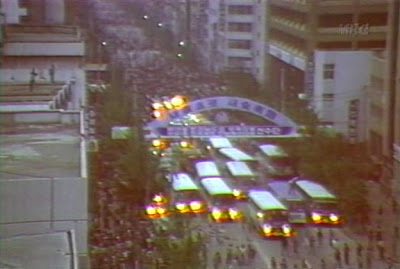
Still from footage of the driver's protest, May 20, 1980

Taxi Protest

I assumed this would be how he would get caught up in the uprising, but this event never even appears in the movie. Perhaps it was due to the fact that they only reimported five Hyundai Ponys from Egypt to use in the movie, but I still think it could have been done with a little CGI and careful editing. Leaving such an important event like this out of the story that makes it easy for me to criticize it. In many ways, I think two episodes of the 1995 TV series Sandglass dealt with the uprising more accurately than this film does (showing the soldiers' assault on the bus terminal, or how they would randomly run into people's houses and attack them, for example, or portraying the effects of regionalism - "You're not from Kwangju, so you have to get out and tell people. They'll never believe us.").

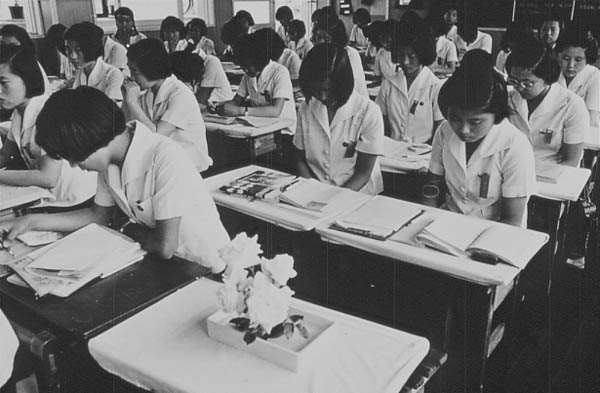
As a high school student, Jin-wu, the younger brother of the main character, allows the story to depict how younger students got involved, as well as evoking this well known image:

Memorial for dead classmate

Ahn Sung-ki's character, the former soldier, seems to be based on (if I remember correctly) a former drill sargeant who began to train some of the citizen's army on May 22. The movie, however, has little or no mention of the citizen's settlement committee, who were negotiating with the army, or the militant students who eventually took it over; as a result, Ahn Sung-ki's character seems to be, as leader of the citizen's army, the leader of the entire uprising, which isn't anywhere near the truth. If I wanted to be generous, I'd just say it's very simplistic. Also, it seems that, though a machine gun was mounted on the top of a building by the citizen's army, it was never actually fired.

Lee Yo-won's character, a nurse, is well used, allowing the story to go into hospitals full of wounded and dying citizens (an interview with her is here). She later moves into a different role, of the woman who drove around and used a loudspeaker to try to rouse the people into making a stand against the army on the night of May 26-27, before the military returned to retake the city. Here is how Henry Scott-Stokes described her:
Suddenly, the silence was shattered by a female voice. Someone up at the provincial government office was using the loudspeaker system. It was a young voice, with a hysterical edge. As the girl shrieked on--her voice resounding over the darkened city--her words merged into a continuum, one continuous shriek, a wail that lasted for perhaps l0 minutes, on and on and on. What was she saying? "This is the end!" That was, no doubt, the pith of it--plus a token appeal to the citizens to come out and join the students, a few hundred students at most? I wish I could convey to you the passion in that voice... imagine that famous painting by Munch, the Norwegian painter, called "The Scream", with the mysterious face and hollowed mouth, and imagine that painting suddenly wired for sound, at tremendous volume, in a black studio. Then you may have some idea of the power of that voice. There is no moment in Shakespeare's entire tragic oeuvre that calls for a "scream" of that power. I listened, I waited. There was no sound of doors opening, no scuffling of shoes in the street. Where were the people of Kwangju? Locked inside their homes, with their doors barred. There was no sound of doors being unbarred, no sound of steps in the street...nothing. All of a sudden the voice cut off.
In the movie, her calls have an effect, and most of the main characters (all male, except for two) come to the provincial hall to fight to the end. In reality, as described above, no one answered her call. In fact, the remaining defenders sent away many of the high school students (and women) who were still there. When the assault comes, the soldiers storm in the front doors, but that's not how Terry Anderson remembers it (not to say that it didn't happen):
Just before dawn, I watched paratroopers filter quietly around the hotel, then begin their assault on the headquarters building. In classic urban warfare tactics, one unit swarmed up the outside of the building to the top, then began working its way down, floor by floor. The soldiers threw stun grenades into each room, shooting at anything that moved.
There are little details in the final battle I noticed, like in one scene a stack of folding chairs can be seen in the background, reminding me of this footage taken on the morning of May 27, after the battle at the Provincial Hall:


Despite such details, I actually thought the final battle was a little too brutal and over the top, in that the soldiers are shown killing everyone they find, when in fact there were many survivors, and some surrendered, as related here:
Armed fighters in the provincial building with Yun were dispatched to the front of the building, but the military approached from the rear. The soldiers ordered the rebels to throw their weapons out into the hallway and crawl out to surrender, or they would be killed. Some complied with the order and surrendered.
Officially, 26 died in the final battle, out of perhaps 150 people who remained in the provincial hall - though it was likely higher. Terry Anderson, in an interview, thought perhaps more than 50 were killed (more on the official numbers here). Of course, surrendering isn't tragic, and tragic and dramatic was what the filmakers were going for. As the Korea Times reported two week ago,
The film was screened in special premieres in Seoul, Busan and the fateful city of Gwangju Sunday. According to Yonhap News, some 3,000 Gwangju citizens -- including family members of victims -- saw the film, and most were unable to suppress tears and gave a long applause. "It's a film that makes us look back to Gwangju," said Yun Seok-dong, 80, whose son Sang-won lost his life as a citizen soldier.
I wonder if the 30 second close-ups of characters crying onscreen contributed to people being "unable to suppress tears". The movie really, really goes for the tear ducts, almost sadistically so. I was starting to wish that I had a stopwatch to keep track of all the crying scenes. That's not to say that there shouldn't be sad scenes, of course, just that there's no need to hit people over the head with it. On the other hand, I didn't know how I felt about a lot of the comic relief in the movie. I doubt the demonstrators were performing a 'gag' show in front of the soldiers before they opened fire - a lot of it just seemed out of place, kind of like how I felt when I watched the foreign characters in Please Teach Me English, who were acting like a Korean would imagine a foreigner should act - very strange.

That said, I liked the final scene, which reminded me of this story by Norman Thorpe:
Some of my memories of Kwangju are like photographs. One is a moving photograph--a slow motion picture of a scene I saw. In it, a man, perhaps middle-aged, steadily pedals a bicycle down a Kwangju side street. Like most Korean bikes in those days, his bike had a strong cargo rack built over the rear tire. Strapped onto this rack and extending out behind his bike was a pine coffin. Someone in this man's family was dead--most likely the victim was one of the many people who had been killed by the soldiers--and the man had gone by bicycle to fetch a coffin.

It is this bicyclist's solitary journey that has stuck in my mind as one of the most poignant images. As the rider leaned forward to get leverage on his pedals, I was reminded how each family had had great hopes for whomever had died, especially for those who had been students. I had just met some of those students in hospitals - lucky ones whom the bullets had only wounded. But here was something I hadn't thought about. Some of the families were so poor that they could only bring a coffin by bicycle. And now in a wrenching upheaval, the focus of their hope was gone.
I was thinking of how the final scene made clear what had been lost, and then remembered Mark's comparison of this film to Titanic, which is a pretty good comparison, now that I think about it. In the end, it's an entertaining tragedy set during one of modern Korea's most tragic historical moments, and is a pretty typical movie made in Korea these days, what with the simplification of history, the ridiculous comedy, the scenes designed to make viewers cry, and well done action set pieces and strong production values. But it's not going to tell you much about the Kwangju Uprising other than lay out the barest outline.

I'm not sure how popular this film will turn out to be. The theatre was less than half full (at a 10 pm showing on a Wednesday (opening) night). When I brought this up in some of my classes, a number of students said they wanted to see the movie, but one told me that though she was interested in it, she didn't want to see it. When asked why, she said, "It'll be too sad."


(At the top of this search, below the poster at the top, are several photos. If you want to see a four minute encapsulation of the film, click on the one titled M/V. If you want to see night vision camera shots of viewers crying in the theatre during the movie, click on 'Making')

Jaws!

Oh, the things you find on Youtube. This is my favorite popsicle - here's an ad from the 1980s:


Just in case this doesn't work, here's a link to the youtube page.

Tuesday, July 24, 2007

Garibong-dong Redevelopment

Erasing the Guro Industrial Complex (from here)


The Guro Industrial complex was built in the mid-to-late 1960s and became one of the main areas in Seoul where textiles and wigs were made, mostly by young women, for export.


The photo above was taken in November of 1974 (more can be found here). The Garibong-dong area southwest of the industrial complex has changed somewhat since that time, however, in both appearance and residents:
After the blue-collar workers and democratization protesters who initiated the country’s labor movement in the area left to pursue better jobs, jjokbang, cage-like rooms built for the factory workers, became filled with migrant workers, mostly from China, looking for cheap rent and daily manual work. As of December last year, about 15,000 ethnic Koreans from China had registered at the district office, followed by 637 Chinese, 232 Taiwanese, 208 Malaysians and 153 Filipinos, according to district office data. If illegal aliens are added, the office said, there are about 20,000 foreigners in the area.
Another Joongang Ilbo story tells about the improving relations between the Koreans and Korean-Chinese living in the area (though there may be the odd incident). The only reason anyone outside of Korea might know about Garibong-dong would likely be due to the fact that it was the setting for the 2001 Im Sang-soo film Tears.

Below is an aerial shot of the area south of Yeouido and Yeongdeungpo station taken in 1966. The Guro Industrial Complex (which was about 500,000 square meters) is at bottom left. Notice the farmland still present at that time (click to enlarge).


Here is the same area today. It's a little more urban.


The area outlined in red needs some explanation. This 2003 article finishes with the following lines:
But many of the old textile factories and assembly lines have recently been replaced by high-tech start-ups and other cutting-edge industries. Most of the Korean- Chinese are unskilled, which means, some say, their days of working here are likely to be numbered.

The first-mentioned Joongang Ilbo article continues:

Joseonjok Town in Garibong-dong, Guro District, western Seoul is scheduled to be destroyed in 2009 as part of a city redevelopment project. Under the plan, the Garibong area will be transformed into business and residential centers to support 859 information technology start-up firms operating in the district.

“The area is designed to provide convenience to information technology businesses in the district. There will be hotels, convention centers and shopping malls, as well as a residential area,” said Jeong Woo-seok, an official at the Korea National Housing Corporation in charge of the redevelopment project.

A rendering of the new development. Bye Joseonjok Town.

The redevelopment project, which aims to be completed by 2012, targets 279,110 square meters (3 million square feet) of areas in Garibong that now contain cramped residential buildings, Chinese restaurants, bars, grocery stores, tour agencies and street markets.

On July 9, Guro’s district government announced that a city committee had approved its plans to change the name of the road in Guro 3-dong from Gongdan-ro to Digital Danji-ro, wiping away the name that evokes an industrial complex and replacing it with one that suggests shiny new technology. The subway station in the district was given a new name in 2005. Today, you can call it Guro Digital Complex Station. Its old name, Guro Industrial Complex Station, will be wiped off the map.

The district seems dedicated to covering up its unflattering past as the home of manual workers at textile, wig-making and printing plants from the 1960s to the 1990s.

Reading about the name changes, of the desire to wipe away the past, reminded me of Antti's post about the desire of residents in nearby Sillim-dong and Bongcheon-dong to change the names of these neighbourhoods, due to their association with the poor hillside neighbourhoods of the 1970s and 80s (or even later). In one bit of irony, he cited Guro's efforts to efface its past as precedent for such renaming. Also ironic is that Korean-Chinese are beginning to settle in Sillim-dong.
Sillim 4-dong, jammed with flats and small apartments, has two or three stores that specialize in ingredients for Chinese dishes. There are more than 10 traditional Chinese restaurants with Korean-Chinese chefs, and many of the customers are actually Korean-Chinese.

"The number of people coming to Korea from China has increased since 2003, and people favor working in the service field instead of manufacturing sectors," said Kim Yong-pil, the chief editor of "China-Korea Town News."

He explained that the Garibong or Guro areas were favored because they had cheap rooms and the Chinese first started working at factories in the areas. Since the Guro Industrial Complex became a digital complex, it doesn't attract that many Korean-Chinese anymore.

It's understandable that Guro's district office wants to create a new 'brand' for the district and move in a 'digital' direction (and wash away those memories of wig factories) but it's interesting that one of the best-known foreign enclaves in Seoul is being razed. Is this the typical redevelopment at the expense of the poor we see in Seoul regularly, or, with the central government resettling North Korean refugees in ways that discourage the formation of North Korean 'ghettos', is there more to it than that? This Chosun Ilbo article from a few months back lists a number of foreign enclaves in Seoul. What's interesting is that Changshin-dong, where 'Nepal town' is, will become a new town in the near future. The plans for the new town pre-date the influx of Nepalese restaurants, however, and are likely more a response to the remnants of the (still active) textile sweatshops there than anything else.

Friday, July 20, 2007

The Flood of 1925


A year ago this week, many of the areas next to the Han River were submerged (as can be seen here), though it may be worth remembering that 72 years ago this week, much of Yongsan was underwater, along with parts of Noryangjin, Yeongdeungpo (and likely all of Yeouido, I would guess), Ttukseom, Jamsil-do, and other areas next to ( and islands in) the river. This was due to the constant rain that had fallen between July 15 and July 18, 1925, and according to this, it killed "over 600 people [and] damag[ed] a good 17,000 houses". Beyond Seoul, it seems several villages were destroyed and crops were ruined, or so a glance at the snippets of US newspaper articles from the time available via Google tell us, such as the Chicago Daily Tribune, on Jul 19, 1925 :
Flood Engulfs Corean Capital - Hundreds Dead
Dikes Break - Sleepers in Homes Carried Away.

Hundreds of Coreans have perished and thousands more are threatend with starvation as the result of floods at Seoul following torrential rains which started Thursday and continued intermittently for two days, according to a radio message from there tonight.
A New York Times article from two days later is headlined "Korean Flood Recedes.; Rescue Work In Seoul Continues, but Crops Are Ruined."


Above is a photo of the Han River Railway Bridge and the Indogyo Bridge (like almost all of these photos, its from Seoul Through Pictures 2: Seoul under Japanese Aggression(1910~1945)). The railway bridge didn't fare so well in the flood:


Yongsan didn't fare well in the flood either:


The Tudor-looking building above is Yongsan Station. Here's a clearer view of it:


The location of the station can be seen on the map below, from around 1920:


Notice the location of the 'Railway Official Residences' above. Perhaps that's what we see in the photos below, which were all taken in Yongsan:


Noryangjin didn't fare well either:


Neither did Yeongdeungpo (which leads me to conclude Yeouido - which flooded so often that it was considered useless, reflecting it's name "You can have it" - also was submerged):


Here's a shot of Songpa after the flood receded (I'm not certain if Songpa would have been on Jamsil-do or not):


In the area not so far from Songpa, one of the positive effects of the flood can be found - the flood unearthed the prehistoric dwelling site in Amsa-dong. According to this (again), one of Korea's earliest documetaries was about the flood:
Films have always been in love with the [Han River], right from the industry's beginning: in 1925, one of the industry's first pioneers Lee Pil-Woo directed, edited and was DP for 한강 대홍수 (The Great Flooding of the Han River), a documentary about the 1925 Han River flood.
In the aftermath of the flood, the Japanese colonial administration set to work building retaining walls and better drainage systems in order to prevent such a disaster from occurring again (though it often took many years of improvements for them to accomplish this task - even today floods break through the walls, like they did in the Dangsan area of Seoul last summer). One interesting thing I found was that irrigation improvements and retaining walls were needed in order to make the plains in present-day Yangcheon-gu (especially the Mok-dong area) a viable rice-growing area. It was the fact that rice grew there that left Mok-dong undeveloped until the 1980s (while Hwagok and Sinjeong had been developed in the 1960s and 1970s), making it one of the more upscale areas in Seoul. Funny how the history of the city played out that way.