Wednesday, July 11, 2007

Tears in Pyeongchang

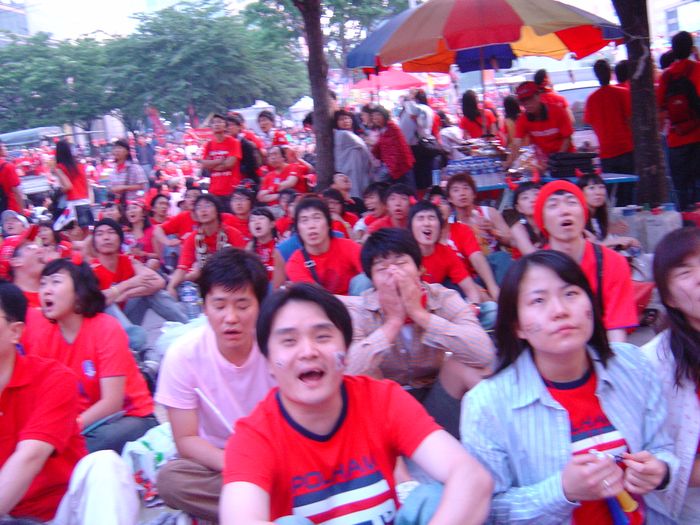
The soon-to-be-crying children are at bottom left.


While working on another post, I'd planned on posting a photo of the kids crying in Pyeongchang after it was announced that Sochi, Russia, and not Pyeongchang, had gotten the 2014 winter olympics. As usual, a quick search for another photo or two led me in another direction. The photos below came from various sources (1, 2, 3, 4, 5). One source is a video, which I'll get to in a moment. A screenshot from that video (above) shows us the gathered citizens at 8:22 in the morning on July 5. As the Joongang Ilbo tells us:
Nearly 3,000 residents of Pyeongchang gathered to watch the announcement on a giant screen, but they walked away with tears of disappointment. Celebratory concerts and festivities were cancelled.
Giant screen? Combine that with the image below and you've almost got something akin the scenes we saw during the world cup last year (and in 2002), with perhaps civic pride being mixed in with the sports and nationalism this time.


Alas, it was not to be. The little girl below was seen crying in just about every Korean newspaper and broadcast, and even overseas. What happened? Did she realize that they were going to have to go to school that day after all?


Her friend on the right looks on with concern as she continues crying; then she begins to console her.


Then she starts to cry.


Now the boy on the right is crying. And what's that girl in the background (wearing the yellow bandana) on the left doing? Is she smiling? (Yes)


She's not smiling now.


Nope, she (yellow bandana girl) is looking decidedly sad. The girl on her left looks like she's either smiling or confused.


Yellow bandana girl is standing up and wiping her eyes now. Her friend on the left looks confused, but isn't smiling.


Unlike most of the others, we can actually see yellow bandana girl shedding tears. Now her friend is starting to wipe them away.


Yellow bandana girl has removed her bandana and now she and her friend are both using them as a hankerchiefs.


Now the girl on the right has moved to the left, and finally gotten around to removing her "Yes" bandana. She looks like she's about to cry.


Actually, if you watch the video below (from which the still above is taken), she looks like she's trying to cry, but isn't having much luck; the video cuts away from her before we can see the fruits of her efforts.


What could be motivating this contagious crying? It should be pointed out that it seems the crying doesn't begin until the man on the screen finishes a speech and begins wiping his eyes with a hankerchief.


One of the most important influences can be seen in the background of the photo below. What we don't see in the rest of these photos are the dozens of photographers who are taking photos of of these children.


The screenshot above (like all of the yonhap news screenshots) were taken from a video that can be found here (it's playable in Mozilla, but you may want to open it in a new window - it resizes your browser). It really is a must-see; watch to see how people act when cameras focus on them after the loss is announced. Also, listen for the sounds of cameras as the children cry - there are lots of them).

Whoever shot that video, you'll notice, filmed shots of the same people before the announcement, going for the obvious before and after effect. I've pointed out how it spread throughout the children, following the first girl's example as dozens of cameras were pointed at them. What really stood out for me were how the adults began to cry when cameras were put in their faces. Notice that because they've covered their faces with the banners-become-hankies, few tears can be seen.

Other photos can be found here.

One might be tempted, seeing as it was just over a year ago, to remember the crying fans after Korea was eliminated from the 2006 world cup.


The funny thing was, I was there, but I didn't see any crying, just disappointment. While it's possible that those in front of city hall were of a more patriotic breed, my guess would be that there were dozens of photographers there ready to record the outcome. Again, the person who took this photo probably was standing quite close to her, so she may have been compelled to act 'correctly'.

When I saw these images, I immediately thought of something I'd been looking into for another (unfinished) post, about funerals in Korea, and how the media deals with them. Funeral rituals here, traditionally, call for crying at appropriate times, though the relationship between the media and mourners is quite different than in North America. In North America you’d likely punch a photographer who tried to take photos during a funeral or a wake, but in Korea it seems to be accepted, judging by the number of such photos that can be found. I'd had no idea how realistic the cremation scene in Park Chan-wook's "Sympathy for Mr. Vengeance" was until I saw this photo:

Back in late April, the body of a girl who'd been raped and murdered was found in Jeju-do, and this is a photo of her parents at her cremation. I can think of lots of photos like this (and I'll deal with this in more detail in another post), and as someone from a completely different cultural background, I wonder why this occurs. Perhaps the concept of Korea being a shame society, where a person must "live up to [their] obligations and the expectations others have of [them]", is helpful. A camera carries the threat of thousands, or millions of people seeing your behavior, so perhaps that motivates people to act passively, even while mourning. A helpful comment on Lost Nomad's post about the crying children said, "When I saw that photo, I was reminded of news footage from North Korea after the death of Kim Il Sung." In North Korea, everybody is watching everyone else in a way which is quite oppressive. In Korea, perhaps it's the media that serves such a role.

In this case, it's not the death of a person, but the 'death of a dream', perhaps even a national disgrace. I found this article (via the Marmot) describing presidential hopeful Chung Dong-young, amusing: "
Pyeongchang was an unknown town. Now it is on the world stage, and it fought well and fought honorably," said Chung wiping away tears.
Doesn't sound like a politician at a funeral at all, does it?

In many ways, I find the reactions of the adults more interesting (because they 'know' how to act), but there were so many photos of the children it was possible to construct how the crying spread under the weight of the cameras pointed at them. The children are interesting as well because you can see how many of them didn't necessarily understand what was expected of them. This isn't to say, of course, that everyone acted this way. Many people in the video aren't crying at all, and I'm sure the ones that the photographers zoomed in on who didn't cry ended up on the cutting room floor. There were enough, however (there always are) to make you wonder just why it happens.

Other more material reasons may have been due to property speculation in what is now worthless land. As for reasons why Pyeongchang didn't get the Olympics, James Card has long list here.

Sunday, July 08, 2007

Fake stream, fake river, fake island

Yet another bone tossed to the construction industry (from here).

This is from a few weeks ago, on June 18:
Former Seoul Mayor Lee Myung-bak, the front-running opposition presidential aspirant in December's election, proposed Monday creating a "Manhattan-like" island near the border with North Korea and building an inter-Korean industrial park there to ease military tension.

Dubbed "Na-deul," which means a narrow waterway in Korean, the manmade island would be home to a 30- million-square-meter industrial park aimed at "combining North Korean labor and South Korean capital" and helping the communist country open up, Lee told a news conference at his Seoul office.

The island, proposed on the west sea of the peninsular, "would serve as an 'open square of unification' bringing the North out into the open," Lee said ahead of Tuesday's presidential policy debate within the Grand National Party (GNP).
Funny, last time I looked at a map of the west coast, there were lots of islands, so I don't really see the need to build a man-made island. Sure, people might live there already, but that never stopped Lee from booting merchants from the Cheonggyecheon area when it was redeveloped, or from pushing New Town redevelopments that have seen 76% of people forced to leave the Gileum New Town area, unable to afford the new apartments. Of course, pretty much every single endeavour Lee has undertaken has involved the construction industry, so simply moving everyone off their land may not be quite the handout of taxpayers' money that the industry was hoping for - best to build a fake island, to add to the fake stream downtown and the fake rivers his canal plan will create. In fact, he's linked the canal and the island together:
Lee suggested his proposed inter-Korean complex near the border with North Korea could serve as a gateway to the canal, adding the North would be open to the project. "There is nothing to worry about because the North wouldn't take it as a direct threat to its regime," Lee said.
A post on this topic over at One Free Korea touches on why it wouldn't be a threat:
Lee Myung-Bak wants to build another [Kaesong], even though the costs are so much more manifest than the gains. And if the idea isn’t stange enough, North Korea has about 300 miles of wasteland — just look on Google Earth – on which it could be built. Instead, Lee insists on helping Kim Jong Il isolate any reforming influence by building an island to put it on, which reveals just how insincere the reform-through-slave-labor theory really is.
Also to be found at One Free Korea is a very thorough look at Lee Myung-bak written two years ago, which also led me to an article criticising how much Lee spent on PR during Cheonggyecheon's construction and around the time of its opening (which may have helped it become the 'hit product' of 2005). Also worth mentioning is that Lee isn't doing anything new here, even for the GNP. I talked to someone in the planning department of the Gyeonggi-do government who told me that they had been planning for a few years (under Sohn Hak-kyu) to develop Paju into a transhipment area for goods from North Korea.

Of course, Lee may have other things to worry about these days, what with his reporting of fake residences coming to light, as well as his apparent selling of land to relatives in a district which was chosen as a New Town when Lee was mayor of Seoul. If the latter allegation turns out to be true, it will be interesting to see how he tries to weasel out of it.

As for Nadeul Island, I found this to be pretty funny:


Look closely at the Han River in Seoul. Notice the two islands? One is Nanji-do, which disappeared decades ago (after it became a dump, and is now World Cup Park), while the other is Jamsil-do. I was surprised to stumble onto this fact as well - that the Jamsil area was once an island, and was reclaimed before being developed in the 1970s. What's also interesting is looking at the west sea coastline around Incheon, because it no longer looks like that at all. The Songdo new city should be about a centimeter south, and much of the coast is now several kilometers further out into the sea (though for some reason, despite it being an old map, they chose to make Incheon Airport (also built on reclaimed land) look correct). I wonder if, by choosing such an old map, the paper was trying to say, "Ahh, the whole damn coast is fake - why not built another fake island?" More likely it was just a mistake, but the juxtaposition is a little odd.

Tuesday, July 03, 2007

"Fainting play"

That's the translation of my new word for the day: 기절놀이. For the unenlightened (as I so recently was), this Joongang Ilbo article provides an introduction.:
An elementary school boy in Gunsan, North Jeolla, was found unconscious around 9 p.m. on Thursday at home by his father. The boy appeared to have strangled himself with a cord used to carry a book bag, police said yesterday. The child was moved to a nearby hospital, but died Friday.

“He used to play the choking game, in which he strangled himself with a rope. I have scolded him many times,” the victim’s father was quoted as saying by the police. Police believe the boy killed himself while playing the dangerous game. Choking has become an increasingly popular schoolyard activity in Korea in recent years among some elementary and middle school students, educators say.

In the game, youngsters restrict the supply of oxygen to the brain, often by pushing hard on the chest or through strangulation. It is said to create a sense of euphoria.
Photo from here.
It is not the first time that the highly dangerous activity resulted in serious injury. In July last year, a middle school student in Iksan, North Jeolla, died after he passed out during the game and fractured his skull on the floor.
There are a few videos and photos to be found on Naver, but not many, though news articles referencing this pastime go as far back as June, 2004. The photo above dates from last year. The Chosun Ilbo also has a brief article about this most recent episode, while another photo, said to be of a boy holding a string intended for choking, can be found here:


A news report using the footage from a year ago can be found here. In it, a young student is asked by a reporter why they do it. The obvious reply? "It's fun."

Apparently, it's thought to be fun by kids from all over the world, at least according to wikipedia:
Practitioner demographics are strongly weighted towards juvenile males but includes females and adults of both genders. The activity has been responsible for a large number of juvenile deaths and permanent neurological disabilities almost entirely among the juvenile male cohort. There are estimates that as many as 250 to 1,000 young people die in the United States each year playing some variant of the choking game. Tracking the exact number is difficult because many of the cases are reported as suicides.
You learn something new every day.

Updates:

Oh, hold on, Lost Nomad has a post about this - the comments are worth reading. So does the Paint Roller blog, where Joe makes clearer the idea that this has come from the US (or elsewhere in the world) to Korea. Whether that was around 2004, when the first articles on Naver turn up, or earlier, I have no idea.

Monday, July 02, 2007

Balsan development video

I finally got around to putting this together.

Saturday, June 30, 2007

Tonight

I'm taking part in this (there's a map to the venue). I don't really know what it's going to be like, but a friend of mine is involved and the always impressive Jet Echo will be playing live, so it should be interesting...

Wednesday, June 27, 2007

The Crime of Korea

Also at archive.org I found a 1950 US propaganda film about the Korean War called The Crime of Korea, which details communist atrocities (and reflects the worldview of the US government at the time). What's interesting is that it begins in 1945, and some footage of Seoul at that time can be seen. Also, I recognized a number of shots in the film, as they were similar to photos I had seen before, such as the one below, taken in Incheon on September 16, 1950, the day after the Incheon landing.


I first saw this photo at the Korean War Children's Memorial website.


The photo's caption sheds some light on the similar film and photos. According to photographer PFC Ronald L. Hancock,

Sfc Barnes, a. Motion Picture Cameraman and I were looking through Inchon, Korea for pictures when we saw some marines detaining some North Korean POW's. As we started to take picture, we heard a child crying and saw a better picture. The results appear in this picture, which I call "All Alone."

The Chosun Ilbo has some newly released photos from the Korean War, as well as some released last year; among the latter, the first photo reminded me of a passage by Reginald Thompson of the London Daily Telegraph quoted in the book Korea Witness, which perfectly described the photo. One detail is different, however, making it clear that such a scene repeated itself many times throughout the war.

I'm quite certain the second photo in this set was taken at the same time as this photo from this post, just before the first and fifth marine corps split up, the first moving through what is now Bucheon towards Yeongdeungpo, the fifth moving towards Kimpo Airport, and the neighbourhood I live in at the moment. I'll post about that in the next day or so.

Century-old books about Korea

Over at the Marmot's Hole a week or two ago, Robert linked to a 100-year-old book about Korea at archive.org. As it turns out, there are more than a few old books about Korea there. This is just what I've found so far:


Narrative of a voyage in His Majesty's late ship Alceste, to the Yellow Sea, along the coast of Corea, and through its numerous hitherto undiscovered islands, to the island of Lewchew : with an account of her shipwreck in the straits of Gaspar - M'Leod, John, 1817

The new glories of the Catholic Church - Wiseman, Nicholas Patrick, 1859

Corea of today - Gilmore, George W. 1894

Corea, the hermit nation - Griffis, William Elliot 1894

Problems of the Far East: Japan - Korea - China - Curzon, George Nathaniel 1894

Quaint Korea - Miln, Louise Jordan 1895

Corea; or, Cho-sen, the land of the morning calm - Landor, Arnold Henry Savage 1895

The life of Rev. William James Hall, M. D. : medical missionary to the slums of New York, pioneer missionary to Pyong Yang, Korea - Hall, Rosetta Sherwood 1897

Korean sketches - Gale, James Scarth, 1898

The vanguard, a tale of Korea - Gale, James Scarth 1904

Fifteen years among the top-knots; or, Life in Korea - Underwood, Lillias H. 1904

China's intercourse with Korea from the XVth century to 1895 - Rockhill, William Woodville 1905

The passing of Korea - Hulbert, Homer B. 1906

Ewa : a tale of Korea - Noble, W. Arthur 1906

In Korea with Marquis Ito - Ladd, George Trumbull 1908

A modern pioneer in Korea : the life story of Henry G. Appenzeller - Griffis, William Elliot 1912

The church in Corea - Trollope, Mark Napier 1915

For the faith : life of Just de Bretenières, martyred in Korea, March 8, 1866 - Appert, Camille, 1918

A diplomat's helpmate ; how Rose F. Foote, wife of the first U.S. Minister and envoy entraordinary to Korea, served her country in the Far East, - Lawrence, Mary Viola Tingley 1918

Administrative reforms in Korea; articles reprinted from the "Seoul Press." 1919

Korea S Fight For Freedom Mckenzie, F. A. (Frederick Arthur) 1920

The new administration in Chosen. Comp. by the government-general of Chosen. July, 1921


The Passing of Korea and In Korea with Marquis Ito have been interesting to read, as has Fifteen Years Among the Topknots, which has personal observations of Korea's history between 1890 and 1904. Quaint Korea (reviewed in Korea Bug) was written by a women who had never been to Korea (!); Corea, or Cho-sen, land of the Morning Calm is fun to read, due in no small part to the writer's personality. And that's just scratching the surface.

I'll link to more books as they turn up.

Monday, June 25, 2007

Bits and pieces

Seeing as I've talked about development in Bucheon before, I found Joe's photos over at Paint Roller blog taken of (and from the top of) the yet-to-be-finished We've The State apartments in Bucheon to be pretty nifty. Antti's panoramic photos of Busan at Hunjangui Karuchim are well worth a look as well.

With such neighbourhoods in mind, an article over at the Hankyoreh about the disappearance of Mom and Pop stores (to be replaced by... bars?) and other small business trends is worth a read.

Mark's post about Chinese 'gold farmers' (ie people who are paid low wages to play massive multiple player online roleplaying games) and online economies over at Korea Pop Wars is fascinating. About the only knowledge I have of World of Warcraft comes from a South Park episode dealing with it. One of the scenes made me chuckle:

Kyle: "Wow, look at all these people playing right now."
Cartman: "It's bullcrap! I bet at least half of these people are Koreans."

This kind of cultural recognition is probably even less palatable than Stephen Colbert's rip on Rain...

This month is the 20th anniversary of the June 1987 democracy protests, and Kotaji is doing a great job covering them, by posting contemporary day to day reports by British newspapers. They can be read here (with the first post being at the bottom, of course).

A bit late in linking to this, but Jamie over at Two Koreas has a post about his trip to the Kaesong Industrial Complex. My camera accompanied him, but it returned without a memory stick (North Korean Immigration seemed to be concerned about photos of (likely non-military) construction sites near Kaesong; someone should have told them "Hey guys, do you have any idea how much of South Korea looks like this?). Obviously, after this outrage I turned in my North Korean Workers' Party membership card. Bastards.

Lastly, a (downloadable) full trailer for the film "May 18" can be found here. At the end of this post, I wrote, "It should be interesting to see how the uprising is portrayed now (ten years after "A Petal" and "Sandglass"), seeing how Korea, and how Kwangju is remembered, has changed quite a bit since then." I might have to change that from 'interesting' to 'painful'. Judging from the trailer, it seems someone decided that the "action melodrama" genre would be a good idea, perhaps using "Taegukgi" as a model (ugh). Not really my cup of tea, obviously, but then it's likely a younger crowd they're appealing to, and considering how little even university-aged students know about the Kwangju uprising today, that's not necessarily a bad thing. In all fairness, I suppose the film shouldn't be judged by its trailer.

Sunday, June 24, 2007

Subway suicide figures

The Korea Times reported today that the number of suicides in subway stations is expected to increase this year:
So far this year, a total of 22 people committed suicide by jumping on subway tracks in Seoul and the metropolitan area, according to Seoul Metro and Seoul Metropolitan Rapid Transit Corporation, or about four people a month on average. The number is a 30 percent increase from the same period last year. In 2006, the figure stood at 34.
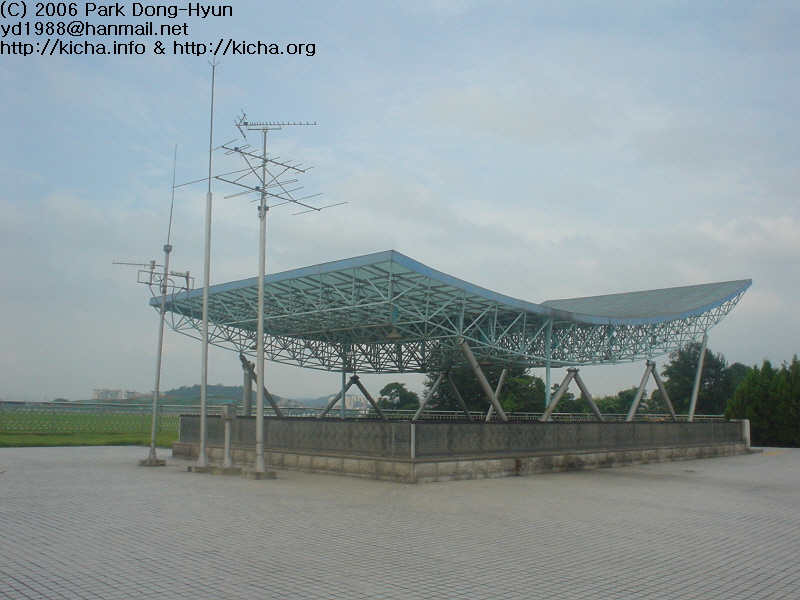
The most recent suicide occurred around 2 p.m. on June 17 when a man in his 30s threw himself onto the subway track at Gunja station on subway line 5. This month alone, five people have killed themselves on subway tracks.
The Chosun Ilbo continues:
There were 21 suicide in subways in 2000, rising to 52 at the height of the recession in 2003. The number dwindled to 34 and rose again to 41 in 2005. This year, it is also expected to exceed 40.
That the Korea Times (and the Chosun Ilbo, in its Korean edition) used the graph below to illustrate the projected rise is a bit silly, seeing how, if they had started with 2003, the 2007 figures would still seem low; the graphic doesn't really seem very helpful.


The station with the most suicides during the period was Guui Station on Line 2: a total of six people killed themselves by jumping on the tracks there. Noryangjin and Songnae stations on Line 1, Kkachisan and Gunja Station on Line 5 and Hansung University Station on Line 4 are also popular with suicides with five each. The common factors are that there are fewer distractions because there are not many passengers, and that they are in lower middle-class areas.
I don't know all of those stations, but, to judge by the presence of new apartment complexes nearby, Noryangjin fits that description (not for long though, as a new town is headed its way), as does the Kkachisan Station area (which is also likely getting a new town). Songnae Station in Bucheon, on the other hand, has large apartment complexes nearby, though the husband of a former coworker witnessed a suicide there back in 2002.

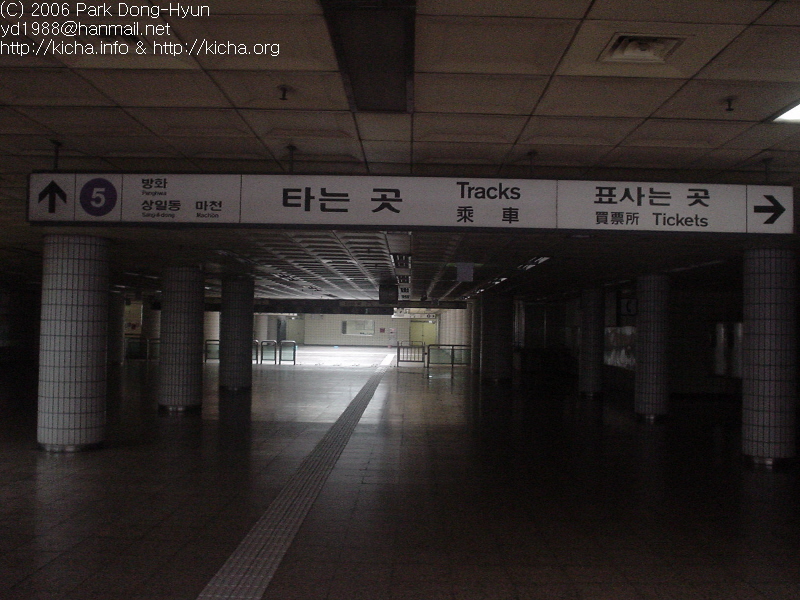
Since the train yards and offices for line 5 are found in Banghwa-dong, I've had several students over the years who worked for the subway in some capacity (as drivers or engineers). One engineer told me that he has to examine Magok station every night to check for structural flaws. What's interesting is that Magok station is in the middle of farmland at the moment, so the station isn't open. According to him, two people have killed themselves there in the past; if you want a station with "fewer distractions" and "not many passengers", I guess it would be hard to beat Magok station (most of the blogs in this image search at naver have some good photos, especially the fifth entry, which shows the station's construction back in the early 90s).
Most of the suicides were unemployed or suffered economic hardship. Most were in their 20s to 40s, and men vastly outnumbered women. According to analysis of 300 train suicide accidents from 2003 to 2005, 70 percent were unemployed. Some 216 men committed suicide, three times the number of women, which was 85. By occupation, 24 were factory workers, 13 were office workers, six were public employees, and four had their own business.
The article goes on to tell us that the appearance of screen doors in subway stations have ended suicides there, but that "Of the 256 stations in Seoul and metropolitan area, only 20 or less than 10 percent have screen doors." You'd think the advertising possibilities these screens present would make them affordable in the long run; when they first appeared at Yeongdeungpo Gucheong station they were covered, for the entire length of the station with ads for a single product.
Some experts say changing the atmosphere in stations can also prevent suicide. Dr. Nam Yoon-Young of Seoul National Hospital said, "People commit suicide in places and times when there are fewer people. They could also be discouraged from suicidal thoughts by music or signs."
Somehow, I don't think music or signs are going to make a huge difference to someone who's decided to kill themself. I doubt they would have dissuaded this man:


This was taken in Wangshimni station in January; for those with morbid (or sociological) curiosity, a video taken from CCTV cameras is here. In fact, numerous videos of suicides (all blurred) can be found over at naver.com, including one where two men jump down and pull a suicidal man off the tracks seconds before the train arrives.

Seeing as I once knew a subway driver, and having seen a few of these videos, something came to mind that the Korea Times mentioned:
The increasing number of suicides at subways also leaves irreversible trauma to train drivers, which is emerging as a serious social problem, according to Kim Hae-gon, a subway expert.
It can't be a very pleasant thing to witness from the driver's seat.

When I was in Sinjeong station (next to the aforementioned Kkachisan station) a few weeks ago I saw these emergency evacuation ladders (which I haven't seen elsewhere) and wondered if they were for people who'd fallen on the tracks, or something of that sort.


The guide below suggests that fires or terrorist attacks (etc.) are what whoever put them there had in mind, though it would seem that, according to the stats above, a person jumping onto the tracks is a much more likely occurence than a fire or terrorist attack.


One would hope a suicidal person wouldn't use these to make his or her descent onto the tracks that much easier.

Thursday, June 21, 2007

Post-liberation photos of Seoul and Incheon

[Update]
Robert over at the Marmot's Hole links to a Kyunghyang Shinmun article which shows a few more photos taken by US forces in Korea.


In the Chosun Ilbo today was a story about some newly released photos:
Some 1,056 photos taken by the U.S. Navy for military purposes in late August and early September 1945 of Seoul, Busan, Incheon, Gunsan, Jinju, and Masan were released on Tuesday.

They [were] taken on Aug. 28-29 and on Sept. 9-10, right after national liberation on Aug. 15, 1945. Except for Seoul, all the other locations are ports. The U.S. military authorities seem to have taken photos of major areas, first of all, to obtain information on Korea after the collapse of Japan. [...] During the colonial era, Japanese authorities also took aerial photos, but only of downtown Seoul.
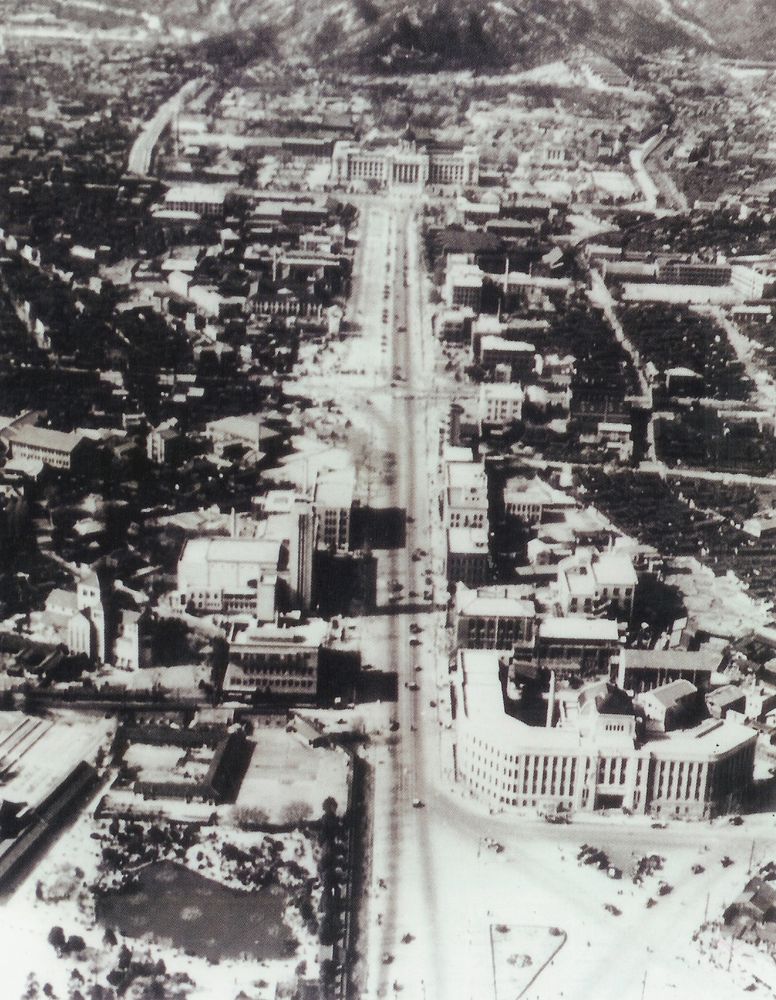
Below are some of the photos. The first looks north, with city hall near the center and Gahoi-dong at the top.


The next photo, though marked "Jinsen" (Incheon), shows the area near Dongdaemun, with the athletic grounds and Cheonggyecheon visible (as well as the Han River, at upper left).


For some reason, searching for articles about this at naver has turned up nothing, though another photo can be found here. Unfortunately, I can't seem to find another photo I know I have somewhere, of the area around Seoul Station; what's interesting about it is that another plane is visible, and its pilot can be seen quite clearly. [Update: Here it is, along with a photo of Jongmyo]:


These photos (of Seoul, especially) were taken as US troops arrived to occupy Korea south of the 38th parallel and disarm the Japanese troops here. For more on how the decision to divide Korea into occupation zones came about, this article is well worth reading, as it is a very in-depth look at the decision making. The Chosun Ilbo states that some of the photos (likely the ports) were taken on August 28-29, and the following paragraph from the aforementioned article may shed some light on them, as well as on how quickly the occupation of Korea by the XXIV corps, then on Okinawa, was arranged:
Finally, there was the problem for the occupation force of finding any information about the country they were to occupy. One of the few sources of intelligence was the Joint Army-Navy Intelligence Study of Korea (JANIS 75), which had been published in April 1945. This document contained some useful data but was superficial. Korean prisoners of war captured on Okinawa were interrogated and provided a small amount of additional information. Since the situation in Korea was obscure and General MacArthur wanted to avoid any incidents prior to the occupation, aerial reconnaissance of Korea was forbidden. However, some recent prints of aerial photographs were discovered, and the XXIV Corps staff persuaded an Army Air Force reconnaissance squadron on Okinawa to fly a few photographic sorties. The resulting photographs, although inadequate for combat operations, were useful for planning the deployment of the occupation troops. Thus, in the absence of any more authoritative information, the former anti-aircraft gunners of the newly formed Military Government Headquarters planned for the occupation of Korea using War Department field manuals, some illicit aerial photographs, the Cairo Declaration, and JANIS-75.
The occupation force arrived in Incheon on September 8, 1945, and its arrival and the ceremony in which the Japanese turned command of Korea to the US can be found here.


In the two views above Wolmido and its causeway can be seen, as can the long line of US ships entering the harbour - a scene which would repeat itself five years and one week later. One of the nice things about the internet, of course, is that you can find pages like this, where soldiers involved in the occupation share their memories, as well as their photographs. Below, US soldiers march through Incheon on their way to Seoul on September 8.


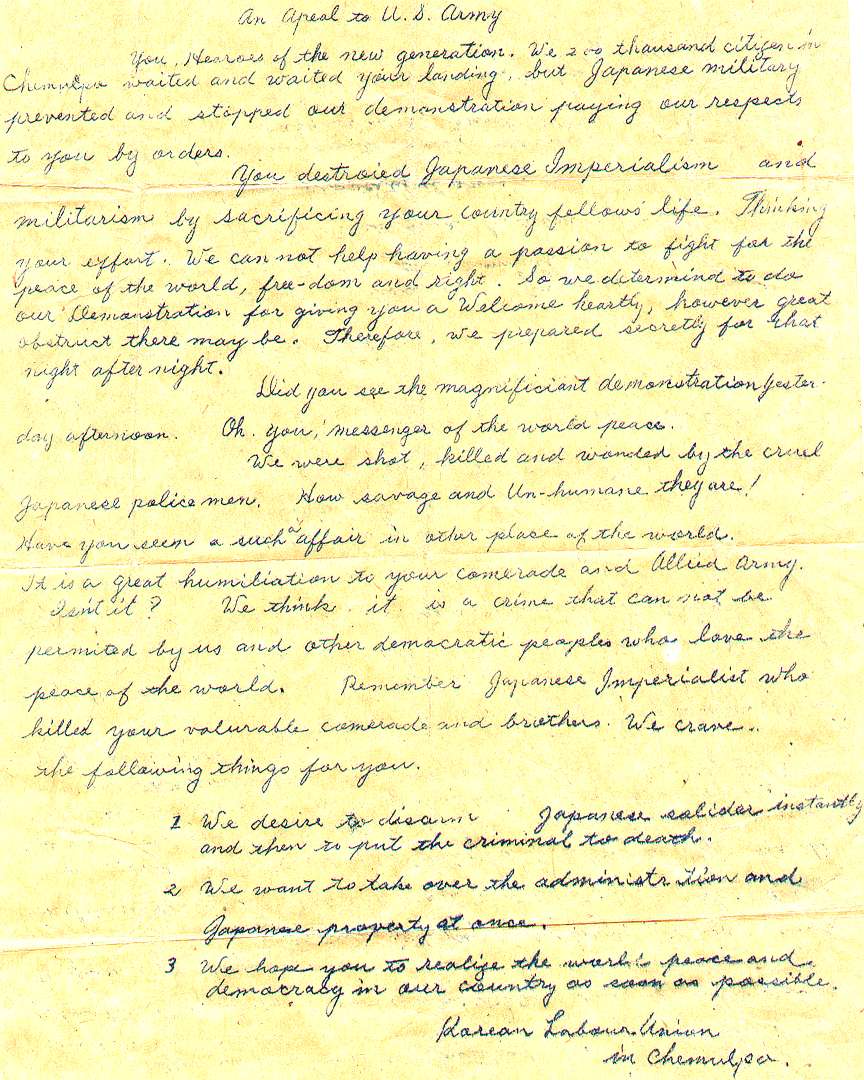
When it was known US troops would soon arrive at Incheon, Koreans set out to welcome them, but Japanese troops fired on them, killing some. When the US troops arrived, they were given a message explaining these demonstrators' position, which can be read here. After the surrender ceremonies in Seoul and the disarming of Japanese troops, US troops accompanied the Japanese to the ports for return to Japan.


Another page with the memoirs of a US soldier can be found here, but the final one is really well worth looking at, because his hobby was taking photos of people and places in post-liberation Seoul, and a gallery of his photos can be viewed.


The photo above is labeled "Korean policeman and Japanese war prisoners", and is interesting because it begs the question of when a certain amount of authority was turned over to Koreans (especially considering how Japanese soldiers had fired on the crowd at Incheon before the US troops arrived).


Interested in Seoul's development as I am, the photo above drew my attention as soon as I saw the title: "Korean kids playing at fire break." In Keijo (Seoul), as in other cities in Japan, the Japanese authorities built fire breaks to stop the spread of fire during incendiary bombings (indeed, it was partly because they were outside working on such fire breaks that so many students were killed in Hiroshima). In Seoul, a number of these were built, and some have turned into streets today (Hunnyeonwonno, running south from Jongno 5-ga, for example). Such "building" was done by demolishing houses in a line which was anywhere from a few hundred meters to a kilometer or more long, and 30 to 50 meters wide. These firebreaks are discussed in the book "Seoul, 20th Century: Growth and Change of the Last 100 Years", where it is mentioned that there is no record of how many houses were demolished, as the Japanese destroyed such records. The following list of firebreaks was made public however, and survives:


The line running south from Jongmyo was "originally reserved for the deployment of US forces at the end of the Japanese colonial period," which may explain why a photo was taken there (I'm quite certain the photo above was taken there, near Namsan). This strip of land was eventually turned into the Sewoon Sangga, which will soon be redeveloped, as I've mentioned before.

Friday, June 08, 2007

Gajwa station rail bed collapse

[Update]

Jon over at I'm a Seoul Man has a post about the collapse; he also has a photo of the same construction site that he took before the collapse, which looks pretty cool at full size. His post made me aware that the Chosun Ilbo and Korea Times both have articles on the collapse as well.

"Safety First"
(by a photographer with a sense of humor)


The Joongang Ilbo tells us that
On Sunday afternoon, two sections of track near Gajwa Station in Seoul, midway along the line, caved in, falling 50 meters to the ground and cutting all rail traffic between Seoul Station and Susaek Station.


I'll get to why this happened in a minute. The main concern was the traffic jams being caused by the severing of this commuter line.
Those who ride the train from Munsan as well as Paju and Ilsan, both in Gyeonggi, were hit the hardest. It took many of them longer than usual to get to work as people scrambled to use alternative transportation.
Photographers got the chance to photograph crowds of people waiting for buses in front of Susaek Station. Of course, they might have had other, more horrific photos to take had things not turned out as well as they did.
A train carrying around 150 passengers passed the accident spot seven minutes before it collapsed, even after the Korea Railroad Corp., the state-run operator of the railway, was informed that signs of a railway collapse were appearing just 17 minutes before the accident.

Ssangyong Engineering and Construction, which was in charge of the project next to the railway, said it detected an impending collapse at 4:30 p.m., 44 minutes before the accident, and withdrew all of its workers from the construction site, according to police. Police said the company informed the Korea Railroad Corp. at 4:57 p.m.
Thanks for waiting for 27 minutes, guys. Of course, the Korea Railroad Corporation almost ended up making quite a mess of things itself.
But the railway operator allowed trains to keep running, merely slowing their speed to 20 kilometers per hour, police said. Of four trains passing the accident spot after that, two were carrying around 150 passengers each.
Blind luck seems to have saved Seoul from another Seongsu Bridge-like disaster. The construction crews unsurprisingly worked quickly to fill in the hole near the collapsed section of the wall.


As the Joongang Ilbo shows us, one track is now open, though it will take two weeks to completely repair it. As to why this happened, read on.
Police said the accident happened after retaining walls on a subway construction site next to the railway collapsed, spilling sand under the railway into the construction site and collapsing the track bed.
Many of the articles mentioned the Gyeong-ui (Seoul-Uiju) line, perhaps for two reasons. That line continues to run next to the construction site, above ground, but it also will eventually be routed underground in Seoul, which is one of the purposes of the construction seen above. What's not mentioned in any of the hundreds of articles at Naver is the fact that the Incheon Airport railway will also take this underground route:


On the (new subway) map above, the dotted blue line represents the unfinished half of the Incheon Airport railway; the accident took place just north of World Cup Stadium. Is the failure to mention this connection to Incheon Airport an oversight, or is it to avoid tainting the name of the "World's best airport"? Considering how lazy the Korean media can be, perhaps the former is more likely...

Thursday, May 31, 2007

City and country, education and marriage

[Update]

In the comments to this post, Mark Russell notes that the number of students as a whole has been dropping for some time. Right on cue, the Joongang Ilbo reports that a school in Dongdaemun-gu in Seoul is closing for lack of students. It then lists some statistics:
During the past 25 years, the number of students across the nation has dropped by 2 million even though the country’s population has increased by 10 million, the Korean Educational Development Institute announced yesterday. The number of students will continue to decline at a faster rate, the institute predicted, meaning a loss of another 2 million students by the end of 2017

[Original Post]

I never would have thought that a Joongang Ilbo article [which will crash Firefox, by the way] about a TV show where two families swap moms for a week would turn out to be so interesting. The reason is that the families are from Seoul and rural Chungcheongbuk-do. While the mother from Seoul, who has one daughter, was overwhelmed by the amount of food preparation and laundry she had to do for a family from the countryside with nine children, the mother from the countryside, while now having theoretically one ninth of her normal workload, had some very interesting observations to make about the differences between her (traditional style) family and life in Seoul.
“I thought it was an opportunity for me to take a break from the huge family that I manage,” Lee said. “However, taking care of a young daughter alone wasn’t an easy task. At home I would let the older children take care of their little brothers and sisters, but here I had to attend to a little girl at all times, and I hardly got a break.”

She also realized how family life in the city has lost traditional family values. “In the past family meant warmth, consideration for one another and enjoying each other’s company,” Lee said. “This week, I learned that families in the city respect each other’s world. Each and every person has their own thing going on and they rarely interrupt other people’s private space. In the long run I believe such a lifestyle would end up deepening isolation and loneliness.”
Or it might give kids the time and freedom to pursue... odd interests on the internet, like that group of 8 - 13 year-olds caught running an S&M website. Obviously, that's a extreme tip of the iceberg, and what she's describing is a very middle class version of life in Seoul. There used to be two families of kids down the street from me who would play outside together, with the eldest caring for the youngest while the parents worked; this pattern of life hasn't disappeared in Seoul by any means, but it's harder to maintain in middle class families with 1.5 children. Several people I know have moved to Banghwa-dong because their parents (or parents-in-law) live there and can take care of their children while they work.
“I missed having people running around the house,” Lee said. “I was really bored during the day.” She worried that the lack of conversation within the family would later lead to a breakdown in communication between parents and children, which she believes many families living in the city suffer from.

Lee said it wasn’t her first time living in Seoul. “Before I was married to my husband I worked in Seoul. But coming back after so many years I realized how complicated every thing is,” she said.
It's interesting to think of this in terms of Seoul's growth, especially considering the fact that according to this article, "more than one in two people in the country will be living in the capital and surrounding Gyeonggi Province by 2011." This is nothing new, of course, as Seoul and its surrounding area has been experiencing massive population growth for quite some time now.


Seoul's growth began to take off from around 1960 (when Seoul's population was around 2 million) and peaked in the late 1980s (at more than 10 million) before decreasing slightly as several 'new cities' were built in nearby areas in Gyeonggi-do. This, of course, was due to millions of people moving from rural areas in the provinces to Seoul, which led Seoul's uncontrolled growth as it, ironically, began to swallow the surrounding farmland which was similar to that which the newcomers had come from. Numerous illegal squatter villages and hillside settlements grew up within the city and then were pushed to the outskirts to make way for redevelopments, until those areas on the outskirts were then redeveloped, a process which continues today.

One reason to come to Seoul was not just for employment opportunities, but was also for the education facilities. Of course, now, with almost half of the population nearby, those educational opportunities now exist in just a handful of neighbourhoods (how many parents have told me they'd like to move to Gangnam (or maybe Mok-dong) by the time their child is in grade 5 in order to take advantage of the schools there?) and the same migration that once took place within Korea as a whole takes place within Seoul itself.

The mother from Chungcheongbuk-do reflects on the differences between the two households regarding education:
Lee at first was surprised at the enormous amount of study put in by Da-hye, the seven-year-old girl. After kindergarten, Da-hye would study piano every day. And once a week Da-hye went to private institutes to study Chinese, English and ballet.

“My children didn’t even go to kindergarten,” Lee said. She has no desire, however, to change her education method. “I tell my children that family comes first. Getting good grades is important but life isn’t all about getting high scores,” Lee said.
Unfortunately, with so many people moving to the cities in general, and Seoul/Gyeonggi in particular, schools in the countryside are finding it harder to give their students a decent education.

The last graduation ceremony of a rural elementary school in May 2007.
The school was due to be closed for a lack of new students. [Hankyoreh]

As the article tells us,
The number of students in farming and fishing villages dropped by 10.4 percent between 1999 and 2004. As a consequence, schools are being forced to close. Up to 2,266 schools in those villages have been closed out in the past decade. The future of about half of remaining 5,163 schools also is unclear, as the government plans to close schools with 100 or less students.
It goes on to describe the plight of Neungjubuk Elementary School in Hwasun, South Jeolla Province:
[P]resently, the school’s two double-story buildings hold only about 50 students. The elementary school only has five grades instead of the usual six, because the 2nd and 3rd graders have been combined into one classroom. Yun Jeong-hyeon, a teacher, said, "Once there were over 700 students. However, as people have left the farming village, the future of the school is at stake."
The movement within Seoul towards Gangnam is found in the countryside as well. A nearby middle school "has 20 students in all, less than seven in each grade. This is because parents who can afford the commute take their children to be educated in nearby cities such as Naju and Gwangju." One has to wonder about this draw towards Seoul and other cities. As it essentially guts the infrastructure of farming communities (a school often plays many roles in a small community), starving them of students and funding, will this, in the end, just hasten the migration of more and more people to cities where that infrastructure can be found?

The countryside isn't just being starved of students, of course; it's also being starved of women willing to marry and live there, which is making it difficult for the men living there to find wives. The solution, as is well known, has been to marry women from other, poorer, countries.
[G]overnment statistics show that the number of marriages to foreigners jumped 21.6 percent to 43,121 in 2005 -- 13.6 percent of all newlyweds. The National Statistical Office said 72 percent of international marriages involved Korean men and foreign women. Chinese brides topped the list at 66.2 percent, followed by Vietnamese with 18.7 percent, Japanese with four percent and Filipinas with 3.2 percent.
Many of these women, of course, are moving socio-economically upward by moving to Korea, much as the Korean women who previously lived in the countryside did when they moved to the city. What's interesting is that international marriage, which could be considered an indicator of cosmopolitanism, is taking place to such a large extent in the countryside. These unions will lead to a large number of mixed race children attending the aforementioned dwindling schools in the near future. What happens as that generation grows up may prove to be quite interesting.