At archive.org, several new (old) books about Korea have appeared (I'll update
this post soon). There you can read
Percival Lowell's 1886 book
Choson: Land of the Morning Calm (you need to use a proxy to download the pdf from Google Books). The book is based on his travels in Korea during the winter of 1883-84, at which time he would have been one of the earliest westerners to visit the country. In the book he describes the fortress walls of Seoul:
The wall of Soul is imposing in itself; in position, it is well nigh matchless. In building it, difficulty was ignored and height forgotten. From whatever point you gaze, within the city or without, it is one of the most striking features of a most striking landscape. Rising steadily from the south gate, it climbs the mountain to its very top, and now dips, now rises, as it follows the irregularities of the summit At one time it disappears behind some nearer spur, and then again comes into view higher still on a projecting ridge. It falls to meet the northeast gate, at the summit of a pass, descending, apparently, only because it must, and starts steeply up again to the high peaks of the Cock's-comb. There it winds in and out, now lost, now reappearing, till distance merges it with the mountain's mass. Like some great python, it lies coiled about the city, stretched in lazy slumber along the very highest points, — over peaks where it can, along passes where it must.
 From Seoul, 20th Century: Growth and
Change of the Last 100 Years
From without, the wall looks formidable enough. It appears to be a solid mass of masonry. In truth, like all these walls, it is a shell of granite blocks enclosing earth. Wherever the ground is level, its height, except for its outside parapet, is the same on both sides. But in places where a steep descent offers an opportunity, the falling away of the ground is taken advantage of, and the wall gains in height on the outer side as much as is rendered unnecessary on the inner. The wall is crenellated along its outer edge by a parapet, and the embrasures and loopholes give it at a little distance the appearance, to modem vision, of a train of cars. Behind the parapet runs a broad pathway of beaten earth, to wander along which is by far the loveliest walk in the city. Like everything else, the wall is sadly out of repair, and loses yearly in strength what it gains in picturesqueness. As you stroll along its top, you come, on the inner edge, upon great chasms that yawn obstructingly at your feet, where some block has given way, and the rains have washed out a gully that falls away toward the town. Great trees in the neighboring gardens raise their heads above the wall, and send out protecting branches to shield it from the sun. Destruction has not as yet overtaken the outer edge, because ruin has been stayed by man. The path itself now rises, now falls, turns here to the left hand, and there sweeps round in a grand curve to the right as it follows the wall in its endless twistings and turnings ; while below lies spread out the city on the one side, and on the other is a sheer descent to the level of the plain.
 From Korea Through Australian Eyes
At irregular intervals stand the eight gates. In theory they stand at the cardinal points and their half-way divisions. Practically, they stand where they may. They are as imposing as they are important; and they are among the finest buildings in the city, unless it be contended that they are outside it. For each, though connected with the wall, is, in truth, a building in itself. They resemble houses raised on perforated foundations. So much so, indeed, that as you approach one of them from the top of the wall, you would imagine that you stood on a level with the ground before some house of the better class. You almost forget that underneath you is a solid arch of stone, till looking down you catch sight of the crowd perpetually swallowed up on the one side, and disgorged again on the other. Fitting into this arch, that from above seems a tunnel, are massive wooden gates, four inches thick, sheathed with iron.
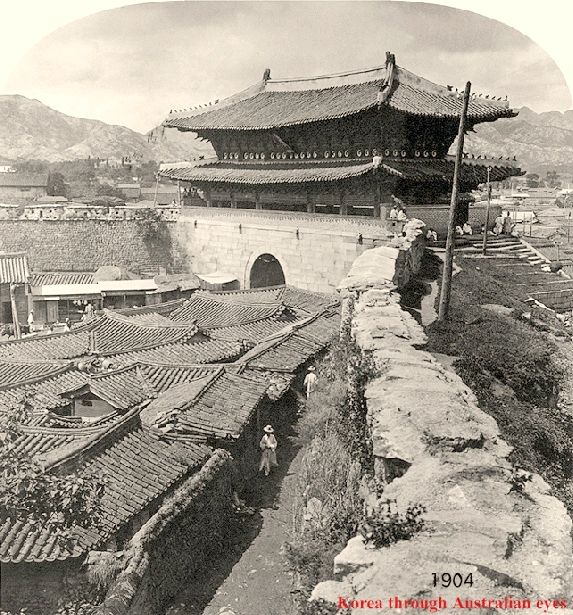 Namdaemun. From Korea Through Australian Eyes
These gateways have names in keeping with their importance. The west gate is called "The Gate of Bright Amiability;" the south gate, “The Gate of High Ceremony;” and the east gate, "The Gate of Elevated Humanity." The various gates differ in size, the east and south gates being much the largest. Some of the gates, too, are consecrated to particular uses. The southwest gate is the gate of criminals; and the southeast one, the gate of corpses. A criminal condemned to be beheaded is always taken outside the city for the execution, and the procession invariably passes out through the southwest gate. To pass out by any other gate would be to defile that gate. The same is the case with the southeast gate for the dead. Only the body of a dead king may be borne through any other. This gate is also called "The Gate of Drainage,” because the river flows out beside it. Lastly, the north gate stands high upon the Cock's comb. It is always kept shut, except at such times as it may be needed as a means of escape for his Majesty; for this purpose alone is it used.
The "Cock's comb" seems to be Bukhansan, which is not where the northern city gate, Sukjeongmun, is located (it's on Bugaksan). Other than that quibble, he provides a rather interesting look at Seoul 125 years ago. The map below shows the location of the city walls, as well as the locations of the gates (including 2 water gates: one for Cheonggyecheon, and the other which was
discovered under Dongdaemun Stadium).
 From Seoul, 20th Century: Growth and Change of the Last 100 Years
The rest of this post will look at these gates and the city wall today; lots of information about them can be found in Sewing's post at the Marmot's Hole titled "
The Gates of Seoul." Construction of the fortress wall began in 1396 and was carried out by 200,000 laborers. At that time, four great gates and four small gates were built to allow passage through at various points along its 18 kilometer-long length.
The best known gate is of course, Namdaemun (or Sungnyemun). It was the first gate to be isolated from the city walls when roadways were built on either side of it
in 1907. It's unfortunately more famous these days for
the fire which consumed much of the upper structure in February 2008; restoration work is
under way.
 My first view of Namdaemun, March 2001.
Heading north, the smaller gate Souimun, and a little further north, Seodaemun (or Donuimun) could be found. Both were demolished in 1914.
 Souimun, from Seoul Through Photos, Volume 1
 Seodaemun, 1904
I'll continue with the others momentarily, as the western small gates exist today due to a restoration project in the mid-to-late 1970s (the photos come from
Seoul Through Photos Volume 5). Colonial urban planning by the Japanese, neglect, and the Korean War took their toll on the wall, and here's what it looked like in 1978 in Cheongun-dong (between Inwangsan and Bugaksan):

The wall was restored in Jangchung-dong (near the Shilla Hotel) in 1978:

Before and after shots of the wall in Seongbuk-dong (1976, 1977):


If you head north from Namsan along the eastern side of the city wall, you'll come to Gwanghuimun, which looked like this over 100 years ago:

By 1971 it was in ruins:

It was restored in 1975:

Here it is in 2004:

Heading north from there, you'll arrive at the newly discovered Igansumun (below), as well as the Ogansumun which straddled Cheonggyecheon.

North of that is Dongdaemun (Heunginjimun), which was rebuilt in 1869, and is seen here in 1904:
 From Korea Through Australian Eyes
North of Dongdaemun is the section of city wall restored in the late 1970s, seen here in a photo from 1980:

It's clear what parts were replaced at that time, but now, 30 years later, the newer parts have pretty much faded to the same colour as the older parts. North of this section (in Samseon-dong) lies Hyehwamun. Here's an image of it from over 100 years ago:

The gate was demolished in 1928 but restored in 1992. Here it is today:

It sits up on a hill, so it has a more commanding view of the city tha the other gates:

Behind me when I took this picture was a section of the city wall, which lay next to a recently razed area ready for reconstruction:

Prompted by an article about the city wall hiking course on Bugaksan in the March issue of
Seoul Magazine, I visited it recently. I started from Waryong Park (I took a taxi from Anguk Station) and headed up to the information center where you need to fill out a form with your alien registration card or passport. The area was opened conditionally in 2006, and is now fully open (you can enter between 10 and 3), though its clearly still a military zone. It's a nice hike, however, combining a DMZ-style military presence with the city wall, great views (on a clear day) and a rarely seen gate. Here's a photo of the restored section of the wall in Samcheong-dong from 1976:

Here is the same view today:

Just visible in the top photo is Sukjeongmun, which was never actually used as a gate, but was built only to fulfill the geomantic need for four 'great' gates in each direction (it was sometimes opened during droughts, and Namdaemun was closed). It never had a wooden tower until one was built in 1976:

Here it is today from the south and north, respectively:


Sukjeongmun is the only gate in Seoul joined to the city wall on both sides, making this a rather unique view. As you continue, you can see the wall snake up Bugaksan:

Before you get to the top, you'll see this tree:

Those are bullet holes from the January 1968 firefight between South Korean troops and police and North Korean commandos sent to kill Park Chung-hee. Unlike the movies (like President's Barber and Silmido),
the battle did not end that night; the manhunt continued for quite some time and left over a hundred people dead or wounded.
Once you descend Bugaksan (which is quite steep and hard on the legs coming down), you reach Changuimun (or Jahamun):

A little known fact: because the Changuimun's tower was built in 1741 (with restoration work carried out in 1956), it's now the oldest gate in Seoul (after the Namdaemun fire).
Not part of the city wall, but close enough, was Yeongeunmun, which is where dignitaries from China were met.

After China's control over Korea ended in the wake of the Sino-Japanese War (1894-95), the Independence Club built the Indepdence Arch, or Dongnimmun in 1896. However, in 1979, construction of Seongsandaero - specifically a tunnel and elevated roadway - led to the gate being moved 70 meters north.

That's where it stand today:
 (Note the remains of Yeongeunmun still standing in front of the gate)
Another nearby gate is the floodgate Hongjimun, which is a part of the Bukhansan fortress (which connects to the Seoul fortress). The photo below was taken in 1884 by Percival Lowell:

The gate, which is 1 km northwest of Changuimun, fell into disrepair in the 20th century but was restored in 1976. I'll finish here with Lowell's description of the view from the southern part of the city wall, on top of Namsan:
The wall has been placed just beyond the highest point, so that but one side of it had to be built. As you stand upon it, your look sweeps down through the forest, off into the distance, to where the river Han, reflecting the sun, gleams like a belt of silver in the plain. In one vast semicircle it girdles the amphitheatre of peaks that surround Soul; and beyond it rises range behind range of mountains, like the billows of a frozen sea for the snow on them. At this height villages merge into their surroundings, and you are left to commune alone with a scene as grandly desolate as the ice and snow that cover it.
I guess you can't call the view of the Seoul area 'desolate' anymore, but there is still some majesty to be found in its "amphitheatre of peaks."
 From Bukhansan, 2002