Thursday, October 20, 2011

A collection of newspaper cartoons about foreign English teachers


I found the above cartoon the other day, and as I was trying to track down a specific cartoon on this site, I thought I'd put all of the anti-foreign teacher cartoons together. After I realized I had no cartoons from 2007 (when anti-foreign teacher articles and reports reached a peak before the E-2 visa regulations changed), I decided a search was in order, but found more than I expected. Here are all of the cartoons or illustrations related to foreign English teachers I could find, positive and negative. You may note the consistency with which the gender and race of the teachers is depicted, as well as certain racial characteristics.

This odd image of a couple kissing is from the incredibly bizarre column titled 'sickening face' published in August 1984 during the French teacher 'scandal.'


This cartoon comes from a Kyunghyang Sinmun opinion article from 1997 (which includes the phrase "Korea is a paradise for unqualified English teachers") :

(NSA: Native Speaking Assistant?)

This one is from a December 17, 2004 Donga Ilbo article titled "Foreigners see various aspects of corruption in Korean society," which paints some foreign teachers as victims of hagwon owners.

("I knew I shouldn't have accepted a job from Chun Doo-hwan!")

On April 5, 2005, the Donga Ilbo published an article titled, "'In Korea, English teachers have a fascinating life'; US recruiting site belittles Korea," which included this cartoon (obviously by the same artist):

"Unqualified"

From an August 15, 2005 Donga Ilbo article about apartment complexes having an English village with a foreign teacher titled "Our apartment's children don't go to hagwons":


From a November 23, 2005 Busan Ilbo article about apartments having English villages with a foreign teacher for marketing purposes:


From a December 7, 2005 Segye Ilbo article about foreign profs and visas (note the artist's signature - he'll turn up again):

"Visa?" 'lecture'

From a December 30, 2005 Kukmin Ilbo column about the Busan dialect:


From a March 6, 2006 Hankyoreh article about need for teachers in the countryside:

'Chungcheongbuk-do': "We have no budget!"

From an April 16, 2006 Hankyoreh article about companies introducing teachers to other businesses making lots of money:


From an April 18 2006 Kyunhyang Sinmun article which asked people, 'Which is more useful, an English camp or a native speaking teacher (55% chose the former, 40%, the latter):


As the teacher has no nose, I'll assume she's one of those 'fake' native speakers. The same question is pondered in this cartoon from the Hanguk Ilbo, April 25, 2006:


A June 4, 2006 Hanguk Ilbo article looks at the placement of native speaking teachers by province or city:


From a July 9, 2006 Segye Ilbo article titled “It’s urgent that measures be prepared for unqualified native speaking English teachers”:


The cartoon below is from an August 16, 2006 Seoul Shinmun article titled "Washout Native-Speaking Teacher Problem":

Late, absent/ gets money and does a runner/ molestation

Two days later, on August 18, the Segye Ilbo, mentioning the arrest of John Mark Karr, provided this cartoon in an article titled "As long as they just speak English... "Don't ask" recruiting of foreign instructors":

"Unqualified"

From an October 9, 2006 Kookmin Ilbo article about English names:

"My name is Jio"

On October, 23 2006, the Hanguk Ilbo provided this illustration for an article titled "US gangster drug criminals became hagwon English teachers?"

English instructor

From a November 22, 2006 Chosun Ilbo article titled "Foreigners started rumors about Hongdae? 'Street of pleasures,' a bitter distortion" (about a Korean woman studying in New York who met foreign men there who talked about Hongdae - and not because of art or music (gasp!)):

"The Girls of Hongdae..."

From a March 6, 2007 Hanguk Ilbo article titled “Public servant who can’t speak English? Don’t even dream of promotion [Ulsan]":


From a March 11, 2007 Hanguk Ilbo article about TOEFL and ways of studying:


I just liked it for the nose on the TV anchor:


From the May 9, 2007 Hankyoreh article ‘The reason for English teachers who speak poor English’ (at 46 places in capital area there were teachers hired for being white but were non native speakers):


From the May 26, 2007 Donga Ilbo article "Learn Korean in Andong":


From the June 11, 2007 Kyunghyang Shimun article "Native speaking teacher ‘low content’ – As long as they speak English, OK":


Translation: "It's chowdah! Chowdah!
I'll kill you! I'll kill all of you -
especially those of you in the jury!"


From the July 13, 2007 Munhwa Ilbo article “fake phone English teachers abound”:

"The pronunciation?" "Shallashalla"

I don't think they could be much clearer about how they feel about talking to a Filipina.

From an October 4, 2007 Donga Ilbo article about co teaching, and the need for training:


From an October 17, 2007 Segye Ilbo article titled “Native speaking teachers work in the country? NO”:

"Big city"

From a November 12, 2007 Gangwon Ilbo article titled "The power of English":


From a February 10, 2008 Kyunghyang Sinmun article about enticements to buy apartments like English camps:


From a February 18, 2008 Hanguk Gyeongje article about a free language chatting site:


A March 20, 2008 Hanguk Ilbo article titled "Killer wanted by FBI openly teaches in Korea" published this cartoon:

"Wanted" "Teacher"

From a March 24, 2008 Maeil Gyeongje article about English immersion education:


From a March 29, 2008 Maeil Gyeongje article about Konglish:


This was in the June 18, 2008 edition of the Weekly Chosun:

"Native speaking instructor"

Ironically, it's a translation of an article written by a foreigner criticizing the abilities of foreign teachers in Korea. As for the cartoon, I love the sign he's holding. Who doesn't want a foreign teacher blow-up doll? If you can't get a robot, I mean.


From a June 25, 2008 Sindonga article titled, “By memorizing a framework of only 200 sentences, you too can master practical English”:

"Shalla shalla"

(It says that the Korean person is someone who has "studied using this method for 1 year." For those doubters out there, perhaps the foreigner is praising him because he isn't a native speaker, as can be seen by the lack of a huge nose.)

From a July 18, 2008 Kyunghyang Sinmun article about taeglish and piglish (taekwondo, piano + English):


This cartoon appeared in a September 26, 2008 NoCut News (and Gyeongin Ilbo) article titled "70% of Incheon native speaking assistant English teachers are inexperienced":

"Experience" .

From a December 5, 2008 Seoul Sinmun article titled “Study English with a native speaker through the computer”:


From a December 17, 2008 Maeil Shinmun article titled "Why do unqualified foreign English teachers abound?," which opens with the question, "If you're white, all goes well?," had this pointy-nosed foreigner holding an (incorrect) graph:


From a January 28, 2009 Hanguk Ilbo article about Seoul shouldering private education costs:


This cartoon accompanied a May 20 Donga Ilbo article titled "'Drug instructors' caught and still teach - schools and hagwons take no action and cover it up":


An August 9, 2009 Segye Ilbo article titled "In a single year, thousands of dollars are spent inviting... fraud native speaking teachers" provided two cartoons:


The August 24, 2009 Weekly Chosun had several articles about English Teachers (see here for translations) and provided these cartoons (the first is meant to comment on how the media views foreign English teachers):


On October 31, 2009, Sports Seoul published an article titled "Pursuing the reality of sex crimes by foreigners which threaten Korean women" in which was written "From Southeast Asians who enter the country illegally to earn money, to white native speaking English instructors... sex crimes against Korean women by foreigners are rampant."


 The Hankyoreh published four positive articles about foreign English teachers on November 29, 2009 and had these four cartoons accompany the articles:

"Forty students?"

"Why doesn't she ever consult with me about classes?"
"Do this today, OK?"

"I want to improve my skills as a teacher" (Book:"Teacher training")

"Are they going to ignore me?"

On December 1, 2009, Ilyo Sisa published a round up of incidents for that week and included a section titled "A bunch of foreign instructors headed to prison... why? A 'stoned lecture' while on drugs," which reported that there had been a shocking arrest of foreigners who worked in kindergartens and schools, including a regular [employee] instructor at a university and an actor seen on a terrestrial broadcaster. Five were arrested, one booked but not detained, and three more were being pursued for smuggling or taking cocaine or pot cookies in Incheon. (SBS also reported on this bust.)


On February 19, 2010, the Donga Ilbo published an article which wasn't about foreign teachers at all (it mentions the native speaker way of thinking when studying English), but which included this bizarre cartoon:

"Correct expression", "accurate pronunciation"
(note that the artist also did this classic cartoon)

On March 24, 2010, the Donga Ilbo published an article titled "By day he teaches, by night he sells drugs... Teacher wanted by Interpol" with the English subtitle "He is a killer, drug dealer… and your teacher" (which depicts the teacher as a gumiho or fox with 9 tails who has turned into an English teacher):


On March 30, 2010,  Ilyo Sisa, published an article titled "Unqualified English instructor who was a former gangster caught; In the US he was a 'murderer', in Korea, a 'teacher.'"


This cartoon is from a Gyeongin Ilbo editorial from October 26, 2010 titled "Opium eater Native speaking teacher":


The Munhwa Ilbo published an article on December 8, 2010 titled "Native Speaker Phone English? Turns out it's a korian. Deception by yuhaksaeng [posing as] 'neitibeu seupikeo'" that included this cartoon (it's not hard to figure out which one is foreign):


From a December 13, 2010 Kyunghyang Sinmun article about a foreign teacher stealing a trophy from other teachers while drunk:


On December 15th, Sports Seoul published an article following up on the 'fake' native speakers titled "'Ddeokbokki should be pronounced 'ddeobbogi' - the sorrow of fake native teachers." The accompanying cartoon, depicting the ddeokbokki incident and a teen talking about her sexual experience in earshot of the teacher (who must play dumb since he 'doesn't understand Korean') raises questions:


Do they have blond hair (and a goatee and earring) and look grotesque (compared to the Korean girls) because they are masquerading as foreigners?

This cartoon is from an August 9, 2011 Chosun Ilbo article titled "Famous Gangnam hagwon owner was LA gang member 14 years ago":


Gyopo murderers working as English teachers in Korea always seem to be fodder for cartoonists; this makes quite clear the person in question is Korean.

This cartoon is from an August 9 2011 Hankook Ilbo editorial about the hagwon owner wanted for attempted murder in the US:

Note the knife in his back pocket. As the teacher has no nose, he has also been pretty clearly depicted not to be a westerner.

From an August 19, 2011 Chosun Ilbo article titled "[Why] Ethnic Koreans in Korea suffer discrimination - wronged native speaking English teachers":


It's good to see the newspaper that printed "White English Teacher Threatens Korean Woman with AIDS" [Korean, English] so concerned about the plight of non-white, ethnic Korean foreign teachers.


On December 9, 2011, the Seoul Sinmun published an articlesubtitled "American gangsters deported for murder, drugs and gun smuggling became native speaking teachers" (more about that story can be read here):


"Fake diploma; native speaking instructor"

This cartoon is from a lengthy March 20, 2012 Donga Ilbo article about the effect the disappearance of native speaking teachers would have on public schools in Seoul, especially with Gangnam-gu having 4 billion won to spend on NSETs when other districts had no money.


On July 10, 2012, this cartoon appeared in a Donga Ilbo article titled "University student 'English study tip': A part time job in Itaewon":


On August 24, 2012, Financial News posted an article about native speaker video English, which was accompanied by the following photo:


On October 11, 2012, the Gyeongnam Sinmun, offered the following cartoon in an article titled "Foreign kindergarten instructor habitually took drugs" (pot cookies):


On May 3, 2013, the Munhwa Ilbo article published the following demonic photo to illustrate an article titled "An American wanted for first degree sexual assault of a child turned out to be... an 'elementary school instructor' on the run in Korea for 9 years":


This July 29, 2013 Munhwa Ilbo article, titled "'Foreigners [caught for] hidden cameras' increase sixfold over four years - concern videos may be leaked overseas," mentions a foreign teacher who took upskirt photos (but not at a beach, which was the focus of the story) and illustrates the article with an image of the same teacher seen directly above, and illustrated by the same artist.


On February 12, 2014, the Kyunghyang Sinmun published this episode of Park Sun-chan's 'Jangdori' in their hard copy edition and online) based on a case of mistreated African performers.

A certain artist. 

"People from poor countries need to realize that they live in luxury in Korea."

A certain criminal.
[Holding bag of 'drugs']

[At a native speaker English hagwon]
"Thank you so much for deigning to visit our shabby place."
"Teacher!" [Bowing deeply.]

On August 4, 2014, the Gyeongin Ilbo published this cartoon about English and Chinese native speaking English teachers leaving Incheon schools:


On December 4, 2014, the Law Times published this cartoon to accompany an article about a judgement requiring a hagwon owner to pay foreign instructors severance pay:


Some additional, non newspaper cartoons include this and these (NSFW) comics, which I also looked at here. The graphic accompanying this article is also amusing.

Vaguely related is an October 23, 2009 Kyunghyang Shinmun article titled "Foreign school students do 'lots of drugs'" depicted mostly Korean students doing drugs with this cartoon:


Plus a 'best of' compilation:

No one is safe. No one.

Last but not least, this is from a cartoon on a blog about a Korean teacher's foreign co-teacher ("shalla shalla" represents what Koreans think English sounds like). For some reason, the gif's animation only seems to work if you click on the photo - so click away:

Monday, October 17, 2011

45 years of calling for revisions to the SOFA

This year there have been a handful of articles portraying Itaewon as dangerous and complaining about the 'shocking' behavior of foreigners there since the curfew for US soldiers was lifted last year. Now that a new curfew has been put in place, Itaewon is being portrayed as a place of peace and calm.

This is quite reminiscent of what happened in Hongdae in January 2007, when YTN broadcast a report on the outrageous behavior of foreigners, especially GIs, which was turning Hongdae into a "lawless zone." Shortly thereafter, USFK command banned U.S. soldiers from Hongdae, and YTN celebrated with a report which stated that, "Since U.S. soldiers stopped going to Hongdae, peace has returned to the area."

Despite there being SOFA in place, if the media place enough pressure, the US has shown that it will place bans, or, most recently, re-instate the curfew, which is wanted mostly for symbolic reasons than for any practical reason. The idea here is to assert sovereignty over the soldiers in an indirect way.

Well worth reading is Gi-wook Shin's paper, "The Media and the U.S.-ROK Alliance:
The South Korean Case," which can be found here. As he notes,
Observers of Korean affairs note that the Korean media have contributed to the rise of the South Korean public’s adversarial attitude toward the U.S. and its changing perceptions of the alliance with the United States.[...]

When excessive media attention is based on misinformation or overly normative judgments, there is ample potential to adversely affect otherwise sound relational dynamics within the alliance. Nonetheless, the perceived U.S. “insensitivity” propelled South Korean public resentment, thereby eventually forcing a U.S. concession.
The concessions referred to here are apologies for the 2002 accident and a ban on beef more than 30 months old in 2008.

Oddly enough, a group claiming responsibility for contributing to the 2007 Hongdae ban was Anti-English Spectrum:
2007.01
Personally went on location to shoot a report on the problems with Hongdae Club Day, the gathering place of low-quality foreigner English teachers, for the purpose of broadcasts and press exposure. Breaknews, YTN broadcast the report numerous times by the hour. A barrage of civil petitions were sent to Mapo Police Station, and after the news broadcast, the police announced that it would implement a crackdown.[YTN: "Hongdae, Foreigner 'Lawless Zone'" - links: English Korean]

2007.02
After our cafe’s broadcast went out on the atrocious behaviors of foreigners at Hongdae clubs, Commander Bell’s U.S. forces in Korea were completely prohibited from entering Hongdae clubs.
[YTN: "U.S. Forces Banned from Hongdae" - links: English Korean]

What's interesting is that though the SOFA may shield soldiers from Korean law - or at least that's how the Korean media describe it - the fact that they are subject to military command means that, through media pressure, soldiers' free time can be controlled to some degree through blanket curfews or bans. This is not the case with foreign teachers, hence AES's call for "continuous monitoring" of foreign teachers.

At any rate, with more calls to revise the SOFA in the air, it might be worth mentioning how it was first negotiated:


Yes, indeed - after the draft was released to the public, the media decried the fact that the Philippines had a "better" SOFA, and calls were made to revise the treaty. So Koreans have been calling for revisions to the SOFA since before it was even ratified.

Calls for the SOFA to be revised after it was ratified first occurred after 'Anti-American Hatefest '88', otherwise known as the XXIV Summer Olympics, but that's a story for another day.

Wednesday, October 12, 2011

An early article about migrant workers in Korea

On September 23, 1989, the Korea Times, with great subtlety and grace, reported on an emerging social problem:


It may be difficult to discern, but I think a close reading of the article may turn up a bit of disgust at the 'hobos,' 'bums,' 'vagrants,' and 'loafers' infesting the country, and gives some idea of how migrant workers would be treated in the future. Actually, once the Industrial Trainee System (ITS) systematized their entry into the country two years later, it could be said that things got worse for them, since they were forced to pay outrageous recruiting fees to come to Korea, and then had their wages controlled and kept low (with forced 'saving plan' deductions making them even lower), while being considered 'trainees' (and so not subject to labor law protections) and only allowed to stay for two years, which was not enough time to pay back the loans back home they took out to pay the recruiting fees in the first place. That system - and the fact that working illegally could pay twice as much for the same work - essentially mass-produced a colony of illegal foreign workers, who amounted to 80% of Korea's 350,000 migrant workers in 2003. On the other hand, since the ITS did allow them to enter the country in (eventually) sizable numbers, it at least meant that not every south or southeast Asian seen on the street was considered to be illegal, as may well have been the case when the above article was written.

More of the development of the ITS can be found here.

Tuesday, October 11, 2011

Directions to Maple Tree House

[Update:
It was great to meet readers last night, and in such a setting. Thanks again to Mr. Devolin and Senator Martin for hosting the event.]

A bit late, I realize, but anyone going to the dinner at the Maple Tree House tonight can catch bus 종로 11 (Jongno 11 - it comes every 5-8 minutes) from the bus stop near exit 2 of Gwanghwamun Station or from in front of the Press center (from exit 4 of City Hall Station) and go six or seven stops, respectively, and get off at 한국교육과정평가원 (Korea Institute of Curriculum & Evaluation), and then walk back a bit to the restaurant. In the photo below, the restaurant is at far right, and the bus stop would be at far left.

Saturday, October 08, 2011

The true origin of pizza

This is probably the best pizza commercial ever:


More videos related to this can be found here (and more commentary is here). There are lots of comments at youtube written by Koreans who clearly 'get it,' but there are also some from those who obviously don't understand that it's satire. Having recently read Hyung-il Pai's 'Constructing "Korean" Origins,' the bit about the archeological evidence made me laugh (as she argues that the use of archeology in Korean historiography has at times involved putting square pegs into round holes). At any rate, kudos to Mr. Pizza - it would be nice to see more like this.

Friday, October 07, 2011

Police arrest man for indecent assault against a foreign teacher

Yonhap published this report yesterday evening:
Seosan Police issue warrant for man in his 50s who indecently assaulted an American native speaking instructor

On the 6th, police in Seosan, Chungcheongnam-do requested an arrest warrant for Mr. Kim (57), who is suspected of molesting (indecent assault) a foreign woman in an apartment elevator.

According to police, on September 23 at 10:05 pm in an apartment in Seosan, Mr. Kim indecently assaulted K (25), an American native speaking instructor, by groping her while riding in an elevator with her.

The police investigation found that he was drunk when he committed the crime, and he was caught after police followed up a report from the victim.
In other news, that the GI accused of raping a 19-year-old in Dongducheon has been put under Korean jurisdiction isn't surprising, but I found this to be interesting:
The U.S. military transferred him to South Korean investigators after the court issued an arrest warrant for the 21-year-old serviceman, identified as “K.”

He was immediately taken to a detention center and will remain in custody during trial, prosecutors said.
After the 1995 subway incident, activists demanded the ability to do what the Korean authorities are now doing, ie. keep US soldiers in Korean detention while the investigation and trial progress. When did the rules change to allow this?

Thursday, October 06, 2011

Dinner Hosted by Maple Tree House and Canadian Parliamentarians

Next week, Canadian parliamentarians BC Senator Yonah Martin and the Honourable Barry Devolin, Assistant Deputy Speaker of the House of Commons, who are co-chairs of the Canada-Korea Parliamentary Friendship Group, will visit Korea.

On the evening of Tuesday October 11, 1at 7:00 pm, Mr. Devolin and Senator Martin will host a dinner reception for Canadian English teachers in Seoul at Maple Tree House, Jongno-gu, Samcheong-dong 31-1 (02-730-7461) for a casual exchange of ideas and open discussion on a range of issues over Korean BBQ. If you are a Canadian English teachers interested in the idea of having a meaningful discussion on Korea-related topics or issues of concern to English teachers in Korea, contact information is below:

RSVP: eslreception@gmail.com
Attendees: First 50 to reply
Cost: Free
Time: Tuesday, October 11, 19:00-21:00
Location: Maple Tree House (Samcheong-dong)

I can post more detailed directions to the restaurant next week.

Tuesday, October 04, 2011

An interesting comparison

On October 2 two articles went up on the Kukmin Ilbo's website (and later in the hard copy paper itself) with in a minute of each other. The first was titled "'Unregistered instructors' abound in hagwons as part-time workers.'

The article introduces Ms. Lee, a 23 year old 4th year student at a private university who works at a hagwon for 3 hours a day, 5 nights a week teaching math to elementary and middle school students after her university classes. She'd previously worked there marking tests and cleaning, but when the math teacher suddenly left in May, she, with an engineering related degree, became the replacement. Saying that most parents don't realize she's a university student, and that there's no need to prepare classes, it's noted that since she's not registered with the education office, she is an 'illegal instructor.'

It notes that incidents of part time workers turning into unqualified hagwon instructors are increasing. "Though the government passed an amendment strengthening the hagwon law on August 15, there are still many blind spots in regard to unregistered instructors and illegal private lessons."

It then quotes a hagwon owner who says that the part time teachers are cheaper and don't have to be paid insurance. As it turns out, according to the laws, it's not impossible (though it would be difficult) for a university student to teach legally, but parents do not want university students teaching their children.

According to the law, hagwons should submit information about their new teachers to local education offices, and the information about the teachers (such as their qualifications), as well as hagwon fees are posted publicly. As the Ministry of Education notes, however, "In reality, enforcement of this is difficult."

Note the lack of judgement. These instructors, and the hagwons that hire them, are not condemned for doing things against the law. There is no worry that these illegal instructors are, say, not being checked for a criminal background, or are a threat to their students.

This stands in contrast to the other article the Kukmin Ilbo published yesterday:

Drugs, Molestation... Holes in supervision of 'delinquent native speaking instructors.'

In August, Korean American Mr Kim (33), the operator of a language hagwon in Gangnam and former gang member wanted for first degree attempted murder, was caught by police. Mr. Kim was wanted for a 1997 attempted murder charge in the US, came to Korea and taught SAT, TOEIC and TOEFL.

Drugs and molestation by native speaking instructors in hagwons are never ending. Education authorities are also strengthening the supervision of native speaking instructors but it's beyond their capacity to crack down on unregistered native speaking instructors.

Under a recently passed amendment to the hagwon law, when foreign instructors are hired, they must submit things like a criminal background check, a health check including marijuana and drug test results, and educational certificates. As well, the education superintendent will conduct training about Korean culture aimed at foreign teachers who have entered the country more than once. According to the Ministry of Education, Science and Technology there are currently 15000 hagwon native speaking instructors registered with city and provincial education offices.

The problem is the effectiveness of the law. This is because government's measure affects only native speaking instructors registered with city and provincial education offices. Even today, most native speaking instructors hired by large hagwons are instructors who received 'Conversation instruction (E2) visas' when they were hired. The E2 visa is for native speakers from 7 countries which use English as the native language such as the US, and even now in order to be issued the visa one must submit a health check which includes a marijuana test. If the hagwon law is introduced then the only difference is that a health check must be received once again.

However 'unregistered instructors' who do not go through the registration procedure are in fact a blind spot in their supervision. According to hagwons, if they bring instructors from countries which can receive an E-2 visa, they normally have to pay over 3 million won a month for housing and a round trip plane ticket. Large hagwons can hire formally registered instructors who have received an E-2 visa, but small hagwons which have issues with expenses have no choice but to hire unregistered instructors. Because unregistered instructors mostly enter on tourist visas, they don't have exacting E-2 visa-like verification. Even after coming to Korea, they can work as native speaking instructors unregistered without any sort of supervision.

On October 2, Byeon Geon-mo, head of Job and Consulting, a company which recruits native speaking instructors, said, "The phenomenon of parents prefering white instructors is clear and large hagwons find it difficult to normally hire non-white native speaking instructors." "Instructors with E-2 visas must be paid 50,000-60,000 won per hour, but because unregistered instructors are only paid 20,000-30,000 won per hour, small hagwons can't help but prefer them."
The difference between these two articles is pretty clear. They harken back to the two articles about Korean "fake native speakers" last December, one of which looked at the "sorrows" of Koreans who pretend to native speaking gyopos in hagwons, which stand in contrast to how "fake" or "unqualified" foreign instructors are treated by the media. To paraphrase B.R. Myers, just as foreigners are inherently evil, while Koreans can only do evil, so it is that Koreans are uniquely virtuous, while foreigners can only do the occasional good deed. Additionally, when Koreans do wrong, it was a mistake, or they had no choice, and understanding is needed.

Unlike western, foreign instructors, small hagwon owners "can't help" but hire illegal, unregistered foreign instructors, who then perpetrate the most outrageous crimes against Koreans who are powerless to stop them due to blind spots in the system. That these 'blind spots' are caused by Koreans who hire these teachers is not worth looking into - like the Koreans convicted of war crimes after World War II who were absolved by a government commission, they had no choice.

An even more stellar example is an article by the Weekly Donga in May, 2010 which looked at the fate of David Nam, a second generation Korean American who shot and killed a "white man in his 70s" as a teen in 1996 and fled to Korea where he eventually worked as an English teacher in a hagwon for the better part of a decade before being arrested in 2008 and extradited to the US where he was found guilty and sentenced to life in prison. The title of the article? I kid you not: 'The "cruel fate" of the Philadelphia fugitive.' In it, it is suggested that the racism that Nam faced as a child from white children helped set him on the path that led him to "pull the trigger" (he didn't mean to kill the man, of course).

When Nam's arrest was reported on March 19, 2008, Yonhap quickly released a story titled "There is nothing to stop foreign criminals from fleeing to Korea," which ended with this:
With the private English education craze, there is an explosive increase in native speaking instructors, however a system to confirm their qualifications is not properly provided for, and as demand for native speaking instructors outstrips the supply, instances of people known to be unqualified being hired have occurred, so in fact there is a need to strengthen enforcement regarding this.
The Hankook Ilbo also published this cartoon the next day:

"Wanted" "Instructor"

As it turned out, Nam had dual citizenship and was under no obligation to get an E-2 - or any - visa, though his arrest led to calls for strengthening the E-2 visa (which had just had a criminal record check, drug and HIV check added to it three months earlier).

Also, the Kukmin Ilbo article states that "Drugs and molestation by native speaking instructors in hagwons are never ending" without giving a single example. None is needed, I guess, since it's simply 'known' to be true, but it might be worth pointing out that of the three reported cases I could find of foreign hagwon instructors being investigated for molesting students, the last took place in April, 2008, or three and a half years ago - so these crimes are hardly 'never ending.'

It's nice to see recruiters Job and Consulting back in another 'news' article (number 6!) depicting western English teachers as potential criminals in order to drum up business for themselves. While 'unregistered' Korean instructors have been a problem reported on occasionally by the media for some time, this is the first time the term has been applied to foreign instructors. You'd think with the vast array of crimes and flaws foreign instructors are already accused of there'd be no need to come up with something new, but the media (and recruiting companies hitting them up for some publicity) are nothing if not inventive and relentless in this regard.

As for the amendment to the hagwon law, I haven't had a chance to look at it yet, but this summary says that
When hiring foreign instructors to work in hagwons, the law legislates that in addition to criminal record checks, health checks, and education certificates, that their passport, visa, and alien registration card also be confirmed.
I'll try to find out more about this.

Saturday, October 01, 2011

The Constitutional Court rules on the Vandom case

It was over two years ago that the Constitutional Court agreed to accept Andrea Vandom's petition to find mandatory in-country HIV tests for non-Korean non-citizens on E-2 visas unconstitutional. For more background, see these articles:

Foreign Teacher Renews Visa With No Health Checks
A letter criticizing Vandom and her response to it.
Teachers to Go to Court Over Visa Rule
Prejudice or ineptitude? Let court decide
Teachers Fight Over Unfair Visa Rule
Infected, Detected, Rejected in South Korea
Victims of HIV-related Travel Restrictions in Korea

Two days ago the court gave its decision - the petition was rejected. It should be pointed out, though, that "the Court has not ruled the tests are "constitutional" - it has rejected the petition."

A summary of the decision can be found here (in Korean).

Hopefully I can post a translation before too long, but for now, Benjamin Wagner's comments on the decision are worth reading:
At 2PM on Thursday the Court rejected Andrea Vandom's petition because in the Court’s opinion the immigration office didn’t force Andrea Vandom to do the HIV and drug tests "required" by the E-2 visa, they just requested her to do the tests. The Court said that just asking for the tests isn’t enough to constitute an action by the government that would violate the rights of a foreigner in Korea.

We had hoped the Court would decide the constitutionality of a rule that required foreigners to be tested for AIDS and drugs merely because they were foreigners and give us a clear ruling that such a practice is discriminatory under the Korean Constitution. We didn't get that but there is much that is positive about this case. First, the Court has NOT said that it is constitutional to conduct mandatory in-country HIV and drug tests on foreigners. Second, the Court’s decision cast a great deal of doubt on whether the tests are mandatory. The government's argument was that it had merely asked for Vandom's HIV status and it made no attempt to argue that mandatory rules were in place to force her (i.e., deportation, visa cancellation) to comply. If someone were to refuse a blood test and argue that a self-declaration of HIV status was all that was required, this case would offer support for that position.

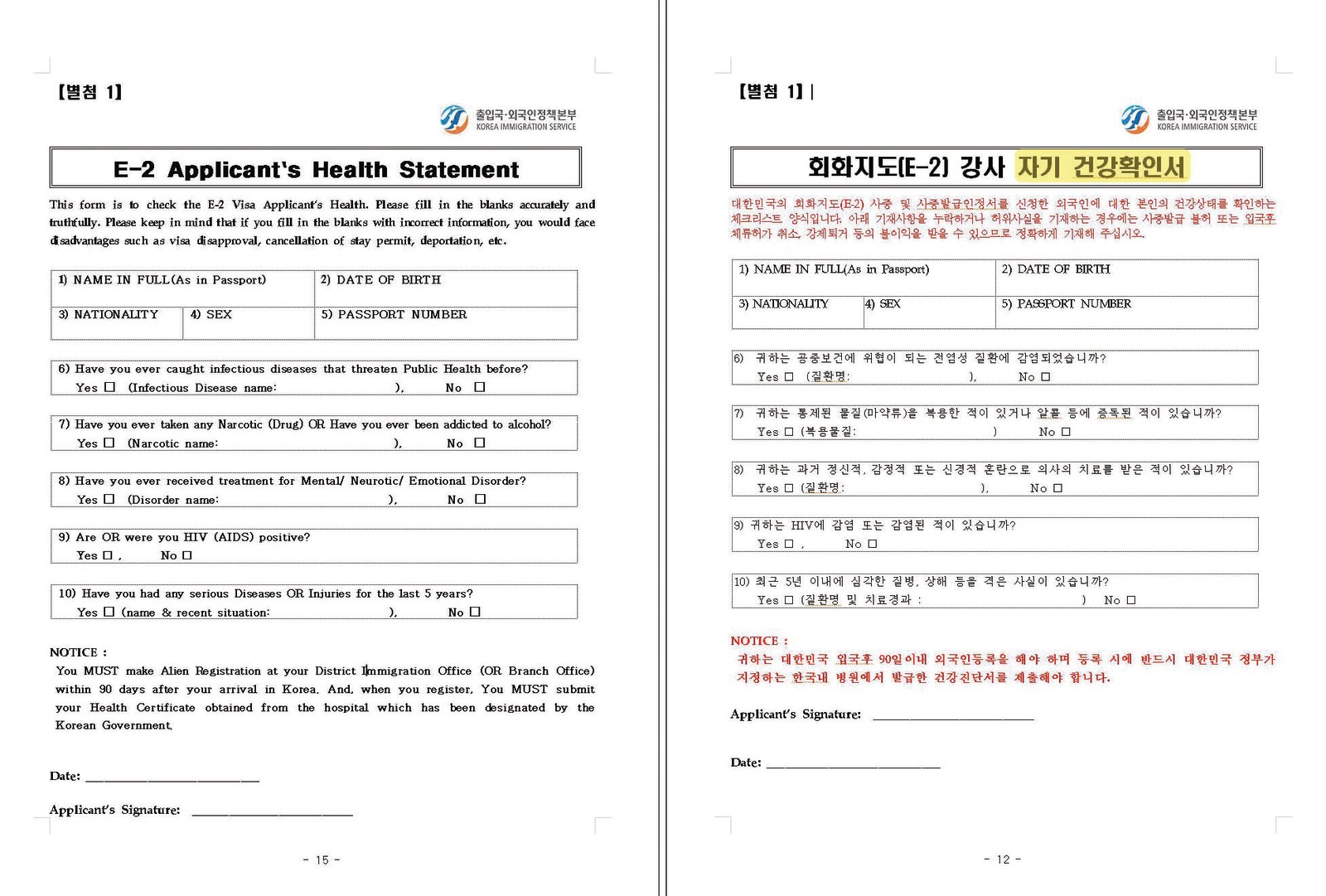
In its decision the Court focused on regulations promulgated on April 3, 2009, which the immigration office calls a "self-health statement" or a "self medical check" (this link downloads a .hwp copy). The questionnaire looks like this (note that the "self" part is only in the Korean version, marked yellow):


The Court looked at questions 7 and 9, which ask:
7) Have you taken any Narcotic (Drug) or have you ever been addicted to alcohol in the last 5 years?

Yes □ (Narcotic name: ), No □

9) Are OR were you HIV (AIDS) positive?

Yes □, No □
So for E-2 visa holders who have taken AIDS tests, and repeat AIDS tests – some 80,000 of them over the past four years – the immigration office says (in this case at least) they were just asking for them, not requiring them.

I discussed this so-called "self-health check" in Feb. 2009 and mentioned how it disingenuously tried to pass off the tests as voluntary measures, pointing out "it appears to be a 'self-check' until you get to the bottom of the page," which reads:
"You MUST make Alien Registration at you District Immigration Office (OR Branch Office) within 90 days after your arrival in Korea. And when you register. You MUST submit your Health Certificate from the hospital which has been designated by the Korean government."
While examining the questionnaire, the Court, for whatever reason, does not take this binding language ("You MUST submit...") into consideration. And perhaps, according to the Court's opinion, this statement should be interpreted as a mere request since the Court's opinion indicates that it's not clear whether the government would take any action if an E-2 holder refused to comply with a hospital exam and just submitted a self-declaration.

Nevertheless, before anyone makes the decision to refuse the hospital tests they should be aware that (in 2009 at least) the immigration office has said the following:
※ 'Recruitment health exam' MUST include TBPE test(tests for drug abuse) and HIV test (tests for AIDS) results . . .

※Those that list history of drug usage, AIDS, or other disease the law defines as serious contagious disease in their self health verification are not allowed to be issued a visa issuance certificate

※Those that are found to have drug intake, AIDS or other disease the law defines as serious contagious disease in their health examination will have their stay cancelled and be deported.”
(This dire warning, to my knowledge, is no longer posted on the immigration’s website. I mentioned this in the NHRCK report (p. 8, FN 27) and there’s copy of it here.)

In 2010 the immigration office stated that persons with HIV will not be rejected for E-2 visas, will not have visa status canceled and "will not be forced to leave Korea." If this is indeed the case then a self-declaration should suffice.

Yet, keep in mind that Andrea Vandom, who made it known that she was not HIV positive, was threatened with deportation by the immigration authorities on numerous occasions for refusing to provide hospital test results – including this threat in the press:
"After the incident, the immigration office said the approval was a mistake by an official and that it would ask her to submit the necessary documents. The office added that it would deport her if she didn't heed the request."
The Court did not take these deportation threats into consideration, however, and focused on the so-called "self health check" document.

* * *

I'll conclude with a thought provoking statement from the case that Judge Kim Jong Dae gave in a separate (concurring) opinion. Judge Kim stated that
"[Under] our Constitution only 'nationals' [kukmin] are entitled to fundamental rights while the legal status of foreigners falls within the range of international law and international treaties . . ."
While the Constitution does indeed use the word "national/citizen" [kukmin] when referring to all fundamental rights, there are several Korean Constitutional Court decisions asserting that foreigners in the territory (and in one case outside of the territory) are in fact entitled to fundamental human rights under the Korean Constitution. Not to mention the repeat declarations by the Republic of Korea (“ROK”) to the international community, which state:
“The principle of respect for human rights and the principle of equality of individuals before the law, as enshrined in the [ROK] Constitution, also apply to foreigners.”
Judge Kim's opinion on foreigners' rights under the constitution is disappointing, but his validation that foreigners' rights are indeed guaranteed by international law and treaties (which is clearly stated in Art. 6(2) of the Korean Constitution) is very positive. However one wonders why this Court didn't go ahead and apply them in this case. If it had, it would have given us a clear ruling that requiring foreigners to submit to HIV tests which are "just intended to assure the parents" is a stigmatizing and discriminatory practice that is forbidden by international law and treaties.

In January 2010 the ROK announced to the world that it was abandoning HIV restrictions on foreigners and was congratulated for it by the UN [link]. In March of the same year, before the Human Rights Council, the ROK said that “early this year as part of the effort to eliminate all forms of discrimination” the ROK had revised restrictions on “foreigners living with HIV in compliance with UN recommendations.” [link to video]

This case should be seen as progress toward confirmation that HIV tests for foreigners on E-2 visas are voluntary. The Korean immigration office should make it clear that those who intend on treating them as such will suffer no adverse consequences.