My last post was just one example of many redevelopment projects in Banghwa-dong at the moment (many of which are within a five minute walk of my home).
Here's a map of developments that have occurred in Banghwa-dong between 1990 and the present; there have been quite a few of them (click to enlarge).
If you're wondering why the southern third of Banghwa-dong has very little development, it's because they're going to build a new town there:
The fields on the right will be developed under the Magok 'R&D City' plan. This is just one of many plans floating around, so I wouldn't trust it too much.
At top right is the Incheon Airport Railway bridge, next to Gungsan (I took photos of both here). Banghwa-dong can be seen at left (my neighbourhood is jutting into the Magok area at top left - I love how it's depicted as being nothing but apartment buildings). At bottom center is the Balsandevelopment.
I thought I'd try to animate (sort of) my map above, but the results aren't great on Youtube...
I've got a few new photos of this development, so I thought I'd just put all the shots from the same angle together to show how it's been coming along.
Jan. 30
Feb. 3
Feb. 15
Feb. 18
April 4
April 21
April 29
May 5
May 10
May 25
June 10
June 30
July 9
July 15
July 21
July 30
Aug. 8
Aug. 15
Aug. 31
Sept. 9
Sept. 22
Oct. 6
Oct. 12
Oct. 23
Nov. 8
The pace really began picking up in July, and now it's rising one floor per week. [Update, Sept. 20] As it's set to have 12 floors, it should be done in 3-4 weeks. [It was finished Oct 31].
The soon-to-be-crying children are at bottom left.
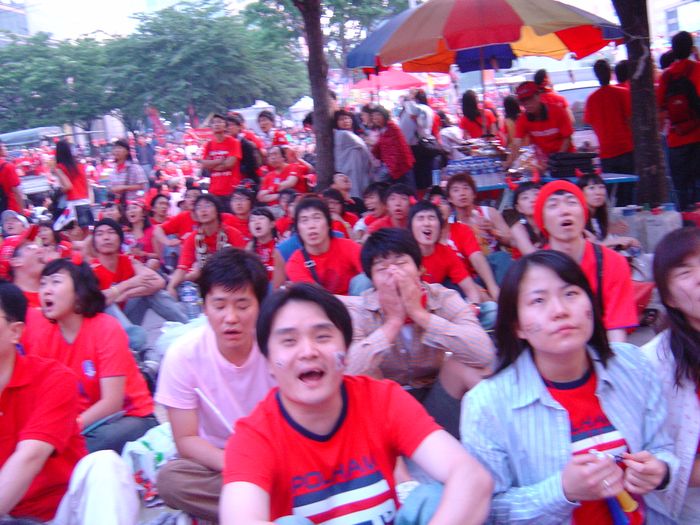
While working on another post, I'd planned on posting a photo of the kids crying in Pyeongchang after it was announced that Sochi, Russia, and not Pyeongchang, had gotten the 2014 winter olympics. As usual, a quick search for another photo or two led me in another direction. The photos below came from various sources (1, 2, 3, 4, 5). One source is a video, which I'll get to in a moment. A screenshot from that video (above) shows us the gathered citizens at 8:22 in the morning on July 5. As the Joongang Ilbo tells us:
Nearly 3,000 residents of Pyeongchang gathered to watch the announcement on a giant screen, but they walked away with tears of disappointment. Celebratory concerts and festivities were cancelled.
Giant screen? Combine that with the image below and you've almost got something akin the scenes we saw during the world cup last year (and in 2002), with perhaps civic pride being mixed in with the sports and nationalism this time.
Alas, it was not to be. The little girl below was seen crying in just about every Korean newspaper and broadcast, and even overseas. What happened? Did she realize that they were going to have to go to school that day after all?
Her friend on the right looks on with concern as she continues crying; then she begins to console her.
Then she starts to cry.
Now the boy on the right is crying. And what's that girl in the background (wearing the yellow bandana) on the left doing? Is she smiling? (Yes)
She's not smiling now.
Nope, she (yellow bandana girl) is looking decidedly sad. The girl on her left looks like she's either smiling or confused.
Yellow bandana girl is standing up and wiping her eyes now. Her friend on the left looks confused, but isn't smiling.
Unlike most of the others, we can actually see yellow bandana girl shedding tears. Now her friend is starting to wipe them away.
Yellow bandana girl has removed her bandana and now she and her friend are both using them as a hankerchiefs.
Now the girl on the right has moved to the left, and finally gotten around to removing her "Yes" bandana. She looks like she's about to cry.
Actually, if you watch the video below (from which the still above is taken), she looks like she's trying to cry, but isn't having much luck; the video cuts away from her before we can see the fruits of her efforts.
What could be motivating this contagious crying? It should be pointed out that it seems the crying doesn't begin until the man on the screen finishes a speech and begins wiping his eyes with a hankerchief.
One of the most important influences can be seen in the background of the photo below. What we don't see in the rest of these photos are the dozens of photographers who are taking photos of of these children.
The screenshot above (like all of the yonhap news screenshots) were taken from a video that can be found here (it's playable in Mozilla, but you may want to open it in a new window - it resizes your browser). It really is a must-see; watch to see how people act when cameras focus on them after the loss is announced. Also, listen for the sounds of cameras as the children cry - there are lots of them).
Whoever shot that video, you'll notice, filmed shots of the same people before the announcement, going for the obvious before and after effect. I've pointed out how it spread throughout the children, following the first girl's example as dozens of cameras were pointed at them. What really stood out for me were how the adults began to cry when cameras were put in their faces. Notice that because they've covered their faces with the banners-become-hankies, few tears can be seen.
One might be tempted, seeing as it was just over a year ago, to remember the crying fans after Korea was eliminated from the 2006 world cup.
The funny thing was, I was there, but I didn't see any crying, just disappointment. While it's possible that those in front of city hall were of a more patriotic breed, my guess would be that there were dozens of photographers there ready to record the outcome. Again, the person who took this photo probably was standing quite close to her, so she may have been compelled to act 'correctly'.
When I saw these images, I immediately thought of something I'd been looking into for another (unfinished) post, about funerals in Korea, and how the media deals with them. Funeral rituals here, traditionally, call for crying at appropriate times, though the relationship between the media and mourners is quite different than in North America. In North America you’d likely punch a photographer who tried to take photos during a funeral or a wake, but in Korea it seems to be accepted, judging by the number of such photos that can be found. I'd had no idea how realistic the cremation scene in Park Chan-wook's "Sympathy for Mr. Vengeance" was until I saw this photo:
Back in late April, the body of a girl who'd been raped and murdered was found in Jeju-do, and this is a photo of her parents at her cremation. I can think of lots of photos like this (and I'll deal with this in more detail in another post), and as someone from a completely different cultural background, I wonder why this occurs. Perhaps the concept of Korea being a shame society, where a person must "live up to [their] obligations and the expectations others have of [them]", is helpful. A camera carries the threat of thousands, or millions of people seeing your behavior, so perhaps that motivates people to act passively, even while mourning. A helpful comment on Lost Nomad's post about the crying children said, "When I saw that photo, I was reminded of news footage from North Korea after the death of Kim Il Sung." In North Korea, everybody is watching everyone else in a way which is quite oppressive. In Korea, perhaps it's the media that serves such a role.
In this case, it's not the death of a person, but the 'death of a dream', perhaps even a national disgrace. I found this article (via the Marmot) describing presidential hopeful Chung Dong-young, amusing: "
Pyeongchang was an unknown town. Now it is on the world stage, and it fought well and fought honorably," said Chung wiping away tears.
Doesn't sound like a politician at a funeral at all, does it?
In many ways, I find the reactions of the adults more interesting (because they 'know' how to act), but there were so many photos of the children it was possible to construct how the crying spread under the weight of the cameras pointed at them. The children are interesting as well because you can see how many of them didn't necessarily understand what was expected of them. This isn't to say, of course, that everyone acted this way. Many people in the video aren't crying at all, and I'm sure the ones that the photographers zoomed in on who didn't cry ended up on the cutting room floor. There were enough, however (there always are) to make you wonder just why it happens.
Other more material reasons may have been due to property speculation in what is now worthless land. As for reasons why Pyeongchang didn't get the Olympics, James Card has long list here.
Former Seoul Mayor Lee Myung-bak, the front-running opposition presidential aspirant in December's election, proposed Monday creating a "Manhattan-like" island near the border with North Korea and building an inter-Korean industrial park there to ease military tension.
Dubbed "Na-deul," which means a narrow waterway in Korean, the manmade island would be home to a 30- million-square-meter industrial park aimed at "combining North Korean labor and South Korean capital" and helping the communist country open up, Lee told a news conference at his Seoul office.
The island, proposed on the west sea of the peninsular, "would serve as an 'open square of unification' bringing the North out into the open," Lee said ahead of Tuesday's presidential policy debate within the Grand National Party (GNP).
Funny, last time I looked at a map of the west coast, there were lots of islands, so I don't really see the need to build a man-made island. Sure, people might live there already, but that never stopped Lee from booting merchants from the Cheonggyecheon area when it was redeveloped, or from pushing New Town redevelopments that have seen 76% of people forced to leave the Gileum New Town area, unable to afford the new apartments. Of course, pretty much every single endeavour Lee has undertaken has involved the construction industry, so simply moving everyone off their land may not be quite the handout of taxpayers' money that the industry was hoping for - best to build a fake island, to add to the fake stream downtown and the fake rivers his canal plan will create. In fact, he's linked the canal and the island together:
Lee suggested his proposed inter-Korean complex near the border with North Korea could serve as a gateway to the canal, adding the North would be open to the project. "There is nothing to worry about because the North wouldn't take it as a direct threat to its regime," Lee said.
A post on this topic over at One Free Korea touches on why it wouldn't be a threat:
Lee Myung-Bak wants to build another [Kaesong], even though the costs are so much more manifest than the gains. And if the idea isn’t stange enough, North Korea has about 300 miles of wasteland — just look on Google Earth – on which it could be built. Instead, Lee insists on helping Kim Jong Il isolate any reforming influence by building an island to put it on, which reveals just how insincere the reform-through-slave-labor theory really is.
Also to be found at One Free Korea is a very thorough look at Lee Myung-bak written two years ago, which also led me to an article criticising how much Lee spent on PR during Cheonggyecheon's construction and around the time of its opening (which may have helped it become the 'hit product' of 2005). Also worth mentioning is that Lee isn't doing anything new here, even for the GNP. I talked to someone in the planning department of the Gyeonggi-do government who told me that they had been planning for a few years (under Sohn Hak-kyu) to develop Paju into a transhipment area for goods from North Korea.
Of course, Lee may have other things to worry about these days, what with his reporting of fake residences coming to light, as well as his apparent selling of land to relatives in a district which was chosen as a New Town when Lee was mayor of Seoul. If the latter allegation turns out to be true, it will be interesting to see how he tries to weasel out of it.
As for Nadeul Island, I found this to be pretty funny:
Look closely at the Han River in Seoul. Notice the two islands? One is Nanji-do, which disappeared decades ago (after it became a dump, and is now World Cup Park), while the other is Jamsil-do. I was surprised to stumble onto this fact as well - that the Jamsil area was once an island, and was reclaimed before being developed in the 1970s. What's also interesting is looking at the west sea coastline around Incheon, because it no longer looks like that at all. The Songdo new city should be about a centimeter south, and much of the coast is now several kilometers further out into the sea (though for some reason, despite it being an old map, they chose to make Incheon Airport (also built on reclaimed land) look correct). I wonder if, by choosing such an old map, the paper was trying to say, "Ahh, the whole damn coast is fake - why not built another fake island?" More likely it was just a mistake, but the juxtaposition is a little odd.
That's the translation of my new word for the day: 기절놀이. For the unenlightened (as I so recently was), this Joongang Ilbo article provides an introduction.:
An elementary school boy in Gunsan, North Jeolla, was found unconscious around 9 p.m. on Thursday at home by his father. The boy appeared to have strangled himself with a cord used to carry a book bag, police said yesterday. The child was moved to a nearby hospital, but died Friday.
“He used to play the choking game, in which he strangled himself with a rope. I have scolded him many times,” the victim’s father was quoted as saying by the police. Police believe the boy killed himself while playing the dangerous game. Choking has become an increasingly popular schoolyard activity in Korea in recent years among some elementary and middle school students, educators say.
In the game, youngsters restrict the supply of oxygen to the brain, often by pushing hard on the chest or through strangulation. It is said to create a sense of euphoria.
It is not the first time that the highly dangerous activity resulted in serious injury. In July last year, a middle school student in Iksan, North Jeolla, died after he passed out during the game and fractured his skull on the floor.
There are a few videos and photos to be found on Naver, but not many, though news articles referencing this pastime go as far back as June, 2004. The photo above dates from last year. The Chosun Ilbo also has a brief article about this most recent episode, while another photo, said to be of a boy holding a string intended for choking, can be found here:
A news report using the footage from a year ago can be found here. In it, a young student is asked by a reporter why they do it. The obvious reply? "It's fun."
Apparently, it's thought to be fun by kids from all over the world, at least according to wikipedia:
Practitioner demographics are strongly weighted towards juvenile males but includes females and adults of both genders. The activity has been responsible for a large number of juvenile deaths and permanent neurological disabilities almost entirely among the juvenile male cohort. There are estimates that as many as 250 to 1,000 young people die in the United States each year playing some variant of the choking game. Tracking the exact number is difficult because many of the cases are reported as suicides.
You learn something new every day.
Updates:
Oh, hold on, Lost Nomad has a post about this - the comments are worth reading. So does the Paint Roller blog, where Joe makes clearer the idea that this has come from the US (or elsewhere in the world) to Korea. Whether that was around 2004, when the first articles on Naver turn up, or earlier, I have no idea.