Friday, May 30, 2014

The first phase of the Magok development nears completion

Back in 2009, just before Line 9 opened, I made a visit to Magongnaru Station; here's a short video of the visit:


This station finally opened last weekend, five years later. I decided to disembark from the train here yesterday evening to see how it looks. And to be honest... not very different at all.

Here's one view in 2009:


And here it is yesterday (the glass panels at right above have been removed):


2009:
Yesterday (the gates are now installed, as is a convenience store):


That must be an interesting covenience store to work at, since there are almost no people getting off at the moment, though that will change over the next month or two when people start moving into the thousands of apartments that have been constructed over the past three years, which can be seen in the top right corner and center bottom section of this Google Maps satellite photo:


There are still more apartments to be built in the bottom right corner, as can be seen below, though the rest of the development will include research and development facilities. As well, the Gimpo Airport Emart, the immigration office in Mok-dong, and Gangseo district office will move here.


You might notice in the satellite photo above a large body of water. That was originally part of the Han River Renaissance Plan developed by former mayor Oh Se-hoon, before he blundered his way out of his job. The Magok development was to receive a lagoon connected to the Han River (by tunneling the Olympic Expressway under a water channel) as well as a lake park.


As the Renaissance Plan began to tank, the lagoon suddenly was reduced to a lake park:


A real estate agent showed me plans last October which made clear the plan had changed yet again, this time to a Botanical Park, with much of the water disappearing, allowing more room for buildings:


Also, ironically, in the station name 'Magongnaru,' the 'naru' part means 'port' or 'mooring' (for example, Yeouinaru), but now that the connection to the river is never to be constructed, the name is rather... incorrect. One wonders if it will ever be changed, or if it will stand as a testament to big development plans which were never realized.

I'm glad there's still some water, but there were also supposed to be canals throughout the Magok area (see below), but those have been turned into park space instead.


As for the construction of the apartments, I'm curious to see if the surrounding infrastructure will be ready in the next couple of weeks. Sidewalks still need to go in, roads still need to be paved, trees are still being put into park space (though most facilities within each apartment complex seem almost ready), but construction crews were quite busy yesterday, so I wouldn't be surprised if it looks ready in a week or two.


From the building on the left I took these photos last summer, including this one looking north (replacing this neighbourhood)...


... and this one looking south (or to the right two photos above):


The Magok area has had lots of construction going on in it for years now, with the construction of Line 9 and the AREX line taking place throughout it. The area used to have far more interesting neighbourhoods nearby, such as this one, which disappeared to make way for the Magok development.


Needless to say, up until five or six years ago, the area used to be far more scenic; for some reason I preferred these summer and fall views...


... to this one taken in about the same spot yesterday:


Likewise, I preferred this spring view...


... to this one taken yesterday (you can make out the same apartments in the distance, and the open space you see is the same open space at the right in this photo):


There are some benefits, however. In the photo below is another complex beginning construction on the right, while at left are two finished complexes as well as a new building that the nearby Gonghang Elementary School will move into, replacing the 30-year-old building 200 meters away (the demolition of which will allow another apartment complex to be built). A friend who works at the school is looking forward to working in the new school.


Still, I miss bike rides though the Magok that once was...

Wednesday, May 28, 2014

Simpler necessities

From Seoul Through Pictures 5: Expanding Seoul (1971-1980) (published by The City History Compilation Committee of Seoul) comes this 1976 poster calling for preparation for emergencies showing life necessities needed for an emergency kit for a family of five intended to last 10 days. On the bottom it says 'Let's all prepare emergency supplies!'


The emergency necessities include, clockwise from top, 30kg of mixed grains (an average of 600g per person per day), 30 yontan, one 500g bag of sugar, one 600g bag of salt, a flashlight, 12 candles, and one 350g bar of soap.

Somehow I imagine the needs of a family today would be quite a bit more.

Monday, May 26, 2014

Foreign instructors receiving education about Korean culture

Back in 2009, KBS reported the following (via Brian):
S.Korea May Force Foreign Teachers to Learn about Nation

A lawmaker is seeking to make it mandatory that foreigners who are hoping to work as English teachers in the nation’s schools or private institutes become more educated about Korea’s culture and the expectations of teachers in Korea.

Representative Cho Jeon-hyuk of the ruling Grand National Party, who is also a member of the parliamentary committee on education, proposed on Thursday revisions to laws on schools and private institutes.

The revised bills seek to make it mandatory for private institutes to have foreign teachers complete educational programs on South Korea’s culture and people.

Cho said most foreign teachers in the nation do not have enough of an understanding about Korea’s culture and practices. He said the revisions are aimed at raising the quality of the nation’s English education programs by mandating that foreign teachers have better knowledge of Korea.
These revised bills were never passed for public school teachers, but the one applying to hagwons was incorporated into the large-scale revision of the Hagwon Law in 2011. Since then such educational programs have been put into place for foreign instructors, and on May 20, Buddhism Zero News, along with several Daejeon news outlets, reported on training for foreign hagwon instructors taking place the next day:
Foreign Hagwon Instructor Training Implemented

On May 21, the Daejeon Metropolitan Office of Education will hold the 2014 Foreign Hagwon Instructor Training Education, organized by the Daejeon branch of the Korea Association of Hakwon, in the auditorium of the Daejeon Institute of Education and Science from 9:30 to 11:30 in the morning.

This training is for 309 foreign hagwon instructors on E-2 visas working at 122 hagwons under the DMOE's jurisdiction and is to be held for the purpose of preparing them for their roles as social educators and to help them adapt to Korean culture.

This training is to strengthen the capability of foreign teachers by inspiring a sense of responsibility and sense of duty as lifelong educators and to educate them about 'understanding Korean culture' and 'prevention and punishment of of sex crimes against children and youth.'

The plan for this year's training is for foreign instructors to have an understanding of Korean culture and laws to prevent such things as sex crimes from happening in hagwons beforehand and to be the starting point for quality instructors to work in Daejeon hagwons.
A whole two hours of educational programs for the foreign instructors, with a large chuck of it devoted to educating them so as to prevent sex crimes against children? Impressive.

Such 'Criminal Prevention' tips for foreign teachers released by the Daegu office of education in 2010 can be seen here, and in the fall of that year, 'sex crime prevention training' for foreign teachers was reported to have taken place in Asan and Busan; a photo from the Asan session is below:


This being Daejeon, the mention of the the session being organized by the Daejeon branch of the  Korea Association of Hakwon made me wonder if this was the same group behind this campaign involving some 200 banners back in the late spring of 2007 (first mentioned on Dave's ESL Cafe and then reported on by Chris Gelken in the Korea Herald:


As it turns out, however, the organization behind this was the was the Daejeon Foreign Language Education Association, a group of foreign language hagwon owners (as is made clear by the Korean sign):


So no, not the same groups at all.

Needless to say, having a significant section of an educational program about Korean culture for foreign instructors devoted to the punishments for sex crimes against children might give them insight into an aspect of Korean culture that the organizers didn't intend.

Wednesday, May 14, 2014

Walk around Yancheon Hyanggyo and Mt. Gaehwasan this Saturday

This Saturday I'll be leading a walk around the area of Yangcheon Hyanggyo Station and Gaehwasan Station for the Royal Asiatic Society. The former location was the seat of Yangcheon Hyeon, or district, during the Joseon period and still sports the only remaining Hyanggyo, or Confucian Shrine, in Seoul, as well as a number of other historic landmarks and a museum to the innovative Joseon Era landscape painter Jeong Seon (1676–1759). I've mentioned the area before (here and here), and this post at Seoul Suburban covers many of the spots we'll visit.


(Yangcheon District in the 1870s)

From there we will take the subway to Banghwa Station to explore Mt. Gaehwasan. After passing through a park with a number of 400-year-old zelkova and gingko trees, we'll head up the mountain to see the numerous tombs, flanked by stone statues, of the Pungsan Shim clan, who for several generations served the Joseon kings and were memorialized for their meritorious deeds. 


We will also go to Yaksasa Temple and see a statue of the Buddha and a three-story stone pagoda which date back to the Goryeo Era.


We'll see an even larger such statue dating from the early Joseon period outside Mitasa Temple, on the other side of the mountain. The statue was found buried in the 1930s, when the temple was rebuilt. Both temples were destroyed during the war, but the pagoda and statues survived.


Next to Mitasa is the Memorial to the Loyal Dead, which was erected to remember the 1,100 soldiers of the Korean 1st Army Division who died defending Mt. Gaehwasan - which overlooks Gimpo Airport - during the opening of the Korean War, which will provide an opportunity to learn more about the fighting which took place on the mountain during the war, as well as its military importance in the present.


Being a mountain, of course, there will be lots of opportunities to take in views of the Han River and surrounding area and enjoy what nature has to offer.


If you feel like joining us, please do! The cost of the tour is W20,000 for RAS members and W25,000 for non-members. The excursion will set off this Saturday, May 17 at 1:00 pm from exit 3 of Yangcheon Hyanggyo Station (양천향교) #906 (subway line number 9). For more information, see here.

Bits and Pieces

Over at asiapundits, Jon Twitch takes a lengthy look at the messy process through which Dongdaemun Design Park came to be, a topic I've touched on before here, here and here. It's well worth reading, and his photos of the destruction of the two Dongdaemun stadiums and of the last days of the flea market alone are worth seeing.

Vanity Fair takes a lengthy look at Samsung's business practices and the Samsung Apple patent war (hat tip to Scott Burgeson).

This Joongang Daily article about discriminatory practices by clubs in Seoul slipped my mind, and isn't particularly surprising (the fingerprint ID only requirement is a nice touch, though), but it did remind me of F5 Waeg's comment that "it does make sense to wish for pure blood if you're a big fan of the incest."

And here's an interview with author Gong Ji-young, perhaps best known for writing Dogani, which was turned into a film of the same name which created enough outrage to bring about new sex crime laws.

Thursday, May 01, 2014

Free subtitled screening of Im Kwon-taek's 'Mismatched Nose' (1980) this Saturday

This Saturday, May 3, at 3pm Barry Welsh's Seoul Film Society and Royal Asiatic Society's Cinema Club will team up to show, with English subtitles, Im Kwon-taek's 1980 film "Mismatched Nose," which tells, mainly through flashbacks, the story of a police officer who has pursued a 빨치산, or North Korean guerrilla, for decades after losing him and ruining his career thirty years earlier. More information about the film can be found here. The film will be preceded by a brief presentation by myself about director Im's career and background as the son of a 빨치산 (see here), the history of the partisans around the time of the Korean War, and Korean films which have dealt with the subject.

Much of the story of the 빨치산, who could be either North or South Korean and were essentially anti-(South Korea) government guerrillas, revolves around the 1948 '4.3' Jeju uprising and its suppression by the US military government and the Republic of Korea. The uprising and its suppression left perhaps 30,000 dead and over half the villages on Jeju burned as the population was forcibly removed to coastal areas (see here for photos). The uprising was a forbidden subject even into the 1990s, with the 1978 publication of Hyun Ki-young's story Suni Samchon resulting in his arrest and torture, and the 1997 documentary 'Red Hunt' being banned from TV and film festivals. The uprising also triggered the Yeosu-Suncheon Rebellion, when South Korean Constabulary (fore-runners of the ROK army) being sent from Yeosu to Jeju to suppress the uprising in Jeju rebelled and took over several towns in the area before being defeated by South Korean troops (see here for Life Magazine photos). Hundreds of soldiers fled into the mountains, especially Jirisan, where they augmented the numbers of the existing bands of guerrillas and were subjected to punitive expeditions by the South Korean army. They would continue to be active into the mid 1950s after the war until eventually being captured, killed, or forced to surrender by the South Korean military. I'll bring up much of this in my introduction, and the film will be followed by a discussion for those who wish to take part.

If you're around this weekend, feel free to join us.

Date: Saturday, May 3rd.
Time: 3pm.
Admission: Free
Place: Haechi Hall in Seoul Global Culture and Tourism Center
(5th Floor M Plaza in Myeong-dong) (See here for more information on Facebook and see here for directions.)

Monday, April 28, 2014

More on Sewol

If you haven't read "The West’s Confucian Confusion: How More Confucianism Might Have Saved the Sewol" over at Sweet Pickles and Corn, do head over there now and give it a read (and click around the other posts there while you're at it). One of the best books I've read dealing with Neo-Confucianism (and how it relates to the political and legal traditions in Joseon Korea), by the way, is The Korean Political Tradition and Law by Hahm Pyong-choon (Ham Byeong-chun, who was killed in the Rangoon bombing in 1983) published by the Royal Asiatic Society.

The author of "The West’s Confucian Confusion" notes in the comments that "a lot of it is probably just intellectual laziness, but there’s also something a little darker at work that always seeks to paint Asian people as a mindless undifferentiated mass." I'm sure that goes back a long ways, but that topic is explored in depth in John Dower's "War Without Mercy: Race and Power in the Pacific War," which examines the the racial aspects of both American and Japanese propaganda; he notes, for example, that while there was room for 'the good German' in Allied propaganda, there was no such category reserved for the Japanese - they were all the same.

As for the corruption at the heart of Chonghaejin Marine Co., which seems responsible for the disaster, see the links put up by King Baeksu over at ROK Drop (I skipped over the other comments, to be honest). As more information about the company and the policies and background of its owner, Yoo Byung-un come to light, it seems a very sordid story is being uncovered.

Thursday, April 24, 2014

Some thoughts on Sewol

As of 1:38 this afternoon, of the 476 people on board the Sewol, 174 were rescued, 169 are confirmed dead, and 133 are still missing and presumed trapped inside the ferry. [Asian Correspondent has been providing regular updates.]

It's been reported that a "sharp turn made by an inexperienced sailor was the fundamental cause of the deadly capsizing of the Sewol ferry," though other theories exist (and are listed on the Wikipedia page). As well, even though the Captain should have been present on the bridge, he wasn't. As the Joongang Ilbo also notes,
The captain was also charged with fleeing the ferry and abandoning passengers, a violation of the Act on the Aggravated Punishment of Special Crimes, and negligence resulting in the death of passengers, a violation of the Criminal Act. If the captain is ruled guilty of all of those three charges, he could receive a life sentence.
The fact that the Captain and much of the crew - the able-bodied sailors at any rate - escaped from the ship and were among the first rescued has brought a storm of criticism down upon them. There is also criticism of the indecision which took place when the first distress calls were made (a transcript is here) as well as the other safety measures which failed:
The Sewol was equipped with 46 lifeboats that could each hold between 10 to 15 people. The lifeboats should inflate automatically once their pins are released. But only one of them functioned. 
This has led to a great deal of criticism and bitterness, with the Tokyo bureau chief of the JoongAng Ilbo penning an editorial comparing Korea's emergency preparedness unfavourably with Japan's and writing things like "In Korea, you die if you follow orders and save yourself if you don't" and "Let’s give up the title of "developed country" for now." As for blame, the current administration getting lambasted in some quarters, while elsewhere criticism falls upon the "opaque, undutiful and craven corporate" sector.

At the same time, stories of selflessness have been brought to light as well, including a crewmember and two teachers who died trying to save others.

Unsurprisingly, there have been many mentions in the (Korean) media about past accidents that resulted in great loss of life. A news search on naver (yesterday) turned up the following results for the following search terms:


489 results for 세월호 삼풍백화점, or the collapse of the Sampoong Department Store on June 29, 1995, which killed 501 people.


447 results for 세월호 대구지하철, or the Daegu Metro fire on February 18, 2003, which killed 198 people. [Photo.]


291 results for 세월호 성수대교, the collapse of the Seongsu Bridge on October 21, 1994, which killed 32 people, including students on their way to school. [I looked at it and the incident below here.]


40 results for 세월호 대구 지하철 가스폭발, the Daegu gas explosion, which took place during construction of the subway system, on April 28, 1995 killed 101 people, the majority of them students.  [Photo.]

[Out of interest, another disaster from that time period I came across was the Ahyeon gas explosion, which took place next to what is now Aeogae Station on December 7, 1994, and which killed 12 people.]

It's not surprising that collapse of the Sampoong Department Store in 1995 and the Daegu Subway fire are the most referenced, as they both resulted in a catastrophically high number of deaths and were both either immediately due to or greatly exacerbated by incompetence and negligence. These characteristics are also found found in the other tragedies, but the collapse of the Seongsu Bridge resulted in fewer deaths, while the Daegu gas explosion wasn't, I suppose, exacerbated by negligence, just caused by it. With so many students killed, however, I can't help but wonder if the reason it hasn't been referenced so much is because it took place in Daegu, and not Seoul, though the references to the subway fire there would seem to suggest that that isn't the case.

In addition to these more well-known disasters, two others have been referenced as well, for obvious reasons:

[Photo from here.]

241 results for 세월호 서해 페리호, the  October 10, 1993 sinking of the "passenger liner Seohae Ferry... off the southwestern coast of North Jeolla Province, killing 292" out of 362 passengers. The ferry was carrying 141 more passengers than the 221 it was meant to carry. Initial reports also stated that there were far less casualties than there actually were.

 [Photo from here.] 

160 results for 세월호 남영호, the December 15, 1970 sinking of the passenger liner Namyoung, sailing from Jeju to Busan, off the coast of Yeosu, killing 323 people out of 338 on board. According to this article, it was meant to carry 130 tons, but was actually loaded with 230 tons of cargo.

[Some information is from this Yonhap list of shipping accidents.]

Again, it's interesting that these ferry disasters aren't well remembered; I suppose they tend to involve people not from the capital region, and took place before the internet age and explosion of media, which allows for much more 'access' to the event. (To be sure, there were many, many train and bus accidents, as well as hotel fires and building collapses back in the 1970s in particular, which are not well remembered today, even though they took place in Seoul.)

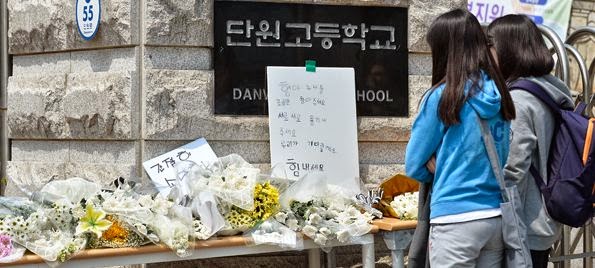
Something that weighs more on my mind is the effect so many deaths will have on the residents of Ansan, which is relatively small with a population of 76,000, as well as Danwon High School in particular. According to this article, 325 11th grade students went on the trip, and 13 stayed behind. As only 75 students have been rescued - and there's little hope at this point more will be - that leaves only 88 out of 338 students from that grade left in the school.


Last week the first funerals were held, marking the beginning of what will be hundreds of funeral processions. As well, only 3 out of 14 teachers were rescued, and one of them, the vice-principal, later committed suicide. To have 250 students and 12 teachers suddenly absent from a single grade is a loss that is almost unimaginable.

What happens when there are more empty desks with flowers on them than students, and not just in one classroom, but in ten or more?

Friday, April 18, 2014

Park Chung-hee, Songwriter

Go check out Roboseyo's post on the 1972 Shin Joong-hyun song 아름다운강산 (Beautiful Rivers and Mountains). Beyond discussing Shin and the song (and linking to the various versions of it, including the psychedelic wonder of the 1972 original and Kim Jung-mi's version from a year later) he also let me know that the writer of 나의조국 ('My Country') was Park Chung-hee. I actually have an LP of that same name by the 'National Chorus Choir' which was released in March 1977, and the songs on it are all godawful (as I figured it would be - but seeing the song titles like 'Song of the Minjok' and 'Saemaeul Song,' along with lyrics and a picturesque enough cover, made me want to buy it).


(Interesting that there are song titles in English.)

Here's what 'My Country' sounds like - just to give you an idea of what Park Chung-hee wanted people to listen to:


The song was written in late 1976, as this December 11, 1976 Maeil Gyeongje article relates:
President Park songwriter of 'My Country'

It has been revealed that the lyricist and composer of the song 'My Country,' which has been played widely on radio and TV, is President Park Chung-hee.

This was revealed on December 10 by an official who knew this fact while returning in a car to Seoul after attending a Saemaeul leader convention in Daejeon.

The official explained that on a weekend at the beginning of October, President Park personally wrote the lyrics and composed the song 'My Country' and after that when it got into general circulation via TV President Park "instructed [them] to let the lyricist and composer be anonymous, and as of yet the lyricist and composer have not been revealed."
As it turns out, releasing the song and officially claiming credit for it later was how Park did things. As this June 30, 1972 Kyunghyang Sinmun article, titled "President Park songwriter of 'Saemaeul Song,'" reveals, the Saemaeul Song was written in early May 1972 (two years after the start of the Saemaeul Movement) by the president, and the original recording featured piano played by a high school student. Park, however, had not wanted it known upon its release that he had written it, so "the writer of the song that people across the country loved to sing was hidden, but the fact was spread from mouth to mouth" until it was officially announced by the Blue House on June 30 that he had indeed written it.

This very lengthy report gives a ton of information about the Saemaeul Movement, as well as a translation of the lyrics. Here's the song itself:


Saemaul Song
Written and composed by Park Chung-hee

1. Dawn bell rings, new dawn breaks
Let me get you up, for building Saemaul

Refrain:
My village a good place for living
Let us build with our hands

2. With thatched roofs replaced, with village roads widened
Let us create green, tending it carefully
(Refrain)

3. By helping each other, by working with sweat
Endeavoring for income boost, let us create a rich village
(Refrain)

4. We all strongly, working while fighting
Fighting while working, let us build a new father land
(Refrain)
The funny thing is, while 'let me get you up' isn't how I'd translate it, it's more true to how things turned out, at least according to what a former Peace Corps Volunteer told me. Apparently the Saemaeul Song was played at dawn every morning through an outdoor speaker near his house, so the song did actually 'get you up,' or wake you up, at least. To paraphrase him, 'I don't know how many times I thought about going out and cutting that damned speaker wire.'

The style of the music, the fact that it was played every morning for citizens to wake up to, and the lyrics should give some idea of the culture clash at work between the youth culture of the day and the culture the authoritarian government wished to cram down its citizens' throats (or in their ears), a clash that ended in 1976 with the arrests of dozens of musicians, artists, and film directors. 'My Country' is essentially a victory cheer by President Park, and a reiteration of his vision for a counterculture-free society. But I can't help but notice how similar it is to North Korean music I've heard.

I'd thought of doing a long post about music from the 60s and 70s, but Rob gave me the (great) idea of doing a series of smaller posts. So up next will be a look at Shin Jung-hyun's first album from the late 1950s.

Tuesday, April 15, 2014

Bits and pieces

A few articles in the Joongang Ilbo yesterday looked at how 'the system' is failing children (and single mothers) in various ways. First is an article with lots of adoption-related statistics:
Over the past decade, the number of children living in foster care has doubled, from 7,565 in 2003 to 14,384 in 2012. In most cases, children were cared for by grandparents (67.9 percent) or relatives (25.6 percent), and children living with another family accounted for just 6.5 percent.[...]

The ultimate goal of the foster home system is to send children back to their birth parents. However, only 12.9 percent came back to live with their birth parents in 2012, down from 19 percent in 2006. Most children living with foster families stay with them until they’re legally adults and sometimes even later.[...]

Though the number of domestic adoptions grew continuously until 2011 to 1,548, it abruptly dropped the following year to 1,125.[...]

In 2012, of more than 2,000 babies adopted in and out of Korea, 92.7 percent were born to single mothers.[...]

Many child care advocates insist that’s precisely why the government should establish a system in which single parents can raise their children without giving them up. According to research conducted in 2011 by the Ministry of Gender Equality and Family, 46 percent of unwed mothers had debts averaging around 13 million won ($12,514), with an average monthly income of about 785,000 won.[...]

Right now, the Ministry of Gender Equality and Family provides 150,000 won to unwed mothers 24 or under. But out of a total of 360,000 mothers, just 2,005 receive benefits.
Next is an article about the lenient sentences received by two stepmothers who beat their stepdaughters to death.
A court in Daegu sentenced one woman, surnamed Lim, to 10 years in prison for beating her 8-year-old stepdaughter so hard at their home in Chilgok, North Gyeongsang, that she died of an intestinal rupture. Lim then intimidated the victim’s 12-year-old sister into taking the blame.[...]

In the second case, an Ulsan court handed out a 15-year jail sentence to a stepmother who beat her 8-year-old stepdaughter so hard last October that 16 of her 24 ribs were broken. Some of them pierced her lungs, and she died from her wounds.
The first word that pops into my head is 'scum.'In the first case, ten years does not seem enough, especially with the added factor of intimidating the sister into taking the blame.

Another article looks at criticism of a private high school in Jinju after two fifteen-year-old students died less than two weeks apart in separate instances of violence at the school.

Thursday, April 10, 2014

Article about drug arrest of Korean national states "Drug crimes by native speaking teachers are never ending"

On April 3, Daejeon City Journal followed up their article from a day earlier about this drug bust with this article by reporter Shin Yu-jin. And the first paragraph isn't badly written due to my translation; it's faithful to the original, which used 등 a few too many times:
No inquiry made into native speaking instructor who taught students while on drugs

Criminal record inquiry only confirmed whether there were sex crimes

Since it was recently exposed that people such as native speaking instructors who teach children in places such as hagwons or schools taught children while high on drugs such as methamphetamine, it's been pointed out that the preparation of countermeasures is urgent.

In particular, since criminal record checks mean to filter such criminals out beforehand are limited only to sex crimes, people have loudly expressed that they should be expanded to include crimes such as drugs as well.
It then goes on to retell the story of A, the Thai tour guide who brought and sold the meth to B, the problem with whom was that he was a native speaking instructor who taught students. It continues:
Besides this, it was disclosed that nine other people including acquaintances bought the meth from B and used it, and among these was a hagwon instructor who, like B, taught children.

In addition, before these two hagwon instructors were arrested, they worked in places like hagwons and an investigation confirmed that they were criminals with records involving five and fourteen charges, respectively, including drug crimes.

Prior to this, last month as well an English instructor of United States nationality was booked without detention for smuggling drugs. Drug crimes by native speaking teachers are never ending.

In fact, if we look at the status of native speaking assistant English teacher crime, between 2009 and August 2013, twenty five committed crimes, with drug crimes making up most (8), as compared to six drunk driving charges, three assault charges, and two theft charges.

The reason for such a high drug crime rate is that the criminal record inquiry for hagwon instructors who teach children or teens only confirms whether there are sex crimes.

An official from the West Daejeon Education Office said, "In the case of hagwon instructors, one month before they are hired they receive a physical examination at a designated hospital where they are also checked for drugs, but after they are hired they can use drugs." "Foreigners have criminal record checks from their home countries, but in connection to the child and youth law the criminal record check only inquires into sex crimes."

In regard to this, one parent asked, "What would happen if they committed other crimes when teaching children while high on drugs?" "There should be, without a doubt, inquiries into not only sex crimes, but also drugs."
I have a hard time believing drug crimes for foreign instructors are not looked at by immigration, but have no idea how the Ministry of Education operates; there's nothing about only sex crimes being looked at in the 2011 Hagwon Law revision. At any rate, Koreans are not subject to the the part of the law dealing with 'foreign instructors,' though the subjects of the most current arrests are Korean citizens (the second 'hagwon instructor' mentioned above is neither described as 'foreign' or as an 'English instructor,' and you can be sure he/she would be described so if they were).

More fun is the fact that we're dealing with Korean nationals being arrested, but the reporter can declare "Drug crimes by native speaking teachers are never ending." Even better is the fact that he/she quotes from statistics about crime by public school foreign teachers* and then declares that "The reason for such a high drug crime rate is that the criminal record inquiry for hagwon instructors who teach children or teens only confirms whether there are sex crimes." Brilliant. I actually had trouble translating that sentence because it took a minute to realize it was actually saying something that stupid.


* Statistics which reveals a drug arrest rate about average for foreigners in Korea (which is not that much higher than the Korean rate, of course).

Wednesday, April 09, 2014

Arrest of Korean citizen native speaking instructor exposes loopholes in criminal record check system

At least one 'native speaking teacher' was arrested for smuggling and taking meth last week. Newsis, which published an article that likely has the most information, reports:
Arrests for taking and transporting meth include native speaking English instructor

[The Daejeon regional police drug investigation unit held a briefing on April second about 11 people including a native speaking English instructor from Gyeonggi-do arrested for taking and smuggling methamphetamine.]

Police caught a group of offenders, including a native speaking English instructor who taught middle and high school students, for the illegal smuggling, selling and taking of methamphetamine.

On April 2 the Daejeon regional police drug investigation unit arrested five people including native speaking English instructor Mr. Choi (39) for bringing methamphetamine from overseas and selling and taking it, in contravention of the drug control law, and booked without detention six people including Mr. Kim (50) who only took the drug.

According to police, Mr. Choi is suspected of meeting a Thai tour guide in the vicinity of Incheon Airport on January 14 at 8:00 in the morning and buying a gram of meth from him for 400,000 won and both taking it and reselling it.

The police investigation found that because Mr. Choi knew that tour guides have simplified customs procedures, he wanted to exploit this and coaxed A, who he had known for some time, into bringing Thai-made meth into the country.

In particular, Mr. Choi immigrated to the United States as a child and became a permanent resident (his nationality is South Korean), but in 2005, he was deported for domestic violence and after that came to our country and taught students as a native speaking instructor in the Bundang and Suji areas of Gyeonggi-do for several years.

Police also disclosed that in 2006 he was sentenced to and served two years in prison for involvement in the crime of manufacturing drugs.

When Choi was arrested at dawn on February 26 he was high on methamphetamine and he said that the hallucinogenic effects of one dose of methamphetamine lasts about five days.

Police explained that Choi taught at three hagwons and 7 private lessons, and they cannot rule out the possibility that he taught middle and high school students while high.

(Police show off confiscated disposable syringes.)

The criminal background check hagwon that must be undergone by instructors teaching young people only confirms whether or not there are sex crimes, and Choi, with his drug-related criminal activity, was not filtered out.
We've seen cases like this before where Korean nationals deported from the US come back to Korea and teach English, and are described as 'native speaking instructors.' Of course, it's often seen that Korean Americans can have a hard time being considered native speakers, unless of course they commit crimes, in which their 'native speaking instructor' status will be included in headlines.

While the title of the KBS report about this is fairly tame ('Hagwon native speaking instructor turned out to be a drug criminal'), News Y's report is suitably sensational: 'Native speaking hagwon instructor with criminal record for drugs teaches class while high.' One has to appreciate how we go from the assertion that police "cannot rule out the possibility that he taught middle and high school students while high" to the headline above. Local media tend to highlight the identity of the teacher:

Daejeon Ilbo: 'Native speaking instructor habitually takes meth'

Daejeon City Journal: 'Native speaking instructor who teaches students [there's another kind?] takes meth'

Mind you, Chungcheong Today's article wins the most points in this regard, both with its title - 'Drug-taking native speaking instructor spouts nonsense ("shalla shalla") at the lectern' - and its opening sentence:
There is shock after it was disclosed that a native speaking instructor who was released after serving time in prison for being involved in drug production recently taught young students while high on methamphetamine.
Anyway, the overseas criminal record check requirements called for in the 2011 revision of the Hagwon Law apply only to 'foreign instructors', who are defined as "non-citizens of the Republic of Korea who [...] are responsible for instruction in a hagwon." There clearly is a loophole here for Koreans who have lived abroad and are considered 'native speakers.' The public school system, as far as I know, requires overseas criminal record checks from even Korean nationals, but clearly the Hagwon Law does not call for that, despite there being several cases where this kind of thing has happened. Of course, the problem is that even local drug arrests didn't seem to matter for a Korean national teaching in a hagwon, and, unsurprisingly, there are calls to change this.