Tuesday, May 23, 2006

Bibliography of the Kwangju Uprising (in English)

[Links updated on February 1, 2022.]


Here are the books, articles, and other resources I know of (mostly in English) that pertain to the Kwangju Uprising, beginning with the earliest books to be published.

Books

Donald N. Clark, ed, The Kwangju Uprising: Shadows Over the Regime in South Korea, Westview Press, Inc., 1988.
  • At the Association for Asian Studies conference in 1986, according to contributor Mark Peterson, "Linda Lewis, Donald Clark, David McCann, and I decided to put Kwangju on the national agenda of American academics" by preparing a panel on Kwangju in April of 1987. This collection of essays grew out of that panel.

Arnold A Peterson, 5.18: The Kwangju Incident, 1990, in 아놀드 A. 피터슨, 5.18 광주사태, 풀빛, 1995.
  • Arnold Peterson was one of several American missionaries in Kwangju at the time of the uprising.


Kwangju in the Eyes of the World: The Personal Recollections of the Foreign Correspondents Covering the Kwangju Uprising, Pulbit Publishing Company, 1997.

This book collects the accounts of seven foreign journalists who were present in Kwangju during the uprising. The accounts can be found online here. An article about the book by contributor and editor Henry Scott-Stokes can be found here.


Jae Eui Lee, Kwangju Diary: Beyond Death, Beyond the Darkness Of The Age, translated by Kap Su Seol and Nick Mamatas, Univ of California Los Angeles,1999. New edition available as a pdf here (clicking begins download).

The underground 'bestseller' after being banned when it was released in 1985 under the title "죽음 을 너머, 시대의 어둠을 너머", under the name of well known author Hwang Seok-yeong. It could be seen as being hyperbolic and emotional - but perhaps for that reason it captures the esssence of the uprising, at least from the point of view of a student. Additional essays by Bruce Cummings and Tim Shorrock come from a very clear point of view.


Juna Byun and Linda S. Lewis, eds,The Kwangju Uprising After Twenty Years: The Unhealed Wounds of the Victims, Dahae Book Publisher, 2000.

A look at those who still bear the scars and wounds of the uprising 20 years later.


John A. Wickham, Korea on the Brink: A Memoir of Political Intrigue and Military Crisis, Potomac Books, 2000.

Wickham was the US General in charge of the Combined Forces Command, and thus most of the Korean army. Details his dealings with Korean military leadership. An interesting look at the propaganda and point of view of the Chun clique, at least from the bits I've read so far. It also includes the 1989 White Paper.


William Gleysteen,Massive Entanglement, Marginal Influence: Carter and Korea in Crisis, Brookings Institution Press, 2000.

An account of the period between Park Chung-hee's assassination and the sparing of Kim Dae-jung's life, with a close look at US relations with Park Chung-hee  Chun Doo-hwan and the build-up to the Kwangju Uprising, by the US ambassador at the time. Provides a good look at the political scene in Korea; several cables sent back and forth between the embassy and Washington are included.


Henry Scott-Stokes and Jae Eui Lee, eds, The Kwangju Uprising: Eyewitness Press Accounts of Korea's Tiananmen, M.E. Sharpe, 2000.

This book is essentially an updated version of Kwangju in the Eyes of the World, which includes Korean journalists' accounts of the uprising. Again, the foreigners' accounts can also be found online here.


Linda Sue Lewis, Laying Claim to the Memory of May: A Look Back at the 1980 Kwangju Uprising, Hawaii Studies on Korea, 2002.

Lewis, an anthropologist who witnessed the uprising, reflects on her own memories and how Korean society has come to memorialize the event. Excerpts can be found here (1 2 3 4)

Lewis also wrote the chapter "Commemorating Kwangju: The 5.18 Movement and Civil Society at the Millennium," in Korean Society Civil Society, Democracy and the State, Charles K. Armstrong, ed., Routledge, 2002.


Gi-Wook Shin and Kyung Moon Hwang, eds, Contentious Kwangju: The May 18 Uprising in Korea's Past and Present, Rowman & Littlefield Publishers, Inc, 2003.

A collection of essays by various contributors looking at different aspects of the uprising. US missionaries present during the uprising, sociologists, medical specialists, historians, and others examine the event and its legacy.


James V. Young, Eye on Korea: An Insider Account of Korean-American Relations,Texas A&M University Press, 2003.

Young was one of the first to be trained as an area specialist in the US military and spent 14 years in Korea. A fluent Korean speaker,Young served as a military attache at the US Embassy in Seoul in 1979, acting as a liason between the ROK Army and the Embassy. He offers criticism on all sides of the events surrounding Chun Doo-hwan's rise to power.


Ryu Shimin and Jung Sangyong, Memories of May 1980: A Documentary History of the Kwangju Uprising in Korea, trans. by Park Hyejin, Kwangju Minjuhwa-undong Kinyeom-saeophoi, 2004.

Includes everything from statistics and victim, witness and military testimony, to injury reports and internal military documents. A very useful book. It is available as a pdf here (clicking begins download).


Choi Jung-woon, The Gwangju Uprising: The Pivotal Democratic Movement Which Changed the History of Modern Korea, trans. by Yu Young-nan, Homa & Sekey Books, 2006.

Originally published in Korean as "The Sociology of the Gwangju Uprising" (오월의 사회과학) in 1999.


Donald Kirk and Choe Sang-hun, eds, Korea Witness: 135 Years of War, Crisis and News in the Land of the Morning Calm, Eunhaeng Namu, 2006.

Over 40 pages of this book are dedicated to journalists' accounts of 5.18.


Georgy Katsiaficas and Na Kahn-chae, eds, South Korean Democracy: Legacy of the Gwangju Uprising, Routledge, 2006.


Paul Courtright, Witnessing Kwangju, Hollym, 2020.

Paul Courtright was a Peace Corps Volunteer who witnessed the uprising and helped interpret for foreign journalists, including Time magazine's Robin Moyer, who contributed a number of his unpublished photos to the book.


David Lee Dolinger and Matt VanVolkenburg, Called by Another Name: A Memoir of the Gwangju Uprising, Goggas, 2022.

David Dolinger was a Peace Corps Volunteer who witnessed the uprising and befriended the student leaders, helped smuggle dissident materials in and out of Korea after he was forced to resign from the Peace Corps, and later took part in US-based efforts to promote human rights in Korea during the 1980s. The book includes a chapter memorializing fellow PCV Tim Warnberg, who wrote the first academic article about the uprising, which is also republished here.

Hwang Sok-yong, Lee Jae-Eui, and Jeon Yong-Ho, Gwangju Uprising: The Rebellion for Democracy in South Korea, Verso, 2022.

A substantially-expanded version of 죽음을 넘어 시대의 어둠을 넘어 (Beyond Death, Beyond the Darkness of the Age, published in English as Kwangju Diary in 1999) was published in Korean in 2017, and this is a translation of that book. For some reason, in both the Korean and English versions, novelist Hwang Sok-yong is given top billing despite only writing an introduction and titling the book back in 1985.
Kim Yeon-min, Robert Grotjohn, eds, Selected Oral Histories of the May 18 Gwangju Uprising: Vol. 1. Testimonies from Various Locations, Chonnam National University Press, 2023.

This is the first of at least four planned volumes of oral accounts of the uprising (and is available from online Korean booksellers like Kyobo and Aladin).


Juyeon Bae, ed., Competing Memories of the Gwangju Uprising and Democratization in Post-Cold War Korea: Between Official and Grassroots Memories, Palgrave Macmillan, 2026.


Articles and Internet Resources

Missionary John Underwood's unpublished account of the uprising, June 5-6, 1980.
  • This account was sent to the US Embassy, and cabled to Washington June 10. The cable can be read here. Ambassador Gleysteen referred to it as "the most balanced record and analysis of [the] incident we have seen so far." (The cable is actually missing a page or two; the full account is here.)
Another account of the uprising by American missionary Charles Betts Huntley, "When It Wasn’t Fun (The Kwangju Incident Of May, 1980)," was likely written in 2005.


"Korea May 1980 People's Uprising in Kwangju," Ampo, Japan-Asia Quarterly Review Vol. 12 No. 2, 1980.
  • This magazine was likely the first in English to compile as much information as possible on what happened in Kwangju, and contains things such as newspaper articles, poems, and photos. It was published perhaps in June or July 1980, and can be downloaded here.

Martha Huntley, "Should we tell you about this?" Presbyterian Survey, March 1982.
  • Huntley was one of several missionaries in Kwangju during 5.18. This article has only a little about 5.18 but she apparently also wrote an account of the uprising which is quoted in Warnberg's article.

Tim Shorrock, “Korea: Stirrings of Resistance,” The Progressive, February 1986.
  • Shorrock interviews Kim Dae-jung, who declares the US to be responsible for ordering troops to Kwangju. It can be found here.

William H. Gleysteen, Jr., “Korea: A Special Target of American Concern,” in The Diplomacy of Human Rights, David D. Newsom, ed., University Press of America, 1986.
  • Former Ambassador Gleysteen first wrote about the challenges he faced regarding Park's Assassination, the 12.12 coup, and 5.18 in this chapter.

Tim Warnberg, "The Kwangju Uprising: An Inside View," Korean Studies, v.11, 1987.
  • An excellent account of the uprising by a Peace Corps Volunteer in the city at the time, it's the first scholarly article on the uprising. It can be downloaded here.

Jame's Fenton's "Kwangju and After", from Granta 24 as well as an extended version in All the Wrong Places: Adrift in the Politics of the Pacific Rim, Atlantic Monthly Press, 1988.
  • A British journalist's brief account of the uprising in 1980 and the 1987 protests and election. The Granta article can be downloaded here.

After the June 1987 democracy protests, in 1988 the National Assembly held an inquiry into the Kwangju Uprising. In response to questions by the National Assembly, the US State Department released a ‘White Paper’ in June 1989 titled “United States Government Statement on the Events in Kwangju, Republic of Korea, in May 1980.”


American diplomatic cables from late 1979 to mid 1980 (the Cherokee Papers) were obtained and written about by journalist Tim Shorrock in a February 27, 1996 Journal of Commerce article titled "Ex-Leaders Go On Trial In Seoul." An even longer version was posted at Kimsoft in 1997 (judging by the Wayback Machine) titled “The U.S. Role in Korea in 1979 and 1980.”

In 1997 the Gwangju May 18 Historical Materials Compilation Committee released volumes 6 to 10 of the May 18 Gwangju Democratization Movement Materials which contain this entire collection of unclassified cables sent between the US Embassy in Seoul and the State Department in Washington DC, which total around 3,700 pages. They can be found online as part of this collection (전자자료총서):

Volume 6:  Jan – July 1979
Volume 7:  Aug – Nov 1979
Volume 8:  Dec 1979 – April 1980
Volume 9:  May – July 1980
Volume 10:  August – Dec 1980

The US government in 2020 released fully-uncensored versions of 43 these cables; they can be downloaded from the 5.18 Archives here. 문서 목록.pdf  is the table of contents, while 미측 기록물(43건).pdf contains the cables.

The US Embassy website is also hosting over 100 cables, 33 of which it posted in spring 2020; 36 more followed in 2021. The most recent additions are from the Jimmy Carter Presidential Library. The majority of this material is available above the cables at the US Embassy's website in six large pdfs under the names "Carter Presidential Library Documents." Another set of documents from this collection can be found here at the May 18 Archives website; they're contained in a zip file (look for "파일: 카터 기록관 신규 공개자료.zip") with various folders of material, including one folder of cables related to the immediate aftermath of Park Chung-hee's assassination and another of cables related to Kim Dae-jung's trial. 

May 18 Archives site has uploaded what appears to be all of the Defense Intelligence Agency (DIA) reports Tim Shorrock obtained through FOIA requests in the 1990s. They, and other documents, can be found here. Among them are this April 1980 DIA report on Chun Doo-hwan's means of maintaining loyalty.

The National Security Archive has made available 18 internal US government documents related to Korea from the Carter Presidency.

I have posted a number of CIA reports, including "North Korean Reactions to Instability in the South" and "The South Korean Political Scene" (Dec. 1979 and Feb. 1980) and "Political Reconstruction In South Korea" and "Prospects for Takeover by Military Strongman Chon Doo Hwan" (May 1980). More CIA reports can be found by searching its FOIA Reading Room.

Seven documents about 5.18 coming from the US and North Korea, including Donald Gregg’s May 21, 1980 Memorandum for Zbigniew Brzezinski, can be found at the Wilson Center here (or here). As well, a key document not in that document collection is the May 22 Action Memorandum From Richard Holbrooke And Anthony Lake To The US Secretary Of State, ‘PRC Meeting On Korea’, an excellent companion piece to the Platt Memo.

The May 22, 1980 PRC Platt Memo - a memo by Nicholas Platt, then a senior aide to Defense Secretary Brown, recording the conversation at the Periodic Review Committee meeting at the White House that day - can be found in English at the bottom of this page or as a Word file here.


Interviews with diplomats who worked at US Embassy or State Department in 1979-80 can be found here.


Mark Peterson, who interviewed General Wickham and former Ambassador Gleysteen in 1987's The Kwangju Uprising: Shadows Over the Regime in South Korea, presented a paper titled "The Kwangju Resistance Movement, May, 1980: Some American Perspectives" at a 1997 conference in Kwangju. Peterson was the Fullbright director in Seoul at the time of the uprising. (Hat tip to Plunge)


Donald Sohn's 1998 MA Thesis Chun Doo Hwan’s Manipulation of the Kwangju Popular Uprising, which is based in part on the Cherokee Papers, can be found here.


James Fowler’s “The United States and South Korean Democratization,” published in 1999 in Political Science Quarterly, Vol. 114, No. 2, pp. 265-288.
  • This article, which can be found here, makes extensive use of the Cherokee Papers, and provides many details about the political situation in Korea leading up to Kwangju (though I did find some small errors of fact, such as incorrect dates).

Sallie Yea, "Maps of Resistance and Geographies of Dissent in Cholla Region, South Korea," Asian Studies Institute Working Paper No. 7, Wellington: Victoria University of Wellington, 1999

Sally Yea, "Rewriting Rebellion and Mapping Memory in South Korea: The (Re)presentation of the 1980 Kwangju Uprising Through Mangwol-dong Cemetery," 2002.


George Katsiaficas, "Comparing the Paris Commune and the Kwangju People’s Uprising: A Preliminary Assessment."
  • This article can be found here. Interesting in that it provides a diagram showing the organization of the struggle committee, as well as not just comparing the two uprisings, but showing that the Kwangju student/intellectual leaders had studied the Paris Commune.

In Sup Han, "Kwangju and Beyond: Coping with Past State Atrocities in South Korea", Human Rights Quarterly 27, 2005


George Katsiaficas, “Neoliberalism and the Gwangju Uprising,” 2006
  • An article based on the Cherokee Papers which highlights the US's economic interests in Korea and tries (but fails) to link early 1980s economic restructuring to the suppression of the Kwangju Uprising. It can be read here.

Peace Corps Volunteer David Dolinger's account of what he saw in Kwangju during the uprising can be found here, while additional comments by him can be found here.

Matt VanVolkenburg, "'Tell the World what is Happening': The Americans who Witnessed the Kwangju Uprising,"Transactions of the Royal Asiatic Society Korea Branch (Vol. 94, 2019): 129-144.  This is based on published accounts by, and interviews with, missionaries and Peace Corps Volunteers present in Gwangju in May 1980, as well as US embassy cables. It can be read here (or on this page; scroll down).


Steve Choe, “Memories of the demos and popular Korean moving image narrative,” Journal of Japanese and Korean Cinema 14:1, 2022.

Yun-Jong Lee, “Gwangju and the 1980s Film Movement: the Representation of the Minjung in Oh! My Dream Country,” Journal of Japanese and Korean Cinema 14(1), 2022.


Popular Arts

For links to narratives of the Kwangju Uprising in different media (like short stories, poems, woodblock prints, etc), see here.

William Amos,The Seed of Joy
  • A fictional account of the Kwangju Uprising by William Amos (a peace corps volunteer in Jeollanam-do at the time). An interview with Amos can be found here.


기영이의 5·18여행, 도래미,이우진 (5.18 기념재단), 2005.

I picked this up in Kwangju in 2005. A comic (with photos as well) which depicts the uprising, and in which fictional characters interact with real victims of the uprising. An interesting study in how the city instills civic pride and creates a mythology of the uprising for the younger generation.


I'll update this as more comes to my attention.

Thursday, May 18, 2006

5.18 - Those who fell under the paratroopers' clubs


Today marks the 26th anniversary of the beginning of the Kwangju Uprising.

I've written about the uprising before, looking at the escalation of violence during the first three days of the uprising (which provides an overview of those days), at narratives of the uprising in several different media, and at the campaign to revoke medals given to soldiers who took part in suppressing the uprising, as well as how students in Kwangju view the uprising, a list of books and essays in English about the uprising, and a look at US media coverage of the uprising.

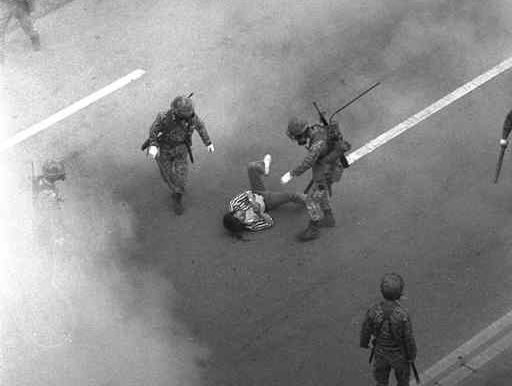
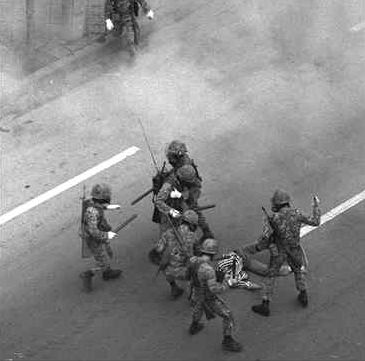
In The Kwangju Uprising, Kim Chung-keun, of the Donga Ilbo, describes what happened when the paratroopers of the 7th Brigade left the university campuses they had secured and arrived downtown to suppress the demonstration that their brutal behavior on and near those campuses had helped spark.
When the martial law army showed up in the heart of the city for the first time - I was there - they paraded in front of the Provincial Hall in a very official way. They formed up ranks, and when they marched, they marched in columns. [...] It was done in a very orderly way. The soldiers formed up in lines, spacing themselves as the drillbooks require. Then, off they went, marching towards the heart of the demonstration. Stones struck them, Molotov cocktails set their sleeves on fire. Paying no attention, they kept formation and marched ahead. The demonstrators stepped aside to let them pass, and the soldiers went on towards the core of the demo in the heart of Gumnam-ro. As the column passed through them, the demonstrators closed up behind them.

Then an order was shouted. The soldiers broke ranks, dashing into the demonstrators around them, beating them mercilessly with their heavy sticks. This was not a strategy for nudging a crowd or a demo off a street from one side - as in Pusan or Masan the previous year - to get the streets back to normal and open and functioning. It was a strategy of terror, a blitzkrieg. [...]

The boundary that had existed between the soldiers and the crowd was eliminated. It vanished in the midst of a melee, a free-for-all with no holds barred and no rules. The soldiers smashed out with their clubs at all and sundry, regardless of age, sex or anything else. [...]

Words fail me in seeking to describe what I saw. "Brutality." "Outrage." "Indiscriminate assault." The words fall short, way short, of the reality. I came up with this expression: "hunting humans", or "Human hunting."


From Memories of May 1980: A Documentary History of the Kwangju Uprising in Korea, come these "Examples of Casualties on May 18th" (who are all male, except for one):

Yi Chong-nam, 27
Assaulted by paratroopers next to Taehan Theatre near Bus Terminal at 4:50, received medical treatment for lacerations on scalp, contusion and abrasion on right hand and lower leg, and fracture of right hand, fifth finger bone.

Yi Chong-an, 25, Insurance company employee
Was making an insurance contract at a store near Tourist Hotel past 12 o'clock, when assaulted by batons, gun butts and military boots and arrested by three paratroopers. Released on May 25 while receiving treatment at Armed Forces Hospital.

Kim Myong-ho, 44
Paratroopers carrying M16s with fixed bayonets broke into home at 80-2 Nam-dong at 7:30 pm, struck and assaulted residents with gun butts. Destroyed house, smashing windows and doors, claiming to search for students in hiding.

Yi Kun-jae, 58
Assaulted on way back from provincial government building to rear entrance of Jungang elementary school while protesting against paratroopers stripping and beating several female students near wall of rear entrance.

Kim Yong-chol, 32, Carpenter
Assaulted by paratroopers near MBC on way home by foot at 8pm because there were no buses.

Kim Kyu-jin, 50, Teacher
Kicked in waist, struck with gun butts and assaulted in front of Catholic Center at 3 pm, lost four front teeth.

Kim Nam-il, 48, driver
Assaulted by paratroopers near Kwangju park at 3 pm, right forearm fractured, then taken to police. Sent to Armed Forces Hospital on May 20 (contusions on upper right limb, face, side, and left leg).

Kim Tae-ho, 28, agricultural worker
Was riding a bus to friends house because transportation to go home from visiting a flu clinic in Yu-dong was blocked, when paratroopers fired tear gas bombs, stopped the bus, got on, dragged him off, and assaulted him on charges of demonstrating, and dragged him to Chonnam National University after he lost consciousness. Transferred to prison on 21st, assaulted by troops of 20th division in jail. Released July 3.

Kim Pom-dong, 34, cook
When he was witnessing a woman getting her clothes ripped off, being kicked and collectively beaten by 3 paratroopers in front of Kwangju Cheil high school barbershop at 3 pm, during work as a cook at a Chinese restaurant near entrance to Chungjang 5-ga, 30-40 troops suddenly poured in from Kumnam 5-ga, approached and destroyed the restaurant window, and collectively beat him into unconsciousness.

Kim Tae-ran, 39, Standing Committee member of Tongildang (Democratic Unification Party)
Assaulted and taken by martial law troops during demonstration on Kumnam 5-ga at 5pm, handicap to spine and urinary organs due to indiscriminate torture after they discovered Tongildang membership pass. Died in June 1984 due to aftereffects of torture.

Kim Chong-sop, 35, civil servant
Attended colleagues wedding at 2pm, then was riding a bus to Bus terminal at 3:30 to go home when paratroopers forced everybody off the bus and moved them on foot to Tongyang Steel on Kumnamno. There he was assaulted with riot baton on back of head, lost consciousness, and collapsed.

Kim Kwi-sik, 21, University student
Upon hearing news of extended curfew on way home to Kwangju from a trip to Yosu with five friends, got off at South Kwangju station and walked along railroad track till arrival in front of Chosun University at 9-10 pm. Caught by paratroopers stationed there. 10 paratroopers took turns punishing the six for about two hours, threatening them with fixed bayonet M16s against their foreheads and beating them with gun butts.

Park Chong-hwa, 20
Had come to Kwangju on motorcycle to pick up his brother (high school student) and was passing in front of Mudang stadium when paratroopers assaulted and took him to police. Released from Sangmudae (base) three months later. Suffered mental disorder thereafter and died.

Paek Hong-nam, 35, Housewife
Struck on right side of the head by five paratroopers in front of Catholic center. Required 13 stitches.

Yang Sam-gun, 29, Printer
Was riding by bicycle for personal business during work at Honam printing shop in Taein-dong when he witnessed dozens of armed soldiers suddenly appear from Kumnamno area and assault all young people who came into sight. Escaped to a nearby restaurant but paratroopers chased him and beat him mercilessly.


Yang Il-jun, 29, technician
Assaulted and taken by paratroopers in Sinan-dong at 2 pm. Taken to Armed forces hospital and received medical treatment for more than one month.

Yun Yong-chol, 25, driver
Was in Chilsong Billiards hall in Puk-dong at 4pm when 10 paratroopers armed with bayonets ran in and beat him in the head, face and sides with batons and kicked him with military boots. He passed out on the spot. The paratroopers stole his watch.

Yi Sung-min, 49, commercial worker
Assaulted by paratroopers who intruded into a store next to Kwangju fire station and 2 pm and lost consciousness.

Chang Han-won, 27, driver
Was driving truck back to house in Sansu-dong and was about to step back into truck after a check at Kyerim police box when paratroopers beat him with riot baton from behind. Protested, but paratroopers continued assault until he lost consciousness and was taken away, then sent to Armed forces hospital.

Chang Song-am, 23
Assaulted by seven paratroopers with batons, military boots, and gun butts, between Soochang elementary school and bus terminal at 2 pm, then passed out.

Chong Yong-uk, 21, student
Was innocently entering school with friends through front gate of Chosun University at 12-1 pm after visiting a friends house, when he was caught, kicked, and assaulted by paratroopers.

Cho Kap-tae, 16, employee at restaurant
Went outside at 5 pm to check source of noise, but was collectively assaulted by two paratroopers on Kumnamno.

Kim Mak-tong, 25, architect
Was waiting for bus to Changhung to depart from bus terminal at 3 pm to receive reserve forces training, when paratroopers suddenly stepped inside the bus, dragged him off the bus and assaulted him on head with riot batons.

Yu Byong-yang, 25, driver
Picked up 5 students in Kwangchon-dong in taxi and was going towards Chonnam National University when a paratrooper who had been beating 20 male and female students lying face down on the street in front of Johan hospital in Im-dong saw taxi and stopped it for inspection. Protested they were passengers, but paratrooper ruthlessly hit back of head with gun butt; escaped by driving away in nearly senseless condition.
Ha Hon-nam, 29
Was stabbed by bayonets wielded by paratrooper, and fell unconscious in front of main office of Kwangju bank on Kumnamno around 8 pm while returning home. Transferred to Kim orthopedic clinic thereafter.

Wednesday, May 17, 2006

Crossing Temporal and Spatial Boundaries in Dohwa-dong

[Update, 2009.2.23 - New photos have been added below.]

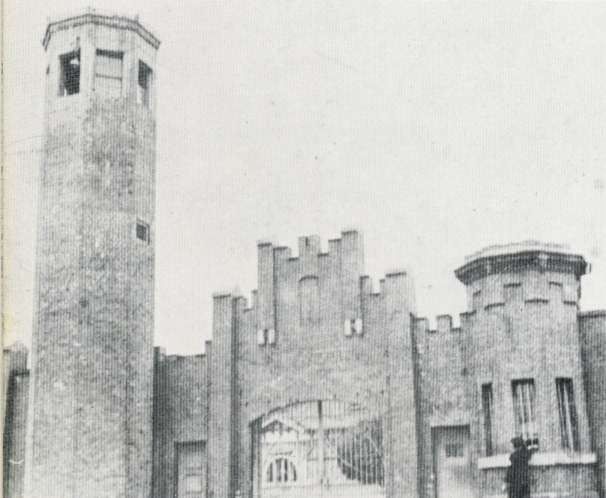
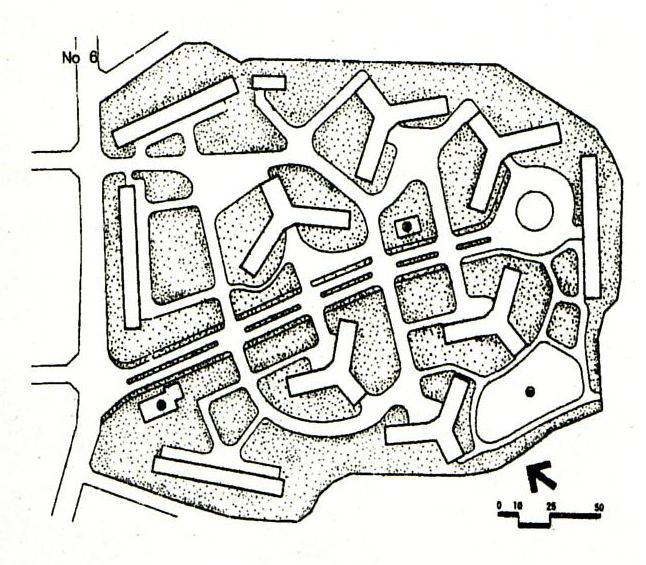
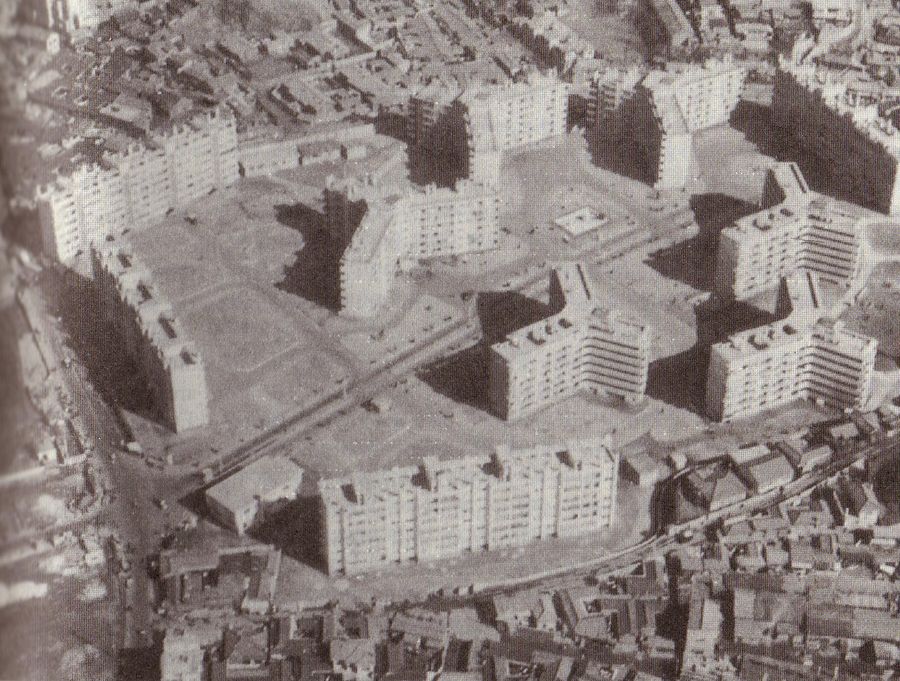
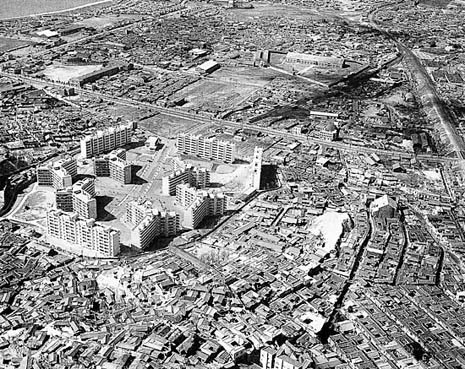
One of the first large-scale apartment complexes in Korea was the Mapo apartment complex, built between 1962 and 1964 in Dohwa-dong in Mapo-gu. As Andrei Lankov says in this article, "it was the Mapo complex that truly started the history of large-sale apartment construction in Korea." He goes on to describe all of the difficulties the developers faced when they were designing, building, and ultimately, trying to sell it (Antti notes also that the Korean Housing Corporation used marmots to test rooms for gas leaks). One other fact he mentions leads me to ask this question: Does anyone else find irony in the fact that it was built on the location of a former prison? Jokes about apartment complexes and prisons aside, the prison in question was Mapo prison. According to this page, in October 1908, Gyeongseong (the Japanese name for colonial Seoul) Jail (Gamok) was built near Seodaemun by the Japanese, but when a new prison was built near Mapo, it was named Gyeongseong Gamok instead, and the former prison's name was changed to Seodaemun Gamok in September, 1912. This page reveals that "Mapo prison in Seoul [was] a prison intended mainly for long-term prisoners sentenced to more than ten years". Seodaemun and Gyeongseong Jail were changed from gamok to hyeongmuso in May, 1923 (perhaps akin to changing from 'jail' to 'prison'). The prison was named Mapo prison after liberation and was obviously demolished before 1962.
Mapo prison during the colonial era.

Mapo prison on a 1946 US military map of Seoul
("Prison brick yard")

The plan for the Mapo Apartments, 1962.

In the photo below is the complex as it looked in 1963. Notice the absence of the long, rectangular apartment buildings which surround the complex in the plans above - they were obviously built later.


Here's what the finished complex, made up of ten, five-storey buildings, looked like from the air (looking northeast):


An even better photo (looking west) reveals the complex's surroundings, showing just how much they stood out in a landscape of single-storey houses:


Below is a shot of the area from 1970 looking northeast, with the Mapo Apartments on the left.


[Update:] Here are some photos I received from Julia Welch, who wrote me after reading this post:
I am an American citizen who lived in the Mapo apartments with my 2 young boys in 1969 and 1970 when my then husband was serving in the US Army and stationed south at a missile base at Reno Hill. I have fond memories of my lovely neighbors. ... When you entered the complex we were in the first long building to the right on the second floor.

Of the photos, she wrote, "One is hanging on the wall by my front door - it is our view out the children's window to the maze of traditional homes." Here are some of them.


Above is the view out the front window, which I made by stitching two photos together. Below is the same view in another season:


While those views might seem familiar to those who live in Seoul today, the photos taken from the other side of the apartment showcase a very different view than what we can see today:


View from the boys' bedroom.


Buddhist Temple


View from the kitchen.


View from the bathroom.


View from the back window.


The Mapo market, behind the apartments.

Thank you very much for the photos, Mrs. Welch! It's great to be able to see these scenes, especially in colour.

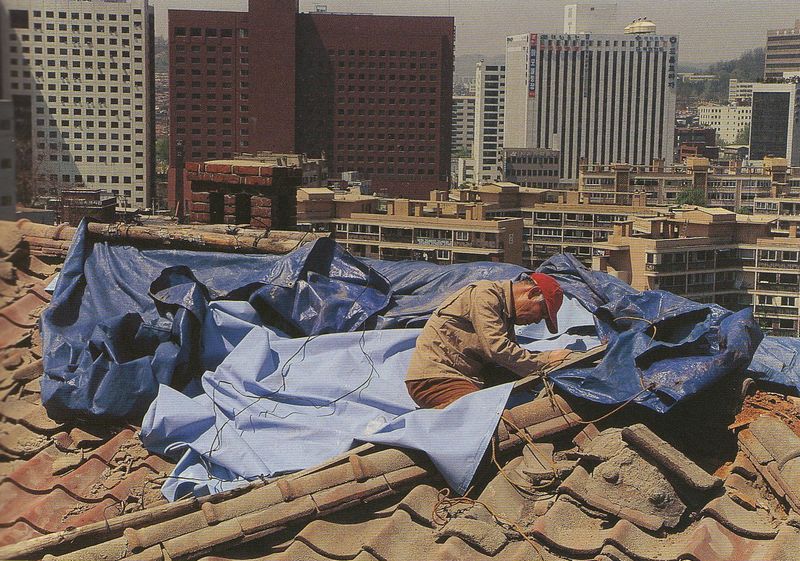
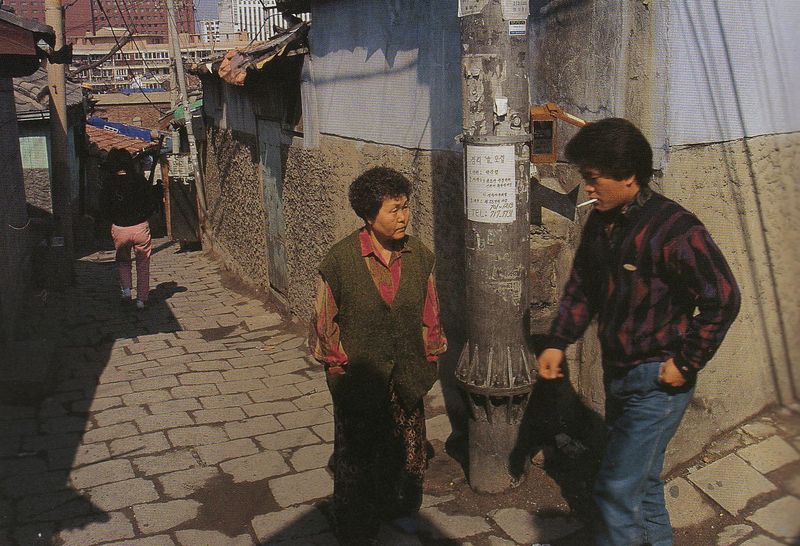
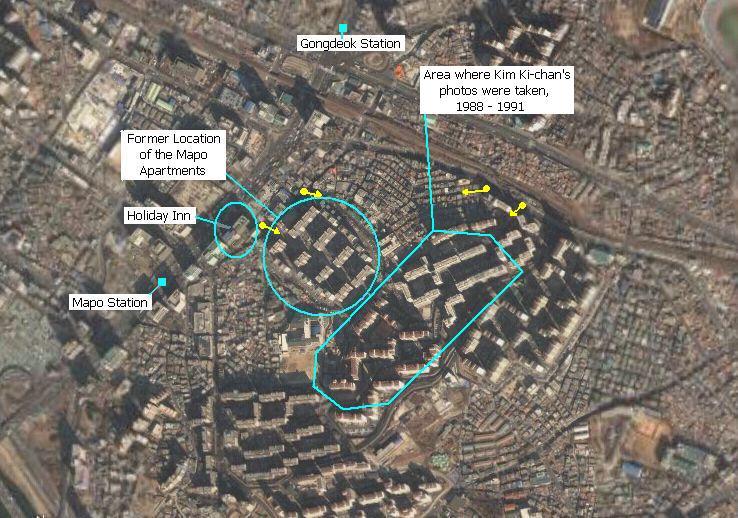
To see the fate of these single-storey houses 25 years later, you need only look at '그 골목이 품고있는 것들' ('The things embraced by the alleyways') a book of photos by Kim Ki-chan and Hwang In-suk. I began to notice, while looking at the photos taken in Dohwa-dong between 1988 and 1991, that a number of them had the Mapo apartments and Holiday Inn in the background. In these photos, you can see how much the area around Mapo-ro had changed, as the street is now lined by a number of tall buildings, including the brown-coloured Holiday Inn. Almost all of the photos in which the Mapo apartments and Holiday Inn are visible are looking west, which helps give you a sense of space and helps you, to some degree, orient yourself around this neighbourhood.


I was introduced to the photography of Kim Ki-chan by a post over at the Metropolitician. In it (about a quarter of the way down) he talks about interviewing Kim Ki-chan, and discussing with him the fact that the golmok (the small back alleys, in older, cramped, single-storey dwelling neighbourhoods of Seoul), the focus of so much of his photography, were disappearing. He had set out to document a disappearing urban environment, and the way of life that came with it; Dohwa-dong was most certainly not an exception in this regard:


When these golmok neighbourhoods were torn down in Dohwa-dong, the Mapo apartments were not spared; as Lankov notes, they were demolished in March, 1991. The satellite photo/map below reveals what has (unsurprisingly) replaced much of the neighbourhood pictured above (click to enlarge):


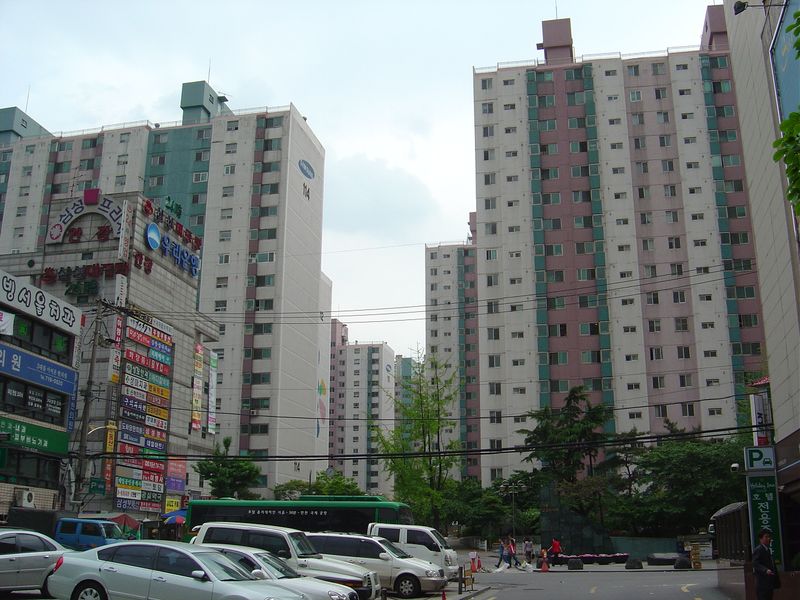
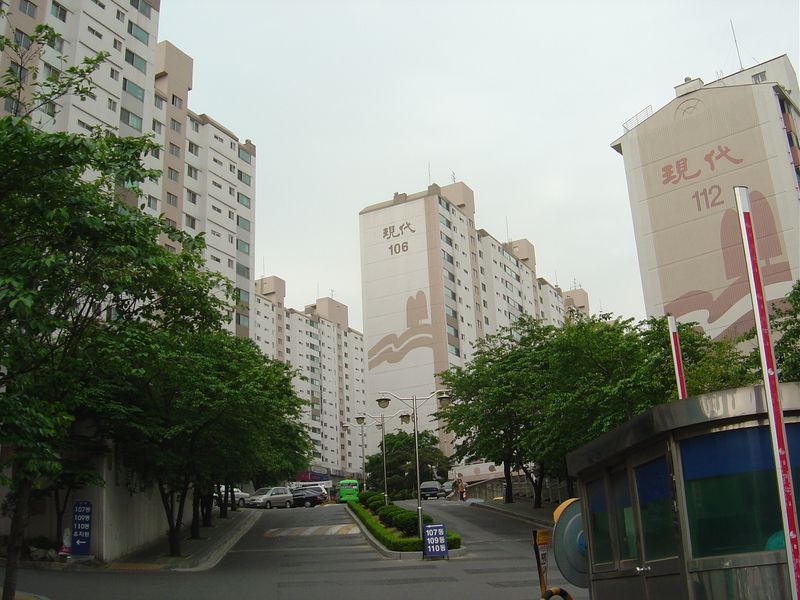
Last weekend I walked around Dohwa-dong briefly to take a few snapshots. The (crude) yellow arrows on the map above show where (and in what direction) I took the four following photos (the dots can be 'read' in order, from left to right). Looking east from behind the Holiday Inn, these are the Samsung apartments which replaced the original Mapo apartments.


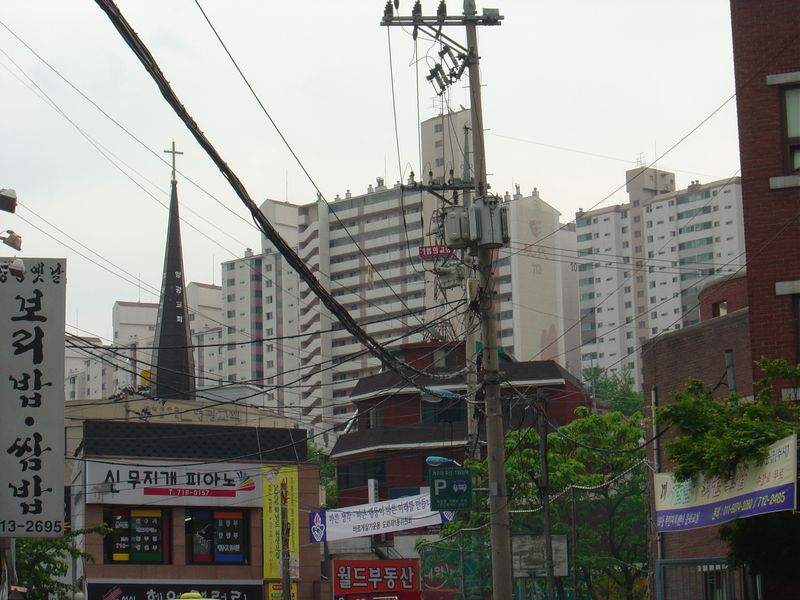
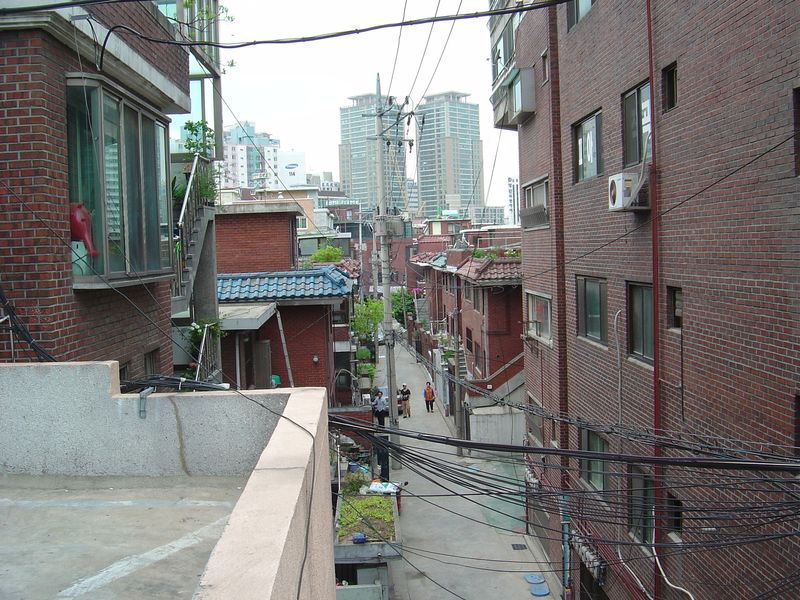
Looking slightly northeast, we catch a glimpse of the Mapo Mansion Apartments, which loom over the four to five storey villas below...


...streets lined with which are clearly visible below (looking back west, with the Samsung Apts in the distance).


At the main gate of the Mapo Mansion Apartments, looking southwest, you may notice a slight difference between the living environment on this hill now...


..and the living environment on this hill in 1989 (looking west from the top of the hill).


One wonders if the developers of the original Mapo apartments had any idea what they were unleashing on the landscape of Korea. Did they have a 5 year plan to begin zealously imposing endless monotony on the landscape, with reinforced concrete towers sprouting like mushrooms all over the penninsula, or was it ultimately just as spontaneous and random as the golmoks Kim Ki-chan used to wander through in his quest to preserve on film what the descendents of the Mapo Apartment's developers would soon pave over?

Tuesday, May 16, 2006

45 Years Ago Today...

Park Chung-hee led his troops into Seoul...

If you want to read a lot about Park's coup (and much of his life and death), Cho Gap-je's biographical series for the Chosun Ilbo, "Spit on my Grave" can be found here (It's on the page where the coup begins - remember everything is posted in reverse order).

Friday, May 12, 2006

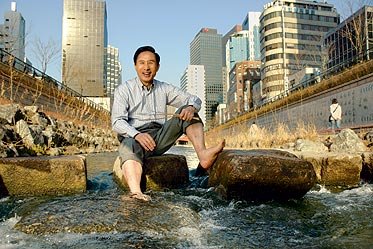
Lee Myung-bak: Here to save your Seoul!

Suggest an appropriate caption! Photo from Time.


The Marmot linked to this Time article, “Saving Seoul”, about Lee Myung-bak and the environmentally friendly changes that have occurred during his tenure as mayor. It was nice to see that Time basically rewrote this Sept. 2005 Korea IT Times article.

On top of that, they didn’t see fit to mention that Lee is likely to run for president in the next election (instead of “Saving Seoul”, their next article about him may be titled “Saving Korea”). I have to say, I’ve spent quite a bit of time looking into the Cheonggyecheon project, the new town project, and several other topics related to these, but I amassed so much information (and found other topics to write about in the meantime), that I just haven’t gotten around to starting to write about these projects yet. Consider this a dry run, as I comment upon a few aspects of this article.
Seoul—a city long synonymous with unchecked urban development, where Parks were more commonly found in the phone book than on the streets—is growing green. Besides the restored Cheonggyecheon, which opened last October, the city has helped plant some 3.3 million trees since 1998 and recently developed Seoul Forest, a $224 million patch of urban woodland comparable to London's Hyde Park.
Hyde Park? Wherever did Time get such a comparison? Perhaps from the Seoul city website?
Seoul’s so called Hyde Park, "Seoul Forest" will open on June 18 after 2 years and 5 months of construction.
The aforementioned IT Times article mentioned that the
Ddukseom area, where there had been a golf course and a horse-racing course in the past, could have generated profits of about 4 trillion won if it were developed into a residential area by building apartments or commercial buildings. But we judged that it will be far more meaningful for our citizens and descendants to make it a green zone instead of a residential or commercial area.
Just to compare, this is how the Hankyoreh put it:
It was not constructed unilaterally at the hands of the city government. The body behind Seoul Forest's construction is Seoul Green Trust, an organization that his half-government and half-private. Accepting the citizen demands for more green areas, the city gave 350,000 pyeong in land, and private citizens then sought corporate participation and organized volunteers to build the forest
I have to admit, I haven’t made my way over to Seoul Forest yet, but am a little curious about a park that won’t allow people to walk around in the forest, instead channeling them through it upon elevated walkways. Still, it’s better than another apartment complex. The Time article continues:
And when soccer-crazed Seoulites gather by the thousands in front of City Hall this summer to cheer South Korea's performance in the World Cup, as they did in 2002, they'll be celebrating on a neatly trimmed lawn called Seoul Plaza.
It’s handy that Seoul Plaza, with all of its festivals, concerts, the ice skating rink in winter, and the fountains for children to play in during the summer, is directly in front of City Hall. No one is going to say that replacing asphalt with grass is a bad thing, but the location of this popular spot basically provides a constant reminder that all of this was “brought to you by City Hall", and by association, the mayor – who has made no secret of his presidential ambitions. I tried to pass in front of City Hall the night after Cheonggyecheon opened, and was surprised at the crowds in front of its front door – until I saw the mayor a few meters from me, shaking hands and walking around with a grin that was impossible to miss.
Cheonggyecheon, which means "clear valley stream," has been a mirror of Seoul since the nation's capital was first moved there in 1394. During Chosun times, Cheonggyecheon was a prime site for laundry, gossip and kids at play, and as early as 1760 the government began landscaping it, employing 200,000 men to build stone embankments along the stream to prevent floods. As Seoul expanded, the water grew foul, becoming little more than an open sewer after the Korean War, when refugees built shantytowns along its banks.
I can’t help but chuckle and remember Horace G. Underwood, giving a talk for the Royal Asiatic Society a few years ago (shortly before he passed on), saying “It was never a clean stream.” The “open sewer” aspect of it predates the Korean War by quite a bit. Isabella Bird Bishop wrote of it during her first visit to Seoul in 1894:
One of the “sights” of Seoul is the stream or drain or watercourse, a wide, walled, open conduit, along which a dark-colored festering stream slowly drags its malodorous length, among manure and refuse heaps which cover up most of what was once its shingly bed.
Even back in the early days of the Chosun dynasty, a decision was made to treat the stream (and all of its smaller streams flowing into it) as a means by which to flush the waste out of the city – in other words, as a sewer. The 'restored' stream has not been restored to its previous function at all, but instead has been recreated in a very idealized form. It may have been so idealized, in fact, that the city, in its hurry to finish the project, cared little about the numerous cultural properties they found as they excavated the stream - until a citizens' group filed a complaint. 'Development at any cost' may not be such a relic of the past - just look at Saemangeum.
After South Korea's development kicked into gear, authorities were quick to hide the stream with the highway, a symbol of Seoul's rush to modernize regardless of the environmental cost. "Under the highway, the area was filthy, and population and business decreased," says Seoul Vice-Mayor Chong Seok Hyo, who led the stream project in its later stages. "There was a need to change the environment totally."
This vice mayor seems to be forgetting the business of the well-known markets and street vendors that existed in this area prior to the redevelopment. I guess that’s the easiest way to sidestep the images of riot police sweeping them off the street and sticking them in the middle of Dongdaemun stadium, where they do a fraction of the business they used to.
There's also mounting skepticism about the assumption that clean, attractive environs come at the cost of economic performance—a belief still widely held even in advanced Asian cities like Hong Kong. "If we don't place an emphasis on environmental friendliness, not only will citizens leave the city, but foreign investors won't choose Seoul," says Mayor Lee. "I believe that over the long term, choosing the environment serves a dual purpose."
The mayor may perhaps be a little disingenuous when he suggests that he is in fact choosing environmental friendliness first, and the image of the city and its attractiveness to foreign investors second. There are numerous plans to develop the Cheonggyecheon area in order to make the northern part of the city more competitive with Gangnam (Not for nothing did vice mayor Yang Yoon-jae accept some hefty bribes in order to change height restrictions in the Cheonggyecheon area so developers could squeeze a little more profit out of the property.)

Beyond a number of smaller projects and scheduled demolitions are some much larger projects, such as the Sewoon redevelopment project, which will see four large blocks in front of Jongmyo Shrine razed and rebuilt. The plan below was taken from the website of Koetter Kim & Associates, who won the contract. A few more photos can be found at their site.


The Sewoon development is separate from Lee Myung Bak’s new town project, which will see some 24 square kilometers of the city rebuilt. The location of the new towns can be seen below. Two new towns, Wangshimni and Changshin, will be built adjacent to parts of Cheonggyecheon.


I cobbled this map together quite some time ago, and it really needs to be labeled, but it will do for now. There are a few other non-new town developments there as well – two in Bucheon, which aren’t really related; the path of the new subway line 9 (which seems to have affected the choice of some of the new town areas); and the planned R&D town to be built in Magok-dong, near Kimpo Airport. Development in Magok (pictured below, with Kimpo Airport in the background) was first announced during Kim Young-sam's presidency.


The article does provide a bit of balance, however:
Some deride Cheonggyecheon as a developer's artificial idea of what urban ecology should be. "Environmentalists like to call it the 'fish tank,'" says Lee Cheol Jae, a water expert at the Korean Federation for Environmental Movement, who says it will cost nearly $2 million a year to pump water into Cheonggyecheon, which is often dry on its own. "It's a fish tank that cost 360 billion won." Over tea in Insadong, the cheery, traditional shopping district near downtown Seoul that she helped plan, architect Kim Jin Ai makes the case that Cheonggyecheon is just fast-track overdevelopment by another name. "In the 1970s and '80s, Mayor Lee put up huge developments, and he never really came out of that mindset," she says. "I think he made a very artificial stream."

Lee doesn't dispute that Cheonggyecheon is artificial, but he believes that the stream's real value is as a symbol of the direction in which Seoul is headed. "We've made people realize that quality of life is important," he says. "We've set a new standard not just for Seoul, but for Korea." It's a standard that the rest of Asia can learn from, as its cities slowly wake up to the costs of development. Kim Won Bae of KRIHS tells the story of visiting Shanghai and meeting a Chinese urban planner who had a burning question: how many 100-m-high or taller buildings did Seoul have? "I asked her why she asked that," he says. "She was still in the age of triumphalism. Seoul was once in that period as well, but we have passed it."


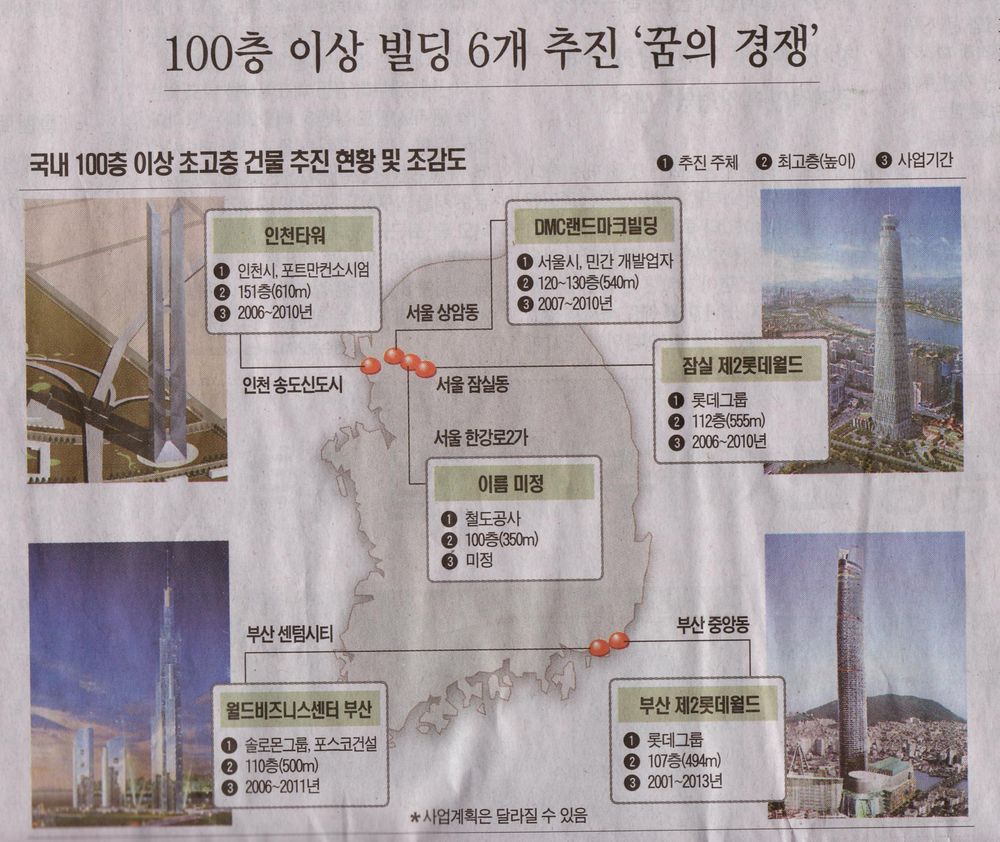
When there are plans to build half a dozen buildings taller than 100 floors by 2010, (when the tallest building in Korea at the moment is only 73 floors) I have to seriously question that assertion.

Thursday, April 27, 2006

Triumph of the Wall


The above photo, posted in the Joongang Ilbo on Saturday, April 22, is followed by this caption:
The final section of the 33-kilometer (20.5-mile) embankment for the Saemangeum reclamation project was filled in yesterday. The goal of the project, on Korea's southwest coast, is to form a tidal flat of 28,300 hectares (69,930 acres) for rice production and tourism. Some 60 meters are left to seal the water inside.
More photos of this moment can be found here, while a television report filled to the brim with thrilling, earth-moving images (and half a dozen "Mansei!"s) can be found here. It has not been smooth sailing for this project, due to the objections of environmental groups who point to the Saemangeum mud flats as supporting some of the largest and most important concentrations of migratory birds in Asia; with the completion of the wall, the mudflats will be freed of these seasonal visitors “in due course”. The most comprehensive presentation against the project can be found at this website. Their unhappy response to the completion of the sea wall can be found here, while a (small) video is shown here.

More on the history of the project (and the opposition to it) can be found in this article:
Initiated in 1991, the Saemangeum Project was aimed at turning 40,100 hectares of mudflats in coastal areas some 250 kilometers southwest of Seoul into 28,300 hectares of farmland and a freshwater lake by building a 33-kilometer seawall to seal off the mouths of the two rivers running through the area.

This is what the seawall looked like a few years ago. It’s worth noting that at 40,000 hectares (or 400 square kilometers), it’s two-thirds the size of Seoul. The article continues:
In August 2001 environment civic groups filed an administrative suit against the government demanding the nullification of the project. In July 2003 the Seoul Administrative Court ordered the temporary suspension of the controversial project until a court decision determined its future. But seven months later, it decided to let the reclamation of Saemangeum continue […]

On Nov. 12 [2004] the Seoul Administration Court held a final public hearing on the nullification suit, hearing final opinions on the project from civic groups and the government.
In February, 2005, the court ruled that further construction of the sea wall (to close the remaining 2.7 km stretch) should be halted. According to this article,
They listed the following reasons to support their ruling to change or cancel the original permit:

• the possibility of using land reclaimed through the project for agriculture is very low
• it is anticipated that the water quality in the reclamation reservoir will be too poor to use for agriculture
• estimates of economic benefits to be derived from converting the existing area to agriculture are flawed
• massive damage will be caused to the tidal-flat ecosystem.
The government took the case to the Seoul High Court, which overturned this decision in December 2005, and allowed construction to resume.

Now that the wall has been completed, the government still insists it will use the area for farming, as well as for creating parks, though it hasn’t finalized plans yet.

If you’re curious as to what the government and developers may have in mind, you need look no further than this website. There are numerous photos to be found there, such as the one below.


Care to look into some farmland there? Perhaps this real estate agency can help. If you’re still not finding yourself excited over this, you need to get pumped up by this video!

Perhaps you need more than videos and photos to be convinced that this is a good idea, and that it won’t cause a great deal of environmental damage. Will photos of birds on main webpage (linked to above) do?


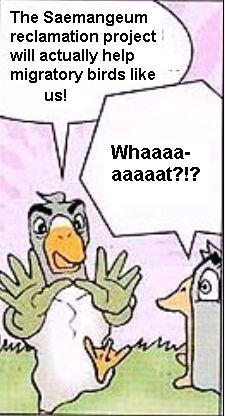
If even this does nothing to help, and you’re still skeptical of such transparent corporate propaganda, then the only thing left is to show you is something that is simultaneously hilarious and creepy - this little piece of opinion engineering in the form of a comic strip:


Now, in truth, that is not what the father duck says in that panel in the original version, but it does communicate the essence of this little piece of corporate propaganda. Seriously – it’s like one of those boring documentaries the kids are forced to watch on The Simpsons, except that it isn’t a joke. The father duck (who has obviously had a few cake boxes sent to him by the developers) tells junior that Korea has a long history of reclaiming coastal land, pointing to the reclamation that enlarged Ganghwa Island in the Goryeo period (strange that he didn’t mention the 1994 Lake Shihwa reclamation project, which failed for the same reasons environmentalists believe Saemangeum will), and then talks about how they’ll be able to feed 1.5 million more people (“Like North Koreans”), how the wall will become a freeway making travel between Buan and Gunsan much, much faster than it is now on the nearby (already existing) expressway, and how it’s going to become a wonderful tourist area with its large freshwater lake.

You can check out this woefully transparent (yet perhaps for that very reason, oddly amusing) piece of propaganda here.