Monday, December 26, 2022

News reports on arrest of instructor link him to 'AIDS threat'

The Rise and Fall of E-2-visa HIV testing in South Korea, 1988 - 2017

Part 1: The 1988 Olympics and Korean fears of AIDS
Part 2: HIV testing for foreigners in the aftermath of the 1988 Olympics (unfinished)
Part 3: Anti-English Spectrum begins to link foreign English teachers to AIDSPart 5: Using their own articles, Anti English Spectrum petitions for E-2 visa changes
A month or so after having his "AIDS threat email" highlighted in several articles by the Chosun Ilbo in May 2007, much to the delight of Anti English Spectrum, the Australian instructor who sent it found himself in the hands of the authorities. As AES leader Lee Eun-ung wrote in an op-ed article published in February 2009,
After this writer and others pursued him with the cooperation of relevant authorities, he was finally arrested by police in the capital region after living at a guest house in Seoul.
Whether or not he was actually involved in catching the culprit, the content of the Chosun articles carrying Anti English Spectrum's 'White foreign English teacher = AIDS' propaganda was referred to when his capture was reported by numerous media outlets. On the morning of July 2, 2007, NoCut News published the first report about the arrest of several foreign English instructors, including A:
Unbelievable foreign English instructors - 'From molestation to stalking'
A bunch of unqualified foreign English instructors caught for 'forgery of well-known overseas university diplomas'

Police have arrested a bunch of unqualified foreign English instructors who went as far as forging well-known overseas university diplomas in order to work in Korea as English instructors. Among those arrested, some were fired for flirting with students and after being hired again as an instructor, stalked Korean women.

'I' is a Canadian who has worked at a foreign language hagwon in Anyang for more than three years. He graduated from a famous university in Canada but all his background consisted of was working in a factory after graduating high school.

Canadian J made tens of millions of won working as an instructor at an English hagwon in Gangnam in Seoul, but only worked at a fast food restaurant after graduating from a junior college.
The article then described how it was possible to get a job and an E-2 visa with a fake diploma, and the connivance of recruiters and employers in this. It then continued:
For some foreign instructors, it's not just English proficiency but conduct which is a problem.

Australian English instructor A was fired for habitual excessive physical contact with students and KFTRA (Korean native speaking instructor recruiting association) put him on their blacklist, but he was openly hired as an English instructor. What's more, A bore a grudge against the Korean girlfriend who broke up with him and who had a different boyfriend and cursed her, saying "Last year in the Philippines I had sex with a prostitute and now you have caught AIDS," and also stalked her via email and phone.   [...]

The Foreign Affairs Division of the Seoul Metropolitan Police Agency has arrested three teachers including the Australian A on suspicion of forging diplomas to work as English instructors, and booked I (29) without detention, and has also booked five people without detention including Mr. Lee, the owner of a employment agency which arranged jobs for instructors despite knowing they were unqualified.

During the police investigation they stated that "We came to Korea because we heard that in Korea that you can easily work as an instructor and make lots of money."
YTN then broadcast a news report about the arrests at noon (which was repeated a least twice):
As ever, there are foreign instructors with forged degrees and ineligible visas

"Foreign instructors caught with forged diplomas"

It's been revealed that there are still unqualified foreigners teaching English in places like hagwons or youth centers.

And there are still incidents of using fake degrees to get E-2 visas, which are given to native speaking instructors.

In then explained the blacklist [above], how people got on it ('taught while drunk,' 'fraud'), but said that some of them were still able to teach, and that some did so on tourist visas.
32 year old A from Australia was caught for teaching at a hagwon without an E-2 visa.

A, whose name is on the blacklist where he is criticized for behaviour approaching molestation of students, has despite this taught students at various hagwons since 2001.
  [One of many shots of A at the police station.]
[Interview: A, foreign English instructor.]
"Why didn't you get an E-2 visa?"
"Basically, I didn't know how long I was going to stay in Korea, so I thought, I will work for a couple of months, and if I like the school, then they will give me an E-2 visa."

It looked briefly at the E-2 guidelines and how diplomas could be faked, and then criticized the attitudes of hagwon owners who said they were too busy to check. It ended by saying that the damage caused by unfit instructors was shifted by irresponsible hagwons to the students.


The YTN report did not mention the 'AIDS threat.'

Yonhap, on the other hand, was more than happy to put the 'AIDS threat' in its sub-title in the article in published at noon (republished by the Chosun Ilbo and Joongang Ilbo), which reiterated the story of I and J, who it said made 30 million and 60 million won, respectively, and told the story of the third teacher, a Canadian, S, who bought a diploma from the University of Manitoba for $300 in 2003 and made 100 million won working at a hagwon in Songpa-gu on an E-2 visa.
A bunch of foreign English instructors with forged degrees caught
Even threatened "You've caught AIDS" to an ex girlfriend

[...]

Police also arrested Australian English instructor A (32) for threatening a Korean girlfriend who broke up with him as if she had caught AIDS (contravening the Law related to punishing violent behaviour).

A, who was dumped by his Korean girlfriend who he dated for about a year, is supected of calling or sending her emails six times since last December saying "I had sex with two prostitutes in the Philippines. I hope you gets AIDS too."

Police said that A graduated from a 4 year university in Australia and was issued an E-2 visa normally but was put on a blacklist by the Korean native speaking instructor recruiting association (KFTRA) for arousing criticism and being fired for molesting students.
It ended by mentioning the five Korean brokers who were arrested. Needless to say, with the Yonhap wire service highlighting the AIDS threat, other news outlets soon picked it up.

An hour later, the Kyunghyang Sinmun published a report which began just like the YTN story and, like the Yonhap article, told the story of S, I ,and J, before getting to A.
More foreign instructors with forged degrees and 'zero conduct' caught

[...]

There was also a problem with some foreign instructor's attitudes.

Police also arrested Australian A (32) on suspicion of threatening a Korean girlfriend who broke up with him, saying "Since you had sex with me you caught AIDS."

A graduated from a 4 year university in Australia and was issued an E-2 visa normally but was put on the native speaking instructor blacklist for being fired for habitual excessive physical contact with students.
It also ended by mentioning the five Korean brokers who were arrested.

An MBN article published a little later, titled "Foreign instructors caught for forging degrees," mentioned only the three foreign teachers caught for forged degrees.

Later that evening, after 9 pm, MBC broadcast a report about the arrests.

'Low quality instructors'
"Native speaking teacher, Low quality teachers"

Anchor: Even now such low quality instructors are rampant in English hagwons.

Lee Ji-seon reports on native speaking instructors who make a habit of forging degrees and even molesting students.

This is a children's English hagwon in Gunpo, Gyeonggi-do. At the beginning of this year the hagwon got a flood of complaints from parents.

An instructor from Australia was molesting children.

Hagwon owner: "Children said he wouldn't let go when shaking hands. And it increased to two or three kids repeatedly and I said absolutely do not touch them."

This instructor had already been fired for molestation but was able to get a job at this hagwon without much difficulty.

This is because the instructor hid the fact he was fired and also no prior check was done by the hagwon.

Suspect: "Munhwa [culture] is different. In Hoju [Australia] it is okay to touch the child. I didn’t touch in a sexual way."
It then quickly mentioned the Canadian instructor in Anyang with the fake degree who was hired even though his visa had expired and a hagwon owner who said "I don't ask for detailed facts about their academic past because time is short."
Among such native speaking instructors there are many unqualified people involved in diploma forgery and molestation, and even alcoholics.

But because there are not enough instructors, hagwons will overlook this and so even today they are openly teaching students.
More news articles followed, some of which made reference to the fact that he had 'threatened his Korean girlfriend with AIDS,' including the Segye Ilbo ("Unqualified Shameless English Teachers... Faked Backgrounds and Molestation") and the Chosun Ilbo: ("Native Speaking English Teacher Pattern). 

More televised reports were to come. Anti-English Spectrum claimed they contributed to the several of these reports, and among those that followed were reports that not only highlighted the "AIDS threat email" but also interviewed Anti-English Spectrum head Lee Eun-ung.

Saturday, December 24, 2022

The Chosun Ilbo promotes AES with articles like "White English instructor threatens Korean woman with AIDS"

The Rise and Fall of E-2-visa HIV testing in South Korea, 1988 - 2017

Part 1: The 1988 Olympics and Korean fears of AIDS
Part 2: HIV testing for foreigners in the aftermath of the 1988 Olympics (unfinished)
Part 3: Anti-English Spectrum begins to link foreign English teachers to AIDSPart 5: Using their own articles, Anti English Spectrum petitions for E-2 visa changes
Part 6: The Chosun Ilbo: "White English instructor threatens Korean woman with AIDS"

After six months of petitions by Anti-English Spectrum members to ROK government ministries calling for health and criminal record checks for E-2 visa holders, on April 5, 2007, a post appeared at AES by its leader, Lee Eun-ung, titled "Illegal Native Speaking English Teachers reported":


It noted tips on several foreign English teachers. Among them was 'A', from Australia, who was said to be responsible for an "AIDS scare against a Korean person" and who had re-entered the country and was staying in a guest house. As AES head Lee Eun-ung wrote in an op-ed article published by the Weekly Kyunghang in February 2009:
In spring of 2007, our group received a tip from a woman who wanted help. A teacher from Australia threatened her, saying he’d had sex without a condom in southeast Asia and she should be careful of AIDS, too. The tip also said the teacher was loitering around her place, trying to terrify her. 
One result of this tip was Anti English Spectrum contacting Sports Chosun, where reporter Kim Yun-hui penned one of the more blatantly xenophobic anti-foreign English instructor articles of this time period, which was published around noon on May 27, 2007. This was followed by chosun.com and the Chosun Ilbo, where articles appeared on May 27 and 28, 2007. Getting this story into one of Korea's biggest newspapers was certainly a propaganda success for Anti English Spectrum, especially in identifying the race of the culprit:
From molestation to AIDS threats – Shock at the perverted acts of some foreign instructors

Beware the 'Ugly White Instructor'
Put on the KITA blacklist... Unfit instructors reported by [online] cafe as well


◇ Left: The chatting site profile posted by foreign instructor T, who works in Andong
Right: Email by foreign instructor A to his ex girlfriend which threatens and describes the possibility of AIDS infection.

◇ KITA (Korean Native Speaking Instructor Recruiting Association) blacklist.

People have been shocked as the perverted acts taken too far by white foreign instructors have become known.

It's been revealed that some white foreign instructors use the fact that Korean women are enthusiastic to study English, and that they are preferred to black instructors, to compulsively commit molestation and harassment.

A Korean woman, Ms. Kim (31). recently met Australian native speaker instructor "A" (30) at a friend's birthday party and entered into a romantic relationship with him. However she became frightened by A's excessive obsession and crippled appearance and soon told him she was breaking up with him.

The vindictive A realized that he might be infected with AIDS and forced Kim to have sex with him. On February 7 he sent her an e-mail saying, "Last year in the Philippines I was drunk and had sex with two girls without a condom. After that I came to Korea and had sex with you without a condom. I was too scared to tell you. I feel sorry about it. I didn't even get (AIDS) tested. When I think about what you did to me (breaking up), however, I feel very satisfied. If you were nice, I would feel guilty. I'm not making this up, it's all true. I'm lucky I can get a cheap AIDS test in Bangkok."

KITA (the Korean Native Speaking Instructor Recruiting Association) put A on the blacklist on its homepage and warned that he was "A person who often puts his hand on students' bodies. It reaches the level of molestation, so absolutely do not hire him. He was fired due to the strong complaints of students and parents." However, it is known that A is currently working at a hagwon in Seoul's Hyehwa-dong.

As well, in Masan, Gyeongsangnam-do, American instructor “B” (40), who has been working at an English hagwon and an elementary school for one year, has been accused of harassing Korean women while pretending to be unmarried despite being married with four children. The victimized women, fearful of retaliation, all refused to be interviewed but gave this evaluation of B: "He has a very disordered private life, always drinking and sleeping with groups of women, and cannot be a role model for elementary school students.”

At P High School in the U.S., where B worked in 2005, he was fired for molesting a 17-year old female student. A student from that school, K, attested that, "At a pep rally a female student hit him in the face with a pie, and B grabbed her waist and rubbed his face between her breasts. Then he was fired."

Another instructor, T (43), who lives in Andong, came under fire by netizens for introducing himself on a chatting site by writing on his profile that his "favorite thing" was "looking at the glistening sweat on the curves of a woman's breasts, thighs, back and ass." As well, under "What you like to do in your free time," instructor T wrote, "sex."

Ms. Hong (28), who works as an English instructor in Busan, said, "90% of the native speakers are white. This is the result of Korean people's racist tendencies and the greed of hagwons who try to improve their image." "White instructors tend to think that 'it's easy to fool Korean women who approach me to learn English (It's easy to have sex with them).'"

Citizens infuriated by the explicitly sexual remarks and molestation of such white foreign instructors have started a voluntary movement to improve things. A portal cafe with 14,419 members (Anti-English Spectrum, cafe.naver.com/englishpectrum.cafe) is actively carrying out a "citizen"s movement to expel illegal foreign language instructors" by reporting unfit foreign instructors and holding joint investigations with police. Cafe manager Lee (ID 엠투 (M2)) said, "This year, too, we are concentrating on making an issue of, and informing [the public about], low, lascivious, unfit native speaking instructors."

Reporter Kim Yun-hui
The email in question is here:


Twelve hours later, in the early morning of May 28, 2007, the Chosun Ibo published the following article:
White English instructor threatens Korean woman with AIDS
Retaliation for being dumped after dating

Some native speaking instructors who habitually molest or sexually harrass Korean women are arousing criticism. Last year Ms. Kim (31) met Australian native speaker instructor Y (30) at a friend's birthday party and dated him. However a few months later she told him she was breaking up with him. But in February Ms. Kim received an email which said "Last year in the Philippines I had sex with two girls without a condom. After that I came to Korea and had sex with you without a condom. I was too scared to tell you. I feel sorry about it. [See photo.] He said, "I didn't  get  an (AIDS) test. When I consider what you did to me (breaking up), [I think] you deserve to get AIDS. Therefore I'm safisfied. I'm not making this up, it's all true."

Korea Foreign Teacher Recruiting Association (KFTRA) put Y on their blacklist. On this blacklist are the names of 68 poor foreign instructors who have been reported for things like sexual harassment or contract breaches. It says of Y, "He often puts his hands on students' bodies. It reaches the level of molestation, so absolutely do not hire him."

The KFTRA said that currently, of the 20,000 to 30,000 foreign instructors working in our country, approximately 10 percent of them had been fired due to serious problems such as molestation or refusing to teach classes.

Reporter Son Jin-seok
And just before noon on May 28, the Chosun Ilbo's English-language site posted this article:
Australian English Teacher Blacklisted for AIDS Threat

Allegations of improper conduct against expatriate English instructors in Korea refuse to go away. The Korea Foreign Teacher Recruiting Association estimates that about 10 percent of the 20,000-30,000 foreign instructors working here are fired after they were found to have committed sexual improprieties or refused to teach classes.

It cites the case of a Korean woman identified as Kim who says she met an English instructor from Australia at a friend's birthday party. Kim went out with him for several months. When she broke up with him, the Australian sent her an e-mail in February saying he had had sex with two prostitutes in the Philippines without using condoms in 2006 and Kim had been his next date. He said he was so afraid that he could not tell her about it, and had not had an HIV test. The instructor said Kim "deserved" to get AIDS considering what she did to him.

The KFTRA has added the instructor to a blacklist of 68 foreign instructors accused of sexual harassment and contract breaches. The association told institutes not to hire the Australian.

In an earlier case, an American instructor who worked in a high school in Yongin made headlines when he was fired for teaching students how to smoke marihuana and said Japanese women "are the best."
That article translates in the nicest way the above Chosun Ilbo article, and adds the last paragraph in for good measure.

The teachers blacklist in question at the website of Korea Foreign Teacher Recruitment Association (KFTRA) was reported on by the Korea Times on August 26, 2006. As the article notes, posting the instructors' names online in that manner made the association vulnerable to libel suits. 

In the interest of fairness, a blogger at this time contacted the (clearly visible) sender of the email and got these responses:
(Email 1)
The whole thing was extremely unfair. I was just the victim of a vindictive, venegeful Korean woman. I would sue, but this is Korea. Please also mention her name, ***, and the fact that she has slept with every man in Itaewon. She was cheating on me, not the other way round. She loves hurting men. I regret ever meeting her. Your help would be appreciated.
(Email 2)
As this whole thing is so blatantly unfair, make sure you mention her name,***, mine was exsposed, why shouldn’t hers. And the sneakly, manipulative nature of the girl. You have no idea how cruel she is. She’s evil. I know, I lived with her for 3 months. She loves hurting men, I could never work out why. She even had an ex canadian boyfriend put in jail for hash. She knew he had some in his appartment and when he cheated on her, she called the police. This is not a nice girl we’re talking about. Just let the truth be known for justice’s sake.
While commentary on English-language blogs and forums at the time found little sympathy for the writer of the email(s), there was a great deal of criticism directed at the Chosun Ilbo for focusing on its author's race and for hiding the recipient's name but not the sender's.

While these articles garnered a fair amount of publicity for Anti-English Spectrum's campaign to portray foreign teachers as AIDS threats, their true success would come a month later when A was arrested and major TV networks aired the "AIDS threat email" on the evening news.

Friday, December 23, 2022

Using their own articles, Anti English Spectrum petitions for E-2 visa changes

The Rise and Fall of E-2-visa HIV testing in South Korea, 1988 - 2017

Part 1: The 1988 Olympics and Korean fears of AIDS
Part 2: HIV testing for foreigners in the aftermath of the 1988 Olympics (unfinished)
Part 3: Anti-English Spectrum begins to link foreign English teachers to AIDS Part 5: Using their own articles, Anti English Spectrum petitions for E-2 visa changes

On September 18, a post appeared at the Anti-English Spectrum site heralding their success in publicizing the narrative that foreign English teachers were AIDS threats, titled "Breaknews (AIDS Foreign teacher) wide distribution!!!"


"Today it's come! Till now [the idea that English teacher are AIDS infected] hadn't risen from the internet! The report's in terminals, convenience stores, subways!!!!!!!!!!!!!"

It should be noted that, much as they had used posts found on an HIV counselling website written by women who were worried about HIV infection from sexual encounters with foreign teachers to promote such fears, this picture, which appeared at the top of the article, is of President George W. Bush's former U.S. Global AIDS coordinator Randall L. Tobias being publicly tested for HIV/AIDS in Ethiopia in an effort to fight AIDS stigma. In the article, however, the photo was used to create the exact opposite effect.

In many ways, this was nothing new. BreakNews had already published five articles about foreign English teachers that summer; the first article focused on Anti-English Spectrum, while the rest quoted a 'Mr. Kim' or 'Mr. K' - a member of the 'movement to counter low quality foreign teachers' - as an informant. 'Mr. Kim' was described as being 37 years old - the same age as Lee Eun-ung - and in the second BreakNews article, he could be seen in a pixelated photo.


On October 29, 2006, that BreakNews article was reposted at Anti-English Spectrum (above), and in the comments, members thanked 'Mr. Kim'. 'M2' - Lee Eun-ung, the manager and public face of the site - coyly wrote "I'm curious about Mr. Kim;..." Regular poster 'jasminhyang' later wrote in a comment "the first letter of Mr. Kim's nickname is 'm'." In a Breaknews article published two days later, Mr. K also made comments, and was described as "Low quality native speaking instructor expulsion site manager Mr. K," suggesting once again this was a pseudonym for Lee Eun-ung.

The September 18, 2006 BreakNews article, "Tracking [down] blacklisted foreign teachers suspected of having AIDS," ended with an interview with 'Mr. K' titled "Protection of human rights first, behind the protection of citizens; Enhance the E-2 visa, to reduce risk of HIV infection." In it, 'Mr. K' stated the following:
It is a fact that we are now exposed to more open sexual cultures and more dangerous situations, and [Korean] women who have met with foreigners are crying out over their anxieties regarding AIDS. It is inevitable that the levels of danger will increase when we consider the teachers who have entered on tourist visas, or illegally sojourning foreigner teachers that related authorities are not even capable of keeping track of.

[In response to those who would call his perspective "exclusivist/xenophobic"] This is not an exclusivist/xenophobic view; this is a matter of the survival of Korean women. They [foreigners] have entered Korea and are enjoying personal rights, but if Korean women are being exposed to the threat of AIDS, isn’t it right for the government to at least put some effort into blocking the source of the problem through [enhancing] the E-2 visa requirements?
Armed with this article and the interview with Lee, Lee and other members of AES set out to convince relevant government agencies that foreign teachers with HIV were a potential problem, one that could be solved by imposing HIV tests upon E-2 visa holders, and they cited the news article Lee had contributed to as proof that there was a problem. 

The next day, September 19, a petition to the Ministry of Justice asking for health checks for E-2 visa holders was posted at Anti English Spectrum. Nine days later, a petition to the Ministry of Justice asking for mandatory HIV tests and criminal record checks for foreign English teachers on E-2 visas was posted: 

This is the complaint I filed with the Ministry of Justice today.
Gaon (rightnation)

Application Date: 2006.09.28 

Title:
Please strengthen E-2 qualification requirements to make known the criminal record and health status of foreign English instructors!

Contents:
A September 18, 2006 Break News story titled "80% of those using the HIV test center for foreigners are native speaking instructors,” revealed that even Koreans suffer serious harm due to the sexual behavior of some foreign instructors.

To quote the newspaper article, the center explains that a significant number of foreigners visiting the AIDS Counseling and Examination Center for Foreigners (hereafter referred to as the Center) located in Seoul are white-collar, and a frequent posts by worried Korean women at an AIDS Counseling Center online bulletin board reveal that they are wondering if they have caught AIDS after having sex with foreigners, adding to the seriousness.

In this situation, it was confirmed that the occupation of a large number of foreigners residing in Korea is English instruction, and many of those English instructors enjoy sexual relations with not just one, but several Korean women. In light of these direct appeals by Korean women, it can be concluded that women are being defenselessly exposed to AIDS.

Also, on September 16, a suspect in the 1996 murder of Little Miss Colorado John Bennett Ramsey was arrested after 10 years, and the suspect in this mysterious case was an American named John Mark Carr, who lived in Thailand. Even though the John Mark Carr in question was a teacher who was shockingly dismissed in 2001 for possession of child pornography,, he worked as a native English teacher for children in Korea in 2002. (“Saengbangsong Seven Days,” Episode 159, aired 2006-08-25).

Indeed, looking at these two cases, it seems that the current laws of the Republic of Korea are too lenient and lax regarding foreign English instructors.

Unfortunately, however, there is no way to legally regulate these foreign instructors under the current laws. When applying for an E-2 visa, to be eligible foreigners from Western countries need only to show they have graduated from a 4-year university, even if they haven’t submitted a criminal record check or a health record that can confirm their health status.

It is also regrettable that some insist only on the human rights of foreign instructors while caring little for protecting their own citizens.

I appeal to the Immigration Office, the Ministry of Foreign Affairs and Trade: When issuing an E-2 visa to foreign instructors, please make it mandatory to submit a health check and criminal record check so that their health status and whether or not they have committed a crime can be known. It is only natural that teachers who teach our children and students should at least reveal that they are not criminals and have no health problems.
It should be noted that the SBS 'Seven Days' report "Unverified foreign English teachers are a danger to children" is a report that Anti English Spectrum also claims credit for.

AES members would continue to post several petitions sent to the Ministry of Justice asking for health tests for either HIV, STDs or drugs, as well as criminal record checks, until the end of the year. Other petitions would be sent in June 2007 which made reference to the episode of "Pandora's Box" (known for its shrill caption, "Illegal foreign instructors are violating Korean women!!!")  that they contributed to.

In just a month and a half, Lee twisted the meaning of two brief references to English teachers voluntarily getting tested for HIV in order to connect the 'problem of native speaking English teachers' to AIDS, found frightened women and spread internet rumours in the form of a horror story to try to give this claim more substance, got a lengthy story presenting this view published in online (BreakNews) and newspaper (Inside Story) media, and then cited the articles or news stories they contributed to in petitions to the Ministry of Justice. Less than a year later, they would find far more popular newspapers willing to publicize their cause.

Thursday, December 22, 2022

Anti-English Spectrum begins to link foreign English teachers to AIDS

  The Rise and Fall of E-2-visa HIV testing in South Korea, 1988 - 2017

Part 1: The 1988 Olympics and Korean fears of AIDS
Part 2: HIV testing for foreigners in the aftermath of the 1988 Olympics (unfinished)
Part 3: Anti-English Spectrum begins to link foreign English teachers to AIDS (2006)Part 5: Using their own articles, Anti English Spectrum petitions for E-2 visa changes (2006)

Part 3: Anti-English Spectrum begins to link foreign English teachers to AIDS

Throughout the 1990s and 2000s foreigners on entertainment visas (known as the E-6 visa after 1993) needed to provide HIV-free papers upon arrival or face HIV testing in Korea after an amendment to the AIDS Act came into effect in 1989, and in 1994 this requirement was expanded to foreign workers entering Korea to become "industrial trainees"; those in the country already would be subject to in-country tests, and new arrivals would need to submit HIV-free papers or be tested on arrival.

By the mid 1990s a new group of foreigners in Korea became increasingly visible, especially as the EPIK program began placing them in public schools - foreign English teachers. One politician who took early note of them was future Democratic Party leader Kim Han-gil, who wrote in mid 1997 of illegal teachers, "As they enter the country on tourist visas, they do not have to take AIDS or drug tests." He also later said in regard to these teachers that "Elementary school students are defenseless before things like AIDS," and "That they don't even have to take drug or AIDS tests in particular and are entering the country and teaching children in hagwons or homes is a serious problem."

Though immigration statistics revealed 7,607 teachers on E-2 visas at the end of 1997, the financial crisis that year would have seen many leave by year's end. Including illegal teachers, there may have been 10,000 or more teachers before the crisis (I'd estimate around 9,000 on E-2 visas), but Rep. Kim estimated that there were 70,000. In his comments on the need for drug and AIDS testing, and in saying that "the reason white men really like Korea is to chase after Korean women," Rep. Kim was ahead of his time in painting foreign teachers as a moral problem. The rest of society would catch up in 2005 during the English Spectrum incident, when that website's photos of a sexy costume party and "Ask The Playboy" column raised the ire of netizens and led to the formation of the netizen group "Anti-English Spectrum", who soon rebranded themselves as "Citizen's Movement to Expel Illegal Foreign Language Instructors." It was only in 2006, however, that another article would appear (since Kim Han-gil's in 1997) mentioning both foreign English instructors and AIDS.

On August 14, 2006 the Donga Ilbo published an article titled "Foreign AIDS infection rate 10 times that of domestic." This article bases that statement on statistics revealing that the 2005 rate of HIV infection among Koreans was 1.4 per 100,000, while the rate among foreigners in Korea was 11.1 per 100,000. It then notes the problem that illegal immigrants aren't tested, and so could be a source of further infections. One paragraph reads:
There are six HIV counseling centers in Korea that are available for Koreans, but for foreigners there is only one place: the international HIV/AIDS clinic in Itaewon, Seoul. An official at the [Itaewon] clinic said, "Mostly white collar foreigners, such as English teachers, visit our clinic, and we have almost no illegal immigrant foreigners."
Two years earlier, in February 2004, the Joongang Daily had reported on the testing center in Itaewon:
In a nondescript building on a busy street near Itaewon, one AIDS help center for foreigners quietly set up shop a year ago. The only way to find the location is if you know where it is. They don’t advertise their presence, having a sign that displays only the group’s acronym. 
“We had so much difficulty finding a building owner who would let us sign a lease,” says Nalina Taneja, a counselor there. To get their current office space, they hid that they were an AIDS organization. The other tenants are still unaware that the office space is for AIDS counseling. 
The organization was created to fill a need in the foreign community by offering help while maintaining confidentiality. The center answers questions about HIV testing, prevention and treatment in English, Hindi, Urdu and Korean. 
Returning to the August 2006 Donga Ilbo article, the underlying idea of the article was that getting tested is beneficial to public health, and the fact that illegal immigrants were not getting tested was a problem.

Another article mentioning foreign teachers and AIDS appeared a month later, titled "AIDS is not a disease to hide any longer" and published by Breaknews on September 7. A day later, it was reposted at the website of the Korean Alliance to Defeat AIDS:
Kim Ji-yeong of the AIDS Prevention Center says without hesitation that “Korea’s men are the biggest victims of AIDS.” After seeing the attitude of a foreign English teacher after he/she found out that he/she was infected with AIDS, she says that she was very shocked by the difference in thinking that is still deeply rooted in our society.[...]

"There is too much of a clear difference in the way people view the disease and how they view those who are infected, and therefore it is a reality that people infected with AIDS within our society can only live buried under the shadows. It is now time to pull them up out into the light, and altogether be concerned and find a solution together.[...]
However, those working at the Daegu branch of the AIDS Prevention Center say that the inveterate thinking of our society that is influenced deeply by Confucian views on sex is extremely difficult to improve. Double-standards regarding sex, and excessive sexual contact purely for pleasurable pursuits that are loudly bragged about as if relating heroic stories … these are the structural ironies of our society’s thinking.
In a mostly unpublished interview for this article, the aforementioned Kim Ji-yeong of the AIDS Prevention Center explained why she was 'shocked' [thanks to Adam Walsh for sharing this]:
In 2005, a foreign English teacher came to our center for a HIV/AIDS test. The result was positive. When we informed him with the results, he was rather calm and said it wasn’t a "big deal" and told us he was going to go back to the States after a week. He further mentioned that he wasn’t too shocked with the results because he was taught since elementary school that HIV/AIDS is not fatal if taken good care of. This was quite surprising for me since the reaction was so different from Koreans. Normally when Koreans are informed of such a result, they start crying and act as if it's the end of the world.
On August 15, 2006, the day after the article "Foreign AIDS infection rate 10 times that of domestic" appeared at both donga.com and naver.com, two comments were left at the article at Naver by m2t24 - Lee Eun-ung, the leader of "Citizen's Movement to Expel Illegal Foreign Language Instructors," or Anti-English Spectrum.


While the other comments discussed illegal immigrants, his had a different focus. In the first comment, he wrote,
So, at the counseling center, they say that there are many native speaking instructors... Parents, let's raise awareness.
Seven minutes later, he wrote,
It is funny. Why would an educator be visiting an AIDS counseling center? ... Native speaker English instructors!! Parents, your children are being exposed to danger.

On September 9, almost four weeks later, Lee wrote a post on the Anti English Spectrum site titled "This is serious!!! (Concerns about AIDS after sex with foreigner teacher)". In it, he wrote:
Not long ago I read in a Donga Ilbo news article that mostly white collar white people and foreign instructors visted an AIDS counseling center in Itaewon. [...] Seeing this case, it was very serious. There are too many people trembling from the fear of AIDS after having sex with foreign English instructors - men and women... 
Now the problem of low quality native speaking instructors has reached as far as AIDS. For your information, native speaking fake instructors who come to Korea on tourist visas pose a great danger because, unlike E-2 visas, they don't submit proof of medical history.
There are counseling cases - cases of men and women! Really, what arises from the shadows?
This was followed by stories written by two Korean women, with the source not stated: 
I had sex with a foreigner instructor I met by chance when I went to a bar (a Canadian instructor at a children’s English hagwon).
We used a condom but we also had oral sex (he did not ejaculate in my mouth). I am so afraid that I cannot sleep. I am too afraid that I could not even go to get tested.
In the case of foreigner teachers, do they get health tests when they enter the country?

Normally I am never involved in promiscuous sexual relationships… It was just this one time, and I am so, so worried.

If by any chance that foreigner has AIDS, would I also be infected? I am so worried that I have even lost my appetite.
Please give me an answer.

----------------

I had sex with a foreigner instructor one week ago. I got to know him as an Internet friend and met up with him… we had some drinks and I went to that friend’s home… This friend lives in OO, and his character is lively and vivacious… He said that he’s been teaching English at a hagwon in Korea for one year.

I don’t know… He came to Korea and has been here up until now… and his friends also seem to be okay…

But then I had sex once with this friend and in the middle of it he started to bleed, so we stopped and we cleaned our genitals and went to sleep… Later on, he told me that it was because he had weak blood vessels… and that he had allergies… he is 22 years old… I don’t have any recent sores around my genitals, but we did not use any condoms… He said that it was his first time with a Korean.
These comments were left by members at the bottom of the page:
메머드: That is really serious… AIDS after [sexual] relations…
가온: I think it would be a good idea to get tested.
메머드: It would be essential for you to get various tests, including tests for STDs, when you get married…
As is noted in this Breaknews / Inside Story article, which was published later,
The reason why 'Inside Story' decided to report on this issue was because we received information about an AIDS Counseling Center online bulletin board where many Korean women were continuously submitting complaints about their anxieties regarding AIDS infections after having sex with a foreigner.
This 'AIDS Counseling Center online bulletin board' was the likely source of the above stories, but instead of trying to assuage their anxieties, AES used these stories to spread such anxieties as widely as they could.


The same day a look at how AIDS tests operate within the visa system was posted, with the focus on how illegal foreign teachers on tourist visas do not receive health tests.

In a post the next day about a native English teacher 'AIDS horror story', readers were told "There is an 'AIDS horror story' saying that infected foreigners are indiscriminately spreading the virus."

[A full page but less readable screen shot is here.]
Have you heard of the native speaker English teacher AIDS horror story…

The truth behind the “AIDS horror story” circulating around Itaewon.

Infected foreigners are indiscriminately spreading [AIDS].
The “AIDS horror story” of Itaewon.

Recently, there is an “AIDS horror story” - saying that “foreigners infected with AIDS have been indiscriminately spreading the AIDS virus” - that has been circulating around places where foreigners gather, such as Itaewon. The rumor says that AIDS infected people are deliberately approaching people to have sex in order to spread the AIDS virus.

Recently, an “AIDS horror story” that is being spread around Itaewon, says that some foreigners who are infected with AIDS have been deliberately approaching other foreigners or Koreans in places such as nightclubs with the goal of spreading the AIDS virus.

It is said that those infected with AIDS have various citizenships and jobs, and include foreign workers, native speaker English teachers, nightclub dancers, etc. Other than those foreigners who reside in Korea, there are also foreigners who are said to visit Korea temporarily in order to spread the AIDS virus – they stay for a little while and then leave the country.

One waiter “A” who works at an Itaewon nightclub that has many foreigner patrons, says, “Recently, there is an AIDS horror story that has been circulating around nightclubs where foreigners tend to gather. However, because nobody knows who is infected with AIDS or not, suspicions only grow larger.”

The methods that these AIDS-infected foreigners mostly use are deliberate sexual relations and deliberate blood donations.

In the case of deliberate blood donations, the possibility of the AIDS-infected person being revealed is high, and [therefore] his or her personal identity will be exposed, so this rumor is a bit unbelievable.

However, in the case of deliberate sexual relations, it is easy to approach people and difficult to expose [the identity of] the person, so it is said that the possibility of AIDS-infected foreigners choosing this method is high.

However, it is not known yet whether a foreign AIDS-infected peoples’ organization is responsible for inciting these people, or whether it is the infected foreigners within Korea just working among themselves. The only truth known from the rumor is that these people are spreading AIDS in order make their existence known. 
The waiter “A” says, “These AIDS-infected people also deliberately spread the virus in order to let their existence be known.” He goes on to explain, “I heard the rumor that some people spread AIDS because they feel it is ‘unfair to suffer alone’ and also it is very certain that there are foreigners who are infected with AIDS.”

An official at the Ministry of Health and Welfare’s Korea Center for Disease Control and Prevention said, “There is little probability that someone will be infected by AIDS as long as that person does not have sex with a foreigner. However, if the rumors are true, then Koreans who have had sexual contact with a foreigner will almost all contract AIDs.”
To help support this Lee added a photo (since removed) and text taken from this article posted at the website of the Korean Alliance to Defeat AIDS on September 8 (originally published by Breaknews on September 7):
Kim Ji-young of the AIDS Prevention Center says without hesitation that “Korea’s men are the biggest victims of AIDS.” After seeing the attitude of a foreign English teacher after he/she found out that he/she was infected with AIDS, she says that she was very shocked by the difference in thinking that is still deeply rooted in our society.
By this point Lee had twice taken a reference to foreign English teachers and AIDS and removed it from its original neutral or, in this case, positive context and used it to give support to the idea that foreign English teachers have AIDS, and that "Koreans who have had sexual contact with a foreigner will almost all contract AIDs."

Similar versions of the 'Itaewon AIDS horror story' can be found more recently here and here. Of course, I couldn't see the term 'AIDS horror story' (에이즈 괴담) without being reminded of the 'mad cow horror stories' that helped set off last year's mad cow protests - something also noticed at this blog at chosun.com. It might also be worth noting that the story of an American missionary who injects a Korean boy with 'deadly germs' in order to kill him - in Han Sorya's 'Jackals' (1951) - is one of North Korea's most enduring novels. [See B.R. Myers' presentation here.]


The same day the 'AIDS horror story' was posted, September 10, a picture of an 'AIDS mummy' was also posted.


As should be clear, Anti-English Spectrum's method was to take whatever snippets of information they could find which might imply a connection between foreign English teachers and AIDS and spin them in the worst possible way in order to create fear, and considering how taboo a topic AIDS is in Korea, creating fear - and interest - was not difficult to do.

On September 15 Lee wrote a post titled "Things are about to take off!"


This low quality native speaker teacher story is no joke. It is a big deal on Dreamwiz and Agora also...

Soon the AIDS native speaking teacher issue will take off... Get ready to freely spread the resources and original materials. Low quality native speaking teachers and AIDS... It was the truth!!!!!111111111111111 Please wait and see.
On September 18, Lee put up this post, titled "Breaknews (AIDS foreign instructor) wide distribution!!!"


"Today it's come! Till now [the idea that English instructors are AIDS infected] hadn't risen from the internet! The report's in terminals, convenience stores, subways!!!!!!!!!!!!!"

The article Lee is describing, which he contributed too, and which he is interviewed in, is the Breaknews / Inside Story article "Tracking [down] blacklisted foreign teachers suspected of having AIDS," which is translated here.

Tuesday, September 27, 2022

Light of the East discography, 1973-1975

(Among other things)  

Two weeks ago I gave a lecture titled "1970s Youth Culture at its Zenith: Music and film in the years before Emergency Measure 9," which can be watched here and is summarized in this Korea Times article. Just as the question period ended, I was asked where Korean music from the 1970s could be found. I've already posted an online discography of Shin Joong-hyun's music from 1960 to 1975, so this post will focus on the folk-rock music that developed from the university student folk music scene, in particular the music performed by the session band 동방의 빛 (Light of the East).  

Anyone wanting to learn a lot more about this period should read the relevant volume(s) from 신현준, 최지선, and 감학선's 한국팝의 고고학 series, which has four volumes, each focused on a decade between 1960 and 1990. (Both the 1960s and 1970s volumes are pertinent for those interested in rock and folk from the mid '60s to the mid '70s). Shin Hyunjoon also wrote, with Pil-ho Kim, "The Birth of "Rok": Cultural Imperialism, Nationalism, and the Glocalization of Rock Music in South Korea, 1964-1975." Also worth reading is Mark Russell's Pop Goes Korea and Roald Maliangkay's chapter "Pop for Progress: Censorship and South Korea's Propaganda Songs" (in Korean Pop Music: Riding The Wave).

As for music sources, Youtube has increasingly been a boon for discovering this music, as both passionate individuals and, more recently, record companies have digitized records and upload them. 집고양이 has uploaded many rock records, as well as some key folk albums, while 김일환 has uploaded dozens of folk LPs to Youtube, particularly the Golden Folk Album series, the discovery of which prompted my interest in this particular group of recordings. The channel Mystic Moods also has a variety of folk / rock / funk mixes and full rare LPs from this time period. I was also surprised to discover how many of these albums have been officially released by record companies on Youtube over the past two years. Information on these albums and songs comes mostly from maniadb.com, a useful, if not entirely complete, archive of Korean LPs.

While I've long had an interest in this music, there was so much I didn’t know, and it was actually while cataloging the music charts from Korean-language weekly magazines from 1969 to 1976 that I discovered so much more about this music. Youtube provided me with easy access to most songs, as long as I knew what to look for. I discovered that in 1974 and 1975 – prior to the song bans (금지곡) and the marijuana crackdown – over 55% of the music on the charts was folk, or rock, or pop, or some variation of the three, with a bit of country, prog rock, or synth-pop thrown in. And so many of the songs are not only well-written and performed, but also, because production quality improved so much, sound great today.

How did this begin? While part of the story is told in Shin Joong-hyun’s discography, another important factor relates to the development of folk music and folk rock.

According to an interview with Lee Jang-hee in 한국팝의 고고학 1960, in 1966 Lee and Yun Hyeong-ju, then attending Yonsei University, formed Linus Trio, which played acoustic covers of songs by groups like the Kingston Trio. Lee thought this was the first such singing group playing acoustic guitars to be formed by university students. They were together for about 6 months, and after that Yun started going to the music hall C'est Si Bon in Mugyo-dong, met Song Chang-sik, and formed Twin Folio in 1967. Twin Folio is remembered as the first folk duo, and they covered various Western songs, though - as was the style at the time - they changed the lyrics to Korean. They and singer Cho Young-nam drew attention at the time, appearing on TV and even in movies occasionally.

A collection of Twin Folio songs can be found here, set to start with their best-known song, "하얀 손수건 (White Handkerchief)."

It was at C'est Si Bon that Korea's first 'nude happening' was held in May 1968, and where Hahn Dae-soo held his first performance in August of that year, introducing a style more derived from Bob Dylan than the Simon and Garfunkle-sound of most folk duos in Korea. Hahn also wrote his own songs rather than simply writing Korean lyrics over Western songs. By late 1969, numerous folk duos had appeared, but they were no longer performing at C'est Si Bon, which had closed suddenly over money woes in May 1969. 

Twin Folio was the first folk duo to record and release songs in 1969, and released a full-length LP in early 1970, but broke up by the end of that year. The second folk duo to record was 뚜와 에 무와 (Toi Et Moi), and they scored folk music's first top ten hit, "약속 (promise)," which peaked at number 4 in October 1970. The next year saw more folk music in the top ten charts, with 라나에로스포 (Lana Et Rospo)'s song "사랑해" and Eun-hee's "꽃반지 끼고 (오솔길)" reaching number one. 

(These performers' albums have been uploaded to Youtube: Toi et Moi - First LP, Second LP, Third LP, 임이 오는 소리; Lana et Rospo - First LP, Second LP, Third LP; Eun Hui - 꽃반지 끼고.)

Meanwhile, a new live performance space, 청개구리집 (Green Frog House) opened in the basement of the YWCA, across from Myeong-dong Cathedral, in June 1970, and among the programs it offered were folk music concerts. With its central location and cheap entry fee (100 won), it drew students and became a gathering place for various folk musicians. In September 1970 the first Folk Music Festival was held at the YWCA; another Christian source of support for this music was CBS radio.

YWCA’s 청개구리집 opening ceremony, June 29, 1970 (Jugan Yeoseong 1970.07.15)

Y Folk Festival, YWCA, September 2, 1970 (Jugan Yeoseong 1970.09.16)  (Note a scene common at the time - someone holding a separate mic up to the guitar.)

It was at Green Frog House that Yang Hee-eun and Kim Min-gi were first noticed. Like Hahn Dae-soo (who was absent from 1971-74 serving in the Navy), Kim Min-gi was a gifted lyricist and songwriter who recorded a full album of songs in 1971.

김민기's first LP can be listened to in full here. His incorporation of various instruments, with classical flourishes, went a step beyond his contemporaries, (and he was the first to record a Hahn Dae-soo song) but its sometimes morose lyrical topics appear to have led the government to soon ban the sale of this record. As a result, Yang Hee-eun became his voice over the next few years, and she scored a number 1 hit in 1972 with her version of Kim's song "아침이슬 (Morning Dew)," a song made iconic by its adoption by student protesters in the 1970s and 1980s.


Most folk singers at this time were more likely to release a song or two on a compilation LP before getting their own album (and some groups or singers went years before releasing a full album - if ever). The six volumes of an early collection from 1971, 별밤에 부치는 노래 시리즈 (Songs sent on a starry night series) include songs by Song Chang-sik and Yun Hyeong-ju (formerly of Twin Folio) and other C'est Si Bon alumni like Kim Se-hwan and Lee Jang-hee, as well as up and coming singers like Two Ace, Lee Su-mi, Hong Min, Seo Yu-seok, and Im Hui-suk. They can be found on Youtube here: Vol. 1, Vol. 2, Vol. 3, Vol. 4, Vol. 5.

A truly unique record of this time, however, is the 맷돌 (Millstone) LP. According to this account, in either late 1971 or early 1972, the Green Frog House in the basement of the YWCA, which had nurtured the folk music scene for over a year and a half, stopped hosting performances (ostensibly due to money woes but government pressure may have been involved). 

As a result, the 'culture salon' on the 3rd floor of the Koreana Department Store in Myeong-dong - with backing from the magazine Sunday Seoul - began hosting folk performances in mid-June 1972. These were named the 맷돌 (Millstone) series and the folk singers involved attempted to mix old and new by not only providing a modern interpretation of traditional Korean melodies, but also by asking poets such as Jang Hyeon-jong, Im Jin-su, and Lee Tan to write lyrics. This culminated in a special performance held on September 26, 1972 at the National Theater in Myeong-dong, which featured performances by folk singers as well as traditional mask dances and pansori. The folk songs sung by 4월과 5월 (April and May), Song Chang-sik, Shin Chang-gyun, Kim Min-gi, Seo Yu-seok, and Yang Hee-eun were recorded and released on LP in November 1972. 

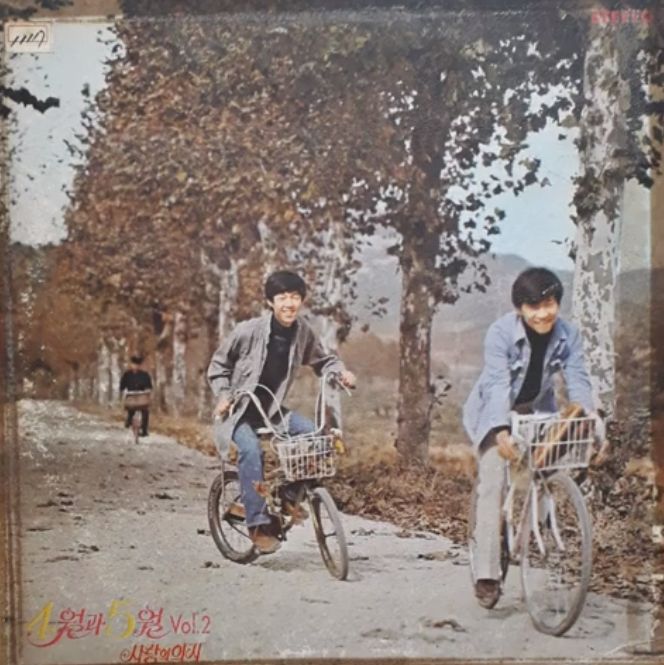
Close up of the cover; a photo of April and May with gayageum accompaniment by Kim Hye-seon.

맷돌(밝은노래모음) [ Millstone (Bright song collection)]
The album can be listened to in full here (Side 1; Side 2). 

April and May's version of 'Ding Dong Daeng' accompanied by a gayageum is fantastic, and it's really something to hear Seo Yu-seok's classic, "타박네", played live, but for me, Kim Min-gi's quiet, hypnotizing version of "새벽길 (Dawn road)" is the standout here.

This is also notable for including snippets of conversation by MC Lee Baek-cheon, who had once been a producer at TBC-TV, an MC at C'est Si Bon (where he was inspired to put Hahn Dae-soo on TV), and had been active with Green Frog House. This LP is also, as far as I know, the only live recording of folk music from this time.


The aforementioned 4월과 5월 (April and May) - the first folk duo to choose a Korean name - were, despite being accompanied by a gayageum on this album, moving in another direction. The duo, which started off playing catchy acoustic songs with vocal harmonies, was formed in 1971 by singer-guitarist-songwriter Baek Sun-jin and singer-songwriter Lee Soo-man, who is best known as the future founder of SM Entertainment and an architect of K-pop's idol training system. Lee soon left and was replaced by Kim Tae-pung, though Lee continued to make music sporadically in the following years.

April and May's first release was side 1 of the first volume of the "Oasis Folk Festival" series. Though it pictures Kim Tae-pung on the cover, it was Lee Soo-man who performed on the album. Among the songs on this album is "화(和)" (Reconciliation), a garage-rock / pop hybrid that marks the first step taken towards folk rock in Korea (which was co-written by Baek Sun-jin and Lee Soo-man). The version on this LP (which can be found here) is much rougher than the better-known, more polished later version, though that's not a bad thing. This song pointed to the more rock-oriented direction they would go on future albums and may have inspired other folk performers to do the same.

(The Oasis Folk Festival series can be found here (digitized by Oasis Records): Vol. 1, Vol. 2, Vol. 3, Vol. 4, Vol. 5, Vol. 6. They highlight singers like April and May, Lee Soo-man, Song Chang-sik, Lee Su-mi, and Hong Min, among others.)

Best 4월과 5월 - 1973

This 'Best of' album is a compilation of their early songs released across several volumes of the Oasis Folk Festival series, and can be found here. The rerecorded version of 화 is here.
4월과 5월 Vol. 2 - 1973

April and May Vol. 2, available here, features a great leap in production quality. Side 1 displays a pop sensibility featuring vocals harmonizing over welling strings, flute, piano, and burbling organ fills, and is reminiscent of groups like The Association. Side 2, on the other hand, opens with a distorted guitar riff that signals that the rest of the album is about to veer off in another direction. What follows are songs in a folk-rock mode that mix in funk and psychedelia, with "우리의 세상 (Our world)" being a standout.


If you listen to Shin Joong-hyun's records with The Men (late 1972-1973), April and May Vol. 2, or the records highlighted below, it becomes clear that production quality improved across the board at this time. Stylistically, it's not clear who might have been influencing who, in part because April and May Vol. 2 has no clear release date other than '1973'. Shin Joong-hyun's classic forays into folk rock with Kim Jeong-mi were released in November 1973, while Lee Jang-hee's hit LP was released in June 1973. 

Arguably the most varied and commercially-successful set of music by folk performers released at this time was the output of Orient Productions, which, according to this post, was founded in 1973 by Na Hyeon-gu, who had formerly worked for Seongeum Records. Unlike other companies, Orient Productions had its own 'house band' that performed on almost all of its albums, known as 동방의 빛, or 'Light of the East.' While this name does not appear on LPs from this time, it was used for music performances when they performed as Lee Jang-hee's backing band. The key member of this group was Gang Geun-sik, who had performed with Lee Jang-hee since the late 1960s when they were a duo. Gang had also worked with musician Jeong Seong-jo, and it was through this work that he met fellow session musicians drummer Yu Yeong-su and bassist Jo Won-ik. When Lee Jang-hee went to record his third LP with the newly formed Orient Production, he needed a band, so these three musicians joined keyboardist Lee Ho-jun to form Light of the East.
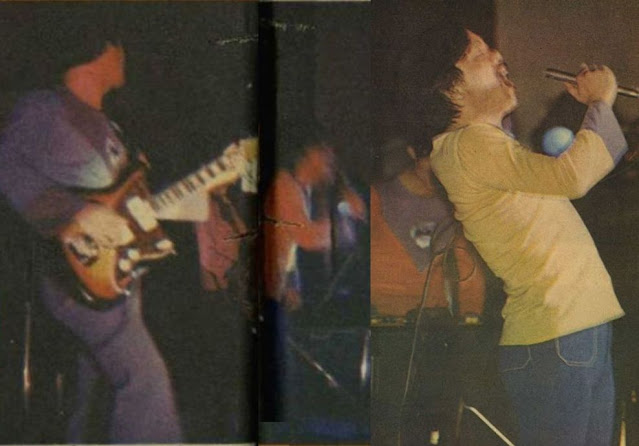
Lee Jang-hee (right) performing with Light of the East; Gang Geun-sik is on the left. (Sunday Seoul, 1974.04.28)

As Gang Geun-sik remembered it in an interview in 2002, he considered Orient Production founder Na Hyeon-gu to be a lover of music and said, "Not only did he invest in musical instruments, such as purchasing a [Moog] synthesizer for the first time in Korea, he also provided us with the conditions to make music freely." 

From mid-1973 to early 1976 Orient Productions and Light of the East released around 35 albums of songs in various styles - folk, pop, rock, electronic, and permutations of all of these - recorded by various singers and written by a group of singer-songwriters including Lee Jang-hee, Song Chang-sik and Yun Hyeong-ju (formerly of Twin Folio), and Yang Byeong-jip, as well as some by Baek Sun-jin (of April and May) and Jo Dong-jin (who soon left to do military service but became well known in the late 1970s). Much like Shin Joong-hyun, they often recorded various versions of certain songs with different singers. 

Compared to others making this kind of music aimed at young people at this time, however, Orient Productions' output was incredibly successful. Between late 1973 and late 1975, seventeen of their songs became top ten hits, including nine number 1 hits. On top of this, a number of instrumental albums with Moog synthesizer were released, and it was on these and other releases that Gang Geun-sik pioneered an effects-laden fuzz guitar sound that went on to influence groups like Sanullim. In fact, a key draw of these albums is the guitar playing by Gang, a talented and versatile guitarist who was not only able to play in a variety of styles, but who also experimented with effects pedals to create novel sounds. Though he had an affinity for country music, that style is only obvious on a handful of these recordings.

Though Seongeum Records and Orient Productions released albums by Kim Eui-cheol (available here), Yun Ji-yeong, Lee Yeon-sil (available here), and Hong Min (available here) in 1973, they are generally in a different style (acoustic folk with only violin accompaniment) from the Light of the East material, though Hong Min's album does seem to feature some guitar by Gang Geun-sik. So it seems likely that the earliest album made by Light of the East was Lee Jang-hee's 그건너. 

Lee Jang-hee had been active in the folk music movement from the beginning, and by 1973 had had recorded two albums, Young Festival Vol. 1 and Young Festival Vol. 4. His third album, recorded with Light of the East, featured better production values and incorporated more rock elements and spawned a massive number 1 hit with "그건너 (It's you)."

Lee Jang-hee - 그건너 (It's you) - 1973.06.20

The title track went to number one in late 1973 and sold over 100,000 copies, turning Lee into a star. He wrote all of the songs, which tend to be slower and moody while also showcasing Gang Geun-sik's lead guitar. The title track and "친구여 (My Friend)" are standout songs, with the latter featuring a great guitar solo. The album can be listened to in full here.  


Kim Se-hwan - 노래모음 (비) - 1973.09.23

Of all the Light of the East recordings, the singer with the most top ten hits was Kim Se-hwan, who had six hits (one of which - the country-ish "좋은 걸 어떡해" went to number one). This is due to his honeyed voice on the one hand, and, on the other, to the quality of these breezy folk-pop songs that feature sentimental yet optimistic lyrics. One exception to the lighter fare was the brooding "비 (Rain)," which was a hit in 1974 and features a fantastic guitar solo by Gang Geun-sik. Bizarrely, neither of Kim Se-hwan's two albums from this time period is available in full on Youtube, but this collection of his hits features most of his best songs from this time (up to track 12, though a couple of the songs are glaringly, obviously from the 1980s).

Kim Se-hwan - 노래모음 (사랑하는 마음) - 1974.10.25

This album spawned three hits, including "사랑하는 마음 (Loving heart)," written by Song Chang-sik (who sang it on TBC's Show Show Show with actress Mun Suk in late December 1975). 


A light, catchy folk-pop duo formed by Jeong Jong-suk and Park Heon-ryong (Park wrote most of the songs), they're best known for the catchy "당신의 모든 것을 (Everything about you)" and "언덕에 서서 (Standing on a hill)". The album can be listened to in full here (though the sound quality could stand to be better). Their follow-up 1975 LP (mostly not performed by Light of the East) also features a lovely cover of John Denver's "Annie's Song."


Cho Young-nam - 컴백리싸이틀 - 1973.12.27

Though the title of this album (Comeback Recital) suggests it's live, it's not. This tends more towards rock, with a standout being his version of Lee Jang-hee's hit, 그건너, which features a more aggressive guitar sound. The album can be listened to in full here.  

Choi Heon / Lee Yeon-sil - 1973.12.27

A split record featuring, on side 1, former He6 singer Choi Heon (before he formed 검은나비 (Black Butterfly) with former members of Shin Joong-hyun's band, the Men) singing guitar-and-piano-based songs mostly written by Jo Dong-jin. Side 2 features folk singer Lee Yeon-sil (whose songs are mostly written by Yang Byeong-jip). Her song 소낙비 is a cover of Bob Dylan's "A Hard Rain’s A‐Gonna Fall." The album can be listened to in full here.  

Yun Hyeong-ju - 새노래 모음 - 1973.12.27

Folk pop from the former Twin Folio member. The album can be listened to in full here, though it's from a crackly record, so this version of the opening track sounds clearer.

Yang Byeong-jip - 넋두리 - 1974.03.20

Yang's solo album features folk songs with occasional rock and synthesizer flourishes (such as "잃어버린 전설"), while "소낙비," "역," and "너와 나의 땅" are covers of Bob Dylan and Woody Guthrie songs. The album can be listened to in full here.  

Lee Jang-hee and Gang Geun-sik - 별들의 고향 OST - 1974.04.05

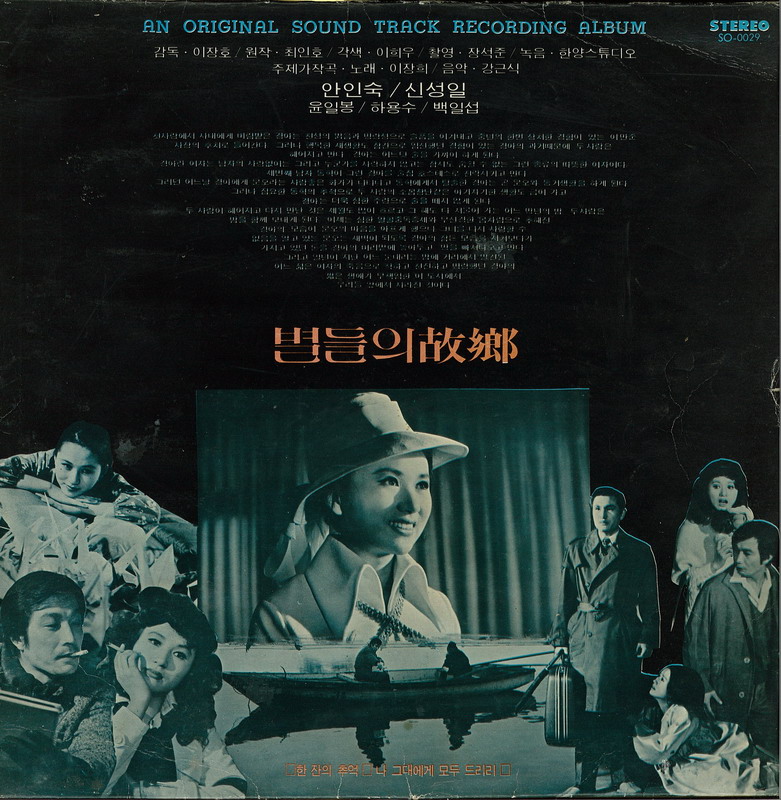
A key record of this era is the soundtrack to the then-biggest film in Korean history (see here for more information), which opens with a ballad but then shifts to more experimental, psychedelic, Moog synthesizer-infused songs and instrumentals. "한 소녀가 울고 있네" hit the top ten, and "한 잔의 추억" spent weeks at number one. The original cover was quickly banned and replaced two months later with this one. The album can be listened to in full here.  

Light of the East - '74 Hit Parade - 1974.07.22

An album of instrumental versions of mostly previously-released songs, often building upon the original backing tracks and replacing the vocals with guitar or synthesizer (in its best instances) or saxophone (which I tend to skip). "그애와 나랑은," "주기도문" (A cover of this song), and "한잔의 추억" are standouts. The album can be listened to in full here.  


Two Koreans - 나 그대에게 모두 드리리 - 1974.08.10

Two Koreans, the duo Kim Do-hyang and Son Chang-cheol, had released 3 LPs since 1971 and were known for their strong vocals (one of them could do an impressive Louis Armstrong impression). While a number of their versions of popular songs like "그건너" come off as comedic, their version of "들리지 않네" is well worth listening to for both their singing and Gang Geun-sik's guitar. The album can be listened to in full here.


Light of the East - Rain Rain Rain - 1974.08.10

Of the four instrumental albums Light of the East released, this is the best, but it's unfortunately not available online, except for two tracks that appear in mixes - a version of Kim Se-hwan's hit "비" and the unique Moog-focused 비야 비야 - set to a chorus of frogs.


4월과 5월 - 3집 - 1974.11.30

April and May's third album is one of the best Light of the East records, featuring a hazy production aesthetic combining fuzz guitar, organ, and occasional synthesizer - a far cry from their acoustic folk beginnings. The song "등불 (Lantern)" cracked the top ten. The album can be listened to in full here.  

Hyeon-gyeong and Yeong-ae - 1974.11.30

This duo's lovely voices float over songs ranging from the folk pop of "아름다운 사람" to the folk-prog rock of "나 돌아가리라 (I Will Go Back)". The final track, "다시 부르는 노래 (Song that's sung again)," is a beautiful version of Jo Dong-jin's poetic "마지막 노래 (Last song)" complete with soaring synthesizers, but it was actually not released on this LP. Recorded during these sessions, it was included as a bonus track on the CD rerelease but originally wasn't released until 1977 on an omnibus LP, which is odd, considering that it's probably the best song they recorded. The album can be listened to in full here.  

송창식 - SONG CHANG SIK - 1974.12.30

A solo album by the former member of Twin Folio, who had written a number of songs for other Light of the East records. "한번쯤 (Once or so)" went to number one in early 1975; "밤눈 (Night snow)" is also a standout, as is the Gang Geun-sik guitar solo-featuring song "새는 (A bird)," which ends with a psychedelic coda. The album can be listened to in full here.  

임희숙 노래모음 - 1975

Singer Im Hui-suk had recorded since at least 1969, when she appeared on a split record with the Key Boys. It's a hard-to-categorize album, as it embraces various styles, but is held together by her strong voice. There are also four Two Koreans songs here, all from their 1974 album. The album can be listened to in full here.  


Lee Jang-hee's fourth album - another highlight of the Light of the East releases - features low-key synthesizers and guitar with novel effects (perhaps meant to mesh with the synth) that make this a unique-sounding album. On top of this, the songs are in a variety of genres, drawing on rock, folk, funk, blues and country. The album can be listened to in full here.  


Light Of The East - '75 Hit Parade (1975.11.29)

More instrumental versions of songs in the mold of '74 Hit Parade and Rain Rain Rain. The version of "고래사냥 (Whale Hunting)" here opens the 1975 film "바보들의 행진 (March of Fools)", while its atmospheric version of "날이 갈수록 (As Days go by)" is different than that on the film OST. The album has a far better hit to miss ratio than the '74 edition, and can be listened to in full here.  

There is also a '76 Hit Parade LP (released 1976.03.15) here, however all but two songs are taken from the previous two Hit Parade LPs.


Golden Folk Album series

Perhaps the best known output of Light of the East and Orient Productions is the Golden Folk Album series, released in 14 volumes in 1974 and 1975. The early volumes serve mostly as compilation albums, since the majority of the songs were previously released on other Orient Productions LPs and only a few songs are new, but the new material increases over time and many of these records feature songs not found elsewhere, or early versions of songs that became well-known later. In fact, a number of the Light of the East songs that charted did not appear on the full albums above, but on these omnibus LPs. Two feature film soundtracks. These were all uploaded to Youtube by 김일환.


Golden Folk Album [Vol. 1] - 1974.02.15

Previous hit songs by Lee Jang-hee, Kim Se-hwan, and others provide a draw for this collection. The album can be listened to in full here.  


Golden Folk Album Vol. 2 - 1974.03.20

While most songs are, again, from previous releases, new material includes a cover of the Carpenters' "Jambalaya," the song "예전에" by One Plus One, and the original, quite different version of Song Chang-sik's "새들". The album can be listened to in full here.  

Golden Folk Album Vol. 3 - 1974.03.20

This features an early version of Song Chang-sik's "강변에서" and a new song by One Plus One, "나 세월속에." The album can be listened to in full here.  

Golden Folk Album Vol. 4 - 1974.08.10

Song Chang-sik does an early version of his song "사랑하는 마음" - here titled "더좋은건 없을걸" - which Kim Se-hwan would score a top ten hit with. The album can be listened to in full here.  

Golden Folk Album Vol. 5 - 1974.10.25

Song Chang-sik does an early version (seeing a pattern here?) of his song "한번즘," which went to number one in early 1975, a Hyun-gyeong and Yeong-ae song appears ahead of the release of their album (their songs become fixtures on future volumes), while Jo Dong-jin's otherwise unavailable "작은 배" is a standout. The album can be listened to in full here.  

Golden Folk Album Vol. 6 - 1974.10.25

There are some good songs here, but the only new one (other than Hyun-gyeong and Yeong-ae's) is "당신이 좋아서," a rock-pop song by Jang Mi-ri. The album can be listened to in full here.  

Golden Folk Album Vol. 7 - 1974.11.30

"당신을 처음본 순간" gives a sneak peak at Lee Jang-hee's upcoming new LP, songs from April and May's third LP, released that day, start to appear in this series, while Jeong Mi-jo's "휘파람을 부세요" would top the charts in the spring of 1975. The album can be listened to in full here.  

Golden Folk Album Vol. 8 - 1975.01.25

For the first time, most of the songs are new, with the first appearance of Kim In-sun, and the most interesting of the songs by several first-seen singers is likely Park Seong-won's "오해야 정말." The album can be listened to in full here.  

Golden Folk Album Vol. 9 - 1975.02.25

Hands down the best song on this album is the opener, Lee Soo-man's "모든 것 끝난뒤 (After everything is over)," an atmospheric, synth and guitar-based song that leans towards space rock. April and May's top 10 hit "등불" and new songs by Jeong Mi-jo, Yun Hyeong-ju, and Kim In-su also appear, as does Kim Tae-ung's song contest prize-winning "Julia" and 송창식's new song and future number one hit "피리부는 사나이." The album can be listened to in full here.  

Golden Folk Album Vol. 10 - 1975.02.25

This album features new songs by Kim In-sun, Lee Soo-man, Yun Hyeong-ju, and even a song by the He 5. The album can be listened to in full here.  

Golden Folk Album Vol. 11 - 1975.03.28

Side one is the soundtrack to the hit film (and arguably the best film of 1975) March of Fools. Sung by Song Chang-sik, it features the iconic songs "왜 불러 (Why do you call?)" and "고래 사냥 (Whale hunting)," the latter of which was written by the movie's screenwriter and author Choi In-ho and features stellar guitar work from Gang Geun-sik, making it arguably the best rock song of 1975 - though both of these songs were banned in December that year. The album can be listened to in full here.  

Golden Folk Album Vol. 12 - 1975.07.26

Songs on this serve as the soundtrack to the 1975 film 여고 졸업반 (Girls' High School Graduating Class), and the title track by Kim In-sun not only went to number one, it's also arguably the first synth-pop song in the 1980s mold. Another synth-heavy song, "불꽃" by Jeong Mi-jo, also went to number one, but was removed from the charts when it was banned in December. The album can be listened to in full here.  

Golden Folk Album Vol. 13   

The new opening song, "잊어질까," features Kim Se-hwan (shown on the cover with shaggy hair that one imagines he didn't keep for very long) and Gang Geun-sik playing with a delay pedal. It also features new songs by Lee Jang-hee, Yang Byeong-jip, and even includes songs by Park In-hui (formerly of Toi et Moi), and Hahn Dae-soo's "To the land of happiness." The album can be listened to in full here, though note that the song listing in first comment is wrong.


Golden Folk Album Vol. 14 - 1975.03.20

The final volume opens with Lee Yong-bok (known as a blind singer with a lovely voice) doing his version of "Julia," which reached the top ten, as well as new songs by Kim Se-hwan, Kim In-sun, Jeong Mi-jo, and Lee Jang-hee. Lee's driving, fuzz-guitar solo-featuring "편지" is another standout, and the LP also features Hahn Dae-soo's "물좀주소" The album can be listened to in full here, though note that the song listing in first comment is wrong.


As noted in my lecture, a number of the songs mentioned here were banned by the government in 1975, and many of the people who made this music - including Lee Jang-hee, Gang Geun-sik and other members of Light of the East, Kim Se-hwan, and Yun Hyeong-ju - were arrested for marijuana use in late 1975 or early 1976, and some received lifetime bans on recording, performing, or broadcasting from the Entertainer's Association. In response, Gang Geun-sik switched to making music for advertisements. Others returned to recording after Park Chung-hee's death in 1979, but were never able to attain their former level of success. While some reunion concerts by these performers can be tepid affairs (like this one), Lee Jang-hee and Gang Geun-sik still sound great even today, as can be seen in this 2019 performance along with bassist Jo Won-ik. 

(What's interesting is that Gang's guitar work during that performance leans more toward a country sound. During the Q&A of my lecture I was asked about country music's influence on Korean pop music in the 1970s and replied there was little, and while that's still overwhelmingly true, I'd forgotten about the handful of country-ish, or just plain outright country songs Light of the East did, such as "It’s way past midnight" by Lee Jang-hee or "좋은 걸 어떡해" by Kim Se-hwan.)

I should make clear that was more folk music at this time - including truly fantastic music released by Hahn Dae-soo and Kim Jung-ho - but it will have to wait for another discography post.