Showing posts with label Sports. Show all posts

Thursday, October 10, 2013

Stolen gold

The 1988 Seoul Olympics

Prologue 1: "Why can't Americans be Punished?"

Part 1:  The Seoul Olympics, 25 years later
Part 2:  The 1988 Olympics and Korean fears of AIDS
Part 3:  Americans and bad first impressions
Part 4:  Reptilian Style: The 'live-or-die general war' against Hollywood
Part 5:  An attack in a boxing ring
Part 6:  Media responses to the boxing ring incident
Part 7:  No more lion: US swimmers' 'prank' becomes 'diplomatic incident'
Part 8:  KAIST catches Big Ben
Part 9:  Hankyoreh interviews Korean witness to theft by swimmers
Part 10: Stop me if you've heard this one: Four GIs head to Itaewon in a taxi...
Part 11: Taxi-kicking US runner taken to Itaewon police box
Part 12: NBC uses the power of t-shirts to insult Korea... again
Part 13: Cultivating outrage toward America
Part 14: Politicians engage in damage control
Part 15: Heaven on Earth
Part 16: Hustler magazine tramples the purity of the Korean race 
Part 17: Stolen gold

Part 17: Stolen gold

Boxing had already seen its fair share of controversy at the 1988 Olympics, what with a New Zealand referee being attacked by a Korean coach and other boxing staff for 'favouring' and allowing a Bulgarian boxer to win, which led to an explosion of media-driven anti-Americanism as newspapers lashed out at NBC for daring to do what they paid hundreds of millions of dollars to do - televise the Olympics.

As the final boxing matches drew closer, controversy began to draw a little to closer to home, as a September 29 AP article published in Stars and Stripes noted:
Three South Korean fighters also won by decision, including a 3-2 win at 156 pounds by Park Si-hun over Vincenso Nardiello of ltaly.

The win so enraged the Italian fighter that he kicked the ringpost and then charged toward the official scoring desk near ringside. Nardiello had to be restrained by his coach from attacking the officials.

Korean fighters have won a string of close decisions in front of a highly partisan crowd at the Chamshil Student Gymnasium since several Korean officials attacked a referee last week after Korean fighters lost a pair of decisions.

The quarterfinal victories assured the fighters bronze medals at the worst going into the Thursday semifinals[.]
There was more than a bronze medal assured for Park. As the Guardian describes it,
The final, on the last day of boxing at the Games, was a rout, Jones, barely bothering to raise his guard, landed 86 punches to Park's 32. The Korean took two standing eight counts and was twice warned by the referee. NBC's Count-A-Punch recorder scored the rounds 20-3, 30-15 and 36-14 in Jones's favour. [...]

The three judges didn't think so. Bob Kasule of Uganda, Uruguay's Alberto Durán and Hiouad Larbi of Morocco gave Park the fight, two others giving it to Jones. As the referee, Aldo Leoni, raises Park's hand, the Korean fighter looks entirely embarrassed. Leoni himself looks disgusted. "I can't believe they're doing this to you," he whispered to the distraught American.
I thought Park looked embarrassed and shocked:


The Stars and Stripes article continues:
"It's the worst judging in boxing since I've been in it," said Elmo Adolph, an American referee and judge who has been in amateur boxing for 24 years. "I'm extremely disappointed almost to the point of being incensed."

Anwar Chowdhry, president of the International Amateur Boxing Association, said the scoring was bad and that it had been a frequent problem at other tournaments. With that, AIBA made Jones its most outstanding boxer of the Olympics.

"Outrageous," U.S. Coach Ken Adams declared. "He clearly won the bout. It's a political thing, and that's what's bad about it."
He would take things further than that (via another AP article in Stars and Stripes):


The other Stars and Stripes AP article continues:
"I thought I had beaten him to a point I couldn't get robbed," Jones said. "Unfortunately I was."

Jones' father,-Roy Sr., a former prize fighter, said his son was crushed by the decision. "I've never seen him shed a tear before and he was shedding tears," the father said. "It's every athlete's dream to win a gold medal, and they took it away from him."
The fight and its outcome is described here:


As the Guardian quotes Jones,
"When I had that problem in South Korea. I went with an interpreter to face the guy I fought," he said in 2004. "I asked him 'Did you win that fight?' He shook his head and said 'No'. And then I was cool with it. If you tell me the truth, I'm cool."
Well, he may have been cool with Park, who really wasn't responsible, but he certainly wasn't cool with what happened. Park did grab his hand during the medal ceremony - he clearly feels bad...


But it's pretty clear in the video of the medal ceremony how distraught Jones is.


The Stars and Stripes AP article did note that "Even some of the Koreans in the crowd booed when the decision was announced." In this documentary, it's said that "50 Korean monks arrived to personally express their shame and sorrow" to Jones, who said, "They were so sorry about what had happened to me and what their country did to me." In fact, the Hankyoreh published an article the next day titled "Korea's stained 'insisted-upon medal'" which stated that the paper had received many calls criticizing the result of the match, and apparently many had said that the medal should be returned. So while organizers might have been pushing for this kind of thing, it's clear that not everyone was buying it or thought that 'gold at any cost' was something to strive for.

Mind you, as the Stars and Stripes AP article points out, some were true believers:
Kim Seung-youn, who resigned Sunday as head of the Korean Amateur Boxing Federation over an earlier controversy, said, "Today's decision is very, very fair. There is no scandal today. It cannot happen. I cannot understand why foreigners have such prejudice against Korea."
That would be the boxing ring assault incident that he was finally resigning over. And yes, when coaches assault referees, it's the network showing it who is to blame, and when medals are stolen, such beliefs are due to "prejudice against Korea."

Or not. As the Orlando Sentinel reported,
For his 1996 book, The New Lords of the Rings, [Andrew] Jennings discovered police documents that offered the most damning evidence that bribes were made in Seoul. Records from the files of the Stasi -- the defunct East German secret police -- showed more than $15,000 changed hands among boxing officials in Seoul.
The the Guardian elaborates:
Karl-Heinz Wuhr, the general secretary of AIBA, was mixing his boxing duties with work as a Stasi agent. When the Stasi's secret files were released following the collapse of the Soviet Union the investigative journalist and author Andrew Jennings found allegations of outright bribery. "They did not miss a chance to try to corrupt or influence me," Wuhr wrote. "They [the host nation] repeatedly attempted to persuade me to take back my decisions punishing judges they seemed to have an interest in. There were always judges prepared to declare a South Korean boxer victor, even if this was completely ludicrous." He alleged bribes had been paid to several unnamed judges, including three from Africa and one from South America and felt the "manipulation" went high up into the executive of AIBA. The referee Leoni supported the claims, saying an Argentinian colleague had been offered an envelope stuffed with cash by the Korean boxing authorities.
Oh, and the icing on the case is this:


Recognize the man congratulating Park on his 'victory'?


Wait, wasn't he suspended?

Well, yes, but as the LA Times reports:
After the melee, a seething AIBA president, Anwar Chowdhry of Pakistan, suspended five South Koreans for their role in the melee for the duration of the Olympics.

But nearly a week later, the South Korean Amateur Boxing Federation is largely ignoring Chowdhry's ban. Lee Heung Soo, the Korean coach-trainer who was suspended, has attended every South Korean bout since the riot, coaching from an arena floor-level seat or, as was the case Tuesday night, from the press section.

Although Lee no longer wears an Olympic credential, he has been seen daily in the restricted athletes' zone in the building, freely walking past security check points, and sitting in the arena's floor-level ticketed sections.

Lee also has been seen shouting instructions to boxers from the spectator seats, the press section, and escorting South Korean boxers to and from the arena.

Chowdhry was asked if he had been aware that Lee was still coaching the South Korean boxers.

"That was brought to my attention, and I gave a written directive to SLOOC, asking that the credentials be pulled from all five of the people we suspended," he said. "I am unhappy that those people are even in this building."

The next day, however, Lee was still acting very much like a coach.

And the South Korean boxing federation has yet to issue a public apology for the incident. Kim Seung Youn made a clumsy attempt to do so several days ago. He had about 150 gift boxes passed out to reporters. The boxes, with his name on them, contained after-shave and skin lotion, a razor and two blades.

Of the failure of the South Koreans to apologize publicly for the melee, Chowdhry said: "That has surprised me more than anything, that they have said nothing. All they have done is to assure me there will be a police investigation, after the Olympics."
Well, yes, there's a certain irony in 'the side that demand apologies' not making them, but when you're morally in the right, there's no need to apologize. So I guess the Donga Ilbo's assertion that the Olympics were Korea's way of showing its "moral and ethical supremacy" turned out to be correct. Because when you're morally and ethically supreme, you never need to say your sorry, because it's someone else's fault. The problem is, while being the eternal victim (of 'prejudice' in this case) gives you the moral high ground, it doesn't give you any agency, which leaves nationalists in a bit of a confusing situation. The way out of that will be the topic of the final post in this series (or posts, who knows how long it might get!).

Friday, October 04, 2013

Heaven on Earth

The 1988 Seoul Olympics

Prologue 1: "Why can't Americans be Punished?"

Part 1:  The Seoul Olympics, 25 years later
Part 2:  The 1988 Olympics and Korean fears of AIDS
Part 3:  Americans and bad first impressions
Part 4:  Reptilian Style: The 'live-or-die general war' against Hollywood
Part 5:  An attack in a boxing ring
Part 6:  Media responses to the boxing ring incident
Part 7:  No more lion: US swimmers' 'prank' becomes 'diplomatic incident'
Part 8:  KAIST catches Big Ben
Part 9:  Hankyoreh interviews Korean witness to theft by swimmers
Part 10: Stop me if you've heard this one: Four GIs head to Itaewon in a taxi...
Part 11: Taxi-kicking US runner taken to Itaewon police box
Part 12: NBC uses the power of t-shirts to insult Korea... again
Part 13: Cultivating outrage toward America
Part 14: Politicians engage in damage control
Part 15: Heaven on Earth
Part 16: Hustler magazine tramples the purity of the Korean race 
Part 17: Stolen gold

Part 15: Heaven on Earth

In the November 1988 issue of The New York Review of Books, Ian Buruma wrote a lengthy place about the Seoul Olympics titled 'Playing for Keeps' (which also appears in his book 'The Missionary and the Libertine'). In it he mentions one aspect of Korean culture he came across:
Perhaps the Korean belief in miracles is cultural. Korea is after all a nation of mass prayer meetings, new religions, the birthplace of the Reverend Moon, and a hospitable destination for the likes of Billy Graham. Russell Warren Howe, in his otherwise egregiously ill-written, misinformed book [reviewed here], is probably right to call Korean culture shamanistic. Filipinos often seem to be waiting for a national messiah, but Koreans have a tendency to take a messianic view of the nation itself. One of the more amusing spectacles at the Seoul games was the peddlers of many different sects and creeds lying in ambush outside the main entrances of sports arenas. I shall restrict my quotations to only two of the many pamphlets pressed into my hands by beaming proselytizers. One was from one Presbyter Park Tae-sun, of the Sun Kyung (Fairland) Development and Institution:
To All Mankind!—We proclaim that the Republic of Korea is the country where mankind was first created and civilization was cradled, and the parental country of all mankind. All mankind now participating in the '88 Olympic Games! We advise you to realize the fact that the Republic of Korea having about 5000 year [sic] long history, is your parental country."
 The Kingdom Gospel Evangelical Association had this to say:
The reason why the kingdom of God where our human body can live eternally comes true herein [sic] the Republic of Korea is that the Taegukki, Korea National Flag has the figure of glorious God, and the Republic of Korea has seen the Second Advent of Jesus Christ really coming to it. Now, all the world should recognize the fact that the Republic of Korea is the right place where the heaven of eternal life shall be realized.
One suspects something wrong happened on the way to modern nationhood in Korea. An unfortunate synthesis must have occurred between West and East. The West, usually via Japan in the 1920s and 1930s, gave Korea half-baked German notions of Blood and Soil; it also exported, mostly from America, the equally half-baked notions of vulgar evangelism. Korea contributed an emotional legacy of historical bitterness and a propensity for shamanistic rites. These are precisely some of the ingredients that went into Independence Hall, and were encouraged by the Olympic games. No doubt the sense of victimhood, of being ignored or worse by other powers throughout history, has contributed to the modern zeal to gain recognition, to win gold medals, to beat the Japanese, and ultimately, who knows, the Americans.
Up next we'll look at the lengths gone to to win one more medal for Korea by claiming victory over an American.

Tuesday, October 01, 2013

Politicians engage in damage control

The 1988 Seoul Olympics

Prologue 1: "Why can't Americans be Punished?"

Part 1:  The Seoul Olympics, 25 years later
Part 2:  The 1988 Olympics and Korean fears of AIDS
Part 3:  Americans and bad first impressions
Part 4:  Reptilian Style: The 'live-or-die general war' against Hollywood
Part 5:  An attack in a boxing ring
Part 6:  Media responses to the boxing ring incident
Part 7:  No more lion: US swimmers' 'prank' becomes 'diplomatic incident'
Part 8:  KAIST catches Big Ben
Part 9:  Hankyoreh interviews Korean witness to theft by swimmers
Part 10: Stop me if you've heard this one: Four GIs head to Itaewon in a taxi...
Part 11: Taxi-kicking US runner taken to Itaewon police box
Part 12: NBC uses the power of t-shirts to insult Korea... again
Part 13: Cultivating outrage toward America
Part 14: Politicians engage in damage control
Part 15: Heaven on Earth
Part 16: Hustler magazine tramples the purity of the Korean race 
Part 17: Stolen gold

Part 14: Politicians engage in damage control

Ever since NBC's coverage of the boxing incident, the Korean media had been castigating NBC, and after American swimmers were caught stealing a lion statue from a hotel, this negative media coverage extended to any perceived infractions by any Americans in Korea. By that point, even politicians were starting to jump on the bandwagon. As one Donga Ilbo article (in this post) noted on September 26,
A prominent member of Korea's ruling Democratic Justice Party expressed regret at NBC's coverage, warning that "If NBC continues with its distorted reports about Korea, it will further inflame the anti-American sentiment already spreading among the Korean people."
Three days later, a report by the LA Times on the swimmers included this:
On Wednesday, a leading South Korean opposition politician added his voice to the rising criticism of Americans after another U.S. athlete was arrested in an altercation with a Korean taxi driver.

Kim Young Sam, president of the Reunification Democratic Party, said conduct by American athletes here have given the Korean people the impression that Americans "ignore the feelings of Koreans or look down upon them."

Citing the undisciplined march into the Olympic Stadium by the U.S. delegation during the opening ceremony Sept. 17 and a series of altercations between Americans and Koreans since then, Kim said "there can be ebbs and flows in friendship," and declared: "We are in an ebb now."

"In the past, incidents (such as the ones that have occurred) would not even have been reported because of our comradeship," said Kim, who finished second in a four-way presidential election last December. "But those days are gone."

South Korea, he predicted, "will emerge from the Olympics as a nation too significant to ignore in the international arena."

"The United States should recognize Korea as an equal partner," he said.

"I don't know why, but Americans seem to be neglecting Korean feelings too much," he said.
By September 29 - the day that LA Times article was published - it had become clear to the government that things were going too far. President Roh Tae-woo even went so far as to go to the Olympic main press center and shake hands with foreign reporters (from the Korea Herald):


As AP reported that day,
President Roh Tae-woo said today that the news media of South Korea and the United States should show restraint and avoid reports that may provoke the sentiments of their people.

Roh made the remarks after receiving a briefing on growing anti-U.S. sentiment in South Korea during the Olympics now under way in Seoul.

"The news media of the two countries now should report in a way not to provoke the sentiments of each other's people," Roh said during a visit to the main Olympic press center.

The president commented on a raging controversy involving NBC, saying the American television network's reports of South Korea were "mostly affirmative."

"Even if the reports of NBC included something that hurt our self-esteem, we should put up with it, since most of the network's reports were affimative," he said.

Prime Minister Lee Hyun-jae also took up the issue today and said, "We should not let one-time feelings damage the traditionally friendly relations between the United States and our nation."

Governing and opposition politicians also expressed concern about rising anti-U.S. and pro-Soviet sentiment in South Korea and warned that the trend could hurt South Korea's national interest.

South Koreans enthusiastically backed the Soviet Union in its victorious semifinal basketball match with the United States on Wednesday.

Governing party officials said the Soviet Union, which has no diplomatic relations with Seoul, appeared to have won the favor of the South Korean people with extensive cultural programs even before the Olympic Games opened Sept. 17.

In an elaborate approach to South Korea, the Soviet Union sent to Seoul the a Bolshoi ballet contingent, a philharmonic orchestra and two choir groups plus a sports photo exhibition.
These overtures would eventually lead to increased trade followed by diplomatic relations being opened between Korea and Russia three years later, and as this AP article noted,  
In an unusual move, the Seoul government, eager to establish relations with East bloc countries, has announced it will not grant political asylum to any athletes who seek to defect.
On September 30 the Korea Herald published the following article which featured interviews with the heads of the political parties, including future presidents Kim Young-sam and Kim Dae-jung:


There are some choice quotations above that will be discussed in a concluding post (though there are still a few more to come before that). Needless to say, this media-led wave of grievance felt against the US must have seemed something that would fade quickly, but when it didn't, politicians and the government felt the need to try to put a stop to it. What they didn't understand was that this kind of unleashing of pent-up resentment against 'unfair treatment' by the US was going to become both a mainstream attitude and a fixture of politics in South Korea in the future.

Monday, September 30, 2013

Cultivating outrage toward America

The 1988 Seoul Olympics

Prologue 1: "Why can't Americans be Punished?"

Part 1:  The Seoul Olympics, 25 years later
Part 2:  The 1988 Olympics and Korean fears of AIDS
Part 3:  Americans and bad first impressions
Part 4:  Reptilian Style: The 'live-or-die general war' against Hollywood
Part 5:  An attack in a boxing ring
Part 6:  Media responses to the boxing ring incident
Part 7:  No more lion: US swimmers' 'prank' becomes 'diplomatic incident'
Part 8:  KAIST catches Big Ben
Part 9:  Hankyoreh interviews Korean witness to theft by swimmers
Part 10: Stop me if you've heard this one: Four GIs head to Itaewon in a taxi...
Part 11: Taxi-kicking US runner taken to Itaewon police box
Part 12: NBC uses the power of t-shirts to insult Korea... again
Part 13: Cultivating outrage toward America
Part 14: Politicians engage in damage control
Part 15: Heaven on Earth
Part 16: Hustler magazine tramples the purity of the Korean race 
Part 17: Stolen gold

Part 13: Cultivating outrage toward America

If we remember (and as was noted here when we looked at the aftermath of the boxing ring incident), in this Korea Times article by Rhee Chong-ik, he wrote that
Of course, if we can, we like to see our young Korean athletes win many medals at the Games, but the most important thing what Korean wants is to have the proud Korea correctly appreciated by the world and many visiting friends. Biased and unfriendly views on Korea and Koreans of the past, was what we wanted to correct by means of hosting the Games. 
Or as the New York Times would put it after the boxing incident,
Ever sensitive to their international image, South Koreans are particularly angry about any coverage they deem negative because they see the Olympics more as a potential public relations bonanza than a sports event.
 As AFP reporter Charles Whelan wrote in Korea Witness,
In the run up to the 1988 Seoul Olympics, the good news stories were outnumbered by tales of dog soup, tear gas, and North Korean terrorists. But for us it was all good copy, and the number of journalists in Seoul rose steadily as the September 17 - October 2 games approached. Wire-service reinforcements including me landed about six months ahead of the Olympics.

"The stories we wrote tended to be unflattering," said Bryan Matthews, who was a member of the Burson-Marstellar PR team hired by the Seoul Olympic Organizing Committee.

"Most were about security and potentially negative issues," he said. "It became a bit frustrating. People were focusing on what could go wrong."[...] Bryan and partner Bill Rylance, dreamed up a scheme to generate good copy on the Olympics. They would allow 30 foreign correspondents - including 30 based in Seoul - to take part in the traditional Olympic torch relay.
The torch arrived in Jeju from Athens in early September, and though there was "fierce competition" among Seoul Foreign Correspondents' Club (SFCC)  members to take part, there were worries that some of the foreign correspondents really weren't in good enough shape. The first to take part of Paul Smurthwaite of Reuters (who wrote about his experience here). The chapter goes on to say that he went on to become
an Olympic icon by default when it was used by the Seoul Foreign Correspondents' Club in an advertising campaign to attract business. More than 11,000 journalists were in Seoul to cover the games, and the SFCC thought it would be an ideal opportunity to cash in by inviting them to spend their per diems at the club bar.

So the club printed up an advertising poster and pasted it up around the residence for Olympic journalists in southern Seoul. It showed the Washington Post's Tokyo correspondent John Burgess sitting on a wall outside the Chosun Hotel in the middle of a student riot, wearing a gas mask and balancing a laptop on his knees as the tear gas wafted around his head. The poster displeased the Korean Overseas Information Service.

"KOIS went mad," said SFCC president Mike Breen. "They accused us of trying to destroy the finest moment in Korean history. Our explanation that it was supposed to whimsical and funny was not appreciated. The poster was torn down and replaced with the one of Paul carrying the Olympic torch."
There's not a lot of appreciation for pranks or humour out there by officials, is there? A New York Times article from the day before the Olympics began comments on some of the hopes that, for Koreans, the games could "remedy the damage to their national pride":
Yet many Koreans say the Olympics may mark a first step toward assuaging the resentment born of years when foreign occupiers disparaged Korean culture. The Olympics, many hope, can show the scoffers that South Korea is more than a nation of grocers and carmakers and no longer the land of Pork Chop Hill and M.A.S.H. - the Korean War battle and television show that imprinted images of Korean poverty and chaos on America's consciousness.

"For Koreans, this is an event through which they can remedy the damage to their national pride," said Lim Hy Sop, professor of sociology at Korea University. "Korea is known to the people as a world as a country that went through the Korean War and only recently achieved economic development. But Koreans are eager to make the people of the world know that Korea is also a country of long cultural tradition. In terms of political and military strength, we may still be small and weak. But when you talk about culture, we are not inferior to any other country."

Indeed, the Olympics are being hosted by a nation that feels world applause is long overdue. South Korea's extraordinary economic growth and recent progress toward democracy are fueling a long-nurtured nationalism.

"You Americans look down on us -you think of us as low-educated and savage," said C. D. Chang, a 31-year-old travel agent. "I hope the Olympics can change that."
Unfortunately, a few hotheads apparently lived up to negative perceptions:


As the Donga Ilbo noted in this editorial after the western media - and especially NBC, in the Korean view - reported constantly on the boxing incident,
We must carefully mull the reason why our foreign friends are so readily prone to pick on our weak points and shortcomings while we are doing ever so much to welcome them. Hasn't our overindulgence in humbleness brought about a self-degradation?
Well, there certainly wasn't going to be any more humbleness on the part of the Donga Ilbo, as we'll see (in fact, during the Olympics the Donga Ilbo was far more likely to take a nationalist, anti-American stance than the Hankyoreh). And when it was learned that the American swimmers had stolen a mask from a hotel (reported by AP as a 'concrete block'), people got angry:
Police and Seoul newspapers said Monday they have been flooded with calls from irate people demanding the two Americans receive prison sentences.

Newpapers, which referred to the incident under the headline ''Ugly Americans,'' said many readers were calling to complain, and the publications backed the calls for tough treatment. 

The newspapers continued to bristle with denunciations of U.S. press coverage of the Olympics and South Korea. Commentators charged the U.S. media was trying to blacken the nation's image. 

The influential Chosun Ilbo said in an editorial, ''The theft case involving the U.S. swimmers clearly shows the overbearing attitude of Americans.''
[An AP article in the September 26 Stars and Stripes also quoted the Chosun-Ilbo as saying, "NBC has tried to show South Korea is culturally backward by showing our negative aspects."]

''How is NBC, which reported the momentary violent act in the boxing in such a manner, going to explain the theft case involving athletes from its own country?'' Joong-Ang Ilbo said. 

The boxing incident was extensively covered by television around the world. But NBC is the only foreign network seen in South Korea, where it is shown on a U.S. military network. 
As is pointed out here, NBC also stood out for other reasons: "To cover the story, NBC will send more than 1,100 people to Seoul, including about 500 engineers, 70 cameramen, 60 directors and 60 producers." That makes up 10% of the 11,000 journalists who were there.
 
However, as the New York Times continues,
Koreans can watch NBC coverage live on the American military station here, although many of those questioned said their reaction was based on South Korean news reports and hearsay.

Some of the ill feeling clearly results from high expectations of a country South Koreans long regarded as a benevolent patron.

"I heard that NBC repeated the boxing scene for an hour," Mr. Chung said. "It was news, but it was not something to be picked over like that. A lot of Koreans consider Americans as the elder brother. An elder brother should try to cover the mistakes of the younger brother." [...]

"It was news and we covered it as news; it wasn't viewed as a condemnation of the Korean people," said Terry Ewert, coordinating producer for the Olympics for NBC Sports. "But they're very sensitive about their country. You say anything wrong about Korean society and it's like taking a swipe at their whole culture."[...]

In addition to some admiring portraits of South Korean economic and political progress, NBC has broadcast reports prepared by its news and sports divisions on Korean sweatshops, squatters forced from their homes as Seoul prepared for the Olympics, urban poor, prostitutes, and adoption of Korean children by foreigners. Bob Eaton, executive producer for the Olympics for NBC News, and Michael Weisman, executive producer for NBC Sports, said they had received complaints about several of the broadcasts.

Regarding the decision to shelve a planned program on Korean women that was scheduled Monday night, Kevin Monaghan, an NBC spokesman, said: "We know people are very sensitive now about features involving Korea, and the piece wouldn't have been a positive piece."
To quote from that NYT article again,
Koreans can watch NBC coverage live on the American military station here, although many of those questioned said their reaction was based on South Korean news reports and hearsay.
Make no mistake, the media was leading the charge to make Koreans feel aggrieved, insulted, and ready to take action (and, of course, some did take physical action in Itaewon in at least three different cases).

On Monday, September 26, the Donga Ilbo had no less than five articles about the Americans or their broadcasters - none of which were positive. (One, on page 15, about the US soldiers who were arrested, is looked at here.) The first was a column on page two I'll translate as "Phoning in rage," in which Yeon Guk-hui of the foreign news department offered his views (which were more measured than in the rest of the paper):
For a few days now, newspapers have been getting quite a lot of phone calls with strong voices. Among them some have denounced the violence of the Korean athletes during an Olympic boxing match, while others have used the opportunity to vent anger about American NBC's broadcasting stance. We'll slowly mull over self-criticism, but first if we examine NBC's reports, there isn't anyone who wouldn't be angry.[...]

We have many questions we would like to ask NBC. If we visited big cities like San Francisco and New York and went to Harlem and reported extensively on beggars, homosexuals, drunks and drug addicts and played them up, how would you feel? If the Chinese and Soviet media go from shouting the perennial "The US is a country swarming with beggars, gangsters and fraudsters" to "Now American imperialism will collapse," the NBC reporting team would convince and help the Chinese and Soviet people to understand the truth about America as well.
The third sentence in the second paragraph above featured in an AP article, though the word 'homosexuals' was omitted.

On page 13 of the Donga Ilbo was a round-up of Olympics stories which featured the sub-headline "American officials are 'hush hush' about reports of the swimmers' theft":
Upon hearing of the three swimmers, including gold medalists, caught and turned over to police for stealing a sculpture from a hotel, the US Olympic Committee reacted as if it was not a big deal.

However, the US Olympic Committee did not let its athletes know about it and kept it quiet among its officials.

A Korean volunteer for the US Olympic Committee said, "Last time when the violent incident in the boxing area happened, the US Olympic Committee was deluged with phone calls from irate citizens calling to complain about NBC's attitude towards broadcasting." "This incident provides a chance to correct the arrogant attitude of Americans."
Also on page 13 was an article about NBC:
"NBC's unfair concealment, only reports on 'violence'"
AP wires quotes of critical statements made by Korean media and politicians
Only introduces people to Seoul's dark side
Organizers of Seoul Olympics [only] interested in medals

Korean newspapers and politicians have criticized the biased and distorted reporting by foreign media about Korea related to the violence that occurred in the boxing arena on the 22nd.

In the case of the boxing arena incident, major Korean newspapers criticized the foreign media's exaggerated reports which made no mention of the referee's fairness, in particular the American broadcaster NBC, which is intent on reporting on the negative aspects of Korea, including the boxing incident.

One newspaper pointed out that "In introducing Seoul, NBC reports exaggerated its dark side such as dog meat soup and dirty markets in slum areas."

A prominent member of Korea's ruling Democratic Justice Party expressed regret at NBC's coverage, warning that "If NBC continues with its distorted reports about Korea, it will further inflame the anti-American sentiment already spreading among the Korean people."

Meanwhile, South Korea's media criticized Japanese newspapers for exaggerated reports about the possibility of terrorist threats by the Japanese Red Army during the Olympics.
Page 14 of that edition of the Donga Ilbo featured the following column by Jeong Dong-woo:
American broadcaster's distorted reports
A deluge of angry phone calls saying "NBC is slandering us"

After reporting the robbery by American swimmers, including an Olympic gold medalist, on September 24, every broadcaster and newspaper received a torrent of phone calls from citizens condemning the American athletes. In indignation and agitation, citizens with the same voice are standing up to the American network NBC, which gave more than one hour of live coverage to the disturbance caused by some Korean athletes and coaches whose dissatisfaction over an Olympic boxing preliminary match decision had boiled over, coverage which criticized the incident as if the entire Korean people had taken part.

Readers said, "Korea's media should also spotlight crimes by Americans." As well, some readers suggested as a title for such a newspaper article, "Hideous crimes are a reflection of the American national character."

When it became known that on that day the American press issued only very brief reports about the incident, the US Embassy was deluged with critical phone calls which asked, "Why isn't the American media covering this incident to the same degree they did the boxing arena protest incident?"

One citizen in his forties drove around Gwanghwamun intersection with a large piece of paper pasted to the back window of his car which read "Strip the thieves of their gold medals!" Such 'anger' among the people is due to distorted reports about Korea by the American media, including NBC, which haven't said a word about the incident.

NBC, which has exclusive rights to the Olympics in the US, came early to Korea for the opening and broadcast special reports in the US such as "The truth about the trafficking of women in Itaewon" and "Black marketing of goods from USFK PXs."  As well, rather than look at the Olympic preparations, it focuses on the dark side and looks at things in a negative light, such as on the 23rd when it showed a meeting of Sechongryeon (Seoul Student Alliance) at Korea University and introduced [Americans to] Korean red-light districts.

Some Korean Americans made international calls to the Donga Ilbo and said that NBC's broadcasts in the US, with such distorted, biased reports, were significantly lowering the diginity and morale of Korea Americans.

At this point, the angry voices of the people say they can't tell whether NBC has come to broadcast the Olympics or to slander the Olympic hosts.

Not long ago, teenage children of US soldiers caused controversy when they group-assaulted a pregnant Korean housewife. As well, on the 24th four drunk US soldiers got a free ride to Itaewon and fled, and when the driver chased them, demanding the fare, they pulled out a knife and badly injured him. Such crimes as these by Americans which arouse national repulsion are increasing.

These incidents happening one after another during the Olympics are casting a dark shadow on Korean-American relations. The American press has to realize that their distorted reporting severely hurting the pride and self respect of Korean citizens who for 7 years have endured all kinds of difficulties together to prepare for the Olympics and is causing anti-American sentiment to become widespread.
Well, Koreans might be shocked to realize that NBC had actually first formed back in the 1920s hoping to one day slander Korea as an Olympic host - in fact, it was its driving aim. Or not.

A September 28 Korea Herald article titled "Ugly incidents undermine historic image of US as global benefactor" (and subtitled "Americans' presence here comes under sharp questioning") wonders if the US is the 'same Uncle Sam who came to the rescue when the Korean War broke out' or whether it is an 'imperialistic power.'
A majority of Koreans may feel that Korea owes the United states much for what it is now. It seems apparent, however, that this perception is being eroded at a fast pace.

One incident that caused a slide in the US reputation among Koreans involves two teenagers, both children of US military officials stationed in Seoul.

Earlier this month, they allegedly beat a pregnant woman waiting for her husband to return home from his office.

The two American teens may not represent the whole United States. Nevertheless, they left an indelible image of an arrogant America in the minds of many Koreans, who asked how dare they punch and slap a defenceless woman in a land far from their home.
Mentioning the 'unbalanced coverage' of the boxing incident and swimmers' theft by the US media and the 'deluge of phone calls' from 'irked' Koreans and reports that a US official dealing with the swimmers told Korean reporters to "Get out of here," the article ends with these paragraphs about the US:
Is it the same nation that went into a secret pact with Japan (the Katsura –Taft agreement of 1905), permitting Japan to annex Korea five years later in exchange for its unhampered dominance over the Philippines?

Or is it the nation which poured billions of dollars into Korea to help it stand on its own feet after independence from Japanese colonial rule?

The United States, now standing between these two historical facts, is not as appealing to Koreans now as it was in the past.
Looking at the laundry list of crimes by 'America' suddenly being enumerated, even going back to 1905 (when the UK was more at fault than the US), I couldn't help but remember this comment by Sperwer at the Marmot's Hole:
[Y]ou can be sure that rather than moving along "Korea" is simply adding this to its elephantine memory of slights and insults to be avenged in a manner wildly disproportionate to the actual offense. It may be pushed onto the back burner for awhile, but beware the return of the repressed.
Once the media began to prescribe outrage as an antidote to the humiliation that they said people were supposed to be feeling ("many of those questioned said their reaction was based on South Korean news reports and hearsay"), even events as far back as Taft-Katsura and the Sinmi Yangyo (of 1871 - remember this article?) were fair game to reach back to to throw on the humiliation bonfire, and it was from here, that any action by an American (or by NBC) that could be construed as an insult to the Korean people would be seized upon by the media to cultivate outrage. And with events of the the second week of the Olympics, from taxi-fleeing soldiers to a taxi-kicking runner to insulting-T-shirt-ordering NBC staffers, there were lots of sparks for papers like the Donga Ilbo to take into their hands and kindle into something outrageous. In doing so, they appeared to hit upon a cathartic way for the populace to "remedy the damage to their national pride."

Not that this should be so surprising. With the easing up of restrictions on the media after democratization began, they not only suddenly had the freedom to say more than they could previously, they had a safe outlet in targeting the US.

By the end of the week, however, even the politicians who had joined in the 'Yankee bashing' had begun to realize that things were going too far.

Sunday, September 29, 2013

NBC uses the power of t-shirts to insult Korea... again

The 1988 Seoul Olympics

Prologue 1: "Why can't Americans be Punished?"

Part 1:  The Seoul Olympics, 25 years later
Part 2:  The 1988 Olympics and Korean fears of AIDS
Part 3:  Americans and bad first impressions
Part 4:  Reptilian Style: The 'live-or-die general war' against Hollywood
Part 5:  An attack in a boxing ring
Part 6:  Media responses to the boxing ring incident
Part 7:  No more lion: US swimmers' 'prank' becomes 'diplomatic incident'
Part 8:  KAIST catches Big Ben
Part 9:  Hankyoreh interviews Korean witness to theft by swimmers
Part 10: Stop me if you've heard this one: Four GIs head to Itaewon in a taxi...
Part 11: Taxi-kicking US runner taken to Itaewon police box
Part 12: NBC uses the power of t-shirts to insult Korea... again
Part 13: Cultivating outrage toward America
Part 14: Politicians engage in damage control
Part 15: Heaven on Earth
Part 16: Hustler magazine tramples the purity of the Korean race 
Part 17: Stolen gold

Part 12: NBC uses the power of t-shirts to insult Korea... again

On September 28 the Donga Ilbo reported that shortly before Johnny Gray 'kicked' a taxi in one part of Itaewon, elsewhere in that unlucky neighbourhood another insult to Korea was occurring:
NBC orders T-shirts disparaging Korea
"Put on the phrase 'chaotic 88 performance'"
Owner refuses the order

Some employees of the American broadcaster NBC, which came to Korea to cover the Olympics, are causing controversy due to a group t-shirt order they made which has writing in English denigrating Korea. At 8pm on September 27, Jack Sedrak and three other American employees of NBC came to the Sunflower clothing store owned by Jeong In-cheol (28) in Seoul's Itaewon-dong and ordered 48 T-shirts to be made by October 1, but they asked to have a design and English lettering put on them which denigrated Korea.

The design of the shirt they ordered was titled 'Olympic venue cheap t-shirt' and they wanted written on the back the title 'chaotic 88 performance' above the Korean flag with a boxers having a match in the center, and on the front the NBC peacock pattern and 'we are boxing,' 'we are bad' written in English.

Mr. Jeong said, "The design they ordered gives the impression that all Koreans had acknowledged the ruckus in the boxing arena during the Olympics to be a mistake, so I refused to make them."

The list of 48 people ordering the t-shirt that Mr. Jeong had was confirmed to include NBC reporters, PDs, and engineers.
As can be seen in the examples below, the 'sweatshirt' in 'venue sweatshirt' was not meant to mean 'cheap':


Yeah, like using the Korean flag that way, while making reference to boxing, was ever going to go over well. The Kyunghyang Sinmun also had a great title:

"NBC employees insult the Korean flag
T-shirt group order causes trouble with design of boxing on a taeguk pattern
Even derogatory phrases in English... The order was rejected at 6 places
"


I have no idea if that last part is true. If it is, those staffers were pretty clueless. Here's the Korea Herald's article:


The Korea Times went for a more strident headline:


It wasn't the only flag problem to come light, as this AP article from the 27th revealed:
In another development today, city officials said some 500 Olympic flags have been stolen or damaged near U.S. Army headquarters in Seoul.

Local authorities, who declined to be named, said the flags had disappeared or been damaged since late July in the area around the headquarters of the U.S. 8th Army in the Yongsang district.

Asked if they had any evidence that Americans took the flags, officials said they received reports from citizens that Americans were seen ripping down the flags.
 The next day would see more NBC controversy, as the Miami Herald reported:
In another wrinkle to the boxing incident, the English- language Korea Times obtained and published two cartoons Thursday by Miami physician Ferdie Pacheco, who works as a boxing commentator for NBC. One of Pacheco's cartoons showed NBC boxing commentators in a bunker, surrounded by barbed wire at ringside. Another showed referees dressed in helmets and body armor. The cartoons were displayed at the Main Press Center where thousands of journalists could see them.
'The battle of Chamsil'

'The choice to referee the final between Korea and...'

Have you no respect, NBC? As Ian Baruma put it, "NBC was accused [...] even of insulting the "Korean identity." One wonders whether Bryant Gumbel even knows what the Korean identity is, let alone desires to insult it. But perhaps that was the problem: he should have been more informed about Koreans."

T-shirts would come up again in the same breath as NBC in an October 1 Donga Ilbo article with the following titles:

T-shirt with phrase denigrating Korea
American NBC employees produced them
Read: ‘After the Olympics go to hell’ and ‘ 오 제기랄’


American employees of the broadcaster NBC have once again caused controversy after some shirts they ordered and had made which have designs denigrating Korea and crude phrases were confirmed.

It goes on to  say that at 8pm on September 30 in  - where else – Itaewon, three NBC staffers visited a t-shirt place placing orders for 500 shirts of 3 different types. Only one shirt is shown to exist, as seen below, which reads ‘NBC 1988 Olympic Videotape Team’ on the front and  ‘오 제기랄’  [Damn it!] on the back. Another is said to have the outline of Namdaemun and  ‘AFTER THE OLYMPICS GO TO THEHELL’ written on it , while another has a map of Korea with the 38th parallel on it and the caption ‘THE LOSTVENUE CREW.’ Interesting that there's no photos of anything offensive:


Are we really going to pretend this is anything other than the Donga Ilbo trying to stoke the embers of outrage? And all over something not only as innocuous as ‘오 제기랄,’ but also over something that shows that foreigners were in fact learning something about Korea? The article describes the t-shirts as insulting to Korea, but this story didn’t really lead to much, and NBC disavowed them and explained them differently, as this October 3 Korea Herald report reveals:


Going back to the Donga Ilbo at the top of this post, it appeared on page 15 of the September 28 edition, and was surrounded by three other negative stories about Americans: One was about Johnny Gray's taxi run-in, another was an update on the swimmers, and the other was this cartoon, which shows what happens when an NBC reporter, who says "Let's report only about Seoul's back alleys," runs into a roasted chestnut vendor.


Take that, NBC! Hah!

Even before the T-shirt incident NBC was "warn[ing] its staff not to display their peacock logos in public," as the New York Times reported. And as if making cartoons about NBC and chasing Americans through the streets of Itaewon wasn't enough payback, on the the day that cartoon was published, something else happened. As the Miami Herald put it:
 "We Hate NBC" placards have been flashed at sporting events by Korean spectators. U.S. boxers are booed, and when the U.S. basketball team lost to the Soviet Union on Wednesday, the Korean audience broke into wild cheers. 
That would be the same USSR that blew Korean Air flight 007 out of the sky five years earlier, killing 269 people, just to keep track.


I mentioned some time ago I was doing research about the Olympics to an expat who was here at the time and he just shook his head and said, "The Olympics were horrible. They cheered for the Soviets, so I cheered for Japan." And indeed, there were lots of angry letters in the Korea Times, and one AP article opened with "From the newspaper headlines and the high-decibel booing of the crowds, you would think Yankee-bashing had become an Olympic sport."

Those are for another day, however.

Saturday, September 28, 2013

Taxi-kicking US runner taken to Itaewon police box

The 1988 Seoul Olympics

Prologue 1: "Why can't Americans be Punished?"

Part 1:  The Seoul Olympics, 25 years later
Part 2:  The 1988 Olympics and Korean fears of AIDS
Part 3:  Americans and bad first impressions
Part 4:  Reptilian Style: The 'live-or-die general war' against Hollywood
Part 5:  An attack in a boxing ring
Part 6:  Media responses to the boxing ring incident
Part 7:  No more lion: US swimmers' 'prank' becomes 'diplomatic incident'
Part 8:  KAIST catches Big Ben
Part 9:  Hankyoreh interviews Korean witness to theft by swimmers
Part 10: Stop me if you've heard this one: Four GIs head to Itaewon in a taxi...
Part 11: Taxi-kicking US runner taken to Itaewon police box
Part 12: NBC uses the power of t-shirts to insult Korea... again
Part 13: Cultivating outrage toward America
Part 14: Politicians engage in damage control
Part 15: Heaven on Earth
Part 16: Hustler magazine tramples the purity of the Korean race 
Part 17: Stolen gold

Part 11: Taxi-kicking US runner taken to Itaewon police box

On September 28, after publishing reports on the 24th about the arrest of American Swimmers in Itaewon and on the 26th about the GIs in Itaewon, the Donga Ilbo published the following article about an American and a taxi... in Itaewon:
More violence, this time by an American track and field athlete
Smashed the door of a taxi when it honked at him for standing in the street

At 9:50pm on September 27 in front of Finland Sauna in Itaewon in Seoul's Yongsan-gu, American Olympic 800m runner Johnny Gray (28) used his foot to dent the door of Seoul taxi number 4pa4693, driven by Oh Byeong-yang (45), and was taken to the police.

According to Mr. Oh, Gray and eight others were standing in the middle of the street and when he honked at them to get them to move, Gray suddenly kicked the front right-hand side door and dented it.

Though Mr. Oh protested from his car, Gray and the others ignored him and ran off, and they were caught by riot police working in the area.

Police received a confirmation of Gray's identity from Vincent, the U.S. Embassy consular officer dealing with the incident, and released Gray early in the morning on the 28th.

Police plan to summon Gray today or tomorrow to investigate further.
Biographical information about Johnny Gray can be found here.

AP also published an article that day which includes a rather interesting detail not mentioned in the Donga Ilbo report:
U.S. Track Athlete Arrested For Kicking Taxi

U.S. Olympic runner Johnny L. Gray was arrested for kicking a taxi and is the third American athlete to be detained for unruly behavior in the past week, police said today.

Authorities said Gray was seized by police after he became involved in an argument with a taxi driver Tuesday night.

The driver said he blew his horn at Gray because the runner was blocking the road. Gray kicked the taxi and then tried to flee, but was caught by police, authorities said.

Gray was questioned at a police station, then released in the custody of U.S. Embassy officials, police said.

Ron Rowan, an attorney for the U.S. Olympic Committee, said Gray and three unidentified companions complained that the cab was driving dangerously and almost hit them. Gray was acting in self-defense, Rowan said.

The taxi driver chased the Americans with an object that appeared to be a tire iron, but did not hit anyone before police intervened and detained Gray, Rowan said.

Rowan said the driver had been compensated for the damage.

The case was forwarded to the Public Prosecutor for possible action on charges of violent assault, police said. But the case was considered minor and it was unlikely that any major action would be taken against Gray, a police officer said.

Gray finished fifth in the 800-meter run. He won the U.S. Olympic trials in the event and was national champion in 1985, 1986 and 1987.
There was certainly no mention of a tire iron in the Donga Ilbo report. And charging someone with 'violent assault' for kicking a car? How is anyone supposed to take that seriously? As it was, the case began and ended that night and went no further. But for a first hand account of what happened, the The Atlanta Journal once again interviewed a witness to what happened that night in an October 1, 1988 article titled "McKay Puts in His Time and Then Flies Home, Happy to Leave Seoul." The article is based on an interview with Anthony McKay, who ran two heats in the men's 4x400 relay in Seoul and was with Gray that night.
Socially speaking, McKay isn't exactly planning on staying and working for the Seoul Chamber of Commerce. He was in Itaewon, Seoul's No. 1 shopping district, with half-miler Johnny Gray the night Gray was arrested for an altercation with a taxi driver.

McKay said the incident was misrepresented to the police and misreported by Seoul's newspapers, and generally frightening.

"There were eight of us," said McKay. "I was there with my mother. Johnny was there with his wife. Dennis Mitchell's mother was there. It was around 10 p.m. and we were just shopping around.

"Next thing we know this taxi is coming up over the curb, I guess to make a U-turn. Johnny put his foot out to stop the cab from going through us. That's when the driver jumped out, opened his trunk and pulled out a lead pipe."

McKay said some Koreans nearby began chasing the Americans. He said Mitchell tried to keep people from grabbing Gray, who was wearing a U.S.A. jacket.

McKay accompanied Gray to the police station where McKay said they sat for five hours. At 4 a.m. they were told to go home, McKay said, but not until they'd paid 75,000 Korean won for damage done to the taxi. That's approximately $100.

"You just get an anti-American sense here," said McKay. "A lot of things have been nice here but some of it I won't miss."
One more time: "McKay said some Koreans nearby began chasing the Americans." Which had happened early in the morning and in the evening of the 24th in Itaewon as well (and it could be argued that the same had happened in the boxing ring in Jamsil on the 22nd). Of course, the involvement of  'concerned citizens' in the Itaewon incidents was omitted from most reports, and though this, like the incident with the soldiers, ended soon after it began, unlike the swimmers' ordeal, it served to add more fuel to the anti-American fire. In fact the Donga Ilbo article above was on the same page as another article involving Itaewon and insults to the Korean people by NBC. We'll save that tale for tomorrow.

Thursday, September 26, 2013

Hankyoreh interviews Korean witness to theft by swimmers

The 1988 Seoul Olympics

Prologue 1: "Why can't Americans be Punished?"

Part 1:  The Seoul Olympics, 25 years later
Part 2:  The 1988 Olympics and Korean fears of AIDS
Part 3:  Americans and bad first impressions
Part 4:  Reptilian Style: The 'live-or-die general war' against Hollywood
Part 5:  An attack in a boxing ring
Part 6:  Media responses to the boxing ring incident
Part 7:  No more lion: US swimmers' 'prank' becomes 'diplomatic incident'
Part 8:  KAIST catches Big Ben
Part 9:  Hankyoreh interviews Korean witness to theft by swimmers
Part 10: Stop me if you've heard this one: Four GIs head to Itaewon in a taxi...
Part 11: Taxi-kicking US runner taken to Itaewon police box
Part 12: NBC uses the power of t-shirts to insult Korea... again
Part 13: Cultivating outrage toward America
Part 14: Politicians engage in damage control
Part 15: Heaven on Earth
Part 16: Hustler magazine tramples the purity of the Korean race 
Part 17: Stolen gold

Part 9: Hankyoreh interviews Korean witness to theft by swimmers

Well, I wish I had discovered this piece a few days ago - now we can see the story of the swimmers from a Korean witness's point of view.

On September 27, 1988, the Hankyoreh published an interview with an assistant manager at J J Mahoney's
"Taking a 30kg statue was a prank?"
Rather than an apology, a hail of abuse and excuses
Threats and contemptuous treatment by dispatched US military police as well
Interview with assistant manager where the theft took place

Gu Yu-hoi, the assistant manager of JJ Mahoney's, a leisure club in the basement of the Hyatt hotel, caught the American swimmers who made off with a 630,000 won lion-shaped statue, and is surprised at how the incident has led to a larger problem between the US and Korea than he would have imagined.

Mr Gu said that when he was chasing those who made off with the lion statue, more than punishment he was only thinking that he had to get the stolen article back. When they were confronted with the evidence they denied the crime and even at the police box, rather than apologizing they acted brazenly, and the American military police who were dispatched also strode in arrogantly, which made him furious.

Q: How were they when they arrived at the club?

A: They came in at 1:00am on the 24th with a Korean woman in her early twenties, but didn't seem drunk.

Q: What did they do as they drank?
A: They shared a bottle of Majuang Wine between the four of them, laid back in their chairs and stretched out their legs, and acted as they pleased, hitting two glasses together and breaking them, and they received a warning.
Q: And at the bar in Itaewon where they were caught, they denied that they had stolen it?

A: Though she insisted they hadn't come to our club we persuaded the Korean girl and she just barely admitted it. I found the statue which they had hidden in a music room and produced a photo of the statue previously taken in preparation for a situation like this. Then they started hurling all kinds of obscenities at me and ran off, and we dragged them down as they were getting into a taxi.

Q: What kind of action did you take after that?

A: We immediately reported them to the nearby Itaewon police box and then two American military police and one Katusa arrived and as they tried to take [the swimmers] away a scuffle started for a moment and they were dragged off to the police box.

Q: How did they act at the police box?

A: Up to that point if they had just showed regret and apologized we wouldn't have wanted to take the issue further, but the American military police were threatening and contemptuous towards us, saying "We'll accuse you of unlawful interference." They spit and slept on the police box floor and made me feel humiliated as a Korean.** The Korean police stood in front of the Americans and covered them, and frustrated [attempts] by reporters to take photographs.

Q: What is your reaction to the mass media reports on this?

A: Foreign media such as Worldwide News (WWN), Brazil Television, and NHK flocked to our club to do interviews and take photos. Today as well there are plans for West German television to do a report. The day after the incident six American swimmers including Biondi came to see the statue and laughed and said it was "heavy."*

Mr. Gu added, "The Americans said it was a prank but taking a 30kg statue is never a laughing matter."

Distorted American media report

"Arrested for moving a concrete block"

Meanwhile, American media such as AP and ABC News reported the facts of theft by some American athletes completely differently.
The article concludes by translating an AP article I can't find in its entirety (only its piecemeal incorporation into different American newspapers). Here are a few versions:

From here.

 From here.

Here's one more that mentions it:
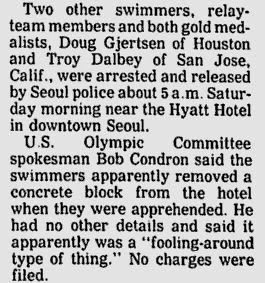
Early today, it was announced that Dalbey and Doug Gjertsen of Atlanta were taken into police custody for allegedly removing a concrete block from a downtown hotel.

No charges were filed and U.S. Olympic Committee attorney Ron Rowan said Gjertsen and Dalbey were released. USOC spokesman Bob Condron said he had few details of the incident, which he described as ''a fooling-around type of thing.''

Condron said the incident took place at the Hyatt Hotel, the USOC headquarters during the Games and just on the outskirts of Itaewon, the neon- lit strip of tourist shops and bars that has become a magnet for foreign visitors to Seoul.

They allegedly removed a concrete block from the hotel, and later returned to the village about 10 miles away, Condron said.
* The article above makes clear Biondi swam the relay race with Dalbey that day, so he likely came to see the mask to see what his teammate had been up to first hand.
** "민족적인 모멸감을 느끼게 했다." [I first wrote 'ethnically humiliated,' but 'humiliated as a Korean' I thought works better. Any other suggestions?]

A note on the testimony of Mr. Gu. He describes that swimmers as being unruly and swearing; while Gjertsen did not describe this, he only really described his own actions after they were caught; he didn't really discuss the others, and as this quote notes,
Gjertsen said a USOC lawyer asked him to apologize in public and he agreed because "Troy would have lost his temper."
As well, Mr. Gu also states that, "we dragged them down as they were getting into a taxi," and that "as [the MPs] tried to take [the swimmers] away a scuffle started for a moment." While how the scuffle played out is described rather differently by Gjertsen, the two accounts do agree on a scuffle happening involving the MPs and on the fact that the swimmers were dragged down by at least two Koreans.

As for the AP report mentioning the 'concrete block,' it's interesting that its not in their archives, since it was the focus (as we see above) of a great deal of criticism by the Korean media. Below is another AP article from September 24 with more information but still a lot of confusion as to what exactly had happened. I've  included links to all seven AP articles in their archives on the incident (and again, I wish I had found these a few days ago!).

U.S. Olympic Swimmers Detained By Police In Theft Case


Angry Koreans Demand U.S. Swimmers Be Jailed

Angry Koreans Demand Prison Terms For Two U.S. Swimmers

U.S. Swimmers Questioned By Police Over Theft Accusation

Prosecutor Will Not File Charges Against U.S. Swimmers For Prank

U.S. Olympic Swimmers To Be Allowed To Go Home

U.S. Swimmers Leave Seoul After Theft Case Cleared

The deluge of anti-American articles which followed this incident will be the topic of an upcoming post. Next however, will be the story of some other Americans caught by police in Itaewon just over 12 hours after the swimmers were caught. When it rained, it poured.