Showing posts with label Joseon Era. Show all posts

Monday, September 12, 2016

A country where foreign English instructors play

The 2005 English Spectrum Incident

Part 1: English Spectrum and 'Ask The Playboy'
Part 2: The Kimchiland where it’s easy to sleep with women and make money
Part 3: English Spectrum shuts down as Anti-English Spectrum is created
Part 4: How to hunt foreign women
Part 5: Did the foreigners who denigrated Korean women throw a secret party?
Part 6: The 'Ask The Playboy' sexy costume party
Part 7: Stir over ‘lewd party’ involving foreigners and Korean women
Part 8: The 2003 post that tarred foreign English teachers as child molesters
Part 9: Netizens shocked by foreign instructor site introducing how to harass Korean children
Part 10: 'Recruit a Yankee strike force!'
Part 11: The Daum signature campaign: 'Let's kick out low quality foreign instructors!' 
Part 12: Movement to expel foreign teachers who denigrated Korean women
Part 13: "Middle school girls will do anything"
Part 14: Netizens propose 'Yankee counter strike force'
Part 15: Segye Ilbo interview with the women from the party, part 1
Part 16: Segye Ilbo interview with the women from the party, part 2
Part 17: Web messages draw Koreans’ wrath
Part 18: Thai female laborers and white English instructors
Part 19: KBS Morning Newstime: 'I can also suffer from the two faces of the internet'
Part 20: AES: Grandfather Dangun is wailing in his grave!
Part 21: 'Regret' over the scandal caused by confessions of foreign instructors
Part 22: "Korean men have no excuse"
Part 23: "Unfit foreign instructors should be a 'social issue'"
Part 24: Growing dispute over foreign English instructor qualifications
Part 25: 'Clamor' at foreigner English education site
Part 26: Foreign instructor: "I want to apologize"
Part 27: No putting brakes on 'Internet human rights violations'
Part 28: "They branded us as whores, yanggongju and pimps," part 1
Part 29: "They branded us as whores, yanggongju and pimps," part 2
Part 30: Don't Imagine
Part 31: Anti-English Spectrum founder's statement
Part 32: 'Foreign instructor' takes third place
Part 33: Art From Outsider's Point of View
Part 34: U.S. Embassy warns Americans of threats near colleges
Part 35: Internet real name system debated
Part 36: Dirty Korean women who have brought shame to the country?
Part 37: Invasion of Privacy Degrades Korean Women Twice Over
Part 38: 60 unqualified native speaking instructors hired for English instruction
Part 39: The rising tide of unqualified foreign instructors
Part 40: Warrant for Canadian English instructor who molested hagwon owner
Part 41: MBC Sisa Magazine 2580: "Korea is a paradise"
Part 42: Foreign instructor: "In two years I slept with 20 Korean women."
Part 43: Viewers shocked by shameless acts of unqualified foreign instructors.
Part 44: Warrant for the arrest of a man in his 30s for breaking into home of foreign instructors
Part 45: [Cultural criticism] Hongdae club day lewd party incident 
Part 46: Unqualified English instructors seen as major problem here
Part 47: Investigation of the realities of 'foreign instructors' methods for luring Korean women'
Part 48: Broadcast announcement: 'For foreign instructors, is Korea a paradise for women?'
Part 49: To white English instructors, the Republic of Korea is a paradise
Part 50: "If they're white, it's okay?" Lots of English instructor frauds... 
 
Part 51: A new message from Anti English Spectrum
Part 52: 
SBS, 'Is Korea their paradise? Blond hair blue eyes' part 1
Part 53: SBS, 'Is Korea their paradise? Blond hair blue eyes' part 2 
Part 54: SBS, 'Is Korea their paradise? Blond hair blue eyes' part 3
Part 55: Viewers of 'Realities of unfit foreign instructors' outraged
Part 56: Foreign instructor: "Korea is a cash and women dispenser."
Part 57: Frustration with low-standard foreign instructors: "Korea's pride damaged"
Part 58: Netizen anger over 'foreign instructor' broadcast
Part 61: A country where foreign English instructors play

On February 21 a column appeared in the Hanguk Ilbo about the SBS broadcast:
[Window] A country where foreign English instructors play

After a television broadcaster showed frank images of foreign English instructors fooling around with Korean women, the internet was teeming with the anger of netizens. What's worse, this went as far as calling for attacks on foreigners. In the worst cases a combination of excessive sadaejuui and it's exact opposite, xenophobia, had arrived. In the (neo) Nazi's xenophobia there is no sadaejuui. In Korea, xenophobia and sadaejuui are two sides of the same coin. From this point of view, at the very least it is worse psychologically.

The actions of the foreign instructors and Korean women are abhorrent but are we indeed to rebuke them alone? Korean women who give their bodies to Western men who suddenly appear before them only [presents us with] a self-portrait generated by our society. This is because the responsible authorities don't even think of cracking down on unqualified foreign instructors who sleep with 50 women in one year while making money illegally.

These social conditions are the inevitable result of a government and ruling class with deep-rooted sadaejuui imposing English upon all citizens. The mindsets of women who admire Western men and offer their bodies to them and government officials who kill indigenous culture because they admire Western culture are fundamentally the same. Young women who are avid to seduce Western men in nightclubs and old officials who try to win favor with and kowtow to Western businessmen are no different.

When, all over the country, the entire minjok [race/nation] is selling out as if devoted to a religion and, without confidence or pride, throwing away what we have and adopting other's things, who indeed can throw a stone at the foreign instructor who does his best to earn and enjoy money and the Korean women drunk on the sweetness of blonde hair? Indeed, if the ruling class had resisted together, could Japan have taken over Joseon? Even if they did take over [after resisting], they couldn't have treated us with such contempt.

When the pro-Japanese gave away our country they said it was, after all, the way of the world and that this was the only path we could take to live. Now it's the age of globalization and it's said the only way to live is to go along with this, so how is the logic of businessmen, management and intellectuals, who now make English scores the standard for everything, any different? Now, rather than say convicting pro-Japanese of crimes was a mistake, or that Japanese imperialism modernized [Korea], this logic and the logic that Globalization can bring us strength are not unconnected.

Let's come to our senses. If we look down on ourselves others will look down on us too. If we intend not to attack foreigners, we must first gain pride ourselves. Only people who love themselves can be loved by others.

Hangeul Culture Alliance Representative Kim Yeong-myeong,
While the comparisons between the sadaejuui of the present - the Korean government and ruling class following American-led neoliberal globalization - and that of the past - when some Korean elites hitched their wagons to Japan's rising star - are likely meant to shock and anger, in considering Korea's position in the international system then and now, they are essentially correct. Kim argues against Korea selling out its identity in a globalizing world, which is fair enough. But that's not all he argues.

One eyebrow-raiser is his argument that because Korean xenophobia involves sadaejuui, or sucking up to great powers, it is, "at the very least," psychologically worse than Nazi xenophobia, which resulted merely in killing millions of people in industrialized death factories. But then attitudes in Korea towards the Nazis have, from time to time, betrayed a lack of concern for their atrocities (enough to open Hitler-themed bars, say, or to use Nazi imagery in TV commercials) or a willingness to play them down in favour of portraying Koreans as uniquely victimized by the Japanese.

As well, while he eventually seems to take the blame away from teachers and women themselves and blames the system they're a part of, he makes it clear he thinks that the "actions of the foreign instructors and Korean women are abhorrent" and refers repeatedly to "foreign English instructors fooling around with Korean women," "Korean women who give their bodies to Western men who suddenly appear before them," the "mindsets of women who admire Western men and offer their bodies to them," the "young women who are avid to seduce Western men in nightclubs," and - my favourite - "Korean women drunk on the sweetness of blonde hair," suggesting a certain preoccupation on the writer's part. Reading Vincent Brandt's A Korean Village Between Farm and Sea, his 1971 book based on his anthropological fieldwork in a Korean seaside village in Chungcheongnam-do in 1966, gives some insight into this preoccupation:
"It seemed to me that in addition to the matter of etiquette and reputation there was an element of distrust involved, fear that a girl or woman's natural lust might get out of hand. Whenever I encountered a woman alone and stopped to talk - on a path, when visiting a house, or if she was working in the fields - a man would join us, sometimes a little breathless from running down the beach or across the paddy field dikes. He would usually proceed diplomatically to disengage me from the conversation, and the woman would leave." [Page 134]
One could say that columns like the one above (or the entire English Spectrum incident) were part of an media-led attempt to "disengage" foreign teachers from their conversations with Korean women by shaming the women, and reminds me of Scott Burgeson's comment that the eventual drug and HIV tests for foreign teachers were "institutionalized cock-blocking."

While it might seem admirable, despite mentions of Korean women "giving" or "offering their bodies" to Western men, that Kim gives Korean women some agency (the "young women who are avid to seduce Western men in nightclubs" seem to be doing the seducing), this is likely written so as to make them even more culpable for their "abhorrent" actions and thus worthy of punishment. Thus, when he writes that "The mindsets of women who admire Western men and offer their bodies to them and government officials who kill indigenous culture because they admire Western culture are fundamentally the same," this is likely meant more as an insult to the government officials.

What I found interesting is how much this all reminds me of the discourse surrounding the study of English and foreign English teachers during the French foreign language teacher scandal of 1984. As an August 25, 1984 Kyunghyang Shinmun article (from a column titled 'Our Language') titled "Sickening Face" described it,
A Parisian dishwasher living in Lyon ended up flying to Korea. Because he was a French person who spoke French well, he was invited to work as a hagwon instructor.

A maiden from a distinguished rich family enamored with the foreigner’s exotic outward charm married the Parisian dishwasher, and this made him a rich man overnight.

Indeed such a thing was reported in a Le Monde article a few days ago. Other Parisian dishwashers, shoe shiners, and car washers are calling en masse the Korean embassy in France. In the end, Parisians are flocking like a cloud [to Korea].
On August 24, 1984, after first bringing the scandal of French foreign teachers living the easy life as language teachers in Korea, as reported by Le Monde, to the public's attention, expanding it into a look at 'fraud' teachers, and painting a picture of a Korea about to be deluged by unqualified young French men, the Joongang Ilbo offered an editorial titled "Foreigners and Foreign Languages," which worried about the effect of these foreigners on Korea:
Ultimately there’s a worry that when learning conversation students will imitate that country’s vulgar culture, vulgar living language, and vulgar values.[...] Also, for this reason it could come to pass that our citizens' image of their level of culture will fall and will offset the effectiveness of gaining foreign language learning.
On August 21, 1984, a column in the Donga Ilbo titled "Jibberish," provided its own commentary on the subject of unqualified foreign language teachers and how well white people were treated in Korea, returning to the story they had reported two months earlier (titled "Koreans have a weakness for Foreigners") of an American who lived for free in Korea for over a year, partly due to misuse of lost credit cards, and partly due to the generosity of Korean women:
At the end of his confession, he said “There are hundreds of foreigners like me, and Koreans are exceptionally friendly to foreigners, especially white ones.” As a joke, he said, "If you go to the United States, even beggars speak English well,” but if the power of foreign language extends this far, it would be difficult to stop people from reflecting bitterly on this [worship of foreign languages] as a great sickness. It’s difficult to tell whether the foreign language boom is a bad thing in itself, or whether [the choice of] a marriage [partner], as a personal matter, can be judged as right or wrong, or whether being [overly] kind to foreigners is something to be criticized. Before any of this can be considered, however, one must stand up and have some self respect.
Or as Mr. Kim ended the column translated above,
Let's come to our senses. If we look down on ourselves others will look down on us too. If we intend not to attack foreigners, we must first gain pride ourselves. Only people who love themselves can be loved by others.
Considering Korea's history - involving colonization, division, and war - and its place in various regional and international systems over the past hundred (or thousand) years, attaining national pride is fraught with complications. Kim complains of "the logic of businessmen, management and intellectuals, who now make English scores the standard for everything," and while this is indeed a problem, it's also nothing new; during the Joseon dynasty the path to success was passing the civil service exam which required mastery of classical Chinese. But back then only a small minority of men had the opportunity to pursue such education; now a majority of the population is forced to study English at some point. Beyond the cocktail of xenophobia, negative nationalism, and misogyny I've highlighted throughout this series, the effect of making "English scores the standard for everything" upon Korean society, especially less than ten years after the "IMF" crisis, is important to remember when placing the English Spectrum incident in its social context.

Monday, March 14, 2016

Jack London's photos all online

Quite some time ago I posted about photos taken by Jack London of Korea in 1904 during his time covering the Russo-Japanese War, which were published in the book 'Jack London, Photographer' (that link also has links to my unfinished series about Jack London, Robert Dunn, and Frederick McKenzie's adventures while trying to cover the war as the only foreign correspondents who initially managed to slip past Japanese attempts to control information).

I was contacted last year by someone cataloging his photos at the Huntington Library, who mentioned that, in addition to his own photography, London had bought a large number of photos while in Korea, and that these would all be online by the end of the year. This only came to mind recently, and they can now be found here. It's easy enough to browse and download photos, but they're not as well organized as they could be. The photos are scans of photos pasted into photo albums, but the search I linked to lists hits for random photos, not entire photo albums. At any rate, they do have annotations making clear whether the photo was taken by London or purchased, unlike the photos listed at this Korean blog (at the bottom of each post are links to other parts in the 8-part blog series). It seems most of the photos there London purchased; at any rate, they are at least very easy to browse. Here are a few from the Huntington Library site:

London in what is incorrectly listed as Changgyeonggung Palace. This is actually Punggyeonggung (풍경궁), a new main palace Emperor Gojong was building as he turned Pyongyang into his 'western capital'; as it turns out, London's photos are the most detailed photos of this palace under construction.

Robert Dunn in the same location. 

I believe this was in Incheon. 

Women doing laundry outside city wall (the French legation is visible, top right). 

Namdaemun Market. 

Uiju. 

Apparently the last photo London took as he left Busan to return home.

There are lots of gems in the collection, so it's well worth checking out. (It also includes photos of the urban poor in London, the San Francisco earthquake, south Pacific islands, etc.)

Friday, February 19, 2016

Recovering a stone wall walkway around Deoksu Palace that never existed

A few weeks ago articles appeared in the Korea Times about a plan to "restore" a walkway around Deoksugung Palace (here and here):
A narrow walkway along Deoksu Palace in downtown Seoul will be restored 132 years after it was cut off by the construction of the British Embassy in Korea, a Seoul City Council member said Monday.

The council member said the Seoul Metropolitan Government will restore the 170-meter-long sidewalk along the stonewall of the Joseon Dynasty (1392-1910) palace at the embassy compound at the expense of 2.8 billion won (US$2.34 million).

The capital city will finish the 3- to 6-meter-wide walkway, commonly called "doldam-gil" in Korean, by the end of the year after compensating the British Embassy, according to council member Choe Pan-sul.

In 1884, the British Embassy purchased the land site for the soon-to-be restored walkway, cutting it off from the present tree-lined sidewalks, famed for their seasonal beauty.

As if such "tree-lined sidewalks" even existed then! There's much more to say about this, but it has already been written by Jacco Zwetsloot in a letter to the editor published a few days ago, which can be found here. Actually, the letter that appears there was rather heavily edited and differs from the one Jacco sent to the Times, so I asked him for permission to reprint his entire letter, which he graciously granted.
Last Tuesday (26th January, 2016), the Korea Times carried a story titled “Seoul city to restore palace walkway.” It showed a map with a proposed 1.1-kilometer long walkway around Deoksu Palace, following the palace wall. It is apparently the plan of Seoul Metropolitan Government to gain access to a 170-meter-long section of wall that abuts the British Embassy. This would involve pedestrian access through embassy property. The article raised a number of interesting questions: about historical accuracy, “authenticity” of heritage, and journalistic practices.

The article states that the proposed walkway is “interrupted by the British Embassy […] and has been since 1884 when the mission purchased land near the palace.” This idea, and, by extension, that the British and U.S. embassies purchased land around the palace, thereby encroaching upon it, is one I have seen repeatedly over the years. However, it is misleading. Deoksu Palace was not a fully-fledged “beop-gung” (a palace where a monarch resides) before King Gojong issued orders from the Russian Legation in 1896 to construct his new palace.

Why did he choose this area? The answer lies in the history of Jeongdong neighborhood. It was once owned by the Joseon Dynasty’s ruling Yi family. Prince Wolsan (1454-1488), older brother of King Seongjong, 9th king of Joseon, once had his official residence there. Although called Deoksu Palace, it was humbler and smaller than a kingly residence, having no throne hall for instance. During the Imjin Wars (Hideyoshi Invasion) of the 1590s, after King Seonjo had fled to the far north and then returned to the capital, he lived temporarily at this old residence, becoming the first king to do so. This is because Gyeongbok and Changdeok Palaces had been destroyed or made unlivable by the population of Seoul, who were angry at his having deserted them.

Once Changdeok Palace was rebuilt in 1618, King Gwanghaegun moved there, Deoksu was renamed Gyeongun, though it was also known as the “Western Palace”; it served as a lesser auxiliary palace until King Gojong’s time. During the intervening centuries, parts of the land around this residence were sold or given to the powerful Min family, and they sold parcels of it to the first Western legations, whose arrival, beginning with the Americans in 1883, marked the opening of Korea to the non-Chinese world.

In 1894-5, the waxing Japanese and waning Chinese empires fought a war in, and for control of, the Korean peninsula; Japan won. Barely 6 months later, Japanese agents and their Korean henchmen infiltrated Gyeongbok Palace to assassinate Queen Min (later given the posthumous title Empress Myeongseong). This caused King Gojong to flee with Crown Prince Sunjong, never to return again.

By 1896, the year that King Gojong spent boarding with the Russians atop Jeongdong’s highest hill, there were also British, American, French, Austro-Hungarian and German legations nearby. A permanent “safe haven” from both Japanese and Chinese influence would have been attractive, and having a palace in Jeongdong was a very visible way to moved Joseon closer to Western powers. It was at this time that Gojong ordered Deoksu Palace to be expanded, rebuilt, and upgraded. Except for Jeukjo-dang and Seogeo-dang, which had long stood there, all buildings and structures date from that feverish period of construction. Upon King Gojong’s move here in early 1897, he proclaimed the Great Han Empire, had himself crowned Emperor, and Deoksu Palace became Gyeongun again -- now as the first imperial palace in Korean history.

It should be clear, then, that the legations in Jeongdong predate the existence of Deoksu Palace as a fully-fledged royal palace. There can be no sense in which the palace was spoiled by the arrival of Western powers in the late Joseon Dynasty. Indeed, the palace became what it did because of the presence of the legations.

Moving on to look at the question of authenticity of heritage, I note also that last Tuesday’s article used the words “restoration” and “recovery” to talk about the proposed new walkway. It is a common theme of historical sites around the world to claim authenticity and genuineness as virtues, but this is often a fraught and deeply contested idea.

A quick look at the signboard map beside the Deoksu Palace ticket window shows that the original palace perimeter looked very different than it does today. In fact, the complex is today about one third its size in 1897, and most people will be surprised to learn that much of the present wall was built no earlier than the late 1960s.

Construction of the original wall was still ongoing when Gojong moved to the palace, and was not completed until 1900, his fourth year as emperor. During his reign, the palace wall had gates to the British, American and Russian legations, perhaps in case the king needed to flee again. After his abdication in 1907, forced by the Japanese unhappy with his attempts to have Joseon represented at The Hague Peace Conference, Gojong remained in Gyeongun Palace, and the name reverted to Deoksu Palace for the last time. Seonwonjeon, a network of buildings where the sacred portraits of past kings were stored in the northern part of the palace, was dismantled and removed to Changdeok Palace; the site was sold. In 1915, Jungmyeongjeon, once the imperial library and Gojong’s temporary residence after a massive fire in 1904, became the headquarters of the Seoul Club.

Gojong’s death in 1919 led to the March 1st Independence Movement, but also provided the opportunity for the Japanese colonial government to tear down even more palace buildings and sections of wall. Dondeokjeon, a western-style building, was torn down, and the western wall of the palace was moved inwards, in order to build a two-lane road between the palace and the US legation. The eastern palace wall was later also moved inwards for the widening of Taepyeong-ro.

Sadly, destruction did not end with Korea’s Liberation. In the 1960s, the entire eastern wall facing City Hall was demolished and replaced with an iron fence. Taepyeong-ro was widened once more, leaving the Daehan Gate of the palace orphaned in the middle of a busy road, until its removal to its present location in 1970. The iron fence was once more replaced with a stone wall in 1968, except for the north east corner, where a police sub-station was built that stood until 1994. A diplomat formerly stationed in Seoul remembers that the gate between the British Embassy and the palace still stood there in the 1980s, but it was removed sometime later by either Seoul Metropolitan or the Korean Government. Perhaps the only section of wall that is in its original location and (more or less) original condition is the western end of the south wall, where the abutments of a pedestrian bridge that once connected the palace to the Uijeongbu (or State Council of Joseon).

Therefore, the idea of “restoring” the palace wall to its former glory and then putting a walkway all the way around it is a very difficult one, since so much of former palace land is now something else, and most of the wall was built in its current location and form after King Gojong’s death. The erstwhile existence of gates connecting the palace to at least three foreign legations shows further that there never was a pathway for ordinary citizens to walk around the entire palace wall. The authentic historic experience that the city wants to re-create through the construction of the circumferential walkway is in fact a new creation, and a very modern invention, connected to ideas of heritage tourism and universal ownership of national history. Nevertheless, the idea is an appealing one that, if it succeeds, would doubtless attract many visitors to the area and grow the interest in Korea’s early modern history.

The final point I would like to raise is a brief but important one. It was surprising that last Tuesday’s article contained quotations from both Seoul Metropolitan Government’s plan and a current City Council member, but no word from the British Embassy. Most embassies have staff that handle public affairs and media relations, and given that the proposed walkway would enter and exit embassy gates and traverse embassy property, one would imagine that the British government would be keen to have a voice in discussing any such plan, especially given modern-day concerns about diplomatic security, personal safety and privacy, but there was no mention of it in the article. Normally in such circumstances, one would at least expect to see a sentence like, "The embassy was not available for comment," or, "We reached out to the embassy, but did not receive a response by time of press," or even, "The embassy declined to comment for this story." The absence of any such statement could leave a newspaper open to the criticism that not enough had been done to get all sides of the story. I think this is a regrettable editorial decision from your otherwise fine newspaper, to which I have subscribed for over 10 years.
Jacco Zwetsloot
Many thanks to Jacco for permitting me to reprint the full letter. He covers a great deal of history there, and I thought I'd add a few photos to illustrate some of what he wrote about.

Here is a photo of Deoksugung Palace in 1961 after the wall had been torn down and replaced with a fence (also seen in the last photo here), with a gate standing in the northeast corner; this was before Taepyeongno was widened.

(From here.)

Here is a photo of Daehanmun orphaned in the middle of the road after the wall was rebuilt in 1968 but before it was moved westward to its current location in 1970:

From here (where lots of photos can be seen).

Here is Dondeokjeon, which was built in 1901 and destroyed around 1926 to allow the Japanese to punch a road through between the U.S. consulate and Deoksu Palace:

(From here.)

Here it is in relation to Seokjojeon, which still stands today; it likely wasn't necessary to tear it down, but the fact that Sunjeong, the last Korean monarch, was crowned there may have have made its demolition more tempting.

(From here.)

It can also be seen in the background of this photo of Samil protesters in 1919 walking around Deoksu palace (most likely to the US Consulate), which should make clear that one could not walk around the palace back then. (Originally from this post.)


Jacco managed to find a column by Nam Jeong-ho in the Joongang Ilbo which dealt with this issue and in which the UK Embassy was actually contacted, and the Embassy said that due to a number of issues the cost quoted by the city (2.8 billion won) is likely far too low, and it may be closer to 10 billion won. Nam suggests that a way around this would be simply to allow people to walk through the back gate (Podeokmun) of the palace and open the north gate near the British Embassy entrance to allow people to walk "around" the palace. Needless to say, it would certainly be a lot cheaper.

Wednesday, February 17, 2016

From an elementary school in Daehangno to a temple bell in Deoksu Palace via Tapgol Park and 560 years of history

If you walk along Daehangno about halfway between Jongno 5-ga Station and Hyehwa Station you'll come upon the gates to Seoul Sadae Buseol Elementary and Girls Middle School.


These gate pillars originally stood at the entrance to Pagoda (now Tapgol) Park, Seoul's first modern park, built under the direction of John McLeavy Brown in 1897. [Hat tip to JiHoon for showing this to me.] About the only photo of the gates I've ever seen is this one from the time of the Samil Uprising in 1919:


I originally posted that photo in this post, which includes photos taken from this page, which has scans of a 1919 Korean Red Cross pamphlet about the suppression of the Samil independence movement. It includes the declaration of Korean independence, 34 photos (taken by Francis Schofield), and a statement from the Korean Red Cross. It was in this park, of course, that the declaration of independence was read on March 1, 1919.

Before the park was built, the ten-story pagoda it is named after stood surrounded by houses, as captured by Percival Lowell in 1884:


Many more photos of the pagoda from both before and after the area became a park can be found here, while Brother Anthony has posted a detailed history of the pagoda (and another that it was modeled after) here

I hadn't realized the fate of Wongaksa, the temple it was built to be a part of. As Wikipedia reveals, King Sejo had Wongak-sa temple built in 1465, followed by the pagoda 2 years later. on the site of an older Goryeo-period temple, Heungbok-sa. The temple was closed and turned into a kisaeng house by Joseon's most notorious king, Yeonsan-gun (who ruled from 1494 to 1506), and his successor, King Jungjong (ruled 1506–1544) turned the site into government offices.

This was actually part of a spate of temple building / improvements by King Sejo, as Gregory Henderson explained in his 1959 article for Transactions of the Royal Asiatic Society, "A History of the Chŏng Dong Area and the American Embassy Residence" (available as a .docx file here - more Transactions articles can be found here). He made a specific addition to Hŭngchŏn-sa, a temple which stood near present day Deoksu Palace:
In 1462, King Sejo, a devout Buddhist, deeply conscience-stricken over his murder of his own nephew Tanjong to attain the throne, repaired and built many temples, notably Wŏngak-sa in Pagoda Park with its pagoda; with these repairs he had a great new bell made for Hŭngch’ŏn-sa in the seventh year of his reign. For more than thirty years the temple continued with this embellishment and with its high tower. In 1495, however, there came to the Korean throne one of the most notorious tyrants of Korean history, Yŏnsan-gun, a man dedicated to sybaritic personal habits, malice and impetuousness. In July, 1504, he ordered the temple razed and built in its place an extra office for the care of his royal horses and their accoutrements. The next monarch, Chung-jong, after overthrowing Yŏnsan-gun, abolished this extravagance and built a public office here. Of the temple, only the five-story shari hall remained. 
Of that five-story hall, Henderson tells us that on
the night of March 28, 1510, the students of th[e] central Confucian college, firmly convinced by their instructors that Buddhism was heresy, marched on the shari hall and enthusiastically set fire to it. [...] The bell now alone remained and this, after many perigrinations through Seoul’s palaces, finally came to the grounds of the Tŏksu (Duksoo) Palace where it hangs today, the only remaining reminder of this temple’s colorful history.
And that's the history of the bell (this one, from this page) that you can see in Deoksugung Palace today, which was cast around the same time as the Wongagksa Pagoda in Tapgol Park was built, the park which saw its original gate pillars moved to an elementary school on Daehangno. A bit of a detour, but hopefully the ride was worth it.

I'll save the story of one of the architects of Yeonsan-gun's overthrow, and his tomb behind where I used to live in Banghwa-dong, for another day.

Monday, June 15, 2015

Protests against the Queer Culture Festival by the Countermeasure Committee for Homosexuality Problem

Christian protesters of the Korean Queer Cultural Festival have been getting quite a bit of attention online. As Korea Observer reported, the Christian protesters first managed to submit rally declarations forms for all available spaces in Daehangno, blocking the Korea Queer Culture Festival from being held there; then when they competed with Festival organizers to submit petitions to Namdaemun Police Station, neither was allowed to hold festivals - a victory for the Christian groups. When part of Seoul Plaza was secured for the on June 9, the Christian groups then set out to hold a counter protest, which is the one which has gotten attention online, mostly at this Korea Observer report (do watch the video); many more videos can be seen at Daehanmindecline.

One note I have to make is that there really isn't any justification to be translating '동성애' - 'homosexuality,' or in the context of many of the posters, 'homosexuals' - as 'fags.' Using that word suggests the protesters were using some specific anti-gay slur in Korean when they weren't. In fact, one sign has "queers" written in English, while one handout referred to the "homosexual party" and another directly translates "동성애 문제 대책 위원회" as "Countermeasure Committee for Homosexuality Problem," so I don't see the need to use such an inflammatory word when the messages on the signs are bad enough already.

There were several equating homosexuality and AIDS:

(From the video here.)
Wrong administration causes our children to die of AIDS (above)
Oppose homosexuals!! What is the reason for the increase in teen AIDS patients?
Abolish the student rights ordinance promoted by homosexuals which spreads AIDS
MERS-AIDS fatal virus - desperately oppose the homosexual festival - the increase in AIDS via Homosexuals
There seemed to be several signs ridiculously tying MERS and AIDS together. A number predict the doom of the Korea or use the language of human rights, even addressing UN Secretary General Ban Ki-moon:
Homosexuals will disease Korea’s future.
Is anal sex also a human right?
UN Secretary General Ban Ki-moon - Is homosexuality a human right? (in English)
UN Secretary General Ban Ki-moon! Homosexuals collapse a country built with blood and sweat.
UN Secretary General Ban Ki-moon! Do you really want a homosexual man as a daughter in law or a woman as a son in law?
A number also address Park Won-soon and call for his ouster:
MERS+AIDS fatal virus - Homosexuals collapse a country built with blood and sweat. Homosexual-friendly Mayor Park Won-soon OUT
Homosexuality - Park Won-soon OUT
Park Won-soon, who allowed Homosexuality rally packaged as culture OUT
I can't help but see the 'Out' posters like this one and think of the earliest examples of signs using the English word 'Out' on them - during the mad cow protests against evangelical Christian President Lee Myung-bak:

(Taken on bike path heading up to Haengju Bridge, 2008.)

One of the more jaw-dropping pieces of literature was not the signs the protesters were carrying, but a handout in English addressed to foreign ambassadors being distributed outside of city hall. (First seen here.)


A few notes on this collection of rants that comes rather close to self parody:
That's one of the few times in Korea you'll see Uganda getting praised. Or not being called 'Africa.' As well, we finally find out who the real victims are - those anti-homosexuals who keep being called mean words like 'homophobic.' (Hat tip to Taeyang.)
As well, the last time I checked homosexuality wasn't illegal in Korea. And as for countries with same-sex marriage permitting beastiality and incest, that doesn't seem like the Canada I remember. Which I should be heading to ASAP considering the ending "we want you to leave Korea right now!" Lots of love there. (For comparison, here are some pamphlets handed out by Christians during the 1988 Olympics.)

It's hard to know about the entirety of 5000 years of Korea's "great moral virtue," but according to Richard Rutt and others (as I noted here) homosexuality was practiced and even tolerated in some cases up until at least the Colonial Era; Robert Neff has also uncovered evidence in the writings of early missionaries at the end of the Joseon Dynasty.

I was sent this handout, which names its distributor as the 동성애 문제 대책 위원회" or "Countermeasure Committee for Homosexuality Problem," which they say "consists of 35 major civil groups fighting for our national security, sound religion's [sic] identity, morality and the human rights of North Koreans suffering from dictatorship." It also names 13 embassies (USA, UK, Germany, France, Canada, Spain, Belgium, Slovenia, Denmark, Finland, Norway, Sweden, EU) and states its purpose is "To request ceasing the embassy participation in the 16th queer culture festival in Seoul".


Once again, there is an astonishing amount of linking AIDS to homosexuality: "We are sure the Europe court's __ decision will prevent gay marriage from expanding AIDs [sic] disease everywhere in the [world] threatening the health of mankind. The Europe highest human rights court's decision ___ high level of sound sex moral to save mankind suffering from AIDs [sic]."

And one can’t help but note this: "Koreans have not intervened in other nation and other country their ethics and [culture.] Koreans historically respect other countries." This is a bit on the hilarious side, considering Korean Christian missionaries are all over the world "intervening" in the cultures of those countries by trying to convert non-Christians, with one memorable instance being when a number of missionaries were captured by the Taliban in 2007, with two being killed before they were ransomed, with the Korean government paying an unspecified amount (usually thought to be 20 million dollars). As a result, the Korean government banned Koreans from travelling to a number of countries, mostly to keep missionaries out. As this Korea Herald article points out,
Korea Crisis Management Service, a nonprofit launched in the wake of the kidnapping of 23 Korean Christians doing missionary work in war-torn Afghanistan in July 2007 [...] was founded in part at the government’s request. The nonprofit body trains missionaries working in countries with extreme crime or civil unrest to avoid dangerous situations and, if confronted with trouble, how to get out of it.
The article also points out the desire to 'intervene' in the 'ethics and culture' of other countries:
"Many missionaries want to go to these Muslim countries," Kim of KCMS said. "They have a love for Muslim people and a calling to preach the gospel."
Perhaps if these Christian groups could promise to respect other countries' cultures by keeping their missionaries at home they might not appear so hypocritical. Needless to say, these Christian groups' hateful and ignorant messages aren't going to get any serious attention by their intended recipients. Having groups known for trying to impose their religion on other cultures - a religion whose founder said "Thou shalt love thy neighbour as thyself" - call on foreign embassies to "leave Korea right now!" because they're interfering in Korea's ethics and culture would be funny if it weren't so sad.

Tuesday, May 05, 2015

RASKB Excursion to Yangcheon Hyanggyo and Gaehwasan next Sunday, May 10

Next Sunday, May 10, I'll be leading a walk around the area of Yangcheon Hyanggyo Station and Gaehwasan Station for the Royal Asiatic Society. The former location was the seat of Yangcheon Hyeon, or prefecture, during the Joseon period and still sports the only remaining Hyanggyo, or Confucian Shrine, in Seoul, as well as a number of other historic landmarks. We will also visit a museum to the innovative Joseon Era landscape painter Jeong Seon (1676–1759), and look at paintings of the area that he made in the mid-1700s. I've mentioned the area before (here and here), and this post at Seoul Suburban covers some of the spots we'll visit.


(Yangcheon District in the 1870s)

From there we will take the subway to Banghwa Station to explore Mt. Gaehwasan. After passing through a park with a number of 400-year-old zelkova and gingko trees, we'll head up the mountain to see the numerous tombs, many with beautifully carved tombstones and flanked by stone civic official statues, of the Pungsan Shim clan, who for several generations served the Joseon kings and were memorialized for their meritorious deeds – one of which was taking part in the overthrow of the notorious king, Yonsan-gun.


We will also go to Yaksasa Temple and see a statue of the Buddha and a three-story stone pagoda which date back to the Goryeo Era.


We'll see an even larger such statue dating from the early Joseon period outside Mitasa Temple, on the other side of the mountain. The statue was found buried in the 1930s, when the temple was rebuilt. Both temples were destroyed during the Korean War, but the pagoda and statues survived.


Next to Mitasa is the Memorial to the Loyal Dead, which was erected to remember the 1,100 soldiers of the Korean 1st Army Division who died defending Mt. Gaehwasan - which overlooks Gimpo Airport - during the opening of the Korean War, which will provide an opportunity to learn more about the fighting which took place on the mountain during the war, as well as its military importance in the present. I'll also touch on the importance of the area during the Imjin War.


Being a mountain, of course, there will be lots of opportunities to take in views of the Han River and surrounding area and enjoy what nature has to offer.


If you feel like joining us, please do! The cost of the tour is W20,000 for RAS members and W25,000 for non-members. The excursion will set off next Sunday, May 10, at 1:00 pm from exit 3 of Yangcheon Hyanggyo Station (양천향교) #906 (subway line number 9). For more information, see here.

Thursday, November 20, 2014

RAS walking tour of Jeong-dong this Sunday


This Sunday, November 23, I'll be leading a walking tour for the Royal Asiatic Society of Jeong-dong, which became the neighbourhood for Westerners after Korea opened to the west in the 1880s through to the end of the colonial period. I've written about the history of this area before (here and here), and will be looking at lots of turn of the century Western architecture and connecting these buildings to stories of Korea's modern history. From the RAS website:
On this excursion we will meet in front of Deoksugung Palace from where we will explore the Jeong-dong's rich early modern history. After a visit to the Anglican church we will take in a view of the neighbourhood from above before heading to the Seoul Museum of Art, which is housed in the colonial era-built former Korean Supreme Court building.To learn about the missionary influence upon the neighborhood, we will visit the Baejae Hakdang, a missionary-run boys' school which educated many of Korea's future elite, now restored as a museum; the Jeong-dong First Methodist Church; and Ewha Girl's High School, the first school for girls in Korea, and also the site of one of Korea's earliest foreign-run hotels, the Songtag Hotel. From there we will visit the restored Jungmyeongjeon Hall, which was built as a royal library but is best known for being the place where the Eulsa Treaty, which the Japanese used to deprive Korea of its diplomatic sovereignty, was signed in 1905. Other stops will include the remains of the former Russian Legation and the beautiful colonial home where independence activist Kim Ku was assassinated in 1949.

The cost of the tour is W20,000 for members and W25,000 for non-members. The excursion will set off from Daehanmun, the front gate of Deoksugung Palace, (subway line number 1, dark blue line, or 2, green line, City Hall Station #132, exit 2) at 1:00 pm.
Feel free to join us!

Tuesday, July 15, 2014

100 year-old drainage tunnels designated as cultural assets

As the Korea Times briefly reported the other day,
The Seoul Metropolitan Government designated two underground drainage
tunnels built in the early 20th century as its cultural assets, Sunday. Pictured is a tunnel beneath Namdaemun [sic], central Seoul, which was discovered in 2012. The other tunnel is under City Hall Plaza.
Here are photos of the 394 meter tunnel beneath Namdaemun-ro (as in the street) from the Donga Ilbo:


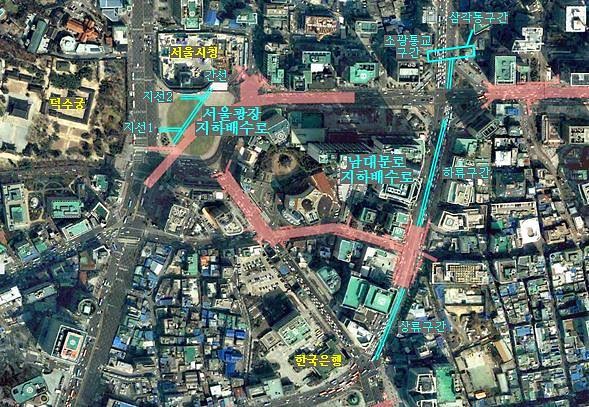
The location of the tunnels can be seen below (marked in blue) in a map published by Aju News:


The 191 meters of tunnel under Seoul Plaza, pictured below (from the Herald Gyeongje), feature two branches which head towards Deokgusgung Palace and a main tunnel which cuts diagonally under the plaza.


To get a better idea of what it looks like to wander in the tunnels, SBS has a report here.

The tunnels were first reported on last October, as this Yonhap article notes, when the city announced that it was considering designating the two tunnels, which had been discovered between December 2012 and May 2013, as cultural properties since they were symbols of modern urban development and civil engineering. Previously tunnels under Deoksugung had been considered cultural properties, but they were included as part of the palace, and this was to be the first time such tunnels would be considered separately as cultural properties. They are thought to have been built between 1907 and 1915; the tunnel under Seoul Plaza is made of brick, with the lower half sealed with plaster/mortar, while the tunnel under Namdaemun-ro has a top half made of brick and a lower half made of concrete, which was a new material at the time.

The SBS report also notes that the city plans for the drains that were designated as cultural properties to be open to the public for free tours from October. That sounds like it would be fun.

(Hat tip to Hamel and Ami.)

Friday, June 13, 2014

It always interesting when leftist radicals and rightist Christians agree on something

As I pointed out in detail in this post about Korean fears of AIDS prior to (and during) the 1988 Olympics, progressives in South Korea portrayed US soldiers, and Americans in general, as being spreaders of AIDS in Korea, with some radical students protesting in the streets with this message. Two days before the Olympics, the Korea Herald reported that
Police hauled away about 20 demonstrators, mostly young women, when they tried to hold a protest in front of the US army base here Thursday [September 15] alleging that American soldiers were responsible for the spread of AIDS in South Korea.
As AP reported in a September 17 article about the opening of the Olympics,
A small protest was held at Yonsei university with less than 100 students taking part. Students distributed leaflets claiming foreigners at the Olympics would spread acquired immune deficiency syndrome.

“Oppose Olympics which oppose Korean peoples’ health with AIDS,” the leaflets said.
The group asked, “The United States is causing many problems as it pursues pro-gay policies like the recent expansion of same-sex marriage legalization, but is it now trying to expand homosexuality in not just the United States, but Korea, too?” They said homosexuality was the main culprit in the occurrence of AIDS, and that homosexuals were at high risk of getting AIDS. They that the number of patients who contracted AIDS due to homosexual activity in Korea is rising like the United States, and asked if the United States was trying to export AIDS, too, to Korea through its gay diplomacy. - See more at: http://www.rjkoehler.com/#sthash.mrsHcNVI.dpuf
 Or, as I noted in this post, Hustler's 'Korean sex-scene guide,' published during the 1988 Olympics and discovered and translated by students, was
Just the ticket to incite an anti-American demonstration, which is what a young man with a microphone nearby is trying to do.

"You see? The Olympic Games are just an excuse for Americans to come to Korea and pollute our country with AIDS!" he shouts. "Yankees out of Korea!"

"Yankees out of Korea!" echoes the crowd of about 50 students. Across the front of the building are four huge posters proclaiming: "Yonsei University students curse American barbarism."
So it wasn't just soldiers, but foreigners (particularly Americans) who were planning to pollute Korea with AIDS as well.

 In mid-October 1988 the Donga Ilbo reported that
the head of the AIDS countermeasures joint committee Im Jong-cheol pointed out that “USFK is an AIDS powder magazine” and revealed that there was an urgent need for an amendment to the AIDS Prevention Law to implement such things as a regular AIDS checkup for USFK members.
By this point, in the wake of the Olympics, calls were being made to amend the SOFA agreement, in some cases to allow for HIV testing of US soldiers.

The fears stirred up by these leftist activists echoed contemporary North Korean propaganda which accused US soldiers as having infected 100,000 prostitutes in the south with AIDS.

In May 1989, AP described a protest against Yankee 'devils' in Daejeon which sounds similar to such propaganda:
''Let's inflict an irrevocable defeat on U.S. imperialism and advance the unification of our fatherland,'' said student leader Im Chong-suk.

Cheering students chanted, ''Punish Yankee imperialism'' and ''Yankees go home.''

Leaders denounced a proposal to relocate some U.S. military units from Seoul to Taejon. They charged American soldiers would spread AIDS among the local population.

Speakers ridiculed American soldiers as the ''AIDS legion.'' 
So it was not without a sense of irony that I read Robert's post at the Marmot's Hole about right-wing Christian activists protesting in front of the US embassy against alleged US embassy support for the Korean Queer Festival:
Korean Queer Festival
The group asked, “The United States is causing many problems as it pursues pro-gay policies like the recent expansion of same-sex marriage legalization, but is it now trying to expand homosexuality in not just the United States, but Korea, too?” They said homosexuality was the main culprit in the occurrence of AIDS, and that homosexuals were at high risk of getting AIDS. They that the number of patients who contracted AIDS due to homosexual activity in Korea is rising like the United States, and asked if the United States was trying to export AIDS, too, to Korea through its gay diplomacy.
I wonder how comfortable those right-wing Christians would be realizing their accusations mirror those made by left-wing radical students not so long ago. Perhaps their affinity for believing in Korean exceptionalism (especially in exceptional moral uprightness (compared to Americans) and exceptional victimization) which lies at the heart of many narratives of Korean nationalism might allow them to reach across the ideological divide and shake hands for a moment. Or not.

(They both might want to send their kids to this hagwon, at least.)

Oh, and it's not wise to blame the west for the expansion of homosexuality in Korea, considering that it appears to have been at the very least tolerated in Joseon-era rural society, as I noted here, and as Robert Neff discussed here. Richard Rutt also examined this topic in his article 'The Flower Boys of Silla (Hwarang)' published in the October 1961 issue of Transactions of the Royal Asiatic Society (which, along with other Transactions articles, can be downloaded here).

Wednesday, May 14, 2014

Walk around Yancheon Hyanggyo and Mt. Gaehwasan this Saturday

This Saturday I'll be leading a walk around the area of Yangcheon Hyanggyo Station and Gaehwasan Station for the Royal Asiatic Society. The former location was the seat of Yangcheon Hyeon, or district, during the Joseon period and still sports the only remaining Hyanggyo, or Confucian Shrine, in Seoul, as well as a number of other historic landmarks and a museum to the innovative Joseon Era landscape painter Jeong Seon (1676–1759). I've mentioned the area before (here and here), and this post at Seoul Suburban covers many of the spots we'll visit.


(Yangcheon District in the 1870s)

From there we will take the subway to Banghwa Station to explore Mt. Gaehwasan. After passing through a park with a number of 400-year-old zelkova and gingko trees, we'll head up the mountain to see the numerous tombs, flanked by stone statues, of the Pungsan Shim clan, who for several generations served the Joseon kings and were memorialized for their meritorious deeds. 


We will also go to Yaksasa Temple and see a statue of the Buddha and a three-story stone pagoda which date back to the Goryeo Era.


We'll see an even larger such statue dating from the early Joseon period outside Mitasa Temple, on the other side of the mountain. The statue was found buried in the 1930s, when the temple was rebuilt. Both temples were destroyed during the war, but the pagoda and statues survived.


Next to Mitasa is the Memorial to the Loyal Dead, which was erected to remember the 1,100 soldiers of the Korean 1st Army Division who died defending Mt. Gaehwasan - which overlooks Gimpo Airport - during the opening of the Korean War, which will provide an opportunity to learn more about the fighting which took place on the mountain during the war, as well as its military importance in the present.


Being a mountain, of course, there will be lots of opportunities to take in views of the Han River and surrounding area and enjoy what nature has to offer.


If you feel like joining us, please do! The cost of the tour is W20,000 for RAS members and W25,000 for non-members. The excursion will set off this Saturday, May 17 at 1:00 pm from exit 3 of Yangcheon Hyanggyo Station (양천향교) #906 (subway line number 9). For more information, see here.

Thursday, March 27, 2014

Putting the wrong people in charge

Well, this is certainly an interesting story about the head of the Korean Association of Hagwon (hat tip to Scott Burgeson - see his comment here):
Police are investigating allegations that Pagoda Education Group President Park Kyung-sil plotted to kill a relative of her estranged husband Go In-kyung.[...]

According to investigators, in August last year Park allegedly paid her driver to kill one of Go’s relatives who had frequently advised him on business matters.

However, the driver did not carry out the murder; and he has been questioned by police several times.[...]

Lee Jung-hwan, Park’s lawyer, denied the allegations, claiming that his client gave the driver the money to find and hire a new legal representative for business matters.

“We explained to the police that she would not be immediately available because of the upcoming election for the Korea Association of Hagwon (KAH),” Lee said.

“It also overlaps with the schedule for another legal case.”

In this case, police are investigating claims that last year Park gave 1 billion won ($926,354) to a middleman identified as Seo to allegedly bribe officers investigating her for embezzlement and breach of duty.

However, on Jan. 6 she was found guilty of the charges by Seoul Central District Court and sentenced to 18 months in prison suspended for two years.[...]

Park has led the Korea Association of Hagwon (private learning institutes), which has more than 50,000 private institutions under its wing, since 2011.
Sounds like the kind of person you want as the national figurehead of owners of businesses that care for children (but hey, hagwon owners have to evade taxes too, right?).

Speaking of putting the wrong person in charge, the Joongang Ilbo reports on the fustercluck that the Namdaemun restoration has turned out to be.
Authorities investigating the faulty restoration of Sungnyemun, or Namdaemun Gate, said yesterday that they will further investigate Sin Eung-soo, the chief carpenter for the restoration process, over allegations he spirited away lumber donated by the public for the reconstruction of the country’s No. 1 national treasure.

Authorities estimated that the value of the stolen lumber was approximately 42 million won ($39,020).

The police raided Sin’s lumber mill in January on suspicions he supplied substandard wood for the restoration. The gate reopened last May after a five-year restoration, but some of the work was found to be rushed and substandard.

The police also suspect the 71-year-old carpenter purloined four Geumgang pine trees that were provided in 2008 by the Cultural Heritage Administration (CHA) for the reconstruction of Gwanghwamun, the main gate of the Gyeongbok Palace, under Sin’s supervision. Geumgang pine trees are praised for their resilience, straightness and density. The estimated value of the four pine trees is about 60 million won.
Both of these stories are surprising, and yet not really that surprising, at the same time.