Showing posts with label Canada. Show all posts

Thursday, August 28, 2014

Skies and water

Apologies to my readers for the utter lack of posts the last month. I spent much of the month in Canada, and a good portion of that time was spent away from the internet. The weather wasn't always great, but I can't help but take a certain amount of pleasure from sleeping with layers of covers on in August, considering the impossibility of that in Seoul these days. Lots of photos of skies, water, and nature follow:


A couple days after the super moon (thanks to Ami for the settings).


A particularly hazy day driving (excruciatingly slowly on the Gardener Expressway) into Toronto.

Spooked geese make for more interesting subjects than calm ones.

Swallowtail butterfly.

Pure luck involved in this shot - the hummingbird was flitting about here and there and I zoomed in and just happened to shoot at the right moment.


More regular posting will begin from here on out.

Wednesday, March 12, 2014

Canada - Korea FTA concluded

Well, that took awhile:
Negotiations with Canada were the longest ever for an FTA by Korea. Initial talks began in July 2005, followed by 13 rounds through March 2008. Negotiations were halted in April 2009 after Canada challenged Korea’s ban on imports of Canadian beef six years earlier at the World Trade Organization. Korea instituted the ban in 2003 after an outbreak of bovine spongiform encephalopathy, commonly called mad cow disease.
Korea resumed Canadian beef imports in January 2012, and the trade talks resumed last November. Korea was the last major Asian market to lift its ban. Under the accord reached yesterday, Korea will reduce tariffs on Canadian beef over 15 years.

Canada will eliminate a 6.1 percent tariff on Korean automobiles within two years of the deal being ratified, compared to the five years in Korea’s FTA with the United States, which went into effect in 2012.

Korean automakers had a combined 12 percent share of the Canadian automobile market last year versus 34 percent for Japanese and 45 percent for Americans, and automobiles accounted for 42.8 percent of Korea’s exports to Canada in the same year.

Tariffs on textile machinery, a large export item from Korea, will be removed over five years. Within two years Canada will also remove most of its tariffs on clothing and textile products, which now stand at 18 percent at the maximum.[...]

Bilateral trade volume tallied $9.9 billion last year, and Canada was Korea’s 23rd largest export partner.
According to the Canadian government,
the Canada-Korea Free Trade Agreement is projected to create thousands of jobs for hardworking Canadians by boosting Canada’s economy by $1.7 billion and increase Canadian exports to South Korea by 32 percent.
I love the addition of 'hardworking' above. An article announcing Harper's visit gave this information:
Diplomatic ties between South Korea and Canada were established in 1963. Approximately 230,000 South Korean nationals reside in Canada. 
That's more than ten times the number of Canadians who live here (half of whom are Korean Canadian).

I could only think when I heard about the Prime Minister's visit that the embassy staff here must have been pretty damned busy preparing for it...

Thursday, July 11, 2013

Sad news

Via commenter Brent (and Kushibo) comes that sad news that Hannah Warren, the 2-year-old girl born without a windpipe who had a new one grown from her own stem cells, has died:
A 2-year-old girl who was implanted with a windpipe grown from her own stem cells has died, three months after she became the youngest person to receive the experimental treatment.
Hannah Warren died Saturday at Children's Hospital of Illinois in Peoria, hospital spokeswoman Shelli Dankoff said. The hospital said in a statement that Hannah couldn't "overcome additional health issues that were identified as her care progressed."
Her family asked for privacy, but expressed their sorrow in a fundraising blog updated Sunday: "She is a pioneer in stem-cell technology and her impact will reach all corners of our beautiful Earth. Her new trachea was performing well, but her lungs went from fairly good, to weak, to poor."
.......

Tuesday, May 14, 2013

Canadian - Korean child given a windpipe made from her own stem cells

[Update - Below, Kushibo links to a site for raising money for the girl's care.]

Here's a more upbeat story about a foreign English teacher than a lot of the stuff I've been posting recently:
A 2-year-old girl born without a windpipe now has a new one grown from her own stem cells, the youngest patient in the world to benefit from the experimental treatment.

Canadian-South Korean Hannah Warren has been unable to breathe, eat, drink or swallow on her own since she was born in South Korea in 2010. Until the operation at a central Illinois hospital, she had spent her entire life in a hospital in Seoul. Doctors there told her parents there was no hope and they expected her to die.

The stem cells came from Hannah’s bone marrow, extracted with a special needle inserted into her hip bone. They were seeded in a lab onto a plastic scaffold, where it took less than a week for them to multiply and create a new windpipe.

About the size of a 3-inch tube of penne pasta, it was implanted April 9 in a nine-hour procedure.[...]

Only about one in 50,000 children worldwide are born with the same defect. The stem-cell technique has been used to make other body parts besides windpipes and holds promise for treating other birth defects and childhood diseases, her doctors said.

The operation brought together an Italian surgeon based in Sweden who pioneered the technique, a pediatric surgeon at Children’s Hospital of Illinois in Peoria who met Hannah’s family while on a business trip to South Korea, and Hannah — born to a Newfoundland man and Korean woman who married after he moved to that country to teach English.

Hannah’s parents had read about Dr. Paolo Macchiarini’s success using stem-cell based tracheas but couldn’t afford to pay for the operation at his centre, the Karolinska Institute in Stockholm. So Dr. Mark Holterman helped the family arrange to have the procedure at his Peoria hospital, bringing in Macchiarini to lead the operation. Children’s Hospital waived the cost, likely hundreds of thousands of dollars, Holterman said.
There's more background on this story here. She seems like quite the little trouper in the photos in the articles (or these ones), and what science has been able to accomplish in this case is pretty amazing.

Sunday, February 03, 2013

The Imjin River hockey game recreation

[Update: The Joongang Daily also has a report on the game.]

As I mentioned the other day, today the Imjin River hockey games involving Canadian troops during the Korean War were recreated at City Hall. MBC did a report which has video footage of the game which I'd never seen before. Yonhap took some photos, including a few which compared today's scenes to those of the past:

(From here.)

 (From here.) 

(From here.)

I had a chance to see the photo exhibition at the Canadian Embassy the other day and was able to read the captions for the photos, which revealed something amusing about the one below. The soldiers in it are actually crawling onto the ice, because it's a game between Australian and New Zealand soldiers - who don't know how to skate:


Meanwhile, in Gangneung today, there was a demonstration of floor hockey ringette in connection with the Special Olympics (with the Yonhap article titled "Floor Hockey is Fun").


Monday, January 28, 2013

Recreation of the 1951 Imjin River hockey game this Sunday at Seoul Plaza

As the Joongang Daily recently noted, two weeks ago, the Canadian Embassy in Seoul
kicked off a series of celebrations throughout the year to commemorate the 50 years of Seoul-Ottawa diplomatic relations, which was Jan. 14.

As part of the celebration, this year has been designated as the “Year of Canada” in Korea by Prime Minister Kim Hwang-sik and also the “Year of Korea” in Canada by Prime Minister Stephen Harper. There are also a string of cultural, political, academic and trade programs and events being held to highlight the anniversary.
One of those events is a recreation of the 1951 Imjin River hockey game on Feb. 3  at 9:30 am at the Seoul Plaza skating rink, which will see two time gold medalist Catriona Lemay Doan act as honourary referee for the game. As per the Embassy:
Canadians’ enthusiasm for hockey was in evidence during the Korean War, in which 27,000 Canadian troops participated in defence of freedom. Many of these troops were surprised to find in Korea a climate not much different from that which they had left in Canada, with cold winters meaning frozen rivers where they could play their favourite sport.

In honour of the 60th anniversary of the armistice, and the 50th anniversary of diplomatic relations between our two countries, the Canadian Embassy - in collaboration with the City of Seoul, the Pyeongchang Olympics Organization, the Korea Ice Hockey Association, and our sponsors - are proud to commemorate that involvement. On 3 February, 2013 at 0930, the Embassy, with the help of a locally-based hockey group – the Geckos – will be organizing a demonstration game on the ice rink at Seoul City Square, as part of the final day of the skating season in Seoul City. The teams will be wearing the colours of the Canadian teams which squared off on the ice of the Imjin River, almost 61 years to the day. We are also pleased to arrange with the City the opportunity for citizens to work with some of Korea’s best hockey instructors and share the enjoyment in this winter sport which unites Korea and Canada.

There will also be an exhibition of photographs made available by Library and Archives Canada. These photographs demonstrate the enthusiasm for the game that the troops carried with them to Korea. Playing hockey in the midst of the terrible events must have been one way to bring a bit of home to the troops, amid the trying conditions of the war.
A comment at the Hole also links to this page I'd never seen showing the photos and remembrances of a Canadian soldier who was in Korea during the war which has a photo of soldiers watching a hockey game "organized for the amusement of the visiting dignitaries." 

Here are some of the photos provided by the Canadian Embassy:

"Imjin Gardens" is the scene of a hockey game between teams of the Royal 
Canadian Horse Artillery officers and "Van Doos" officers, Korea, 1 Mar. 1952


That Marmot's Hole post notes that these and other such photos will be on display at Schofield Hall on the first floor of the Canadian Embassy from January 28th to February 1st, and will then up at Seoul Plaza on February 3, the day of the game.

Thursday, November 01, 2012

A day late, but...

A friend emailed me today telling me to check out bing.ca; the main page featured the house below with ghosts appearing from time to time. As it turns out, the house is just down the road from him, overlooking Lake Erie. There are quite a few abandoned farm houses like that in his area.


I'd tried making a jack o'lantern from a danhobak a few years ago; its small size presented certain challenges, but it didn't take long to clean out, unlike the one I made from a real pumpkin this year.


I'd kind of forgotten about bobbing for apples until I saw this article about a foreign teacher at a school in Jeju having a Halloween party. Looking at the second photo of the girl with the apple, I could only remember working for a large hagwon a decade ago and having the idea of apple bobbing knocked down by the comment, "Uhhh, do you know how expensive apples are here?"

One video I'd use to illustrate trick or treating is this scene from "It's the Great Pumpkin, Charlie Brown."


Kid Koala's take on that scene is rather classic:


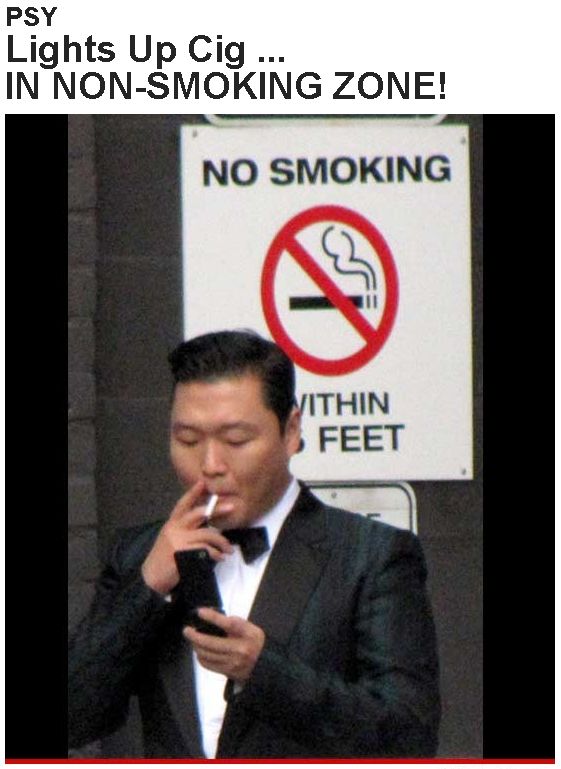
Psy before feet

Found via Daum, I found this photo (from here) and commentary amusing:


Korean invisible horse rider Psy was too busy checking how many minutes of fame he had left to notice that he lit up a cigarette right next to a No Smoking sign in Toronto on Tuesday.

In his defense, who has time to follow the rules when you're squeezing the very last drops out of that "Gangnam Style" song?

Eh sexy lady. 
What amused me was the idea that this took place in Toronto, since Canada - well, the world, really, excepting Liberia, Burma, and the U.S. - uses the metric system.

(Mind you, I'll admit that, at times, the metric system has twice as many syllables - six inches vs fifteen centimetres, for example, which can make it a little more unwieldy to use when speaking.)

Wednesday, August 29, 2012

Game of Death at Beopjusa Temple

I was reading this list of 'top ten movies that were never made' when I came across the following video about Bruce Lee's unfinished film "Game of Death." I had no idea it was to involve Korean gangsters, feature two Korean hapkido masters (only the fight with Ji Han Jae was filmed; the fight with Hwang In-Shik was not), and be set in the five story pagoda of Beopjusa Temple. Since the video refers to Lee's drawings, I imagine the scenes we see of Beopjusa Temple were shot more recently; the temple does not appear in the 1978 version of the film which used only a few minutes of the footage Lee shot.


And while I'm thinking of it, though I posted this years ago, I had to update the video link, so here's a 1971 interview with Bruce Lee by Pierre Berton.


And just for fun (though this may be NSFW in Korea), here's a celebrity tip by Berton which aired about six weeks before he died in 2004 (hint: it involves rolling something, and it's not a fajita).

Thursday, August 23, 2012

Volunteer Positions to Teach English to North Korean Defectors

I was away from the internet last week and didn't get a chance to post this:
Applications for Volunteer Positions to Teach English to North Korean Defectors

The Embassy of Canada in Seoul, in cooperation with Citizens’ Alliance for North Korean Human Rights, will continue our program whereby Canadian English teachers would volunteer to teach North Korean defectors English here at the Embassy.

We would like to offer those interested the opportunity to apply for this program. Our program has received rave reviews from the Korean government, NGOs and most importantly, the defectors themselves. This program aims not only to teach the young North Koreans English, but also to help expose them to Western culture, including Canadian values and global perspectives. The time commitment will involve teaching one two-hour class per week, held weekdays during business hours, for twelve weeks from September through December.

If you are interested in participating in the program, please forward your CV and a cover letter, which explains why you would be an ideal candidate, to seoul.canadaprogram@international.gc.ca by Friday August 31.
I taught for the pilot program (there's a little more on that here), and it was certainly worthwhile. The students came from varied backgrounds (some came from the northeast, others from Pyongyang) and were at different levels (from one student who just received a scholarship to study in the U.S. to another who had only arrived in South Korea 2 months earlier and had no English background at all), but the progress made by those who attended regularly was pretty impressive. It's well worth looking into if you have the time.

Monday, August 06, 2012

Olympics, coast to coast

I'm back in Canada at the moment and it's interesting watching the Olympics from a non-Korean point of view. I just saw this ad on TV:


Mind you, it's also nice that the time difference is more favourable here, making the soccer semi finals easier to watch.

Sunday, July 01, 2012

Canada Day: An interview with Ambassador Chatterson

Today is Canada Day, and this year marks the 145th anniversary of Confederation. I had a chance to interview Canadian Ambassador to Korea David Chatterson last week and talk to him a bit about the Korea-Canada relationship.

One of the more prominent images - especially keeping this recent story in mind - of the relationship is of Canadian veterans of the Korean War returning to Korea, so I asked him to comment on how the battle of Kapyong and other Canadian contributions are commemorated.

Describing Kapyong as the "iconic battle, the most noted battle for Canadian troops here on the peninsula," he said that Canadian troops were "thrown into the breach, so to speak, against overwhelming odds and managed to hold their ground. It was an important battle, because had our Commonwealth troops not stood, there were tens of thousands of Chinese ready to flood down that valley with nothing between them and Seoul."

"When our veterans come back, many participate [in the commemorations of the battle], and when they go there, you can see it in their eyes, 60 years later, they still remember the heights of land and the valley… So it’s very emotional.

"When we have these revisits, and our veterans come back, they do a variety of things. They go to the national cemetery, to the UN cemetery in Busan, Kapyong, the war museum, and for most of them it’s the first time they’ve back in 60 years, so they’re amazed at what they see, given that 60 years ago the country was in ruins.

I asked about the repatriation of Archibald Hearsey's remains, and he said, "That was really quite dramatic. His dying wish was to buried with his brother, whom he’d been separated from for 60 years."


Commenting on the return of Hearsey's ashes, accompanied by his daughter, grandson and a group of veterans, he said, "His daughter was spectacular, she really did a fantastic job, and the spotlight was very much on her. The Ministry of Patriots and Veterans Affairs did a great job – they very much supported this, in particular the Minister – they received the ashes at Incheon Airport and temporarily laid them to rest at the National Cemetery, which is quite an honour, and then the next day we went down to Busan and interred the ashes."

More on their visit can be found in this speech by Canadian Senator Yonah Martin (she met them during a layover in Vancouver on their way to Korea). The Ambassador also noted that KBS had filmed a documentary about the Hearsey brothers that aired June 24. That documentary can be seen here.

Asked about the number of veterans who return every year, he said that it varies between 50 and 100. "Next year will be the 60 year anniversary of the armistice, we’ll probably see in the neighbourhood of 100. But they’re getting old. [At the time] a great number of them were 18 or 19 years old, very young, first time volunteers. The youngest might be 78. There’s few of them around, and it gets more difficult. In fact one of the veterans who came to visit died just about a week after he returned to Canada."

I was curious if Canadian veterans returned at other times of year to commemorate events other than Kapyong, and he said that at other times of year, such as the anniversary of the outbreak of hostilities or the signing of the armistice, a cross section of veterans from different countries are brought over, so there are usually Canadians veterans who come, not just for Kapyong but for other anniversaries as well. He reiterated that "It’s really with the support of the Ministry of Patriots and Veterans Affairs. They make that possible."

He also described another way the war is remembered which I wasn't familiar with: "November 11 is our Remembrance Day, the armistice day of the First World War, and Korean War veterans came up with the idea of turning towards Busan at 11 am on the 11th. Everyone takes a few minutes and turns toward Busan. It’s a way to keep the memories alive."

I also asked about how Francis Schofield is remembered in Korea.

Scene from the April 1970 state funeral for Dr. Schofield.
"The Schofield Memorial Society has a commemoration, as he’s buried at the National Cemetery as well, and they quite often have readings and they're very committed and have very strong memories, fond memories of Dr. Schofield and his contributions to Korea. Quite often I’ll mention his name and people will go "Oh yeah," and start telling a story they've heard or that they're directly related to."

He also mentioned that former Prime Minister Chung Un-chan was assisted by Dr. Schofield in his middle school studies. "In those days you had to pay money to go to school and Dr. Schofield supported him in his studies, and 40 years later he became prime minister."

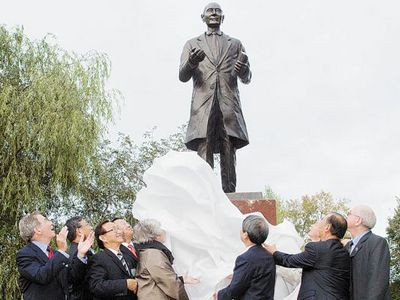
Statue of Francis Schofield at the Toronto Zoo

"He was just back in Canada for the Schofield memorial which was constructed at the Toronto Zoo – it’s huge, it’s quite astounding. He went there for the dedication. He threw out a pitch at a Blue Jays game – it was quite a successful visit."

Former Prime Minster Chung Un-chan after throwing the opening pitch at a Blue Jays game. From the video below.


The former Prime Minister also visited Toronto in 2010 in relation to the statue and the surrounding Korean garden built at the zoo. Senator Yonah Martin also brought up Dr. Schofield in a recent speech (her other speeches, some of which are related to the Korean-Canadian relationship, can be seen here).

Also, with the recent news that negotiations would re-start for the Korea Canada Free Trade Agreement, I asked the Ambassador for his thoughts on this. He noted that the two countries "haven’t actually had discussions for almost three years" but were now committed to "move forward toward a conclusion."

As for what stalled the talks, it was one sticking point: "Beef was the issue. The problem was that in 2009 Korea reopened their market to US beef and not Canadian beef, and there was no basis for that whatsoever, and it just became politically untenable to continue with the negotiations."

Korea was taken to WTO over this by Canada. "The case didn’t progress to a final decision, but we had a very strong case. The Koreans asked to come to an agreement and they reopened their market in January this year. We’ve now had several months of shipments and its going well."

Asked about who would benefit from the FTA, he said, "The benefit first and foremost goes to the consumers more than producers, because you're reducing barriers and increasing competition."

"When you look at our trade and areas of economic activity, I think our economies are pretty complimentary, as opposed to being competitive." Calling it a "win-win situation," he said, "I'm an old trade negotiator - I really do believe in this stuff."

He also laid out another benefit of the FTA:

"It focuses more attention on the relationship and I think both Canada and Korea would benefit from that. When our companies look to the growth area of northeast Asia they see China and Japan – they often don’t see Korea. Korea looks at North America and sees the bright lights of the US, but often doesn't see Canada. So this shines a light on the two countries, and it's a demonstration of a commitment on the part of the governments to that initiative."

Perhaps the agreement will reached by next year, which will mark the 50th anniversary of diplomatic relations between Korea and Canada.

I'd like to thank Ambassador Chatterson for taking time out to talk to me. Another interview with the Ambassador can be read at Busan Haps here.

Thursday, April 26, 2012

The 'Taegukki'-like Hearsey brothers

Yesterday I posted briefly about Archibald Lloyd Hearsey, a Canadian Korean War veteran who asked to be buried in Korea with his brother, who was killed in battle here in 1951.

As it turns out, there's more to the story. I was talking to Canadian embassy staff last night who emphasized that this was the first time any foreign veteran of the Korean War had asked to be buried in Korea, and when the group of veterans and Hearsey's daughter and grandson arrived at Incheon Airport, an ROK honour guard was waiting.


I was told his family members come from northern Ontario, and had to fly to Thunder Bay, then Toronto, then Vancouver, and then Incheon, and that after that long trip, the reception, with 20-30 reporters present, was a bit overwhelming.


As the Korea Herald reported,
Archibald Hearsey’s ashes were brought to Korea as part of the Ministry of Patriots and Veterans Affairs’ program providing Korean War veterans with a chance to revisit Korea. The program began in 1975 and 28,500 veterans have visited Korea since then. [...]

[Hearsey's] story was first conveyed to Korea’s Ministry of Patriots and Veterans Affairs by Canadian Senator Yonah Martin. The story fueled a fundraising campaign to enable Debbie Hearsey to make the trip to Korea.
As this article adds,
The visit was part of Korea Revisit Week, an annual event supported by the South Korean government. This year, a total of about 200 veterans from Canada, Australia, the United Kingdom and New Zealand spent five days in South Korea visiting historical sites.
This would be because on April 22, 1951, the Chinese spring offensive led to the battles of the Imjin River and Kapyong, with British troops playing a large role in the former (as depicted in Andrew Salmon's book To The Last Round) and Canadian, Australian and New Zealand troops playing large roles in the latter.

Archibald Hearsey's ashes were interred with his brother at the UN Cemetery in Busan yesterday.


The above image is from KBS's news report, which can be seen here. There have actually been quite a few Korean language news reports about this. This YTN report (with video as well) is titled "Older brother, because of me you entered the war, I want to be buried with you." What has captured the imagination has been the similarities of the Hearsey brothers' story - in which an older brother joins the military to fight in the Korean war to protect his younger brother, and who dies in the younger brother's arms - with the Korean film Taegukki: Brotherhood of War; hence the title of this Yonhap article, titled 'Canada "Taegukki"-like Hearsey brothers interred together.' This news report also begins with footage from the film, and riding the AREX home last night, I saw a headline flash on a screen showing YTN news which was similar to the title of the Yonhap article. At any rate, kudos to the classy way in which the Ministry of Patriots and Veterans Affairs handled this.

Oh, and unrelated (though this very disturbing article on the topic just came out), but it came up in conversation last night - I had no idea Tablo was a Canadian citizen.

Wednesday, April 25, 2012

Return to Gapyeong

The Joongang Ilbo has an interesting story about the tribute to the Canadian troops (attended by 50 veterans) who fought at the Battle of Gapyeong between April 22-26, 1951, which focuses on the story of Archibald Lloyd Hearsey, who fought in the battle.
Six months [after Gapyeong], Hearsey would survive another battle on Hill #187 in Yeoncheon County, Gyeonggi, north of Gapyeong. That would be the day of his greatest tragedy. Stumbling into the battle, he discovered that his older brother Joseph William Hearsey had enlisted, been shipped to Korea, and was fighting alongside him.

Joseph would die on Hill #187 - in his younger brother’s arms.

The group of visiting Canadians have brought the ashes of Archibald, who died last June, to be reunited with the remains of his brother Joseph. They are the first two foreign siblings who fought together in the Korean War to be reunited in this way. Archibald left a will asking his family to try to make it happen.
Read the rest here.

Monday, February 06, 2012

Hockey night in... Korea

I discovered this site, which looks at the history of hockey in Korea. Such a history can't do without some photos, like the one below, of Canadian troops playing hockey in Korea during the war.

Thursday, January 19, 2012

Canadian returns to Korea to confess to a murder

A bit late on this, but a Canadian who taught English in universities from 2001 to 2009 returned to Korea to confess that he'd murdered his ex-girlfriend, a university student, in 2009. He'd gotten away with it and made it look like accidental drowning, but he was wracked by guilt and returned to confess to her family and police. The fact that he said he did it because he thought she was going to kill him doesn't suggest the most stable of minds (but who knows what actually happened). Unsurprisingly, there were a lot of news reports on this (39 at last count), one of which is translated at Korea Beat. It's also been reported by the Korea Times, Korea Herald, and Chosun Ilbo.

I liked this scene in YTN's report:


One wonders if there are actually any police officers in the room or if they are all journalists. It's one of the things that baffles me, the allowing of the press into police stations. Perhaps it's part and parcel of being a shame-based society. At any rate, you can hear him talking in that video.

I wonder who all the people are in the screenshot below (from an MBC report); he certainly towers over everyone.


I've never come across any arrests of English teachers for murder in Korea (not counting Korean American gangsters who committed crimes in the US or Canada), and while it wouldn't surprise me if this was used as fodder for more "there is yet another loophole in the native speaking verification system" articles, I almost wonder if the interest here might be more in the fact that the man - a product of a guilt-based society - returned to Korea to confess the crime, rather than the crime itself.

For example, the article translated at Korea Beat has the following:
Netizens had various reactions to the news of the murder and the Canadian’s confession, such as “he must have been haunted by a Korean ghost even in Canada,” and “it’s lucky that the defendant was so full of sadness.”
Here are a few of the titles from the 39 articles. Most common is the title the Maeil Gyeongje used: "Canadian English instructor who murdered girlfriend gives self up after three years."

Newsis: Native speaking instructor who murdered Korean female university student in Han River gives self up after three years.

Chosun Ilbo: Canadian English instructor: "The ghost of my girlfriend who died three years ago has followed me around... I came to be punished."

Segye Ilbo: Canadian English instructor who murdered girlfriend but was found innocent gives self up after three years.

IB Times: Canadian who killed lover turns self in is "miserable"... 'Why' did he kill woman 14 years his junior?

Donga Ilbo: "The scene of my girlfriend's murder constantly replays in my mind..." Canadian voluntarily returns to Korea and turns self in after three years

less than a third of the articles mention "English teacher" or "native speaking teacher" in the title, so that angle is not being as played up as it could be.

I keep wondering when the Canadian press is going to pick this up.

Friday, December 30, 2011

Internship at Canadian Embassy

If any Canadian citizens are interesting in applying for an internship at the Canadian Embassy from March to August 2012 (or know someone who would be), the details can be read here.

Tuesday, October 11, 2011

Directions to Maple Tree House

[Update:
It was great to meet readers last night, and in such a setting. Thanks again to Mr. Devolin and Senator Martin for hosting the event.]

A bit late, I realize, but anyone going to the dinner at the Maple Tree House tonight can catch bus 종로 11 (Jongno 11 - it comes every 5-8 minutes) from the bus stop near exit 2 of Gwanghwamun Station or from in front of the Press center (from exit 4 of City Hall Station) and go six or seven stops, respectively, and get off at 한국교육과정평가원 (Korea Institute of Curriculum & Evaluation), and then walk back a bit to the restaurant. In the photo below, the restaurant is at far right, and the bus stop would be at far left.

Thursday, October 06, 2011

Dinner Hosted by Maple Tree House and Canadian Parliamentarians

Next week, Canadian parliamentarians BC Senator Yonah Martin and the Honourable Barry Devolin, Assistant Deputy Speaker of the House of Commons, who are co-chairs of the Canada-Korea Parliamentary Friendship Group, will visit Korea.

On the evening of Tuesday October 11, 1at 7:00 pm, Mr. Devolin and Senator Martin will host a dinner reception for Canadian English teachers in Seoul at Maple Tree House, Jongno-gu, Samcheong-dong 31-1 (02-730-7461) for a casual exchange of ideas and open discussion on a range of issues over Korean BBQ. If you are a Canadian English teachers interested in the idea of having a meaningful discussion on Korea-related topics or issues of concern to English teachers in Korea, contact information is below:

RSVP: eslreception@gmail.com
Attendees: First 50 to reply
Cost: Free
Time: Tuesday, October 11, 19:00-21:00
Location: Maple Tree House (Samcheong-dong)

I can post more detailed directions to the restaurant next week.

Wednesday, April 06, 2011

Rat Tales

On January 21, 1972, the Korea Herald reported on an odd economic venture - one which PETA would likely not approve:


I couldn't help but remember this story; the Simpsons episode where Fat Tony runs a rat-milking operation to supply the school cafeteria also comes to mind. The comment "I wanted to make them compensate us for what they have done to us" is interesting in the light of the economic damage rats are portrayed as causing in the article.

One wonders what became of this venture. I somehow get the feeling that when Korea and Canada celebrate the ways in which the two countries have worked together in the past, this is something that is not brought up.

Still, the Korea of ten years later, in 1982, would not have been imaginable to those living ten years earlier in 1962, and as odd a tale as it is, it points to the measures people were willing to take to create wealth and pull the country out of poverty.