Showing posts with label Subway. Show all posts

Saturday, March 28, 2015

Line 9 extension to Sports Complex on Line 2 opens today


Line 9's extension from Sinnonhyeon Station to Sports Complex Station on line 2 officially opens today (they seemed to be doing trial runs to the latter station in recent weeks; last week I got on at Gimpo Airport and the announcement and on-train information screens both said it was heading to Sports Complex). In late January they changed the schedule to prepare for this opening, going from one express train for every two all-stop trains to a one to one ratio. While this meant more express trains, it also resulted, as Kojects tells us, in there being 60 less train tripss per day, and intense overcrowding at rush hour, as this JTBC report on the 'hell train' - translated at Korea Bang - tells us.


This all looks rather familiar. While I was lucky enough to be able to take the express train towards the tail end of morning rush hour (catching it between 8:10 and 8:25), I used Line 9 to commute to work for five years, and it was still quite crowded at that time of day. The report notes that the most crowded stretch is between Yeomchang and Dangsan, and that doesn't surprise me; my commute ended at Yeomchang, and I was always amazed at how crowded it got, sometimes having to fight my way off the train (much more aggressively after once being pushed back onto the train and having my foot drop into the gap). Another memory that stands out is seeing people cram on at Gayang Station (the express stop between Yeomchang and Gimpo Airport) and seeing a man leaning at a 45 degree angle as he pushed the people ahead of him onto the train. The only way to ensure I could get off was to stand next to the door when I got on, otherwise it would likely have been impossible.

One problem leading to overcrowding is that there are only four cars in each train, while every subway platform has room for at least eight cars. At this point, the solution won't be more trains running, but more cars on each train. Unfortunately, as Kojects notes, 20 new cars won't be added until late next year, with more to follow the following year. Since the new schedule with more express trains was implemented in January, the number of people using line 9 has increased by an average of 2,700 daily, and the projected number of people using it after the extension opens will be 610,000 daily (compared to 250,000 in 2011, when more trains were added). For now, one rush-hour measure by Metro 9 has been to operate express buses, but I hardly see how useful they'll be in rush hour traffic.


Covered up schedule for trains to Sports Complex at Sinnonhyeon Station yesterday (hat-tip to Ami).

Wednesday, March 18, 2015

Foreign graffiti artists deface Seoul's subway trains

The Joongang Daily reported the other day that... well, here's the title: "Graffiti punks from abroad target Seoul’s subway."
On Feb. 2, four Australians in baseball caps and hoodies appeared around Wangsimni Station, eastern Seoul, at three in the morning. They carefully scoped out the area and then stopped in front of a ventilation window behind a bus stop. They cut the bars of the window and swung down to a temporary garage where a car for the Line No. 5 subway was idle. Using spraypaint, they covered the car with graffiti art and then moved on.
They then tagged two more trains, one two days later at Anam Station, and another at Sinnonhyeon Station on Feb. 5. The Joongang Ilbo's Korean-language article includes this graphic (click to enlarge):


And yeah, judging by the noses, they do seem to have been foreigners:


I found this to be a bit spooky:
It was only after they flew back to their home country on Feb. 7 that the police identified the four Australians with security camera footage. They matched their faces on security footage from the airport and then checked immigration records.
We're then told that police are baffled by foreigners who "knew so expertly the subway stations' structures" and that "We believe most of them were painted by foreigners." In fact, they "discovered that most of them are from Australia or Canada based on the style of graffiti paintings." That's some impressive sleuthing. The Joongang Ilbo then goes on to interview a Korean graffiti artist, which begs the question why the police are saying it must have been done by foreigners.
Lim Hun-il, a pioneering Korean graffiti artist better known as Hudini, explained that “seeing a train running around the city with their graffiti art on it is like the biggest honor.”

Another graffiti artist conjectured, “It is likely that foreigners who used to practice graffiti art are working as English teachers during the day and painting at night.”
Actually, though, that's not what the Korean-language article by the Joongang Ilbo reported. In it, after that comment by Lim Hun-il, the journalist adds that "The fact that Korea's subways are so clean may have inspired such 'graffiti expeditions.'" This is followed by a quote from "a graffiti artist" who says, "foreigners who used to practice graffiti art and worked as foreign language instructors after entering the country may have let their friends know about Seoul's subway." One assumes, in the context of talking about how foreigners could have known about the subways, that these "friends" they let know about Seoul's subway were overseas. The article notes that:
No foreigner has been caught by police for defacing the trains, possibly because they have left the country quickly like the Australian group. Property damage is not a serious enough crime to try to extradite them.
Apparently that's not the case in Singapore. The article also notes that incidents of graffiti on trains have been increasing, and lists the locations of each incident:


The Joongang Ilbo has been on a bit of a crusade here, translating another article today, as well as publishing a CBS radio interview with a Korean graffiti artist. I'm not sure that publishing the exact locations of the incidents was the best idea if they wanted to stop it from happening, but then I'm not an editor there.

Wet Casements also has a post about this here.

Thursday, July 10, 2014

Bits and Pieces

Last week the Joongang Daily published an article about subway crimes, describing among them people who urinate in subway stations. I'd never seen that happen before, to be honest, but the very day I read that article, I happened to pass by this guy at Gimpo Airport Station. Classy.


On a similar topic, K-law Guru looks at subway sex crimes and the current police crackdown on them.

Speaking of class acts, Gag Concert did another blackface skit making fun of Africans. (Hat tip to Scott Burgeson.) Also classy was the response last week to the Korean World Cup team's return home:
At that moment, the team became the target of a volley of pumpkin yeot (Korean taffy) thrown by a small group of fans yelling “Eat yeot!” and “Shame on you!” Some of them also held signs, one of which read “Korean football is dead.” Fortunately, their bad aim meant no Korean team member was struck by the candy.

In Korean, the phrase “eat yeot” is an offensive slur equivalent to “screw you,” which originated in the 1960s when students protested against the Education Ministry over a question on their school exam regarding how the taffy is made.
While I know about the incident from the 1960s, I hadn't realized it's where the term 'Eat Yeot' as a swearword originated from. It's described in Seoul Through Pictures 4: Seoul, To Rise Again (1961-1970) on pgs 304-5:
In December of 1964, elementary school students in Seoul took junior high school entrance examinations. Question 18 in the Science section asked, "What can replace malt when making rice taffy?" Choices included 'diastase' and 'radish juice,' the correct answer being 'diastase.' However, 39 parents of those studnets who chose 'radish juice' filed a lawsuit, presenting rice taffies that were made with radish juice as a piece of evidence. The Supreme Court accepted 'radish juice' as a correct answer and the students who passed the examination by earning the extra point were able to enter their desired schools in May of 1965.


Hell hath no fury.

On a more classy note, I liked this story about Seoul building bug hotels, though I wonder about the people raised in the city who live in fear of insects and how they would feel about it.

Friday, June 07, 2013

Subway stations and history

I was playing around with my blogroll on the sidebar last night (and created the 'defunct blog' list below it) when I decided to check out Seoul Suburban, and was pleasantly surprised to see that the photos no longer have the photographer's name running across the center of the photo - my dislike for which led me to stop reading the blog quite a while ago (great idea for a blog, didn't like the execution). At any rate, it's far more viewable now, and it was also nice to see that they'd hit several stations in my area, including Yangcheon Hyanggyo. They covered the station's titular Hyanggyo (Confucian shrine), which is the only one to be found in Seoul (which I looked at here), as well as Gungsan. I hadn't known about the gingko tree and well featured in the post or seen the sign telling the history of the area (a problem with riding through the neighbourhood on a pretty well worn route). The sign in the post features this map of Yangcheon Hyeon (county) from 1875:


One thing not noted in the post is that the local school - Yangcheon Elementary - is notable for being 113 years old (it opened in 1900 as the Gongnip Sohakgyo, or public elementary school), which makes it quite old by Korean standards, and points to the former importance of the area (after which, today, is named a major street and even a city district (Yangcheon-gu, best known for Mok-dong). Here's a shot of the Hyanggyo:


At any rate, I'll have to get over there soon to find the spots I've missed.

They also checked out Sinbanghwa Station awhile ago, and were underwhelmed, which is understandable. The area used to have far more interesting neighbourhoods nearby, such as this one and this one, though they've disappeared to make way for the Magok development. Needless to say, the Magok area - which Sinbanghwa station borders - used to be far more scenic:


While there are a few good restaurants nearby, I suppose the most interesting spots are currently on the tops of nearby buildings where you can see what is becoming of Magok-dong:

(The above apartments are replacing this neighbourhood)


I have lots more to say about this development, but I'll save it for another day.
 
While Sinbanghwa Station has little to offer, Banghwa Station, on the other hand, has quite a bit of history - most of it to be found on Mt. Gaehwasan (which can also be reached from Gaehwasan Station and Gaehwa Station).


That, also, will have to wait for another day.

Tuesday, February 12, 2013

Foreigners love, threaten, and owe apology to Korea

Gord Sellar takes a look at an interesting/disturbing meme/image and makes one of his own. He also links to this Weekly Chosun article titled "Korea gets much better thanks to ramyeon" and subtitled "Blue-eyed ramyeon evangelist Rogers," even though he may not have blue eyes. It opens with:
Ramyeon is now not just the favourite food of Koreans only. Though it's not yet all over the world, among foreigners who have tried Korean ramyeon there are many ramyeon enthusiasts. Meet American Kim Mi-nam, who really likes Korean ramyeon.
'I'm stomach cancer and I approve of this article.' Anyone who thought the 'Mi-nam' in his name referred to a handsome man is to be disappointed, as it stands for '김치를 좋아하는 미국 남자,' or 'American man who likes kimchi.'  'Look at me ~ I'm in the Weekly Chosun!^^' Seriously, of all the foods Korea could pitch to the world - and there are lots - ramyeon is barely a step above hongeo (fermented skate). And I'm afraid the Japanese have Korea beat in the ramyeon department.

Moving on, a month ago I looked at a Chronicle of Higher Education article titled "Growing pains for foreign academics in South Korea." Three Wise Monkeys has followed it up by translating articles by YTN and Chosun Ilbo on the topic (with the latter receiving an 'evil foreigner' stamp of excellence). The professor at the center of the controversy offers his side of the story which raises eyebrows, but also raises questions by the last minute inclusion of the fact that he left Korea last May. I did like the fact that the author of the Chronicle article, David McNeill, stated that "KU said even quoting Foster would be libelous. That, paradoxically, made the editors more interested and probably triggered the decision to print."

Over at ROK Drop, GI Korea reports that USFK has not issued a full apology for the recent alleged subway sexual harassment incident; it has apologized for the soldiers being loud on the subway, but not for anything else. This may be because the investigation is ongoing, or because the events may not have turned out exactly as depicted here (hat tip to Robert):


Perhaps, like the 1995 USFK subway incident which was reported by the Kyunghyang Sinmun as "Drunk US soldiers commit sexual harassment on the subway and group assault passenger who protests," the truth of what happened differs slightly from the reported version. Expat Hell also made a good point about the young woman's behaviour: "For long term Korea residents, the idea of a single female university student walking up to a group of older men on the train, and telling them to be quiet is akin to spotting a UFO or unicorn, or something." The Chosun Ilbo, on the other hand, stated that "U.S. Forces Korea personnel enjoy a degree of impunity since the U.S. side has jurisdiction over them." Y'know, if I had to guess, I'd imagine US military justice punishes crimes like rape or assault quite a bit more strictly than the Korean justice system. Unless, of course, there's no proof that it happened but the public is demanding punishment despite the facts, in which case the Korean system has proven itself to be stricter (with one outstanding example being the wife in the 1995 subway case - who was the real victim - being charged with assault and made to pay a fine).

And last, but not least, the Joongang Daily, reporting on exhibition skating at the Pyeongchang Special Olympics, reminds readers that the Korean race's vendetta against Apollo Anton Ohno will never end. Never.
The two belonged to different groups and thus never competed against each other, but Kim was obviously mindful of Ohno. As he was skating behind another retired Korean short-track athlete, Sung Si-bak, the 2010 Olympic silver medalist, Kim raised his hand in a show of surprise as if he were protesting a foul by Sung, apparently to re-enact the same gesture by Ohno that led Kim to be stripped of another Olympic gold in 2002. [How clever! No one has ever done anything like that before!] Korean fans have supported him, often citing a video replay of the competition that Koreans say only confirms a deliberate overreaction by the American. Ohno remains one of the most reviled athletes in the world for Koreans.
Reviled! And Koreans supported him at the time by shutting down the Olympics website, threatening to sue the referee (a step up from actually assaulting a referee during the 1988 Olympics), boycotting American products, and releasing the song 'Fucking USA,' which was a hell of a way to get the country in the mood to host an international event like the World Cup. If the reaction to bad calls at the 2012 Olympics is any indication (such as this editorial stating that "the [fencing] incident will be remembered as one of the most controversial decisions in Olympic history" (you mean like this one?) or this editorial doubting the sincerity of the preparations for the Olympics and declaring that "South Korea has so far been the biggest victim of misjudgment"), then the 2018 Olympics should be interesting to observe. The Joongang article finishes with this conclusion:
Kim managed to fire off another barb at his rival when he told a reporter that Ohno appeared to have gained weight since the last time he had seen him, saying the American surely would have lost to him if they had competed against one another in Gangneung.

Kim still believes Ohno owes him apology.

Thursday, June 28, 2012

My cup overfloweth

I saw this ad for Ocean World on the subway today:


The Korean could be translated as "have you reached the point of climax?" Though I imagine there's a better translation. With the crashing waves, cleavage and skin, and 'climax' in Korean as well, I'd guess the English phrase was chosen with the knowledge of its range of meanings. Then again, perhaps not.

There are apparently even larger billboards out there.

Wednesday, February 01, 2012

Future plans for Seoul's subway from 1988

On January 29, 1988, the Korea Times published this article outlining the future plans for Seoul's subway system:


Interesting that the idea then was for extensions and spur lines. Line 4 was pretty much extended as planned, but the Kimpo and Chonho spurs were (roughly) eventually joined to make line 5, while line 3 was extended only a little (and extended a little further again in 2010), with the Godok and Songnam spurs basically being joined to make line 8. Spur lines as an idea haven't died, really - several light rail spur lines are planned to be built throughout Seoul over the next decade - see here and here for more information.

Thursday, December 15, 2011

AREX Gongdeok Station open

I was heading home from downtown Tuesday night and decided to go down to Seoul Station and take the airport express home, even though the transfer from line 1 to AREX takes more than five minutes and probably takes just as much time to get home (though you're more likely to get a seat). I'm glad I did, because I was surprised when the train stopped at Gongdeok Station; the station - with its transfer to lines 5 and 6 - wasn't supposed to open until the end of this year. As it turns out it was opened on November 30th:


(from here)


Judging from Daum's map, compared to the other transfers (at Digital Media City and Hongdae), the transfer looks to be quite a bit shorter.


Always nice to see the city getting easier to navigate. Mind you, not everyone is happy; this article takes the transfer to task for having very poor handicapped access.

Monday, September 05, 2011

Line 9 has more trains in service

I was surprised a week ago when the all-stop train I'd taken on line 9 stopped at Gayang Station and an express train came into the station ten minutes ahead (or behind) schedule. As it turns out, the planned expanded schedule I mentioned a few months ago has been put into place - at least at rush hour. I'm hoping we'll see more trains at other times as more of the new trains are put into service, but as it stands now the service has improved considerably, as this timetable at Gimpo Airport (headed east) shows:


There are now twice as many express trains (and 1.5 times as many all stop trains) at rush hour, which makes a huge difference. There are more options, time-wise, and with this the crowding has been greatly reduced in the morning.

In other subway related news, fares are set to increase, but considering it's been 4 years since the last increase, it's not that surprising.

Monday, August 22, 2011

Line 1 under construction

On January 7, 1970, the Korea Times published the following article:


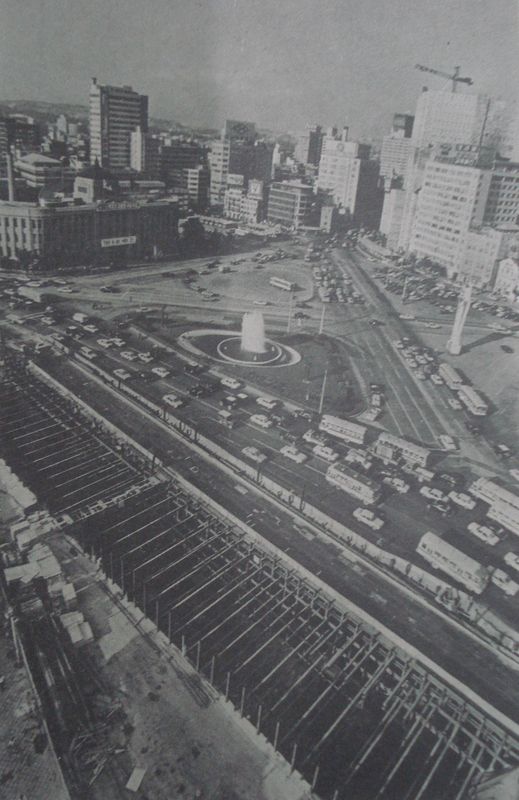
Two years later, on January 1, 1972, the Korea Herald published this photo of the subway construction.


Even back then things got built very quickly.

Wednesday, August 17, 2011

A history of subway station names

Awhile ago the Joongang Daily published two articles looking at the history of place names in the Seoul area through Subway station names. They can be read here:
Part 1. Part 2.

Odd that they didn't include Mapo, AKA 'hemp port.'

Tuesday, July 05, 2011

Hazy days

On Saturday I took the AREX downtown. I usually enjoy the view as the train crosses the Han River, and that day was no exception.


I obviously had to brighten the photo up a bit to be able to make out the Banghwa Bridge. At left is Deogyangsan, on top of which is the Haengju Sanseong. In the haze, the view reminds me of old (especially Chinese) landscape painting.


The view that followed, not so much.


The view (prior to the freeway) almost compensated for the horribly humid weather that day.

Monday, June 27, 2011

More trains to be in service on Line 9 by year's end

I was waiting at Gayang Station on Line 9 last week when a train inched into the station. Its speed and the fact that the announcement board said not to board the train made me curious, and this is what it looked like inside:


The sign reads "Train on trial run - do not board." A look at the Wikipedia entry for Line 9 revealed this welcome bit of information:
Currently [sic] there are 36 trains with four cars each. The express train comes every 20 minutes and the all-stop train comes every 6.7 minutes. Due to the number of riders exceeding 250,000 per day, 12 additional four car trains have been ordered and are expected to be in service starting October, 2011. This would mean the express train comes every 7~10 minutes and the all-stop train comes every 5 minutes.
This Munhwa Ilbo article is listed as a source, which makes clear that, when the 12 new trains are put into service in October, there will be 36 trains in total, meaning there must be 24 trains at the moment (most likely 8 express and 16 all-stop trains). It also notes that the new trains would arrive in July 2011, 16 months after the order was placed for them (ie March 2010). I imagine they've arrived early, and that the train above is one of them.

The increase in the number of trains is welcome news. The express trains are jam-packed to the point they can no longer take on passengers (after two stops!) in the mornings, and are little better in the evenings. One reason for this is that the trains are only four cars long, but the stations have room for trains with eight cars. I'd wondered if this was a bid by the company to save money, seeing as it initially planned, if I remember correctly, to charge a fare of 1,300 won, but was forced by the city to charge 900 won (it's vaguely mentioned here). Perhaps this isn't the case, however. I think increasing the number of trains, rather than the number of cars, is the best way to go. The trains come infrequently compared to other subway lines (all-stop trains leave Gimpo Airport Station every 10 minutes, with express trains leaving every 20 minutes). Needless to say, I'm looking forward to the change, though as far as going downtown is concerned, the AREX line will always be faster, especially when the transfer at Gongdeok station opens at the end of this year. The two lines together have made the Gangseo-gu area feel much closer to downtown, and have affected housing prices as well.

One nice thing about the Line 9 trains is being able to look out the front window...

(Note much space is available for more cars.)


Monday, April 04, 2011

The unruly crowd

A September 4, 1975 letter to the editor in the Korea Times:


At that point the Seoul subway (line 1) would have been operating for a year. One wonders if the writer had a chance to ride it at rush hour. Certainly, even on line 9 today, trying to get off the express train during rush hour sometimes requires "brute force" just to be able to step off the train and not get pushed back inside by those rushing to get on (and pushing those in front of them).

Thursday, December 30, 2010

The Incheon Airport Line opens

As the Joongang Ilbo reported, the Seoul Station - Gimpo Airport section of the Incheon Airport Railway opened yesterday:
The Incheon International Airport Railroad (AREX) linking Seoul Station to Incheon International Airport will whisk travelers to their flights in 43 minutes, roughly 15 minutes shorter than via airport limousine. The fare is 13,300 won ($11.59) and makes no stops. The express train runs every 30 minutes, and operating hours are from 5:30 a.m. to 10 p.m.

A local train with 10 stops runs the same Incheon route in 53 minutes and only costs 3,700 won. The stops include Hongik University, Digital Media City, Gimpo Airport, Gyeyang, Geomam, Unseo and Incheon International Airport Cargo Terminal. (Gongdeok Station will open at the end of next year.) The hours of the commuter line are 5:20 a.m. to 12:00 a.m.

Travelers departing for Gimpo Airport can use the local line from Seoul Station. The trip takes 19 minutes and costs 1,200 won.
As I posted back in November, according to a Hankyoreh article I read, the transfers at Hongdae Station and Gongdeok wouldn't open until later. Obviously, I was confused when I saw this sign at Gimpo Airport Station.


The Hongdae transfer was listed, and though I didn't get a chance to try it out yesterday, a friend of mine (who I sorely disappointed when I mentioned the Hongdae transfer wouldn't be open for some time) messaged me to tell me it was indeed open, and that the trip from Banghwa Station to Hongdae took 20 minutes. When I tell people I live near Gimpo Airport, I often hear about how 'far' away it is. It started getting closer with Line 9, and it's even closer now with this new line open. It'll be nice to finally take a ride on it, seeing as I've been photographing its construction for the last four years.

Tuesday, December 07, 2010

Seoul in 1979


I managed to find the article "Seoul: Korean Showcase" in the December 1979 National Geographic at a bookstore in Toronto summer before last. That's the cover date, however. It actually hit news stands just as Park Chung-hee was assassinated (something it noted in its next issue, saying that it also published an (interesting) article about South Korea in 1950 just as the war broke out. One of my favorite photos, for obvious reasons, is the one below, of the Jamsil apartments, looking northwest from what is now Lotte World (click to enlarge).


The subway construction for line 2 can be seen. The apartments in the photo above are all quite new at that time (completed just the year before), but have since been reconstructed (except perhaps for those on the right), as can be seen below:

(The vantage point of the photo (likely from a helicopter)
is marked by the yellow circle.)

The article has many other photos; a few of the ones I liked most follow:

(Is that soju next to the beer?)


(No need for introductions.)


Female taxi drivers await their licenses at a ceremony.
(Note the Hyundai Pony taxis)


"Death to Kim Il-sung"
(See the captions below.)


Million person march.


I guess having the air raid drills at 2pm has made accompanying blackouts pointless. Interesting to see how many people reportedly came out for a protest after it was announced the north had dug a tunnel under the DMZ. It's interesting how different that response was to actually having Korean territory shelled. Mind you, back then people believed the reds were actually red, and had tails, etc. One also wonders if attendance at that million person demonstration was mandatory for some of the participants...

Thursday, December 02, 2010

Subway groper exposed

[Update: The man in question turned himself in.]

According to Yonhap (via the Segye Ilbo) yesterday a netizen posted a video of a middle aged man groping a woman asleep (or passed out?) next to him. It was taken at Sincheon station on Line 2 on the last train headed for Sindorim at 12:30am Tuesday night.


Perhaps in the future gropers might want to rein in their hands if people around them have their phones out.... which would probably put a stop to all groping on subways. Police are currently investigating the case using CCTV footage and traffic card ID records.

Monday, November 29, 2010

Line 9 derailment


According to Yonhap, at 8:10 last night, train 0913 on Line 9 derailed as it headed towards Sapyeong station (in the direction of Shin Nonhyeon Station). Luckily, it was going under 20km per hour when it happened, so there were apparently (according to Metro 9 officials) no injuries. As can be seen above, passengers exited out the front of the train. SBS has a video here which the following photos are taken from (YTN also has video, and according to YTN it took only 8 hours to restore service).


That's quite the spacious tunnel. I've taken photos before out the front of the train as it's moving and thought that it might be fun to walk around the tunnels - but a derailment would not be my first choice in getting such an opportunity.


It's also not exactly comforting that it happened on Line 9, considering I take it every day.

Tuesday, November 09, 2010

G-20 and 'global etiquette'

One of the places where it has been easiest to observe the PR campaigns leading up to the G20 has been the in places connected with subways, as the police presence in subway stations has been growing for some time now (I first wrote about this in June, when I posted the photo below):


Changing trains at Gimpo Airport Station, I'm likely to see around ten police officers there a day, but nothing quite like these guys, who are likely more armed due to the fact that they are at Coex, the G20 venue:


On Line 9, with its trains and stations having screens which continuously replay the same ads, there are also several G-20 related ads, or at least ads I imagine are related, such as the one showing the subway police presence on trains and in stations as they tackle thieves and gropers


Above they take away a wanted criminal, and below is the video accompanying methods for preventing sexual harassment/groping.


I would assume that's meant to be seen by G20 visitors, though it's interesting that they are depicting groping in these videos - I'd imagine that's not the kind of thing the nation branders want to present to the world. One video which refers to the G20, brought to us by Seoul City and SK Telecom, shows both Koreans and foreigners enjoying themselves in Seoul/Korea, but the opening shot is certainly interesting:


That's actually a second or two too late - it begins with her kissing him on the cheek (the entire ad is in slow motion as well). The accompanying text reads "I made a family in Seoul "(but throws this '+a' symbol into the sentence which I don't get), much as the one below reads "I made a miracle in Seoul."


The image above is also reminiscent of this campaign during the last world cup.

What I found rather interesting the other day was a video in the subway station which showed people being rude, which then had a guy superimposed over these images of rudeness talking (via subtitles) about 'global etiquette,' making clear that knocking people out of your way and shouting into your phone loud enough to be heard in Busan are not ways to behave during the G-20.

These images make it clear what the global etiquette campaign is about (click to enlarge):


You can find out more about sunfulls here (sunny + peul ('repeul' instead of 'reply') maybe?). I wonder if the photographer deliberately positioned the western girl under that particular word?


A video about the global etiquette campaign can be found here as well.

Just in time for the G-20 is the Cheonggyecheon Lantern Festival.

The Korea Times also posted an article titled "It’s the foreign journalists, stupid!":
G20 is coming soon. And the Lee Myung-bak administration has decided to mount a massive charm offensive for the most important guests to the event who will shape the way the world audience will feel about the global gathering: foreign journalists.

The local daily, Dong-a Ilbo, said the government has embarked on a plan to “earn the hearts and minds of nearly 3,000 foreign journalists,” who will descend upon Seoul to cover the G20 conference.
Conferences like these always lead to security measures which inconvenience (or anger) locals, but parts of Seoul are taking the charm offensive in oversensitive directions:
Residents in Seoul’s Seodaemun Ward in the city’s west are baffled by their local authorities’ latest move to please the visiting VIPs. They say officials will halt operations at a waste processing facility from Nov. 10-12 for fear that the stench of food waste could tarnish the country’s image. The facility is located in an area through which the global leaders will be passing en route from Incheon International Airport to the capital.

Also ahead of the Nov. 11-12 summit, the Seoul Metropolitan Government this week launched a large-scale cleaning spree, involving more than 50,000 citizens and public officials. Divided into two stages, the project aims to first clean all roadside facilities throughout the city and then keep up their appearance until two days after the summit. (Yonhap News)
Is it just me, or is the phrase "keep up their appearance until two days after the summit" a little too obvious?

I'm curious to see how quickly (or if) the police disappear from the subways.