Thursday, September 20, 2012

Wolmi 306 Captain Suh's account of the rescue of the Baileys part 1


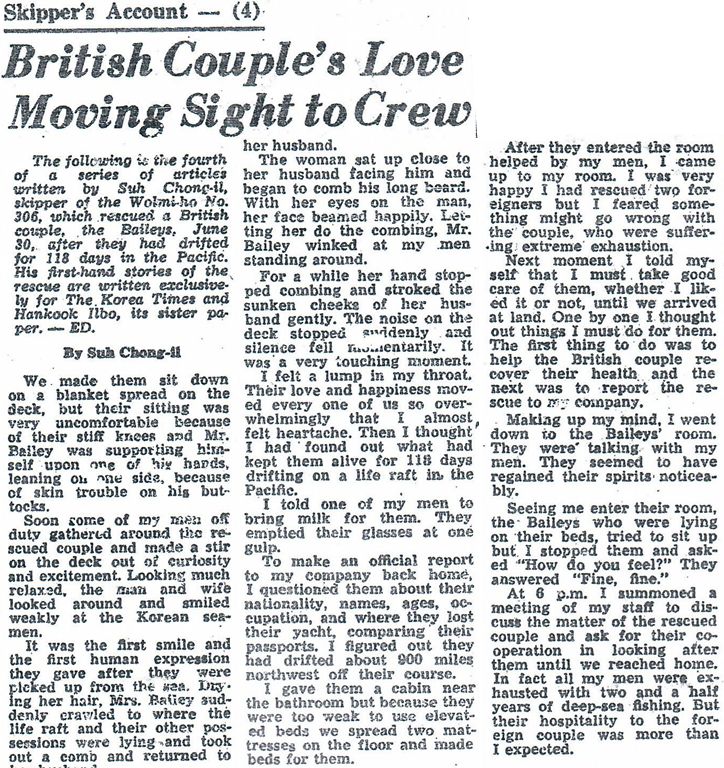
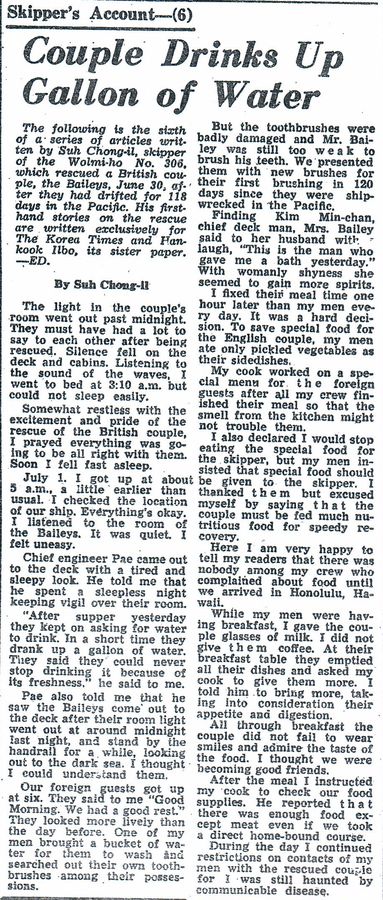
Yesterday I posted the story of how, on June 30, 1973, the Korean fishing vessel Wolmi 306 discovered Maurice and Maralyn Bailey, a British couple who had been adrift at sea in a life raft for 118 days. Several weeks later, the ship's captain, Suh Chong-il, wrote accounts of the rescue which were published in the Hanguk Ilbo and Korea Times. Here are the first six of the 13 installments, as well as commentary from the Bailey's book '117 Days Adrift.' On July 18, the Korea Times published the first part of the captain's account:


This photo from 117 Days adrift shows them being brought aboard, and gives a clue as to how emaciated they were:


Maurice Bailey also describes, in the book, how the captain was worried that they might be Russian, and also how the captain found his northern England accent to be difficult to understand, so his wife answered a lot of the questions.
I looked around at the sea of faces in that small cabin and, unable to disguise my happiness, I smiled at each one, regretting my inability to show our gratitude more effectively. Crew members would pass the door and, unable to speak English, were content to stand and smile at us. A feeling of well-being enveloped us; we had goodwill for everyone.


A photo from the book of one of their first meals:


I'll post the other installments tomorrow.

Wednesday, September 19, 2012

The rescue of the Baileys by Wolmi 306

The shipwrecked Baileys and their rescue by Koreans in 1973


On June 30, 1973, sailors aboard the Korean tuna fishing vessel Wolmi 306, which was sailing in the Pacific Ocean west of Central America, made a surprising discovery.


(Hoisting the raft and dinghy aboard; from here.)

Maurice and Maralyn Bailey had been sailing from England to New Zealand in their yacht, the Auralyn, when it was hit by a whale and sank - 118 days earlier. They managed to transport supplies and food into a life raft and dinghy and live on rainwater and sea animals. In the meantime they had drifted 2,400 km, lost about 40 pounds each and had seen seven other ships, all of which had failed to notice them.


In the Baileys' book '117 Days Adrift,' they note that the Wolmi 306 had also passed them by, but the captain decided to take a closer look at the dark shape in the distance. Here is a later, posed photo of the couple in their raft (from here):


When the captain of the Wolmi 306, Suh Chong-il (서정일), got a reply after radioing his employers, he was surprised by the response, as described in the title of this Donga Ilbo article: "World media pursuing the Wolmi as war for coverage of the rescue of the near death castaways takes off." Or as Captain Suh put it to the couple in '117 Days Adrift,' "You are a world sensation." Below is a photo of the Wolmi 306 and Captain Suh Chong-il, as well as a shot of the radio center in Incheon which was in contact with him:


Here is how the Korea Times reported it on July 5, 1973:


A report from the Korea Times the next day:


On July 7, the Korea Times reported that the ship was to stop in Hawaii so they could receive a medical examination.


A July 8 Korea Times report:


This July 10 report describes some of their health problems and their recovery on board the Wolmi 306:


The initial plan was to sail to Korea, but the couple were urged to stop in Hawaii:


As noted in '117 Days Adrift,' this decision to stop in Hawaii
caused a lot of disappointment to the Captain and his crew as we had promised to spend time with them and to meet their families in Busan. They sadly thought that once we had landed at Honolulu and tasted the comforts of American living we would not wish to travel to Korea. We tried to reassure them that it was our wish to continue on board Weolmi to Korea, but we felt that they were unconvinced.
The same day as this entry in their diary (July 13), the Donga Ilbo published a report titled "Captain's cable to home in Seoul: 'The English couple's care is my responsibility, we arrive in Honolulu tomorrow'" which featured this photo of his parents and sister (in the center) reading the telegram:


They arrived in Honolulu later that day. I'll save that for part two, though.

Monday, September 17, 2012

Foreign teacher sent to prison for molesting students

Last night the Gyeongbuk Maeil published the following story about the outcome of the trial of the foreign teacher accused of molesting 4 elementary school boys at a school in Daegu in 2010. He fled the country after it happened but was caught and sent back to Korea in April of this year.
American native speaking instructor who habitually molested elementary school student[s sentenced to] prison

An American native speaking instructor who habitually molested male elementary school students has been sentenced to 4 years in prison.

On September 16, Mr. M (56), an American English instructor who had been charged with habitually molesting male elementary school students (contravening the special law punishing sex crimes), was sentenced by the Daegu District Court to 4 years in prison and completion of a 120 hour sexual abuse treatment program, as well as 5 years of having his personal information made public.

On that day the court gave as reasons for this sentence, "The defendant had serious self reflection and had not been criminally punished before and also settled with some of his victims."

Mr. M, who worked at an elementary school in Daegu from 2008 to June 2010, was arrested and charged for molesting 4 boys at the school, including an 11 year old, by reaching inside their underwear and touching their genitals several times.

Immediately after the incident, Mr.M fled to the United States, but during the first half of this year, through international law he was caught and sent back to Korea.
You'd think fleeing the country would have led to a higher sentence, but 'self reflection' and settlements with victims can go a long way. I suppose this guy is lucky he wasn't brought back a year from now, considering all the newly proposed laws purporting to end sex crimes against children.

This case in 2010 led to the announcement of new E-2 visa rules (as noted here and here), and assertions in the media such as 'Deviant and criminal acts by foreign teachers are now common'. The new visa rules involved including marijuana in drug testing and the requirement of federal criminal record checks for North Americans E-2 visa applicants. I guess if you're going to test for drugs, actually testing for the one foreign teachers are caught with most would make sense. What didn't make sense so much sense was leaving HIV tests in place for foreign teachers while removing them for other visa categories. But that's another story.

Friday, September 14, 2012

Namsan: Of vanished history and unfulfilled plans

A few days ago my friend Hamel sent me many of the links to photos that follow, and that got me started on this post, so I tip my hat to him. The photos at this blog post have dozens of photos and maps of the Chosen-jingu on Namsan - the central Shinto shrine in Korea - during the colonial period. It was built in 1925, and its construction caused life to become more difficult for Koreans in general, and Christians in particular:
The beginning of this new colonial situation may be dated to the erection of the central Shinto shrine for Korea in Seoul in 1925 and the enforced attendance at the shrine's ceremonies by students and ordinary citizens. This was not the first Shinto shrine erected in Korea. Probably the first Shinto shrine in Korea was erected to Amaterasu omikami in Inch'on in 1883. Shrines such as these, however, were intended for the use of Japanese residents in Korea and were not officially considered to be State Shinto shrines. Shrines given the latter designation were not considered legally to be religious structures but were said to be places for the performance of patriotic rites associated with the ancestors of the imperial family and the nation. With the construction of the Chosen-jingu in 1925, the religious situation changed dramatically. It was plain that in the future, all Koreans could called upon to perform a "patriotic act" at one of these shrines. By the end of the colonial era in 1945, there were a total of 1,140 shrines associated with the State Shinto cult. Thus, during the colonial era the shrines of an allegedly non-religious (ie. patriotic) cult became prevalent throughout Korea, visibly reminding Koreans of the fact of the colonial domination of their country.
This domination could mean bowing while you were on the streetcar and it passed near the shrine, or it could mean being made to walk up the many stairs to the top to bow before it (something students were subjected to often). This became a major issue for Christians, with some churches refusing to bow and being punished for it, and others acquiescing (in one case saying that they weren't bowing, they were just taking a closer look at their shoes). The photos below are from 'Seoul Through Pictures' volumes 2 and 3.

Here's a shot of the torii and stairs leading up to the shrine (near Namdaemun).


A closer view of the stairs can be seen here. Below is the shrine itself; Seoul Station can be seen at the bottom of the hill about an inch in from the right.

Link
Of the 1,140 shrines built in Korea (some of which are pictured here), all but a handful (such as this one in Gyeongju) were destroyed after liberation. (In fact, this 1965 Donga Ilbo article says that according to Government General figures, 134 Shinto shrines or other 'enshrinements' were destroyed or burned between August 15 and September 8, 1945 (when the US forces arrived to accept Japanese surrender)). In the Joseon Shrine's case, the buildings at bottom left of the photo above were destroyed before the Korean War, but the others survived through the war, as this color photo taken during the war reveals. The same photographer has a shot taken at the same time of the stairs (with the torii removed) which were by that time known to foreign visitors and soldiers as the '1,000 steps,' a tourist landmark at the time.

The Korean government found new uses for the area after the Korean War, such as turning it into a park, as can be seen here:


A color photo taken in 1959 from a different angle is here. Standing in the middle of the park is this ever so modest statue of Syngman Rhee, which was put up while he was president:


Here's a view of the area from the air in 1958:


It's easy to see how imposing it was and how it loomed over the city.

One of the things I was reminded of when looking through these photos - which prompted this post - was this 1959 ceremony which took place in front of Rhee's statue:


This was the groundbreaking ceremony for the new national assembly building.


I wondered if there were still plans for the building that could be found, and then remembered the existence of a site called 'Google,' and a search turned up this:


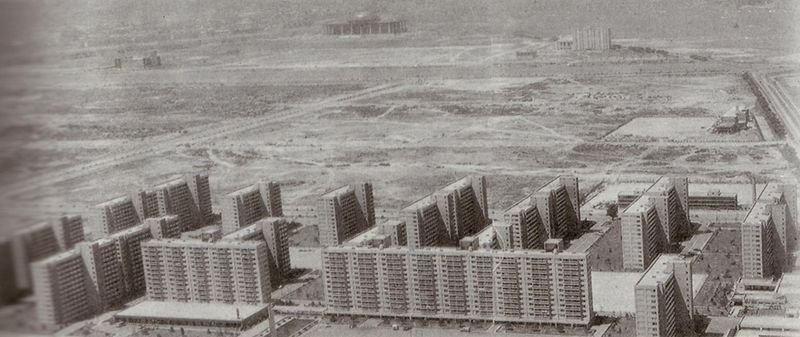
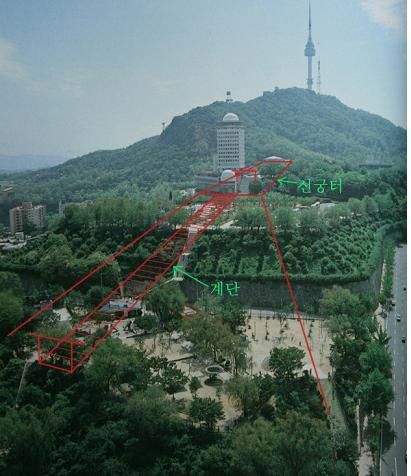
This building was all set to go, but in 1960, president Rhee was overthrown by a student uprising and his statue was torn down (part of it is currently in someone's backyard). Plans remained to build the new national assembly until Park Chung-hee's Coup in May 1960, and in December of that year the plan was canceled (the assembly would remain in what is now the Seoul Metropolitan Council building (across from city hall) until the new assembly building was completed on Yeoiudo in 1975).

Instead, in 1969 the area on Namsan came to house a park dedicated to Kim Gu, an Ahn Jung-geun memorial hall, and other statues and memorials to Korean patriots. It's don't think it's too hard to figure out why tributes to two of Korea's best known anti-Japanese assassins independence fighters would be placed there. In addition the '1,000 steps' (actually, according to Ohmynews, there were 384 steps) were removed. I'd be interested to see if there was any other justification used for removing them other than erasing an unpleasant part of the past.

The area also had park space and a fountain built, and became home to the Korea Children's Center, which was completed in 1970. The building then housed the National Library of Korea from 1974 to 1988, and now houses the Seoul Education Research Institute, and because of where it is placed and it's distinctiveness, the building still stands out in Seoul's landscape today.


The building and the park feature prominently in the 1975 Lee Man-hee film "A girl who looks like the sun," which is worth watching because many locations around Seoul feature as backdrops, and for its featuring of the youth culture of the day (it even has the original version of Shin Jung-hyeon and the Yupjuns' Mi-in (which is different from this better-known version) on the soundtrack).


I'm not sure if those steps would have been part of the original steps to the Joseon Shrine or not - as this picture shows, the area where the main section of the stairs was has been changed so much as to be unrecognizable. Which is really too bad - I imagine the park would be far more accessible if the stairs were still there. On the other hand, I can understand how people who were likely forced to walk up those stairs many times to bow and honor the emperor of their colonial overlords might see them - and the entire area - as a scar upon the city, and relish the idea of banishing them to the dustbin of history.

Thursday, September 13, 2012

Concluding observations from CERD meeting

As an update to Korea's appearance at the late-August CERD meeting I mentioned here, CERD has published "Concluding observations of the Committee on the Elimination of Racial Discrimination" in pdf form here. One thing (out of many) that it mentions is a need for an anti-discrimination law in Korea, a point made in this Korea Times article published today.

Wednesday, September 12, 2012

RAS Lecture on the Earliest Sound Recordings of Korean Music

On Wednesday evening Dr. Robert Provine will be giving a lecture for the Royal Asiatic Society titled "Revolutionaries, Nursery Rhymes, and Edison Wax Cylinders: The Remarkable Tale of the Earliest Sound Recordings of Korean Music." It sounds like it should be interesting:
On 24 July 1896, three young Korean men in Washington DC were recorded on Edison wax cylinders by the famous American proto-ethnomusicologist Alice Cunningham Fletcher, as they sang traditional songs from their home country. These recordings, now stored in the Library of Congress, predate the next known recordings of Korean music, made in Japan, by eleven years. There were only a few Koreans in the United States capital at the time, most of them associated with the Korean Legation that represented the largely unknown country named Chosŏn. These musical recordings, part of the complex story of early Korean-American relations in the turbulent late nineteenth century, resulted from circumstances involving an extraordinary collection of interesting and influential people, from exceptional historical events in Korea and the United States, and from a fair dose of serendipity. The recordings form one part of a wider research project that might be described simply as Korean music in late-nineteenth-century America, the other parts being two museum collections that include Korean musical instruments and the matter of Korean musicians sent to the World Columbian Exposition of 1893 in Chicago.
More details can be found here. The lecture will be held at 7:30 p.m. Wednesday in the Residents' Lounge on the 2nd floor of the Somerset Palace in Seoul, which is north of Jogyesa Temple, and is 5,000 won for non-members and free for members.

Tuesday, September 11, 2012

Criminal record check loophole or slow news day in Daegu?

I'd forgotten about this, but on July 4, the Yeongnam Ilbo published the following article.
When a foreign instructor with a 'sex crime record' refuses no inquiry can be made.

Because of a lax law only parents are anxious.

It's legally mandated that hagwon instructors have sex crime record checks, but because of a lax law, the check isn't done and parents are anxious.

Last May, Canadian native speaker 'C', who has been working for three years at B taekwondo academy in Mr. A's neighbourhood (Daemyeong-dong in Daegu's Nam-gu), was asked by the Nam-gu office for a criminal record check for sex crimes against children, but as of yet they have not received one. C has been working part time on weekends since 2003, before B hagwon moved to its current location, but no particular request for a criminal record check has been made.

According to the law, the representatives of institutions involved with children or youth must get criminal record checks from all people who are hired, and if they hire people with criminal records, they are punished.

Nam-gu office said in response to Mr. A's petition/complaint that, "As a result of the on the spot investigation the foreign instructor was let go in the middle of May and plans to return to his home country immediately. The situation is that C didn't inform us of his alien registration number and we can't do a sex crime background check."

However, it's been revealed that at the end of May, C accompanied a hagwon camp. Mr. A sent photographic proof of this to the Nam-gu office and again demanded a criminal record check be done. As well, if the relevant hagwon law is violated and instructors are hired without a check, a fine is levied against the hagwon, which he demanded.

Regarding this, the Nam-gu Office questioned the Ministry of Gender Equality and Family as to whether punishment was possible if 'the hagwon representative didn't ask the foreign instructor for a sex crime criminal check, but already planned to fire that instructor, and refused to check themselves.' The Ministry of Gender Equality and Family decided 'it is not punishable.' This is because the regulation punishing institutes which don't request sex crime background checks was established in 2010, and there is no legal basis to apply it retroactively.

Mr. A vented his displeasure, saying "If the law is this lax, anyone can refuse a criminal record check and greatly abuse the law by lying and saying they worked before 2010."

Regarding this, a Nam-gu office official explained, "Institute representatives can directly only request a criminal background check. If the foreign instructor refuses and the hagwon fires him, there is no basis for legal punishment."
What a bizarre story. The Canadian has been working at the Taekwondo academy for 3 years, or since 2003. No need for math skills, I suppose. And how is a Canadian working at a Taekwondo academy? I can only imagine he's on an F visa, unless he was volunteering, but the article doesn't say that. And why refuse the Criminal record check? Was there something to hide? If so, why did the academy have him along for a camp after he was supposedly let go? And why apparently lie about this to the Nam-gu Office?

Then there's the question of just who Mr. A is. At a guess, he seems to have it out for the academy, the way he keeps pushing for a CRC to be done (how did he know it hadn't been done?) and demanding the academy be punished. And then there's the office and the way it said it couldn't figure out his alien registration number (which would likely be useless for all but a Korean criminal record check), which sounds like they really didn't care.

I'm also not sure what law it is they're referring to (the amendment to the hagwon law that I know of was passed in 2011). But 'he was hired before it came into effect' seems like a weak excuse (the 2011 law made it mandatory for those foreigners already hired to hand in the necessary documents within a month of the law coming into effect. The fact that E-2 visa holders had already submitted such documents to the MOJ was ignored).

And then there's the question of why this was news (not that 'there's a loophole in the law that needs to be closed' isn't a common enough topic). It must have been a slow news day.

(Note: This was published several weeks before the discovery of Han A-ram's body in Tongyeong, which set off the current burst of concern about sex crimes against children.)

Monday, September 10, 2012

Ilyo Sisa denounces the barbarity of white men against Korean women

At the late-August CERD meeting I mentioned here, Yong Ho-seong, director of the culture and leisure policy division of the Ministry of Culture, Sports and Tourism, described one of its policies:
[I]n order to prevent prejudice or distorted expressions of race and culture appearing in media that is socially influential, we are producing and distributing a brochure for producers of broadcast and media content. And through these brochures, we aim to educate creative artists and content producers from unknowingly reproducing racial prejudices.
But will it have much effect upon those who are knowingly "reproducing racial prejudices"?

On August 24 (2012) Ilyo Sisa, (who previously put out an article about ethnic Korean Chinese with the subtitle "Their 'Korean dream' has been corrupted into 'Korean killing'") published a lengthy creative writing piece article (the translation is almost 1800 words) which reaches back to the English Spectrum incident of 2005 and the 2006 English Village molestation incidents (which did not involve native speaking instructors) and combines them with more recent events to create a tale of atrocious white males on the prowl and the pitiable, victimized, promiscuous, white-worshipping Korean women who enable them.
"Tips for targeting Korean women" spread by foreign English instructor spreads quickly
Treat them as 'sex toys' and throw them away when they're finished

Reporter Kim Ji-seon

The disparaging of Korean women by foreign English instructors and foreigners living in Gangnam or Itaewon is not something that just started yesterday. White men who deliberately approach Korean women for sex or to defraud them commit all kinds of illegal acts against Korean women. Even worse, anyone can commonly hear about incidents of illegal drug taking and rape by foreigners. However, claims that the cause of these incidents is a national character which is lenient towards white people are gaining traction. We are publicizing detailed excerpts of some posts from "Anti English Spectrum," a blog which denounces the barbarity of foreigners.

English Spectrum, a website where one mainly comes into contact with foreign English instructors who live in Korea, is updated with dozens of postings denigrating Korean women on its bulletin board every day. Among these posts, "How to target Korean women," a collection of tips explaining how to meet Korean women to sleep with them was a popular topic, earning more than 2000 hits. Below is a selection of postings put up directly by American English instructors active at English Spectrum.

Korean women who are crazy for white people - Why?

First, "When going with Korean women they hate being held so you must hold their hand. If Korean women have a white boyfriend, they will become more confident and feel proud." Next, ▲when riding in a car or bus, go first. ▲Typically, Korean women will have luxury bags and wear heavy makeup like showgirls. Meet a girl from a rich family who can invest a million won in you during the first month. ▲Korean women pay for the all the date expenses and personally drive you. ▲If you (white men) just speak only in English it will end in bed. Talk in the car. Many Korean women like this gather in the Gangnam area. ▲There are many Korean women who are impatient to go to our white countries. Before they become disappointed in this dream, treat these women as sex toys to your heart's content and when you're done, throw them away. ▲Eat disgusting kimchi and street stall fish cake. If you say you like Korean food, it's even better. ▲If Japan comes up in conversation, criticize Japan unconditionally and take Korea's side. Say to Korean women that small eyes are attractive.▲If the chance to appear on the MBC show 'Surprise' presents itself, go on the show. You'll become a superstar among Korean women overnight. ▲Always tell them they're thin. They prefer thin figures. They have flat chests and butts, but instead recognize that we don't pay and get to sleep with Korean women. ▲ Constantly show that you are a gentleman. If you do this, there is no tree that won't fall after ten chops. Finally, the post says, "Toss away and give to a black colleague any beggar-like Korean girl who wants to go to the US with you."

If the above is true, foreign English instructors' main purpose in coming to Korea, more than for teaching English, is nothing more than a desire to coax Korean women into dating them. In fact, at Anti English Spectrum, they capture in detail and accuse foreign men of denigrating Korean men and women or bluntly trampling upon our country's distinct culture.

Pretend to like Kimchi, if you criticize Japan, you'll enjoy yourself more
Give their body thinking they'll learn English for free, pay for the date


Among the posts is one that says if Korean women are made to choose between a Korean man and white man, as long as you're white 100 of them would chose the white man. Though Korean men have a more outstanding financial capability than white men, Korean women absorbed in white supremacy prefer white men more and think they can learn English for free and choose white men without hesitation. Among northeast Asians (Japan, China, Korea), Korean women are considered the easiest and fastest to sleep with, and no reference was left out of how it was possible to sleep with several women in a single day with only marijuana and alcohol.

As well, they disparaged Koreans, saying, "I kissed two students (middle school students) I'm teaching now. If I want to sleep with them, what should I do? There are no women who are as easy to sleep with as Korean women, why do Korean men pay for sex?"

Their barbarity does not end there. Since there have been daily reports in the news of incidents of molestation and assault by foreign instructors and American soldiers for some time, there has been criticism of our country's English sadaejuui. A typical example is the English Village sexual assault incident. This was not reported in the news, but the incident in which a number of sleeping female students were unilaterally molested by foreign instructor caused great shock.

Attempt to molest minors

A, a female middle school student witness who was molested complained of injustice, saying, "A native speaking instructor at ---- English Village molested my friends and I one by one while we were sleeping. He fondled my breasts and thighs and all around below and when I resisted he ordered me to "GO TO BED" and moved away elsewhere. After that he fondled another friend without hesitation. The next day they accused him of molestation to the supervising teachers but instead the native speaking instructor treated the victims as if they were crazy and the school concluded it was slight physical contact and in the end it all came to nothing. There is romance about the English village, but after going through such a terrible experience, I don't want to go back there again."

An even greater shock was received regarding such sex crimes against Korean minors by foreigners through increasing molestation of elementary school students. J, a native speaking instructor at a large language hagwon in Busan, indiscriminately molested a male elementary school student bathing at bath house and was arrested by police. The problem is that foreigners who commit crimes and are disqualified from teaching can once again fake their degree and return to Korea. By exploiting loopholes in domestic investigative agencies and the immigration agency, the many crimes they have committed in their country, and especially in Korea, are wiped clean and they work with clean hands as instructors or soldiers, earning over 5 million won a month.

Recently, sarcastic videos produced by foreign instructors showing how Korea is absorbed in English sadaejuui have been popular on Youtube. In the animated videos, the Korean students do not understand the foreign English instructor at all and repeatedly scratch their heads and when foreigners see Koreans they consider them to be like fools. In particular, a foreign instructor saying to his Korean students "ME SAY, YOU LISTEN!" is reminiscent of how in the film Tarzan the person, Tarzan, speaks to monkeys. The video had more than 2000 hits and netizens from various countries appreciated it and left comments which made cynical remarks like "I sympathize with you" and "Koreans really are just like stupid yellow monkeys." Korean netizens who saw the video exploded in anger as one and after spreading it on various blogs and portal sites, took the lead in getting its maker to face extensive charges and wanted [by police].

With foreigners' barbarity intensifying day by day, the pace of attempts to determine the cause of their crime pick up, and amid this criminal psychology specialists have caused shock by pointing out that it's the characteristics of Koreans who are crazy about white people which encourage them to commit crimes.

In fact, we heard an eyewitness account of the story of a white man [or white men] in Hongdae from a man who had heard it from a Korean woman. He said, "A white man hugged a Korean woman and touched her bottom and asked for her phone number, and she liked it and was wide open to it, and once drunk he saved her number in his phone. I wanted to understand it and thought it might just be some, but I saw a full 8 people doing it." He said with disgust, "I understand 100 times over why enjoying one night stands with Korean women is so well known among foreigners, and why are there 120,000 Korean women selling sex overseas."

Foreign English instructors share guides to Itaewon and Gangnam
Attempts to kiss and touch university students and of course middle school students


B, a Korean man who worked as a KATUSA, revealed that, "I was shocked to hear talk of how white US soldiers would go to motels with Korean women for three hours. Korean men who didn't pay would be treated like beggars, would be cut down to size and be unable to do that, so why do white men get such generous treatment? Even more, they boast about having a good time with Korean women without paying a cent." "I can't understand why the sexual consciousness of Korean women is so generous to white men in particular."

Because of the open sexual consciousness Korean women have towards white men, there are countless instances of harm done to them. One woman became pregnant after a one night stand with a white man she met in a club, and after finding out contacted the white man but he had already left the country and she decided to get an abortion.

Another woman's case was even more serious. C, a university student who had dated a foreign man once, said in a media interview, "Foreigners' habitual fraud can be seen as charming. They often move in together with a girl and pretend to be her lover and then pocket the rent and deposit and leave the country, and a girl I know who dated a foreign man had a health check and was diagnosed with AIDS and sank into depression." "Most of them (white men) think of Korean woman as targets for one night stands, and there are almost none who think of having a romantic relationship with them. When something happens with a girl, they get afraid and evade responsibility by changing their phone number beforehand or by leaving the country and disappearing."

First we must change from white supremacy

A psychologist stressed that, "With the advent of the era of globalization, the influx of foreigners will gradually increase. With this trend of increasing numbers of foreigners, rather than our unconditionally open mind towards foreigners, there is a need for us to have critical thinking and seriously consider Korea's social climate."
That's quite a tale of woe. Describing Anti English Spectrum as "a blog which denounces the barbarity of foreigners" is one of the more honest descriptions of them that I've come across, but it's probably worth mentioning that hardly anything is posted there anymore (there was only a single post in August).

The description of English Spectrum as being "updated with dozens of postings denigrating Korean women on its bulletin board every day" might have been 'true' before January 2005, but the site was taken over by hiexpat.com quite awhile ago. While the English Spectrum incident continue to reverberate today, with one result being the E-2 drug and HIV testing policy implemented in December 2007, it's quite impressive to see a "news" outlet pretend that it's still going on right this minute.

As for "Toss away and give to a black colleague any beggar-like Korean girl who wants to go to the US with you," I read quite a bit of the English Spectrum material saved at AES years ago, and I don't remember this, though some of what's written in that 'guide' sounds familiar enough.

When considering the anger with white men "bluntly trampling upon our country's distinct culture," one can only assume this "distinct culture" is being equated with "ethnic homogeneity and genetic purity," though I'm still mystified how a country that's said to have been invaded so many times can have possibly maintained such 'purity.'

Reading that it is "possible to sleep with several women in a single day with only marijuana and alcohol," I'm reminded of the line from the 1985 film Queen Bee which presents a Korean view of foreign men's "dream life of Itaewon":
You can have your three essences of life here: women, liquor and joints. That’s why I like this country so much. I’m gonna make a record of having affairs with a hundred girls.
As for this - "I kissed two students (middle school students) I'm teaching now. If I want to sleep with them, what should I do?" - it seems to channel this infamous post from the English Spectrum incident.

The article engages in a tiny bit of hyperbole discussing "daily reports in the news of incidents of molestation and assault by foreign instructors and American soldiers" and then describes a previously unheard-of English village molestation incident (which was "not reported in the news" - how convenient) based on the 2006 incidents (neither of which involved native speaking teachers - see here, here, here and here for more information).

It does reference an actual molestation case (the Busan bathhouse incident) while asserting that foreign teachers try "to kiss and touch university students and of course middle school students" [of course!], but then conjures up the specter of "loopholes" (used by these filthy evildoers to return to teach in Korea once again) and exaggerates how much money they make:
By exploiting loopholes in domestic investigative agencies and the immigration agency, the many crimes they have committed in their country, and especially in Korea, are wiped clean and they work with clean hands as instructors or soldiers, earning over 5 million won a month.
Truly frightening. I also like the reference to the evil teacher fired for posting Youtube videos which supposedly denigrate Korea (causing "Korean netizens who saw the video [to] explode in anger as one" - a prime netizen pastime).

The article also refers to "criticism of our country's English sadaejuui." The aforementioned 1985 film also had a Korean man screaming, "This is Sadaejuui! Sadaejuui!!" as a foreign man drives off with the Korean girl he fancies (which had nothing with him trying to drag her into a motel). New Daily's September 2010 article about drinking at GEPIK orientations also featured this quotation: "The low quality foreign teacher problem is not simply a problem with the foreign teacher’s mind. Our country’s growing disposition towards sadaejuui is also an important reason." The above article goes on to make a similar claim:
With foreigners' barbarity intensifying day by day, the pace of attempts to determine the cause of their crime picks up, and amid this criminal psychology specialists have caused shock by pointing out that it's the characteristics of Koreans who are crazy about white people which encourage them to commit crimes.
So you see, the problem is not only with the white men, but with the treasonous misguided women who "are crazy about" them. We learn the truth about these white men - that "one woman became pregnant after a one night stand with a white man" who fled the country, while another Korean damsel had a white man move in and "pretend to be her lover and then pocket the rent and deposit and leave the country," and yet another "who dated a foreign man had a health check and was diagnosed with AIDS and sank into depression." In the end, they are faced with this truth:
"Most of them (white men) think of Korean woman as targets for one night stands, and there are almost none who think of having a romantic relationship with them.
It's interesting how these truths are quite similar to the MBC video "The Shocking Truth About Relationships with Foreigners." Note that its producer said the piece intended to portray "Korean women who are out of their sense and get involved in these kinds of affairs" and that "We need to be awakened and try to change this culture." It's good that Ilyo Sisa has also taken up this fight, and especially that it names Anti English Spectrum as a source, especially when you consider what the founder of AES said was his reason for forming the Naver cafe 7 years ago:
Anti English Spectrum cafe manager 'Bba'allyuchi,' who is leading the 'anti' movement by establishing the cafe and making the photos of the lewd party public, explained why he opened the cafe: "It's always just sad that some thoughtless women sympathize with foreigners who they don't realize have approached them with this (sexually demeaning) way of thinking about Korean women." "[This cafe] is a place where people who are worried about this and who want to make an issue of foreigners who demean Korean women as if they are all cheap whores."
The Ilyo Sisa article has lots of 'quotes' which sound like they came from such 'bitter worried people,' such as "I understand 100 times over why enjoying one night stands with Korean women is so well known among foreigners, and why are there 120,000 Korean women selling sex overseas." Or the KATUSA who says that "I was shocked to hear talk of how white US soldiers would go to motels with Korean women for three hours." [Which wouldn't be so shocking if he admitted they're prostitutes, much as the Itaewon club described in a July 2010 New Daily article (titled "Itaewon - 'a loser's paradise' where Korean women are ruined?") where Korean women throw themselves at foreigners in is actually a juicy bar.] The descriptions of white men in Hongdae picking up so many women is reminiscent of the July NoCut News article about the "night streets of Itaewon" (scroll down) (or perhaps of this 2005 article). We're eventually left with a perplexing question:

(From 'Queen Bee' - He's actually saying "This is sadaejuui!")

How to solve this problem?
A psychologist stressed that, "With the advent of the era of globalization, the influx of foreigners will gradually increase. With this trend of increasing numbers of foreigners, rather than our unconditionally open mind towards foreigners, there is a need for us to have critical thinking and seriously consider Korea's social climate."
Answer: Become more xenophobic!

So there you have it.

I couldn't help noticing that the reporter - Kim Ji-seon - is most likely female. Which begs the question: Why is it that so many of these articles are written by women?

For example, in 2006, Sin Yeon-hui used AES as a source to write 6 sensationalist articles for Breaknews:

07.24 “Low-quality foreign teachers absorbed in money, women, drugs.” [Link]
08.07 "Low quality English teachers: 'Korean women are a source of money and sex partners'" [Link]
o8.16 "Women give English teachers 'full service like a king'"[Link]
08.21 "Affairs with High School Students, Spreading Nude Photos on the Internet" [Links: English Korean]
09.12 "Foreign teachers demand mothers in substitution for tutoring fees." [Link]
09.18 "Tracking [down] blacklisted foreign teachers suspected of having AIDS" [Links: English Korean]

The latter article was used in petitions to the government for HIV tests for foreign teachers, much as May 2007 Sports Chosun by Kim Yun-hui was: "From molestation to AIDS threats - Shocking perversion of some English teachers; Beware the 'Ugly White Teacher.'" [Links: English Korean]

As well, there were two articles written by Lee Mi-ji (who is mentioned on the Anti-English Spectrum site) about foreign teachers in the Donga Ilbo in May 2009, one of which quotes Lee Eun-ung and features an awesome cartoon.

One of the best known instances of such 'journalism' is the July 2009 series "Native speaking teacher frauds" by Chosun.com intern reporter Choi Hui-seon:

"The sex crimes of native speaking teachers who don't distinguish between young students and female coworkers" [English Korean]
"'[We're] Substitutes for married women's husbands...' The demeaning words of some native speaking teachers." [Links English Korean]
"Can even high school dropouts live in Korea?" [Links: English Korean]
"Foreigner with 9 crimes on his record professor at distinguished Korean university" [Links: English Korean]
"Native speaking teachers only protest articles criticizing them without reflection" [Links: English Korean]

And those are just some of the particularly sensationalist articles. While some might wonder if
they were dumped by a foreign boyfriend or whether they have fully imbibed the 'foreign predator' koolaid, I'd wonder whether they are fairly new to the game and simply have little choice but to write it up when handed the assignment by their editor. I can't help wondering if perhaps it's a way to make sure they're playing for the right team, kind of like writing out a self-criticism for their gender as a whole. Mind you, mandatory 'self-criticism' sounds rather North Korean.

"The entire world accuses the US Army of unpardonable barbarity
against south Korean women."

I guess that's a little more to the point than the 1800 word opus above...

Friday, September 07, 2012

Foreign teacher busted for meth

Yesterday Newsis published the following report:
Foreign instructor arrested and charged for smuggling drugs via international courier

On September 6, the Cheongju District Prosecutors' Office announced that it had arrested and charged A (34), a British hagwon instructor, for violating the Narcotics Control Act by using an international courier to smuggle methamphetamine on several occasions.

A is suspected of smuggling meth on several occasions such as on July 31, when he had 0.37g sent from the Philippines via international courier, and smoking it at home.

A said during the prosecutor's investigation that, "I took meth that had been given to me on several occasions by my girlfriend in the Philippines."

The prosecutors had earlier been contacted by the airport which discovered drugs in the international courier shipment sent to A, and after disguising themselves as courier employees and confirming that shipment was A's, arrested and investigated him.
This is the first reported drug bust of a foreign teacher in two months. For some reason, Newsis is the only media outlet that has reported this. Perhaps the Korean media is distracted by something else?

Thursday, September 06, 2012

Protests, public space in Seoul, and cyberspace - Part 5

Part 1: From the Joseon Dynasty to the 5th Republic
Part 2: Sports nationalism in 2002: Through a video screen darkly
Part 3: Funeral processions from the Joseon Dynasty to the present
Part 4: The 2002 candlelight protests: A new form of demonstration
Part 5: Anti-communist exhibitions

I've looked at how the public space in downtown Seoul - especially near city hall and Gwanghwamun - has been used by protesters since the end of the nineteenth century, but it's worth noting that the government also used the same space. While this is obvious today, with the existence of plazas created (by the city government) in front of city hall, Gwanghwamun, and Cheonggyecheon, the space in front of city hall was used by the government back in the 1960s as well, as can be seen in these photos of anti-communist exhibitions from 1964 and 1965.

(The Bando Hotel is in the background on the right)(1964)


(A captured North Korean submarine) (1965)

I've never put much effort into looking for it, but I think it would be fascinating to see South Korean anti-DPRK propaganda from the 1950s to the 1980s. School textbooks would be especially interesting, as I have a recent grade 6 통일 (Reunification) textbook, and I imagine a comparison would be pretty jarring.

Wednesday, September 05, 2012

Statistics on foreigners in Korea, and the ROK before the CERD

I've written two posts (here and here) about the ROK being taken to the CERD accused of racial discrimination over HIV testing of foreign English teachers.

This year the Republic of Korea submitted its "Combined fifteenth and sixteenth periodic reports of States parties due in 2010," which can be read here. The report has lots of interesting statistics, including those on naturalized citizens, foreigners, mixed race marriages and children, and refugees, some of which I'll reprint here:
The total number of naturalized citizens during the eleven years from 2000 to 2010 amounts to 98,329, which is 0.19 per cent of the 50,515,666 registered citizens. [...] Chinese immigrants take up the majority of naturalized Korean citizens, followed by those from Vietnam and the Philippines. The number of naturalized citizens from Vietnam outnumbered that from the Philippines in 2007. 16,312 persons were naturalized in the year 2010 alone, and among them 11,874 were Chinese (72.8 per cent), 2,997 were Vietnamese (18.4 per cent), 450 were Filipinos (2.8 per cent), 181 were Mongolians (1.1 per cent), and 68 were Pakistanis (0.4 per cent).
Here's a table illustrating this by year (click to enlarge):


Number of foreigners compared to Koreans by year (note that it says 'foreign residents' but those figures include tourists):


The number of documented and undocumented foreigners:


The number of married immigrants (foreigners who married a Korean citizen) is consistently increasing every year. As of December 2010, 141,654 married immigrants are residing in the country: 18,561(13.1 per cent) are males and 123,093 (86.9 per cent) are females. By nationality, there are 66,687 Chinese (including 31,664 ethnic Koreans, 47.1 per cent), 35,355 Vietnamese (25.0 per cent), 10,451 Japanese (7.4 per cent), 7,476 Filipinos (5.3 per cent), 4,195 Cambodians (3.0 per cent), 2,533 Thais (1.8 per cent), and 2,421 Mongolians (1.7 per cent).


Although no statistical data has been kept regarding children born from inter-ethnic unions at the State level, the Ministry of Public Administration and Security has been able to accumulate data on the subject by incorporating a survey on foreign residents' children (under foreign parents, foreign-Korean parents, naturalized Korean parents) with the 'Study on the Foreign Residents by Local Administration,' which has been conducted annually since 2006.[...]

As of 1 May 2011, there are 151,154 children of foreign residents residing in the Republic of Korea. Among them, there are 93,537 (61.9 per cent) children under the age of six (children not attending school) and 37,590 (24.9 per cent) between the ages of 7-12 (children attending elementary school), which accounts for 86.8 per cent of the total foreign residents‟ children in Korea. As of 1 May 2011, 76,985 (50.9 per cent) of the foreign residents‟ children are male and 74,169 (49.1 per cent) are female. 9,621 children (6.4 per cent) have two foreign parents, 126,317 (83.6 per cent) children have one foreign parent, and 15,216 (10.1 per cent) children have parents who are naturalized citizens.


Since Korea joined the Convention Relating to the Status of Refugees in 1992, a total of 2,915 persons have applied for refugee status by December 2010; 222 of them were recognized as refugees3, and 136 applicants were granted stay permits on humanitarian grounds. 258 applications were reviewed in 2010, and 424 applicants still remain on the wait-list as of December 2010. Since the establishment of the Nationality and Refugee Division in the Ministry of Justice in February 2006, the number of recognized refugees and those granted stay permits on humanitarian grounds increased significantly. The yearly statistics from 2006 to 2010 are as follows:

For more on the early years of accepting refugees, here's a post I wrote in 2005.


Now, submitting the report these statistics are taken from was only one step in a process states who are party to the Convention on the Elimination of All Forms of Racial Discrimination undergo. For the next step, on August 22 a delegation from the Republic of Korea presented the report to the Committee on the Elimination of Racial Discrimination, who then asked questions about the report regarding how the ROK is implementing the provisions of the Convention. The ROK then had a chance to answer some of the (many) questions which were asked.

At one point, Anastasia Crickley, the Committee Member acting as Rapporteur for the Report of the Republic of Korea, asked
I understand also that there has been a lifting or a proposed lifting of the requirement of mandatory HIV testing for all foreigners, and I would be interested to know something about this – which foreigners does it apply to, why, from where, and in which circumstances?
The ROK chose not to provide an answer to this, which is interesting, considering that the ROK has a complaint pending on that very topic before the Committee.

This isn't the first time such a question has been evaded by the ROK. In May 2008, the ROK took part in the Universal Periodic Review before the UN Human Rights Council (in which the domestic human rights records of all 192 UN Member States are reviewed every four years) and were asked by the UK about HIV testing for the E-2 visa:
Some visa categories, notably ‘E-2 Teaching Foreign Languages’ ask applicants for their HIV status, and there have been reports of foreigners being deported because of their HIV status. Does the ROK Government consider this to be discrimination and, if so, what measures will it take to address this issue?
No answer was given to this question, however.

As for the CERD meeting of two weeks ago, this was but one of many topics that were brought up, and there are lots of interesting questions asked. A summary of them can be found here, while video of the nearly six hour meeting can be watched and downloaded here.

Sunday, September 02, 2012

An inventive way to isolate people

Last night I was emailed and told that a friend of a friend had heard that police were warning people not to answer a call from the number 010-4878-4040 lest they be charged 250,000 won. I did a news search for the number and according to the Chosun Ilbo it's an internet folktale - not only did the police say it's not possible, but they also caught the guy who started it. Apparently the person with that number misdialed and called him and they got into an argument, so to get revenge he spread that story on the internet, hoping that people would no longer accept his or her calls. That's inventive, twisted, amusing and kind of sad all at once. You have to wonder how many people didn't answer this poor person's calls. I guess it's no longer an issue - the number is no longer in use.