Friday, November 23, 2012

Turkimchi!


Yesterday News1 (and a few other outlets) published this photo of a Thanksgiving party at Pagoda, with the students and foreign teachers hanging out. Whether teacher or student, the woman's role is apparently to spoon feed the men like they're infants. At any rate, nothing says Thanksgiving like turkey and kimchi. Hopefully the foreign teachers get to return the favour during the Lunar New Year holiday by dousing the ddeokguk with ketchup, mustard, and mayonnaise.

(Snark aside, if the hagwon did provide turkey for their teachers, I'm sure it was a nice treat. Though perhaps they could have done without the media presence.)

Thursday, November 22, 2012

Former foreign English teacher spreads Korean culture in New York, invited to Korea

Via ROK Drop comes this Yonhap report about a visit to Korea by students and representatives of a school in the U.S. which uses the 'Korea Style' of education:


A group of teachers and students from U.S. charter schools that successfully adopted the Korean education met with the education minister here on Tuesday and shared their experiences.

Some 40 faculty members and students from Democracy Prep Public Charter Schools (DPPS) are in Seoul for a two-week trip through Wednesday to have chances to learn the Korean language and culture, just as they did at their schools.

Inspired by the Korean education system after having taught English in the Asian country for one year, Seth Andrew established the DPPS network in Harlem in 2006 and currently operates seven schools in New York.

The schools have been in the spotlight for their outstanding academic performance, with parents having enthusiastically enrolled their children in the charter schools, and Mayor Michael Bloomberg hailing their success, according to local media.

All students, mostly Latinos and African-Americans, are required to learn Korean language as a mandatory class, and they also do club activities related in Korean culture, such as Korean traditional dance and folk songs, or Taekwondo, through which they can learn "the core values of discipline, respect and enthusiasm," according to a school official.

During a meeting on Tuesday, South Korea's education minister Lee Ju-ho and the DPPS members exchanged views on "the secrets behind the successful Korean system and the personality education which Seoul has put an emphasis on in recent days," the education ministry official said.
I wonder if they all had to dance to Gangnam Style while singing 'Korean Style.'

It was back in June that the Korean media discovered this school. From a Korea Herald report at that time:
The Korean way of learning is making for a success story in New York City’s Harlem, thanks to a devoted educator who prioritizes discipline, enthusiasm and accountability.[...]

[Speaking of  Seth Andrew:] The 34-year-old, who used to teach English at a public school in Cheonan, said he had a “tremendous impression” from his teaching experience in Korea.

“I was in Korea for one year but the impact that had on me was profound, because I saw my students love learning and also love and respect teachers,” he said.

There is also something special about his school. Unlike other American schools, Democracy Prep High School is known for its strict discipline, and students study longer hours than their neighborhood peers.

He said the five core values of his school are discipline, respect, enthusiasm, accountability and maturity.

“I call it DREAM value,” he said, adding that he, especially, copied the benchmark for the level of discipline and respect for teachers in the Korean education system.
The American media had reported on this school much earlier, for example in the New York Times or here:
Black visits a Korean language class, which all Democracy Prep students take. Andrew says that the school chose Korean because it’s phonetic and has an alphabet (unlike Chinese and Japanese where there are thousands and thousands of characters) so it is actually possible to learn to read and write anything in Korean pretty quickly. Also, he figures it will give his students an advantage when they apply to college, as very few black and Latino students have studied Korean.
As noted at ROK Drop, however, the reason the students at the school get such high marks is that they only invite students who already have high marks.

Korean media reports aren't very interested in this, however, and for obvious reasons. The most important aspect of the school is that it disseminates Korean culture (a video of the students doing Korean-style drumming is here; another photo of students learning Korean culture is here):
Harlem, long one of New York City's more infamous neighborhoods, is home to a highly successful public charter school where Korean language and culture have become core pillars of their curriculum.

Recently the Democracy Prep Charter School, located in the borough of Manhattan, held a "Korean Night" festival.

The event showcased an array of performances,.. from a fusion of traditional Korean folk dance and pop music, to a demonstration of Taekwondo martial arts.

The stunning display of multiculturalism is even more impressive because the school doesn't have a single Korean student.
No doubt this is impressive for people who equate culture with 'blood.'

Speaking of blood, Mr. Andrew, if you ever feel like seeing the Korean education system at first hand again, and enjoying the wonders of 'discipline' like this, positions are open - as long as you turn in your drug and HIV test.

Tuesday, November 20, 2012

Teenage Runaway articles update

As I noted in this post, the Hankyoreh has been translating a series of its articles about prostitution among teenage runaways, and several more have been added:

Part 1: Runaways flee abuse at home, end up in prostitution
Part 2: The lives of female runaways in Seoul
Part 3: Runaways' prostitution
Part 4: Runaways live with the pain of rape
Part 5: The exploitation of teen runaways

Al Jazeera also reported on this topic.

All of the articles are worth reading; Al Jazeera's starts out with a correction stating that it "first published this story quoting an estimation by a coalition of women’s groups that there are 1.2 million women in the sex trade in South Korea, and that 20 per cent of all South Korean women aged 15-29 were involved in prostitution. However, these NGO figures are not supported by any official data and are impossible to verify."

It's hard to know what the figures are (1 million was thrown around in reports before the 1988 Olympics), though 20% in the 15-29 age bracket seems too high - unless, according to this report, you happen to be a North Korean defector ("More than 30 percent of women from the North turned to prostitution as they tried to settle in the South, according to one study"). On the other hand, one study in 2008 found that one in every three female secondary school students in Busan had received sex trade proposals while chatting online, and 6.5% of the respondents said they had sold sex. So while 20% is too high, the actual percentage is still likely to be an uncomfortable figure.

Needless to say, with the first hand accounts in the articles, they're a pretty depressing read.

Monday, November 19, 2012

In the valley of Misan-ri

Last weekend I headed to Misan-ri in Gangwon-do, through which flows the Naerincheon stream. I'm usually able to read in cars, but that final road along the stream was a bit too windy for any of that. While the leaves were just a little bit past their peak last weekend in Seoul, in the higher elevations of Gangwon-do the only colours left were those evergreen trees which change colour and drop their needles (though I'm not sure what they are exactly; in the photo below the needles appear similar to spruce).


At any rate, they were colourful enough.


The Naerincheon Stream is set in a deep valley, and in the summer you can raft down it.


It took about an hour and a half to reach the pension from the two or three year old Seoul - Chuncheon Expressway (#60), which is quite impressive for just how much of it is made up of tunnels (it's eventually supposed to run all the way to Yangyang). It still took 6 hours get back to Seoul, however; here's the view of cars backed up at the Gapyeong rest stop.


It's always nice to get out of Seoul, but returning is often a trial...

Thursday, November 15, 2012

Seoul's new city hall

I visited the new Seoul city hall a few weeks ago to check out an exhibit in the new building. A model of both the old and new city hall buildings is on display, and looking at the outside of the new one, I'm reminded that I once described the design as 'atrocious.'


It's still not much to look at on the outside, but the inside is certainly interesting. There's a coffee shop on the 9th floor (if I remember correctly) which provides a pretty good view of Seoul Plaza. The more compelling reason to visit is to take in the spectacle of the building itself. The outer latticework creates a open space inside which is full of terraces, platforms, plants and a sculpture made of what looks like balloons (but is clearly something more solid) which is lit from within. My friend made a comment about how we seemed to be visiting the future.


Oddly enough, the reason we visited was to check out an exhibition of drawings by a manhwa artist of scenes of Seoul from the 1930s to the 1960s based on stills from contemporary films (many of which I've seen).

(A scene of streetcars on Jongno in front of the Korean-owned Hwashin Department Store, 
built in 1931, demolished in 1987, and now the site of Jongno Tower)

On October 26 the old city hall building was opened as a library, but I haven't had a chance to visit it yet. This article has some information about the library as well as a photo of its interior, but seeing as everything but the facade of the building and the tower was demolished (see here), there won't be much on the historical architectural side to see (such as at the refurbished Sinsegye Department Store). Still, I imagine I'll visit it at some point to see what's been done with it.

Monday, November 12, 2012

In case you've forgotten, most foreign English teachers aren't certified teachers

This morning Newsis posted this article:
Only 10% of Chungcheongbuk-do native speaking teachers have teaching certificates

It's come out that among native speaking teachers placed in Chungcheongbuk-do elementary, middle and high schools, only 10% have teaching certificates.

According to materials from a Chungcheongbuk-do education office administrative inspection on the 12th, as of April of this year, out of 470 elementary, middle and high schools, 408 schools (86.8%) have 315 native speaking teachers placed in them.

This is an increase from last year, when 371 schools (78.3%) had 283 native speakers placed there.

However, among the 344 native speaking teachers placed in schools, English experience centers and other provincial education office institutions this year, no more than 36 native speakers (10.5%) have teaching certificates.

As well, this year among native speaking teachers the number of those who had not completed the course for a TESOL foreign language instructor certificate reached 207 (60.2%).

Regarding this, an official from the provincial education office said, "There is no problem selecting them as native speaking teachers as long as they have a diploma from one of the 7 countries which uses English as the mother tongue, such as the U.S. or England"
You can pretty much set your watches by these kind of reports; they come out several times a year. The official quoted in the last paragraph should likely note that generally a diploma from one of the 7 countries alone won't get you an E-2 visa, though I suppose, since one school had a teacher from India, that there are some loopholes there. Also worth pointing out is that if there are 315 teachers in 408 schools, there are quite a few working in more than one school (a friend working in Gongju years ago worked in 3 or 4 different schools a week).

Also on this topic are Scroozle's thoughts about foreign teachers in the public education system in Korea  (via Roboseyo).

Friday, November 09, 2012

Interesting op-ed in the Chosun Ilbo about new MOE requirements for foreign teachers

On November 5 the Chosun Ilbo published the following op-ed in its hard copy edition:
Expedient administration 'discriminates' against foreign instructors
Kim Ung-sik, Sogang University public policy graduate student

As the number of native speaking instructors in the private education market gradually increases, so do arguments over teachers who are unfit due to things like criminal records. To improve this, last October the amended "Act on the Establishment and Operation of Private Teaching Institutes and Extracurricular Lessons" came into effect and it became mandatory for native speaking teachers to submit copies of a criminal background check, references, a health check, their diploma, and their passport, visa and foreign registration card to the relevant education office for verification.

However, it should be pointed out that in this process the purpose of the law's amendment has been overshadowed due to administrative expediency.

Unlike other visas which are for working in Korea, for the conversation instruction visa (E-2) things like a criminal background check and diploma must be submitted to the immigration office. As well, within 90 days the results of a medical test taken in a Korean hospital must be included when doing foreigner registration. In other words, the fact that a foreigner in Korea possesses an E-2 visa and alien registration card is in the end the same as proof of verification at the national level. However, education offices demand the same verification materials again every time native speaking teachers change workplaces (hagwons, etc.) and if this is not followed, they can impose a fine of up to 3 million won according to the revised law. In this situation,the actual circumstances are that hagwons and foreign instructors are going to immigration offices to request that their information be accessed so that they can see the documents they submitted when they applied for the visa and submit copies to the education offices. Native speakers have also complained of how foreigners who have already passed through a legal process when entering the country and are already in the country repeatedly have ineffective materials demanded of them, and this has also caused a problem of administrative waste.

In the long term it will be necessary to develop a context dependent management program, but when native speaking instructors who have already entered the country change jobs, the most recent health check (including drug and marijuana test results) is enough to serve the purpose of the revised law. There are more than a few complaints that policies which view native speaking instructors as potential criminals are a form of discrimination against foreigners, but because these foreigners are a minority it is not easy to advance a political view or build up public opinion to improve the system. Korea is rapidly developing into a multicultural society. Therefore, it's urgent that we move away from an amendment which went along with public opinion centered on Koreans and establish a system for foreigners which everyone can accept.
You know, I honestly can't think of an op-ed or editorial that I've seen that has ever sided with foreign teachers (certainly these ones, this one by Lee Eun-ung of AES, and the one saying that foreign teachers are opium eaters didn't). It's nice to see that this was published, especially since the author has a clear grasp of the issues. And as he put it, "the fact that a foreigner in Korea possesses an E-2 visa and alien registration card is in the end the same as proof of verification" (something I looked at here).

The hagwon law revision stated that the "person who established or manages the hagwon must, when hiring a foreign instructor" must submit and "have... confirmed before hiring the instructor" a criminal background check, a health certificate (issued within the previous month and including the results of a drug and marijuana test), an educational background certificate, and "anything else prescribed by presidential decree." It also stated that according to the requirements above, "those currently working as foreign instructors must submit the documents listed in article 13-2 within one month of this law coming into effect." This was problematic considering that US and Canadian national criminal record checks take 3-4 months to process, and as was discussed at Dave's ESL Cafe (here, here, here, and here) some Ministry of Education branches would allow teachers already in country to make copies of their documents at the immigration office, while others wouldn't. During its "The Reality and Twisted Values of Some White Men" series this summer, NoCut News also mentioned the hagwon law revision and quoted a MEST official who said, "We are pushing ahead with an enforcement ordinance amendment which will omit the criminal record check and degree check for instructors who have been issued an E-2 conversation instruction visa." Of course, the NoCut News article railed against this 'weakening' of the revised bill (which would make it easier for white men to sully the motherland) and complained that "in the name of MEST's administrative expediency and due to the clamor of hagwon operators, the likelihood of wavering from the original purpose of a bill revised with difficulty gets larger and larger." Needless to say, it's ironic that both the NoCut News and this op-ed make reference to "administrative expediency," but mean it in opposite ways.

At any rate, I'm glad Kim Ung-sik took the time to write this piece, and it was nice to see the Chosun Ilbo publish it.

Wednesday, November 07, 2012

Busan Police: Parents hiring Filipino nannies or foreign instructors "need to take particular caution"

On October 29 the Law Times published the following report:
Hired foreign teacher turns out to be drug criminal
Busan prosecutors arrest 2

Investigators from the Eastern Branch of Busan District Prosecutors' Office announced on the 25th that Mr. A (37), a Filipino domestic assistant, Mr. B (24), a Chinese American English teacher, and Mr. C (30), a Korean American English teacher, had been arrested and charged for secretly bringing methamphetamine and marijuana from places like the U.S. and Hong Kong.

Mr. A worked as a domestic assistant and is suspected of smuggling 8.8 grams of meth from Hong Kong and taking it when the owner of the house (where he worked) wasn't at home.

Mr. A is known to have hidden the meth in his bag or clothes and re-sewed them or had it delivered via international mail. It was revealed that the amount of meth he smuggled was enough to dose around 290 people. As it's been confirmed that Mr. A often visited the Filipino Market in Hyehwa-dong, the prosecution is investigating drug buyers and takers centered around the Filipino market. They have also requested that the Hong Kong police cooperate in their investigation by providing information related to sellers who provide drugs to Filipino housekeepers.

Mr. B, who works as an elementary English teacher* at an international university's school of continuing education, is suspected of secretly bringing 4.84 grams from the U.S. and smoking.

Mr. C worked as an English teacher** in a language hagwon and is charged with smoking 2.8 grams of marijuana on 14 occasions since August.

The prosecution said that "All of the foreigners prosecuted for drug crimes are residents of the Gwanganni Beach area, and the area's many low rent, small officetels and foreign clubs are the cause of frequent drug crimes." "Parents who employ Filipinos as domestic assistants extra-legally for the purpose of child care and English education or foreign instructors need to take particular caution."
I'm not sure who's responsible for this grouping of arrests - whether it's the police or the media outlet - but I'd imagine it's the latter, considering the headline (which is even more amusing since the article mostly focuses on the Filipino - not that that's surprising). Sloppy work all around, really - the sub-headline says 2 were arrested, while the opening paragraph says it was all three. Also, I'm assuming the (*) is  not an elementary school teacher, while (**) you'd think the Law Times would know that teachers (교사) don't work at hagwons; instructors (강사) do. Nice to see prosecutors warning parents to take extra care around foreign teachers and Filipino nannies - it has been three years since national assembly representative Lee Ju-yeong described native speaking instructors as 'especially potential child molesters,' and one can never be too vigilant.

Monday, November 05, 2012

We don't envy schools with native speaking teachers

On October 15, Herald Gyeongje published the following article:
Even without a native speaker, our school is good at English

Goyang Baeksong Elementary School student cyber English education, takes note of model to replace native speakers

The most expensive part of private education is English. In public education as well the area with the greatest budget put into it is the hiring of native speaking assistant teachers for English speaking. Amid never ending controversy over the effectiveness and verification of native speaking assistant teachers, Goyang Baeksong Elementary School, which has no native speaking assistant teacher, is running a self-directed learning English study program which students and teachers can participate in, and is drawing attention as an alternative to native speakers.

The model introduced at 62 schools in Gyeonggi-do is the self-directed learning English study program 'Cyber GIFLE(Gyeonggi-do Institute for Foreign Language Education).’

At Goyang Baeksong Elementary School, which has no native speaking assistant teacher, once a week students have a cyber lesson under the guidance of a teacher in the school computer room, and four days a week they cyber study at home. Through face to face management of students by teachers at school, they can give feedback on the contents of their home study and help the students improve their English skills.

Go Eun-jeong, a teacher in charge of Cyber GIFLE explained that, "As Cyber GIFLE is being run, students themselves have confidence in their English speaking, and as there is an appreciable improvement in their reaction and concentration during class time, we don't envy schools with native speaking assistant teachers."

In particular, the word from current teachers is that Cyber GIFLE's characteristic repetitive study which drills correct-in-context integrated sentences immerses students in the fun of learning English speaking. With drilling where students think of and speak one or two sentences by themselves, it breaks the stereotype that you must have a native speaking assistant teacher to improve one's English ability.

Goyang Baeksong Elementary School's principle Shin Dong-ju said, "Cyber GIFLE is a program which, without native speaking assistant teachers, realizes English education by the education office, school and students working together, and by reducing the budget and increasing educational effectiveness, kills two birds with one stone." "With good content, the interest of parents and the effort of teachers, you can see that it's a model which strengthens public education."
I'll have to reread that, but I think that elementary school doesn't have a native speaking assistant teacher. It's not surprising this is happening in a school in Gyeonggi-do, the province which pioneered the 'massive native speaking teacher budget cut.'

The same day the above article came out, Yonhap reported (in Korean) that the education ministry planned to recruit 2,300 English speaking Korean instructors for next year, but stuck a photo of a native speaker at the top of the article, which may be why the original English version of the article (which can be see here). It subsequently corrected the English version (though perhaps the original Korean version also contained the mistake - though perhaps not, since it still has the photo of the foreign teacher).

The Joongang Ilbo later reported in more detail on the ministry's move, noting that there are currently 6,104 English speaking Korean instructors in Schools around the country, and once 2,300 more are added, there will be 8,400, which is meant to give every school access to one. It also notes that
these Korean instructors who speak English fluently will focus on revamping the English education in classes and teach from revised teaching material.  
The ministry further said it plans to revise an ordinance so that these English-speaking teachers will be able to work at the same school for up to eight years. Currently English instructors can be employed by the same school only up to four years.
These Korean instructors were first introduced to public schools in 2009, a topic Brian covered several times.

Sunday, November 04, 2012

Survey about teaching English in Korea

A reader asked me if I could direct people toward an online survey he has posted about teaching English in Korea:
Basically my survey is to test some of my core assumptions about the ESL teaching community in Korea. I taught there in 2007-2008 for 1 year and although I had a CELTA and some great intentions I quickly found it wasn't enough to run a classroom.

While there I founded the Bundang Social Club (BSC) on Facebook, which has around 1700 members now. Although I don't run the club anymore (it's now in the hands of far more capable people who are on the ground) I learned a lot (and continue to) from my experience with the club. I realised that the problem isn't that Korea attracts malcontents or that the ESL industry is full of people who don't care about teaching and would rather party. It's that if you don't have the right resources and work environment then you won't be very effective at your job and if you aren't good at your job you won't enjoy going to work everyday and if that's the case then you're very unlikely to be a happy camper in general. And it seems a little silly to me really as there's no shortage of good resources in the world (I know having taught ESL in Sydney for a few years after I left Korea) and there's no shortage of teachers who need them, so all that's required is to put the two together.

So my questions mostly relate to work conditions as well as other questions designed to try and give me more of an insight into what the ESL teachers think and feel are their biggest problems at work. As I wrote the survey I realised just how many assumptions I had about who Korean ESL teachers are as a group and how untested they were not just by me but by almost anyone. I can think of only one blog out there that takes a data and research driven approach to what they write and that's your blog, Popular Gusts. I think the results would be really exciting and would shatter some core assumptions. I also think it's one of the few, if any, meaningful ways that the average teacher can have their voice heard in a quantitative and qualitative way. I'd love to get 1,000 respondents and have the results in the public domain. If people answer, share with their friends and post it to different places online then that would be really neat, I think.

Whatever you can do to get the word out would rock. Thanks heaps, I'll leave the survey up for a week or two more.
 The survey is here.

Thursday, November 01, 2012

A day late, but...

A friend emailed me today telling me to check out bing.ca; the main page featured the house below with ghosts appearing from time to time. As it turns out, the house is just down the road from him, overlooking Lake Erie. There are quite a few abandoned farm houses like that in his area.


I'd tried making a jack o'lantern from a danhobak a few years ago; its small size presented certain challenges, but it didn't take long to clean out, unlike the one I made from a real pumpkin this year.


I'd kind of forgotten about bobbing for apples until I saw this article about a foreign teacher at a school in Jeju having a Halloween party. Looking at the second photo of the girl with the apple, I could only remember working for a large hagwon a decade ago and having the idea of apple bobbing knocked down by the comment, "Uhhh, do you know how expensive apples are here?"

One video I'd use to illustrate trick or treating is this scene from "It's the Great Pumpkin, Charlie Brown."


Kid Koala's take on that scene is rather classic:


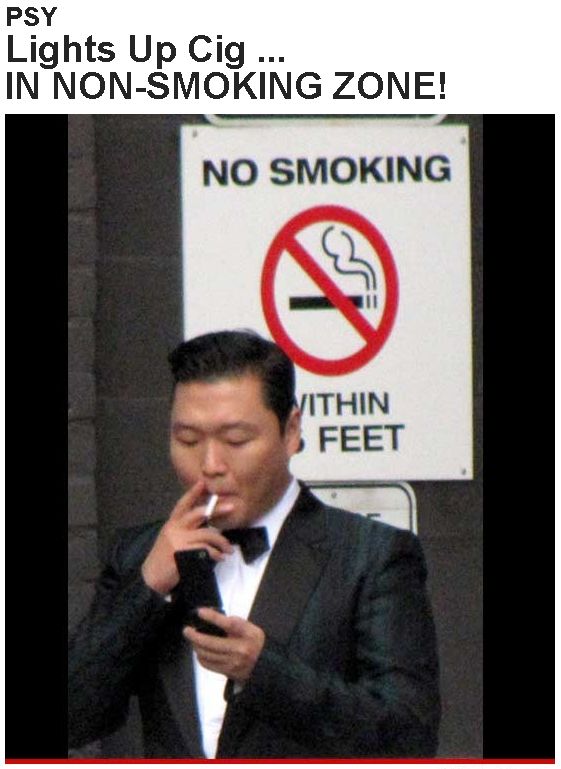
Psy before feet

Found via Daum, I found this photo (from here) and commentary amusing:


Korean invisible horse rider Psy was too busy checking how many minutes of fame he had left to notice that he lit up a cigarette right next to a No Smoking sign in Toronto on Tuesday.

In his defense, who has time to follow the rules when you're squeezing the very last drops out of that "Gangnam Style" song?

Eh sexy lady. 
What amused me was the idea that this took place in Toronto, since Canada - well, the world, really, excepting Liberia, Burma, and the U.S. - uses the metric system.

(Mind you, I'll admit that, at times, the metric system has twice as many syllables - six inches vs fifteen centimetres, for example, which can make it a little more unwieldy to use when speaking.)