Friday, March 19, 2010

The NHRCK stands up for the rights of pregnant teens

The Joongang Ilbo reports on a recent decision by the National Human Rights Commission regarding pregnant teens and their right to an education:
The National Human Rights Commission said yesterday that any school that forces a student to drop out because she is pregnant is being discriminatory and infringing on her right to an education.

The announcement follows the case of Kim Su-hyeon, 19, a teenager who was forced to drop out during her senior year of high school last year because of a pregnancy. Though many Western countries allow pregnant high school students to complete their educations, Kim’s case is the first of its kind in Korea to be decided by the commission. Kim agreed to reveal her real name to the JoongAng Ilbo, commenting that she hoped her case would help other teenage mothers who have been forced to end their studies. Last April, Kim, who attended Ganghwa Girls High School in Incheon, took a pregnancy test. The result was devastating. [...] The father: Kim’s boyfriend, Choi Seong-ho, 25 years old at the time.
According to Yonhap, she was in her last year of high school at the time (making her 17 or 18 at the time). Oh, and her high school is indeed on Ganghwa-do, where I doubt there are many hagwons to send students to (and where students have more free time to dabble in 'extra curricular activities').
After some discussion with Choi, Kim decided to have the child but also continue with her high school education. But when teachers learned of the situation, they told Kim to bring her parents to school because she needed to drop out or go to another school. They told Kim that school regulations state that any student who disrupts the moral code of the school with an “unwholesome relationship” is subject to expulsion.
The full quote from this NoCut news article:
She and her boyfriend and others protested, but the school said, “A student whose scandalous behaviour damages the school’s reputation or who threatens morality by having an unwholesome relationship can be expelled,” according to school rules.
Obviously the school considers any sexual activity by its students to be "unwholesome," though I wonder if only girls are punished for it. "Unwholesome" could be translated as "unhealthy" as well, and perhaps the school is correct, but if it is, the school system itself is responsible for not teaching the students anything about reproductive health. A Korea Time article (which incorrectly states that she was 16) adds that "The school argued such a measure was necessary because she breached the school's code of conduct and that attendance of a pregnant student would have a bad influence on others." The Joongang Ilbo article continues.
The next day, Kim’s mother, Yang Gyeong-ae, 47, got on her knees and pleaded with Kim’s main teacher, saying that if her daughter was expelled, she would not be able to enroll again at a high school or even take a high school equivalency test. Kim’s teachers, however, were adamant. She had to leave. They even threatened to report Kim’s boyfriend to police for having sexual relations with a minor. So Kim dropped out, and Yang brought the case to the attention of the commission.
Since Kim was older than 12, I'm not sure if the boyfriend could be reported for having sex with a minor. But then it seems no one is sure. According to the Korea Times "her high school made her drop out by even threatening that it might sue her boyfriend for the pregnancy." (Perhaps the KT article is just badly translated). According to the Donga Ilbo, the school found out about her pregnancy on April 13, and on April 17 she left school.
Soon, the commission requested that the school take Kim back. After the school refused, the principal got a warning letter from the regional education office. The school finally relented and Kim was able to re-enroll in July and received her diploma.

Kim is far from being alone as a teenage mother. Data from the Health Insurance Review and Assessment Service shows that there were around 3,300 teenage births in 2008. According to a survey by the Korea’s human rights commission, 87.6 percent of teenage moms continued their educations. But one-third dropped out. [...]
According to the aforementioned Korea Times article,
According to the latest survey of the Korea Institute for Health and Social Affairs, less than 17 percent of single mothers attend school in Korea.

Eighty-five percent of unmarried student-mothers quit school though nearly 60 percent of them wanted to continue their studies, according to a 2008 report by the Ministry of Education, Science and Technology.
Make of the rather different figures what you will.
“Forcing a student to drop out is clear discrimination and goes against the student’s right to have an education,” an official at the human rights commission said. “If a teenager stops her education because she is pregnant, there is a high possibility she might not find a job and become entangled in a vicious cycle of poverty.”

Last December, Kim gave birth to a daughter, Si-eun, and is now a student in the tax and accounting department at Kimpo College. “My dream, upon hearing the baby’s heartbeat, became a reality. My goal now is to get a scholarship,” Kim said.
Yesterday this article "One in eight female students at this school are pregnant" (about a school in Chicago) appeared on different sites in Korean cyberspace, which I doubt is a coincidence. At any rate, cheers to the NHRCK for this decision - it's nice to see more options available for young mothers, especially when the government is so concerned with the low birth rate. So concerned, this lengthy AP article argues, that the government is cracking down on abortions. This KT article notes that many doctors are coming out against the law and taking a pro-choice stance, though this is hardly surprising considering the money to made from abortions. It also offers these statistics:
According to a study by the Ministry of Health and Welfare in 2005, a total of 342,433 abortions were conducted nationwide, while 435,031 babies were born in the same year. But activists claim the reported cases are the tip of the iceberg, estimating that the actual number is around 1.5 to 2 million each year.
The Chosun Ilbo reports that the abortion law may be changed, along with another controversial law:

The government is moving to scrap Korea's singularly punitive adultery law. A special committee under the Justice Ministry tasked with reforming the country's criminal code in a recent meeting agreed to abolish the draconian law, a member said Wednesday. Consisting of 24 legal experts endorsed by the judiciary, prosecution and the Korean Bar Association, the special committee has been discussing the overhaul of the criminal code since September 2007.[...]

The committee is also reportedly discussing permitting abortions, which remain illegal in Korea. "We have not reached any conclusions since it is a very controversial issue," a committee member said. "But discussions are under way allowing abortions if they are conducted before a certain period of pregnancy and clamping down on those that take place after that phase as seen in advanced countries."
These sound like good ideas to me. Of course, giving teenagers access to more information about reproductive health might reduce the need for abortions, but seeing as the debate over sex education in schools has been going on for years, I don't expect any to see any major changes on that front any time soon.

Thursday, March 18, 2010

Homer wants Bart to become Korean

So on last Sunday's Simpsons episode (a pretty good one, actually), Bart fails to do his homework yet again and his parents come for a chat with the principal, who shows them the a stack of homework - an entire month's worth - that Bart has failed to complete.


Marge and Homer have different reactions, as the following conversation shows:
Marge: One month? That's a heavy workload for a fourth grader.
Homer: I say this boy needs more homework. (I don't have to do it with him, do I?)
Principal Skinner: No.
Homer: Pile it on! I want him to be Korean by the time he's done.

I wonder how Korean students would react to seeing the stack of homework in the photo above.
I was also curious as to whether this Korea reference was influenced by President Obama's comments about the Korean education system. I could remember a few other references, however, and this guide gives us a list of all the previous references to Korea in the Simpsons (I remembered the references to Korean gangsters and to the broken-legged gymnast, along with another shown below).

Of course, another reason for the Simpsons to refer to Korea would be because the show is animated in Korea, as this interview with Nelson Shin (신능균) shows. Be sure to watch it - not only is there a behind the scenes look at the studio, and animation in progress, but we learn a little about Shin's past (While I was aware he had animated the Transformers cartoons in the 1980s, I had no idea he'd animated the Pink Panther or created the rotoscoping for the lightsabers in the first Star Wars film - very cool).

At the end of the clip, the interviewer mentions a scene I remembered well from a 1992 episode which featured Kent Brockman reporting from a studio in Korea showing how animation for American shows was done (click to enlarge the panorama):


I suppose that was during Roh Tae-woo's presidency, and Chun Doo-hwan had been voted out only five years earlier, but, as the interviewer mentions, Shin must not have been very impressed animating the scene (though he responds diplomatically, talking about cultural difference).

I've made brief references to the Simpsons before here and here (and more here that I forgot about), though not quite as often as you would expect from someone who did an undergrad thesis on the Simpsons, and who once had a student draw a 'map' of my brain with 'Simpsons' at the center.

Wednesday, March 17, 2010

For those who don't know, I just found out that the Joshing Gnome is posting again. Good to see him back, and with posts like this or this I look forward to more. And of course I immediately tried to figure out where the cityscape in his header was taken (Bucheon, from a helicopter over Suncheonhyang Hospital looking northeast circa 2004 would be my guess (pre-We've The State at any rate)).

Also nice to see Asadal Thought back after a hiatus, posting about the 'race of singles' and (a month ago) a tribute to the monk Beop Jeong who died last week, who I didn't know a lot about; in the comments a link to this translation of some of his sayings was left, which I enjoyed. His new Korean Football Blog is worth reading as well.

Also, (a bit late to the party - sorry) ZenKimchi’s March Madness is a fun way to spend a few minutes by voting on your favorite Korean foods from different regions, playoff style:
Korean foods from different regions compete for fame and glory on the international stage. Which cuisine will reign supreme?

Here’s how it works.

It all starts at midnight Seoul Time on March 14th. Every day pairs of foods from the regions of Seoul-Gyeonggi, Northern, Southern and Central will vie for your votes. Each region has sixteen foods. The winners of each region will square off in the semi-finals and finals. By the end of March, we will award a lucky Korean food the title of 2010 World Champion.
The results are interesting. I mean, saengseon gui (생선구이) is beating jjim dalk (찜닭)? Jeyuk bokkeum (제육볶음) is beating yukhoe (육회)? Say it ain't so! At least dalkgalbi (닭갈비) is beating kalguksu (칼국수) ....

Tuesday, March 16, 2010

Statistics on Korea's foreign residents

This Korea Times article from earlier this month tells us that "870,636 registered overseas nationals live in Korea and 255,000 of them live in Seoul."
By district, Yeongdeungpo District had the highest number of foreigners with 35,949 and by dong, Garibong-dong in Guro had the largest number at 7,638. [...] Following Yeongdeungpo, Guro-gu, Geumcheon-gu and Gwanak-gu had large numbers of expatriate residents. These areas have concentrated industrial complexes, and many migrant workers live near their workplace.

Yongsan District, known as a "foreigners' district" marked sixth with 12,492 expatriates. The foreign resident population of Seoul has grown 4.5 times in 10 years, compared to the 57,189 in 1999.
Interesting that the article doesn't mention that much of Gur
o-gu's Garibong-dong - the neighbourhood with the most foreigners, if we remember - is going to be razed and redeveloped (here as well).

At any rate, if at the beginning of this month there were
870,636 foreigners registered in Korea, we can compare it to these statistics (scroll down and wait until the download button appears at bottom left) from the end of 2008 which show that there were then 854,007 foreigners registered in Korea - and increase of 26,629 people in 14 months.

The listing of 255,000 foreigners in Seoul earlier this month seems no different than the 255,207 listed at the end of 2008 (of which 195,618 were Chinese). Here is the breakdown by district (of the 2008 statistics):

Gangnam - 7,792
Gangdong - 4,949
Gangbuk - 3,480
Gangseo - 6,697
Gwanak - 17,317
Gwangjin - 11,772
Guro - 27,901
Geumcheon - 17,924
Nowon - 4,827
Dobong – 2,792
Dongdaemun – 11,413
Dongjak – 10,068
Mapo – 8,122
Seodaemun – 9,043
Seocho - 5,745
Seongdong - 8,467
Seongbuk - 8,062
Songpa – 7,618
Yangcheon – 5,556
Yeongdeungpo – 35,438
Yongsan – 12,819
Eunpyeong – 4,963
Jongno – 9,049
Jung – 8,449
Jungnang - 4,974

Here are the number of foreigners by province and city:

Gangwon-do – 12,892
Gyeonggi-do – 256,827
Gyeongsangnam-do – 51,707
Gyeongsangbuk-do – 35,731
Jeollanam-do – 19,690
Jeollabuk-do – 18,749
Jeju-do – 4,902
Chungcheongnam-do – 35,254
Chungcheongbuk-do – 22,700

Gwangju – 11,923
Daegu – 19,877
Daejeon – 14,056
Busan – 31,499
Ulsan – 14,472
Incheon – 48,521

(In Gyeonggi-do, Bucheon, where I lived years ago, has a foreign population of 14,659.)

If you're curious to know more, the statistics linked above are worth perusing.

Monday, March 15, 2010

50th anniversary of Masan uprising officially recognized

The Korea Times has an article about the Korean government giving recognition to the protest against SyngmanRhee's electoral corruption in Masan 50 years ago today which set off the a chain of events leading to Rhee's ouster after the April 19, 1960 Student Revolution.
It took half a century for Masan to get the level of respect from the government it has sought for the legacy of the movement as well as for remembering the victims. The government Friday designated the date of the uprising as a "national day of commemoration." This means that the Ministry of Patriots and Veterans Affairs will be in charge of organizing the commemoration, rather than the local authorities as has been the practice for the last 50 years.

More importantly, it means that for the first time, the state has officially recognized the incident as a part of the nation's democratization movement and institutionalized a state ceremony to remember its spirit. [...]

A local commemorative association has organized a reenactment of the bloody pro-democracy crusade to mark its 50th anniversary this year.
Today's re-enactment of the 1960 protest.
When President Lee visited the city as a presidential candidate in 2007, he pledged that he would seek a national commemoration of the movement. "The movement is the impetus for the April 19 Movement and the pioneering event in our democratization," Lee stressed.[...]
Ah, election promises. Nice to see he could deliver on one.
The events were touched off by the discovery of the body of Kim Ju-yul, a Masan-based student killed by a tear-gas shell in demonstrations against the election rigging of March, in Masan Harbor. Kim's skull had been split by a tear gas grenade. He has since become a symbol of the March 15 uprising.

This photo was on the Korea Times site in the article last night but has since been taken down and replaced with Kim's student photo. Video of today's ceremony can be seen here (via Yonhap).

I looked at this incident before in the larger context of the April 19 uprising - this year will be its 50th anniversary. As Time Magazine described it, the March 15, 1960 election was rigged using ballot stuffing, intimidation by pro-Rhee youth groups and police, and forcing mayors and police chiefs to tender their resignations before the election, with the promise that the resignations would be accepted if Rhee's candidate for vice-president didn't win.
Tension ran high in many areas, and in the normally peaceful town of Masan voting was still in progress when a disgruntled crowd raised the cry, "Dirty polls!" It was like a spark in dry straw. Suddenly, 200 angry citizens raced to a police station, set it afire, fled with captured weapons. Another mob, 2,500 strong, gathered before the town hall, stoned firemen, who vainly attempted to hook up their hoses to fight back. After tear gas failed, scores of police arrived from nearby Pusan. One lowered his carbine and fired into the screaming crowd, a signal that led other cops to do the same. When it was all over, at least ten were dead, some of them schoolchildren, scores were wounded and hundreds were pushed into police vans and hauled off to jail.
An April 25 article tells us that
Five weeks ago, in the midst of the rioting that gripped the quiet city of Masan during Korea's presidential elections, a 16-year-old student named Kim Chu Yul sortied out into Masan's streets and never returned. The police claimed they knew nothing about him. But last week [on April 11] a Masan angler, fishing in the city's harbor, brought up Kim Chu Yul's bloated body. Still protruding from the corpse's head was a fragment of one of the tear gas shells that Masan police had used in quelling the election-day riot.
As the news spread through Masan, 10,000 infuriated citizens, many of them high school students, flocked to the building where Kim's corpse lay and demanded the body "so we can take it to Seoul and show it to the National Assembly." When the authorities refused, the crowd ran amuck. Raging through the streets, shouting demands for the resignation of President Syngman Rhee, the rioters sacked Masan's city hall, the local offices of Rhee's Liberal Party, the home of Masan's mayor and a brewery that a local pol allegedly received as a bribe for switching his support to Rhee in the elections.

From the brewery—where they found stacks of leftover ballots marked for Rhee's running mate, 63-year-old Vice President-elect Lee Ki Poong—the rioters moved on to Masan's police headquarters, smashed through a police cordon and wrecked the station. When Masan's police chief came driving up, infuriated women set fire to his Jeep and beat him so badly that at week's end he was still in a coma. For the next two days, the students of Masan paraded ceaselessly through town bearing placards that read "Down with Fraudulent Elections" and "Can Freedom Gained Through Blood Be Taken Away by Bayonets?"

Masan has long been a stronghold of opposition to Rhee's Liberals. In 1956 the people of Masan gave Rhee only half as many votes as Progressive Party Candidate Cho Bong Am (later hanged by Rhee's police for treason). Masan's voters flatly refused to believe that this time they had voted Liberal by nearly 3 to 1.[...]

Rhee himself came up with the predictable conclusion that the Masan riots were the work of Communist agents. The Masan police arrested so many violators that the city jail overflowed and some prisoners had to be held in railroad freight cars.
Things turned out all right in the end, considering that Rhee would be overthrown by the will of the people (and the military's decision to back the people, as well as US pressure for him to step down). Of course, a year later, Park Chung-hee would overthrow the government and rule for 18 years until a debate over how to deal with anti-government protests in Korea's southeast in 1979 lead KCIA head Kim Jae-gyu to kill Park. The location of those anti-government protests? Busan and Masan - which leads me to wonder if the 부마항쟁 (Bu-Ma uprising) is also commemorated by the government.

North Korean comic books

Global post has an article about an American professor's collection of North Korean comic books:

Heinz Insu Fenkl, a literature professor at the State University of New York (SUNY) at New Paltz, has cracked one secret to understanding the bizarre regime of North Korea: by reading its comic books.

The academic, who refers to himself as an American-Korean, spends hours in his office tucked away in upstate New York, churning out English translations of the rare books (called "gruim-chaek" in North Korea) after he gathers them at shops in China and from colleagues who travel to Pyongyang.

The plots are often wacky, usually pinning blame on loud-mouthed Americans and opportunist Japanese for cursing their promised land with vice. Most books are leaked to China through the border town of Dandong — a hub of smuggling in North Korean goods. Others end up in a single shop in Tokyo that specializes in hermit-state memorabilia. Still, others mysteriously make their way to university libraries in the U.S.

Of the "gruim-chaek" I’ve located, those published this decade tend to be spy thrillers probably aimed at young boys and teenagers. The cartoonists establish the storylines strictly as moralistic good-versus-evil tales. And almost all the books are printed in black-and-white on poor quality paper.

“I've also seen some covers of more recent comics that seem to be re-establishing a mythic narrative by referring back to old folktales,” Fenkl said, adding that he’s planning a single massive web archive for all his North Korean comic books.

I'd be curious to see that archive when it's up and running. And good on him for taking the time to translate those comics - interesting things can happen when you translate comics.

The article provides a few examples of the covers, such as below (which make clear they should be Romanized as 'Gurim Chaek' (or Geurim Chaek).

"Virgin Sniper" and "Human Bomb Hero."

If the soldiers on the cover of the book on the right look more like Japanese soldiers, a reason for this is given by B.R. Myers in his book The Cleanest Race:
[T]he masses are reminded with increasing frequency that because the nation cannot survive without the leader who constitutes both its heart and its head, they must be ready to die to defend him. As if the logic were not in itself reminiscent of fascist Japan, the regime makes increasing use of the very same terms - such as "resolve to die" (kyolsa) and "human bombs" (yukt'an) - that were so common in imperial Japanese and colonial Korean propaganda during the Pacific War.
'Human Bomb' can be seen in the title of the comic on the right above - '육탄영웅.' Good to know children are reading comics like these.

A 1968 Japanese New Wave film titled 'The Human Bullet' also deals with this concept, but in a very satirical and absurd way, telling the story of a man in a barrel strapped to a torpedo, floating in the ocean waiting for the Allies to arrive. Somehow I imagine that's not what these North Korean comics are like...

Friday, March 12, 2010

Interview with Choe Yun

Korean Modern Literature in Translation links to an essay by Mark Morris at Japan Focus titled "The New Korean Cinema, Kwangju and the Art of Political Violence," which looks at recent films about the Kwangju Uprising, a similar topic I looked at here. More importantly, there is an interview with Choe Yun, who wrote the novella "There a Petal Silently Falls" (translated into English here: Part 1 ; Part 2), on which the Jang Sun-woo film A Petal is based. She made several interesting comments:
Not only for me but for many writers, the Kwangju Uprising was like a gigantic pool into which poured all the anguish of past eras of Korea’s modern history. It was a reality which could be gotten past without being written of, a reality that exceeded the real. One of the great powers which literature always possesses is that of writing a reality which cannot be spoken. In the context of the Korean political situation, however, Kwangju was like an enormous hole into which poured all debate, unable to be assimilated through reporting or testimony, cries or tears. In it they mingled and smouldered. [Emphasis added.]
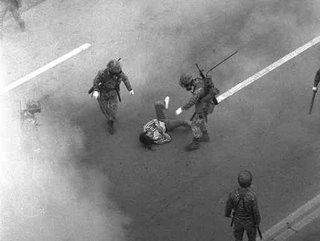
I couldn't read what she said about the Kwangju Uprising being unable to be "assimilated through reporting or testimony" without thinking of something similar. As I've noted before here, in The Kwangju Uprising, Kim Chung-keun, of the Donga Ilbo, describes his inability to describe what he saw in Kwangju:
Words fail me in seeking to describe what I saw. "Brutality." "Outrage." "Indiscriminate assault." The words fall short, far short, of the reality. I came up with this expression: "hunting humans", or "Human hunting."


Choi also comments on the interaction (or lack thereof) between history and literature in Korea:
Literature was directly linked to politics, and a historically critical conscience occupied the forefront of literature. Historical novels, and interest in history in general, remained strong within Korean literature; for ordinary Korean readers, a special relationship was formed between literature and historical novels to the extent that they could be taken as synonymous. From the 1990s, however, Korean literature began to escape from the heavy influences of reality and history and to display incomparable diversity in its depiction of various subjects. However, such advances should not lead us into mistakenly believing that facts and reality from the past no longer hold any importance. Korean literature still seeks to interact directly with historical reality in the name of realism and truthfulness.[...]

This does not mean that I simply want to criticise younger Korean readers for being oblivious to the past. I even wonder if it was forgetfulness of the extremity of the past events that actually helped Koreans to move without fear into the future and build their modern nation. Also, I can only speculate about whether being oblivious in this way was in itself a positive source of energy in a uniquely Korean way.
Something worth noting is that one reason people might be oblivious to the past is that they don't read. Korea ranked last in a study of 30 countries' reading habits.* It's an interesting question whether this forgetfulness is a positive source of energy or not (in some ways I believe it is), but the problem is that it is very selective forgetfulness. As I noted here, historical films about the 20th century became more and more simplistic (and often happy to blame outsiders (ie. the US or Japan - not China!)) over the last decade (though that decade coincided with the sunshine policy and the Roh administration, so perhaps it's not a long term trend. Or rather, I hope it's not). Also, as B.R. Myers notes in his new book, The Cleanest Race,
Many in the West wrongly assume, as George Orwell did, that a regime cannot reinvent history without resorting to brainwashing and intimidation. One need only look at the South Koreans, who celebrate their liberation from Japan every year with nary a mention of their liberators, to see how easily nationalist mythmaking goes down even in open societies.
This similarity between North and South Korean historical myths is also looked at by Scott Burgeson in his book 더 발칙한 한국학 in the full version of this essay, where he calls the U.S.-led liberation of Korea an "absent presence" at Independence Day ceremonies. With these things kept in mind, I'm not sure that I would describe the younger generation as being "oblivious to the past." The past - as viewed through a nationalist, 'we are such a small country who has been victimized so many times by outsiders' lens - is still quite present.

I'll take a closer look at Myers' book another time, but if you have any interest in South Korea, then his book (about North Korea) is well worth reading, and basically gives the reader a skeleton key to understanding North (and South) Korean myths.


* That link came from a footnote in Myers' book.

Wednesday, March 10, 2010

Down by the Han River park near Banghwa

I had a pleasant surprise the other day when I rode my bike down to the Han River park in Banghwa-dong:


What you see above is what used to be a single lane bike path which people walked on and which was often borderline dangerous, as there were blind curves where you could have close calls with oncoming bikes or pedestrians. No longer, and it makes for a much more pleasant ride. Down near the Banghwa Bridge is the Gangseo Ecological Wetland Park, which seems to have recovered somewhat from the 2006 flood which scoured much of the vegetation away.


They've added a wall to the railing at right, which I imagine was to keep people from being seen by the birds in the area. On the left above was a bird similar to a crane or a heron, but it was too far to get a good photo. In another spot, visitors can remain hidden and look out onto the Han River, where this view awaited me:


It's hard to see, but there were some 200-300 ducks off in the distance, as well as along the shore just in front of the viewing enclosure. Off to the right is the Banghwa Bridge:


On the right a current can be seen jetting out between the piers. Seen in the photo below (the blue area is the ecological park; the yellow dots at bottom center are where the photos of the bike path were taken), that water used to come from a cove to the right of the bridge:


Back in June construction started there, though I wasn't sure what its aim was. I can't be sure, but I imagine the water is the outflow from the nearby sewage treatment plant (which I should mention doesn't smell, actually).


Now I know. The entire cove was covered over with a sports playground (seen at right in the distance below). The exercise machines were also added.


A water taxi post was also added, but didn't seem very popular that day. I wonder if it's ever used.


These improvements are welcome, but it's too bad they've made some of the areas seen here harder to get at. This seems to be part of the Han River Renaissance Plan, which is good in that some areas are made more accessible, but seem to enjoy 'improving' real nature in order to turn it into a visitor-friendly park. At the moment, however, the balance struck in the Banghwa section of the Han River Park still seems favorable to nature.

This is just one of the several park improvements made in the area, but I'll save those for another time.

Thursday, March 04, 2010

Ramen in Fukuoka

The first time I had ramen in Japan was in Oita (where my sister lived for two years) in 2002,
but at the time I really didn't think much of it (though I enjoyed a lot of the other food, and drinking Kirin on tap). I'd had another chance to try Hakata (Fukuoka) style ramen at a place in Hongdae last year (Hakata Bunko, maybe? It's down the alley north of the broadcaster there (극동방송국)) and enjoyed it, so when I had a chance to go to Fukuoka on a visa run last week (I'd flown into it twice before, but had never explored it), and walked all over the city during my two days there (around 14km - my feet were pretty sore at the end of each day), I finally had a chance to try it at the source. With Kirin draft, of course. It made for a very filling lunch.


The one above was at a place I stumbled upon near Canal City (a shopping center worth visiting just for the architecture, i thought), while the one below was from Ippudo, which I saw advertised on the Fukuoka Now tourist map, and which also offered (non powder-based) take home packs.


I think I preferred the first place better, but Ippudo had this:


That's right - a sesame seed grinder. Very cool. (In second place was the automatic pint-pouring machine at a restaurant I went to for dinner).

Oh, and I had to listen to a lecture on Korean history this week which mentioned that the Japanese deny Korea's ancient influence on their culture (other than the Emperor mentioning several years ago that his great, great (x 67) grandmother was a Baekje princess). I guess he didn't see the several exhibits at the Fukuoka city museum mentioning Korea's influence on the area.

Anyways, sometime soon I'll try one of those take home packs of ramen...

Wednesday, March 03, 2010

More of Gindeung Maeul being destroyed

I've looked at Gindeung Maeul before, in these posts:

Exploring Gindeung Maeul
The Disappearance of Gindeung Maeul

Here's how it looked back in June, 2008:


Here's how it looked in November that year:


And here's how it looked in early February 2010:


Interesting that in the last six months a lot of grass and other plants have begun to colonize the now unearthed soil. What is difficult to see in the photo above is this:


The area in the background is being demolished. If you look below, the yellow area is part of the Banghwa New Town plan for the Gindeung Maeul area. It seems now though that the areas in red are all empty, and the part in red at bottom right is currently being destroyed.


I decided to go have a look at it. The building in the center above is visible below:

Here's the view from the top of that building:


Walking to the east along the renains of the street visible above:

No more using these cards to study English:

The view further east:


Here's what it looked like on August 15, 2007.


These are just a few of the photos I took. I'll save the indoor shots for later.

Tuesday, March 02, 2010

Dobongsan


A couple weeks ago I hiked Dobongsan with a friend. The last (and first) time I'd gone was in 2001. On the way up there were a lot of birds. Crows, magpies, and quite a few of these (I'm not sure what it is, though I am quite certain it was not a pigeon!):


There were chickadees (I saw some, and heard their call) as well as these little guys (not a great photo):


As we went along the ridge, we reached a spot with this view (a close up is at the top of this post), which made the hike well worth it.


Worth it even though it soon turned very difficult. It had been raining throughout the day, and suddenly the temperature dropped, it began to snow, and the muddy trails began to freeze and become slippery - just like the rock slopes next to 30 meter drops.


What should have been a three hour or so hike turned out quite a bit longer, and it took a few days to recover. Never made it to the top of the highest peak like I did last time I went, but did get a nice photo of it, at least...

Monday, March 01, 2010

Happy Samil

Today is the 91st anniversary of the 1919 Samil independence movement (and also one of the few holidays to fall on a weekday this year).

I've written about Samil before, looking at towns burned by the Japanese and the Canadians involved in exposing this, the battle in newspapers for American support by both the Japanese and the Korean independence movement, unseen photos of the Samil movement, and the role the protests played in making the space in front of present day city hall a symbolic protest space.