Saturday, June 14, 2008

Child murder in Daegu

[Update at bottom]

A June 5 Joongang Ilbo article titled "Police ask public for help in case of kidnapped girl" gave details on a week-old kidnapping:
Police yesterday opened their investigation into the kidnapping of a 12-year-old elementary school girl in order to obtain public help. Daegu Dalseong Police Precinct announced that two men in their 20s broke into a house in Dalseong County, Daegu at around 4:10 a.m. on May 30 and started beating the girl’s 71-year-old grandfather, identified only by the last name Hur, in the main bedroom. The man’s eldest granddaughter, Hur Eun-jeong, tried to stop the attack and was kidnapped, police said. Eun-jeong’s younger sister, 10, was hiding in the next room and called the police.
The house she was kidnapped from.
“I was lying down when a man entered my room and started punching me in the face. After a while, the other one helped him and then they kidnapped her,” Hur said. “One of two said, ‘I came here to kill you.’”

Investigators presume that the two suspects have a grudge against Hur because they have made no ransom demands and did not steal anything from the house. The two schoolgirls live with their grandfather, away from their parents, due to financial problems in the family.

Police have discovered that the missing girl called a close friend three times between June 1 and 2. “According to her friend, the missing girl said, ‘I was released after being kidnapped,’ on the phone,” the officer said. “However, she did not call us. We are now trying to discover her whereabouts in order to gain some clues into the case.”

Police had been conducting a closed investigation, but opened the probe to the public yesterday after failing to make any progress in the case. They cited the lack of a ransom demand as a source of difficulty, compounded by inconsistent statements from the injured man.
A YTN video from June 4 can be seen here. The Korea Times also had an article from June 4 titled "13-Year-Old Schoolgirl Kidnapped for 7 Days". I find it interesting that Korean news articles report that she is in fact 11 years-old (using western reckoning), while an English language newspaper used Korean reckoning. Makes a lot of sense. At least it included a photo of her:


One other mystifying thing about the Korea Times article is that it didn't mention where the kidnapping took place! Maybe readers wouldn't mind knowing if such things are taking place in their backyards. For example, there was the rape of an elementary school girl that took place in Deungchon-dong, which is very close to my house. A quick search at Naver turns up... two more cases than I expected. On April 23, two girls (13 and 14) were raped by a (Korean) soldier on vacation and 16 year-old, who they met after chatting on the internet and drank with in a park in Deungchon-dong. On April 10, a 76 year-old man raped a 12 year-old after seeing her on a street in Gangseo-gu and inviting her to his house to eat 'something delicious'. Perhaps someone needs to streetproof their child better. I finally found the case I was thinking of, which YTN reported on, where a 12 year-old on her way home from a hagwon was raped in the underground parking lot of her apartment. The perpetrator was obviously prepared:


Back to the case in Daegu, as this June 6 article notes, something that the English language media hasn't mentioned was the fact that the "close friend" who talked to the victim "three times between June 1 and 2" had actually been lying about it. You'd think a 15 year old might know better than to tell lies during a kidnapping investigation. At any rate, here's a map of the area where this occurred:


The story doesn't have a happy ending, as the June 13 Joongang Ilbo article "Police find naked body of kidnapped young girl" relates:
A 12-year-old girl, kidnapped from her home two weeks ago, was found dead yesterday in her own neighborhood, Daegu Police said yesterday. Police officials found the body of Hur Eun-jeong at around 5 p.m. yesterday in a valley about two kilometers from her home, the Dalseong Police Precinct of Daegu said. The body was naked and severely decomposed.
Police at the site (source).
The last in a series of searches for the kidnapped girl began yesterday morning in a five-kilometer radius of her home, as 440 police troops, a helicopter and six search dogs joined the operation.
Here's a photo/map of the area (from here):


Her clothes (she was wearing shorts and a t-shirt when she was kidnapped) were found 300 meters from her body. Perhaps it's sometimes good not to have everything translated to English, as this article goes into more detail on how the decomposition of her body has rendered it very difficult to determine a time of death or whether or not she had been raped (which police strongly suspect). A little more information can be found here. This YTN video looks at the discovery of her body, while this MBC video does the requisite "Let's go to the victim's school and take photos of her crying classmates" report.


Flowers and letters from her friends sit on her desk. Below we can see her classroom and classmates, as well as her flower covered desk on the right.


The MBC article mentions that the school is Biseul Elementary School, whose website I found in seconds by googling it. It dawned on me that it was likely a small school, and it might be easy to find photos of her. The third photo I clicked on presented this image, taken May 17:


The girl in the green shirt on the left, I thought, looked like her. A quick look at the MBC video (the still above) revealed that the two boys in the middle of the above photo are in the MBC video, and the desk at which the green-shirted girl is sitting is the one with flowers on it. The girl covering her face at right is the one crying in the MBC video. As it turns out, there are dozens of photos with Hur Eun-jeong in them:


The above photo shows her at left during the opening ceremony for the school year in March. The school is so small there were only three children entering first grade. Though the school wasn't so small that they couldn't have native teachers teaching them English - in this case US soldiers (It may not have been a very regular thing; I'm not sure). An entry on a bulletin board for grade 6 students from May 31 is titled "Find Hur Eun-jeong, Please Find Her" and has comments from people saying they miss her.


It also seems that for some field trips the whole school would go. Hur is seen at left above and in the center below.


The eeriest photo? A month and a half before her kidnapping, her school went to the Daegu District Police Office for traffic safety training (Hur is at far right). This same office is now in charge of her murder investigation.


[Update]

Some people are criticizing the police investigation into her kidnapping:
Initially, only 80 police officers and volunteers searched for Hur Eun-jeong in a one-kilometer (0.62-mile) radius of her home. When they broadened the search area and enlisted more policemen Wednesday they made the gruesome discovery. Eun-jeong was found in a remote area 2.3 kilometers from her home. In the end, 510 team members along with two rescue dogs were used, according to police.

“We could not call out more policemen because they were dispatched to the candlelight demonstration sites in Seoul and Daegu,” said Ahn Jae-gyeong, an officer on the case. Police originally said that Eun-jeong was probably a runaway after they got a report from one of her friends saying that Hur escaped from her abductors on June 1 and was safe. The friend’s information turned out to be false.

In addition, it took seven days for police to ask the public for help and to offer a 5 million won ($4,794) reward for information leading to her discovery. Police are now investigating 60 sex offenders who live near Eun-jeong’s home. Kyungpook National University Hospital failed to find the cause of death in an autopsy yesterday. “Her body was badly decomposed,” Ahn said. “Also, we could not confirm whether someone raped her or not.”

Friday, June 13, 2008

The Herald on candlelight rallies in 2002 and 2008

The Korea Herald published a decent (and lengthy) article today comparing the candlelight vigils of 2002 with the current candlelight vigils. The writer repeats the tired refrain "that students... sparked the current uproar," but other than that it's worth reading. I'd simply link to it, but the Herald won't let you do that, and it'll disappear after a week, so it's reprinted below (mainly so I can link to it later in another post I'm working on):


Deja vu? Candlelight vigils in 2002 and present

It is often said that history has a way of repeating itself. The massive candlelight vigils against the re-importation of U.S. beef reveal a social earthquake rumbling through Korea.

For some, it must seem like deja vu.

June 13 marks the six-year anniversary of when two Korean schoolgirls were killed after being run over by a U.S. military vehicle. That event in 2002 triggered a tidal wave of national outrage. It is also when candlelight vigils first made their profound presence felt in Korea.

Today, as thousands pour into the streets to commemorate the anniversary of the schoolgirls' deaths, and to continue their vociferous protests against the government's U.S. beef policy, one can't help but consider the historical parallels.

There is certainly a causal effect between the protests. However, the two developments also have unique characteristics.

As Koreans light their candles once again for events past and present, a look back at the 2002 candlelight vigils may shed some light on the nationwide outcry today, as well as the deeper socio-political changes that are happening in this country.

Mi-seon and Hyo-soon

It was June 13, 2002. Korea was in the grip of "World Cup fever." However, as the "Taeguk Warriors" were making their legendary run to the semi-finals, a tragic event took place. Two young girls walking alongside a narrow village road north of Seoul were run over by a U.S. armored vehicle. Shim Mi-seon and Shin Hyo-soon, both 14, were on their way to a friend's birthday party when their lives were cut short.

At the time, the incident did not get an immense amount of mainstream media attention. The Red Devils were making history at the World Cup and it was perhaps the most exciting sporting accomplishment ever for this nation.

Gwanghwamun was often teeming with more than a million people that summer, but they were hardly somber protestors. They were Korea's soccer fans, caught up in street celebrations whenever the national team was in action. Not surprisingly, the World Cup overshadowed the deaths.

But "World Cup fever" soon died down and the country settled back into reality. Renewed attention was focused on the dead schoolgirls, especially during the two soldiers' military trial.

The U.S. military court acquitted the two defendants, Sgts. Fernando Nino and Mark Walker, on charges of negligent homicide in November 2002.

Many criticized this decision and demanded that Korea be given jurisdiction over the case - something that was impossible under the Status of Forces Agreement. Calls to revise SOFA became more pronounced.

However, the spark that led to the mass candlelight vigils at the time did not come from mainstream press criticism.

Grassroots uprising

Ronda Hauben examined those events in a 2007 paper published by Columbia University entitled "Online Grassroots Journalism and Participatory Democracy in South Korea." For Hauben, an expert on the "netizen phenomenon," the 2002 uproar had its roots online. In fact, she traced it back to a posting by an angered internet user who wasknown online as AngMA.

He wrote, "Let's walk in Gwanghwamun holding a lighted candle. Let's commemorate the lives of Mi-seon and Hyo-soon, who were forgotten in the joy of June. Will the police prevent us? Even if they forbid it, I will walk in Gwanghwamun, even if the police attack me."

He added, "Even if only one person comes, it's ok. I will be happy to say hello. I will talk about the future of Korea in which Mi-seon and Hyo-soon can take a comfortable rest. I'll go on this week, next week, the following week. Let's fill Gwanghwamun with our candlelight. Let's put out American violence with our peace."

According to Hauben, AngMA posted this message on several websites and it struck a nerve. The results: 15,000 people showed up at the first candlelight vigil on Nov. 30, 2002. This ballooned to more than 100,000 by Dec. 14 in front of Gwanghwamun, where, just months earlier, millions of Koreans were jumping up and down in celebration of the nation's World Cup success.

What ensued had an immense impact on Korean politics. 2002 was a presidential election year and the heavily favored Lee Hoi-chang of the Grand National Party was expected to beat the relatively unknown Roh Moo-hyun of the Millennium Democratic Party.

Mainstream media polling showed Lee ahead of Roh up to the day of voting. But groups like Nosamo, roughly translated to "People who love Roh," and the upstart news website Ohmynews, were instrumental in mobilizing people online.

There was indeed an overlap between the candle-bearing people angered over the schoolgirls' deaths and those who subsequently came out to vote. Many of those citizens ended up supporting Roh, who was seen as a sympathetic outsider and maverick, even within his own political party.

There are many theories as to what led to Roh's successful bid for the presidency. But many analysts, including Hauben, point to the candlelight vigils of 2002 as a seminal moment in the sprouting of netizen power, giving power to people who had not had a voice in the nation's political debate.

It is said that Roh Moo-hyun swept into the presidency on the coattails of a sweeping anti-American sentiment blowing across Korea. That certainly may have been the case, but according to Hauben, Roh was just the conduit of a wider megatrend occurring in Korean society: "the importance of the 2002 election was that it was not based on support for Roh personally, but was a manifestation of the desire of young netizens for political reform."

Candlelight vigils today

Fast forward six years, and it appears that a similar phenomenon is occurring today. On April 18, Korea and the United States agreed to renew shipments of U.S. beef, which had been banned since 2003 due to a case of mad cow disease. It was the eve of newly elected President Lee Myung-bak's summit with U.S. President George W. Bush and the deal was meant to facilitate passage of the KORUS FTA.

Again, the mainstream media did not foresee the magnitude of discontent, which was sparked by online reactions to a TV documentary alleging the dangers of tainted U.S. beef (in 2002, a TV documentary also highlighted the schoolgirls' deaths and the subsequent trial). And, once again, the internet became the medium for a swelling of mass public anger at the authorities for pushing an edict that went against majority opinion.

Thousands have reemerged with relit candles in central Seoul. The vigils today are symbolically encapsulated by the now ubiquitous image of "candlelight girl," a cartoon drawing of a young girl holding aloft a lit candle. It is a powerful and poignant image, especially considering the fact that the original 2002 vigils were for the two young girls, Mi-seon and Hyo-soon.

Also poignant is that students roughly the same age as Mi-seon and Hyo-soon sparked the current uproar. Those students, rightly or wrongly, fear that mad-cow tainted beef is being forced down their throats by an uncaring government. Akin to 2002, the students' outcries have snowballed into a nationwide phenomenon encompassing diverse groups banding together to collectively demand reparations for perceived injustices. The political establishment has again been shaken to its core.

2002 and 2008 contrasted

Although it may seem like "a Korean thing" based on the current media frenzy, candlelight vigils are not a Korean invention. They are a traditional form of assembly. Wikipedia offers this definition:

"A candlelight vigil is an outdoor assembly of people carrying candles, held after sunset. Such events are typically held either to protest at the suffering of some marginalized group of people, or in memory of lives lost to some disease, disaster, massacre or other tragedy."

Some notable candlelight vigils include people in various countries lighting candles for the victims of the Sept. 11, 2001 terrorist attacks in New York City, or those held by divided Cold War-era Germans prior to the collapse of the Berlin Wall in 1989.

If candlelight vigils themselves are nothing new, then Koreans have certainly added their own flavor to the events, both in 2002 and today. That being said, the candlelight vigils for the schoolgirls and today's beef uproar are not facsimiles of each other. Some subtle and not-so-subtle differences are apparent.

For example, in 2002, the deaths of Mi-seon and Hyo-soon triggered an outpouring of anger that many observers say was driven by anti-Americanism. There was a general sentiment in the country that the SOFA agreement was unfair and that America was doing more harm than good for Korea.

Today's candlelight vigils are not as overtly anti-American, but they are definitely anti-Lee Myung-bak.

Yes, the issue that sparked the outcry was U.S. beef. And yes, there are some radical protesters who harbor anti-American sentiments. Anti-American sentiment may grow, depending on how the situation unfolds, but it does not reflect of the vast majority of protesters so far.

An interesting irony in the beef outrage is apparent through recent polling that shows the majority of the protesters still support the KORUS FTA and the benefits it may bring. Koreans on the streets may arguably be confused or conflicted, but to say that everyone bearing a lit candle is anti-American would be inaccurate.

However, if one listens to the chants of the protesters and the signs posted all over Seoul, it is apparent that the overriding anger of the populace has been squarely pointed at Lee, not at the United States.

At the outset of his term, his cabinet and secretarial appointments were a disaster. Now derisively nicknamed collectively after famous actresses "Kang Bu-ja" (pun using "Gangnam" and "bu-ja", which means "wealthy" in Korean) or "Ko So-young" (pun referring to Lee cronies from Korea University, Somang Presbyterian Church or Yongnam Province), they presented an image of an elitist, "good old boy" network of people running the country.

The then-popular Lee vigorously set about with his agenda, pushing through policies that were not unanimously supported. Lee once told Bush that he was not the president, but the "CEO" of Korea. He was certain that disagreements over his plans could be overcome through his successful "bulldozing." After all, he had done so at Hyundai Engineering and Construction and as Seoul mayor, specifically with the Cheonggyecheon project.

Therefore, the anger has more to do with Lee's governing style than just simply the debate over whether American mad-cow was going to afflict the nation. The public resented the sense that Lee was the "CEO" and Koreans were merely employees expected to follow his orders. Somewhere along the way, his pledge to be a "servant to the people" got lost, and approval ratings below 20 percent reflect his extreme unpopularity.

Netizens' Comeback

The question then arises - if Lee is so disliked now, how was he elected so overwhelmingly in the first place, and where were all these "anti-Lee" people prior to last year's presidential election?

A possible answer has again been provided by Ronda Hauben. In a recent analysis published in Ohmynews entitled "Korean Government Mishandled Beef Deal," she says that the netizens so crucial to Roh Moo-hyun's victory in 2002 were largely muzzled due to stricter online campaigning laws in 2007.

"Over 65,000 online comments by netizens relating to the election were removed from the internet and over 1000 netizens received summons to report to the police," writes Hauben.

As a result, the same people who profoundly influenced the 2002 presidential elections in the aftermath of the schoolgirls' deaths were largely relegated to the sidelines. Voter turnout for the 2007 presidential election was drastically lower than in 2002. The lack of netizen mobilization, coupled with the public thirst for an economic savior, allowed Lee to take the 2007 election in a landslide.

For Hauben, these stifled online voices have now come out after the elections, in angered reaction to Lee's performance through his first 100 days.

She states, "After the election, however, when it again became possible to discuss political issues, netizens in Korea took up to actively discuss the nature of democracy and the importance of having government officials who are the servants, not the masters of the citizens."

And, as demonstrated by today's mass candlelight vigils, the response has been overwhelming.

Candlelight conclusion?

When examining the past events of the candlelight vigils circa 2002, another looming difference from today's uproar is apparent.

In 2002, there was a resolution to the protests. Roh Moo-hyun sweeping to the presidency could be considered a victorious accomplishment for those who felt aggrieved.

But, for the drama unfolding through the candlelight vigils of today, there is no apparent denouement.

Presidential and parliamentary elections are over and done with. For the next few years, people will be unable to punish their leaders at the ballot box, so they take to the streets.

President Lee has tried everything, to no avail. The en masse resignation of his secretariat and cabinet is unprecedented in Korean history, but it has been jeered by his opponents as a "political stunt." Measures to ensure that 30-month-old U.S. beef will not enter the country are not placating the citizenry. Unpopular plans like the cross-country canal project and privatization of state firms have been shelved indefinitely, but, still, the people protest.

The fear is that the current vigils, which have so far taken on a somewhat festive atmosphere, may evolve into a socially precarious situation.

Ideological clashes are brewing as the protesters, having a progressive leaning, witness counter-protests by conservative groups who are saying "enough is enough."

The rhetoric has grown heated. There are calls for Lee's resignation, his impeachment, or, in the most severe cases, a desire to forcibly remove him from office. The sporadic violence that has occurred took place when some of the protesters attempted to march all the way to Cheong Wa Dae.

Need for reflection

Ironically, a voice of reason has come from the central political figure of the 2002 vigils: former President Roh Moo-hyun.

Speaking to his Nosamo supporters last week, Roh said that the march to Cheong Wa Dae was a meaningless act and that, "Even if the beef deal was wrong, it is still wrong to push for the removal of the (Lee) administration. It's unconstitutional and undemocratic."

As someone who suffered through the Cheong Wa Dae hot seat for five years, Roh can surely empathize with Lee's dilemma, though he probably feels it was largely self-inflicted.

In fact, the former president could possibly take the lead in fostering calm as he, unlike the current president, still has some clout with the netizens who have sparked today's unrest.

The fact that candlelight vigils remained dormant for the duration of Roh's five-year presidency is a testament to that. There were misgivings over his "pragmatic" decisions such as sending troops to Iraq or signing the KORUS FTA, but his somewhat disgruntled internet supporters bit their tongues, for the most part, and kept their candle wicks unlit.

The current president has no such luxury. Barely more than 100 days into his presidency, he still must endure about 1,700 more days of this maelstrom. It will take a very dramatic turn of events to salvage the rest of his term.

"I'm determined to make a fresh start. Let's pursue aggressive challenges in these difficult times," Lee said recently, noting that he, too, took part in democracy protests as a youth. Heeding his peoples' demands, and pursuing a complete overhaul of his staff and style will be fundamental to improving his fortunes.

As the drama continues to unfold over candlelight vigils today, the nation can gain much perspective from the vigils of 2002. On the sixth anniversary of Shim Mi-seon and Shin Hyo-soon's tragic deaths, the two schoolgirls have ended up becoming an infinitely bigger influence on this country than anyone could have ever imagined.

By Henry Shinn

Wednesday, June 11, 2008

From Jeju to Paju...

Today (well, yesterday) marks the 21st anniversary of the June 10 uprising which led to democratization in 1987 (much more about it can be read here). June 9 was the anniversary of Lee Han-yeol being hit by a tear gas cannister, which caused injuries he died from almost a month later. His mother is seen here yesterday standing before his portrait.

The anniversary has been overshadowed, of course, by this:


Whether 1,000,000 people marched in the streets is uncertain, but there were certainly a lot of people. The police prepared for it by putting containers in place across Sejongno; the preparations, such as welding them together and covering them with grease, can be seen here.

The barricade near completion.

Kotaji has an interesting post on barricades in general, and I love some of the posters affixed to the containers (명박산성!). You can see how the protests grew between 7:00 (and 7:30) and 8:00, until they became rather large.

From a New York Times article on the protests

As the crowd ebbed and flowed, there were lots of different people protesting many different issues, for example the Grand Canal:


For those interested in 70's folk music, Yang Hui-eun sang "Morning Dew" for the crowds (the song was the unofficial anthem of the student movement - probably the best version I ever heard was of a bunch of guys, arm in arm, singing it loudly in a pojang macha near my house).

By 4:00 am protesters brought large pieces of styrofoam and built a pyramid which allowed them to climb to the top of the barricades (in what seems a symbolic, not tactical, act - look here to see the pyramid being built). Of course, not everyone needed a pyramid to get to the top.


It seems the tops of tall buildings in the area were occupied by dozens of reporters.


Though Seoul was the center of attention, protests took place in many other cities throughout Korea tonight, as this Seoul Sinmun article shows (it also has a graph showing the size of the protests over the last month according to both police and organizers).


According to the stats above, protests took place at 108 locations around the country.


In Jeonju there were 3,500 at 7 pm.


In Gwangju 20,000 gathered on Geumnamno. Those without candles used their phones.


There were even gatherings in Jeju City. Some 20,000 people took part in Busan, where protests have taken place in recent days:


Protests also took place in nearby Masan and Changwon, where this photo was taken.


The photo is of Lee Byeong-ryeol, who set himself on fire during a protest in Jeonju on May 25 and who died on June 9. More on him can be found in English here. Perhaps because his actions took place in Jeonju, they did not get much mention in the English Language press. This is a different person than Kim Gyeong-cheol, who set himself on fire on June 5 in Seoul, and whose actions were mentioned in this article,
“My husband has attended candlelight vigils for the past two weeks,” Kim’s wife said, adding that he lost his job at a cattle farm in Gyeonggi about a month ago when the farm shut down.
This article added,
Yonhap News Agency said he seemed to be disgruntled with the government's compensation policy for his evacuated residence in Seoul. Kim, a day laborer, had reportedly been joining daily candlelight vigils, which have recently turned into anti-government protests.
This article mentioned that in March of 2007 he was forced to leave his residence in Bon-dong, Dongjak-gu, which was being redeveloped, but didn't get 이주비, which I take to be some sort of compensation for moving (the assumption being that he was renting?) . The article also says he blamed the loss of his job at a farm on mad cow disease and began going to protests. Here's what his former neighbourhood, which lies just south of the Han river between the Han River Bridge and the Han River Rail Bridge, is planned to look like in the future:


Whatever the reason for his decision to immolate himself, Kim's injuries are not life-threatening. Ironically, both Kim and Lee were treated for their burns at Hangang Sacred Heart Hospital - the same place where Bill Kapoun was treated.

Tuesday, June 10, 2008

Protests, public space in Seoul, and cyberspace - Part 1

Part 1: From the Joseon Dynasty to the 5th Republic
Part 2: Sports nationalism in 2002: Through a video screen darkly
Part 3: Funeral processions from the Joseon Dynasty to the present
Part 4: The 2002 candlelight protests: A new form of demonstration
Part 5: Anti-communist exhibitions

Part 1: From the Joseon Dynasty to the 5th Republic

As protests have been going on in downtown Seoul for over a month now, I thought I'd take a look at where they've been taking place, and how they relate to other large protest movements in the past. Here's a trusty map of where many of the larger protest movements of the past have taken place in downtown Seoul, from 110 years ago to the present.


In the first post I'm going to look at why the area around City Hall became important in the final days of the Daehan Empire, at how early protest movements came to be, at why the Japanese built the roads and buildings in the area that they did, and how these spaces were used in post-Korean War protest movements. Part two [Update - and three] will look at the use of these spaces in the new millenium and how the urban space and cyberspace have become entangled, among other things.


The above map should make clear that in 1776, there were only a few prominent streets in Seoul: Jongno, Namdaemunno (which make a sort of T shape), Sejongno (leading to Gyeongbok Palace), Euljiro, Cheonggyecheon, and the street leading from Jongno to Changdeok Palace.

During the latter half of the Joseon Dynasty, Changdeok Palace was the main palace, having been rebuilt in the early 1600s after its destruction (along with all of the other palaces in Seoul) during the Hideyoshi invasions of the 1590s. Worth noting (according to Samuel Hawley's The Imjin War) is that it was Seoul's citizens, angry that the king was fleeing and leaving them to their fate, who burned Seoul's palaces - not the invading Japanese armies. In the 1860s Gyeongbok Palace, having sat in ruins for over 250 years, was rebuilt, and it became the main palace under King Gojong's rule. The two most common types of protest at the time were peasant uprisings and (if I remember correctly) bowing before the palace's gate and submitting petitions to the King.

Street scene in Seoul, 1884 (by Percival Lowell)

Lillias Underwood's book "Fifteen years among the top-knots; or, Life in Korea" describes a scene she witnessed not long after her arrival in 1888:
We soon found that the stones and missiles were coming our way, and were forced to run for shelter to a Korean house. For a few moments the fight was hot around us, and then as it seemed to have passed on quite far down the street we ventured forth, only to find that the tide had again turned, and the whole mob were tearing in our direction. Mr. Bunker, for it was he, said there was nothing for it but to scale a half-broken wall into an adjacent compound, and run for it to the house of Mr. Gilmore, not far distant. So, reckless of my best gown, I scaled the wall with great alacrity, and we ran for it quite shamelessly. Missiles of considerable size were raining around us, and the possibility, or rather probability, that one would soon light on our heads, accelerated our speed to no small degree.
While it may sound as if she had encountered a modern-day protest, complete with stone throwing, she had actually encountered something different:
During my first year I had the exciting and doubtful privilege of being present at a native sectional or stone fight, an experience which few covet even once and which the wise and informed, at least of womankind, invariably forego. Once a year at a certain season, where two neighborhoods or sections have grievances against each other, they settle them by one of these fights. They choose captains, arrange the opposing parties, and begin firing stones and tiles at each other.
A stone fight

Also during her first year in Seoul, she experienced this:
Some person or persons, with malicious intent, started a rumor which spread like wild-fire, that foreigners were paying wicked Koreans to steal native children, in order to cut out their hearts and eyes, to be used for medicine. This crime was imputed chiefly to the Japanese, and it was supposed the story had been originated by Chinese or others especially inimical to the large numbers of Japanese residents in the capital. Mr. Underwood acquainted the Japanese minister with the rumors, in order that he might protect himself and his people ; which he promptly did by issuing, and causing to be issued by the government, proclamations entirely clearing his countrymen of all blame in the matter, which it was left to be understood was an acknowledged fact, and consequently the work of other "vile foreigners," namely, ourselves and the Europeans.

The excitement and fury grew hourly. Large crowds of angry people congregated, scowling, muttering, and threatening. Koreans carrying their own children were attacked, beaten, and even killed, on the supposition that they were kidnapping the children of others ; and a high Korean official, who tried to protect one of these men, was pulled from his chair, and narrowly escaped with his life, although he was surrounded by a crowd of retainers and servants. It was considered unsafe for foreigners to be seen in the street. Marines were called up from Chemulpo to guard the different legations, and some Americans even packed away their most necessary clothing and valuables, preparatory to fleeing to the port. The wildest stories were told. Babies, it was said, had been eaten at the German, English, and American legations, and the hospital, of course, was considered by all the headquarters of this bloodthirsty work, for there, where medicine was manufactured and diseases treated, the babies must certainly be butchered.
While the mob's anger eventually dissipated, it revealed how even the most unlikely accusations aimed at foreigners could be believed by mobs in a crowded urban space where rumors traveled quickly. Not for nothing did Isabella Bird Bishop write that "Gusts of popular feeling which pass for public opinion in a land where no such thing exists can only be found in Seoul." In speaking of non-existent public opinion, she was referring to the lack of newspapers in Seoul. This would change in April, 1896, with the establishment of the Independent (more on that here). Writing in 1897, Isabella Bird Bishop relates that
The sight of newsboys passing through the streets with bundles of a newspaper in En-mun under their arms, and of men reading them in their shops, is among the novelties of 1897.[...] Only those who have formed some idea of the besotted ignorance of the Korean concerning current events in his own country, and of the creduility which makes him the victim of every rumor set afloat in the capital, can appreciate the significance of this step and its probable effect in enlightening the people, and in creating a public opinion which shall sit in judgement on regal and official misdeeds.
The Independent was born a few months before the Independence Club, which, after building Dongnimmun and an Independence Hall, held debates about the direction Korea should take in the future. The would eventually organize an "assembly of officials and the people" at Jongno intersection in October of 1898 as they called for more popular participation in the ruling of the country.

Prior to this, something that would change the future shape of Seoul had taken place. In February 1896, King Gojong fled from the Japanese controlled Gyeongbok Palace to the Russian legation, from which he ruled the country. Due to criticism (in part from the Independence Club) Gojong moved from the Russian legation to the nearby Gyeonggun Palace (present day Deoksu Palace) in February 1897. The center of power in Korea, and in Seoul, now lay there.

There's a certain irony to this, because it was precisely because that palace had been so unimportant that parts of it had been given to foreigners to be used for their legations during the 1880s. Once they settled there, however, the area became, with its legations protected by extraterritoriality, modern schools, and churches, a sort of globalized space, and a conduit to foreign power, influence, and even protection. Thus Gojong used the formerly unimportant palace site as his new power base - where he hoped he would be protected from the Japanese.

Gyeonggun Palace before 1904

Chong-Sik Lee's "Syngman Rhee: The Prison Years of a Young Radical" describes the actions of the Independence Club:
[T]he Independence Club had debated the need for a parliament since April [1898], and the the Dongnip Shinmun had expounded at length on it in its April 30 issue. And on July 31 the Club sent a memorial to the emperor "begging him to dismiss unworthy persons from the government and to give the popular voice a share in the management of the affairs of the nation." When the Emperor curtly replied that the Club should not interfere with the affairs of the state, the Club members sent off another strongly worded memorial. The fight was on.

As a number of cabinet officers sided with the reformists, the emperor made some concessions by appointing a number of Club members to the Chungchuwon, or Privy Council, as advisors, but it only whet the appetite of the club members. They wanted the corrupt old ministers dismissed and a parliament installed, and decided to resort to a sit-in in front of a palace gate. The four-day-and-night long sit-in, held between October 8 and 12 [1898], was clearly intimidating. On October 12, the emperor relented by appointing a new cabinet headed by Pak Jeong-yang, which began to negotiate with the club.

The photo above is almost certainly not of that sit-in, but gives an idea of what it may have been like. The emperor would renege on his agreement with the Independence Club and arrest its members on November 4. As Yun Chi-ho recorded in his diary the next day,
Yi Sungman [...] and Yang Hong-mook [...] called on my and we agreed that a crowd should be drummed up as soon as possible. They went out and by the help of others succeeded in getting up a crowd in front of the police station demanding to be arrested to share the punishment of the Club Men.
Yes, that is Yi Sungman, future first president of South Korea. The demonstrations would continue for three weeks until November 26. Convinced by the US and British ministers not to fire into the crowds, Gojong gave in to the demonstrators' demands - but not before hiring peddlers to attack the demonstrators, who defended themselves by hiring stone throwers.
On December 1, they decided to celebrate their victory and display their power by holding a funeral procession for a supporter, Kim Deok-gu, who had been killed the previous week in a skirmish against the peddlers. "Tens of thousands" of people joined in the procession and lined the streets to watch the funeral train move from the center of the city, Jongno, to the funeral site at the outskirts of the city wall and then to the burial site. Even though the victim was a mere cobbler, most likely one who weaved straw shoes commonly worn at this time, the funeral rivaled that of any royalty in grandeur and scale.
Gojong would go back on his word and eventually use royal guards and peddlers to disperse the demonstrators, putting the city under virtual martial law on December 24. Most of the people involved with the Independence Club - including Syngman Rhee - would be thrown in prison.

What has been described above is essentially Korea's first modern mass political movement, with citizens taking to the street to influence the decisions of those in power. 'Mass movement' might not quite be the right term, but it has many of the contours of future political movements in Korea.

Of course, this was pretty much the last gasp of the Joseon dynasty, and likely was Gojong's last chance at saving the situation. Seoul would be occupied by Japanese troops in February 1904, at the start of the Russo-Japanese War, and they wouldn't leave until 1945. Among the things done by the Japanese after annexation was a road widening campaign. To be sure, what is now Taepyeongno (which runs from the Gwanghwamun intersection, past City Hall and Deoksugung down to Namdaemun) did not exist before 1900, but whether work was done on it before the Japanese takeover I don't really know. It was certainly widened in 1912, and may have even been built then. An essay titled "Transformation of Seoul's Modern Urban Landscape" by Kyu-Mok Lee says that the building of this street "can be interpreted as [Japan's] intention to remove the base and tradition of the anti-Japanese demonstrations that were held frequently at the square in front of Daehanmun." One would imagine it would be useful for moving troops from Yongsan as well.


The above photo shows Taepyeongno as seen from Namdaemun before 1925, when the building a the visible end of the street was torn down and replaced with what is now Seoul City Hall. The next mass movement that would be seen in Seoul was the Samil Movement which began on March 1, 1919 (which I've written about here, here and here). Protesters would gather in many places, such as on Jongno...


...as well as in the area in front of Daehanmun (modern day Seoul Plaza).


While independence was not achieved by the protests, the cultural policy followed by Japan in the wake of the protests led to more openness. One of the mass movements during this era was the Korean Production Movement of 1923-24, where, in order to support Korean businesses, people bought Korean products when they could. In 1924 the landscape of Seoul changed when the building seen in the background of the photo above was torn down and what is now City Hall was built (between August 23, 1924 and November 30, 1926).


The above photo of City Hall under construction is from this blog, which has numerous photos of the building (as well as its predecessor, which was built in 1896 and stood where Sinsegye Department Store is now). This Joongang Ilbo article tells us that
During colonial rule, the building was called Gyeongseong Bucheongsa. Much like today it was the administrative seat of the government of the nation’s capital. Sohn Jung-mok, a professor at the University of Seoul, said the Japanese colonists intentionally constructed the building right across from Deoksu Palace to break the Korean spirit.

“Deoksu Palace was where King Gojeong resided for 22 years until his death in 1919,” Sohn said. The professor said that because Korea had to sign a number of unfair treaties with Japan, students gathered in front of the palace gates to plead to the king. Tension heightened after the March 1 independence movement that brought about a massive nationwide uprising. “The Japanese believed they had to break the spirit of the area that was the origin of the independence drive, as well as the worship of the Joseon King,” Sohn said.
Considering how the Government General building was built to hide Gyeongbok Palace (and it was built in the shape of the first character that makes up 'Japan'), the idea that the Japanese wanted a stern administrative building next to the formerly important palace isn't a stretch. (The article also notes that as of last week, the City Hall building is no longer used by the city for that purpose, as a new city hall is being built). The article also mentions another building - one of the few from that era that still stands, the Bumingwan, currently the Seoul Metropolitan Council building.


Ground was first broken for the building in July 1934 and it was completed in December 1935. Construction was aided by a 1 million won ($977) donation from Gyeongseong Electric. When first built, various cultural performances, including ballet, plays and music concerts, were held at the venue. Later the building was used mostly for political propaganda of the colonial Japanese government.
Bumingwan, left; City Hall, right

As the article notes, the building was the site of a bomb attack by independence activists on July 24, 1945. No one was hurt. After liberation the streets of Seoul would be filled with people celebrating, and as the atmosphere leading up to the Korean War grew darker, there were many street rallies. Many were held in what was Dongdaemun Stadium.

After the war the Bumingwan was used for another purpose. Between 1953 and 1975, it served as the location of the national assembly. Thus it was in front of this building that students, protesting Syngman Rhee's illegitimate election results and brutal treatment of demonstrators in Masan, held a demonstration on April 18, 1960 - the eve of the April students uprising.


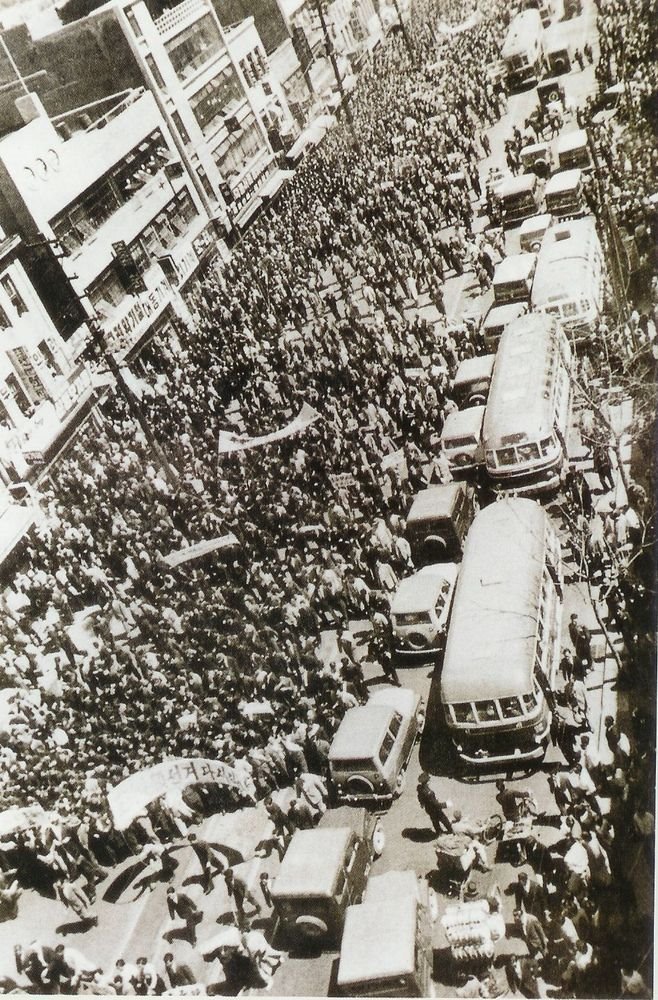
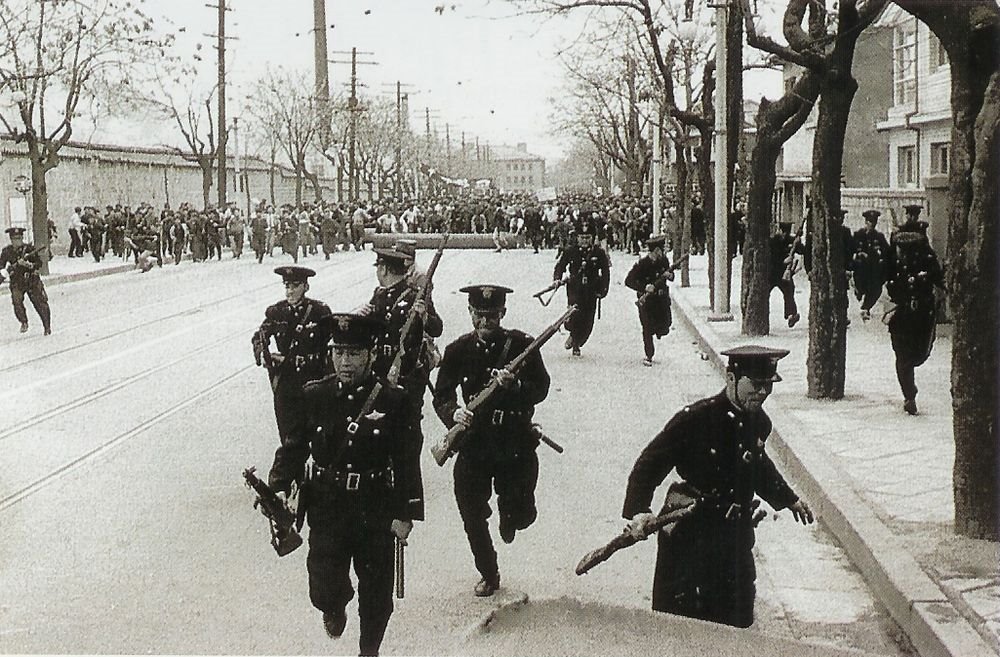
Protests on April 19 took place throughout downtown Seoul, near Gwanghwamun and City Hall, at Dongdaemun and on Jongno.


The protesters advanced on the presidents house, where police fired on protesters, killing more than 100 students.


The army refused to side with Rhee and he was forced to step down.


A year later, on May 16, 1961, a different spectacle would be seen in front of City Hall: Park Chung-hee and his soldiers as they took over the government.


Park would rule the country until his assassination in October 1979. As Chun Doo-hwan took over the military in December 1979, and then the Korean CIA in April 1980, students began to protest on Campus and call for the end of martial law, in effect since Park's death. On May 15, the eve of the anniversary of Park Chung-hee's 1961 coup, a massive protest was held in downtown Seoul - the first time in many years students had protested off-campus.

The protesters would make their way to City Hall, as described here. The students then called off further protests and waited for the government's next move. Two days later martial law was extended, politicians arrested, and the national assembly and universities closed. The military's brutal actions in Kwangju on May 18 set off the Kwangju Uprising. With the uprising's suppression, Chun was free to take over the country. Worth noting is that during this time Myeongdong Cathedral provided sanctuary to dissidents. With the ruling party's poor showing in the 1985 national assembly elections, more student protests began to occur on campuses. In January of 1987, Park Jong-cheol, a SNU student, was killed while police were inflicting water torture, as related here (and here is an article about how a lawyer named Roh Moo-hyeon got involved in the case). This led to more criticism of the government, and more protests on campuses. On April 13, 1987 Chun banned all further discussion of constitutional reform until after the 1988 Olympic Games in Seoul, essentially guaranteeing that his successor in the Democratic Justice Party would become president. This led to more protests, which began to peak after details of Park Jong-cheol's death were released on May 18. The caption for this photo (which I might have titled "modern day stone throwers") at the Hankyoreh: "Protesting the torture of student activist Park Jong-cheol at the hands of police, students at Seoul's Ewha Womans University [sic] wear masks to protect themselves from tear gas at a May 26, 1987 rally, as they hurl rocks at riot police from the university's gate." On June 10, Roh Tae-woo was picked as Chun's successor, which led to almost a month of protests where citizens joined students in the streets. More can be read about the protests here.
Protests at present day Seoul Plaza
Note that Daehanmun can be seen in both photos above.
On June 29 Roh accepted the public's call for direct elections. On July 5, Lee Han-yeol, who had been in a coma since he was injured by a tear gas grenade on June 9, died. "On July 9, more than a million people marched from Yonsei University to Seoul’s City Hall grieving his death," according to an article about his death and his family that can be found here. This essentially marked the end of the June uprising of 1987. Perhaps this mass funeral might remind you of the funeral of Kim Deok-gu, on December 1, 1898? So there we have a (not so brief) history of the use of these public spaces by mass political movements I laid out at the beginning of this post - at least the history of these spaces prior to the World Cup rallies in 2002.

Sunday, June 08, 2008

Legalize it

A May 21 Korea Times article titled "9,000 Illegal Foreign Workers Face Deportation" tells us that two of the Migrant Trade Union's leaders - Toran Limbu of Nepal and Abdus Sabur of Bangladesh - were deported on May 15. These were the two leaders who were arrested in a "regular search", as I described here. There's more:
About 9,000 illegal foreign workers, about 4.4 percent of the total, are expected to face deportation this year as the government is waging a campaign to arrest "unregistered aliens.'' The campaign against these workers has been stepped up since the Lee Myung-bak administration was launched in February.

President Lee told the labor minister in March that he does not want "illegal foreign workers to stay in the country'' and that the government should come up with countermeasures.[...]
While some lamented this, I couldn't help but think that the government seemed to be cutting back this year, because as this February 2008 Joongang Ilbo article relates,
About 22,000 illegal migrants were caught and deported last year [2007], down from 23,000 in 2006.
In comparison, 9000 seemed quite small. But we need only read on:
Officials of the immigration offices nationwide have been given a quota for the number of illegal residents they should arrest _ for Seoul 600 and Busan, 250. The total quota is made up of 3,000 per month from May to the end of July _ no quota has been set beyond that.
Ignoring the fact that the numbers don't make sense, it seems to be saying that 9000 are to be deported (or at least arrested) by the end of July. So it seems to be business as usual after all. Of course, in my previous post, I showed statistics which looked at how the number of undocumented workers here increased to over 300,000 in 2003 before 180,000 workers were legalized under the Employment Permit System, and noted that legalization had made more undocumented workers 'disappear' than crackdowns had.

Obviously, after talking about the 'soaring' number of illegal workers here, the authorities have come to the same conclusion, as a June 4 Korea Times article titled "Working Period for Foreigners to Be Extended to 5 Years" reveals.
The government will extend the working period of foreigners in Korea by two years to five years beginning this year as part of efforts to improve their job security and provide better working environment for foreigners.

Under the Employment Permit System for Foreigners, they are only allowed to work in the five industries ― manufacturing, construction, farming, fishing and service ― for up to three years. To work here any longer, they must leave the country and spend at least one month in their home countries before getting permission to return.

"Beginning this year, foreigners who want to work for more than three years in Korea don't have to leave. They can stay for five years,'' said an official of the Office of the Prime Minister Wednesday. "The measure is also helpful for Korean firms as they can hire skilled foreign workers for a longer period.''
Make no mistake - though the terms 'illegal workers' or 'migrant workers' are not brought up, this two year extension essentially will legalize a large number of workers currently under the EPS and cause the number of undocumented workers in Korea to drop - at least in the short term.

The Jeong In-suk mystery

While looking up information on the Bando Hotel for my last post, I found this article about Korea written in 1971 by Darrell Houston (whose other articles, mostly about Japan (including Yukio Mishima's death), can be found here). There are some things I didn't know about Korean exports in the early 1970s:
And last year something like half a million chipmunks, at 600 hwan apiece, were shipped to Japan. Despite the suggestion by some wags that the critters occasionally end up in the sukiyaki pot, the chipmunks are much favored by the Japanese as household pets.
No wonder chipmunks are such a rare sight on the peninsula! I also became interested in this passage:
Right now, Park's government Is facing a crisis involving the murder of a popular, and wealthy kiesang girl, the Korean equivalent of a Japanese geisha. Former premier Chung Il-kwon has been dismissed in a cabinet reshuffle as rumors persist that he fathered the murdered courtesan's three-year old son, Song-il. Park, an austere – and careful – politician, has thus far stayed above public reproach.
I was curious to find out more about this, and found this article, which named the kisaeng as Jeong In-suk. I found two photos here (with her son) and here as well. This article is available only through cache, so I'll post it all here.

Jeong In-suk, 26, was an alluring gisaeng, a courtesan at a prestigious salon that dealt only with top-ranking officials. Around 11:20 p.m. on March 17, 1970, Ms. Jeong was found dead in the backseat of her Jeep ― murdered by a bullet to the head and one through the left side of her chest.

She left behind a 3-year-old son by an unknown father, a notebook with the contact information of 26 dignitaries and a special passport, which was then available only for high-ranking officials. Thus was born the Jeong In-suk mystery.
The night she was killed, her elder brother, Jeong Jong-wuk, had been driving the Jeep, and had also been shot. But he was only injured, shot in his right thigh. He stopped the car on the Gangbyeon Expressway and asked for help from taxi drivers as they passed by. The police eventually made Mr. Jeong the No. 1 suspect, but he denied any part.

For five years, Ms. Jeong had been a top-ranking gisaeng, and rumor had it that her clients included then-President Park Chung Hee. People speculated about who the baby’s father might be ― maybe the president, or Jeong Il-gwon, the then-prime minister, or any number of who’s-whos.
Jeong Il-gwon
Ms. Jeong, when she was alive, had become the talk-of-the-town; not something that her important benefactors appreciated. So she was sent to Japan, and then to the United States.
On this date, however, she was back in Seoul, packing to move to the United States forever, never to return.

According to the police, Mr. Jeong was not at all happy with his sister’s “untidy” relationships with men, and shot her. Then, to make the murder look like an accident, he shot himself in the thigh and threw the pistol out the window. After his initial denials, Mr. Jeong eventually confessed his guilt and served 19 years in prison.

But that was not the end of the story. After getting out of prison on parole in 1989, Mr. Jeong insisted that he had been forced to confess, and that a big-time politician had promised leniency as a reward. He said two strangers had shot him and his sister, but not before saying “We are running an errand for the National Intelligence Agency.”

He also said Prime Minister Jeong Il-gwon was the baby’s father. The son, now grown and living in the United States, flew to Seoul for DNA testing, but the former prime minister refused. The Jeong In-suk mystery remains unsolved.
If the story wasn't interesting enough already, it would take a turn for the wierd almost 37 years to the day after her death, on March 16, 2007.
The police Friday arrested a 38-year-old man on suspicion of orchestrating last month's kidnapping of a golf course owner. The suspect, Chong Song-il, is the son of Chong In-suk, a woman who was believed to be the mistress of a high-ranking official in the 1960s and who died mysteriously.

Incheon International Airport Police arrested Chong near his house in southern Seoul early yesterday morning, 18 days after the kidnapping. On Feb. 26, the owner of a golf course in Kyonggi Province, identified by his surname Kang, his 24-year-old son and his driver were taken abducted by a group of men at the airport.

They escaped two days later from a villa in PyeongChang, Kangwon Province, where they had been held. Kang claimed two of his relatives had ordered gangsters to kidnap him in a plot to take over management of the golf course. Earlier this month the police arrested the 66-year-old uncle of Kang, identified as Yoon, and a former senior prosecutor, Kim, on suspicion of planning the abduction. Chong is suspected of leading a team of six who kidnapped Kang and the two others.

According to the police, Chong suggested the kidnapping to Yoon and Kim at a restaurant in Seoul on Feb. 20. He asked Yoon to give him 150 billion won in exchange for Yoon usurping the management from Kang. When Yoon accepted, Chong organized the team and kidnapped Kang. Chong reportedly admitted his involvement but claims Yoon and Kim led the abduction.

His mother, Chong In-suk, was found dead after being shot on a road near the Han River in 1970. The culprit was never found. As she was the mistress of a high-profile political figure, speculation has mounted over the identity of her then-three-year-old son's father.

The son, Chong, left for the United States in 1985. In 1991, he filed a suit against former Prime Minister Chong Il-kwon to confirm he was the politician's son, but withdrew the suit one month later.
Orchestrating the takeover of a golf course? There may be something to this talk of his being fathered by a politician after all...