It was out in front of a hagwon, but not one that teaches English.
which pass for public opinion in a land where no such thing exists can be found only in Seoul - Isabella Bird Bishop, 1898


He also blasted the Korean fantasy of "minjok,'' based on the perception of a one-blooded nation, saying that Korean ethnic roots can be traced back to a mixture of various tribes such as Kitans, Malgal, Mongolian, Han and Yemaek.It's not uncommon to see the sentences "Koreans are a homogenous race" and "Korea was invaded many times" in the same paragraph, with little thought given to the effect the latter must have had on the former.
The author commented that both historians and the public turn deaf ears on telling the truth of history. ``Historians conceal the disgraceful facts of history, while the public don't want to look into their shameful past. But by exploring the past, we can see the way of the future and not repeat the same mistakes,'' he said.Sounds good to me.

The posthumous cornea donation by Cardinal Stephen Kim Sou-hwan has inspired many Koreans to sign up as organ donors.As a result of his example, many more people are registering to donate organs, and, perhaps being influenced by this, the government wants to make it easier to declare someone brain dead in order to get more organs to people on waiting list. As the latter article notes, "A shortage of organ donations has been a chronic problem in Korea," something that I looked at briefly here, so one hopes the effect of the late cardinal's example is a lasting one.
Dr. Joo Choun-ki of Kangnam St. Mary’s Hospital, who performed the procedure and examined the corneas, said Kim had cataract surgery in 2001 but his corneas were good for transplantation. Two people at the top of the waitlist received a cornea each.

Of course, the masses of people who came here were paying their respects to a building, not a personOther funerals came into my head, such as Park Chung-hee's, in 1979. Upon searching, I found this article (and others), which suggested Park and Kim Ku (whose 1949 funeral can be seen here) as precedents. It also suggested a third person, and the first that came to mind for me.


She died later that evening. Also killed by a ricocheting bullet was high school student Jang Bong-hwa. As can be seen in the video, her funeral was attended by thousands of people.


“Kookmin Bank has all the details of its clients dating back to 1984.”Interesting date.
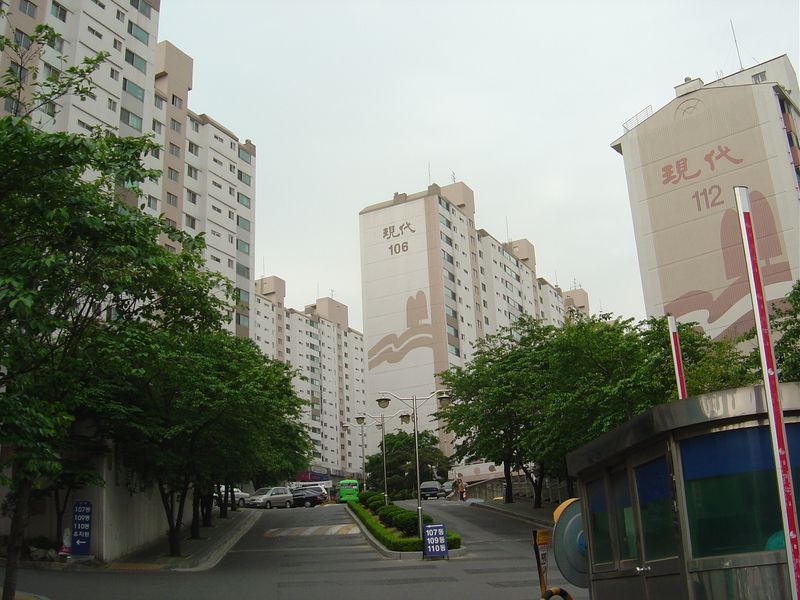
I am an American citizen who lived in the Mapo apartments with my 2 young boys in 1969 and 1970 when my then husband was serving in the US Army and stationed south at a missile base at Reno Hill. I have fond memories of my lovely neighbors. ... When you entered the complex we were in the first long building to the right on the second floor.


there is, at least within certain segments of the media, the feeling that guest workers, because they’re coming from Asia, because they’re coming from third world countries, are a disadvantaged class, while G.I.s and English teachers are a privileged class because they’re white and coming from western countries.Another time I'll look at how groups opposed to illegal immigrants have been capitalizing on the murder of middle schooler Gang Su-hyeon and using her photo to promote their agenda. As for groups with similar agendas, at the Marmot's Hole, Robert translates a Weekly Kyunghyang Shinmun article by Lee Eun-ung of the “Citizens Group for Proper English Education” (or “Citizens Movement to Expel Illegal English Teachers”) otherwise known as anti-English Spectrum:
Foreign teachers with AIDS have actually been confirmed, too. In spring of 2007, our group received a tip from a woman who wanted help. A teacher from Australia threatened her, saying he’d had sex without a condom in southeast Asia and she should be careful of AIDS, too. The tip also said the teacher was loitering around her place, trying to terrify her. After this writer and others pursued him with the cooperation of relevant authorities, he was finally arrested by police in the capital region after living at a guest house in Seoul. It was learned that the teacher had before been fired for molesting a child and had been added to the Korea English Teacher Recruitment Association (KETRA) blacklist.In the comments to this post by Roboseyo, Anti-English Spectrum member Liveswithpassion left 8 links to articles about English teachers molesting children (of which only three of them actually had stories about foreigners being arrested (here, here, and here)). Two others referred to 'A', the Australian teacher who 'threatened' his ex with AIDS, which was a bad breakup turned into news by an angry ex and xenophobic news media (with a little help from Anti-English Spectrum, according to Lee). 'A' is used by Lee as his sole example of "Foreign teachers with AIDS [who] have actually been confirmed" but does not say if he was ever tested, or if anyone saw the results. It might also be worth looking at the claim that "It was learned that [he] had before been fired for molesting a child." Actually, according to this article, a co-worker said that he poked high school-aged girls with paper (?) and read their palms, while in this article it says that the blacklist read, "he often puts his hand on the students’ bodies. It does not rise to the level of sexual harassment but it is absolutely inappropriate. Students and parents said they were suspicious of him.” Inapropiate, yes, but you certainly can't say he 'molest[ed] a child.' Unless you're anti-English Spectrum, I guess. To be sure, with his comment, "Many people were outraged... at the lewd clubs in front of Hongik University that degraded Korean women," Lee makes it clear that he has not forgotten the grudge over Hongdae, and is doing his part to keep the Han River free of ink. And if he or 'Damage' or '그것이 알고싶다' err on the side of exaggeration or gross generalization, remember - they're doing it for the children.
Are you a foreign English teacher working/living in Seoul or the surrounding areas (Incheon, Gyeonggi Province)? Participate in research on the lives of English teachers in Seoul, complete a short 15 minute survey and go in the draw to win an Apple Ipod Nano.The survey is here. If you have any questions, he can be contacted at ariflc [at] nus.edu.sg


Her younger daughter (17 years) was sold to a yorichip (roadside restaurant) by her husband. She did not know better than to go and did not even notify her mother for some months. Now she is kept here in town. She has been sparing her spare time weeping at her mother’s. The mother is distracted. The price of the girl has gone from ¥100, which the husband received, to ¥230. The police doctor [has] sent her to the hospital and already the price is ¥240. [I received] ¥60 from the US recently. The mother thinks she can raise ¥60 by selling her sewing machine. I do not have the [funds] even to advance [the rest]. [pg 178]The above quote goes to illustrate the way girls could be sold, something that was occurring long before the joshi teishintai, or the “women’s self-offering corps,” was established. Clark also describes the observations of Ethel Underwood, writing that, "In her view, recruitment for military brothels was an extension of the established business of prostitution that preyed on girls from poor Japanese families as well as from Korea." He then presents an excerpt of Ethel Underwood’s October 1942 unpublished (due to wartime censorship) report titled “The Darkest Blot in Korea”:
Agents deliver the girl to the crowded dormitory of the employment agency. From here they are sold and resold to factories, hotels, inns, and private homes. The younger girls are taught how to serve food and drink, how to dress and comb their hair, then they are sold to “cafes” or “drink houses,” [and] resold at rising prices until the original 100 yen becomes 200 yen, 300 yen, or sometimes 1,000 yen or more. Girls who from infancy have learned submission to men are now taught to please them. At any stage from the mother’s door to the third or fourth sale the girl may be raped, “broken in,” “prepared” for commercialized vice. The totals are appalling. During the one month of March 1940, 1,500 Korean girls around the age of fourteen were taken through the one port of Antung into Manchuria and northern China. Parties of ten to twenty little pre-adolescent girls were constantly seen being taken into police stations for identification, for travel permits, medical examinations, [etc.]. Older girls are not wanted. “They fight too much if they are not broken in before puberty.” Police regulations make the tracing of girls difficult…There's little I feel like adding to that disturbing picture. Unfortunately, the hatred she speaks of would find new outlets in the late 1940s, and it was in that maelstrom that Ethel Underwood was killed in her own house after communist assassins broke in trying to kill one of her guests.
Sometimes a tearful mother goes on a journey and returns with a pitiful little body, sick and defeated, disillusioned and disgraced. More often nothing is ever heard of the little girl. But the dives of Mukden, Peking, Shanghai, and the barracks of Nanking, Hong Kong and now Manila have competent doctors to throw out any girl dangerously diseased. Koreans hear, shudder, and are ashamed. They revile and hate their rulers and despise them. Thousands of Korean leaders from schools and churches, newspapers and farms [who have been] thrown into jails these last few years report that the only conversation of the police force is of drink, and of the lustful delight of girls from inns and cafes, and from the registered brothels. Brutal by day and bestial by night, the policeman is both hated and despised. [Pg 200]
Archbishop Yoon Gong-hee, who once headed the Gwangju archbishopric, recalled yesterday that on May 23, 1980, he received a letter from the cardinal through a chaplain, without the knowledge of the military, which had blocked all roads and communications in and around the southwestern city.The article also tells us that, "It was officially tallied that 240 people were killed, with 409 missing and thousands injured." Those figures are certainly news to me, but I digress. Here are several photos of the Cardinal throughout his life. The first photo is of him when he was attending Dongsung Commercial School, about which more is said here:
"I am very concerned that so many people were either injured or dead. I know it is a very difficult time, but I hope everything will end peacefully,'' Kim wrote. Alongside the letter was 10 million won in cash.
"People criticizing the government were arrested on rebellion charges. The cardinal didn't write at length or specifically, but people in Gwangju were more than impressed to have received such a consoling message during such a turbulent time from the cardinal,'' Yoon said. The money was used to treat victims, Yoon said.
The late Cardinal had always showed compassion for Gwangju, and when Pope John Paul Ⅱvisited Korea in 1984, Kim allegedly advised him to visit Gwangju first. The pope indeed started his visit in the city, walking along Geumnam road and Provincial Office square, where the military suppressed and even killed citizens advocating democracy. He then moved to the Mudeung Stadium to hold his first mass.
Kim expressed his sympathy for Gwangju several times. ``It was the hardest moment of my life. The case wasn't properly promoted. I thought I did all I could but it didn't work. It left so many people hurt and wounded,'' he said in interviews later on.
Kim Sou-hwan was deeply distressed. The question on the test paper for an ethics class read, “Write down how you feel about becoming an honored citizen of an imperial state mandated by the Emperor.”It seems that a great many people are glad that the principal's prediction was wrong.
The year was 1940, during Japan’s colonial rule over Korea (1910-1945), and Kim was a senior at Dongsung Commercial School (now Dongsung High School) in Jongno, central Seoul.
Kim spent a good hour agonizing over the test item, until he finally wrote, “I am not a citizen of an imperial state. Thus, I don’t have anything to say.” After the examiners checked his paper, Kim was taken to the principal’s office, where he was clapped around the face and told he would never be a priest. He was too subversive, he was told.
Nlan [, a 24-year old Vietnamese woman,] was living with her parents near Ho Chi Minh City after graduating from high school when she first met her husband through a broker. She was told that he had been divorced once and wanted to start a new family. His past didn’t bother her, so they soon married, and Nlan became pregnant. Shortly after the delivery of her first child, however, her husband suddenly asked her to send their baby to his ex-wife.Notice that that article was published about two years after her second child was born. Yesterday, the Korea Times published an update:
“My husband tried to convince me by saying that we could have another baby, but his ex-wife couldn’t,” Nlan said. “He said she lives a lonely life now.” She reluctantly agreed, and moved on with her life.
After giving up her baby to her husband’s ex-wife, Nlan gave birth to her second child in 2005. Soon, however, her husband suggested that they also send their second child to his ex-wife. When Nlan came home from the hospital, she discovered her second child was gone. Shortly after the incident, her husband asked for a divorce.
"I was too young and naive at that time,” Nlan said. “I had no friends or family whom I could ask for help. And I didn't speak Korean at all. When my husband’s attitude turned cold, I could do nothing except sign the divorce contract.”
After divorcing him, she found that her husband had reunited with his ex-wife with Nlan’s children. Nlan then realized that she was used as a surrogate mother for his husband’s marriage because his ex-wife was barren. Now she is pursuing a legal suit against him.
A court rejected a Vietnamese woman's request Monday for the custody of her biological children who she had with a Korean husband. The Seoul Family Court cited the "children's lack of awareness'' of her as their mother as its primary reasoning. The 26-year-old married to a divorced Korean man in his 50s in August 2003 and gave birth to two daughters in the following two years.Actually, according to this Ohmynews (or this Hankyoreh) article, she gets to visit her children at her ex-husband's house the third Saturday of every month from 2pm to 6pm. A total of 48 hours for the year. Is that Korea's "basic right" for biological mothers?
But, immediately after the birth of the two children, they were sent to the husband's former Korean wife. The Korean woman, now recognized by the children as their mother, has nurtured them since then. [...] Just days after the immigrant wife delivered the second child, the husband abruptly divorced her and began to live with his former Korean wife. The Vietnamese woman filed a suit in a bid to secure custody of the children, which is usually granted to the father for financial reasons.
The reason the man sent the children to live with his former wife has not yet been confirmed, with those involved in the case unavailable for comment. The court also refused to elaborate, saying, "It was not the point of the case.'' [...] The biological mother reportedly claimed during court proceedings that the Korean used her as a "surrogate mother,'' which is strictly banned in South Korea. It remains uncertain whether or not the Korean woman is sterile.
The Vietnamese woman now lives in a rundown house in Seoul, and is said to be barely surviving by working at a sewing factory. Although failing to gain custody, the court granted her visitation rights with the children one day per week in order to guarantee her basic right as biological mother.
"During the proceedings, we gave her a chance to meet the babies. But they did not recognize her as their mother at all,'' the court spokesman said. "Given overall conditions, we decided to give custody to their father but enabled her to meet them on a regular basis for humanitarian concerns.''So you mean the court can't do anything to enforce the visitation rights given to her? I suppose when her only choice is to go over to her ex-husband's house to see them, it would be too difficult to enforce, especially seeing how court decisions are little respected here anyway (how many chaebol owners and political cronies and sons of his former elementary school classmates will the president pardon this year?).
The former husband has appealed the case to overturn the court's decision to grant her the right to meet the children. The lawyer for the migrant woman was cautious in commenting on the case for fear that media exposure may adversely affect her and further anger her former husband who may withholds the children from her.
"The court allowed the meeting, but it doesn't necessarily mean the meeting will be realized any time soon,'' the lawyer told The Korea Times. "If the former husband refuses, it's impossible for her to meet them.''
The lawyer added another suit for alimony is underway, with its conclusion expected by the first half of the year.I really have to wonder how successful that will be, especially if the court can't really enforce it (though the courts may have gotten more teeth in enforcing child support). The article ends with our immigration factoid for the day:
The Korea Immigration Office estimated the number of Korean-Vietnamese couples here to be 27,092 last year, the third largest international marriage group.This woman's case really stood out when I first read about it over a year ago, and I remembered it as soon as I read this most recent article. While the first response is to reading it is obviously going to be like these ones - anger and disgust - the question remains as to what legally could be done. She agreed to the divorce, unfortunately, and women in Korea - as in women who are Korean citizens - seem to regularly get the shit end of the stick in divorce cases, so it's hard to be optimistic about what hope there is for a foreigner who also doesn't speak the language (or didn't when this mess began). On top of all of this, as this article notes (note that it is over two years old), there are other problems:
According to the law, selling eggs is illegal, but there are no regulations for surrogate mothers. That is why the industry has no problems luring cash-strapped young women. Surrogate mothers are paid W30-40 million (US$1=W956), while egg donors get W3-4 million.The article begins by looking at messages left at internet portals written by people looking for surrogate mothers. If the law hasn't changed, then I don't know legally what can be done, other than giving her visitation rights and alimony, as the court has a point - the children don't even really know her. The laws as they exist now may not have taken such a situation into account.
One result has been that more and more Japanese infertile Japanese women seek Korean surrogates. In 2003, Japan completely banned surrogate pregnancies and industry brokering.[...]One hopes that this perverse case, which could set a precedent for turning Vietnam into Korea's 'womb colony' leads to changes in the laws so that should this happen again, the courts will be able to punish it. Let this opportunity not be wasted.
Grand National Party lawmaker Bahk Jae-wan on Monday published Ministry of Health and Welfare materials which say there are 13 Internet groups on major domestic portal sites related to surrogate mothering, 65 related ads, and 2,295 users registered to the groups. “With the lax regulations on surrogate pregnancies in Korea, the number of Japanese finding surrogate mothers here is rising. My concern is that we could be reduced to Japan’s womb colony.”
Set towards the end of the Yi Dynasty (the late 19h century in the Western calendar), Surrogate Mother uses a historical setting to pinpoint the roots of problems which remain endemic in Korean culture. Im’s specific target is the principle of male lineage, strong in all Confucian societies but still capable of ruining lives in present-day Korea.That's very true.

Turning still, the steamer suddenly brings into view a little knoll, at whose base are grouped some score of houses. They are not so far off but that a glance shows them to be not Korean, but Japanese. It is the Japanese colony of Fusan. It is in some respects a remarkable colony. In the first place, it is the only one that the Japanese have ever had. The spirit of trade — the great colonizing motive-power — is not a strong element in the Japanese character; the Chinese are the English of the far-East. Secondly, it is historic. For centuries it has been a bit of transplanted Japan. Ever since the invasion of the peninsula in 1592, the Japanese have held it almost without a break; it has been a little fortress by itself in an alien land. Yet, though it has lived amidst Korean manners and customs for so long, it has not been in the least affected by them: it is still Japan. Nor have the Koreans, in their turn, been leavened by it. The natives of the neighborhood, impelled a little by the desire to trade, and more by the curiosity for foreign sights, visit it by day, but they return at night to their own town. The only thing they have deigned to acquire has been some knowledge of the Japanese language; so that to-day interpreters from Korean into Japanese are either men from the neighborhood of Fusan or else returned refugees.It's interesting that he makes a distinction between Fusan (the Japanese settlement) and Pusan (the Korean settlement). They would, of course, merge as the years went by. As this recent essay* points out, the Japanese expanded their concession (which was not much larger than the waegwan) by asking for land for a graveyard (to the north), for a coaling station (on Yeongdo) and by reclaiming land.
The Korean town of Pusan lies about two miles away, round the bay. When you learn to distinguish the thatched roofs of the houses from the brown of the withered grass, it can just be made out from the steamer's anchorage. From Fusan a road leads over the seaward slopes of the hills to it, and you are first made aware of its existence by seeing a procession of distant ghosts slowly winding their way along this path. The white dresses of the Koreans, and their slow decorous movements, lend themselves involuntarily to such spiritualistic hallucination.
Looking South: Yeongdo, left, Yongdusan, right. Undated.He missed being born in Korea by six months: he was born in the US while his parents were home on a leave. They were here before, so he was raised during the Japanese colonial time and he spent most of his youth in Suncheon and went to high school in Pyongyang where his father was a teacher in the Presbyterian seminary. And then he went back to the US for college and medical school and during that time it was the end of the colonial period in World War II. He came back in 1947 [.]He was born to Dr. John Curtis Crane and Florence Hedelston Crane, and as they were in Korea before his birth, I'd imagine they were knew the other Crane family (perhaps they were related?), but have no idea which family the infant Elizabeth Letitia Crane was born into. His parents were based in Suncheon, and Donald Clark's book also describes the missionaries' summer retreat in Jirisan, writing that "The children learned to collect wild flowers by the trails, and there are oldsters who still remember helping Florence Crane collect flowers for her book Flowers and Folklore From Far Korea" (I love the cover design).
U.S. Lieuts. Stewart M. Greenbaum and Gordon Mohr, Army observers in Sunchon, narrowly escaped death. The rebel sergeant assigned to kill them was an old friend, who had drunk beer with them in their billet many times. He took the two officers into a field, fired into the ground and then led them to the Presbyterian Mission of Dr. John Curtis Crane, who was barricaded in with his wife and four other missionaries.From one of the doctor's shirts and a few colored rags the ladies made a 16-star, eleven-stripe U.S. flag and put it up. The rebels began pounding at the compound gate, yelling: "Let's kill the Americans!" Suddenly one shouted: "No, no, not them; they are my friends." It was the lieutenants' friend, the sergeant. The rebels went away.
Gordon Mohr, who 'narrowly escaped death," relates a much more brutal and gruesome tale of his experiences in Suncheon here, though I should warn that it's filled with accounts of torture, murder, mutilation and rape (often all taking place at the same time, with too much of it involving children). Not to doubt his account, but this account of his life (which mentions his experiences in the Korean War) also describes how he came to realize that the Jews were funding the communists to take over the world, with examples of his essays to be found here. Ahem.
Lately, I have been hearing people refer to my family as being "multicultural," but my family is just an ordinary family like any other. Up until now, there haven't been many cases where I have experienced particular difficulties due to the fact that my mother is Japanese. So why is there all of a sudden so much interest in differentiating between "normal" families and "multicultural" families?[...]The article reminds me of an adult student I taught last summer. He traveled in Canada several years ago (working on farms in B.C.)(no, not those kind of farms) and that was where he met his future wife. The first time I met him he mentioned he was going to Japan for a vacation, and that he had been there many times, before finally revealing that his wife was Japanese, and he and his family were heading to Japan to visit his in-laws. It was interesting as he talked about the challenges his wife faced (similar to those of the girl's mother in the above article), especially regarding language. She spoke Korean fairly well, he said, but sometimes she would call him from the bank, say, to get his help translating something. He then looked at me and said, "I guess it must be difficult for you here sometimes, too."There are many kids who don't even know what a multicultural family is. When my teacher tried to explain the term "multicultural family" to the class, I felt really uncomfortable. Is there something unusual about multicultural families? I still don't get it. What makes me so special?[...]
I don't know whether I want to call my family "multicultural." But what I do know is that I want to work really hard and become a respectable person so that I can make people see that not only is our family not abnormal, but also that multicultural families are valuable to society and can help the world progress.
“Old Partner,” a low-budget documentary about the 30-year friendship between a farming couple in their 80s and a loyal cow, attracted 305,000 viewers from Jan. 15 to Feb. 10, a record in Korea for an independent film. The movie was originally screened in just seven cinemas on its release date. But word spread quickly among film lovers, and it is now showing in over 100 movie theaters nationwide.Actually, this Korea Times article has more information on the movie and how it was made; The Joongang article is about how the movie's success has affected the lives of the couple seen in the film:
Despite the unexpected popularity of the movie, the elderly couple have complained to the movie crew that their lives have been turned upside down. They say they are inundated with calls and requests from the media and ordinary viewers who want to meet and talk. [...]That reporters "went inside their house although the couple strongly resisted" reminds of a story Oranckay told about the actions of a rather unscrupulous reporter in the media blitz that followed Kim Sun-il's beheading in Iraq in June of 2004 (from the wayback machine - scroll down to July 5, 2004)
Some television network producers have already visited and filmed the couple’s village without advance permission. Some even went inside their house although the couple strongly resisted, according to a producer of the movie. The two live in a small hilly village of 40 in Bonghwa county, North Gyeongsang Province.
Just heard from a very reliable source that the above picture of Kim Seon Il, used repeatedly in the media and at street protests, was stolen from his family's home by a reporter when journalists stormed the living room to take pictures like this. It has been used repeatedly for things like this and later things like this.[I removed a few dead links; here are photos taken at his family's home at the time: 1 2 3]
I have no way to confirm if the story is true or not, but at the very least, it is believed to be true by many journalists covering the whole situation, particularly from Busan where his family resides.
The reporter, btw, is said to work for a newspaper with national circulation, one that also publishes a daily in English. Exclude the Joongang and figure it out yourself.

Yu-na can credit her success to her parents, who have spared no expense for her career. Her monthly training costs average more than 2 million won, which includes renting the Gwacheon ice rink and hiring instructors. When she takes part in an international competition, it’s at the family’s expense. But it is overseas training that truly costs a fortune. To create her program, Yu-na and her mother have gone abroad and paid huge sums to hire professionals such as choreographers.Nowadays, as the Korea Times reports, Kim doesn't have to worry so much, seeing as
a rough tally of Kim's already sealed endorsements, sponsorships and cash prizes show that her total income this year will probably hover between eight to 10 billion won, more than double the amount she raked in last year.It's nice to see that the effort and money she and her parents put into her training has paid off so well, and it's worth noting that she has donated millions of won to charity over the past few years, as noted here and here. A Chosun Ilbo article asks:
Why do businesses like Kim? A staffer with Cheil Worldwide said, "When things are difficult, people want to hear hopeful news. For example, Pak Se-ri drew attention in the financial crisis in 1997 and national football coach Guus Hiddink became popular during the credit card crisis in 2002. As gloomy news about the recession pour out, consumers are becoming frenzied about Kim as a symbol of hope."They aren't the only ones. Yesterday former GNP leader Park Geun-hye posted a picture of herself as a child on skates on her Cyworld homepage (yes, that's her pictured above, not Kim Yu-na) and wrote about the hope and courage that Kim's victory has brought, like a new spring, to the nation. Even politicians/daughters of former dictators aren't immune from Kim Yu-na's power. I found another photo of her at Dongdaemun Ice Rink in the 1960s, along with her sister and her mother:


The Korean Government will prevent illegal activities by verifying requirements of native English teacher and tighten their non-immigrant status [...] [and will] eradicate illegal activities of native English teachers who are causing social problems such as ineligible lectures, taking drugs and sex crimes. English teachers, who disturb social order during their staying in Korea such as illegal teaching, taking drugs and sex crimes, will be banned from entering South Korea.[...] [We will] prevent illegal English teaching activities and the taking of drugs and sexual harassment of English teachers, [...] teachers who disrupt the social order by taking drugs, committing sexual harassment and alcohol intoxication.Is it just me, or does such language seem to reflect the almost three years of xenophobic media reports equating white male English instructors with sexual misconduct, drug use, AIDS and even lawlessness? The release by immigration ended with this:
It is expected the uneasiness of citizens incurred from ineligible English teachers will be mitigated [...] thanks to this measure on the native English teachers by the Ministry of Justice.It might be worth asking who created such uneasiness in the first place. Not that laws haven't been broken by English teachers, of course, but things were so blown out of proportion that my boss could mention in 2006 that there had been 'many' sexual 'problems' and crimes recently due to English teachers. When I asked for examples, none were forthcoming. What's interesting about the Korean Immigration Service's E-2 Visa Policy Memo (which mandates the drug and HIV checks) is that, according to an ATEK statement,
This Policy Memo was not created by Presidential Decree. It did not go through the formal regulation approval process (which is why it is called a "policy memo," and not an "enforcement ordinance" or "regulation"). The Korean Immigration Service acted independently and without oversight in adopting these rules, which are at odds with both domestic and international law.I do find it rather ironic that in order to combat the spectre of English teacher crime - which certainly didn't exist to the extent that the media (or Immigration) made it out to be, and which had little basis in fact, Immigration created rules that have no legal basis - phantom rules for phantom crime.
Photo from here.
A law professor filed a report with the National Human Rights Commission yesterday asserting that health and criminal checks required of native English language teachers entering Korea are discriminatory.It's interesting to note that, at the moment (will the Herald get on board?) there are as many English language articles about this as there are Korean language articles - one from Hanguk Gyeongje and one from Yonhap. Funny how the Canadian teacher accused of molesting three elementary school students was reported by 5 news outlets in Korean, but this garners only 2 reports.
Kim Young-geun, a deputy director at the Justice Ministry’s Korea Immigration Service, said the ministry doesn’t agree with the report. People who want to work in Korea need to follow the country’s law, he said.That's pretty much the same thing they said a month ago. The statistics that Wagner found regarding drug arrests were very interesting: the highest number of arrests in a given year was 24 marijuana arrests in 2007 - out of 17,721 E2 visa holders - and 0 arrests for any other drug, though it's for drugs other than marijuana that E2 visa holders are being tested for. Sounds like a necessary requirement to me. Perhaps car insurance records from home countries should also be submitted with E2 visa applications... they'd seem to be about as relevant.
“Different countries have different visa policies. It is a matter of a country’s sovereignty to decide who should be allowed to enter the country,” said Kim. He added that the ministry included only requirements that it deemed necessary.