[Update]
Well, damn. I wasn't able to view this page on the ciao site, but could access it through a google search. Now I can't access it at all, and I bet no one else can either. If you want a copy of this just leave a comment.
I just found an essay called 'The United States and South Korean Democratization', by James Fowler, which was published in Political Science Quarterly in 1999.
I haven't had a chance to read it in its entirety, but it examines the US role in the pro-democracy movements of 1979-80 and 1987. He uses the declassified 'Cherokee' files (the same ones Tim Shorrock used), but actually cites each document. From what I've read so far it's a pretty balanced look at the US role, and his examination of America's application of public and 'private' pressure on the Park and Chun regimes is a useful one. My main criticism so far would be that he seems to rely too much on the cables for accounts of events in Korea (like the Busan-Masan and Kwangju uprisings) and gets certain details and dates wrong. Despite this, I think it certainly falls into the 'Required Reading' category.

Thursday, June 30, 2005


Wednesday, June 29, 2005
Put That Boxcutter Down, Kid

Of all the photos by Korean students displaying their hatred for Japan that were posted last week, one grabbed my attention more than others. The reason for this can be found in Gord's comment upon it:
"No need to use large swords when an exacto knife does the job. Curiously, exacto knives are pretty much standard issue for all students in Korea."
This is something I've noticed before on many occasions, and my immediate order to "Put that away," has always been met with confusion by my students. The main reason for this is that they simply don't consider them to be dangerous. After all, they're usually used as pencil sharpeners, and pencil sharpeners can't be dangerous, now can they?
The reason why the picture above stood out is that a few weeks ago a grade six girl in one of my classes began to play with a boxcutter she'd taken out of her pencil case, extending and retracting the blade because she liked to listen to the sound. This was after a short round of teasing (which was both playful and in English) between her and the (younger) boy next to her. For a joke, he decided to grab the knife from her after she retracted the blade...but before she again extended it. He immediately yanked his hand back (so fast that there was no blood left on the blade), and the look of surprise on his face was what really got me. He had no conception that a knife like that might be dangerous.
Before the pain really start to the set in I had him out the door, and after running water over his hand it was clear he had cut three fingers to the bone. It took two and a half hours of surgery to reconnect the tendons, but when I visited him that night he seemed in good spirits. The visit was a bit awkward, as the girl's parents were there (even though it wasn't really her fault), but neither of the boy's parents were (the father was out of town and the mother was at home making dinner for his younger brother). At any rate, a week later he was back in class, though even now he has a large bandage with elastics stretched between his 3 fingers and his wrist.
I decided to do some googling and found an interesting case in Texas in November 2003 involving a Korean-American student:
When she was growing up in South Korea, Sumi Lough says, she used the traditional pencil sharpener that all children there used: a 2-inch-long blade that folds into a small handle. But what may be considered a routine item for schoolchildren there was alarming enough in the Katy school district to get Lough 's 13-year-old daughter in deep trouble. School officials viewed it as a potential weapon.It goes on to describe the parents' lawsuit, which criticizes the school's zero tolerance policies. There's a follow up article here, (and google results) and the outcome of the lawsuit is here. A traditional Korean pencil sharpener apparently looks like this:
Christina Lough, a straight-A student at Garland McMeans Junior High School, was punished after a teacher saw the sharpener in class on Oct. 8. In addition to being ordered to attend a special disciplinary class for seven days, the girl was removed as president of the student council and honor society.

It's described as "a common implement for students in South Korea," but I've certainly never seen one. The only ones I've seen look like the one above that's plunging into Japan. I'd have to guess that with a folding blade, the incident in my class I described above would never have happened. The ease with which a boxcutter's blade extends and retracts is part of what makes it so dangerous (and useful).
The Strange Coincidence of 'Twist Kim'


Over a week ago, on June 16th, the Donga Ilbo had an article on the plight of "Twist Kim" :
The article goes on to describe how Kim eventually had his reputation and career ruined by his presumed connection to these sites, and how he even attempted suicide.
“Twist Kim,” or Kim Han-sub, now 69, was beloved for his dance scene in the 60’s movie, “The Young with Naked Feet.”
His eyes turned red with tears at the “Information Communications Ethics and Mature Society conference” hosted by Gathering for a Mature Society, a civic group, at the Sejong Center for the Performing Arts on Wednesday while he talked about the “cyber terrorism” perpetrated against him.
Kim found out that his professional name, Twist Kim, was being used as the name of illegal porn sites or their domains. The number of such sites that he himself picked out reached 27.
In a truly strange coincidence, the day after this story was published, Bitwin released on dvd the aforementioned “The Young with Naked Feet,” perhaps better known as "Barefoot Youth", as part of its "Korean Film Collection" (which consists of films (like these) released in the 1960s, all with English subtitles). Seeing as there have been less than ten Korean films from the 1960s (and none from the 1970s) released on dvd, Kim's appearance on this medium is one that's quite rare for actors from that era of Korean film history.
If you're interested in seeing this classic of Korean film, Seoul Selection is screening it this Saturday. For more info on the film and the screening, have a look here.
Monday, June 27, 2005
Kowonsungi Attacks! Dokdo, Monkeys & Gamers
By now, of course, everyone has seen those anti-Japan pictures drawn by students at Gyeyang Middle School in Incheon and posted in a nearby subway station. If you haven't, they can be found here and here, and the Marmot provides some additional information about the growing attention being placed upon them.
Now, some of the photos depict the Japanese as monkeys (and monkeys getting their asses kicked, at that):


These pictures are described (on the site where they are hosted) as racial slurs, though I'm not so sure. I do have to wonder where children would learn these. Parents? TV? At school?
Maybe it was while they were playing computer games:


Well, at least the humour in the last paragraph is intentional this time (the story is obviously written by a gamer). The screenshots of the Koizumi monkeys make me wonder if any of the students who drew the pictures had seen the game. It certainly has many of the elements seen in the students' pictures (Korean flags, thoughtless patriotism, monkeys, fighting to the death, a simplistic reduction of the conflict to 'Us vs Them', etc). And it's worth noting that the Korean fighters are invading 'Daemado' (Tsushima), and thus 'turning the tables on the hated aggressor' (that 'simplistic' aspect of it again).
Even if this game didn't influence the pictures (possible, but it should be remembered that the game was publicized a great deal in the Korean media two months ago (and even in an English language paper) so I would imagine it's the likely source) I doubt that the monkeys are meant as a slur. One of the student pictures posted above has a tiger fighting a monkey; both animals are indigenous to one country but not the other (maybe I should say were indigenous, in the case of tigers in Korea). The monkey seems more a Western racist characterization of East Asians rather than a Korean one of the Japanese. If the idea for the monkeys came from the video game, does it make the 'slur' angle more or less likely? Do they play on existing associations or are they just seen as cute and humourous animal characters in a game? Something to ask my students about, I guess.
Speaking of my students, I’ve showed the pictures to some of my middle schoolers. The usual response is ‘very good’, ‘very funny’. And I’ve learned it’s not worth the time to argue about it, unless the person has shown some semblance of an open mind beforehand. After seeing this photo, (taken in March) I edited it a little in order to show it to my students and ask if stepping on someone else's flag was a good thing; when they said no, I could show them the original. It seemed like a relatively easy point to make… Upon my saying that the edited picture was fake and that I had altered it to make a point, their only response was “You made that picture?!” Sigh…
For those interested in online gaming in Korea, Robert Neff blogged on that topic awhile back and his post is well worth reading, as are the comments (it's a whole world I knew nothing about).
In trying to find more info on the video game I turned up this article on the current Dokdo situation, which covers a lot of ground and makes a good summary for those who are unaware of the background.
Now, some of the photos depict the Japanese as monkeys (and monkeys getting their asses kicked, at that):


These pictures are described (on the site where they are hosted) as racial slurs, though I'm not so sure. I do have to wonder where children would learn these. Parents? TV? At school?
Maybe it was while they were playing computer games:
Strong sentiments on the Dokdo islets have led domestic online game developers to create Dokdo-related quests, enabling players to fully exhibit their patriotism in cyberspace. GoonZu Online is a role playing game that takes place in 1598, during the Joseon period, and involves trade, politics and war. Recently, the developers added a special quest in which one can battle Japanese soldiers who invade Dokdo.Does the writer of this piece realize just how much that last paragraph encapsulates the experience of so many young people in Korea at this moment in time? It may not be entirely fair to say that, but it's at least partially true. If you want to see some (not so interesting) screenshots of the game's Dokdo setting, have a look here.
"There is a lot of fighting with Japanese troops in the game, but fighting off soldiers on Dokdo somehow made me feel more heroic although I knew it was just a game," said Lee Kang-min, 23. Mr. Lee is unemployed and spends most of his time playing games, "just until the economy gets better and I can find a job," he says.
In a recent updated campaign to conquer the Japanese island of Tsushima, the game developer added two monsters that one has to battle. (The beauty of online games is that they never end, since the developer adds new projects.) These two monsters are monkey-like creatures that jump around and attack in groups when you reach Tsushima. Interestingly, although the animals are monkeys, users could obviously see that they bore a resemblance to Japanese Prime Minister Koizumi.The attack of Kowonsungi?

Are game developers going too far? Not so, according to GreenLove, a player that I met on cyber Tsushima. "Koizumi should get what he deserves," she said, brandishing her sword against the monkeys that started to mill around her.Here are some full screenshots. (I found 'em here)


Well, at least the humour in the last paragraph is intentional this time (the story is obviously written by a gamer). The screenshots of the Koizumi monkeys make me wonder if any of the students who drew the pictures had seen the game. It certainly has many of the elements seen in the students' pictures (Korean flags, thoughtless patriotism, monkeys, fighting to the death, a simplistic reduction of the conflict to 'Us vs Them', etc). And it's worth noting that the Korean fighters are invading 'Daemado' (Tsushima), and thus 'turning the tables on the hated aggressor' (that 'simplistic' aspect of it again).
Even if this game didn't influence the pictures (possible, but it should be remembered that the game was publicized a great deal in the Korean media two months ago (and even in an English language paper) so I would imagine it's the likely source) I doubt that the monkeys are meant as a slur. One of the student pictures posted above has a tiger fighting a monkey; both animals are indigenous to one country but not the other (maybe I should say were indigenous, in the case of tigers in Korea). The monkey seems more a Western racist characterization of East Asians rather than a Korean one of the Japanese. If the idea for the monkeys came from the video game, does it make the 'slur' angle more or less likely? Do they play on existing associations or are they just seen as cute and humourous animal characters in a game? Something to ask my students about, I guess.
Speaking of my students, I’ve showed the pictures to some of my middle schoolers. The usual response is ‘very good’, ‘very funny’. And I’ve learned it’s not worth the time to argue about it, unless the person has shown some semblance of an open mind beforehand. After seeing this photo, (taken in March) I edited it a little in order to show it to my students and ask if stepping on someone else's flag was a good thing; when they said no, I could show them the original. It seemed like a relatively easy point to make… Upon my saying that the edited picture was fake and that I had altered it to make a point, their only response was “You made that picture?!” Sigh…

For those interested in online gaming in Korea, Robert Neff blogged on that topic awhile back and his post is well worth reading, as are the comments (it's a whole world I knew nothing about).
In trying to find more info on the video game I turned up this article on the current Dokdo situation, which covers a lot of ground and makes a good summary for those who are unaware of the background.
Thursday, June 23, 2005
Korean Literature in Translation
If you have any interest in reading 'modern classics of Korean literature', you really do have to check out the Korean Literature Today website. KLT is a journal which is devoted to translating Korean literature into English, and the good news is that this quarterly journal's back issues from 1996 to 2000 are all (mostly) available online.
So if you're looking for short stories by writers like Hwang Sun-won, Lee Bom-son, Choi Yun, Yi Sang, Cho Se-hui, and many others, there are at least one or two stories available by each one. There's also quite a bit of poetry translated as well. The people responsible for these translations have made the Portable Library of Korean Literature possible; many of the titles on the KLT website have been published as part of this series. If I had any complaints, it would be that many of the authors' best known works are not included in this series (for example, Hwang Sun-won's 'Sonagi', and Choi Yun's 'There a Petal Silently Falls', which inspired the 1997 Jang Sun-woo film about the Kwangju Uprising, 'A Petal'), but that's a minor quibble.
So if you're looking for short stories by writers like Hwang Sun-won, Lee Bom-son, Choi Yun, Yi Sang, Cho Se-hui, and many others, there are at least one or two stories available by each one. There's also quite a bit of poetry translated as well. The people responsible for these translations have made the Portable Library of Korean Literature possible; many of the titles on the KLT website have been published as part of this series. If I had any complaints, it would be that many of the authors' best known works are not included in this series (for example, Hwang Sun-won's 'Sonagi', and Choi Yun's 'There a Petal Silently Falls', which inspired the 1997 Jang Sun-woo film about the Kwangju Uprising, 'A Petal'), but that's a minor quibble.
Wednesday, June 22, 2005
The Triumph Of Folk Culture In Korea
I've been wanting to track down some of Gregory Henderson's books (like Politics Of The Vortex) and found the essay 'Grappling with the Korean Persona: A Cultural Profile' online the other day. The essay covers several aspects of Korean society, but I thought his evaluation of the relationship between artistocratic and folk culture to be quite interesting:
Now, this essay is almost 20 years old, but much of it still rings true. For cinematic representations of the folk culture he describes, Im Kwon-taek's Chiwaseon (2002) or Chunhyang (2000) (which is accompanied by a pansori performance), or Kim Ki-young's Yangsando (1955)(recently released on dvd) are good examples. Im's Sopyonje may well deserve credit for making Pansori popular again in the 1990s.
What has happened, quite evidently, is that the old aristocratic tradition has thinned to a vague abstraction, except in advertising or in the classroom. Behavior and aspirations associated with the Korean under classes have spread and come to the fore. The image now projected before us is the vibrant, adaptable, aggressive, ambitious, devil-take-the-hindmost Korea of the great majority long held under aristocratic control. Traditional aristocratic ideals conflict with this behaviour and confuse Western observers. To make matters worse almost all study and scholarship on Korea's traditional background has been devoted to the aristocratic tradition. Most written sources are devoted to it, while almost no attention has been directed to Korean folk culture. Our study of Korea is on collision course with the Korea before our eyes.
The aristocrats, with their essays, histories, poetry and calligraphy, produced an enormous body of work mostly unread today. This work floats on a great cultural lake of music, dance, ceramics, furniture, folk and court painting done by poor or preliterate Koreans, almost all of it commonly seen, much a part of Korean life today. I believe that in no sophisticated culture is the folk component so high as in Korea.
Now, this essay is almost 20 years old, but much of it still rings true. For cinematic representations of the folk culture he describes, Im Kwon-taek's Chiwaseon (2002) or Chunhyang (2000) (which is accompanied by a pansori performance), or Kim Ki-young's Yangsando (1955)(recently released on dvd) are good examples. Im's Sopyonje may well deserve credit for making Pansori popular again in the 1990s.
Sunday, June 19, 2005
Text Messages and Other Cell Phone Topics
[Update]
Apparently, 4.5 million phones were reported lost in 2004. I wonder if there's a correlation between phone loss and alcohol consumption?
Also, I've asked a number of my students how often they send text messages on their phones.. Elementary students generally were around 10 per day (higher if they were girls), and several middle school students said around 20 or 30, but one middle school girl said 100, and a high school boy said he sends 150 (!) every day. With numbers like that, 370 million doesn't seem a particularly high number at all.
[Original post]
According to an article in the Chosun Ilbo,
Koreans send and receive some 370 million text messages a day, and assuming that an SMS costs W30 to send, the country spends over W10 billion (US$10 million) a day on sending text messages.
The article goes on to explain how to save on SMS charges (though, at 3 cents per message, they're already pretty cheap), so we can imagine that many people aren't paying full price. I was initially shocked by the number of 370 million, but when you consider there are (acording to figures which are a year old) 36 million cell phone users in Korea (out of a popularion of 48 million people), an average of 10-11 messages per day is not an absurd figure at all, especially considering the habits of students, which have certainly been noticed by the telecom companies: "SK Telecom and LG Telecom introduced packages that allow adolescents to send unlimited SMS, while KTF offers a package giving users up to 500 free text messages a month."
I was curious how Korean text messaging habits compared to the world total, but estimates vary from 'over 1 billion' to 7 billion text messages being sent every day. Perhaps it would be more interesting to compare Korea's numbers to Britain's. 50 million British cell-phone users (out of a population of 60 million) send about 75 million text messages per day, which means that though Britain has 40% more users, they send about 20% of Korea's message total per day. Something to consider is that it's much easier to type in Korean than in English on a cell phone keypad, though I'm sure there are more compelling social or cultural reasons for the difference.

In a related story, on June 16th, the sports daily Ilgan Sports, reportedly sent pink slips to 23 staff members by text message. Of course, this isn't the first time people have been fired by SMS.
The way in which cell-phones are used as status symbols (I've had friends laugh at mine, even just after I'd bought it), and the desire by students for the latest model, guarantees a short life cycle for phones and therefore a steady market. According to the Korea Times,
Korean mobile phone makers release around 400 new models every year. According to U.S.-based tech consultant iSuppli, Korean makers provide more than 27 percent of 2,700 different cell phone models available today in the global market.
This turnover, which some consider the shortest in the world, is causing some environmentalists to wonder about the consequences of constantly buying new phones:
In South Korea, which is known for its short handset replacement cycle, about 10 million mobile phones in a year find resting places in drawers and closets since they can't be thrown away.
Last year, about 13 million mobile handsets were thrown away or replaced, but only 4 million were retrieved by wireless operators, according to data from the Ministry of Commerce, Industry and Energy.
Of the retrieved phones, about 2.2 million were exported or reused, the data showed. The remaining 1.8 million phones were incinerated or wound up in landfills, fanning concerns of a future environmental problem.
Beyond such environmental concerns, the ways in which cell phones are changing people's behavior worries some (and you need only look at how many people in any given subway car are playing with their phones). This especially applies to students; I can't count how many times I've had to tell kids to put their phones away in class. Obviously, authorities have noticed this, and the Seoul Metropolitan Office of Education has produced a leaflet on mobile phone etiquette for distribution to elementary, junior high and high schools. Sometimes I do think punishments are a bit harsh; one of my middle school students, in class at her school, lent her phone to a friend who got caught using it and had it taken away for a week. I'm sure a day or two would have made the appropriate impression on her. On the brighter side, at least he didn't hit her.
One last cell phone related topic: While Samsung has been celebrating itself by building statues to honour the mobile telephone (and Samsung) in at least 10 different countries, and the Chosun Ilbo has reported on Samsung and other Korean companies' increasing popularity in developing countries in Asia and elsewhere, Samsung has had to deal with a certain amount of unpopularity at home.
Wednesday, June 15, 2005
Internet Witchhunts and Conflict Resolution
The 2005 'Dog Poop Girl' incident
Part 1: Internet Witchhunts and Conflict Resolution
Part 2: Riding the wave of 'cyber terror' articles
Part 3: 'Real Names' in Korean Cyberspace
Part 4: Portals and the Cyber Terror blame game
Part 5: Dog 'Poop' Girl Redux
Part 1: Internet Witchhunts and Conflict Resolution
This is from an article on Korean Internet Witchhunts, which can be read here.
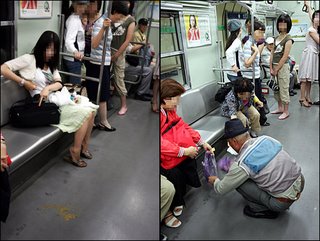
You know, when I read 'droppings', I didn't picture splattered diarrhea. As far as I'm concerned, the public anger is a little more justified by the second picture, in which elderly people are cleaning up after this little princess. 'Hey, we only suffered through the war and built the country up from rubble to modernity with our sweat and blood - we'll be happy to clean up after you!'
There were a variety of responses to these photos, which ranged from angry posts, to being part of the cyber-mob out on the rampage, to constructing some clever (and some not-so-clever) parodies of the incident. Doing a search for 개똥녀 will turn up a plethora of posts by people on different sites weighing in with their opinions, as well as the few bursts of creativity:

The true story of a terror that will overturn Korean history
"Hey Lady! Is this the first time you've seen my dog? He's funny...really..."
Even now, the dog-dung girl is there...
2ND LINE SUBWAY DOG-DUNG GIRL INCIDENT
Other such parodies can be found here and here, while an untouched photo of the event, worthwhile because you can see the reaction of the other people on the train, can be found here.
While the parodies are rather amusing, this is a little bit scary. Titled 'The next day', it's clear at least two photos were taken of this girl.

I'd guess that the person wasn't entirely certain it was her, but zooming in like that is a bit creepy. And those photos being on Daum, thousands, if not millions of people have seen them. Considering how the university it was assumed she goes to had its server crashed by netizens (followed up by phone calls) one might assume that the girl herself might be in danger of a severe dressing down (or worse) should she appear in public.
It's hard to make an informed guess about what treatment might await her in public, but precedent can be found in English Spectrum-Gate. In January 2005, the foreign English teacher site English Spectrum, which had posted pictures of foreign men and Korean women together at a club and had given tips on how to 'score' with Korean women, was shut down by, as Marmot put it, the "media-driven cyber assault" of Korean netizens after different media outlets picked up the story. As the internet witchhunt continued, it was seen as possible that the violence might move offline, but apparently this never happened (though it did prompt more searches by immigration for foreigners teaching English illegally). The targets of such possible violence would have been foreign males, however, who might not have seemed so easy to confront offline. Of course, foreign males were not the only targets of netizens; Korean women who dated foreign English teachers soon became targets - especially the women who had appeared in the photos posted at English Spectrum:
As anthropologist Linda Louis writes in Laying Claim to the Memory of May:
There does seem to be a growing awareness that these witchhunts are getting out of hand; I saw the titles of several Korean articles referring to this as the hunt for dog-dung girl raged. The Chosun Ilbo recently had an editorial about 'Online Terror':
This may be confirmed by Isabella Bishop's discription, in her 1898 book "Korea and Her Neighbors" of "Gusts of popular feeling that pass for public opinion". Over 100 years later, I doubt anyone could come up with a better, or more poetic, description of Korean internet culture.
(Hat tip to Lost Nomad)
Part 1: Internet Witchhunts and Conflict Resolution
Part 2: Riding the wave of 'cyber terror' articles
Part 3: 'Real Names' in Korean Cyberspace
Part 4: Portals and the Cyber Terror blame game
Part 5: Dog 'Poop' Girl Redux
Part 1: Internet Witchhunts and Conflict Resolution
This is from an article on Korean Internet Witchhunts, which can be read here.
On Monday, the hottest issue on some Korean Web sites was a photo of a woman in her 20s who got off a subway car without cleaning up her dog's droppings. As the photo circulated, the woman was dubbed the "dog dung girl," and some Internet users decided she was a public enemy.Well, I did a little searching and turned up these:
They began visiting the Web site of the university they assumed the woman attended, and bombarding it with postings. The site's server went down because of the surge in traffic. Then people began calling the university, where a staff member finally looked at the photo and said there was no such student at the university.

You know, when I read 'droppings', I didn't picture splattered diarrhea. As far as I'm concerned, the public anger is a little more justified by the second picture, in which elderly people are cleaning up after this little princess. 'Hey, we only suffered through the war and built the country up from rubble to modernity with our sweat and blood - we'll be happy to clean up after you!'
There were a variety of responses to these photos, which ranged from angry posts, to being part of the cyber-mob out on the rampage, to constructing some clever (and some not-so-clever) parodies of the incident. Doing a search for 개똥녀 will turn up a plethora of posts by people on different sites weighing in with their opinions, as well as the few bursts of creativity:

The true story of a terror that will overturn Korean history
"Hey Lady! Is this the first time you've seen my dog? He's funny...really..."
Even now, the dog-dung girl is there...
2ND LINE SUBWAY DOG-DUNG GIRL INCIDENT
Other such parodies can be found here and here, while an untouched photo of the event, worthwhile because you can see the reaction of the other people on the train, can be found here.


While the parodies are rather amusing, this is a little bit scary. Titled 'The next day', it's clear at least two photos were taken of this girl.

I'd guess that the person wasn't entirely certain it was her, but zooming in like that is a bit creepy. And those photos being on Daum, thousands, if not millions of people have seen them. Considering how the university it was assumed she goes to had its server crashed by netizens (followed up by phone calls) one might assume that the girl herself might be in danger of a severe dressing down (or worse) should she appear in public.
It's hard to make an informed guess about what treatment might await her in public, but precedent can be found in English Spectrum-Gate. In January 2005, the foreign English teacher site English Spectrum, which had posted pictures of foreign men and Korean women together at a club and had given tips on how to 'score' with Korean women, was shut down by, as Marmot put it, the "media-driven cyber assault" of Korean netizens after different media outlets picked up the story. As the internet witchhunt continued, it was seen as possible that the violence might move offline, but apparently this never happened (though it did prompt more searches by immigration for foreigners teaching English illegally). The targets of such possible violence would have been foreign males, however, who might not have seemed so easy to confront offline. Of course, foreign males were not the only targets of netizens; Korean women who dated foreign English teachers soon became targets - especially the women who had appeared in the photos posted at English Spectrum:
Online rage switched targets from foreign men to the Korean women in the photos. Some online media described the pictures as "scenes of women openly enjoying sex with foreigners." These stories were often accompanied by malicious comments like, "Whores, are Western bastards that good?" Even more frightening was that calls for the women's names, work places, email addresses and phone numbers to be made public were promptly answered.Foreign men are not known to have experienced offline violence as a result of the English Spectrum-Gate witchhunt, but these women did; that the 'Dog-dung girl' could face violence in person is much more likely precisely because she is female. It's worth noting that the netizens, of course, need a target for their cyber-attacks. In the case of the Dog-dung girl, the university someone assumed she goes to (and just who was that someone?) was inundated with traffic by angry users until the server went down, and then users resorted to phone calls. Phone calls seem to figure heavily in these cases as the second step, and are a more direct form of harrassment. Other examples can be found in the article I linked to at the top, which also has this quote:
The club manager describes the pain that followed as "trampling on her life." "I get anonymous threatening phone calls at the club all the time. 'Why don't whores like you just die quietly,' 'Foreigners' whore! Why don't you shut down your club?' 'We will hold a picket demonstration in front of your club'... I get nervous anytime I hear the phone ring."
The victims are suing the Internet media behind publication of the pictures. Their lawyer Im Sang-hyeok said, "Just as the tsunamis in South Asia left wretched survivors in their wake, Korean women were left as victims in the places swept by excessive Internet enthusiasm."
Attorney Lee Yeong-hui said, "People tend to think that illegal acts committed online are not a serious matter. This is a big problem. Even if the content is proven to be factual, posting a photograph or spreading personal information can result in punishment for defamation, which is something Internet users need to know."There are a lot of things that are illegal in Korea, but a good many people tend to think that the law doesn't apply to them; perhaps this is just another example. I do think, in such instances where a third party (often a very large third party) of netizens intervene to administer what they consider to be justice, that we are seeing traditional Korean conflict resolution played out on a massive scale in cyberspace.
As anthropologist Linda Louis writes in Laying Claim to the Memory of May:
As a social process, the Korean cultural scenario for conflict resolution involves the public expression of grievances by both sides, as a means of informing the neighbors, of shaping local consensus, and of mustering popular support for each side of the argument.If we apply this model to internet witchhunts, we most certainly see the public airing of grievances and the mobilization of a third party. In most cases, however, the dispute is already over. The girl had already failed to clean up after her dog. But, in that case, as in others, people on one side of a dispute which traditionally would have appeared to be over decide to air their grievances, such as in this case, which appears in the article linked to at the beginning:
It is above all else also a process that relies heavily on the involvement of a third, mediating party for a sucessful outcome. In fact, it is through the public airing of the dispute that the antagonists solicit the intervention of others. Intense verbal aggression and the public expression of grievances serve not as a prelude to physical violence, but function to mobilize third party intervention, to prevent just such an escalation in the dispute.
Last April, relatives of a 30-year-old woman who committed suicide after her boyfriend broke up with her wrote about him online. Soon, the location of his workplace and even his cell phone number were being circulated. He eventually quit his job.Here we see the relatives of the dead woman airing their grievances, and the third party who obviously intervened, but it was not to prevent violence but to harrass someone who was thought to be guilty. Also in that article was this quote:
A recent poll at an online community called Damoim found that 23 percent of its 1,805 members agreed with the statement, "When the law is not strong enough, the Internet must be the judge."Obviously this form of conflict resolution is continuing, in a modified form, into the digital age. However, considering the sheer number of people on the internet in Korea (some of whom spend perhaps too much time on the computer), the degree of broadband penetration, and the organization of portal sites, the third party in such conflicts has grown to an immense size. Still, it's interesting to consider that anthropological research done 30 or 40 years ago in small Korean villages is applicable to the actions of thousands, perhaps millions of people on the internet today. As Vincent Brandt, who developed this model of conflict resolution wrote, in a village "the sound and fury of conflict is there for all to see." Go to any portal site and the issue of the day will be easy to find; obviously, it would be more correct to say not that "the Internet must be the judge", but that "the public must be the judge." Therefore it's worth considering this statement from a Gregory Henderson essay I read recently:
In the non-socialist world, I have so far sensed nothing comparable to the South Korean shadowing of the private by the public sphere.Though he was referring to the role of the (authoritarian) government in 1985, the concept of the "shadowing of the private by the public" most certainly applies to South Korean cyberspace 20 years later. The degree to which the relationship between public and private in Korea has been replicated online in Korean cyberspace - the web of online forums, chatrooms, "mini-hompis", digital cameras and cellphones - is well worth studying further.
There does seem to be a growing awareness that these witchhunts are getting out of hand; I saw the titles of several Korean articles referring to this as the hunt for dog-dung girl raged. The Chosun Ilbo recently had an editorial about 'Online Terror':
Finding that there is no redress for online slander and abuse is no longer a rare experience. Anyone can be put on trial by Internet at any time and see their reputation sentenced to death... Most cyber terror victims have no alternative but to put up with the abuse. In extreme cases, victims lose their jobs and social life and attempt suicide. Cyber violence has long crossed the danger level, to the point where some are calling for the use of only real names online, a measure that could threaten many of the Internet’s benefits.These cyber witchhunts tend to take on a logic of their own; it may well be that unless action like that suggested in the editorial is taken (wherein there would be consequences for such behavior) things will continue as they have. Of course, the Korean government has shown itself quite willing to interfere in cyberspace in the past (it regularly blocks sites it considers harmful to youth), so the measures suggested in the editorial aren't as far-fetched as they would be considered to be in other countries. I have my doubts that the sheer mass of netizens, who have been learning this behavior for some time, will change anytime soon without there being reason to.
This may be confirmed by Isabella Bishop's discription, in her 1898 book "Korea and Her Neighbors" of "Gusts of popular feeling that pass for public opinion". Over 100 years later, I doubt anyone could come up with a better, or more poetic, description of Korean internet culture.
(Hat tip to Lost Nomad)
Thursday, May 19, 2005
The Escalation of Violence During the Kwangju Uprising
This is a (lengthy) response to comments about a piece on Kwangju posted by the Marmot. The comments in their entirety can be found here, though it was a comment by usinkorea that prompted me to write this; as it began to get longer, I decided it wouldn't be very gentlemenly of me to hog the Marmot's bandwidth, so I've posted it here. The information comes from various sources, especially Memories of May 1980: A Documentary History of the Kwangju Uprising in Korea (which, though clearly biased, includes everything from victim, witness and military testimony, to internal military documents; referred to below as MoM1980), Laying Claim to the Memory of May by Linda Louis, the declassified Cherokee papers, Reporters' accounts, and other sources.
I had written (to someone other than usinkorea) “Forgive me if i ignore your ’sob stories’ about the poor soldiers, who after stomping and bayoneting the shit out of random people for 2 days made people angry enough to fight back.”
To which usinkorea responded:
"I lean toward bulgasari’s side, but this is a dangerous simplifiction. I doubt very seriously the non-military side did “nothing” for 2 days…"
This is correct on both accounts. It is an oversimplification - very few things can be summed up in a single sentence, and the circumstances surrounding Kwangju are indeed very complex, which is partly why I ended up writing this. When referring to the 'non-military side', a distinction should be made between those who were initially engaged in protest and those who were bystanders; this is a distinction the paratroopers did not make, as is well known. On the first day students most certainly did throw stones and burn a few police cars; on the second day citizens, beginning to outnumber students, built barricades, threw stones and molotov cocktails, and burned broadcast vehicles belonging to media outlets in frustration or revenge because they were not reporting what was happening.
What has to be understood is that any escalation in the tactics of the students was preceded by escalation on the part of the soldiers. The 33rd & 35th battalions of the 7th brigade arrived in Kwangju shortly after midnight on the 18th, captured the universities and beat and detained any students found on campus. In the morning they stood by the gates of the universities and administered what witnesses and victims described as incredibly brutal beatings upon any students who approached the gate (unaware of the University's closure). A marine corps master-sgt watched from his home near Kwangju National University of Education as the soldiers grabbed a student and
Worth pointing out is the fact that since these were student protests consisting of perhaps 1000 students across the city by mid-afternoon, riot police alone may have been enough to subdue them. MoM1980 states that 31st Division Commander
Almost an hour earlier, however, despite the fact that the soldiers had yet to come into contact with the demonstration downtown, orders had come down from the top to move four more battalions of paratroopers, this time from the 11th Brigade, from Seoul to Kwangju, a move which was completed early the next morning. When the paratroopers from the 11th Brigade were deployed the next day, these new troops had to contend with much larger demonstrations which were beginning to include more and more citizens, enraged at the actions of the 7th Brigade paratroopers during the afternoon of the 18th. However, at 6:30 am on May 19th, before these reinforcements from the 11th Brigade even arrived, military commanders in Seoul decided to reinforce the 11th and 7th Brigades with five battalions of the 3rd Brigade, who arrived in Kwangju early on the morning of May 20th. Before the second day of demonstrations even began, almost 3,500 special forces troops were in or headed to Kwangju. Kwangju's citizens had no idea more troops were on the way (and wouldn't have been able to tell, as the paratroopers' names and regimental insignias were missing), and the arriving troops had no idea how much animosity towards them the previous troops had aroused.
One of the main reasons special forces units had been used to suppress the Busan Masan uprising in October 1979 was because of the fact that citizens had joined the students. What occurred in Busan and Masan was as close to the term 'insurrection' as one can get (though no arms were taken up by citizens); many police boxes were destroyed, and many public buildings (thought to contribute to the Yushin system) were attacked or burned. But in 1979, though the soldiers were known to be brutal in dealing with the protesters (with most of the beatings occurring after dark), no one was killed. As Donga Ilbo reporter Kim Chung-keun put it,
Considering that students in Kwangju had continued to hold demonstrations for a day longer than the rest of the country (due in part to one of the student leaders' friendship with the chief of Cheollanam-do police - both would be tortured in prison), it is very possible that they would have held demonstrations without the brutal actions of the paratroopers giving them further reason to protest. Though student associations at many universities around the country had made plans to rally off campus in the event of campus closures, only Kwangju's students did so. Whether this is due to the brutality of the soldiers urging them on, or due to Kwangju's students being more radical than those elsewhere, is impossible to know. What is certain is that it was the brutality of the paratroopers in the city centre on the afternoon of the 18th that turned Kwangju's citizens against them.
According to a Dong-A Ilbo reporter,
By early morning four divisions of the 11th brigade had arrived in the city and taken control of principal police boxes. Most stores in the city were closed, along with elementary schools, and while public buildings and middle and high schools were open, work and studying had stopped. Around 10am, 2000-3000 students and citizens gathered in front of the Catholic center to protest. When the 11th Brigade, 62 and 63 battalions arrived, the crowd dispersed. A noncommissioned officer of the 11th Brigade explains what happened next:
The first 3 days of the uprising saw the situation escalate on both sides, initiated by the soldiers. Their actions on the first day shocked onlookers, who couldn't believe what they were seeing (it also shocked the regional commanders, when they found out what was happening); then on the next day when some people gained the courage to try to stand up to the soldiers, four more battalions descended on the city and initiated more brutality, to which citizens began to respond with rocks, barricades, club-style weapons and burning vehicles. When their numbers grew to the point that they were a threat to the soldiers (and their use of a vehicle protest proved effective at occupying public space) the soldiers began to open fire, which led protesters to arm themselves. By the time a number of protesters had gained arms, the army had retreated from the city, hoping to encircle and isolate it until the situation (and emotions) calmed down. From a military standpoint this worked; when the army's tanks rolled in 6 days later, few were willing to risk their lives in a hopeless battle. The fact that some people were, and that some did lose their lives in the final battle, however, proved to be inspiring to those facing repression in the 7 years that followed.
[1] "My Splendid Holiday," Operations Order - Splendid Holiday, ed. Yun Chae-gol (Silcheon Munhaksa, 1988)pp. 35-37. Quoted in MoM1980. (I do hope the translations in this book are accurate...) (Note - 'Splendid Holiday' was the code name for the paratroopers' military operation in Kwangju)
I had written (to someone other than usinkorea) “Forgive me if i ignore your ’sob stories’ about the poor soldiers, who after stomping and bayoneting the shit out of random people for 2 days made people angry enough to fight back.”
To which usinkorea responded:
"I lean toward bulgasari’s side, but this is a dangerous simplifiction. I doubt very seriously the non-military side did “nothing” for 2 days…"
This is correct on both accounts. It is an oversimplification - very few things can be summed up in a single sentence, and the circumstances surrounding Kwangju are indeed very complex, which is partly why I ended up writing this. When referring to the 'non-military side', a distinction should be made between those who were initially engaged in protest and those who were bystanders; this is a distinction the paratroopers did not make, as is well known. On the first day students most certainly did throw stones and burn a few police cars; on the second day citizens, beginning to outnumber students, built barricades, threw stones and molotov cocktails, and burned broadcast vehicles belonging to media outlets in frustration or revenge because they were not reporting what was happening.
What has to be understood is that any escalation in the tactics of the students was preceded by escalation on the part of the soldiers. The 33rd & 35th battalions of the 7th brigade arrived in Kwangju shortly after midnight on the 18th, captured the universities and beat and detained any students found on campus. In the morning they stood by the gates of the universities and administered what witnesses and victims described as incredibly brutal beatings upon any students who approached the gate (unaware of the University's closure). A marine corps master-sgt watched from his home near Kwangju National University of Education as the soldiers grabbed a student and
kicked him with their military boots and hit him with the butts of their guns, and later loaded him into a 3/4 ton vehicle. I wondered if they could really be soldiers, and I felt choked. It was like when a dog becomes so crazy that it can't recognize its owner.As news of the paratroopers' actions spread, about 200 students gathered near the gate of Chonnam University and began protesting, calling for an end to martial law. They began throwing stones at the now-reinforced troops, who charged the students and administered more savage beatings. The students scattered throughout the city calling for a rally in front of the Provincial Hall in the city's centre (as had been planned in the event of university closures); the soldiers remained on the outskirts. The police had, during the student demonstrations held between May 14 and 16, previously helped control traffic near the rallies and left the students unmolested. That day, however, as students began demonstrating near the Provincial Hall, the police began to tear gas and beat students in order to push them off the streets. The protests moved back and forth and when the number of students increased, they attacked two police boxes and set police cars on fire. Citizens watched but most were too scared to get involved.
Worth pointing out is the fact that since these were student protests consisting of perhaps 1000 students across the city by mid-afternoon, riot police alone may have been enough to subdue them. MoM1980 states that 31st Division Commander
Major General Chong Ung suggested controlling the demonstration only with police forces for the time being since the size of the demonstration was quite small, but the order from higher level pressed for troop commitment.(MoM1980 takes great effort to point out how the normal chain of command was ignored, and how the opinions of regional commanders (like Chong) had no bearing on decisions about troop deployment which were being made at the highest levels in Seoul.) After receiving orders to send the paratroopers into the city at 2:00, Chong delayed for nearly an hour before delivering the orders (after proposing to use the police instead). By 2:00, however, the paratroopers of the 7th Brigade 33rd and 35th Batallions had already started moving towards the city centre, again suggesting that their orders were coming directly from higher up, circumventing the normal chain of command.
Almost an hour earlier, however, despite the fact that the soldiers had yet to come into contact with the demonstration downtown, orders had come down from the top to move four more battalions of paratroopers, this time from the 11th Brigade, from Seoul to Kwangju, a move which was completed early the next morning. When the paratroopers from the 11th Brigade were deployed the next day, these new troops had to contend with much larger demonstrations which were beginning to include more and more citizens, enraged at the actions of the 7th Brigade paratroopers during the afternoon of the 18th. However, at 6:30 am on May 19th, before these reinforcements from the 11th Brigade even arrived, military commanders in Seoul decided to reinforce the 11th and 7th Brigades with five battalions of the 3rd Brigade, who arrived in Kwangju early on the morning of May 20th. Before the second day of demonstrations even began, almost 3,500 special forces troops were in or headed to Kwangju. Kwangju's citizens had no idea more troops were on the way (and wouldn't have been able to tell, as the paratroopers' names and regimental insignias were missing), and the arriving troops had no idea how much animosity towards them the previous troops had aroused.
One of the main reasons special forces units had been used to suppress the Busan Masan uprising in October 1979 was because of the fact that citizens had joined the students. What occurred in Busan and Masan was as close to the term 'insurrection' as one can get (though no arms were taken up by citizens); many police boxes were destroyed, and many public buildings (thought to contribute to the Yushin system) were attacked or burned. But in 1979, though the soldiers were known to be brutal in dealing with the protesters (with most of the beatings occurring after dark), no one was killed. As Donga Ilbo reporter Kim Chung-keun put it,
They were rough. They had a simple and plausible objective, though: to break up demos, to push people back off the street and at the same time, to keep the city functioning.Kim goes on to describe their actions in Kwangju as "a strategy of terror, a blitzkrieg". Why the paratroopers acted so differently in Kwangju may be due to the uncertainties that existed after Park's assassination, which usinkorea summarized in his comment. I'm not sure if "soldiers pushed from hotbed of unrest to hotbed of unrest" is an accurate description of the use of the Special Forces during this time. It gives the idea that they were being used to put down protests, but I don't think this is the case. The declassified Defence Intelligence Agency cables presented in the Tim Shorrock article refer to them:
A Feb. 27, 1980, dispatch to Washington, "ROK Special Warfare Command Locations and Key Personnel," stated that the SWC "continues to be involved in ML (internal security) activities." The report noted that the SF troops located in the Seoul area were "not as visible during the daylight hours, however at night, key locations are reinforced with SF personnel." According to the report, SWC "is still one of the forces Chun Tu Won, the DSC Commander, relies upon to maintain his power base."A May 8th DIA cable said that during the previous months
all Special Forces units "had been receiving extensive training in riot control, in particular the employment of CS gas had been stressed...Many were growing weary of the internal security role that SF was assigned. During the Oct. 79 Pusan/Masan riots, the officers and men sent from SF were ready and willing to 'break heads.' During their most recent deployment to standby in Wonju, there was a noticeable change in attitude. Many voiced opinions that the coal miners were in the right. It was true that the coal miners needed a higher wage, etc." According to the DIA source, "the prospect of quelling student activities is viewed a bit differently, but not with enthusiasm." The source would "not predict that SF would refuse to fire on the students, but made it clear that such demands might have significant impact on SF discipline."That the special forces were one of the forces Chun Doo-hwan relied on to maintain his power base is interesting, especially considering how the normal chain of command was circumvented at Kwangju and orders came from the top. Whether it was because Kwangju was the only city where there were any kind of student protests that day (a city that had seen protests on the 16th, when in Seoul and elsewhere, protests had been called off), or because it was the capital of the area from which Kim Dae-jung (arrested only the night before, along with most of the local student leaders) was from, or because of regionalism, the 7th Brigade paratroopers were ordered into the city centre to suppress relatively small student demonstrations, and four more battalions from the 11th Brigade were ordered in three hours after these limited protests began. Someone gave orders that the paratroopers acted on by brutally beating anyone who looked young, or who simply happened to be there, in some cases to death. It has never been made clear who exactly gave those orders. There seemed to be nothing restraining the troops, and though 31st Division Commander Major General Chong Ung (a regional commander) would issue orders to try to rein in the troops behavior on the 19th, they were ignored. One of the most important instructions was "when dispersing crowds, concentrate on that alone and do not try to arrest people". The paratroopers did not at all seem concerned with dispersing the demonstrations during the first two days; it was in trying to apprehend people that most injuries were inflicted.
Considering that students in Kwangju had continued to hold demonstrations for a day longer than the rest of the country (due in part to one of the student leaders' friendship with the chief of Cheollanam-do police - both would be tortured in prison), it is very possible that they would have held demonstrations without the brutal actions of the paratroopers giving them further reason to protest. Though student associations at many universities around the country had made plans to rally off campus in the event of campus closures, only Kwangju's students did so. Whether this is due to the brutality of the soldiers urging them on, or due to Kwangju's students being more radical than those elsewhere, is impossible to know. What is certain is that it was the brutality of the paratroopers in the city centre on the afternoon of the 18th that turned Kwangju's citizens against them.
According to a Dong-A Ilbo reporter,
At exactly 4 pm on May 18 paratroopers stood in a line at the Kumnan-5 intersection. It wasn't yet one minute since warning announcements had cautioned citizens to return home quickly... Immediately upon the commander's order to the paratroppers to arrest all people out in the streets, they inserted bayonets in their M16s and charged at the citizens in bayonet drill formations. They beat up indiscriminately any and all citizens nearby, dragged them away like dogs when they fell down, and herded them into military trucks.The soldiers chased actual demonstrators, as well as anyone who might be a demonstrator, into businesses, homes, and buses, and beat them and dragged them away, often stripping them down to their underwear; the victims ranged from middle school students to people in their 50s or 60s. Quite a few of the victims were taxi or truck drivers, some of whom were carrying students to safety, or taking victims to the hospital. Students would gather and chant slogans, and then flee when the soldiers charged. By early evening, though most citizens were too terrified to venture out onto the streets, some (mostly young men) began to join the students and fight back against the soldiers with stones. Curfew was extended from 9pm until 4am, and police and soldiers were stationed in strategic locations across the city.
By early morning four divisions of the 11th brigade had arrived in the city and taken control of principal police boxes. Most stores in the city were closed, along with elementary schools, and while public buildings and middle and high schools were open, work and studying had stopped. Around 10am, 2000-3000 students and citizens gathered in front of the Catholic center to protest. When the 11th Brigade, 62 and 63 battalions arrived, the crowd dispersed. A noncommissioned officer of the 11th Brigade explains what happened next:
After some time an order was passed down to 'get off'. We heard these instructions as 'beat up all young men'. When we got off the vehicle all of the demonstrators had already fled in different directions, and since we had to unleash our hatred on somebody, all of us began to search the buildings nearby... In a group of 7 or 8 I went to search a motel... Nobody would open the door even when we banged on it, but when the other soldiers went over the wall and opened the door, a few employees rushed out saying there was nobody in their motel.By noon the demonstrations had been suppressed, but when the paratroopers went away for lunch, leaving police and a few troops behind on guard, citizens came out and began demonstrating near the Catholic centre. Angry at the media for not reporting anything that had happened, they set two broadcasting vehicles on fire and pushed them towards the police barricade, along with oil barrels from a construction site. They began to build barricades and hurl stones at the police, while workers who were building an underground pedestrian pass collected pipes, wood, and tools to use as weapons. The paratroopers quickly returned and soon all 5 available airborne battalions were converging on the city centre. The protest was broken up, but the protesters melted away to hold isolated demonstrations, only to reconverge elsewhere later in larger numbers. By early evening pitched battles were taking place between citizens and the army near the Fire Station and the Bus Terminal. As a paratrooper recounts:
They should have escaped through the back door. Some of us kicked them and others of us began to strike them with riot batons... this baton was so hard and heavy that, with just a little force, if they blocked it with their wrists, their arms would break... We made all four of them stand backwards against the wall when the Major came along. He made them kneel down, then with all his might he kicked their faces one at a time with the military boots he was wearing[...] Their faces turned so gruesome it was painful to look at[...]
[He goes on to describe finding 10 guests, including a couple who pleaded that they were on their honeymoon] No conversation was necessary. It was about merciless beating [...] Citizens who were captured were first beaten up. It was in order to prevent them from escaping, and to dishearten them. Next we took their clothes off and left them only in their underpants. Then we tied their hands behind them with their belts, made them hold their clothes with their hands tied, [and] walked them to our truck [...] Then we transferred them by truck to the Chosun University sports complex. The suffering did not end there [...] I can't write in words how much they were beaten... [1]
Around 8pm, about 70-80 soldiers from our regional division faced the demonstrators and fought the kind of hand to hand combat that we had only heard about before [...] There were wooden sticks, stones, and bricks in the hands of the demonstrators, and we had riot batons in our hands. Still, the civilians, however large in number, were no match for our well trained soldiers. Of course, there were 7 or 8 people lightly wounded on our side, but with the exception of a dozen casualties who were unable to run away, all of the demonstrators were forced to flee. We beat and trampled on the injured demonstrators again, then withdrew [...]More people were killed or injured on the 19th compared to the previous day as the protests against the soldiers became larger and more fierce, and many more soldiers were now in the city. In comparison to the previous day, soldiers used bayonets more often, and (accidently) opened fire on a handful of occasions. The 2nd day of protests, towards the end, began to move towards an uprising, and a citizen's one at that. As Linda Louis writes:
Although 5.18 has been characterized as a students' uprising, college students were in fact just the catalysts, the first participants. It was only a relatively small group of them who were active, and armed, throughout the entire event. Students comprised just 19.5% of the official victims and were only a slight majority (15 of 28) of those killed on the last day (May 27) when the army retook the Provincial Office Building.The next day saw more soldiers enter the city, and even larger demonstrations, a large vehicle protest in the evening by taxi and bus drivers angered by the soldiers' attacks on drivers, and, by the early hours of the 21st, the retreat of the army from every part of the city centre except the Provincial Office Building, where a confrontation the next morning would see soldiers open fire on a large demonstration, killing over 50, which would prompt the citizens to arm themselves, and force the military to retreat from, and surround, the city.
The first 3 days of the uprising saw the situation escalate on both sides, initiated by the soldiers. Their actions on the first day shocked onlookers, who couldn't believe what they were seeing (it also shocked the regional commanders, when they found out what was happening); then on the next day when some people gained the courage to try to stand up to the soldiers, four more battalions descended on the city and initiated more brutality, to which citizens began to respond with rocks, barricades, club-style weapons and burning vehicles. When their numbers grew to the point that they were a threat to the soldiers (and their use of a vehicle protest proved effective at occupying public space) the soldiers began to open fire, which led protesters to arm themselves. By the time a number of protesters had gained arms, the army had retreated from the city, hoping to encircle and isolate it until the situation (and emotions) calmed down. From a military standpoint this worked; when the army's tanks rolled in 6 days later, few were willing to risk their lives in a hopeless battle. The fact that some people were, and that some did lose their lives in the final battle, however, proved to be inspiring to those facing repression in the 7 years that followed.
[1] "My Splendid Holiday," Operations Order - Splendid Holiday, ed. Yun Chae-gol (Silcheon Munhaksa, 1988)pp. 35-37. Quoted in MoM1980. (I do hope the translations in this book are accurate...) (Note - 'Splendid Holiday' was the code name for the paratroopers' military operation in Kwangju)
Wednesday, May 18, 2005
The Kwangju Uprising - Background
A group of women in Seoul held a sit-in strike, first to strike for better working conditions, and later to protest the closure of the factory where they were working in, and months later hundreds of people were killed and thousands injured by the Korean military in Kwangju. What may appear to be two seemingly unrelated events are in fact links in an important chain of events in Korean history.
Before one can understand the events leading up to the Kwangju Uprising, some knowledge of Park Chung-hee's 18 years in power is needed, and this site provides an excellent overview. Despite his 'strong-arm tactics' (US publications like Time loved to call him a 'strongman') and repression against those calling for democratic and labor rights, Park remained popular for many years due to the rapid growth of the economy under his rule. As the repression became more severe in the latter half of the 1970s, and the economy began to experience a downturn in 1979 (especially affecting port cities like Busan and Masan) opposition to Park's Yushin system began to manifest itself.

The sit-in held in August 1979 by the female workers of the YH Textile Company was arguably the first overt sign of discontent, and its suppression was the first in a chain of events which led to Park Chung-hee's assassination, and eventually, to the Kwangju uprising. The women had at first held a strike for better working conditions, and then to protest the closure of their factory after its owner, a Korean American, fled the country. When they were locked out of their factory and the government ignored their demands to save their jobs, they protested with a sit-in at the office of Sinmindang, the opposition party. Sinmindang had won a plurality in the 1978 elections, but since one-third of the parliament's members were government-appointed, the opposition didn't win a majority of the seats. Needless to say, Sinmindang, and its leader, Kim Young-sam, were not well liked by those in power.
On August 9th, a thousand riot police were used to suppress the YH sit-in at Sinmindang's headquarters, in the process causing the death of one of the workers, who fell from a window. This event gained the opposition a great deal more support from the public than usual. It also, along with arrests of other Sinmindang members, radicalized the opposition. In a speech on September 10th, Kim Young-sam said that he would start a movement to “overthrow the Park regime,” and a few days later he criticized the government in an interview with the NY Times. As a result of this, he was stripped of his membership in the National Assembly on October 4th. In protest, opposition assembly members resigned as a group on October 13.
On October 16, in Pusan, Kim Young-sam's hometown, anger at his dismissal, combined with discontent caused by the recession, led to a civil uprising (the only information about which I found here).
That morning, more than 1,000 students stormed the library of Pusan University in protest, and as their numbers swelled and citizens joined in, 11 Pusan city police boxes were destroyed. When the government closed Pusan University on the 17th, students of nearby Tonga University walked out in solidarity. In response, the government declared that Pusan would be placed under martial law, beginning midnight of the 18th, and paratroopers were sent in to quell the demonstrations.


The morning of the 18th dawned on a fresh set of demonstrations in nearby Masan, and over 1,000 students of Kyungnam University marched through the streets until 5 p.m.. They attacked 19 public buildings, including the provincial subdivision office of the Republican (ruling) party, Masan City Hall, Masan Law Court, Masan MBC (a local broadcasting station) and the north Masan police box -- all regarded as structures which were helping to maintain the Yushin system. The street demonstrations continued until 2 a.m. on the 19th. Then, 1,500 soldiers descended on the city. By the 20th of October, the Pusan and Masan Democratic Uprisings had come to an end. In all, 1,563 demonstrators had been arrested, 500 of whom were students. "

Though Special Forces units were used to suppress the uprising, and did so harshly, no one was killed.
Disagreements over how to react to the uprising and student agitation in general eventually led KCIA head Kim Jae-gyu to kill Park Chung-hee and and his security chief Cha Ji-cheol on October 26th. The country was put under partial martial law, under which the civilian government retained control, and Kim was arrested soon after. Prime Minister Choi Kyu-ha was put in charge of an interim government, one which began to loosen some of the political controls Park had instituted, and which spoke of having new elections in the near future. This plan was derailed on the night of December 12th, when Chun Doo-hwan used his troops to take over the military in a 'coup in all but name', though just how much 'Seoul Spring' was to be derailed would not be obvious for another 5 months. During that time Chun, who had been part of an association in the military called Hanahoe (see here, scroll down) used the martial law put into place by his predecessors to quietly build his power base.
The loosening of political controls resulted in the venting of a great deal of frustration that had previously been suppressed. As the economy continued to worsen prices began to rise at a rate of 3-4% per month, but the Economic Planning Board froze wage increases at 10-15%. As the period of wage increases arrived in March, numerous labor disputes broke out. In the first 4 months of 1980 alone, there were almost 800 disputes, compared to only 105 in all of 1979. The most prominent strike at this time was the Sabuk coal strike, in Kangwon-do, which began on April 18. When it was realized that the miners' union manager had colluded with management to settle for a low wage increase, 3000 miners and over 2000 family members held a strike. When police injured four miners with a jeep while trying to suppress the strike, the protest escalated and the miners occupied the town for several days, driving away the police. Though it was eventually calmed down, the authorities lied to miners and tried to arrest them after promising not to; they also put a special forces brigade on standby, but never used them.
Students, free of the repressive controls of the previous 5 years, began to openly organize previously banned student associations at the beginning of the new school year in March, beginning with Seoul National University, but soon spreading across the country.
But I'll get to that later...
[Update] Much later it would seem. I updated some information about the YH sit-in and Kim Young-sam, aided a great deal by this essay.
Before one can understand the events leading up to the Kwangju Uprising, some knowledge of Park Chung-hee's 18 years in power is needed, and this site provides an excellent overview. Despite his 'strong-arm tactics' (US publications like Time loved to call him a 'strongman') and repression against those calling for democratic and labor rights, Park remained popular for many years due to the rapid growth of the economy under his rule. As the repression became more severe in the latter half of the 1970s, and the economy began to experience a downturn in 1979 (especially affecting port cities like Busan and Masan) opposition to Park's Yushin system began to manifest itself.
The sit-in held in August 1979 by the female workers of the YH Textile Company was arguably the first overt sign of discontent, and its suppression was the first in a chain of events which led to Park Chung-hee's assassination, and eventually, to the Kwangju uprising. The women had at first held a strike for better working conditions, and then to protest the closure of their factory after its owner, a Korean American, fled the country. When they were locked out of their factory and the government ignored their demands to save their jobs, they protested with a sit-in at the office of Sinmindang, the opposition party. Sinmindang had won a plurality in the 1978 elections, but since one-third of the parliament's members were government-appointed, the opposition didn't win a majority of the seats. Needless to say, Sinmindang, and its leader, Kim Young-sam, were not well liked by those in power.
On August 9th, a thousand riot police were used to suppress the YH sit-in at Sinmindang's headquarters, in the process causing the death of one of the workers, who fell from a window. This event gained the opposition a great deal more support from the public than usual. It also, along with arrests of other Sinmindang members, radicalized the opposition. In a speech on September 10th, Kim Young-sam said that he would start a movement to “overthrow the Park regime,” and a few days later he criticized the government in an interview with the NY Times. As a result of this, he was stripped of his membership in the National Assembly on October 4th. In protest, opposition assembly members resigned as a group on October 13.
On October 16, in Pusan, Kim Young-sam's hometown, anger at his dismissal, combined with discontent caused by the recession, led to a civil uprising (the only information about which I found here).
That morning, more than 1,000 students stormed the library of Pusan University in protest, and as their numbers swelled and citizens joined in, 11 Pusan city police boxes were destroyed. When the government closed Pusan University on the 17th, students of nearby Tonga University walked out in solidarity. In response, the government declared that Pusan would be placed under martial law, beginning midnight of the 18th, and paratroopers were sent in to quell the demonstrations.
The morning of the 18th dawned on a fresh set of demonstrations in nearby Masan, and over 1,000 students of Kyungnam University marched through the streets until 5 p.m.. They attacked 19 public buildings, including the provincial subdivision office of the Republican (ruling) party, Masan City Hall, Masan Law Court, Masan MBC (a local broadcasting station) and the north Masan police box -- all regarded as structures which were helping to maintain the Yushin system. The street demonstrations continued until 2 a.m. on the 19th. Then, 1,500 soldiers descended on the city. By the 20th of October, the Pusan and Masan Democratic Uprisings had come to an end. In all, 1,563 demonstrators had been arrested, 500 of whom were students. "
Though Special Forces units were used to suppress the uprising, and did so harshly, no one was killed.
Disagreements over how to react to the uprising and student agitation in general eventually led KCIA head Kim Jae-gyu to kill Park Chung-hee and and his security chief Cha Ji-cheol on October 26th. The country was put under partial martial law, under which the civilian government retained control, and Kim was arrested soon after. Prime Minister Choi Kyu-ha was put in charge of an interim government, one which began to loosen some of the political controls Park had instituted, and which spoke of having new elections in the near future. This plan was derailed on the night of December 12th, when Chun Doo-hwan used his troops to take over the military in a 'coup in all but name', though just how much 'Seoul Spring' was to be derailed would not be obvious for another 5 months. During that time Chun, who had been part of an association in the military called Hanahoe (see here, scroll down) used the martial law put into place by his predecessors to quietly build his power base.
The loosening of political controls resulted in the venting of a great deal of frustration that had previously been suppressed. As the economy continued to worsen prices began to rise at a rate of 3-4% per month, but the Economic Planning Board froze wage increases at 10-15%. As the period of wage increases arrived in March, numerous labor disputes broke out. In the first 4 months of 1980 alone, there were almost 800 disputes, compared to only 105 in all of 1979. The most prominent strike at this time was the Sabuk coal strike, in Kangwon-do, which began on April 18. When it was realized that the miners' union manager had colluded with management to settle for a low wage increase, 3000 miners and over 2000 family members held a strike. When police injured four miners with a jeep while trying to suppress the strike, the protest escalated and the miners occupied the town for several days, driving away the police. Though it was eventually calmed down, the authorities lied to miners and tried to arrest them after promising not to; they also put a special forces brigade on standby, but never used them.
Students, free of the repressive controls of the previous 5 years, began to openly organize previously banned student associations at the beginning of the new school year in March, beginning with Seoul National University, but soon spreading across the country.
But I'll get to that later...
[Update] Much later it would seem. I updated some information about the YH sit-in and Kim Young-sam, aided a great deal by this essay.
Tuesday, May 17, 2005
3 Cheers For Dokdo!

I'm sure you're wondering what kind of parade this float appeared in. A nationalist anti-Japan rally? A Mayday rally? Nope. It was in the Lotus Lantern parade - the one that celebrates Buddha's birthday. And oh yes, it brought hearty cheers from the spectators around me. This float was almost as good as the one which had a tv with the Dalai Lama talking on it. In the corner of the tv were the words 'Dokdo in Korea'. Which of course, makes sense. Anyone I know who has ever met the Dalai Lama has told of how they tried to ask him questions about the path to enlightenment, only to be met with yet another speech about how arrogant the Japanese are to believe that Dokdo belongs to anyone besides Korea.
Sigh. Sorry if I sound exasperated. But when Dokdo is brought up, my first and second grade students will begin to sing the '독도는우리땅' song. You'd think changing the last word to 똥 and drawing two cartoon blobs of poo poking out of the water would make 8 year olds laugh, but you'd be wrong (well, 1 or 2 of the boys did). And it's funny, but I don't remember singing songs about territorial disputes when I was in the first grade (though a rousing chant about the Black Death still sticks in my head). The mere mention of Japan to my middle school students gets a similar response ('Ohhh, I hate Japan!'). For a written composition test, one of the topics a friend gave his university students was 'Why I Like Japan'. Few chose this, but one who did wrote, "I like Japan because they are so good at lying..." The response from my adult students (and people in general) isn't much different. Not to say that everyone is uncritical, but nonsense like this is more the rule than the exception. Of course, when their elected representatives provide examples like this, I guess no one should be too surprised.
I think a more appropriate float would have had models of the islands travelling down the street followed by a flock of sheep.
Subscribe to:
Posts (Atom)