Thursday, July 01, 2010

Reunification, assimilation, and three-legged races

A few weeks ago I posted unification posters done by some of my students. In the comments, Ben Wagner noted the similarities between this poster...

We are one minjok (race/ethnicity/nation).

...and this colonial era poster calling for 내선일체 (naisen ittai, or 'Japan and Korea as one body'), which I posted here:

Read from left - (on shirts) 내,선 [Japan, Korea] (at bottom)
협력일치 세계복자 [Feel free to offer a translation]


A search for 통일포스터 turns up posters that are even more similar (see here), such as these:

Two dream of winning as being one.


Running together towards that day.


North and South together in the 2010 World Cup!

Three-legged races seem to be popular in both Japan and Korea, but it should be noted that the Korean posters do not specifically feature three-legged races, only similar stances or poses.

Any Korean friends I've mentioned this to have either noted that there are pretty large differences between the situation of North and South Korea now and the situation of Korea and Japan over 65 years ago, or have been dumbfounded by the assertion there could be similarities. I was told by the co-worker who nicely translated the Hanja in the poster above that it was a 'foreigner's point of view.' Perhaps it is, but let's take a look:

By the time Japan instituted the naisen ittai, or 'Japan and Korea as one body' policy in the late 1930s, it was at war with China, and wanted Koreans to assimilate and become Japanese (but without any sort of benefits like political representation) and were forced to learn in Japanese at school and forced to take part in Shinto ceremonies. The policy went even further as the Pacific War began, and soon Korean newspapers disappeared, Koreans were (pretty much) forced to take Japanese names, were conscripted into the army, etc, etc.

While this is seen as being very different from what is perceived would happen with reunification (as a friend put it, Korea could never be a part of Japan), there are some who seem to disagree. Gi-Wook Shin's Ethnic Nationalism in Korea quotes from the 1998 book Korea and Its Futures, by Roy Richard Grinker, who says that unification "can be a euphemism for conquest, a gloss for winning the war... and [a belief] that north Korea must be totally absorbed into the south, its state destroyed, and its people assimilated." [Shin, p. 187] That possibility doesn't sound like much fun for North Koreans, and it seems the knee-jerk assumption in the South is that unification is something that both sides want, and that of course the northerners would want to be under the southern system (though younger generations of southerners increasingly want to postpone unification due to the cost). What might make it a little clearer might be asking the question, "Would southerners want to unify under the control of Kim Jong-il and become part of the North Korean system?" The answer there (except for a comparatively few deluded souls) is most certainly no, though it doesn't seem to occur to anyone that northerners might feel the same way about a South Korea-dominated unification. They - like southerners today in regard to the north and Koreans more than 65 years ago in regard to Japan - might not be too keen on having little choice but to be assimilated into an alien economic and belief system.

While ethnic nationalism could certainly be used to bridge (glaring) differences between north and south when unification comes, the similarity between posters drawn by school children in the south and symbols found in Japanese propaganda* might suggest that a form of ethnic nationalism that touts the oneness of southerners and northerners could be seen by those on the losing end as just as chauvinistic as Japanese attempts at assimilation. If Japan's naisen ittai policy and North Korean plans for reunification are looked upon negatively, why shouldn't unification under South Korean dominance? It's doubtful such dominance would be uniquely beneficial. Considering the problems North Korean refugees have in adapting here, and the discrimination they face (especially lately), these fairy tale renderings of the unity and benevolence of those who share Korean blood might be useful in the short term, but in the long term a disconnect between rhetoric and reality seems likely.

In a related story, a story in the Korea Herald a month ago reveals that naturalized foreigners are taking Korean surnames, most of them preferring common ones such as Kim, Lee and Park.
From January 2009 until last month, 91 foreigners were permitted to change their surname to a Korean one in North Chungcheong Province, according to the Cheongju District Court yesterday. Of them, 81 were women, most of whom were immigrant wives, said court officials.[...]

Chinese-turned-Koreans generally kept their original names, only changing the pronunciation to Korean style. Former Vietnamese or Filipinos, mostly immigrant wives, often chose an existing Korean name which sounds most similar to their original name, said court officials.[...]

The number of foreigners applying to register their new Korean surname rose from 63 in 2008 to 156 last year.
It's interesting that this is being reported on so favorably, especially considering how bitterly Koreans remember being forced to change their names during the last 5 years of colonial rule. It should be noted that the migrants changing their names to Korean ones are sometimes doing so for reasons other than convenience:
Aura Aurel Abache, a Filipino who was naturalized as a Korean after marrying a Korean man in 1999, never expected her name to be a problem in living as a Korean. The housewife in Gokseong, South Jeolla Province, soon found that her Filipino name was too long, difficult, and her children were even made fun of by other kids at school for their mother's name.
This suggests that some people are changing their names for reasons that are not as cheerful as the first article might suggest. While this is by no means the same as Japan's deliberate policy to force Koreans to change their names (and is occurring in much smaller numbers), it still stands that some of these people are only changing their names to Korean ones because they feel forced to. You'd think this would set off alarm bells here, but then again, considering how little thought is put into the colonial period by the media (and I imagine, school textbooks) other than Korea = good, Japan = bad, I don't think it's that surprising that it doesn't.

* (not that its alone in that, as B.R. Myers has pointed out)

Wednesday, June 30, 2010

Recent drug busts involving English teachers

There have been several drug smuggling stories and arrest stories this month, some involving English teachers. The most recent was on June 24, when YTN reported on it in an article titled "53 including singer and composer caught for pot smoking."
In a massive bust, police have caught over 50 people involved in distributing and smoking marijuana, including singers, composers, and English teachers.

Among four people who were arrested was a 30 year old Mr. Lee, an LA gang member who smuggled and sold pot for 2 years, while among 49 who were booked without detention was a beatbox singer also named Lee. Lee the gang member had been smuggling and selling in Seoul area clubs since April 2008. Police are attempting to find the whereabouts of 7 others who fled abroad.
How many English teachers were arrested? Who knows. The Kukmin Ilbo and My Daily make no mention of teachers in their reports, but you can always count on YTN and Yonhap for this.

YTN reported on this story the same day (which doesn't involve English teachers):
The Seoul Metropolitan Police Agency's Narcotics Division has applied for arrest warrants for two men, including 41 year old Mr. Park, for growing marijuana in the basement of a downtown shopping district. Police have also booked without detention 18 people including 29-year-old Mr. Choi for buying from these two to sell or smoke.

Mr. Park and co. are accused of growing 52 plants in a market building basement in Seongnam over the last 5 months, selling 370 grams at area clubs and making 8.000.000 won. They installed special lighting and ventilation to grow and dry marijuana over a short period of time. As always, police are sure more people purchased from these men, and are expanding their investigation.
Indoor grow ops - not just for gyopo English teachers anymore. An SBS news report has more information, including video, and is the source of these screen shots (the building in question was in Bundang):


On June 15 the Gyeongin Ilbo reported on cases which involved foreign teachers. Of course, looking at the title, you'd imagine most of those arrested were teachers:
27 people including Native speaking teachers caught smuggling new drugs

Marijuana cake and other new drugs are spreading rapidly through Korea, and this influx is centered around native speaking teachers and American soldiers, alarmed authorities have revealed. Incheon police have revealed that the have caught 27 people, including foreign professors and native speaking teachers, smuggling new drugs like Kratom [I'd never heard of this before], JWH-018 [which has been mentioned here], and snacks containing marijuana. Of these 27, four have been arrested.

Two foreign university professors, including Canadian K (42), who teaches English literature, received smuggling charges for using international mail to smuggle Kratom from January to March. 24 year old Canadian 'S' was among 6 native speaking teachers arrested for bringing pot cookies and other snacks containing marijuana from January to May of this year.

11 Japanese, including 43 year old 'S' [likely not related to Canadian 'S', but who knows?] were arrested in a joint crackdown by prosecutors and customs for using international mail to smuggle new drugs like TFMPP, JWH-018, salvia divinorum.

Meanwhile, the Incheon District Prosecutors' Office uncovered a domestic methamphetamine smuggling ring with ties to a Mexican drug organization and caught six men. Three men were arrested and two men were booked without detention.
It would appear 8 of the 27 caught were foreign teachers, so why weren't the 11 Japanese arrested for meth (more numerous and a more dangerous drug) featured more prominently in the headline? Yes, that's a rhetorical question.

NoCut News steps up to bat to tie three different cases in Jeju together and paint a picture of foreign teacher pot smugglers as a threat to Korean society in a story from June 21:
In Jeju as well, case after case of foreign teachers smuggling pot

Among cases of smuggling and spreading marijuana through international mail, in Jeju as well there has been case after case centered on foreign teachers. A 24 year-old American (J) working as an English teacher in Jeju City was arrested on June 17 for secretly bringing in 388 grams of pot. He as well as other foreign teachers frequently used international express mail to have it sent from California, and received marijuana in the form of a cake, as well as other new forms of drugs.

Also, on June 10, another 24 year old American teacher (K) was arrested for having 44 pot seeds which he ordered from England sent to him through international mail, a case that was shocking because he was a native speaking teacher in an elementary school. [What if he was out walking and injecting himself with marijuana and he tripped over a local teacher passed out on the ground and accidentally jabbed the needle into a passing student!?]

Before this, on May 31, a 47 year old Canadian was arrested after ordering almost 11 grams of marijuana over the internet (from the Netherlands) which was sent through international mail and intercepted at Incheon Airport.

Thus, in the last three weeks there have been three cases of foreign teachers smuggling marijuana that have taken place in Jeju. Fortunately, the drugs have been discovered by customs at Incheon, but nationwide the spread of marijuana is linked to increased smuggling. Furthermore, most smuggling cases have involved foreign teachers, indicating it is becoming a serious social problem.
These cases were previously reported in the Jeju Ilbo on May 31, June 10, and June 21, respectively. They don't have much to add, other than that the 388 gram marijuana cake 'J' received was sent by his mother. The May 31 article about the 47 year old Canadian who had 11 grams mailed to him is similar to the NoCut news article in that neither of them make any mention of him being an English teacher, and yet NoCut news is able to talk about three cases in as many weeks of English teachers on Jeju smuggling marijuana. I also love the first sentence: "Among cases of smuggling and spreading marijuana through international mail, in Jeju as well there has been case after case centered on foreign teachers." NoCut News doesn't feel the need to describe any previous cases, since everyone already knows about the foreign teacher drug smuggling 'problem.' Note also that the sentence "He as well as other foreign teachers frequently used international express mail to have it sent from California, and received marijuana in the form of a cake, as well as other new forms of drugs" conflates more than one case while describing "J".

I have smuggling stats provided by customs for the past few years, but don't have the time to sift through them at the moment. Needless to say, while foreign teachers may have been over-represented in recent years, by no stretch of the imagination do you find that "most smuggling cases have involved foreign teachers."

Monday, June 28, 2010

I rather enjoyed this quote:
"Shin Jung-hyun said in a recent interview, “There is no real music on Korea’s pop music scene these days. There is only greed.”
Read the rest in Extra! Korea's post about the ballooning plagiarism scandal in Korea's music industry.

Saturday, June 26, 2010

Drowning out the rest of the world

These days signs encouraging street cheering for Korean World Cup games have appeared in subway stations in Seoul. Here is the entrance to City Hall station:


The billboards (lit up from behind) at Dangsan Station are easier to photograph and make clearer what the "Shouting Korea" campaign is all about:

From here there are only 7 stops to Seoul Plaza where
you can passionately shout with the Taeguk Warriors.


With passionate red shouting that will stop up the ears
of the world, shout louder than the sound of a subway.


Essentially, the idea is to drown out the rest of the world. On page 15 of Gi-Wook Shin's essay "The Paradox of Korean Globalization" (available here as a pdf), he notes that
Eighty-one percent of the respondents agree that “the world is an arena of competition among nations”, and 75 percent subscribe to a claim that “the survival of the fittest is a major principle of contemporary world.”


Interesting that there are no Asians included in "the world." Also interesting is this quote from a comment here:
"[Marcus] Noland explains that in 2002 the Pew Survey on Global Attitudes took a public opinion poll. The survey interviewed more than 40,000 people in 46 countries from around the world on a variety of issues. Within this survey, one of the questions asked was whether the respondents agreed with the statement that “Our people are not perfect, but our culture is superior to others.” Of the 46 countries polled, France, which is known for its reputation of cultural chauvinism, had only 40 percent of its interviewees agree with the statement. In Russia and the United States, 60 percent of the people polled responded affirmatively, and both of these countries maintain a strong degree of nationalism. The Japanese responded with an even higher rate, with 75 percent of the populace seeing itself as better.

“However, according to Noland, the highest percentage of people who viewed their culture as superior to others around the world, with an overwhelming 90 percent of its population believing this to be so, was South Korea. Noland goes on to explain that “Paradoxically, while an astonishing share of Koreans apparently feel culturally superior to the rest of the world, they also apparently lack confidence in that culture’s resilience—five out of six Koreans think that it should be protected from foreign influence”
That survey would seem to be here, but I can find no exact statistics, like the ones found at this blog regarding the 2002 survey:


It's not surprising Korea's ranking would be so high in 2002, the year the World Cup was held in Korea (and Japan), but in 2007 86% still agreed that their culture was superior, coming in third among countries polled after India and Indonesia (see statistics near the end of this pdf).


In this excellent article, B.R. Myers describes
a panoramic painting of a procession of exultant tourists during 1989's Pyongyang World Festival of Youth and Students. In whatever direction they happen to be looking, their faces are partly obscured by a sinister shadow. A fat Caucasian woman wears a low-cut blouse, while a few African women appear in halter tops; in Pyongyang today, such clothing is considered indecent. Here and there, unsavory-looking men sport long sideburns and denim, more signs of Western decadence.


These sourpuss-faced foreigners may not all be under sinister shadows like the ones in the North Korean painting, but this American, his face shaded by the ridiculous hat, with facial hair and a tattoo, is a little on the unsavory side, considering what tattoos are associated with in Korea (and the unpopularity of facial hair).


Myers continues:
The only well-groomed and attractive person in view, and the only one whose face is evenly lit, is the Korean guide -- an innocent young girl, naturally -- who leads the way in traditional dress.

Are there any innocent young girls leading the way in traditional (World Cup) dress below?


Kim Yuna's unbiquity continues in the series of billboards at Dangsan station:

[Park] Ji-sung oppa! I[/we]'ll meet you at Seoul Plaza!

Has she ever met Park Ji-sung? At any rate, the wording above helps to convey a feeling of "we're all one big family," or as Gi-Wook Shin put it, "Ninety-three percent of respondents 'strongly agree' or 'agree' that 'Our nation has a single bloodline.'"

Moving along, Yuna also adds her face to a billboard demonstrating the "shouting dance."

Dance together with Yuna at Seoul Plaza now!

It seems all this national pride doesn't translate so well into civic pride, however, considering the hundreds of tons of garbage that has been left on the streets (and beaches) after games.

Funny thing, though. If we're trying to stop up the ears of the world, why so many articles about foreigners taking part in street cheering?

(From here.)


(From here.)


Even Arabs are taking part, says the Kookmin Ilbo.


(From here.)


(From here.)


(From here.)


Look! One of them's an outlander!


These two are from an article titled "Blue Eyed Red Devils."


(From here.)


Even the voice of the people is getting into it!

There are a few more here, here, here and here, or just go here to find many more (though that also turns up ridiculous articles like this (yes, foreigners also play in fountains when its hot)).

I find it hard to see such photos ('Foreigners love Korea!') without thinking of this painting from the 1984 book "The People's Great Leader" (from here) titled "All the peoples of the world praising Kim Il Sung."


Do these "Foreigners love Korea!" articles and photos not serve the same purpose?

(From here.)

Friday, June 25, 2010

60 years

North Korean tanks near Dongdaemun.

Today is the 60th anniversary of the beginning of the Korean War. Above is a photo of North Korean tanks on Jongno near Dongdaemun as North Korean troops entered Seoul. Three months later, UN and ROK troops returned to Seoul, but there were some slight differences.


Note the photos of Stalin and Kim Il-sung above, and the DPRK flag on the streetcar below (apparently all of them were decked out this way).


Familiar landmarks can be seem below, such as Seoul Station:


The Han River Railway bridge:


The Capital Building and Bugaksan:


Myeongdong Cathedral:


Obviously, it was easier to see those landmarks from a distance when much of the city was in ruins.


I'll save a somewhat less gloomy photo - taken near Seodaemun - for last.


I received a pleasant surprise the other day when I took my recycling out and ran into a security guard I'd never seen before. We chatted, and when he found out I was Canadian he noted that Canada had helped Korea during the Korean War and he thanked me. In nine years living here I've never had that happen. Thank you, sir.

Thursday, June 24, 2010

An 8 won kick in the teeth


From the Joongang Ilbo:
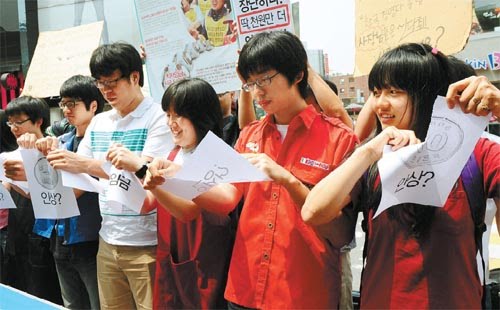
Students and members of People’s Solidarity for Participatory Democracy rip up signs of a 10 won ($0.01) coin to protest a proposal by employers to raise the minimum wage by 8 won. The protest, held in Daehangno, central Seoul, called for a rise in the minimum wage by 1,000 won to 5,100 won.
What an insult. To put that into perspective, after working 60 hours - two or three weeks for a part time worker - they'll be able to afford an extra samgak (triangle) kimbap. Wow.

Of course, minimum wage workers aren't alone in being poorly paid:
Foreign workers earn far less than Koreans with their average paycheck lower than that of the bottom 10 percent, a government report says. A more chilling fact is their meager wages are not increasing.[...]

According to the findings by the National Tax Service (NTS), the average annual wages of a foreign worker last year who paid income tax was 13.17 million won - a decrease of 2.9 percent from the previous year's 13.56 million won.

The annual paycheck of the "bottom 10 percent" of a South Korean worker was 14.60 million won, the government agency said.

The number of foreign workers who paid income tax rose by 22.2 percent, or 62,519, to reach 344,583, last year, from 282,064 in 2007.
What a way to treat such a valuable resource.

Wednesday, June 23, 2010

Teen beaten to death for 'gossip'

The Joongang Ilbo and Korea Times report on a shocking murder of a 15 year-old girl by middle school dropouts. As the Joongang Ilbo describes it:
A gang of teenage dropouts took ruthless revenge on a member who gossiped, holding her hostage for four days as they beat her to death - all while the kidnapped girl’s parents made no effort to locate her.

The blanket-wrapped body of the 15-year-old, identified only by her surname, Kim, floated to the surface of the Han River last Thursday, eight days after police say her friends locked her inside a house and began their onslaught.

Police have arrested the leaders of the mob, a boy named Jung and a girl named Choi. Warrants have been issued for three others involved in the attack, as well as a 19-year-old man surnamed Lee who allegedly helped dispose of the girl’s body after it had been drained of blood to make it lighter to carry. All of the suspects except Lee are 15 years old.
The article also notes that police haven't released a cause of death (a Korean-language article is here). One assumes it's because they don't know, and not because it's too disturbing (when a 13 year-old girl was raped and murdered in Busan in February, police informants were more than willing to release - without proof - apparently erroneous theories that she might have been held captive and raped repeatedly over a period of days - something that must have cheered her family to hear).

The Korea Times adds that
when Choi heard that Kim had been talking behind their backs calling them “slutty,” she beat Kim up for four days. The other four joined in and beat her to death.
Other cases like this have occurred before, and it seems isolating someone and having a group beat them for an extended period of time is not uncommon, usually because they are 'love rivals,' or because the victim was thought to have talked about the attackers behind their back or on the internet. In March 2009, a girl "was beaten for "cheating with another man"":
A 17-year-old mentally disabled girl was killed after being beaten almost daily over 21 days by four teens who lived with her, police said yesterday. Seongnam police requested an arrest warrant for the four teenagers on suspicion of assault and homicide yesterday.

They allegedly tied the victim, identified only as Yoo, to a chair for two to three hours and dropped a knife with the blade facing down or poked her with needles under the guise of giving her a tattoo. They also confessed to whipping her with a jump rope.
Lovely. A case similar to this received coverage in New Zealand when a group of Korean girls studying there attacked a 'love rival:'
Six schoolgirls are likely to face serious charges after they allegedly held a 16-year-old girl captive for more than an hour while they punched, kicked and burnt her with cigarettes during an horrific attack in Auckland last month.
In another case, a girl was isolated and beaten on camera in December of 2006. As this article relates, the reason for the group assault on a lone girl was quite similar to the situation in New Zealand:
The group allegedly took the victim to an apartment of one of the suspects on Dec. 8 and held her there from 12 to 4 p.m., beating her nearly continuously. The leader of the gang told police that the group assaulted the girl because they thought she had spread rumors that caused the leader’s boyfriend to break off their relationship. The victim denied that claim, police said.

“Two members of the gang beat her up and the other two videotaped the scene with a cell phone camera to show it to other friends,” a police official said. “One of the gang sent the clip to another friend, who allegedly edited and posted the clip on the Internet.”

More such examples of beatings are looked at here and here. In one, three teenage boys were arrested along with a 15 year-old girl in Busan because the girl asked the boys to rape her 14 year-old classmate as a favor, which they did. In another case, a March 2009 assault on a girl by a group of girls in Incheon who repeatedly kicked her in the face was videoed and put on the internet.


The Korea Times related more of the story, noting that the girls were barely punished by the school for the beating, and that it only became an issue after the video was spread online.

Most of these stories have featured girls as both victims and attackers, but of course, that's not always the case, as in this story of a middle school boy beaten to death in Cheongju in November 2008.

Such violence occurs in elementary schools as well, but one can't help but wonder where children would get the idea that violence is any way to solve problems.

Monday, June 21, 2010

End of the line

According to the Hankyoreh, Seoul's last daldongne, or "poor hillside village," in Junggye-dong, Nowon-gu, will be torn down and replaced by apartment buildings.


The photo above is taken from this blog, and more photos can be found here.

For a before-and-after set of photos of the destruction of another, much larger, daldongne, Antti Leppänen's photos of Nangok in Sillim-dong taken between 2000 and 2006 here are well worth your time.

Alternatives

It's nice to see that demolishing a villa isn't the only option available:


Dozens of shots of the renovations can be found here.

Thursday, June 17, 2010

International press on the North Korean team

AP profiled North Korea's striker Jong Tae-se before the match on Tuesday:
"He is Japanese but isn't a Japanese, he is Korean but is playing on the North Korean squad, he is a North Korean national but lives in Japan - all these things are very difficult for the world to understand," Shin Mu Koeng, a friend and his biographer, said. [...]

"My homeland is not Japan. There's another country in Japan, called Zainichi," he says. "None of these countries - South Korea, North Korea and Japan - can be my home country, because I'm a zainichi and therefore Zainichi is my native land.
The LA Times has more on him here. His tears during the playing of the national anthem [which apparently meant he was an 'emotional wreck'] attracted attention, as noted in this article. What I found interesting was this:
It took six hours for North Korea's official news agency to issue its brief match report. ''There was a game between the North Korean and Brazilian teams this morning Pyongyang time,'' said the report. ''On the 88th minute … player Ji Yun Nam dashed into the gate and … goaled.''

North Koreans lucky enough to have access to a television will get to see their heroes perform, but only if they wait. ''They never broadcast live sport, they normally broadcast one or two days late,'' said Simon Cockerell, who has made 90 trips to Pyongyang as general manager of Koryo Tours.

While the match was on, fans were instead treated to Echo of Mountain, a comedy about farmers' attempts to boost grain output.

The LA Times also looked at Koreans of Northern and Southern descent watching the game together in Los Angeles, interviewing a women who fled North Korea ten years ago. Even Lee Myung-bak was cheering for them.

The game highlights are here and Ji Yun-nam's goal is here [open these in a new window - it resizes your browser].

Wednesday, June 16, 2010

Korean films with English subtitles in Seoul

The Servant has been playing on several screens in Seoul with English subtitles, and finishes its run tonight at Yongsan (20:50 and 23:35), Myeong-dong (22:05), and Gangnam (22:05). 71: Into the Fire debuts today (information about the film can be found here, and a trailer is here), and plays on four screens in Seoul with English subtitles this weekend:

Gangnam: Friday 12:30, 17:50, 25:20
Sat. and Sun. 11:30, 16:25, 24:10

Myeong-dong: Friday to Sunday 17:00, 24:30

Guro: Friday 13:10, Saturday 22:00, Sunday 18:10

Yongsan: Friday to Sunday 9:40, 14:50, 20:00