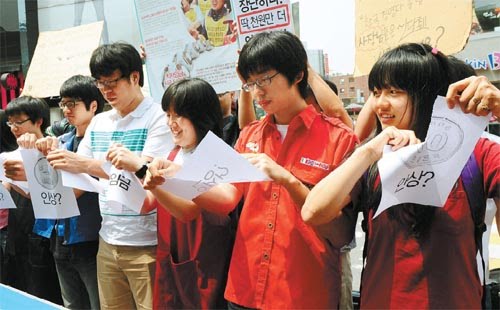
We are one minjok (race/ethnicity/nation).
...and this colonial era poster calling for 내선일체 (naisen ittai, or 'Japan and Korea as one body'), which I posted here:
 Read from left - (on shirts) 내,선 [Japan, Korea] (at bottom)
협력일치 세계복자 [Feel free to offer a translation]
A search for 통일포스터 turns up posters that are even more similar (see here), such as these:
 Two dream of
 Running together towards that day.
 North and South together in the 2010 World Cup!
Three-legged races seem to be popular in both Japan and Korea, but it should be noted that the Korean posters do not specifically feature three-legged races, only similar stances or poses.
Any Korean friends I've mentioned this to have either noted that there are pretty large differences between the situation of North and South Korea now and the situation of Korea and Japan over 65 years ago, or have been dumbfounded by the assertion there could be similarities. I was told by the co-worker who nicely translated the Hanja in the poster above that it was a 'foreigner's point of view.' Perhaps it is, but let's take a look:
By the time Japan instituted the naisen ittai, or 'Japan and Korea as one body' policy in the late 1930s, it was at war with China, and wanted Koreans to assimilate and become Japanese (but without any sort of benefits like political representation) and were forced to learn in Japanese at school and forced to take part in Shinto ceremonies. The policy went even further as the Pacific War began, and soon Korean newspapers disappeared, Koreans were (pretty much) forced to take Japanese names, were conscripted into the army, etc, etc.
While this is seen as being very different from what is perceived would happen with reunification (as a friend put it, Korea could never be a part of Japan), there are some who seem to disagree. Gi-Wook Shin's Ethnic Nationalism in Korea quotes from the 1998 book Korea and Its Futures, by Roy Richard Grinker, who says that unification "can be a euphemism for conquest, a gloss for winning the war... and [a belief] that north Korea must be totally absorbed into the south, its state destroyed, and its people assimilated." [Shin, p. 187] That possibility doesn't sound like much fun for North Koreans, and it seems the knee-jerk assumption in the South is that unification is something that both sides want, and that of course the northerners would want to be under the southern system (though younger generations of southerners increasingly want to postpone unification due to the cost). What might make it a little clearer might be asking the question, "Would southerners want to unify under the control of Kim Jong-il and become part of the North Korean system?" The answer there (except for a comparatively few deluded souls) is most certainly no, though it doesn't seem to occur to anyone that northerners might feel the same way about a South Korea-dominated unification. They - like southerners today in regard to the north and Koreans more than 65 years ago in regard to Japan - might not be too keen on having little choice but to be assimilated into an alien economic and belief system.
While ethnic nationalism could certainly be used to bridge (glaring) differences between north and south when unification comes, the similarity between posters drawn by school children in the south and symbols found in Japanese propaganda* might suggest that a form of ethnic nationalism that touts the oneness of southerners and northerners could be seen by those on the losing end as just as chauvinistic as Japanese attempts at assimilation. If Japan's naisen ittai policy and North Korean plans for reunification are looked upon negatively, why shouldn't unification under South Korean dominance? It's doubtful such dominance would be uniquely beneficial. Considering the problems North Korean refugees have in adapting here, and the discrimination they face (especially lately), these fairy tale renderings of the unity and benevolence of those who share Korean blood might be useful in the short term, but in the long term a disconnect between rhetoric and reality seems likely.
In a related story, a story in the Korea Herald a month ago reveals that naturalized foreigners are taking Korean surnames, most of them preferring common ones such as Kim, Lee and Park.
From January 2009 until last month, 91 foreigners were permitted to change their surname to a Korean one in North Chungcheong Province, according to the Cheongju District Court yesterday. Of them, 81 were women, most of whom were immigrant wives, said court officials.[...]It's interesting that this is being reported on so favorably, especially considering how bitterly Koreans remember being forced to change their names during the last 5 years of colonial rule. It should be noted that the migrants changing their names to Korean ones are sometimes doing so for reasons other than convenience:
Chinese-turned-Koreans generally kept their original names, only changing the pronunciation to Korean style. Former Vietnamese or Filipinos, mostly immigrant wives, often chose an existing Korean name which sounds most similar to their original name, said court officials.[...]
The number of foreigners applying to register their new Korean surname rose from 63 in 2008 to 156 last year.
Aura Aurel Abache, a Filipino who was naturalized as a Korean after marrying a Korean man in 1999, never expected her name to be a problem in living as a Korean. The housewife in Gokseong, South Jeolla Province, soon found that her Filipino name was too long, difficult, and her children were even made fun of by other kids at school for their mother's name.This suggests that some people are changing their names for reasons that are not as cheerful as the first article might suggest. While this is by no means the same as Japan's deliberate policy to force Koreans to change their names (and is occurring in much smaller numbers), it still stands that some of these people are only changing their names to Korean ones because they feel forced to. You'd think this would set off alarm bells here, but then again, considering how little thought is put into the colonial period by the media (and I imagine, school textbooks) other than Korea = good, Japan = bad, I don't think it's that surprising that it doesn't.
* (not that its alone in that, as B.R. Myers has pointed out)