Tuesday, May 06, 2008

The Seoul Folk Flea Market opens


The Seoul Folk Flea Market opened on April 26, and a few articles have mentioned this. This is supposed to be the final location for the merchants displaced by the Cheonggyecheon restoration project which I looked at here.

A Korea Times article on the market can be found here, where you can see several photos of the market. We're told that
The Hwanghak-dong flea market originated in the early 1950s when secondhand goods dealers put various items on sale. In 1973, when the Cheonggye Stream was covered to make for an elevated expressway, Hwanghak-dong grew into a center for secondhand goods. Then when the stream was reclaimed in 2003, the flea market moved to the now-demolished Dongdaemun Baseball Stadium. With plans to turn the Dongdaemun area into a park, the market once again moved to Sinseol-dong, not far from Cheonggye Stream. To celebrate the new site, the market gave itself the name Seoul Flea Market. The market has some 894 shops in its two-story site.

You can see the location of the Flea Market at top right:


The Korea Herald also has a lengthy article titled "Flea market blossoms under new roof," from May 6, 2008.
The Seoul Folk Flea Market, which recently opened under a new roof near Sinseol-dong subway station (Lines No. 1 and 2), breathes the typical adventurer spirit. It has everything from craftwork, decorative stones and specialties from different regions to adult toys, electronics, food courts, clothing and ancient music records.

The new white two-storey building is the third downtown home for used-good traders, who originally hawked their wares on the streets of Cheonggyecheon for decades. Some 73,000 street vendors were forced to leave Cheonggyecheon in 2003 as the city government launched a project to restore the stream. Those from the "dokkaebi sijang" or "goblin's market" were relocated in Dongdaemun Stadium in early 2004, while others nestled in new buildings along the Cheonggye Stream.

Four years later, as the city now plans to tear down the stadium to build a design park there, nearly 900 stores have moved to an old school site in Sinseol-dong, two metro stations away from Dongdaemun. There were angry protests against the forced removal from the stadium, resulting in injuries during a scuffle with people hired by the city government. A handful of shopkeepers are still opposing the move but most have settled in. "The new facility is nice and clean but the location is bad," said Hong Il-moon, who has been selling Chinese antiques for 20 years. "There aren't many passersby and we have little parking space."
Whereas Dongdaemun Stadium was in the heart of the city's major shopping district, connected to four subway lines and dozens of buses, the new venue is in the middle of a residential block, a seven-minute walk down the alleys from Sinseol-dong station Exit No. 10.

"It's a rather closed space with limited access from the people as we no longer have the random spread of vendors like the old times," said Cha Sung-sook, who sells hair pins and other accessories.
Still, the city government is upbeat about making the market a major international tourist attraction. "We will make the Seoul Folk Flea Market the city's leading tourist spot," Mayor Oh Se-hoon said at the market's opening on April 26. "(The city) will provide the merchants with low-interest loans and encourage sales by placing marketing experts."

Seoul City spent over 8 billion won ($8 million) on the structure, which has canopies over a steel framework painted white. It threw auction events featuring celebrities for the opening and placed promotional banners and stickers on buses. A tourist information booth within the market is scheduled to open on May 15.

The Seoul Folk Flea Market is open between 11 a.m. and 7 p.m. The market is a hundred meters from the Hwanghakgyo bridge across Cheonggyecheon.
It's nice to see that the city is supporting it (at least for now), even though it isn't in the best location. It seems they're being treated much better than when they were moved to Dongdaemun Stadium. Worth noting are those figures: 73,000 removed in 2003, and less than 900 are now in the flea market. I would imagine the city will support only a sanitized history of the merchants' movement. The Herald certainly does, with this comment: "There were angry protests against the forced removal from the stadium, resulting in injuries during a scuffle with people hired by the city government." Those "people hired by the government" are otherwise known as gangsters, or thugs. In the final photo of the Times article, a display with photos of the market's past is shown. I wonder if there are any photos of the events of November 30, 2003?

(More photos of the market can be found here).

Monday, May 05, 2008

10 years

Old news, yes, but I was struck by a few of the things said in this article about the Namdaemun arsonist:
The 70-year-old arsonist who set a fire to the national treasure of Namdaemun was sentenced to 10 years in prison, the Seoul Central District Court announced yesterday. Chae Jong-gi had pleaded guilty to setting the fire which gutted the 610-year-old gate on Feb. 10.

“It was necessary to hand him a severe punishment, considering that he caused indescribable damage to the nation,” read the court’s ruling. “Chae’s burning down the gate while he was still on probation for setting another fire at Changgyeong Palace is antisocial behavior that cannot be allowed in a law-abiding country.” Prosecutors had sought a 12 year sentence.
To be sure, no one wants this to happen again and there's no surprise that a harsh sentence was imposed. For a somewhat similar case in the U.S. (which did not have such destructive results) see here; the indictment can be seen third on the list here, where his crime is described as "attempting to damage and damaging an archeological resource." Leaving a few dents on the Liberty Bell by hitting it with a 4 pound hammer got him 9 months in prison.

Using words like "indescribable damage to the nation" in a judgement strikes me as being a little too emotional. It might better describe a situation such as this:

Kwangju, 1980

Yes, I realize Chun Doo-hwan was initially sentenced to death, (for mutiny and treason, not for anything specifically to do with the uprising, mind you) which was later commuted to a life sentence, and then he was pardoned. But he was only held accountable years later due to a shift in the fortunes of Kim Young-sam. And Chae may well not serve his entire sentence, but I would imagine he, who set fire to a 600-year-old building, would serve more time than a man who presided over what eventually became a military attack on a South Korean city which left hundreds dead. That, to me, fits the description "indescribable damage" much better.

I guess the trick is to inflict "indescribable damage" while in the process of seizing power. Inflicting it in order to get more money for your property is not going to get you invited to a chat with Lee Myung-bak.

(May 20, 2006)

Saturday, May 03, 2008

Don't fear the sculptures

Perhaps you have heard of Jeju Love Land. If not, perhaps you've heard of a similar park in Samcheok, Gangwon-do. What you may not have heard of is this park:


It's on the highway that runs from close to Namyangju to Seoraksan, at a rest stop about an hour from Sokcho. There is a sculpture park outside, as well as gallery inside of carvings. The very prudish may want to avert their eyes from the following photos.


It was certainly amusing, through western eyes, when a car pulled up and children got out and immediately ran to and began climbing on the giant penis.


Their mother took photos of them and then had them pose on the bear seen in the first photo. What's amusing to me, of course, is that the average North American mother would likely freak out and yell, "Get off of that - NOW!" Many of the people at the rest stop stood on front of the sculptures and took photos. People were not afraid to touch the giant penis. In the gallery people pointed and chuckled at some of the sculptures.

I couldn't help but remember this experience (from two weeks ago) when I read this article.
According to the Chosun Ilbo, the incident began when seven members of Gyeonggi provincial council visited the headquarters of the world's largest sports utilities maker Nike in Portland, USA, early March as part of their efforts to forge ties between Korea and the US. While there, two council members reportedly touched the breasts and private parts of a female statue. Witnesses said they even tried to put their hands in the statue's crotch while giggling. This left many of the workers there feeling horrified.[...]

The two shunned members sent an abrupt apology email to Nike saying if any inappropriate demeanor had taken place, it was never on purpose but due to a difference in cultures. They later claimed that they may have "leaned toward the statue'', but nothing like what was mentioned in Nike's complaints. "We did take pictures but no such dramatic things happened. It was miscommunication stemming from a difference between cultures. We just made an apology because Nike seemed to want it, that's all,'' a council member said.
It wouldn't surprise me if it did indeed happen as the Nike people saw it, but the Koreans involved simply didn't perceive it in the same way at all. Hoping to restore their working relationship, the face saving gesture would naturally follow. Hopefully next time the Korean delegates will remember that in America, some people project their prudishness and fear of sex onto statues.

Friday, May 02, 2008

Another airfield

The Korea Times has an article on Yeouido Airport:
Until the early 1900s, Yeouido was farming land, [oh really?] but in 1916 during Japan's colonial rule of Korea (1910-1945), the Japanese army built an airstrip there.

In May 1920, two Italian airmen making a cross-Eurasian flight arrived at the airfield before heading for Tokyo, and were greeted by tens of thousands of Koreans in a welcoming ceremony to see the new means of transportation. Two years later, Korea's first pilot Ahn Chang-nam who studied in Japan flew from Japan to Korea and was met with cheers from Koreans at the airfield.

In April 1929, the airstrip was expanded and was upgraded to an official airport as part of Japan's plan to make Yeouido a stopover for flights between Japan and Manchuria. As an official airport, Yeouido was equipped with basic facilities, including staff offices, telephones, anemoscope, anemometer and a 231-square-meter terminal. The official opening ceremony was held on Sept. 24 that year, the same day as another airport was opened in Ulsan in the southeast of the peninsula. In addition the Japanese colonial authorities built airports in Daegu, Pyongyang, Sineuiju, Cheongjin and Hamheung.
There's some interesting information there (even if Yeouido was not used as farmland), but this is not entirely correct:
The airport was turned into a plaza where mass gatherings were held, and became a bicycle park at weekends. In 1999, the asphalt was removed, grass was planted and the site was renamed Yeouido Park.
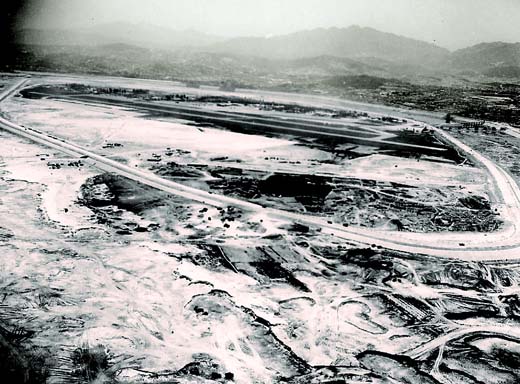
I'm assuming, with the reference to asphalt, "airport" above means "runway". If that's the case, it might be worth looking at some photos of the runway before 1971. Here's a shot of it in 1952, when it was used as an airport during the Korean War (more photos by this photographer of Yeouido, Seoul and Gimpo Airport during the Korean War can be found here).


Here are two shots taken in 1968, when the levee was built around the island to prepare it for development. The first looks west.


This one looks southeast.


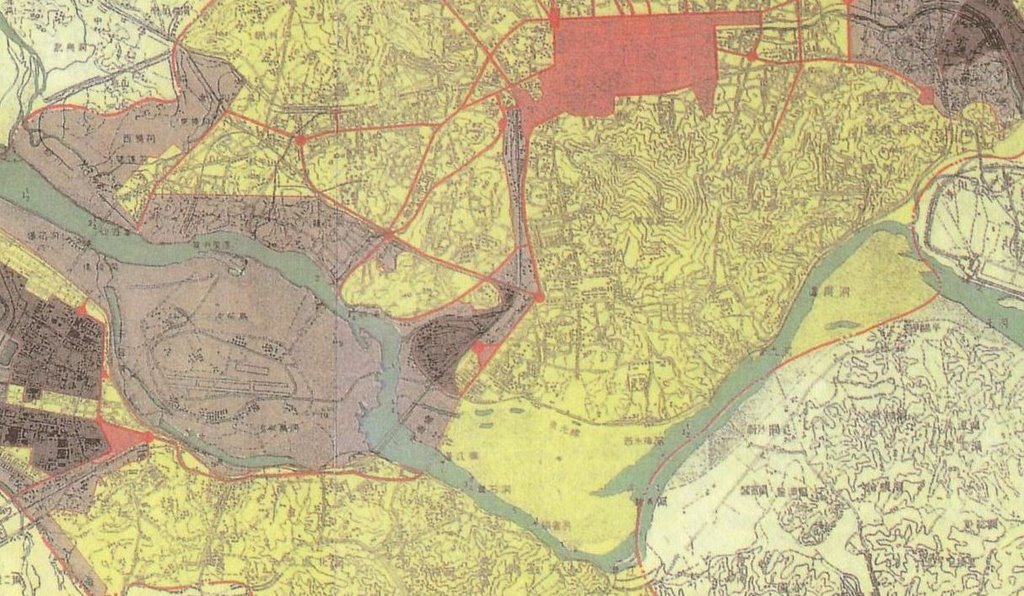
If these aren't clear enough, here's a map from either the colonial era or in the years after independence showing the location of the runway.


Yeouido Park runs almost perpendicular to it, so I think we can be pretty sure it was never the runway.

Monday, April 28, 2008

Colonial remains on Jeju Island

[Update at Bottom]


Photos can be found here.

The Joongang Ilbo has an interesting article (which may crash Firefox) about the Alddeureu Airfield (알뜨르 비행장) built on Jeju Island in the 1930s by the Japanese military.
Half a century has passed and now Alddreu is a vast potato field, unrecognizable as the military installation that the Japanese built in the late 1930s during the colonial period.
The Cultural Heritage Administration designated the airfield a heritage site last year as part of a broader effort to preserve sites in the country linked to its modern history and the Japanese colonial era. Seogwipo City is planning to develop the area into a major theme park, which will include a museum. The main construction is scheduled to start in 2009 and last through 2015.
The airfield served as a transoceanic bombing base during the war between China and Japan in 1937. The planes ran bombing missions over Shanghai, Nanjing and other cities in the East Asian theater. The strip was expanded until 1943 when 19 hangars dotted the landscape. At its height, 2,500 Japanese soldiers and numerous fighter planes were based here. [...]
Photo from here (where more can be found).
Located on the Songak seashore, facing southwest, there are 16 caves cut into the grey cliffs. These were launching bases for special mini submarines designed to sink larger ships on what were essentially suicide missions.

Scholars say that right before the capitulation of Japan in August 1945, more than 70,000 Japanese soldiers gathered on Jeju Island in anticipation of a final showdown with Allied forces. The Japanese military command thought the Allies would start their final push to Japan from Jeju. The island's estimated population at the time was 220,000, underlining the strategic importance Japan had put on Jeju at the time.
The first three abstracts on this page mention the forced labor that was used to build the military installations on Jeju Island and the buildup of troops there. I'd had no idea there were 75000 Japanese troops on the island.

This article from June of 2006 mentions that the airfield was going to be registered as a cultural property. It includes this photo of the airfield:


Interestingly enough, if you look in the center of the circle marked as "Alddeureu" below, you can just make out a lighter-colored smudge, which represents what we see above. The caves are also within that circle.


Also marked above are the Jeongddeureu (정뜨르) airfield, which became Jeju Airport, and Jinddeureu (진뜨르) airfield, which, according to a comment left by long term resident Fred Dustin, is now a melon patch east of Jeju City, with the road occupying the former runway. Needless to say, if he hadn't described where it was, I would have been clueless as to its location.

(The approximate location is outlined in Yellow)

With three airfields and 70,000 troops present, the fate of Jeju Island had the war continued is pondered in the article:
The Alddreu airfield and caves for the submarines are a reminder that the people living on Jeju at that time could have been caught in a bloody and prolonged battle in 1945. Arguably, had it not been for the atomic bombs that prompted Japan's surrender, Jeju could have been another Iwo Jima.
I would imagine Okinawa would be a better comparison. Though it escaped a bloodbath in 1945, Jeju would not escape that decade unscathed. This year is the 60th anniversary of the Jeju Uprising.

Thursday, April 24, 2008

Dongdaemun, not Namdaemun

Update, March 3, 2018:

As it turns out I was wrong below about the photo from Dongdaemun not facing into the city. It is indeed facing into the city and the grove of trees at right is Jongmyo (in larger photos its wall is visible). Many thanks to a reader for pointing this out.

Original Post:

The two photos below were used in this post, where they were identified as being taken from Namdaemun. That is incorrect. I noticed in the background in the video mentioned here that the first picture below was shown with a caption indicating that it was taken from Dongdaemun looking into the city. Looking into it, I've found that that isn't exactly correct.


The first photo is perhaps from the 1880s. The date of the one below is more difficult to ascertain. I believe the tram was double-tracked out to Cheongryangni in 1911, and that the road was widened before 1920, neither of which help much in dating it.


Here are the photos I've found in roughly chronological order.


The above photo is from Korea Through Australian Eyes, which features photos taken by George Rose in 1904 (during the Russo-Japanese War). Note the Japanese police/soldiers taking a Korean away. Dongmyo is visible at top right.


Note how the street curves off in the distance in the first photo. Note the similar curve in the photo above, and the smokestacks next to the gate.


The photo above is another George Rose photograph, which is clearly of Dongdaemun, and has the same smokestacks in the background. It's pretty obvious, then, that the first photo, and the one below, taken at a later date, are both taken from Dongdaemun, which still works for the argument I made in that post, as it's still looking outside the city and is nowhere near where the well-to-do lived.


Also mentioned in my older post was Murayama Chijun, and the photos he took. This paper notes that he was a graduate of the Tokyo University Department of Sociology, and "published
several excellent research reports on the condition of the Korean people by commission
of the Government General of Korea." To help date his photos, it mentions that Murayama had done fieldwork in 1930. Another article mentions him working between 1929 and 1937.


Oh, and here's some vintage Japanese propaganda, another book to be found scanned here, titled
'Administrative reforms in Korea; articles reprinted from the "Seoul Press."' The articles are from November of 1919, just after Baron Saito arrived to present a kinder and gentler form of colonialism to Koreans. To give you a taste of what you're in for if you choose to read it, it begins with a review of one of its earlier publications:

THE KOREAN "INDEPENDENCE" AGITATION.

Price 20 Sen, Postage free.

The London and China Express etc. Sept 4, 1919, says:

The Korean Independence Agitation (Seoul Press Chosen) is the title of an interesting booklet which has come to hand. Its contents are made up of a series of articles which originally appeared in the Seoul Press. The articles are particularly interesting, as throwing a somewhat new light upon the alleged stories of atrocities committed towards those Koreans who took part in the disturbances. The view is advanced that it is unjust to think that the excesses committed by the police and others in suppressing the outbreak had the approval of the higher Japanese authorities. Emphasis is also given to the fact that many of the stories of atrocities committed by
the Japanese were very much exaggerated by people with a strong anti-Japanese bias, and that the brutality was not always on one side. There is of course a natural tendency among many people to sympathise with the weak against the strong, but this inclination ought not to influence our sense of justice. The booklet performs a useful purpose by supplying what appears to be a perfectly impartial rendering of events which in the past have no doubt been distorted by prejudice and passion.

Heh - when it says it's "perfectly impartial," you know it's going to be good.

Tuesday, April 22, 2008

Cigarette burns

As mentioned here, in February Korean schoolgirls in Auckland, New Zealand, held and assaulted another Korean girl, burning her arms with cigarettes. The original March 16 Sunday Star Times article, "Schoolgirls torture love rival," is here.
Six schoolgirls are likely to face serious charges after they allegedly held a 16-year-old girl captive for more than an hour while they punched, kicked and burnt her with cigarettes during an horrific attack in Auckland last month.

The group reportedly decided to ambush their victim outside a supermarket as she walked to school one morning apparently because she was more popular and one of the group had a crush on her boyfriend. The victim and her attackers five of whom attend two top Auckland schools are all Korean.

Police have confirmed they are investigating an attack on the young woman. A spokesman said a 17-year-old girl would appear in youth court this week facing a charge of injuring with intent. He said further charges against all six could not be ruled out, but would not confirm the girls' ethnicity or their schools.

The 16-year-old victim was said to be deeply traumatised and did not tell her mother for weeks. She suffered extensive cigarette burns to her arms. Her mother reported the case to police. She told her mother she was too terrified to run away because she knew they would come after her.

The attack has horrified Auckland's Korean community, which has strongly condemned the girls' behaviour and would be looking into the matter, a spokesperson said.
I imagine the first thing the Korean community thought of (after "This makes us look bad - how embarrassing") was the stream of news reports over the past decade about bullying in Korean schools.


Photo from here.

For example, as this December 8, 2000 article tells us,
Bullying by classmates can be common for many Korean students and, to counter it, parents of a 12-year-old student have hired bodyguards for their daughter. A sixth-grader living in Seoul, who asked to be identified only as A, has gone to school since Nov. 30 with two bodyguards to protect her from bullies.
Unsurprisingly, some students don't deal with being bullied so well. One student, inspired, he said, by the film "Friend", took extreme measures, as this October 15, 2001 article tells us:
The police said the youth stole through the back door of his classroom Saturday morning holding a knife wrapped in a newspaper. He then stabbed his classmate, identified only as Park, in the back while Park listened to the lecture. Kim then quietly got up and walked out of the classroom.
The reason for this was that Park (who died on his way to the hospital) had been bullying Kim for some time. Six months later, it happened again. As this April 17, 2002 article tells us, a 14-year-old student at Ancheon Middle School
entered the classroom at the school around 2:40 p.m. and headed straight for the victim, another boy, witnesses said. The victim was hunched over his desk taking a test with the rest of the class when the youth drew a knife and stabbed him nine times in the back, neck and head. The teacher, shocked, screamed for him to stop, and the 31 other students fled the room in panic.

He told the police that the victim, who was also 14, had constantly beaten up his friends . The boy claimed that earlier Monday he had watched as a close friend was again beaten. He said in a fit of rage he ran to his home near the school, got a kitchen knife, returned to school and found the boy.
I suppose some of the stories, such as this one from September 2003, are not as gruesome:
The Jeongeup Police in North Jeolla province yesterday arrested a high school student accused of torturing a classmate by washing him in a washing machine.
Several stories relate the use of digital and cell-phone cameras when bullying students, as this February 16, 2004 article relates.
On Saturday, the student posted on his homepage two 16-minute excerpts edited from footage he videotaped with his digital camera. The edited cuts allegedly show five or six students slapping the head of a 16-year old boy who is bent over his desk alone. They grab his bag, curse at him, and take photos of his distressed face, ignoring the boy’s plea to stop.
Netizens were outraged by this and left comments on the school's website (as well as forcing the boy to close his homepage down). The authorities were not quite as concerned.
“One boy had just received a camera as a graduation gift and he was taking pictures, but the boy sitting at the desk was very shy and didn’t want to have his picture taken. They were just fooling around,” officials at the South Gyeongsang province’s education office said.
Some people treat the subject a little more seriously (including the principal of the aforementioned school, who killed himself). After describing the bullying of a 13 year old girl, and the way in which her entire school ostracized her, this February 24 2004 article tells us that
This scene is a frequent one these days in Korean schools. The syndrome is called “wang-ta,” a term applied to a victim of group cruelty or ignorance. “Every country has bullying students, but nowhere in the world can we find cases where the entire school harasses one student,” said Kwak Geum-ju, professor of psychology at Seoul National University.
Count on some parents of the tormentors to stand up for their right to torment:
When bullies were punished by teachers, their parents often protested, saying that the tormented child “deserved to be bullied.” [...] Circumstances are even worse for students who are poor or who have physical disabilities. The education ministry said that two out of three children with disabilities in 217 schools in Seoul have reported that they have been bullied.
In March of 2005, Police vowed that they would take on youth gangs who bullied and extorted their fellow students. A look at the Iljinhoe, as the gangs are called, can be found here, while this article relates a typical example of the gangs' behavior:
A seminar on school violence on Wednesday heard how four Iljinhoe girl students assaulted a fellow student in the bathroom of a certain Seoul middle school in March last year on grounds that she was arrogant. They took turns hitting her repeatedly in the face, the stomach and the legs. Such violent behavior is no different from that of gangsters.
An April 12, 2005 article described the suicide of a boy who was bullied:
A schoolboy who was thought to have committed suicide because he thought he was ugly in fact killed himself because of bullying at his middle school, his father said Tuesday. The 15-year-old seventh grader in Masan identified only as Hwang threw himself out of the window of his 18th floor apartment on April 19, 2002. He died in hospital a week later.
Another article on this topic mentioned that
School violence has become a public issue in recent months. Several government ministries recently announced policies to reduce bullying after a survey found that one out of 10 students had experienced violence at school.
An April 21, 2005 article relates just how brutal girls can be:
Two freshmen girls at an Incheon high school have been arrested for a brutal campaign of bullying against a classmate [...] they heated up a spoon with a disposable lighter and burnt Kim’s stomach. Then they used a felt-tipped pen to stab her thighs. They stripped her naked and poked her vagina and anus with writing utensils or twigs, taking pictures of the abuse with a digital camera. Kim did not cry out for fear of further brutality, police said.
Once again, we see the appearance of a digital camera. One appears in this June 8, 2005 article:
The recent attention given to the issue of school violence in Korea has done little to help one 14-year-old student, whose mother says he has been bullied so severely that she has decided to send him to school overseas.

Last year, she says, classmates stripped the boy naked during physical education class, then took pictures of him with their cell phones. He was beaten at least twice a day after classes, she says; classmates often delivered flying sidekicks to his chest.
One of the best known instances of using a cell phone camera was when a girl was beaten on camera in December of 2006. As this article and this article relate, the reason for the group assault on a lone girl was quite similar to the situation in New Zealand:
The group allegedly took the victim to an apartment of one of the suspects on Dec. 8 and held her there from 12 to 4 p.m., beating her nearly continuously. The leader of the gang told police that the group assaulted the girl because they thought she had spread rumors that caused the leader’s boyfriend to break off their relationship. The victim denied that claim, police said.

“Two members of the gang beat her up and the other two videotaped the scene with a cell phone camera to show it to other friends,” a police official said. “One of the gang sent the clip to another friend, who allegedly edited and posted the clip on the Internet.”
For a more positive story, this January 24, 2007 article (likely IE only) looks at a remarkable young woman who has tried to turn her horrible experiences of being bullied into something positive by helping other young victims of bullying.
In March 2005, based on the experience she had gained from running the Web site, Ms. Kim became the youngest counselor at the Prevention of Youth Violence Foundation. They keep records on the number of calls for help they receive. In the first six months of 2006 there were 1,771 calls. Over half of these came from middle school students, a figure that represented a 4.8 per cent increase on the previous year.
This, considering the article that started this post, is certainly worth considering:
She says she often hears of incidents far worse than what she went through. "Branding kids with cigarette burns is basic. There were incidents where the student's head was forced into a toilet bowl."
This article (link is dead) from early 2007 relates another story cigarette burns:
[P]olice in Sanggye-dong arrested two 16-year-old girls and a 14-year-old boy for attempting to force a 14-year-old to sell herself for sex. After she refused, the suspects kidnapped the victim for a day, beating her and burning her face with lit cigarettes [...].
Lit cigarettes were a method of coercion in another well known case:


Above is the June 2006 photo of the cigarette-burned hands of a runaway 14 year-old girl who was held captive for six months in Gwangju by an acquaintance and forced to have sex with 800 men; her captors can be seen in the background.

A February 27, 2008 article looked at the effects of violence on those who are bullied. Not everyone was so concerned about a boy who started to become violent after years of bullying:
“Other classmates bully each other, too,” [his] teacher said during an interview with the investigative team. “It’s not a big deal.”

An expert on school violence who was part of the TV program’s investigative team and did not disclose his name was less dismissive of school bullying. “The victim learns from the bully and bullies other classmates who are powerless,” he said.
This study of bullying in Korean schools (linked to at the Marmot's Hole), has lots of interesting information:
We found that 40% of all children participated in school bullying. By category, the prevalence of victims, perpetrators, and victim-perpetrators was 14%, 17%, and 9%, respectively. The most common subtypes of victimization were exclusion (23%), verbal abuse (22%), physical abuse (16%), and coercion (20%). Boys were more commonly involved in both school bullying and all 4 types of victimization. The prevalence of bullying was greater in students with either high or low socioeconomic status and in nonintact families.
The line in the last article about the cycle of violence meshes well with the category of "victim-perpetrators."

Perhaps we should return to the original article about the girls in New Zealand:
The attack has horrified Auckland's Korean community, which has strongly condemned the girls' behaviour and would be looking into the matter, a spokesperson said.
So what, after looking into the matter, did they conclude about the the girls?
Most of the assaulters have struggled to adjust to life in New Zealand, Sunday Star Times quoted John Cho, spokesperson for North Shore Korean community, as saying.

Some of the girls were living with one parent while the others were living with a homestay family. But all of them, including the victim, had become rebellious and had difficulty adapting to the extreme cultural differences, according to Cho.

It is not uncommon for young people to "get out of control'' when they move to New Zealand. New Zealand society is "too open'' compared to a conservative Asian culture where school children prioritized studies and were denied romantic relationships, Cho said. He added none of the girls had been in trouble before they came to the country.
Ah. So the problem of the girls "who held a 16-year-old girl captive for more than an hour while they punched, kicked and burnt her with cigarettes" has nothing to do with bullying being a huge problem in Korean schools, especially with group violence directed at individuals, where, unlike elsewhere in the world, "we find cases where the entire school harasses one student", and where "branding kids with cigarette burns is basic." Their behavior, according to Mr Cho, does not stem from the culture these girls brought with them, but has occurred due to the differences between New Zealand's "too open" society and the "conservative Asian culture" they came from. That the situation he describes may be a factor in their behavior I have no trouble accepting, but leaving out the fact that such behavior is not uncommon in Korea is either myopic or plain dishonest.


Another case worth looking at is the story of a 19 year-old Korean woman who was beaten by members of her church in Sydney in August of 2005.

I suppose this does beg the question: Where do all of these students get the idea that violence is an acceptable way to solve problems?

Saturday, April 19, 2008

A look at April 1960

Those killed in the uprising

Today is the 48th anniversary of the April 19, 1960 student uprising which ended Syngman Rhee's 12 years of increasingly autocratic rule. I've written about the uprising before, visually comparing it to the Kwangju Uprising (here), but this time I thought I'd use contemporary Time magazine articles to look at the March 15 presidential election and the lead up to the uprising in Seoul.

After the death of Syngman Rhee’s only competitor in the upcoming election, Cho Byeong-ok, this article, from February 29 1960, looks at the tempestuous relationship between Cho and Rhee, which includes Rhee ordering assaults on Cho on several occasions. It ends with this comment:
Since the only presidential candidate is 84 years old, the real race is for vice president. Rhee once again is running ailing Assembly Speaker Lee Ki Poong, 63, as his candidate. The Democratic candidate is again Roman Catholic John Chang, 60, who got his education at New York City's Manhattan College.
A March 21 article looks at Chang's prospects in the election.
Lee Ki Poong, 63, an ailing automaton so unpopular that he has not campaigned at all. Four years ago Lee Ki Poong lost by more than 200,000 votes to the Democratic candidate, Roman Catholic John Chang, 60.

In an open and honest election, Chang might well win again. But the police and Rhee's administration have resources of their own. Chang found himself unable to hire public halls or athletic fields, and bus and taxi service was mysteriously "suspended" whenever Democrats tried to hold meetings. At Suwon, Chang had to hold his rally on a high, bare hilltop while white police Jeeps filled with black-uniformed cops circled the hill and held attendance down to 3,000.

At the southern port city of Yosu, the Democratic Party treasurer was beaten to death with iron bars. In Kwangju, a young Catholic leader was stabbed to death by the local chief of Rhee's green-shirted "AntiCommunist Youth League."
Be sure to read about how Rhee was using "practice voting with model ballot sheets", among other things, to guarantee a victory for himself. When this was criticized, he said it would be stopped, he he would play fair:
As an added inducement, the Home Ministry promised that on election day each polling place will be surrounded by the tough, pro-Syngman Rhee South Korean police "to guard against possible terrorism."
Home Minister Choi In Kyu later admitted that
in accordance with a Cabinet decision, he had collected the written resignations of all Korea's mayors and police chiefs before the elections, and told them their resignations would be accepted unless "they secured victory for Rhee and Lee Ki Poong." But he credited the national police director with the plan for "stuffing ballot boxes beforehand with 40% Liberal votes."

A March 28 article looks at the unsurprising election results of the March 15 election. Though Rhee won the election (8% of voters voted for the dead candidate) the race for the vice-presidency, which Rhee’s running mate Lee Ki-poong won, was contested.
Election day brought many complaints of voter intimidation and open ballot-fixing, of six-foot high boards outside some polling places showing voters how to mark their ballots for Rhee and Lee. Green-shirted members of Rhee's Anti-Communist Youth League lounged outside the booths as voters arrived, often in organized teams of three (so that the man in the middle could make sure that the other two voted correctly). The result was a decisive victory (76%) for Invalid Lee over U.S.-educated (Manhattan College) John M. Chang who had beaten Lee easily in the last election.

Tension ran high in many areas, and in the normally peaceful town of Masan voting was still in progress when a disgruntled crowd raised the cry, "Dirty polls!" It was like a spark in dry straw. Suddenly, 200 angry citizens raced to a police station, set it afire, fled with captured weapons. Another mob, 2,500 strong, gathered before the town hall, stoned firemen, who vainly attempted to hook up their hoses to fight back. After tear gas failed, scores of police arrived from nearby Pusan. One lowered his carbine and fired into the screaming crowd, a signal that led other cops to do the same. When it was all over, at least ten were dead, some of them schoolchildren, scores were wounded and hundreds were pushed into police vans and hauled off to jail.
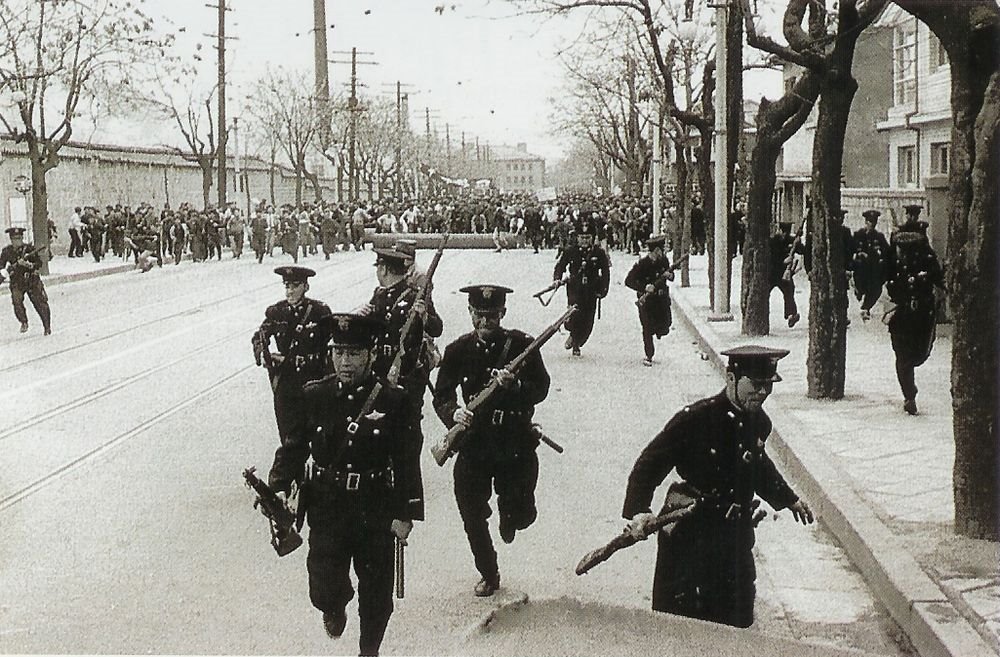
Protests against the results also took place in Seoul, as this photo of an April 6 protest shows:


An April 25 article tells us that
Five weeks ago, in the midst of the rioting that gripped the quiet city of Masan during Korea's presidential elections, a 16-year-old student named Kim Chu Yul sortied out into Masan's streets and never returned. The police claimed they knew nothing about him. But last week [on April 11] a Masan angler, fishing in the city's harbor, brought up Kim Chu Yul's bloated body. Still protruding from the corpse's head was a fragment of one of the tear gas shells that Masan police had used in quelling the election-day riot.
As the news spread through Masan, 10,000 infuriated citizens, many of them high school students, flocked to the building where Kim's corpse lay and demanded the body "so we can take it to Seoul and show it to the National Assembly." When the authorities refused, the crowd ran amuck. Raging through the streets, shouting demands for the resignation of President Syngman Rhee, the rioters sacked Masan's city hall, the local offices of Rhee's Liberal Party, the home of Masan's mayor and a brewery that a local pol allegedly received as a bribe for switching his support to Rhee in the elections.

From the brewery—where they found stacks of leftover ballots marked for Rhee's running mate, 63-year-old Vice President-elect Lee Ki Poong—the rioters moved on to Masan's police headquarters, smashed through a police cordon and wrecked the station. When Masan's police chief came driving up, infuriated women set fire to his Jeep and beat him so badly that at week's end he was still in a coma. For the next two days, the students of Masan paraded ceaselessly through town bearing placards that read "Down with Fraudulent Elections" and "Can Freedom Gained Through Blood Be Taken Away by Bayonets?"

Masan has long been a stronghold of opposition to Rhee's Liberals. In 1956 the people of Masan gave Rhee only half as many votes as Progressive Party Candidate Cho Bong Am (later hanged by Rhee's police for treason). Masan's voters flatly refused to believe that this time they had voted Liberal by nearly 3 to 1.
The article goes on to look at how this incident led opposition party members to begin denouncing Rhee, which, I suppose, did get some results.
In the National Assembly, Home Minister Hong Chin Ki solemnly declared: "I promise to see to it that the police do not secretly dispose of bodies in the future." Instructions were also sent to the Masan police not to fire on demonstrators, particularly schoolchildren, "except when absolutely necessary."
Just to make clear, schoolchildren most certainly took part in the demonstrations that would take place in Seoul.

Rhee himself came up with the predictable conclusion that the Masan riots were the work of Communist agents. The Masan police arrested so many violators that the city jail overflowed and some prisoners had to be held in railroad freight cars.
AP correspondent K.C. Hwang, in the book Korea Witness, describes the results of another protest in Seoul, on April 18:
Several hundred students of Korea University were brutally attacked by unidentified youths on their peaceful return to the campus from a demostration in front of the national assembly on April 18. Using steel bars and clubs, the several dozen youths knocked down dozens of unarmed students on a broad daylight street in the busy center of Seoul. Citizens watching the bloody scene rushed to the rescue of the victims, taking the bleeding and unconscious youth to nearby hospitals, while those on their feet marched back to the school marching angry slogans.
April 18 protest in front of the national assembly.

The next day, things became more violent, as reported by Time correspondent Alexander Campbell:
The enormous crowds lining Seoul's sidewalks clapped good-humoredly as rank upon rank of boys and girls marched along the city's main thoroughfares, sturdily swing ing their briefcases and singing patriotic songs. Not far from the presidential pal ace of Kyungmudae (which means man sion of courage and beauty), the students were halted by determined, heavily armed police. The students demanded that Rhee receive a delegation of three or four of their leaders to discuss new elections and to promise no more police intervention on university campuses. When the request was refused, the crowd again pushed forward. A tear-gas shell fell near the front rank of students and failed to explode. When a student moved forward to toss it back, a policeman shot him.
K.C. Hwang remembered this confrontation as being much more intense:
Alarmed by the increasing number of demonstrators in the capital, the government declared martial law as of 1 pm, but this did not deter protests. [...] Part of the street was excavated for drainage work, with small rocks and sewer pipes alongside. As in any violent demonstration, some of the students picked up rocks and started throwing them toward the police columns. [...] The usually quiet area was resounding with patriotic songs and chanting of slogan while the rock throwing intensified. It was then I heard shooting and screaming from the advance group. It was not sporadic shooting.


The Time reporter continues:
"At that, the whole mass charged forward—and ran into a hail of bullets that left several dead and dying. At this point, Seoul's 30,000 demonstrating students became partly an improvised army seeking weapons and partly a mob bent on destruction. While commandeered Jeeps and vans carried the wounded off to city hospitals, regiments of students, most of them still unbelievably clinging to their satchels full of books, continued to advance on the palace.
By now, the building of the pro-government newspaper, Seoul Shinmun, was burning, and so was the headquarters of Rhee's bullyboy Anti-Communist Youth League. From behind the heavy gates of Lee Ki Poong's home, police guards were firing into the crowd. Outside the city hall, students were beating two policemen to death with lead pipes."

By afternoon, Rhee called in Army Chief of Staff Lieut. General Song Yo Chan and placed Seoul under martial law. Rumbling into town with old Sherman tanks, the 15th ROK Infantry Division took over from the hated police. Genial, able General Song was firm, but his sympathies clearly lay with the students. "Call on me any time," he told a student delegation. As for the police, he warned bluntly: "Policemen found beating, torturing or abusing anyone will be dealt with under martial law."
This May 9 article looks at the end and aftermath of the uprising, heaping praise on army chief of staff Song Yo Chan, who said that "I myself believed the students' demands were just." After three interviews with Rhee where he unsuccessfully tried to convince him to step down, he decided to make it clear the army backed the protesters.
Slowly, the recognition dawned that Song's army was not going to hurt them. By the time the 7 p.m. curfew hour came, the crowd had swelled to monster proportions. Suddenly, some of the bolder demonstrators clambered onto passing tanks shouting: "Long live our soldiers." Doffing their helmets, the young tank crewmen joined the crowd in tribute to the students killed in earlier rioting by singing a Korean war song […]

Secure in the knowledge the army was with them, a million citizens of Seoul swung into a half riot, half parade that lasted all night and far into the next day. The crowd broke into the home of the hated Lee Ki Poong, hauled its contents into the street and vengefully burned them; one of the few things spared was an American flag, which the demonstrators carefully folded and turned over to a U.S. reporter "for safekeeping." Amid the crackle of gunfire from panicky cops, the rioters burned down a police station and the houses of two members of Rhee's graft-ridden Liberal Party. With chaos threatening, U.S. Ambassador Walter McConaughy issued a stiff public statement warning Rhee that "this is no time for temporizing."

Song sent a loudspeaker Jeep into the streets with a suggestion: let student leaders come forward to form a delegation to see Rhee. Fourteen responded. Song chose five and personally escorted them to the presidential mansion. There, as Song stood by beaming paternally, the students told Rhee: "The only way to solve the problem is to hold new elections—and also for you to offer to resign."

Rhee hesitated, then replied: "If the people wish it, I will resign." At that moment, twelve years of Korean history —years when the words "Syngman Rhee" and "South Korea" had been virtually synonymous—came to an end, and the students burst into tears.


The student delegation emerged from the presidential palace shouting, "We have won!" Seoul's streets erupted into a spontaneous expression of joy. Song's tank drivers were all but submerged under swarms of Seoul moppets, good-naturedly let the kids try out the controls. A small regiment of kindergartners marched up to the U.S. embassy chanting: "Thank you, America." A jubilant crowd decorated a statue of General Douglas MacArthur with a scroll that read: "Long life to him who saved us from Communism."
My how things have changed, when it comes to perceptions of the US. Of course, it was perceptions of US action (or inaction) during the Kwangju Uprising which have fueled this change. I couldn't help but be reminded of the behavior of Kwangju's citizens during the five days of citizen rule after the army was driven out when reading this paragraph:
Suddenly finding themselves the victors, Seoul's students showed extraordinary discipline. With virtually all the city's police force in frightened hiding, students ran the police stations, directed traffic, even commandeered city trash trucks and laboriously cleaned up the riot debris. When a group of rowdy schoolboys knocked a statue of Rhee off its pedestal and started to drag it away, older students restored it to place with the reproving reminder: "After all, he is part of our history."
As for the last two sentences, well, things have certainly changed. The rest of the article looks at Rhee’s departure from office, how vice-president elect Lee Ki-Poong, seeking refuge at the presidential mansion, killed his family and then himself, and how the assembly voted for new elections and temporary president Huh Chung’s efforts to clean up the government.


The above photo is of a memorial for the dead held on May 19. The next year, the monument seen below would be unveiled.


Herein certainly lies a large difference between the 1960 and 1980. While the events of 1960 seemed a victory and were championed, a year later things were not so rosy. 1980 seemed a failure and it took years before there was any recognition of those who died (or were injured), but the fact that it happened left the taint of illegitimacy over Chun's entire presidency, and perhaps the example of resistance that others followed.


There are some great photographs of the 4.19 Cemetery in Gangbuk-gu here.

Thursday, April 17, 2008

G-force, Korean style

This post will probably be lost on those younger than 30. Over at the Marmot's Hole, this comment made a reference to Spectra, which reminded me of the cartoon "Battle of the Planets", which I watched as a kid. It's one of the shows Korean friends the same age as me remember from their childhoods as well. In Korea it was titled "독수리 5 형제"(doksuri 5 hyeongje, or "eagle 5 siblings"). Here's the opening theme song to the Korean version:


Here's the 'Battle of the Planets' opening theme for comparison:


It's interesting to note that the Japanese series both shows are based on, "Science Ninja Team Gatchaman," was apparently much darker in tone than the US version, which was edited heavily and had new characters added. I have no idea if the Korean version had any changes made to it, or if it simply redubbed the Japanese original.

I have fond memories of this show from my childhood, but I'd imagine that if I were to watch it again today, it wouldn't fare well against those memories. But then what does?

Wednesday, April 16, 2008

How the president gets from here to there

The president and his wife leaving Seongnam Airport yesterday

Lee Myung-bak left for the US today on his first overseas trip, which means he's likely flying on the equivalent of Air Force One, right?


Well, not quite. One of my students, who works for Korean Air, filled me in on how he's travelling. While the Korean government does own at least one airplane for presidential travel, it's too small for long distance flights, such as to North America or Europe. The solution is to charter a flight from either Korean Air or Asiana. Kim Dae-jung started the tradition of alternating between the two airlines for each flight.


My student didn't know how much the government was billed for the two weeks of use, but assumed at least US$2 million, as he knew it cost $1.6 million ten years ago. It takes 4 or 5 days to refit the 747 for presidential use, as a bed, desks, and other amenities have to be installed in the plane. The plane left Gimpo Airport for Seongnam Airport, a military airport just southeast of Seoul, yesterday so that the president could leave from there today.


Get rid of the seats and there's actually quite a lot of room...

(Photos from here, here, here, and here)

Friday, April 11, 2008

Hair today, gone tomorrow

Well, here is the strangest article I've come across today. It's from December 25, 1910:
HUMAN HAIR MUCH CHEAPER
Due to the cutting off of their top-knots by the Koreans.

There is a glut in human hair, and its cause is a political one – the annexation of Korea by the Japanese. Since that event, so many Koreans have cut off their “top-knots” that in one small town over ten new barbers’ shops have been opened, and the price of human hair has fallen so much that the best quality is now selling at 20 cents an ounce, the former price of the cheapest, and cheap varieties are now fetching only 12 cents.

“The average amount spent on false hair by a ‘smart’ woman is $100 to $150 a year,” a well-known ladies hairdresser said, “and she usually has $8 of foreign hair on her head at a time. This glut of Korean hair will probably so cheapen curls, switches, &c., as to bring them within the reach of all.”
The rest of the article is here.

You have to wonder how much Korean hair was used by the wig industry prior to this. To be sure, many decades later, in the 1960s and 70s, many Korean companies focused on textiles and wig-making. In fact, a strike by female workers at the YH trading company, which made wigs, set off a chain of events which led to Park Chung-hee's death, and all that followed it.

Thursday, April 10, 2008

A look at adoption stats

The Joongang Ilbo has an article (which may crash all but IE) about a Korean couple who adopted the child of Indonesian migrant workers in Daegu. It looks at the obstacles the parents had to face, as well as the discrimination their daughter has had to face due to her darker skin.
"When I walk with my daughter to a public bath or visit the supermarket, I hear people whisper 'She must be living with a Filipino,' or they stare at us with unpleasant looks," said Ha. The girl's father said people look at his family strangely when the three of them walk together. Only when he tells people that Ha-young was adopted will people nod as if they understand. "I never had any prejudice against foreign people whether they have dark or light skin," said Ha. "It really hurts when people look at us with such prejudice."

Lee is highly critical of Korea for its apparent inability to move on. "People talk about globalization but the truth is nothing has changed and Korea still relies heavily on homogeneous bloodlines," Lee said. "How can we advance and compete in the world with such backward prejudices?"
What's interesting about what is related above is that most people who experience such prejudice (and come to such conclusions about it) are part of a mixed-race marriage, which in Korea would also mean an 'international' marriage. The article mentions that instances of Koreans adopting children from other countries are not common (and are not tracked by the government), so it would be very rare to see two Korean parents with a child who looks different than them.

The article also looks the number of Korean children adopted every year:
According to World Partners Adoption Inc., a nonprofit organization, Korea ranked fourth in the world as of 2006 in sending children for international adoption with 1,376 children, behind China (6,493), Guatemala (4,135) and Russia (3,706). The Korean government, though, disputes the figure for Korea, putting it at 1,899.

However, the story is different now. According to the Ministry for Health, Welfare and Family Affairs, for the first time in Korea domestic adoption by families in Korea (1,388 children) has exceeded international adoptions (1,264).
It goes on to explain that a "fundamental shift in attitude" has taken place due to the example provided by celebrities who have adopted children, as well as "economics and [the] recent empowerment of women". Stirring stuff, to be sure. Perhaps the writer (or editor, if the graph was added later) should have looked a little more closely at the stats below:

Between 2002 and 2007, adoptions of Korean children have fallen, with the number of international adoptions falling faster than the number of domestic adoptions. The story is not "different now" in that Koreans are adopting more - they're not. The story would appear to be that either less people are adopting children, or less parents are putting children up for adoption. I'd be curious to know which one it is.