Tuesday, April 08, 2008

Those with blood on their hands, remembered and forgotten

[Update - the Korea Times tells us that in March Jang In-hwan was declared "Independence Fighter of the Month." It also tells us he "accidentally fired" at Stevens. Sure he did.]


In 1956, Korea's first president, Syngman Rhee, in a moment of modesty, had a statue of himself raised on Namsan.


After students protesting his tampering in the 1960 election were shot and killed, Rhee was forced to resign on April 26, 1960.

Needless to say, his statue didn't last very long:


By the end of 1960, the remains of two statues were stored in a backyard in Seoul.


On March 27, the Chosun Ilbo found out what had become of the statues:


As this editorial describes it,
In a corner of a backyard in a private residence in Myeongryun-dong, Seoul, sit two statues of Korea’s first president Syngman Rhee, rusting away. The statues were erected in the late 1950s during Rhee’s term and were pulled down during the April 19 uprising. Only the head is left of the statue that once stood on Mt.Namsan and is covered in blue rope, while the other statue that used to stand in Tapgol Park downtown stands right next to it gathering dust. The only reason these statues are kept in the backyard after spending years at a junk yard is because one high-ranking union official in the Rhee administration saved them during the late 1960s. The official emigrated to another country and sold the house, including the statue.
I'm sure you can imagine how the Chosun feels about a statue of Korea's first president being left to rust. It doesn't make the sound point that GI Korea makes, that Rhee ought to be remembered for his efforts in Korea's independence movement, (some of which can be found here) and not for the autocrat he became once he gained power.

Interestingly enough, March 26 was the 133rd anniversary of Syngman Rhee's birth, but it was also on that day in 1910 that An Jung-geun was executed for killing Ito Hirobumi. As long as we're noting numbers, he had fired the fatal shots five months to the day earlier. Also worth noting is that Park Chung-hee was killed on October 26, 1979, 70 years to the day after Ito was killed.

An Jung-geun

Ito Hirobumi

The Joongang Ilbo presented readers with this photo and caption describing the way in which An's death was commemorated:

A children’s choir sings yesterday at a ceremony marking the 98th anniversary of independence fighter Ahn Jung-geun’s death. He was executed for killing a Japanese diplomat in 1909.
A "Japanese diplomat"? While I realize it's the English language press, it seems a rather poor way to describe one of the founders of modern Japan and Japan's first prime minister. We're also told that "the Chinese government has promised “full cooperation” in the project to excavate Ahn’s remains from the site where the Lushun Prison, controlled by Japan, was located in the early 20th century." So whose bones are these exactly? They seem to belong to a man who shot and killed (let's use the word 'assassinate' instead of 'murder') a prominent former Japanese leader, and in doing so quite possibly hastened annexation. I'm not really sure this is a role model I'd want eight-year-olds singing hymns to. While I'm sure lots of nationalist heroes the world over have blood on their hands, it seems a further stretch to honor someone known only for assassinating someone.

I asked an Irish friend of mine if similar figures existed in Ireland, and he told me that Michael Collins is very popular, but in his estimation was often little more than a cold-blooded killer. The difference, however, is that Collins actually played a part in Irish independence, while An may well have played a part in speeding up the annexation process.

In remembering An, I can't help but remember two other patriots who I've written about before: Jeon Myeong-un and Jang In-hwan.


They, of course, killed Japan's American adviser in Korea, Durham Stevens, while he was visiting San Francisco in 1908. Oddly enough, the date he died was March 25.


When I wrote my post on Stevens months ago, there was no Wikipedia article about him, but within a few weeks one had appeared, helped greatly by the appearance of a book at archive.org with biographical information and the photo above, taken in 1903. That article is now full of information about him (kudos to the person or people who put it together). The article provides links to pages I'd never seen before. I'd pointed out before that the local Korean People's Hall in San Francisco has these busts of Jeon Myeong-un and Jang In-hwan (Pic from here):


As this article makes clear, however, they are not only remembered in San Francisco.
In January 1909, Chang was sentenced to 25 years in San Quentin. Chang said to the judge through his interpreter that he “preferred martyrdom by death rather than by imprisonment.” He served 10 years and was released in 1919. He died in 1930 at age 55 and was buried in a San Francisco cemetery. On Aug. 3, 1975, Chang’s remains were flown to Seoul to be buried in the National Cemetery of Martyrs and Patriots.
And so, it is there, every year, that this ritual takes place:


Of course, this year is the 100th anniversary. "Wait a minute," you're thinking. "It says above Jang died in 1930." That he did, but he and Jeon fired their fatal shots at Stevens on March 23, 1908. It's on that day that the two of them are memorialized. I wonder if they invited the U.S. ambassador.

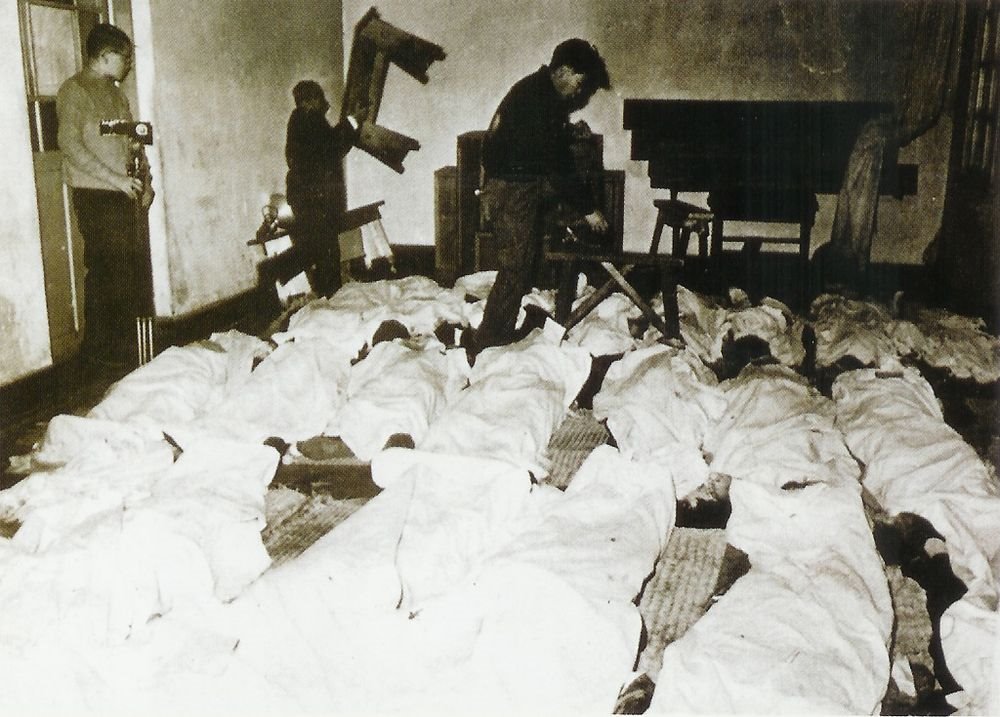
I notice that there are no photos of those who these men killed at their memorials. I guess it's easier to believe that they were living up to abstract patriotic ideals when photos of their actual victims are not present. That's why, of course, Rhee has been vilified by many people - one need only visit the 4-19 cemetery in northern Seoul to see those who died under his orders on that day in 1960:


Because such photos are lacking in the memorials seen above, there is no reflection on the effect of the shots being fired, which might lead to empathy. There is only a celebration of the fact that shots - any shots! - were fired, with little thought as to what the consequences of those shots were. If you were to insert a photo of Ito behind that children's choir and they looked as they were being made to cheer his death, I'm sure they'd look slightly psychotic - to outsiders, at least. As long as there is no reflection on what happened after the shots were fired, it seems likely a group of assassins who did nothing to bring independence closer (and may have even hastened annexation) will continue to be held up as pinnacles of patriotism. Ironically, the one person whose efforts may have helped Korea's position as its fate was being considered towards the end of World War II now has his statues rusting in a backyard in Myeongryun-dong.

Monday, April 07, 2008

Apologies in comparison

Brian over at Brian in Jeollanam-do has been doing a commendable job covering the response to the cosmetic company Coreana's ad campaign, which uses obvious Nazi imagery and refers to Hitler in the ads. The company asked him to remove the copies of the commercials he put on youtube, as they had changed the ads (by removing a single word - "Hitler" - from the line "Even Hitler didn't unite east and west").

Here's an image used in one of the ads:


I couldn't help but remember this photo:

"히로히토도 동과서를 다 갖지는 못했다"

Suffice to say, the photo above got a much different response when it first appeared four years ago. Whereas Coreana felt the only thing they needed to do was remove the word "Hitler," those involved in the photos taken below felt compelled to respond rather differently.

It all started on February 12, 2004. As the Chosun Ilbo tells us,
Lee Seung-yeon, Lototo Inc. and Netian Entertainment Inc. held a press conference Thursday and said “we are taking photos and making a film on the subject of the ‘comfort women’ starring Lee Seung-yeon, and it will be made available from early March by way of a paid service through the wireless service provider, Syswall.”
Here are the photos that were released to the media (a couple are NSFW).


You can imagine how well the last two photos went over. The company's explanation is unbelievable:
They said they were motivated by the recent "Dokdo Islet dispute’ between Korea and Japan, and chose the subject because they were distressed to see the ‘comfort women’ issue being forgotten all the time.

They also said that the “'comfort women’ were the model upon which the sexuality of women was commercialized and were the starting point for a wrong history. They said that much of the profit from the collection would go to help the women who were ‘comfort women.'

The production company said that the filming was done on Palau Island in the Pacific, where the ‘comfort girls’ were really taken to, and plans to conduct second and third filmings in Japan, Nepal and other countries.

How shooting erotic photos of a woman dressed as a comfort woman, crouching in front of a Japanese soldier, and standing before a rising sun Japanese flag work as a protest against the commercialization of women's sexuality is beyond me. The surviving comfort women were not amused:
“I want to see Lee Seung-yeon on her knees in front of me telling me how this all began,” cried Hwang Geum-ju, one of the 132 former Korean comfort woman still living. She and several women’s groups demanded yesterday that the photographer and the production company involved in the shoot cancel their plans to open the Web site.

In a press conference yesterday Ms. Lee defended the photographs as an attempt to “console” the comfort women, not to exploit them. She said she would donate part of the proceeds from the project to them.
So began the apologizing process.


On February 16, Park Ji-woo apologized and shaved his head.


The comfort women were unimpressed, so the next day, Lee Seung-yeon went to the House of Sharing in Gwangju (Gyeonggi-do) and apologized. Members of the media seem to outnumber the participants by at least 10 to 1.


Note the recording devices at bottom right above (and bottom left below).


In the end she tearfully apologizes. Between the crying and the overwhelming presence of the media, I can't help but be reminded of this.

More photos can be found here.

Being made to kneel and cry in front of the comfort women was not thorough enough, however.
Ms. Lee said in a magazine interview that she is ready to give up her career in the entertainment industry. After the 20-minute apology, the former comfort women were still dissatisfied. “The entertainment company director should have come too. Are they mocking us?” they said after Ms. Lee left.
The next day the company director asked to be allowed to show the footage that had been taken to civic groups and members of the government in order to prove that his intentions had been good. This didn't get a favorable response.
“Ms. Lee apologized to comfort women yesterday and the women begged her to destroy all the photos from the project. She cried on her knees but it was all a show,” senior council official Kang Hye-ju said. “We filed a court request for the photographs and video to be banned from distribution on the Internet. We will wait for the court’s decision on provisional disposition.”
The Chosun Ilbo wrote that
It seems like the company's constant delays in destroying the footage are because the company fears serious financial losses. Netian has been pleading that the project is not commercial, and one can see the company's pure intentions by watching the video and looking at the photos, but Korean Internet users have yet to be convinced.

Quite the contrary, users are condemning Netian for being defensive and failing to realize just what they've done.

The next day, Park, joined by several dozen photographers, burned the photos.


With this, after passing from head-shaving to bowing and tears to flames, the furor died down.

I'm sure I don't have to point out the rather large gulf between this and the response of Coreana to western 'concern' over the Nazi- themed commercials. Simply changing a word or a similar action on the part of Netian would never have sufficed to appease the anger of many groups in Korea. Differing perceptions of the Nazis and the imperial Japanese certainly play an important role in this, but note also the difference between a politely worded letter from the Simon Wiesenthal Center and a comfort woman who can say, "I want to see Lee Seung-yeon on her knees in front of me". Those affected by the Nazis, and westerners in general as a group within Korea, simply do not have the voice (and the power to get it heard) that many groups in Korea have. Getting Coreana to dump the whole ad or apologize will require much more than a polite letter.

Thursday, April 03, 2008

Eighteen months

Via ROK Drop, we learn that Shin Jeong-ah has been sentenced to eighteen months in prison:
A disgraced former university professor has been sentenced to 18 months in prison for embezzlement and forging her academic credentials.
I've been curious to see what her sentence would be since an English teacher was sentenced to 6 months in prison last July for using a fake degree to get a job at a hagwon. I've never heard what became of that person, but it might be worth reiterating: using a fake diploma to work at a hagwon received a penalty of 6 months in prison, while using a fake diploma to work at Dongguk University (as well as embezzling money from an art gallery) received a penalty of 18 months. How unsurprising.

Panorama of Itaewon and Yongsan-dong

I visited my friend Mat's new place in Itaewon-2-Dong, near Namsan, and took in the view:


No, even if you click on that photo, it won't amount to much. Try clicking this link for a full size photo. It's a rather impressive view. I've always loved the 'villa'-covered hilly areas of Seoul. You do get some rather glaring juxtapositions of old and new in the area:


We also had to guess that in order to construct a new multi-story building in a spot like the one above, everything would have to be carried a certain distance by hand - not a job most construction companies would want to take, I would imagine.

Monday, March 31, 2008

Korean writers of Japanese poetry

Over at the New York Times is a fascinating article about Korean writers and enthusiasts of Japanese poetry - and the negative response their work often receives.
The best known of the obscure group of Korean writers of Japanese poetry was Son Ho-yun, who died in 2003 at the age of 80. She had published six volumes of tanka, Japanese poems of 31 syllables, in Japan and had been invited to a New Year’s poetry reading at the Imperial Palace in Tokyo.

Despite this, in 2005, when Prime Minister Junichiro Koizumi of Japan recited one of her poems during a news conference with Roh Moo-hyun, then South Korea’s president, most Koreans were baffled as to who she was. In the poem, Ms. Son dreamed of better relations between the countries.
The article provides an example of the responses she received:
Once, a Korean editor who was invited to speak at one of her book parties humiliated Ms. Son by reproaching her for writing Japanese poetry.
Now that's how to behave when you get invited to speak at someone's party! Where do people learn such behavior? It's not like they're reminded of the history between the two countries every day, is it?

On an unrelated note, I had to both chuckle and shake my head in hopelessness when I saw the weather update on the Joongang Ilbo's website (in both English and Korean). It posts temperatures and weather for Korea's 6 largest cities... and one other place:

Wednesday, March 26, 2008

Unseen photos of the Samil movement, 1919

While looking for something else I came upon this page, which has scans of a 1919 Korean Red Cross pamphlet about the suppression of the Samil independence movement (which I talked a lot about here). It includes the declaration of Korean independence, 34 photos, and a statement from the Korean Red Cross. What's most remarkable are the photos, many of which I'd never seen before. The pamphlet says they were taken by a foreigner (singular), and one of them was most certainly taken Francis Schofield, so it would seem they came from his camera. I've included some below, but for those who want to see them all but don't want to spend the time necessary to look at them on the website, I made a pdf, which can be downloaded here (scroll down to bottom left).

The photo below is well known - or at least the right half of it is. I made a panorama from two separate photos. To the left is Deoksu Palace (with some sort of awning set up - perhaps for Gojong's funeral) and to the right is the old city hall, a building I know nothing about.


Here the protesters are behind Deoksu palace, with what I'm quite certain is the British legation in the background (The U.S. legation is nearby as well). [Edit, the building in the background is Dondeokjeon, the first western-style building in Deoksu Palace, built in 1901 and demolished around 1926.]


The caption for this photo reads "Japanese soldiers guarding the park gate." Perhaps this is the gate to Tapgol Park? [Edit - yes it is!]


The caption for this photo says it's in a "corner of the park".


Below are women being taken to the police station for shouting "Mansei!"


The caption for the following photo reads: "Japanese soldiers dot the streets of Seoul and other important cities in Korea like flies - one Japanese soldier at an interval of five houses."


Shopkeepers stayed closed in solidarity with the demonstrators.


The photo below is of "A foreigner who was arrested for harbouring Korean revolutionists on way to trial with his head covered." Perhaps this is Eli Miller Mowry, an American missionary who was arrested and sentenced to 6 months in prison.


Schofield, working as he did at Severance Hospital, would have had many chances to photograph those beaten and tortured by the Japanese.


The following two photos are are very unpleasant, just to warn you.


These are about half of the photos of the wounded, and they really do make clear how brutal the repression was. Schofield hid his papers about and photos of the uprising in his false leg when he left Korea, if I remember correctly, because the Japanese were trying everything they could to stop images such as these from leaving the country.

Below is a well known photo taken by Schofield on April 18, 1919, three days after the Jeam-ri massacre. A Japanese police officer is explaining away the burned houses to a foreign missionary.


Above are two grieving widows. Below is one of the only houses left standing in Jeam-ri.


The photo above shows more destruction at Jeam-ri; the one below shows the destruction at the nearby Whasu-ri:


I've seen photos of Koreans tied to crosses at their executions, but have never been sure such photos were real. Here is one from the pamphlet which is captioned "Crucifixion in 1919: This photograph was taken by the International Film Company a few minutes after the execution by the Japanese soldiers." So what it's saying is that the Japanese, who were trying so hard to make sure no photos of atrocities left Korea so as to influence the west, let a foreign film crew photograph crucified prisoners? I'm not saying this didn't happen, I'm just saying I'd need some more proof.


At any rate, it's a fascinating pamphlet, as I'd never seen most of these photos before.

Tuesday, March 25, 2008

A lack of perspective

In this post I compared the images below, showing how an image of the American merchant ship General Sherman (destroyed on the Taedonggang in 1866) had been reproduced on a beer cap for the North Korean beer Taedonggang:


That post was linked to today in Andrew Leonard's column at Salon called How the World Works. Neat. But... in the comments to that post (and in those to my original post) a question is raised as to whether or not the image is actually of a bridge, and not the General Sherman. A link to these photos of Pyongyang shows the Cheongryu Bridge, which I'd seen on Google Earth before I'd written the post, but dismissed because, well, who's ever heard of a suspension bridge with two towers of very different heights? Those photos of Pyongyang (many more are here) were taken in 2004, two years after Taedonggang beer began production, and the caption next to the photo of the bridge reads: "It is pictured on bottle caps of a beer brand". Digging further, I found the stamps below of the bridge, which show it from a more stylized perspective. I think the most important word there may be "perspective", as the images below make it seem likely that the image on the cap is the bridge foreshortened. Compare the image at upper right and the bottle cap:


It seems pretty certain it is the bridge (which is, I believe, the newest one in Pyongyang), though the perspective is wrong and the blobs under the bridge look nothing like piers. Was the artist who worked on the cap one of the people who worked with Guy Delisle?

Perhaps I should have known - North Korean propaganda isn't typically very subtle, is it?