Thursday, November 03, 2005

Boared

Seoul has had a number of visits from wild boars in the past month, where they have come out of the mountains and into the newspapers. In the English language press, the Joongang Ilbo has definitely found its niche as the online paper that reports on all things boar. If I sound like I'm poking fun, I'm not, really. I remember seeing a boar on a tv news show years ago (when I watched TV) and was fascinated, partly because they aren't to be found where I come from, and partly because Korea has very few large wild animals. Some deer, some reintroduced bears down south, and wild boars, and that's about it for larger mammals. All I've ever seen while hiking throughout Korea were a few chipmunks, a squirrel... and that's about it (though I did see a woodpecker last weekend while hiking at Bukhansan). A few of my students have seen boars in the countryside before; numerous photos of boars in Korea can be found here. A wild boar also played a rather important part in the hit film Welcome to Dongmakgol, the only Korean film I can remember seeing one in (for a photo, scroll down).

The first appearance of a boar (this year - the above link to boar photos makes clear that this has happened in past years as well) was on September 29, when one weighing 130 kilograms appeared in Southeast Seoul and injured two people before swimming across the Han river. By the time 90 police officers were mobilized, it had swum back across the river. Around noon, after a 12 hour 'spree', it was surrounded by police and killed by a hunter. A photo of it swimming across the river is here. Another Joongang Ilbo article from 4 days later stated that Seoul City officials had said that the 160 cm long boar would "be stuffed and displayed at Gildong Ecology Park in Gangdong-gu, Seoul in about 40 days". The official added that "Wild boars are rarely seen in the city."

Just over 2 weeks after this statement, on October 19, another boar appeared in the vicinity of the Walkerhill hotel, likely having come down from Achasan. After an hour long chase by police, it tried to swim south across the Han river and drowned.
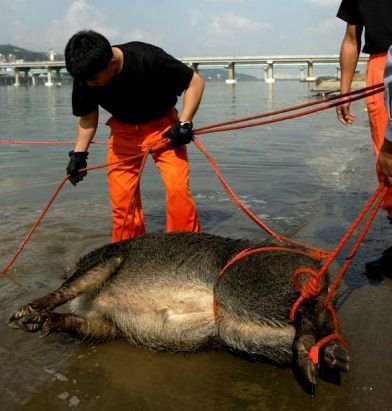
(Pic from Hankyoreh)

Five days later, on October 24, a 200-kilogram, 150-centimeter long pig appeared on the grounds of Changgyeong Palace in central Seoul, causing the evacuation of 300 visitors before it was quickly killed by hunters. It was assumed to have come from the mountains to Seoul's north; after three sightings in such a short time, suddenly wild pig experts found themselves getting phone calls from media outlets.
A naturalist said that with tigers extinct and bears nearly so in Korea, the pigs face fewer natural predators and have multiplied quickly.
Choi Sung-gyu of the Korea Society for the Protection of Wild Animals said he thought that population pressure was driving more animals into the cities in search of food.

According to Environment Ministry, there are about 254,000 wild pigs in the country. They caused damage to crops estimated at 8.2 billion won ($7.7 million) last year. Some experts are urging a culling of the country's wild pig population.
With no less than three sightings in almost as many weeks, it was time for the Korea Times to edge into the Joongang's niche, with an article titled 'Citizens on Alert Over Wild Boars', which informed us of Seoul city's plans to establish an emergency task force in November to cope with the appearances of wild boars. An official said
"We will produce and distribute pamphlets and other materials that contain information on wild boars, such as their characteristics and habitats. Citizens should be well informed about how to handle the situation if they encounter boars"...

[A] researcher advised people not to run away or shout when they are faced with a boar on the street, adding that they should look straight into the boar’s eyes and promptly hide behind rocks or trees.
So there you have it, just in case you were wondering what you should do if you see one. The article also mentioned that "[f]armers and professional hunters usually hunt wild boars around this time of year to prevent them from gorging on harvest-ready crops." I was wondering how legal this was until I found this article, from last January, which said that "wild-animal hunting has so far only been allowed if beasts were found to be damaging crops or threatening farm animals and human life". The article said that hunters would soon be able to hunt them if they were damaging tombs.

On October 27, a boar appeared in an apartment complex in Inchang-dong, Guri city, on Seoul's eastern border, and ended up in an underground parking garage before running off, presumably back into the hills next to the apartments.

This suddenly became international news when Reuters covered the story on October 28, with the memorable opening lines "This wild piggy went to an upmarket hotel. This wild piggy went to an historic palace. And all the wild piggies were chased by South Korean police." The use of the word "invasion" and its somewhat misleading descriptions of the 4 sightings make it sound as if dozens of them are running amok in Seoul on a daily basis, which simply isn't the case. It certainly makes for good entertainment however, which is likely why the story has appeared in online news all over the world (just google it).

The most recent boar sighting was not in Seoul, but in North Gyeongsang province, on October 30, where a man driving an SUV driving from Daegu north to Andong suddenly encountered about 20 boars crossing the highway as he rounded a curve. Five 6-month old wild pigs (each weighing 50 kg) were killed when he was unable to stop in time and hit them. A (not entirely pleasant, though censored) photo of the aftermath can be found here.

At any rate, if they're becoming such a nuisance, especially in the face of a lack of predators, allowing hunting to cull the population might not be such a bad idea. According to this site, in 2004 the whitetail deer population in my home province of Ontario was estimated to be between 350,000 to 400,000 (and one might imagine that in an area of the province the same size as South Korea, there would be less than 254,000, the estimated number of boars in Korea); 80,000 deer were killed by hunters in Ontario in 2003. I have doubts that the boar population here could recover as quickly as deer in Ontario do, seeing as the terrain and settlement patterns are very different, but the stories above (and Antti's comment below) make clear that the boar population is getting a little too large, for both city and country dwellers. I can't help but wonder, if they are such a problem in the countryside, that people living there might be annoyed that the boar problem is only getting attention because it's beginning to affect Seoul...

(Hat tip to Lost Nomad for the Reuters link)

Update:

Kotaji provides some more information about the intimate link between the Joongang Ilbo and wild boars.

Wednesday, November 02, 2005

Witness to An Assassination

The Korea Times had an article today about an upcoming concert by singer Sim Soo-bong:
At a college campus talent search in 1978, the then-23-year-old student struck a chord with the audience and television viewers watching across the country with ``That Person From Back Then (Kuttae Kusaram),'' a song that remains to this day one of her most famous songs.
The name of the song immediately made me think "Waitaminute...", and of course the article went on to relay the moment she is best known for - the fact that she was sitting next to Park Chung-Hee when he was assassinated by Kim Jae-Gyu on October 26, 1979. This review gives a more detailed description of her past up to that point:
Shim Soo-Bong was just a debutante when Na Hoon-Ah, the king of trot, discovered her. She was still using her real name, touring festivals promoting herself. He thought she could make it, become one of the greats, like Patty Kim and Lee Mi-Ja. When Shim, at the height of her popularity, was called to entertain the President, she had a reputation for being a great enka singer. He asked for her specifically, because of his love for Japanese culture and music. But after that momentous night, Shim denied ever singing enka to the President. She said all she sang was that famous song, 그때 그사람 (That Person Back Then). Since then, that song has become synonymous with 10/26.
Though the KT article goes on to perpetuate that myth ("The song she sang that night to entertain the President was none other than `Kuttae Kusaram'"), it also describes how Chun Doo-Hwan banned one of her songs, and also barred her from performing on TV for several years ("I later heard that he had said, `that singer performing will remind people of President Park Chung-Hee and may become a problem for my image,’" she said). 

Park's assassination has of course been brought back into the spotlight this year due to it's dramatization in the film "President's Last Bang" (그때 그사람들); it's Korean title was based on the aforementioned song by Shim Soo-Bong, which is further described in an interview with director Im Sang-Soo here. While most films released in Korea are publicized even before they begin shooting, no information about President's Last Bang was made public until about 2 or 3 months before it was released - something which had never occurred with any other Korean film, to my knowledge. The caution was warranted, considering the film had documentary footage cut from the beginning and end by court order after a suit by Park Chung-Hee's son, and was reviled by rightist critics as being slanderous and full of untruths. Im Sang-Soo goes into quite a bit of detail about this in an excellent interview here (where he says, "I don't really think the film is political. I think it's more of a mob film").

What's funny is that, in this case, the right itself has provided English speakers with the means to see that the film is in fact quite accurate in it's depiction of Park's final hours. Years ago the Chosun Ilbo had a series about the life of Park Chung-hee written by Cho Kap-Je, which began with a very detailed retelling of his final hours, based on the investigation records (which have got to be accurate, seeing as Chun Doo-Hwan was in charge of the investigation, right?). Anyways, the entire story can be read here. Start at the bottom and work your way backwards through the posts, where you can find many photos of the re-enactments as well. 

 (Hat tip to Oranckay for the final link)

Friday, October 21, 2005

Lee Myung-bak's 'Canal Plan'

The Korea Times, earlier this week, posted an article titled 'Seoul Mayor Lee Pushes for Massive Cross-Country Canal'. I'm sure the Times staff were trying to choose between that headline and "Mayor Lee Plans to Throw 10 Trillion in Taxpayer's Money at the Construction Cartel for Utterly Pointless Project" and flipped a coin.

Apparently, this is nothing new; according to the article, he first proposed the idea as a lawmaker in 1996. Why does he think this will work?
``The southern part of the Han River and the upper part of the Naktong River is only 20 kilometers apart. If we are able to connect Seoul and Pusan through an inner-country waterway, it will cut one-third of logistics costs and help the economy by creating more jobs and balancing regional development’’
Sounds wonderful. Luckily, a few sane people have spoken up about this idea:
[C]ritics question whether building a massive canal connecting Seoul and Pusan will be economically reasonable. In a 1998 report jointly published by the Korea Water Resources Corporation (KWACO) and the Korea Research Institute for Human Settlements, the state-run organizations said that it would take more than 10 trillion won to build a canal connecting the Han River and Naktong River.

The groups also questioned the canal’s efficiency as a transport route, saying it would take 62 hours by ship to move cargo up the canal from up to bottom and will need an additional supply of 22 million tons of water to sustain the connection.
Let's address the '62 hours' bit first. I took a ferry once from Incheon to Jeju. It took about 12 hours. The most I could imagine it taking to get to Busan would be 24 hours. So obviously, the canal would save so much time, wouldn't it? Perhaps Lee means to transport goods to inland cities, but there aren't many large ones on the route of the rivers, excepting Daegu.

Let's address, oh, say the following picture:

The Chungju Dam, on the Namhan River, is 97.5 meters high. There's another dam 19 km downstream. There's also a 2km wide dam at the mouth of the Nakdong River. There are two dams on the Han River near the eastern and western boundaries of Seoul, which exist to keep the shallow river high enough for the sightseeing tour boats. According to this page, South Korea has 1,213 large dams, so I would imagine that there are many more dams on these two rivers. This would mean altering these dams to create locks. I can't help wonder if Hyundai Construction (Lee Myung-bak's old company) had anything to do with building these dams. He's already shown with Cheonggyecheon that he's quite good at spending a lot of money to undo projects carried out by his former company years ago. Suffice to say, it's not just a matter of digging a canal between the two rivers, but of building new dams, altering old ones, and carrying out massive dredging projects.

In an interview, he said "The Seoul-Busan Canal plan I announced during the 14th National Assembly is a comprehensive plan to foster national competitiveness and create jobs." Create jobs for who? What industry will benefit from such a huge construction project? He also said, "I went into a firm with 100 employees (Hyundai Construction) and made it into one with 160,000". A plan that will pour 10 trillion won into the construction industry, which happens to be his former industry - what a strange coincidence. Lamenting the fact that Korea does not use its rivers as transport routes, Lee said that "Korea uses its rivers as sewers". I wonder to what degree the actions of his old company played a role in the conversion of Korean rivers to 'sewers'.

It's worth noting that environmentalists opposed to unhindered dam building managed to stop dam building for 6 years, between 1996 and 2002 (though since then work has resumed, with the Peace Dam being finished this month). Much of it centered around opposition to the construction of the Yongwol dam, on the Dong river, in Kwangwon-do, the movement against which is described briefly here. Another article from 1999 mentions that "there are already seven dams within Kangwon, which have led to the displacement of 29,000 people in the past five decades." Considering these numbers refer to only one province, and the variety of dams described here, the effect dam construction has had upon people must be considerable. It's hard not to notice that environmental groups managed to halt projects in 1996, just 4 years after the first civilian government came to power. Under the dictatorships, people wouldn't have been able to complain much about the dislocation caused by dam construction.

One of the more insane projects that was halted only earlier this year is the Saemangeum reclamation project in Jeollabuk-do, where a 33km long sea-wall across the estuaries of the Mangyeung and Dongjin Rivers is almost finished construction. There's lots of information about it here, and relevant pictures are here.

Korean Punk

Speaking of Korean punk rock (yeah, I know it's been a few weeks; I've been doing research on some future posts), I came upon some pages on that topic the other day by accident, and thought I'd post some links to them.

I'd imagine the first article in English about punk rock in Korea would be Stephen Epstein's 2000 article 'Anarchy in the UK, Solidarity in the ROK: Punk Rock Comes to Korea'. It's a lengthy article, but well worth a read if you have any interest in this subject. Eptstein notes that many of the interviews are culled from footage shot for a documentary, released in 2001, called 'Our Nation: a Korean Punk Rock Community', which he made with UCLA folklorist Tim Tangherlini (an article about Epstein and his reasons for making the film appeared in the Korea Herald at the time).

I'd love to see the documentary, but as this page tells us, it only seems available to institutions, for prices well beyond what an individual would want to spend. If anyone is going to be at Seoul Selection tonight, where Stephen Epstein is giving a book reading, perhaps they could ask him about other possible ways to view it.

Thursday, September 29, 2005

The Fate of the Pants Droppers

Another court related story...

After detailing the scandal that occurred when two musicians dropped their pants on a live MBC music show (and all the abuse hurled at the musicians, the indie music scene, and MBC by politicians, netizens, and the media), the story has come to an end (and only two months after it began - the courts are pretty fast here, at least in this case).

As the Marmot reported two weeks ago, prosecutors were asking for prison terms of two years and one year, six months for the two members of the band Couch who dropped their pants. Happily, today the Joongang Ilbo reported, in an article titled "Rude rockers get suspended sentences for raunchy stunt", (which may win an alliteration award) that
Seoul Southern District Court said yesterday that Shin Hyun-bum and Oh Chang-rae, musicians from an underground punk band called The Couch who exposed their genitals during a live MBC broadcast in July, received a 10-month suspended sentence and an eight-month suspended sentence, respectively, both with a two year probation.
It's nice to see this come to a happy end. The court also thought their time in holding cells was sufficient enough to cause reflection.

MBC, however, still manages to piss its viewers off, this time by showing, repeatedly and in slow motion, "gory accident images".

Re-examining the Past Too.

Update 2:

The National Human Rights Commission of Korea said yesterday (Nov. 15) that legislation is needed to remove any statute of limitations that bars prosecution of state-sponsored rights abuses of the past.

Update:

On a closely related note, the Seoul High Court ordered the prosecution's files on KAL858 bombing opened after a suit by a victims' families association.


Two days ago the Chosun Ilbo had an article entitled "
New Reform-Minded Supreme Court Chief Sworn In
", which had this to say:
Lee Yong-hun was sworn in as the 14th chief justice of the Supreme Court on Monday. At his inauguration ceremony, the man widely expected to head reform of the traditionally conservative institution said, “In the decades of dictatorship and authoritarian regimes, the judiciary has not maintained its independence from political pressures nor served as the last stronghold of human rights protection. All jurists deplore the concerns and scars we have caused the Korean public.” [...]

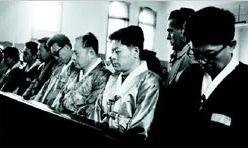
Lee also expressed an intention to admit in whatever form that key decisions by the court -- examples include the discredited death sentence for innocent people in an incident known as the People's Revolutionary Party Incident in 1975 [pictured above] -- were miscarriages of justice. “Above all, it needs the courage to confess past mistakes frankly to restore lost public confidence in the judiciary,” Lee said.
Anyone wondering whether this meant that the courts would begin re-examining their past (like the Defense Ministry and the National Intelligence Service) didn't have to wait long to find out. Two days after Lee's inauguration, today's Chosun Ilbo gave us an article, titled "Courts Start Sifting Through Ignoble Past":
Court officials said Wednesday courts nationwide were ordered to collect several tens of thousands of rulings and trial records on security-related cases under Korea’s authoritarian governments. Courts have been told to prioritize rulings made between 1972 and 1988 with words in the title or text like “democracy”, “dictatorship”, “National Security Law” and “Molotov cocktails”.
Not everyone within the courts agrees with this however:
Some judges resist a drive they say could hurt the judiciary’s independence, but others say it comes not a moment too soon. The dissenting judges argue it is impossible to decide who would have the authority to revise rulings by judges who are considered individual constitutional bodies, and warn the effort could undermine judges’ trial authority.
The other examinations into the past by the NIS and Defense Ministry would appear to be fact finding missions, with little (at this point) intention of pressing charges or punishing those who carried out government sanctioned torture or murder. They also have had rather specific cases in mind, unlike the wide-ranging criteria involved in this judicial probe. Also, statements like "admit in whatever form that key decisions by the court were miscarriages of justice" are somewhat vague but could suggest overturning past rulings. I wonder if there is a legal framework that allows them to do this (especially on such a mass scale), or whether the legislative wing of the government will have to get involved. I also wonder if such wide ranging criteria for inclusion into the probe will make it a rather large undertaking - and just who will be expected to do the extra work. I imagine, beyond the judges who were complaining, that there will be a lot of clerks and whatnot complaining bitterly about having so much more work to do...

Thursday, September 22, 2005

Kwangju Narratives in Different Media


In the book Contentious Kwangju: The May 18 Uprising in Korea's Past and Present, there's an interesting essay by Don Baker titled "Victims and Heroes: Competing Visions of May 18". For the curious, Baker was in Kwangju the day after the military retook the city, and the story of his escape from the city, along with Linda Lewis, appears in her book Laying Claim to the Memory of May. (A quick update - in his review of this book, Baker refers to his connection to the city).

At any rate, Baker's essay is influenced by Paul Cohen's book History in Three Keys: The Boxers as Event, Experience, and Myth, which distinguishes between the reconstructions of events by historians, contemporary accounts, and, as Baker describes it, the "perspective generated by the significance ascribed to [an] event." He continues:
When later generations draw lessons from a significant historical event...they change the way that event is viewed and discussed. Cohen calls this third perspective, refashioning the past to meet the needs of the present, the construction of a "myth"... [T]he mythical retelling of an event is designed not so much to relate what actually occurred as it is to encourage certain sentiments, arouse certain emotions, serve certain political functions, or fulfill certain psychological needs.
He goes on to describe how such myths isolate or focus on certain aspects of an event, and uses this framework to look at how popular narratives of the Kwangju Uprising in different media illuminate either the tragedy of the victims, or the heroism of those who rose up against those who brutalized them. Those narratives published in the years directly after the uprising (mostly short stories or poems) tended to focus on the victims, while some later narratives focussed on heroism of the uprising.

This essay is well worth reading (in fact, the entire book is), but the reason I'm going into a discussion of it here is that Baker's description of these short stories made me aware of their existence and prompted me to look for English translations of them on the internet. I managed to find a number of them, and so link to them I do.

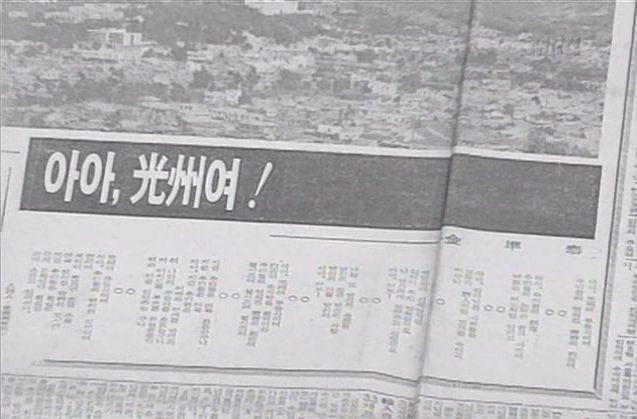
Kim Jun-tae's 1980 poem Kwangju, Cross of Our Nation, was published soon after the uprising occurred; he was dismissed from his high school teaching post for publishing this poem (another translation can be found here). That's a picture of the poem as it was published in the Jeonnam Maeil Sinmun at the top of this post.

Im Cheol-woo's Spring Day (1984), about a character who feels guilty over his friend's death during the uprising, can be found here, while another story involving Kwangju by Im Cheol-woo, A Shared Journey, can be found here (scroll down to the very bottom).

Choi Yun's There a Petal Silently Falls (Part 1 ; Part 2) was the novella upon which Jang Sun-woo's 1996 film 'A Petal' was based.

Kong Son-ok's short story Parched Season (1993), depicts the lives of marginalized figures who are survivors of the Kwangju Uprising.

Parched Season and Spring Day (and 3 other stories about the Korean War) are discussed in the essay Remembering Trauma: History and Counter-Memories in Korean Fiction by Susie Jie Young Kim.

On the topic of visual depictions of the uprising, Hong Seong-dam's woodblock prints can be found here. Hong made most of the prints shortly after the uprising. In 1989 he was arrested under the National Security Law and sentenced to 7 years in prison, of which he served three. Hong's main offense was to have sent to Pyongyang, North Korea a photographic slide of a large mural that he had painted. He discusses the torture he underwent in prison near the bottom of this page.

Numerous Photos of the uprising can be found here, while documentary footage can be downloaded here (about 2/3 down there are 3 files listed; click on 영상1, 2, or 3 or right click and 'save as' to save. I believe the first file is a music video which contains footage from the second and third files).

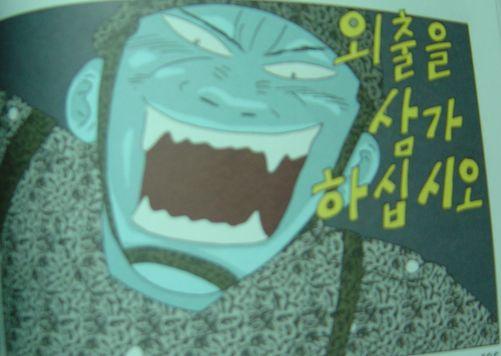
Baker's essay mentions that in some cases, as the idea of who the victims were evolved, certain narratives considered the soldiers to be victims as well, as they were forced to carry out such violence. The protagonist of the film Peppermint Candy is portrayed as a person devastated by his role in the violence, for example. A 200 page manhwa (comic book) I picked up in Kwangju during the 25th anniversary of the uprising has none of this, however; the soldiers are depicted as the embodiment of pure evil, such as in the photos below, one of which depicts a soldier stripping a teenage girl (which was common practice for prisoners of either sex), and later, raping her.


This girl, whose name, Jo Hyeon-jeong, is clearly pointed out, isn't just meant to represent one of many victims; the comic depicts what happened to specific people. This makes clear that people in Kwangju, and the narratives that continue to be produced there, view what happened in much more personal terms than those from other regions of the country, for obvious reasons. When I watched high school students re-enact the shootings of May 21, two of the students I talked to told me proudly that their fathers had taken part in the uprising. The event's relationship with the city it occurred in is something Linda Lewis discusses a great deal in her book, a book I recommend most highly.

There are at least 6 or 7 documentaries (in Korean) about Kwangju on emule. Try searching for 518, 광주, or 5-18 and they should turn up. Some have contemporary footage, while others have interviews with surviving citizen's army members, former paratroopers, and foreign journalists.

Thursday, September 15, 2005

Psychedelic Sounds

Update: Antti found the site linked to below quite some time ago. Also, a recent article on Patti Kim makes reference to her debut in 1959 on stage at a US Army base.


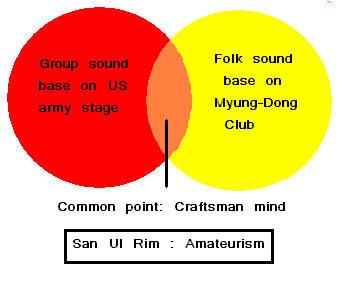
I pulled out some Sanulim cds that I bought last year and as I was listening to them again, decided to try to more information on the band. Luckily, I came across a link to a great site about Korean psychedelia and folk from the 60s and 70s, which has a biography of the band. I was shocked to learn that once upon a time, in 1977, Sanulim sold 500,000 copies of its first album, which is full of stripped-down, fuzzed-out guitar rock. The band only enjoyed this popularity for a short time, before 'dance music' became popular, but the idea that a band like Sanulim was popular seems almost inconceivable in this age of idols and manufactured, disposable pop bands. The thing about Sanulim was that they didn't sound like anyone else at the time - the site says critics said they sounded like they 'dropped out of the sky'. A diagram, followed by commentary, explained this:

The 1970s Korean music scene was divided into two parts. One is the Group sound (Rock band style) based on the US army stage circuit and the other is the folk sound base on Myung-Dong club. The goal of the former is a superb performance (technical skill and accurate copying ability of western classic rock numbers) while the latter had much more importance in personal expression. But both of them had the common point that the craftsmans mind was strictly trained. But San Ul Rim’s music style didn’t belong anywhere (in these 2 parts).
Now, my first question was: "US army stage circuit?" I was really curious about the influence the USFK might have had on Korean rock music. Another page on this site had some more information, regarding the genealogy of a band called He5, a member of whom came from a band called the Key boys, which had
played some 'Package shows', under the name of the Lock & Key in the stages of the 8 th U.S army which settled in South Korea. Also they played at some new venues like 'Music listen Rooms', 'Live Music Salons', or the traditional ones like in Cinema.
[Cf. At that time the concert was held frequently in Cinema Houses. It was called as 'Cinema Show].

With these latter [venues] they were known to general 'Korean' public... (Cf. Because the stages in 8th Army of U.S. was for the Korean in the forbidden area for the evident reason of security. So generally a Korean group or artist who played there was a totally unknown figure to general Korean public).
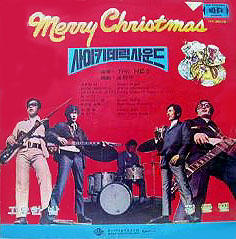
It goes on to say that the Key Boys broke up (one member joined the Korean army's entertainment unit, which was sent to Vietnam) and He5 was formed by Wha-Yang Entertainment Inc, which managed several bands and picked guys from the different bands to be in this 'supergroup' (management and record companies putting together bands? Sounds familiar...). It also mentions that "Wha-Yang Entertainment Inc. was one of the enterprises who dealt with matters concerning the distribution of musicians and entertainers for the 8th Army of USA.- with Universal, Dae-Young, Dong IL." He5 apparently played often in Itaewon. The article says that their live shows were 'heavy and psychedelic' but that the record company wouldn't let them make such records in the studio. On the other hand, the Christmas Album with the 'psychedelic sound' pictured at the top of this post has a 13 minute version of 'Jingle Bells' mixed with 'In-a-gadda-da-vida', and my heart just breaks that the 'Listen' link is broken.

Now, I was vaguely aware of the Myeongdong folk music scene, as well as the history of Itaewon (mostly due to the article 'Itaewon as an Alien Space within the Nation-State and a Place in the Globalization Era'), but I knew nothing about the 8th Army touring circuit, so now I'm intrigued and want to learn more about the effect of the USFK on Korean rock'n'roll. The effect of the US military presence on Japanese and German popular culture is a little better documented, but I don't know how much this has been looked into regarding Korea.

Well, if a Chosun Ilbo article posted today is anything to go by, it would appear North Korea has been aware of the US army's effect on Korean music for some time now:
The U.S. military in South Korea spreads “Yankee culture and all sorts of social ills,” North Korea's state-controlled Pyongyang Broadcasting has claimed. In a program on Wednesday, the broadcaster ... blasted the USFK for spreading "decadent music," citing the corrupting influence of blues and rock and roll in the 1960s, soul in the 1970s, disco in the 1980s and rap in the 1990s.
Ironic I would read this article and discover this psychedelia site on the same day. One question I wonder about - how available was US/UK rock music in Korea in the 1960s and 1970s? Was the USFK the primary conduit for rock'n'roll in Korea, or was edgier American rock music available on Korean record store shelves at the time? Anyone know?

Thursday, September 08, 2005

A Single Spark

Update: Oranckay commented on protest suicide and it's political use by the left and the right, and Antti introduced me to the Chun Tae-il Memorial Foundation website which has lots of photos and even a comic about Chun's life.


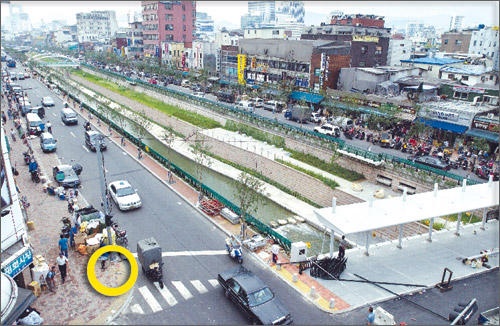
The Chosun Ilbo, in an article titled 'Seoul Immortalizes Single Spark that Changed a Nation', says that when Cheonggyecheon is fully restored on October 1st, Cheonggye6-ga, the street which runs north and south between Dongdaemun and Dongdaemun Stadium, will be renamed Chun Tae-il Street. It was on this street, on November 13 1970, in front of the Peace Market (a building full of sweatshops where he toiled as a garment worker), that 22 year-old Chun Tae-il immolated himself in a protest against the labour conditions he and his coworkers were subjected to. Sweatshops like these were densely packed into the markets around Cheongyecheon street:

The article has a fairly good account of Chun's life and the year or two that led up to his death. Perhaps worth noting that it was the Kyunghyang Ilbo which, on October 7, 1970, printed a story at the top of it's city section titled "16 Hours of Daily Labour in the Back Room", a story which gave Chun hope that the publicity would force the owner of the Peace Market to make changes. When this failed, and the labour inspectors failed to keep their promises, he decided to burn his copy of the Labour Standards Act; or that's what he told his friends. Feeling that there was no other way to bring attention to their plight, he had decided on a more radical course of action, one portrayed in the 1995 biographical film, A Single Spark:

The Chosun article has a photo pointing out where he 'died'.

Well, actually, the spot, pointed out by the yellow circle, was where he fell, still covered in flames. He died 8 or 9 hours later after being sent to two hospitals. And 'Do not let my death be in vain' wasn't his last sentence either; he was conscious for several hours after having his entire body burned, and talked with his friends and mother for some time. As he hadn't eaten for two days, his final words were 'I'm hungry'. According to his biography, the reason he was so badly burned was that his body had been in flames for 3 minutes before anyone thought to put the fire out, so shocked were the people who had seen what had happened. It's a shock that has long since worn off, I think. In a time when self-immolation is still a reasonably common form of protest, it's hard to imagine a time when it was unheard of in Korea, when it could shock people so much they wouldn't think to put it out. While some might jump to blame Chun for starting it all in Korea, I think the blame falls more with the followers.

Within 3 days of Chun's death, several Seoul National University School of Law students had met with Chun's mother in order to take part in his funeral, and 400 held a demonstration. Another demonstration on November 20 led to SNU's indefinite closure, and the next day police arrested a student carrying a gasoline can. In short, it took 8 days for someone to attempt to do it again. That same day, Kim Dae-jung spoke out about Chun and months later Kim included Chun's name in his party's platform prior to the 1971 election (after which election Park Chung-hee declared martial law, before creating the new Yushin constitution in 1972). His name constantly appeared in the press, on the lips of politicians, religious leaders, and student activists. The manner of his death, and the fact that it brought the plight of these garment workers to national attention, almost guaranteed that others would use self-immolation as a form of protest, precisely because it had worked. What these other people who died by setting themselves alight didn't realize was that it was the shock of someone doing this for the first time that had worked, that had roused people into action (or more often, just words). Can you remember the name of another person who used the tactic?

And yet, one gets the feeling, reading a comment like "We Christians have come together not so much to grieve Chun Tae-il's death, but to lament over the apathy and hypocrisy of the churches of Korea," that Chun's name was being used by people to advance their own agendas. The fact that Chun was a Christian could be used by churches to help exaggerate their own importance, while of course the media just wanted to sell newspapers. Students had been protesting Park Chung-hee's 'heavy-handedness' and the extension of his rule (by amending the constitution in 1969, which allowed him to run for a third term in 1971), and it seems Chun's death was a great symbol of all that was wrong with Park's developmental dictatorship, which they seized upon within a matter of days.

Perhaps some of this sounds very similar to what happened to the deaths of Shim Hyo-sun and Shin Mi-seon in 2002, (with Park Chung-hee being targeted instead of the US military). Unlike the accident that killed these two girls, Chun's death didn't help a president get elected (or did it? Maybe one of these panels needs to turn its attention to the possible voting fraud in the 1971 election). If this sounds cynical, it's worth noting that these events cause both genuine anger and often see the rise of people who take advantage of this anger to advance their own causes.

Beyond Chun Tae-il and the girls killed in the 2002 accident, there have been several events where an 'unjust' death has changed the path of Korean history. The reaction to the death of Kim Ju-yeol, a high school student in Masan whose corpse was found floating in Masan harbour after a protest (with tear gas shell fragments embedded in his eye), was the final straw that pushed those angry with Syngman Rhee's fraudulent election onto the streets on April 19, 1960. After protesting crowds were fired on, leading to 192 deaths, Rhee was forced to step down (more info here). On June 9, 1987, Yonsei university student Lee Han-yeol was killed by shrapnel from a tear gas cannister which had exploded above him (in a month when 300,000 tear gas cannisters were fired by police). His death (helped perhaps by anger at Roh Tae-woo being given the presidential nomination the next day) helped propel more people into the streets, especially for a funeral procession where 1 million people marched from Yonsei University to city hall, where some forced their way to the roof and lowered the flag to half mast. On June 29th, Roh conceded to opposition demands for direct presidential elections and political reform. The Joongang Ilbo had an excellent article on Lee Han-yeol's death this past June.

While Chun Tae-il didn't bring about political change in the short term, Chun's protest did kick off the post-Korean War labour movement in Korea, even though martial law in October 1971, and the advent of the Yushin constitution forced it underground until 1979 (at which time the YH strike sparked off a series of events that led to Park Chung-hee's assassination). The movement had another burst of activity in 1980 (urged on this time by the Sabuk Strike), but was again held back by the Chun Doo-hwan regime, before finally kicking into gear in 1987.

It's been argued that the union activity after 1987 led to increases in wages that allowed people to be able to afford to buy more things, thus enlarging Korea's internal economy and leading not just to rampant consumerism but also to more and more people buying cars. Chun's immolation will have not only led to having a street named after him by a city that ignored the conditions which caused his suicidal protest (and having this chronicled by the Chosun Ilbo, a newspaper which likely never gave a shit about those same conditions when Chun was alive); it may have contributed to the traffic jams that will be found on this street every day.

(Most of the information here came from "A Single Spark: The Biography of Chun Tae-il", which is published by the Korea Democracy Foundation).

Tuesday, September 06, 2005

Investigating the Past

Update:
I found an issue of the Korea Journal (from 2002) which has several essays about "Settling the Past". Anyone interested in this will find lots to read there.


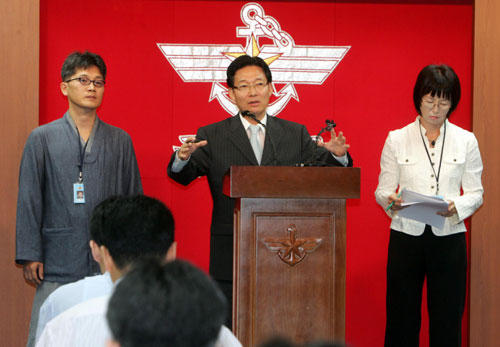
At a press conference on Monday, the Defense Ministry announced that a truth commission will investigate some of the darker episodes that took place during the decades of military or dictatorial rule in Korea. Eight episodes will be investigated in two rounds of investigations.

In an article misleadingly titled 'Panel to investigate four past military incidents in '70s-'80s' (only four?) the Korea Herald reports that
The panel, "Truth Commission on Past Military Incidents" consisting of 12 members - 7 civilians and 5 Defense Ministry - was launched in May as part of efforts to shed light on unjust history, a key agenda of President Roh Moo-hyun's administration. The panel aims to investigate questionable deaths and abuse that occurred during the military dictatorships of the 1970s and 1980s.

The chairman of the panel visited the Defense Security Command yesterday, which retains records of past military events. The DSC announced that "We will actively support the disclosure of reports that the Truth Commission Panel requests, in order to uncover the truth about past suspicions".
A Yonhap article titled 'Military to review brutal crackdown on 1980 pro-democracy revolt' adds this comment:
"We aim to clearly disclose before the public the past wrongdoing committed by the military so as to prevent the recurrence of such misconduct and lay the foundation for the military to receive greater public affection and confidence," said Lee Hae-dong, head of the panel.
(The Korean version of this article has a different photo than the one above - that of Chun Doo-hwan speaking as head of the Joint Investigation Headquarters, which was formed to investigate Park Chung-hee's murder - and from where he was able to maneuver his way into power). The Chosun Ilbo, in an article titled 'Defense Ministry to Review Gwangju, 1979 Coup', continues:
"We considered whether the incidents occurred in the process of the military intervening in politics and whether massive violations of human rights took place against civilians” when determining which incidents to investigate, a commission member said.

The first round of investigations will look into the rise of the Chun Doo-hwan regime, including the 1979 coup, the May 17, 1980 declaration of martial law and the May 18 democratic uprising in Gwangju the same year. It will also look into the Samcheong Re-education Program, the so-called "Nokhwa” or “greening” project of recruiting college activists, and the Silmi Island revolt.

The second round will look into the government's Oct. 27, 1980 clamp down on Korean Buddhists, the forced merger and closing of media companies and firing of journalists, military investigations of civilians during the Chun and Roh Tae-woo administrations, and suspicions of trumped-up spying charges against Koreans in Japan.
The Herald article provides further descriptions of a few of these incidents, like the 'Nokwa' project,
the alleged forced conscription of student activists by the former military regime led by President Chun Doo-hwan...Chun allegedly recruited around 1,100 students whom he considered dangerous to his regime between 1980 and 1984. They were brainwashed or forced to spy on other student activists or activist groups, and ordered to collect information about anti-state activities pursued by fellow students. The panel will probe into who led the conscription and how 6 students died in the process.

Another military abuse under investigation includes the so-called 'Samcheong' incident in which the government arrested around 60,755 alleged criminals in 1981, in the name of uprooting disorderly elements from society. These people were forced into labor, assault and suffered human rights violations. Around 54 people are known to have died in the process, but human rights committees suspect the death toll is much higher.
Of the Silmido incident, (which is well known due to the second most successful film in Korean history being based on it) the Herald tells us that "the panel will attempt to identify the secret agents and uncover the process of their recruitment and where their bodies are buried."

Though the focus on Kwangju will be to determine who gave the order to fire, the Chosun Ilbo article ends by telling us that
The incidents involving the Chun Doo-hwan regime could prove a hard nut to crack. In the case of the bloody crackdown in Gwangju, hearings on the matter in 1988 failed to establish who gave the order to fire, and if those involved continue to keep their mouths shut, the probe could hit a brick wall.

The truth commission also lacks the authority to force figures to appear for questioning and will thus find it hard to investigate key figures in Chun's "New Military Group."
This website has some information about the 1988 hearings on Kwangju:
In August 1988, opposition legislators managed to form the Special Investigative Committee of the May 18 Kwangju Pro-democracy Campaign within the National Assembly, to conduct an inquiry into the government cover-ups. The committee found that 77 of the officers who had led the crackdown against the uprising had been decorated.

In 1989, the National Assembly investigations into the Kwangju uprising took place on a full scale when the hearings of the Special Investigative Committee opened in the spring. The victims of the military crackdown and the army officers involved were summoned for testimony. Their testimony was televised, live. The army officers had become senior officials in the government. Chun Doo-hwan was also summoned, and he testified on December 31. Due to its limited powers, the Committee could only publicize the proceedings, not prosecute those responsible. Attempts to introduce laws to punish the perpetrators of the Kwangju massacre were unsuccessful due to the power of the ruling party in the National Assembly.
From the wording of the above paragraph, ("summoned for testimony") it sounds like the 1989 hearings did have the authority to call people to testify, even if they kept their mouths shut or lied on the stand (This book picks apart some of their testimony by comparing it with contemporary military records regarding Kwangju). This testimony and the existing documents were compiled into the 'Complete Collection Of Historical Records of The Kwangju May People's Uprising' (광주오월민중항쟁사료전집) back in 1990. So while this is not the first time Kwangju has been investigated, questions linger, especially considering Chun Doo-hwan and Roh Tae-woo were not found guilty of murder during their 1996 trial. Existing evidence suggests that the orders were coming from the top, but there is no way to prove this. If they are actually hoping to answer the question of who gave the orders this time, when they failed to last time, you have to wonder why they made this commission more toothless than the previous one.

The other incidents should be investigated as well, expecially considering the numbers of people involved in the Samcheong and Nokwa cases, and the number of deaths that resulted. Of course, the Defense Ministry isn't the only government ministry investigating its past right now. The Yonhap article reminds us that
In a separate development, the National Intelligence Service began probing past questionable incidents involving its former agents [something it announced back in February]. The cases include the death of its former chief Kim Hyung-wook in 1979, the kidnapping of then opposition leader Kim Dae-jung in 1973, the mid-air disappearance of a Korean Air passenger jet in 1987 and the execution of eight student activists in 1974, only 20 hours after they were sentenced to death [which has become the basis for both a novel, and perhaps a future Park Chan-wook film].
(The related articles to the right of most of the above linked articles are well worth reading, especially regarding the investigation into the death of the former KCIA head.)

A lot of people were victimized in the historical events which are being investigated by the Defense Ministry and the NIS, and I imagine these people, or their families, might be relieved to see the names of their former torturers, or the names of those that caused their family member's deaths, brought to light. Not everyone agrees that this is a good idea, at least judging by the debate a post on this subject by the Lost Nomad has caused. I think it is, as these events have been hidden from the public for too long. Hell, it took a movie being made about Silmido to really bring that incident into the public eye, and the Defense ministry panel now wants to learn who the Silmido operatives were and where they were buried. Whether such documents exist after 34 years is another question entirely, and is another reason to hold these investigations now. The most recent events occurred 20 years ago, and waiting longer will just make it more likely that those who were making the decisions will no longer be around. Not that these people will necessarily talk now, but in 10 or 20 years it may not even be possible to try. Of course, considering how toothless these commissions seem to be, they may not even be able to accomplish some of the simpler tasks they've set out for themselves, especially if they have to rely on possibly nonexistent documents.

As a postcript, I should mention that there is another government commission reconsidering the past, which is referred to in this August 18th Joongang Ilbo article titled 'Two leaders of 1980 strike deemed freedom fighters':
On Monday a government commission made the controversial decision to recognize two leaders of a violent 1980 labor strike as freedom fighters. The two men, Lee Won-gap and Shin Gyeong, led a four-day miners' strike known as the Sabuk Incident. That strike, during which hundreds of miners briefly seized control of a Gangwon province town, is remembered as having launched nearly a decade of strikes under the military dictatorships of the 1980s.

"The Sabuk Incident started out as a labor strike, but because it was carried out under martial law, it can be seen as an act of resistance against the authoritarian regime," said a staffer for the Commission for Restoration of Honor and Compensation for Democratization Movement Activists.

The commission, which was launched in 2000, is charged with investigating the history of the pro-democracy movement since 1969, redeeming the reputations of activists who were unjustly charged with crimes and providing financial compensation when merited. The commission's nine members are appointed by the president, the National Assembly and the chief justice of the Supreme Court. To date, the commission has awarded 22.4 billion won ($22 million) in compensation.

Some observers have said extending its mandate seems more likely since President Roh's speech Monday, in which he called for changing the statutes of limitations for crimes committed by the government.
(Oranckay makes a mention of this call for the change in the statute of limitations here). While designating striking miners as freedom fighters may push the limits a little (but I'll agree with it, considering the influence of their struggle), I don't know what to make of the attempt to rehabilitate Kim Jae-gyu (Park Chung-hee's assassin) as a martyr for democracy. I'm not sure if being 'not as bad' as everyone else makes you a democratic martyr, especially when we have only Kim's word that this was his intention.

Friday, September 02, 2005

Comic World is Un-Korean

A couple of my students went to Comic World on Independence Day weekend (yeah, I'm two weeks behind. I know.) One of them was nice enough to buy a Simpsons button for me (as I have a habit of bringing up pertinent Simpsons episodes in class), while the other introduced me to the manga Death Note (the first 6 volumes of which can be found here; the rest are here - but be warned that it's addictive...).

While both of these girls mentioned that there was a great deal of cosplay (costume play - where people dress up like their favourite characters, for those not in the know), the girl who bought me the Simpsons button told me that 'the netizens were angry' about this. Why, you may ask? Well, one of the days upon which Comic World took place was August 15, Independence Day. And of course, as most people know, manga (manhwa in Korean) are primarily Japanese-made. Thus, dressing up as Japanese-created characters on a day celebrating your country's independence from Japan is just not very patriotic. And, perhaps, looking at these people to the left dressed as samurai, I can perhaps understand the sentiments of some of these people. At the same time, it's just kids having fun, and perhaps its refreshing to see people not concerning themselves with the past so much in Korea - or is it an example of the younger generation's self absorption? At any rate, this post over at Daum's KIN board (KIN, when turned 90° to the right, looks similar to 즐, a slang term in Korean meaning something akin to 'Piss off') has just the right antidote - people dressing up in traditional Korean garb, as Korean soldiers, and of course, as An Jung-geun (who assassinated former Japanese Prime Minister Ito Hirobumi in 1909). My Korean skills aren't that great, but basically the message is calling on people to be more patriotic and realize how shamefully they are behaving.

There are other posts of this type here and here. (If anyone wants to fill me in a little better on what's being said, feel free to).

Worth mentioning, though, is that these comics are introducing a great deal of Japanese culture to Korean kids, and I'm not talking about kimonos and samurai swords. Comic genres in Japan run the gamut from romance, to action, to historical, to hardcore pornography. And in that last genre you find a great many fetishes like rope binding and ritual scarring. The sullen, always bored 6th grade girl who introduced me to Death Note talked about her friends and their piercings, how they'd seen Japanese websites featuring photos of scarification, and how they'd scratched their names into their arms with knives. Whether she was just trying to get attention or not, she was obviously aware of the existence of this stuff at a rather young age. A lot of popular or underground culture in Japan is extreme in so many ways, but such extremity is found only in very small subcultures in other countries. Partaking of the cultural products of other cultures can provide an opportunity to learn and challenge existing perceptions. The internet doesn't place any age limits or filters upon this however. While I don't think the 'toe the nationalist line' message of the netizens criticizing the Comic World goers really had this in mind, it's probably still worth saying.

It is Happening....Again

But this time it's on a New York subway.

And no, this time it's not dog poop, it's a guy masturbating in front of a woman on the subway, who decided to put her camera phone to use (and in another link to Korea, it was , as The Register notes, a 1.3 megapixel Samsung P777) and then post it on the internet. I found this by using my nifty statcounter account to see what sites had been linking to my blog, and found a link to said internet site - but had I waited another day, I would never had known what the fuss was about, because as of today the photo (and all the following flamed-out comments) has been deleted. Well, ok, the photo is gone, but Google's cache function has ensured that the text can be found here.

Suffice to say, eventually a suspect was tracked down (due to complaints by other women who had also witnessed the man's public wanking) and it was found the man in question co-owned a chain of 3 raw food restaurants in NY. Of course, netizens quickly found pictures on the resturaunts' website and posted them, and a few people (who were shouted down) argued that maybe posting people's pictures like this online was an invasion of privacy. It made a New York newspaper, as reported here, and today the suspect turned himself in. This is why the original photo was deleted: "This man needs serious help and when he does the right thing by turning himself in, then I will take down this image," the poster said in the original post.

While I think that, had this woman not taken the photo, the man would never have been arrested, the fact that his face has been published all over the internet may have had some unexpected consequences. One that stands out is that the name of the chain of restaurants, co-owned by his ex-wife, has been splashed all over the internet, as has his ex-wife's photo. While what the photo-taker did was likely a necessary thing (the photo could have aided the police), putting it in such a public forum has likely ruined the name of this restaurant, as well as his ex-wife (an innocent person), a result the photo taker never imagined. While I certainly give her credit for removing the photo she posted, it hardly matters, as, due to Google's cache and the actions of other netizens, that photo will never disappear. I didn't read all of the comments by a certain poster, but one (for which he was villfied by other commenters) in which he said, to paraphrase, (as they've all been erased) 'one day the winds of karma will shift and it will be you on the receiving end of one of these internet barrages, and then you may reconsider what you said here today.'

I can't help but agree with him. Don Park's quote, from a comment (#13) on his original Dogshit girl post, that "Attention cuts; retention bleeds", came to mind immediately. His quoting of a Korean netizen's comment, "Thanks to technology, we are able to build a better society in which citizens are the police, prosecutors, and judges," and his response to it - "This problem will visit us rest of us with more immediacy in the near future", were rather prescient. Much of the speculative commentary which followed DSG (an event in South Korean cyberspace, rather removed from the US), is now very much worth another read. This time, it's happening in a place where this commentary is much more pertinent.

And a damn good cup of coffee and a piece of cherry pie for those who caught the reference in the title...