Thursday, May 29, 2008

Shaky foundations

[Update, June 4 - at bottom]

At 2:00 on Tuesday I heard the sirens of a civil defense drill and looked out to see the 'beige guards' occupying one of the main intersections in Banghwa-dong. I found this odd, as they usually don't stop traffic at that intersection and also because it was May 27. Usually such drills take place on the 15th of the month.


These drills strike me as interesting because it's one of the few times that this society intentionally stops the flow of traffic and people - not just slow down, but actually stop. It's also interesting to see people generally obey the rules (though I have seen the guards in their vehicles swerve and block traffic from moving).


When the drill was over one of these flags was left behind. I couldn't help but think it'd be handy for crossing the street when you're late and don't want to wait for the traffic signal.


It wasn't until I read Brian's post that I realized this was an earthquake drill. The Chosun Ilbo "Apartment Republic" cartoon he posted sums up one of the possible problems that could befall Korea in an earthquake: apartments tumbling down like dominoes. When things like this happen without earthquakes, there's good cause for worry:


The collapse of the Seongsu Bridge on October 21, 1994.


The collapse of the Sampoong Department Store on June 29, 1995.

While I'm sure these events led to new laws regarding the construction of buildings, whether these laws were enforced would be a good question.

I couldn't help but note Korean-Japanese director Sai Yoichi's choice of words in an interview (via Korea Pop Wars) when he described Korea's film industry:
As a result of the government’s unified effort to take things to new level, films became eligible for corporate investment. Because they built film into a huge entertainment industry in an unduly short period, it’s come to resemble a structurally unsound building. Its foundations are wobbly.
I've looked before at how not only revisionist history but also the need to recoup larger and larger budgets when making movies has affected the quality of those movies, particularly movies about 20th century history. Though Korean films are struggling against American films at the box office right now (apparently American beef imports are the only American import than is of import at the moment), Kim Ji-woon's The Good, The Bad, The Weird looks amazing and should do well.

Back to Brian's post, he finishes by mentioning that traffic safety drills might be of more importance to students than earthquake drills, as traffic accidents kill so many young people, especially vehicles hitting pedestrians. One such case from last year comes to mind. It was mentioned in passing in the Korea Times as one of the top searches on Naver that week. More information can be found in this ohmynews article.

At 3:24 pm on October 23, 2007, in Anyang, three female 3rd year high school students, Ms. Lee, Ms. Mun, and Ms. Park, were killed when 42 year-old Mr. Yun plowed into them with his minivan.


The Pyeongchon Technical High school students, who had been preparing for the school festival, died on the spot as other students looked on.


Yun had consumed soju at lunch, and had a blood alcohol level of 0.056%.


Yes, Ajeossi's ruin everything. Especially when they're drunk. And nobody chooses to respond to them.

Of course, if you were going to teach children about traffic safety, say in school, the message would have to be reinforced fairly frequently - the once a year 'crackdown' approach would be rather insufficient. Just yesterday I saw some of the students in one of my classes holding the door closed against the efforts of the other students to get in. I decided to show them what could happen to their fingers if they played with doors (a lesson I learned when I held a door closed as a kid and tore a fingernail off my neighbour). I took them out into the hallway, showed them a pencil, and then placed it beneath one of the hinges and closed the door. Crunch. When I saw the look on their faces I hoped I'd gotten through to them. About 30 seconds after I left class I looked back to see that they had pinned a boy's foot between the door and frame trying to force it closed.

[Update - From this Chosun Ilbo article:
According to the Ministry of Land, Transport and Maritime Affairs on Tuesday, an average of 3.34 people died in traffic accidents per every 10,000 cars in Korea in 2006, more than double the OECD average of 1.53. Korea's figure dropped slightly to 3.08 last year, but it still remains high.

In 2007, 6,166 people died in 211,662 traffic accidents in Korea, for an average of 16.9 deaths everyday on the roads. The accidents happened most frequently in the evening, between 6 and 10 p.m., when 24.4 percent of the total number of accidents, or 1,505 cases, took place. Weekends were especially hazardous, with 14.8 percent, or 913, of the fatal accidents happening on Fridays, and 16 percent, or 989, on Saturdays.]

Monday, May 26, 2008

Kwangju, May 20-21, 1980 - Forcing out the troops

I was going to post some colour photos I found the other day of the confrontation in front of the provincial hall on May 21, 1980 that ended with troops opening fire on Kwangju's citizens, but then, after I thought of adding some commentary, the post turned out much longer than I'd planned. I suppose as a prelude to this post reading my posts about those who were randomly beaten by paratroopers on May 18, as well as the escalation of violence over the first three days of the uprising might be helpful, as they chronologically lead into this post.

May 20 and 21 saw the scattered protests of the previous two days become larger, despite the fact that for the first three days, more troops were sent into the city each day; by May 20, 3000 paratroopers were in the city. And yet the citizens of Kwangju would not only stand up to them, but by the evening of the 21st, force them out of the city, though at great cost.

Jung-woon Choi's essay 'The Formation of an "Absolute Community"' from the book Contentious Kwangju describes the events of May 20:
[On] the morning of May 20... a corpse was discovered in front of the Chonnam Brewing Company. Enraged citizens gathered in front of the Taein Market and began to demonstrate. In the afternoon, large numbers of citizens - men, women, the elderly, the young - slowly began to come in from the outskirts of the city and gathered in the downtown area. A large demonstration shortly ensued. At approximately 2:30 pm, paratroopers began firing flamethrowers at the Seobang intersection. Several citizens were burned to death on the spot. The citizens became extremely agitated. Around 3 pm, the Seventh and Eleventh Brigades were redeployed in the downtown area. An all-out battle between the citizens and paratroopers broke out.[...]

In front of Hwani Department Store on Geumnam avenue, a student gave a speech, led in chanting slogans, and read from leaflets. When it became difficult to hear the speaker's voice, someone began taking up a collection to purchase a loudspeaker, and a sum of 400,000 won was collected on the spot.
Choi marks this as an example of the beginning of an "absolute community", where "there were no private possessions, and citizens did not differentiate their lives from that of others." Choi would go on to examine this further in his fascinating book The Sociology of the Kwangju Uprising (오월의 사회과학, 1999), translated into English as The Gwangju Uprising. Whether you subscribe to his description of an absolute community or not, it should be pointed out Kwangju was a relatively small city where, within a few days, almost everyone knew someone who had been hurt by the paratroopers, and because of this many began to take part in demonstrations or support those who were demonstrating. On May 20, the individual, separate protests that had been appearing around the city for the past three days began to coalesce into larger and more organized demonstrations, with people sharing food and building barricades. The most obvious example of this developing community spirit was the fact that taxi drivers mobilized a vehicle demonstration, using their means of livelihood - their cars - to protest with, likely knowing full well that they would not be left unscathed.

That afternoon, taxi drivers in front of Kwangju station had traded stories of the abuse other drivers had faced while trying to help injured demonstrators get to hospitals, and decided to take part in the demonstrations. The organized the other drivers and 200 taxis followed several buses downtown, arriving near the provincial hall around 7:00.
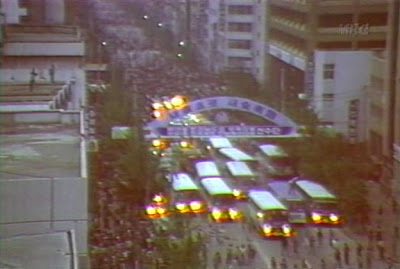
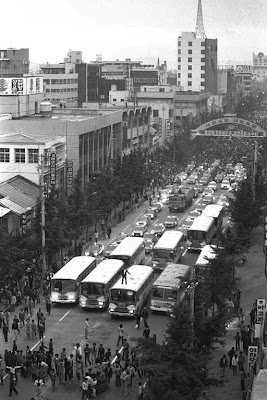


At that point the demonstrators, who thought at first they might be army vehicles, were emboldened by their presence, and joined the drivers.
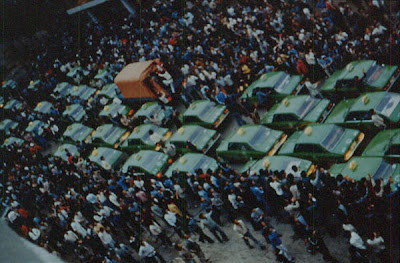

The paratroopers began to build barricades, and once the protesters reached the barricades, the paratroopers fired tear gas and charged, smashing in windows and revealing how precarious the drivers' position was, being unable to easily flee their vehicles.


As the deleted section of a May 22 Donga Ilbo article described it,
A moment later, amidst thick tear gas, the demonstrators, with buses in the lead, fought hand to hand with the soldiers, so that cries of pain and shouting were unceasing in the Chonil Broadcasting Company area near Kumnamno. When this clash ended after 20 minutes, there were bloody and unconscious casualties with broken heads and fractured limbs here and there among the buses, trucks, and taxis. Two young women in their twenties, dressed in guide uniforms, were wailing and holding a man in his thirties in a driver's outfit with a broken head. The choked voices of people carrying casualties asking to "quickly send ambulances for the critically injured," told of the atrocity of the bloodshed.
Choi points to the drivers' participation as a unifying moment. Encouraged by the drivers' solidarity, and urged on by street broadcasts, more and more angry citizens gathered in the streets, hemmed in the paratroopers in several locations and began attacking the soldiers' barricades with cars, some of which were set on fire. In front of the Regional Labor Administration, four police officers were killed when a car driven by a protester plowed into their lines. This may have been due to the driver being blinded by teargas. While it may seem a convenient excuse, these were the only police killed during the uprising, and police were rarely the targets of the citizens' rage, which was almost exclusively reserved for the paratroopers. By the end of the night, MBC and KBS were set on fire (its often said by the demonstrators, but the possibility exists that the soldiers did it, not wanting the protesters to gain access to the facilities). The tax office also went up in flames. These places were abandoned by the paratroopers.


The presence of 30,000 demonstrators who were increasingly fighting together, led to this, as described in Choi's book:
After midnight, paratroopers and police began to use a respectful form of speech through speakers, instead of the high-handed, commanding tone they had used before. They said, "Please return to your homes were your parents and siblings are waiting. At your homes, your families are worried about you because you have not come home yet."
Another battle took place near Kwangju Station, which the military was determined to hold because of its importance for the transportation of troops and supplies. Some protesters tried to charge the soldiers with cars, leading to the first large scale shooting incident, as related by a paratrooper, Kim Yong-jin, who arrived there as a reinforcement sent from the 3rd Brigade headquarters at Chonnam University:
While advancing, a major, an operations staff member of the 3rd Brigade, held up a gun shouting: "I will shoot you to death if you retreat," so that we reached the area near Kwangju Station in terror. When we arrived at Kwangju station, soldiers were standing in a single line in front of the train station building, shooting ceaselessly, and near the fountain buses and trucks carrying citizens had driven into the fountain while charging at the soldiers. One sergeant, a vehicle driver of the 3rd Airborne Brigade, died after being run over by a truck, and about 20 citizens were abandoned near the fountain, drenched in blood.
Many of the demonstrators that had been arrested over the past three days were held in a gym at Chosun University, where they were being beaten regularly. Hearing of this, 3000 demonstrators headed to the university to free them, using buses to charge the gate. The soldiers successfully defended the university, but had to use hand grenades to do so. By daybreak the paratroopers could be found only on the two university campuses and at the provincial hall.

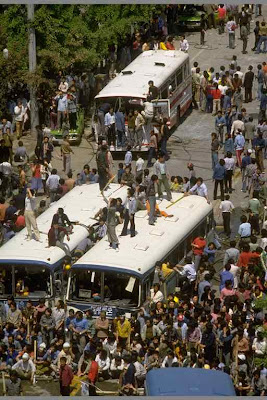
These photos may give some idea of how intense the fighting was.


Suh Chung-won, a Chosun Ilbo correspondent, describes his experience of the next day, May 21:
I heard that three [actually two] bodies had been found when the military evacuated Kwangju Station. The discovery of these dead had outraged the demonstrators[...] At 6am approximately 1000 protesters were gathered in the MBC building area, demonstrating at the intersections on Gumnam-ro. [...] Demonstrators appeared pushing a bicycle cart with two bodies on it. The citizens began to gather once more, as early as 7am.


The mood seemed a bit calmer. A group of demonstrators then appeared with trucks, bringing bread. They distributed food among the people. Then at about 8 am, Chun Ok-ju, thirty two, a woman leader well known at that time, made a speech. She urged the citizens to mourn for the dead and maintained that the demonstration was righteous. She proposed a meeting with the mayor of Kwangju.
Yi Se-yeong, who had taken part in demonstrations, but stayed home the 20th, described the situation on the morning of the 21st:
Wherever we went, women lifted seaweed-rolled rice and rice balls to our car, telling us to fight with courage. Sometimes they wiped our faces, smeared with tear-gas smoke, with wet towels. Women, in neighborhood units, prepared food and distributed it to us. From stores, people tossed us soft drinks and pastries.


Suh Chung-won continues:
From 9 am people gathered in larger numbers on Gumnam-ro. Meanwhile, some demonstrators had obtained armored cars and jeeps from the Asia Motors factory in the Kwangju industrial complex. They drove the vehicles into the downtown area around 10 am. Using the armored vehicles they began to press back the army lines. They pressed towards the Catholic center. Pepper fog and tear gas were useless to hold them back. From 10:30 am, as on the previous day, the demonstrators squeezed in toward the Provincial Hall from three sides.


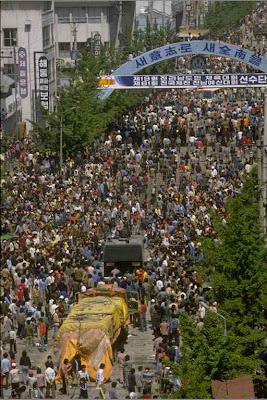
Cho Sung-ho, a Hanguk Ilbo reporter, noted that
About 9 am a crowd of about 10,000 people confronted the paratroopers, protesting the atrocities committed by them between May 18 and May 20. By 10 am the crowd had swelled to 20,000 people or thereabouts.

On the roads leading to Gumnam-ro there were many people struggling desperately with the paratroopers. The latter fired tear gas indiscriminately.[...] Police helicopters announced overhead the words of the governor of South Cholla province and the Mayor of Kwangju - the region's top two dignitaries. Both called for order, using slogans such as "Citizens, let us save Kwangju!" Their announcements simply were not heard.
Suh Chung-won continues:
At noon a rumor began to spread that the demonstrators had occupied the Provincial Hall. Accordingly, the demonstrators at the Catholic center moved forward about 200 meters, with the armored cars and trucks leading the way.


They came within 10 meters of the army defense lines in front of the Kwangju Tourist Hotel. [...]

It was 12:30 pm.[...] A that moment a commandeered armored personnel carrier with a young man standing on it headed straight towards a line of soldiers in front of the Provincial Hall. He was shot and fell, as did several soldiers [one soldier died when the tracked army vehicle in front of him reversed over him]. That triggered an outburst of tear gas fire. For a moment, the demonstrators hesitated. The troops retreated back towards the fountain in the middle of the square in front of the Provincial Hall.
Kim Yong-taek, of the Donga-Ilbo, wrote that
I was looking down on the square with Chonnam provincial governor Chang Hyong-tae from the third floor corridor of the Provincial Government Building, when ammunition was being distributed to the paratroopers in front of the fountain at around 10:10 am. ... It was a little before 1 pm when an armored vehicle driven by demonstrators charged at the paratroopers' defense line, and the time when the demonstrating vehicle [a bus], which was allegedly shot at by the paratroopers, rushed in was not much later, at around 12:58. Straight after, at 1pm sharp, the Aegukka was suddenly heard, at which point the shooting began.
If there is one thing the many accounts of this moment agree on, it's that the shooting coincided with the playing of the national anthem. At a meeting of reporters in Kwangju, several reporters noted what they saw next:
Reporter C: I saw, right in front of me, a person who was hiding behind a wall. He was shot in the neck and died on the spot.
Reporter D: Yes, the paratroopers are deliberately shooting people from rooftops. At 2 in the afternoon they started shooting at anything that moved. Not even a shadow moves around Provincial Hall right now.
American missionary Martha Huntley, who worked at the Kwangju Christian Hospital, which was neither the largest nor closest hospital, describes the scene that followed:
In two hours our hospital alone received 99 wounded and 14 dead. Among the wounded was a 9 year old boy who was shot in the legs. Our first dead was a middle school girl; the second was a commercial high school girl who had donated blood at the hospital 15 minutes earlier and was shot by the troops when she was being returned home in a student vehicle. We received 5 patients with spinal cord injuries, many of whom will never walk again. One was 13 years old. We had patients who lost eyes, limbs, and their minds.
The experience of a nurse at that same hospital can be found here.

As Suh Chung Won continues,
Thereafter, from 3:40 pm onward, the situation was indistinguishable from wartime. Some demonstrators, who had obtained weapons, started shooting back at the soldiers. This was street fighting. At 4 pm I received a message saying that demonstrators had acquired weapons from an armory in Hwasun and were heading for downtown Kwangju in trucks.[...] As was revealed later, demonstrators were flocking back toward downtown Kwangju with weapons they had acquired in such places as Jangsong, Naju, Hwasun, and Damyang.
As to why it was necessary to leave the city to find weapons, Suh notes that "the army had already taken away all the weapons from the Provincial Hall, from police stations, and from police strong points the day before."

Peace Corps Volunteer David Dolinger described the scene in Kwangju after returning to the city on the afternoon of the 21st.
As we neared downtown I heard a helicopter approaching, with its approaching sound I saw the people in the streets running for cover. I was told that they, the troops had been flying over since the morning and shooting into any crowds that they spotted. I then saw it for myself. As the helicopter flew over downtown I saw a soldier lean out of the side door and fire his gun. On Thursday I would visit the major hospitals where I would see those wounded by the fire from the helicopters. All had wounds of the upper torso with the projectile’s trajectory going downwards.

When I reached downtown I saw the side streets of Geum Nam Ro jammed with people. The martial law troops were massed in front of the Provincial Office Building.

From Geum Nam Ro sporatic gunfire could be heard. As I neared I saw that the people were no longer venturing on to Geum Nam Ro but were huddled in the side streets peering around the edges of the buildings. When I peered around the corner I saw a tank parked in front of the Gwangju Bank opposite of the CheIl Bank. The troops were also shooting up the street so as to keep everyone off of Geum Nam Ro. In addition, the machine gun on the tank was being fired. The gunfire was sporadic and did not seem to be directed at anyone.
What Dolinger saw may have been the paratroopers preparing a line of retreat.

Cho Sung Ho described the end of the battle:
At 4:40 pm, demonstrators finally set fire to their trucks and pushed them forward. Paratroopers who had held out now retreated hurriedly. (The paratroopers looked as if they were retreating under attack, in fact they had already been ordered to retreat by 4 pm.) Demonstrators finally entered the Provincial Hall. It was 5:30 pm.
Another large battle occurred in front of Chonnam university, where, as at Choson University, many of the arrested demonstrators were being held. Some 50,000 demonstrators fought with paratroopers at the front and rear gates. When commandeered police tear gas vehicles approached the paratroopers, the soldiers opened fire, killing several demonstrators and wounding many more.

The Military retreated from the center of the city. The 11th and 7th Brigades retreated to Chosun University and then to Jiwon-dong southeast of the city, while the 3rd Airborne Brigade retreated from Chonnam University to the nearby Kwangju Prison, in the northeast of the city. As the troops left Chosun University in a convoy of trucks following armored vehicles, numerous people were killed or wounded when the troops opened fire at random (One such victim is looked at here).

As Linda Lewis notes, the 21st was
the bloodiest single day of the Kwangju Uprising. There were 62 official dead, most (54) killed by gunshot, the majority (66%) in the vicinity of the Provincial Office Buildings.[...] Most of the casualties on May 21 were unarmed citizens, shot down as troops fired repeatedly into crowds of demonstrators gathered downtown and in front of the Chonnam University gate.
Once the troops were on the outskirts of the city, more than 50 people would die at their hands, something I'll look at soon[er or later]. Six days after retreating from the city, the military would return, ending the uprising.

Wednesday, May 21, 2008

Photos of the Uprising Anniversary in 2005

Brian's post about his trip to Kwangju this year for the anniversary of the uprising has prompted me to post a few photos from my trip there in 2005, which I looked at briefly here. I arrived on May 21, and as it was a Saturday, it was the day of street celebrations.


It was, at that time, as far as I saw, purely a celebration of the uprising, and the event was one based on civic pride. A few of the high school students manning the display above told me their fathers had taken part in the uprising. Below is a comic portraying the events of the uprising, namely the troops firing into the protesters and the formation of the citizen's army:


There was a re-enactment of the uprising (of the same shooting, in fact), which I looked at in the post I mentioned above. Here are the buses used in the re-enactment.


The event that year was called 'Red Festa', a name which seems designed to give people like Baduk an aneurysm. I wonder if it was influenced by the 2002 World Cup "Be the Reds" T-shirts? I really don't know. I didn't see any other political causes linked to the uprising anniversary.


The mural above is obviously based on the picture below.


A concert with pop and hip-hop performers began while images from the uprising played on the screen at right.


The next morning we stopped by the memorial in front of the provincial hall, where the final battle was fought between the citizens army and the national army.


It looks to me like colonial-era architecture.


Then we went to the 518 Cemetery. Not being the 18th, it was much quieter than when Brian visited.


Again, my views of the visit were dealt with in much more detail in this post.

Tuesday, May 20, 2008

Mad Cowangju

Do make sure to read Brian's post about his trip to Kwangju for the 28th anniversary of the Uprising, which turned out to be more about... something else.

It's quite different from my experience there three years ago.

Links to essays about the Kwangju Uprising

[Update - The May 18th Memorial Foundation website has an E-book titled "We Saw" with lots of photos that can be found under "Information and Resources", and then "Publications". What's notable is that the dates and photographers are listed with them.]


I've posted a blibliography of the Kwangju Uprising before (though it needs to be updated), but I thought I'd look at some other essays I'd recently found regarding the Kwangju Uprising.

Again, I'll start with Tim Warnberg's 1987 article "The Kwangju Uprising: An Inside View," which is an excellent account of the uprising by a Peace Corps Volunteer in the city at the time. It can be downloaded here (scroll down to bottom left and wait 24 seconds for the 'download' button to appear).

Neoliberalism and the Gwangju Uprising by Georgy Katsiaficas, uses declassified cables to examine how the U.S. pressured the Korean government to liberalize its economy (instead of its political system) in the wake of the Kwangju Uprising. I think it's useful to look at the economic motivations the US had for supporting Chun Doo-hwan, especially when looked at alongside security and geo-political considerations. The essay focuses only on the economic considerations, however, and tries to pin almost all of the negative things Chun did in 1980 (firing and imprisoning thousands of people, the purification camps, etc.) on the requirement of American businesses for a "stable structure" before investing. In my mind there's a little too much coincidence and not enough causation proven in the essay.

During the uprising, I think that Chun did his best to make it look like the US was supporting him. For example, he agreed to distribute fliers with the US position (calling for calm on both sides) in Kwangju, but instead broadcast that the US had approved the initial crackdown. He also asked the US to allow him to move the 20th division to Kwangju when it was not necessary (it had been removed from CFC control on May 16, when General Wickham was in the US) . With this in mind, I'm interested in reading Donald Sohn’s essay “Chun Doo Hwan’s Manipulation of the Kwangju Popular Uprising”, which can be found here.

Mark Peterson wrote about a meeting between US citizens in Korea and the embassy in 1980 where Horace G. Underwood warned that “Chun is wrapping himself in the American flag. If the United States doesn’t do something about it, it will have ‘hell to pay’ in the future.”

I couldn't help but think of this quote when I saw a powerpoint presentation Katsiaficas did. Though it uses some quotes in misleading ways, it also has scans of some of the cables Ambassador Gleysteen sent to Washington. I found one of them very interesting. On June 6, ten days after the end of the uprising, he wrote
US businessmen are cautious over the long-term stability of the ROK but less concerned over democratic development. If the military leadership can develop an apparently stable structure and reinvigorate the economy, then US business and banking circles will be prepared to go back to business as usual.

The missionary community, in contrast, is acutely depressed by recent developments, concerned over the possible mistreatment of the numerous people arrested, and critical – often bitterly critical – of the US for not having in some way prevented these developments. They are quick to bring to the embassy tales of rising anti-American sentiment, are not taken with moves we have already made, and cannot be counted on for support in our difficult maneuverings over the next few months. More numerous and more vocal than those of the business community, we would expect that complaints reaching the department will be heavily weighted on the side of the church-related American residents of the ROK.
In other words, the embassy considered the missionaries, who were warning them of rising anti-Americanism, to be a pain in the ass. But hey, the Japanese in Korea found American missionaries to be pains in the ass as well. Underwood turned out to be very correct.

Things would not be helped by having policy analysts for the Heritage Foundation like Daryl M. Plunk writing stuff like this in September 1985:
Given the extent of the insurrection, the death toll was remarkably low--a fact that reflects the ROK government's efforts to minimize casualties. Those who continue to distort what happened at Kwangju should have their motives questioned. They seem determined to prevent the wounds from healing and to drive a wedge between the U.S. and the Korean people. The ROK government, by contrast, has been trying to put the Kwangju incident to rest and to heal the country's physical and emotional wounds.
"Those" who were continuing to distort what happened was likely aimed at American activists and academics. The paper above is interesting to read because it is obviously written during the fifth republic, lauding the military and blaming the protesters as it does (a view many people who are only vaguely familiar with the uprising continue to hold). The 1987 book The Kwangju Uprising: Shadows Over the Regime in South Korea provides one of the likely sources for the above paper, namely the "Report on the Kwangju Incident to the National Assembly National Defense Committee, June 7, 1985." For example:
Clashes between demonstrators and Martial Law troops led to misunderstandings. Groundless rumors fabricated by impure elements deepened regional acrimony, set apart civilians and troops, and led to arson, destruction, killings and injuries.

At last, demonstrators seized weapons and armed themselves with weapons, turning Kwangju into a state of lawlessness and anarchy as the city's administrative functions were paralyzed.
You know, it seems like something is missing. Like, oh, I don't know, the fact that the soldiers in the photo below would open fire with M16s on the crowd within an hour of this photo being taken?


It wasn't exactly "a state of lawlessness and anarchy" either, as stores began to reopen after the troops retreated from the city on May 21, and people volunteered their time or food to help feed the citizens' army. Others helped clean the streets and collect weapons, and most importantly, hundreds of people donated blood to the hospitals. As Betts Huntley, who worked at the Kwangju Christian Hospital put it on the 21st, the day of the shooting, "The hospital is swamped with people trying to give blood. They're turning people away."

Of course, the first day after the military retreat looked chaotic, and it was that time which was broadcast by the three US networks on May 22 (I've looked at those clips before). Note that the final clip - the NBC broadcast - describes “citizens wounded evidently at random by other citizens”. The correspondent was on the outskirts of the city with the army, and was likely given this piece of disinformation.

Last but not least, here you can find the essay "Women's Role and Experiences During the May 18 Uprising". Two of the stories found in the essay appear in this post, but one story, that of a high school girl who was the only survivor of an attack on a bus that left 17 dead, I've never read before. I'll look at that attack in more detail soon.

Monday, May 19, 2008

Bad taste

This Hankyoreh article last week noted that "There will be several events honoring the victims and embodying the spirit of the [Kwangju] uprising..." According to Brian, (in the comments here) what he saw in Kwangju this weekend "was pretty much wall-to-wall Mad Cow stuff [...] I was hoping for a little solemnity, but was surprised to see everything on the night of May 17th basically be a rally against American beef."

Not to be outdone , the Hankyoreh gives us this cartoon, from May 17:

President Lee Myung-bak is loading troops on the “Back to the Fifth Republic” personnel lorry, troops that include his attempt to seize control of the media and his “politics by public security,” that is, using the public security apparatus to enforce politics to his liking.

Chun Doo-hwan, who was president for the duration of the Fifth Republic, notes that he “never got in fights with the teenagers.”
Of course he didn't.


For those who don't know, these photos were taken in high schools in Kwangju after the end of the uprising. Here is a banner showing the faces and names of students killed during the uprising from my visit to Kwangju three years ago:


For the Hankyoreh to have Chun Doo-hwan say “I never got in fights with the teenagers” in a cartoon the day before the anniversary of an uprising which saw at least 20 teens killed, all in order to criticize Lee Myung-bak, is in pretty bad taste.

Sunday, May 18, 2008

The story behind photos taken in Kwangju in 1980


[Update: It turns out both of these (sets of) photos were taken by the same photographer, Na Gyeong-taek.]

Today is the 28th anniversary of the Kwangju Uprising. I'll post more later, but for now thought I'd look at two photos (or sets of photos) and the story behind them.

Last week Korea Beat posted a photo taken during the uprising, and mentioned that the person in it had been identified. This Newsis article looks at what happened. The photo is of real estate agent Choi Yang-min, now 54, who lives in Kwangju. On May 10, 1980, at the age of 26, he got married in Mokpo. On May 16 he came to Kwangju to visit his wife’s family, and met relatives there the next day. He was staying at a motel near Geumnamro, the street that would be central to the uprising. His sister, Yang-mi, then 24, was also visiting.

On May 18 he was resting in his motel when he heard slogans calling for the end of martial law being shouted outside. He saw people breaking apart sidewalk blocks and carrying them away, and thinking something must be happening, helped them. Then he went to a restaurant, which was surrounded by paratroopers. He finished his lunch quickly and went outside, where four soldiers attacked him with their clubs. He was bleeding from his head and his sister rushed out to help him and try to stop the bleeding. He was taken by the 31st Division but with the help of a friend was set free. He needed 27 stitches.

The photographer had titled the photo “newlyweds”, which was incorrect. In January Choi was at the 518 Cemetery and was surprised to see the photo, saying it stirred painful memories, but that since it started democratization it was worthwhile, though something like that should never happen again.

There were actually at least three photos of this incident. Note that his sister also has blood on her, though the article doesn't mention her having been attacked.


The Donga Ilbo looks at the photographer who took one of the photos which has come to symbolize the uprising, that of a man in his twenties being clubbed by a soldier. The photo was taken by Na Gyeong-taek, now 60, who then worked as a photojournalist for the Jeonnam Maeil. Even seeing this photo now is emotional, and he’d really like to meet the man in the photo, but has no idea if he’s alive or dead.

On May 19, 1980, Na was taking photos from the Jeonil Building on Geumnamro, and found it difficult to take photos of the gory scenes unfolding. His hands were shaking so much it was difficult to take photos. Then the man in the photo appeared with soldiers who were hitting him, though the man seemed to stand up to the soldiers. Na took the photos secretly before the man was put into a truck and taken away.

The photo couldn’t be published at the time due to censorship, so he passed on the film to a foreign journalist (he also talks about hiding it as well). The photo was published in 1987 in the book “Kwangju: Our Country’s Cross”. He had wanted to find the young man in the photo but never had any luck, though he has inquired around.


Oriental Lucy videos

I was wondering if Kim Choo-ja's version of 거짓말이야 might be on youtube and was surprised to find Oriental Lucy's version (uploaded by orienkorean).


I've seen Oriental Lucy live a few times now, and they always put on a good show. Below are some photos I took of shows on April 5 and April 26:


While I'm at it, here's the song Rorina Homestay:


You can also find 노란샤쓰 입은 사나이 (a Han Myung Sook cover) and Butterfly Kiss at youtube. The band's cyworld site is here, and if you feel like seeing them (or any other bands) live, have a look at the Korea Gig Guide.

Friday, May 16, 2008

A beef with online porn

The comparative risk of car accidents and mad cow disease have been mentioned before (here and here), but I found this direct, oblivious linking of the two issues in this article, which looks at reasons for youth participation in the Mad Cow protests, rather amusing:
Park Won-suk, deputy secretary-general of the People's Solidarity for Participatory Democracy, expressed different views regarding youth nationalism. Park said middle and high school students came out on the streets as they felt their health was under real threat. "They are wise enough not to be distracted by misleading information, and they make their own, right decisions,'' he said.

If the story was about automobiles, which are not closely associated with their welfare, Park said he did not think the students would participate in the protests.
Nah, it's not "associated with their welfare" at all:
Accidental injury is the leading cause of death for children ages 1 to 14 in Korea .

Motor vehicle crashes, which cause 46 percent of childhood injury deaths, are the leading cause of injury-related fatalities in Korea , followed by drowning, falls, suffocation and burns.

Every day, 37 Korean children under the age of 14 are killed or injured as pedestrians in road traffic accidents.
Of course, what really must be done to improve children's welfare is to declare war on online porn. Again.
The plan is part of the government's projects to fight against lewd material on television, the internet and elsewhere in order to prevent children from accessing sexually explicit content that sometimes leads to sex crimes.
It was only 13.5 months ago that the last war on online porn was announced. That war was in response to a numerous instances of gang rapes by middle and high school students against their peers, much as this latest crackdown is in response to the recent realization that elementary school students at a school in Daegu had been victims and perpetrators of rape for some time. The crackdown didn't work then, and won't work now; in fact, it has never worked, as Gord Sellar argues in a well-written comment here (do read the whole thing):
[A]n increase in censorship is not the way to go. As with the arguments over American beef, the real solution would be open, honest discussion and cultivation of dialog… “citizen deliberation,” as Lawrence Lessig describes it in terms of a free society. Instead of cultivating a free society where debate can occur, censorship and filtration strangles it at the roots. All of Korea’s modern governments deserve criticism in this regard, but Lee’s especially seems to be embracing censorship with a vigor unseen for years.
This shouldn't be suprising to those who remember his term as Seoul mayor. Remember his response to the punk band TV pants-dropping incident three years ago?
Seoul Mayor, Lee Myung-bak, weighed in on the issue, saying each ward should supervise obscene performances and make a blacklist of the acts who do them.

"Given that the accused said that indecent performances happen every night at clubs in the Hongdae area, the performance, which is not generally accepted, has not been regulated by the authorities," Lee said in a meeting with executive members of the Seoul metropolitan government. [...]

Lee, a member of the conservative GNP, ordered officials of the Seoul City government Monday to draw up a “blacklist’’ of bands whose performances are “decadent and not socially acceptable.’’ Those bands will not be invited to events organized by Seoul City or affiliated institutions, Lee said. The mayor also demanded that each district office strengthen control over possible decadent public performances.
Given his past affinity for "strengthening control", I don't think Lee's embrace of censorship should surprise anyone.

Thursday, May 15, 2008

Another brick from the wall.

A few weeks ago the merchants displaced (once again) by the destruction of the stadiums at Dongdaemun were moved into a new Folk Flea Market. Now the Korea Times reports on another step taken towards the new Dongdaemun Design Park.
Dongdaemun Stadium, the nation's first modern sports facility, is fading from Korea's sports history ― the demolition of the football stadium began Wednesday following that of the baseball stadium last month.

The former baseball stadium is on the right.

Built in 1926 during Japanese colonial rule, it was the symbol of Korea's modern sports, with various international matches and sports events held there until the Jamsil Sports Complex took over the role in the mid 1980s. [...] The aged football stadium was closed in March 2003 and used as a parking lot and folk market. Matches were held at the baseball stadium until recently, but very rarely.
Dongdaemun Soccer Stadium. Photo from here.
Ahead of the destruction of the football stadium, a Goodbye, Dongdaemun Stadium'' ceremony was held. Watching video clips featuring the stadium's past, present and future, city officials and some 30 former national football team members bade farewell to the sports arena. The dignitaries kicked footballs, the last ones in the stadium ― and the ceremony ended with the removal of its huge clock.

A video can be found here.

While on the topic of redevelopment, Kevin's Walk has photos of demolition and construction in another neighbourhood.

Wednesday, May 14, 2008

Branding the mad cow

(Modified from here.)

The above image may or may not amuse you, but there are other reasons to use Bart Simpson to make a point - mainly that cartoons are useful for communicating ideas quickly, precisely because they are often so removed from reality (why are the emergency instructions in the seat pocket on the airplane illustrated instead of using photos?). Here are two images with American flags. It's quite easy, without knowing anything about the characters, to have some sense of how they feel about the U.S.


After having a look around michincow.net, I've come to wonder if perhaps the way that the "mad cow" has been branded has played a part in the appeal to the youth. By youth I also include elementary school-aged kids, because I hear them joking about it a lot. Certainly the name itself, especially when translated as michin so ("crazy cow") is humorous and has a lot of appeal to kids and certainly helped come up with the memorable mascot above. Just mix a crazy cow with an American flag on it and you immediately have a humorous image which comes accompanied with political content. The juxtaposition of a crazy animal, something to be ridiculed, and an American flag obviously leads one to imagine that the flag, and the country it stands for, is also worthy of ridicule. Call it a propagandistic Trojan cow, if you will. The version above was redone with computers and then inserted into all kinds of images to create parodies.


Such parodies aren't new, of course; several turned up after the Dog-poop girl incident, for example. A full gallery is here. And no, I'm not sure why the cow is wearing a sunflower. These images are certainly interesting because the website has taken this brand image and inserted it into humorous parodies of movie posters with its address at the bottom (though the address is wrong). Some are more overtly political, at least visually.


Note that former president Roh is often criticized (and instead of 노무현, his name spelled 놈우현, with 놈 being a rude way to address a man and 우 meaning "cow" - how clever!) as the FTA was negotiated during his term. Here's a poster some may recognize - "The Host":


They also alter one of president Lee's campaign ads (mentioned here), while this seems to tell a story of contaminated food and political betrayal. Looking at the poster above, I notice that Gwangu (mad cow) sounds very similar to Gwangju, which will be celebrating the 28th anniversary of 518 the day after students are supposed to protest this Saturday (the 17th). One hopes they don't make posters calling for a "Gwangu uprising", though considering posters like this, that may be too much to ask. The image of the mad cow has made its appeareance at protests:


There are a lot of questions raised by the michincow website, such as who is running it? Where is the money for, say, printing off these mad cow images coming from? How much influence does the site have?

All I can say for sure is that using a drooling cow as a means to mobilize people is much preferable to using images of girls crushed by a tank.

Tuesday, May 13, 2008

"Just a regular search"

From last Wednesday's Korea Times:
Two top officials of an unauthorized migrants' union will be deported next week on illegal residence charges. The Ministry of Justice announced Wednesday it arrested Nepalese Torna Limbu, 42, head of the Migrants' Trade Union, and Bangladeshi vice president, 39, identified only by his surname ― Sabur, last Friday. The two, who have been illegally residing here for 16 and 9 years, respectively, were sent to the Cheongju Detention Center in North Chungcheong Province.

Members of the union claim the arrest was made to interrupt the establishment of the foreign labors' union that has acted against the government's labor policies. The government denies the allegation, saying it was a regular search.
A statement from the KCTU suggests it may have been more than a "regular search":
Immigration officers had followed the president since the previous day when he participated in May Day activities. The vice president recognized a person who had sat nearby him at a fundraiser the week before among the officers who arrested him. That President Torna heard the officers in the van carrying him communicating consistently with those stationed near Vice President Sabur’s house and in other areas in Seoul also shows clearly that the arrests were coordinated with one another.
When the previous leaders of the Migrants' Trade Union were arrested in November, their cells had the medicine they took waiting for them, suggesting that they had been watched for some time. But no, let's trust the government when they tell us it was just a "regular search". A Chosun Ilbo article tells us that
The ministry formed a task force on May 1 and launched the first crackdown on all migrant workers without visas since the inauguration of President Lee Myung-bak in late February. The ministry plans to continue its crackdown for the next three months, and says that it will prevent illegal foreign workers from making inroads into the domestic labor market.

Lee Jeong-won, an MTU official, said that they saw the crackdown coming after the new government began stating that there should be stricter enforcement of the law. The government wanted to remove the MTU leadership ahead of the crackdown on migrant workers, Lee, the MTU official, added.
The Times continues:
"We prioritize the arrest of illegal employment agents and illegal residents who overstay their visas. The foreign nationals in question have lived here for a long time. Also, they have actively participated in and organized anti-government protests,'' Kim said. [...]

The foreign labor rights group, which has failed to win legal status from the authorities, filed a suit against the government last year and the case is pending in the Supreme Court.
Apparently, criticizing justice or labor ministry policies is "anti-government." Does that mean that the Seoul High Court is also anti-government?
The Seoul High Court issued a judgement on 1 February 2007 calling for the cancellation of the rejection by the authorities of the Migrant Workers' Trade Union's Notice of Union Founding. This ruling, in effect, recognizes and thereby legalizes the MTU as a union representing the rights of all migrant workers, regardless of their status. The Ministry of Labour has appealed against this decision to the Supreme Court.
And this is why the case is still pending in the Supreme Court.
The crackdown on illegal migrants is likely to continue during the next three months since the government launched a special team this month to contain the soaring number of illegal immigrants here.
Here are the numbers of migrant workers in Korea over the last 20 years:

A few notes: Some of these numbers are from here. The numbers in brackets are percentages. All numbers are from December 31 of each year, unless otherwise noted. The industrial trainee system began in 1992 and ended at the end of 2006. Notice the dip in 1998 (due to the financial crisis of 1997), as well as the dip in the number of undocumented workers in 2003. In 2003 the employment permit system was put into place, which legalized around 180,000 workers (who could continue to work for a set number of years); another 27,000 left the country during an amnesty before the government began cracking down on those workers who could not get a permit (anyone who had lived in Korea more than 4 years).

Needless to say, the numbers aren't really "soaring" (as they did from 2000 to 2002), though that hasn't stopped scaremongering before, as this Chosun Ilbo article from 2005 shows:
From next January to August, 118,519 people's visas will become invalid. If only half of them return to their home countries - as was the case this year - the number of alien laborers staying here illegally will exceed 270,000. If this estimation turns out to be true, Korea will become a lawless world for migrant workers, and governmental policies will cease to be binding.
It's all a bit ridiculous, considering the number of undocumented workers had exceeded 300,000 in 2003, prior to the legalization of more than half of that number of workers, and governmental policies did not cease to be binding. Crackdowns certainly do net a large number of workers, as this February 2008 Joongang Ilbo article relates:
About 22,000 illegal migrants were caught and deported last year [2007], down from 23,000 in 2006, according to the service.
Taking a look at the numbers in the chart above makes it pretty clear which tactic - crackdown or legalization - has decreased the greatest number of undocumented workers here.

Thursday, May 08, 2008

A sea of red flames

No, I'm not talking about the North Korean threat back in 1994 to turn Seoul into a "Sea of Fire". I have something more recent in mind.

Students at a candlelit vigil protesting US beef imports, May 6

I have to wonder to what degree high school students, most of whom have just finished mid-term exams, are informed of the issues surrounding this. Is this just an excuse to skip school after being cooped up studying for the past few weeks? How much of this, for high school students, is motivated by anti-American sentiment, an inverse of the "go Korea!" sentiment of the World Cup street cheering of 2002 and 2006? Gord Sellar commented, after attending the first two protests, that the second protest "turned the participants into a mere audience."

Young people cheering the Korean soccer team, June 23, 2006

While some may say that the public are being mislead by an anti-American news media, and others may point out there are legitimate reasons for concern, I sometimes wonder if it's the candle makers (or flashing-horn-headset makers) who are the ones setting the agenda...

Rub a dub dub,
Three men in a rub n' tug;
And who do you think they be?
The muckraker, the lawmaker,
The candlestick-maker;
Turn 'em out, knaves all three!

Yes, I'm poking a bit of fun. But the prosecution frowns upon fun, and wants to add "mad cow horror story maker" to the list above, as the Hankyoreh tells us:
The national prosecution and police say they are going to criminally prosecute people involved in spreading so-called “mad cow horror stories” (gwangubyeong goedam) on the Internet, in addition to prosecuting the organizers of candlelight protests against imports of American beef.

Top ranking officials at the Supreme Prosecutor General’s Office held an unscheduled meeting on May 6 to discuss ways to prosecute “horror stories (goedam) on the Internet.”

“The number of horror stories on the Internet is reaching serious proportions and we can’t just sit around and do nothing,” said one prosecutor. “We’re going to look at what’s going on and see if there are any issues.”

A high-ranking police official, said the police see it as a “serious problem” that there is “inaccurate information about American beef and criticism of government policy that is not factual overflowing” on the Internet.

I guess the inaccurate information about every other topic on the internet is of little concern of them. Much as information (such as videos) of people being beheaded in Iraq was of little concern until Kim Sun-il was beheaded and the government had internet providers cut access to foreign blogs because a few of them were hosting the video.

Anyways, I do wonder what these "mad cow horror stories" are like. Are they something like this?

I heard this conversation on the bus today:
Hey, you know that girl I told you about in my class, the one who was crying after she saw her test scores?
Yeah.
Well after school my friends saw her eat a burger at Burger King.
So?
Guess what happened?
What?
They found her in the parking lot of her apartment building that night. She was lying on the ground covered in blood, and people could see her brains. They looked like...
What??
A sponge.
Wow.
She totally died of mad cow disease.
That's what I heard on the bus today.

I'm curious as to who exactly is writing these stories, and sending those text messages. I'd tend to think they're students, but who knows? How will the writers of these stories be punished? Perhaps the police could force them to stay indoors, sit in one spot for hours, and deprive them of sleep until they're 18.

Wednesday, May 07, 2008

26 Years


In a comment to this post (titled, oddly enough, "10 Years") Gord Sellar mentioned an online comic about assassins who try to take revenge on Chun Doo-hwan for what happened in Kwangju in 1980. A search for the writer's name turned up this article:
The portal site for Kang Do-young’s cartoon “26 years” was jammed after the last episode was released Sept. 28. Kang, widely known by his pen name “Kangfull,” is a famous cartoon artist whose works have gained huge popularity online. His previous works like “Apartment” and “Babo” have been made into films.

“26 years,” Kangfull’s latest work, tells the story of the May 18th Gwangju Civil Uprising. [...] Kangfull’s cartoon creates a fictional account of what would have happened if the victims’ families took revenge on former president Chun. Five main characters appear in the cartoon; the CEO of a big company who feels guilt for his role in suppressing the revolt and four young people who lost their parents during the event.

Kangfull said he decided to tell the story after former president Chun said his vast fortune had been reduced to only 290,000 won. The statement reignited anger towards the former president, who many believe has not sufficiently atoned for the pain he caused during his eight-year rule. “I wanted to let people remember the tragic incident through my cartoon,” Kangfull said.

[...] Chungeorahm Film, the production company that created “The Host,” has obtained a copyright for the cartoon.
The comic can be read online here (Kangfull's site is here). I've only glanced at it briefly, but I'd imagine it would make an interesting film (and perhaps more controversial than President's Last Bang). The comic itself is very cinematic in style, and it reveals the characters experiences during May 1980 in flashback.


The picture above reminds me that a friend of mine used to live in Yeonhui-dong and would get a fruit basket every new years with a note from the Chun household apologizing for the security in the neighbourhood.

Colbert and Rain's Dance-off

I'm sure many people are aware of the Stephen Colbert - Rain "feud", which led Colbert to make his "Singing in Korean" video last year after Rain placed before him in Time Magazine's "100 most influential people" online poll (leaving Colbert in second place):


We've since come to learn that Rain recently responded to Colbert's video, which resulted in Colbert challenging Rain to a dance-off.


Here it is:


(Another better synched clip is here.)

Somehow I doubt the references to the Japanese and Empress Myeongseong would go over well with netizens here, even though actually referencing them (even if to make use of them in trash-talking his opponent) actually shows that someone put some effort into looking them up (even if it was just on Wikipedia). It's just interesting to think of American equivalents. If someone was to describe the "most humiliating thing since the burning of Washington during the War of 1812" and mention reading a biography of Lincoln or JFK, I doubt most Americans would bat an eye. But then history tends to be the past (and long dead) for most Americans, while for many Koreans history is still present (and very much alive). The important question then becomes, "Why is history perceived so differently in each country?"

Tuesday, May 06, 2008

The Balsan development a year later

Over a year ago I took some photos and shot some video of the Balsan development relatively near where I live. Much has changed since then; for example, the street running through it is now connected to the major roads in the area.


The first shots in the pairs were taken 13 months ago. I couldn't quite get the same shot below due to the presence of a park, but you get the idea. The open space in the center of the top photo is now full of commercial buildings which are open for business (but not even started 13 months ago!)


If you cut the top photo below in half and focused on the left side, that's where a school stands now.


This top shot was probably my favourite of the ones I took last year. A school is going up in the foreground on the right.


Turning around from the vantage point above, we see buildings which were just beginning to be built last year, as well as a new school on the left.


A kindergarten now stands to the right in the newer photo here.


Slightly different vantage points below, but you get the idea.


Three years ago this was still farmland...

The Seoul Folk Flea Market opens


The Seoul Folk Flea Market opened on April 26, and a few articles have mentioned this. This is supposed to be the final location for the merchants displaced by the Cheonggyecheon restoration project which I looked at here.

A Korea Times article on the market can be found here, where you can see several photos of the market. We're told that
The Hwanghak-dong flea market originated in the early 1950s when secondhand goods dealers put various items on sale. In 1973, when the Cheonggye Stream was covered to make for an elevated expressway, Hwanghak-dong grew into a center for secondhand goods. Then when the stream was reclaimed in 2003, the flea market moved to the now-demolished Dongdaemun Baseball Stadium. With plans to turn the Dongdaemun area into a park, the market once again moved to Sinseol-dong, not far from Cheonggye Stream. To celebrate the new site, the market gave itself the name Seoul Flea Market. The market has some 894 shops in its two-story site.

You can see the location of the Flea Market at top right:


The Korea Herald also has a lengthy article titled "Flea market blossoms under new roof," from May 6, 2008.
The Seoul Folk Flea Market, which recently opened under a new roof near Sinseol-dong subway station (Lines No. 1 and 2), breathes the typical adventurer spirit. It has everything from craftwork, decorative stones and specialties from different regions to adult toys, electronics, food courts, clothing and ancient music records.

The new white two-storey building is the third downtown home for used-good traders, who originally hawked their wares on the streets of Cheonggyecheon for decades. Some 73,000 street vendors were forced to leave Cheonggyecheon in 2003 as the city government launched a project to restore the stream. Those from the "dokkaebi sijang" or "goblin's market" were relocated in Dongdaemun Stadium in early 2004, while others nestled in new buildings along the Cheonggye Stream.

Four years later, as the city now plans to tear down the stadium to build a design park there, nearly 900 stores have moved to an old school site in Sinseol-dong, two metro stations away from Dongdaemun. There were angry protests against the forced removal from the stadium, resulting in injuries during a scuffle with people hired by the city government. A handful of shopkeepers are still opposing the move but most have settled in. "The new facility is nice and clean but the location is bad," said Hong Il-moon, who has been selling Chinese antiques for 20 years. "There aren't many passersby and we have little parking space."
Whereas Dongdaemun Stadium was in the heart of the city's major shopping district, connected to four subway lines and dozens of buses, the new venue is in the middle of a residential block, a seven-minute walk down the alleys from Sinseol-dong station Exit No. 10.

"It's a rather closed space with limited access from the people as we no longer have the random spread of vendors like the old times," said Cha Sung-sook, who sells hair pins and other accessories.
Still, the city government is upbeat about making the market a major international tourist attraction. "We will make the Seoul Folk Flea Market the city's leading tourist spot," Mayor Oh Se-hoon said at the market's opening on April 26. "(The city) will provide the merchants with low-interest loans and encourage sales by placing marketing experts."

Seoul City spent over 8 billion won ($8 million) on the structure, which has canopies over a steel framework painted white. It threw auction events featuring celebrities for the opening and placed promotional banners and stickers on buses. A tourist information booth within the market is scheduled to open on May 15.

The Seoul Folk Flea Market is open between 11 a.m. and 7 p.m. The market is a hundred meters from the Hwanghakgyo bridge across Cheonggyecheon.
It's nice to see that the city is supporting it (at least for now), even though it isn't in the best location. It seems they're being treated much better than when they were moved to Dongdaemun Stadium. Worth noting are those figures: 73,000 removed in 2003, and less than 900 are now in the flea market. I would imagine the city will support only a sanitized history of the merchants' movement. The Herald certainly does, with this comment: "There were angry protests against the forced removal from the stadium, resulting in injuries during a scuffle with people hired by the city government." Those "people hired by the government" are otherwise known as gangsters, or thugs. In the final photo of the Times article, a display with photos of the market's past is shown. I wonder if there are any photos of the events of November 30, 2003?

(More photos of the market can be found here).

Monday, May 05, 2008

10 years

Old news, yes, but I was struck by a few of the things said in this article about the Namdaemun arsonist:
The 70-year-old arsonist who set a fire to the national treasure of Namdaemun was sentenced to 10 years in prison, the Seoul Central District Court announced yesterday. Chae Jong-gi had pleaded guilty to setting the fire which gutted the 610-year-old gate on Feb. 10.

“It was necessary to hand him a severe punishment, considering that he caused indescribable damage to the nation,” read the court’s ruling. “Chae’s burning down the gate while he was still on probation for setting another fire at Changgyeong Palace is antisocial behavior that cannot be allowed in a law-abiding country.” Prosecutors had sought a 12 year sentence.
To be sure, no one wants this to happen again and there's no surprise that a harsh sentence was imposed. For a somewhat similar case in the U.S. (which did not have such destructive results) see here; the indictment can be seen third on the list here, where his crime is described as "attempting to damage and damaging an archeological resource." Leaving a few dents on the Liberty Bell by hitting it with a 4 pound hammer got him 9 months in prison.

Using words like "indescribable damage to the nation" in a judgement strikes me as being a little too emotional. It might better describe a situation such as this:

Kwangju, 1980

Yes, I realize Chun Doo-hwan was initially sentenced to death, (for mutiny and treason, not for anything specifically to do with the uprising, mind you) which was later commuted to a life sentence, and then he was pardoned. But he was only held accountable years later due to a shift in the fortunes of Kim Young-sam. And Chae may well not serve his entire sentence, but I would imagine he, who set fire to a 600-year-old building, would serve more time than a man who presided over what eventually became a military attack on a South Korean city which left hundreds dead. That, to me, fits the description "indescribable damage" much better.

I guess the trick is to inflict "indescribable damage" while in the process of seizing power. Inflicting it in order to get more money for your property is not going to get you invited to a chat with Lee Myung-bak.

(May 20, 2006)

Saturday, May 03, 2008

Don't fear the sculptures

Perhaps you have heard of Jeju Love Land. If not, perhaps you've heard of a similar park in Samcheok, Gangwon-do. What you may not have heard of is this park:


It's on the highway that runs from close to Namyangju to Seoraksan, at a rest stop about an hour from Sokcho. There is a sculpture park outside, as well as gallery inside of carvings. The very prudish may want to avert their eyes from the following photos.


It was certainly amusing, through western eyes, when a car pulled up and children got out and immediately ran to and began climbing on the giant penis.


Their mother took photos of them and then had them pose on the bear seen in the first photo. What's amusing to me, of course, is that the average North American mother would likely freak out and yell, "Get off of that - NOW!" Many of the people at the rest stop stood on front of the sculptures and took photos. People were not afraid to touch the giant penis. In the gallery people pointed and chuckled at some of the sculptures.

I couldn't help but remember this experience (from two weeks ago) when I read this article.
According to the Chosun Ilbo, the incident began when seven members of Gyeonggi provincial council visited the headquarters of the world's largest sports utilities maker Nike in Portland, USA, early March as part of their efforts to forge ties between Korea and the US. While there, two council members reportedly touched the breasts and private parts of a female statue. Witnesses said they even tried to put their hands in the statue's crotch while giggling. This left many of the workers there feeling horrified.[...]

The two shunned members sent an abrupt apology email to Nike saying if any inappropriate demeanor had taken place, it was never on purpose but due to a difference in cultures. They later claimed that they may have "leaned toward the statue'', but nothing like what was mentioned in Nike's complaints. "We did take pictures but no such dramatic things happened. It was miscommunication stemming from a difference between cultures. We just made an apology because Nike seemed to want it, that's all,'' a council member said.
It wouldn't surprise me if it did indeed happen as the Nike people saw it, but the Koreans involved simply didn't perceive it in the same way at all. Hoping to restore their working relationship, the face saving gesture would naturally follow. Hopefully next time the Korean delegates will remember that in America, some people project their prudishness and fear of sex onto statues.

Friday, May 02, 2008

Another airfield

The Korea Times has an article on Yeouido Airport:
Until the early 1900s, Yeouido was farming land, [oh really?] but in 1916 during Japan's colonial rule of Korea (1910-1945), the Japanese army built an airstrip there.

In May 1920, two Italian airmen making a cross-Eurasian flight arrived at the airfield before heading for Tokyo, and were greeted by tens of thousands of Koreans in a welcoming ceremony to see the new means of transportation. Two years later, Korea's first pilot Ahn Chang-nam who studied in Japan flew from Japan to Korea and was met with cheers from Koreans at the airfield.

In April 1929, the airstrip was expanded and was upgraded to an official airport as part of Japan's plan to make Yeouido a stopover for flights between Japan and Manchuria. As an official airport, Yeouido was equipped with basic facilities, including staff offices, telephones, anemoscope, anemometer and a 231-square-meter terminal. The official opening ceremony was held on Sept. 24 that year, the same day as another airport was opened in Ulsan in the southeast of the peninsula. In addition the Japanese colonial authorities built airports in Daegu, Pyongyang, Sineuiju, Cheongjin and Hamheung.
There's some interesting information there (even if Yeouido was not used as farmland), but this is not entirely correct:
The airport was turned into a plaza where mass gatherings were held, and became a bicycle park at weekends. In 1999, the asphalt was removed, grass was planted and the site was renamed Yeouido Park.
I'm assuming, with the reference to asphalt, "airport" above means "runway". If that's the case, it might be worth looking at some photos of the runway before 1971. Here's a shot of it in 1952, when it was used as an airport during the Korean War (more photos by this photographer of Yeouido, Seoul and Gimpo Airport during the Korean War can be found here).


Here are two shots taken in 1968, when the levee was built around the island to prepare it for development. The first looks west.


This one looks southeast.


If these aren't clear enough, here's a map from either the colonial era or in the years after independence showing the location of the runway.


Yeouido Park runs almost perpendicular to it, so I think we can be pretty sure it was never the runway.