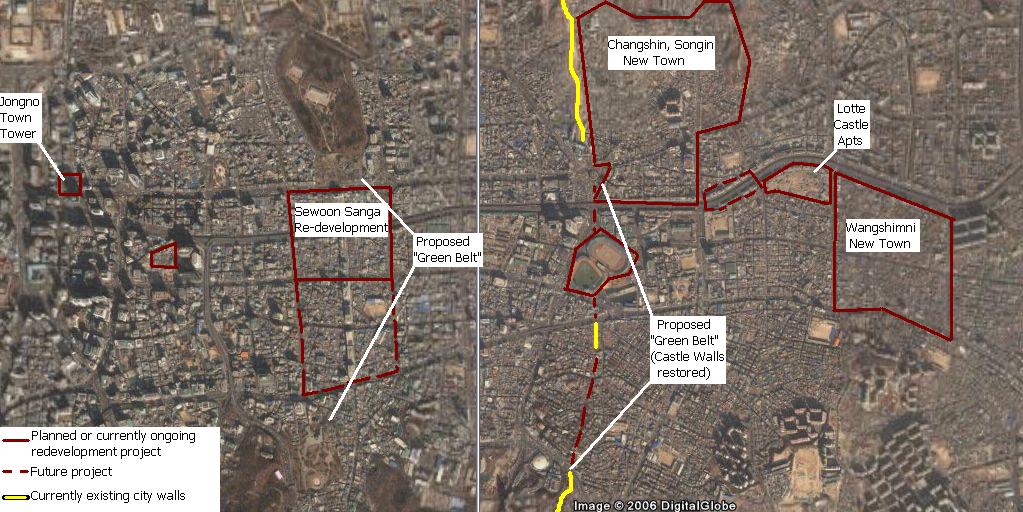
Here's a Seoul subway map I found in a day planner I received as a gift:
Needless to say, the subway system displayed on that map is not the one that exists today. Some of the changes I was already aware of: the new Line 9, the completed Incheon Airport line, the new Bundang Line, the Line 3, Line 7, and old Bundang line extensions, 2 new Incheon Lines, a light railway going north from the Line 2 spur at Sinseol-dong, etc. Many of these are described in this video. But there are a few there I know nothing about, such as an extension south from Sosa station in Bucheon, and other spur lines. The interesting thing is that there are several planned lines missing from that map, but I'll look at those more closely in another post.
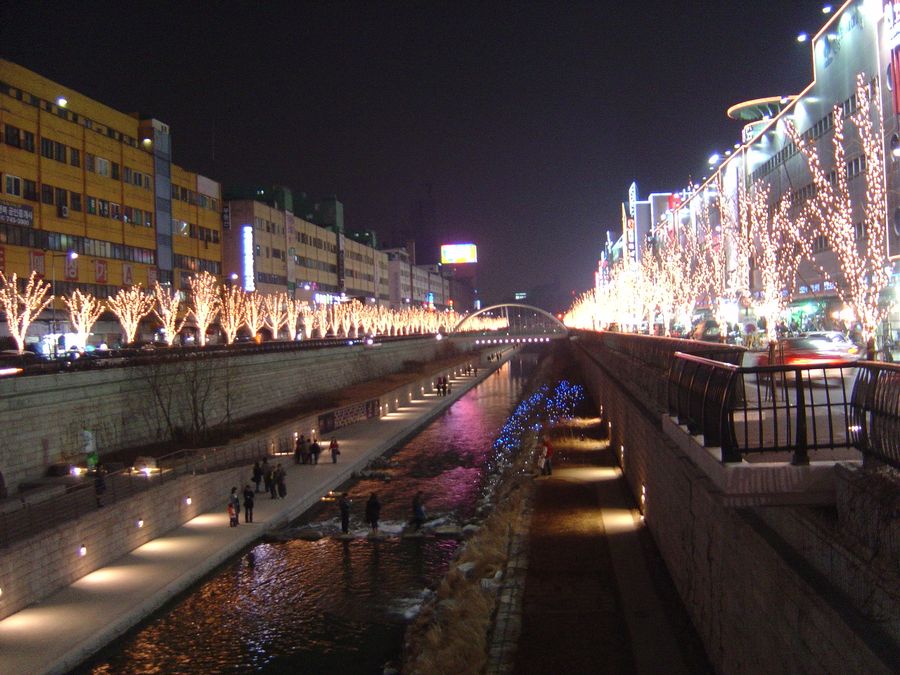
After two flights which were both delayed 3 hours or more and the worst turbulence I've ever experienced, I'm home in Ontario (and no, the picture above was taken on Jeju Island in 2002 - since it was already saved in a draft post, it was easier to use than trying to upload a photo on the 26.4 kbps connection I'm on at the moment). I imagine it will be rather light blogging over the next two weeks, but perhaps I'll find time for a post or two...
I hope everyone reading this has a merry Christmas and happy new year.
The election statistics above, taken from the Joongang Ilbo, show that Lee Myung-bak managed to get 30% of the vote or more in every province and city except for North and South Jeolla province and Kwangju. While it may have been due to the Honam region's historical antipathy towards right wing candidates, there may have been other reasons.
Was it due to this reaction which was caught on camera when he visited the National Kwangju Uprising Cemetery in April of 2005 (which Ohmynews was happy to publish)?
Was it due to him inviting Chun Doo-hwan to the opening of Cheonggyecheon and seeming so happy to see him?
Or was it due to Lee not bothering to come to Kwangju on the 26th anniversary of the beginning of the Kwangju Uprising (like all the other major presidential candidates) and instead getting together with Chun Doo-hwan in the crystal ballroom of the Lotte Hotel two days later?
Doing all of these things together is a pretty good way to guarantee that the southwest is going to vote against you.
The day before former Hyundai Construction CEO Lee Myung-bak was elected president, the demolition of Dongdaemun Stadium began.
To see a clip with more triumphant music, look here.
The redevelopment of this area was supposedly announced by Oh Se-hoon after he became mayor of Seoul, but the story goes back further. Prior to its destruction, a flea market was to be found in the athletics stadium at Dongdaemun. Prior to that, these vendors were located along and under the old Cheonggye expressway.
The above photo was taken near Dongdaemun Stadium in April, 2003. Here's what it looked like three years later:
As always, the process of the transformation wasn't as pleasant as the final product, as this video shows. The contents of the video are described in this December 1, 2003 Joongang Ilbo article.
Three decades ago, merchants congregated in the Cheonggye area, just east of the city center, to establish what grew to be the largest open-air market in the city, selling all things used, smuggled and shady. But yesterday morning, the Hwanghak-dong Flea Market was no more.
The flea market merchants had piled the street with trash and used tires and set them on fire before dawn yesterday; some of them had been camping out since Saturday night hoping to stop the contractors from moving in.
It took, however, a 20-minute clash between a group of merchants who refused to vacate the sidewalk and hired-gun demolition specialists.
Although violence was anticipated and 4,500 riot policemen were on hand, the battle was an uneven one. The roustabouts hired by the city government numbered about 3,500, facing 250 merchants.
The 250 merchants were no match for the 3,500 workers who surrounded them and quickly chased them away while police looked on.
They and their heavy equipment were delayed for only 20 minutes by vendors swinging steel bars and hurling plastic roadblocks.
By 11:30 a.m., the fight was over; the police have five people in custody, including an official with the national association of street vendors, Hong Kyung-hee, whom they charged with instigating the violence.
A Seoul city official said about 250 merchants who cooperated with the eviction would be able to continue business in the Dongdaemun Stadium area, just south of the old market.
Ah, 'roustabouts'. They're usually known as thugs or gangsters. In the video it seems that the only people holding steel bars are the 'roustabouts', but it is just one video. And the police reaction is typical of such situations, where the thugs do the dirty work as the police form a perimeter.
At any rate, it was reported again the next day that the vendors would be moved to Dongdaemun, among other places.
Belongings of 600 merchants out of a total of 1,200 in the Cheonggye area were moved to Seoul’s Dongdaemun Stadium and Nanji Sewage Treatment Plant. The city decided to let 400 merchants who cooperated with the city’s eviction operate their businesses inside the stadium.
Not everyone was allowed in the stadium of course, and others were, unexpectedly, not rushing to set up next to the sewage plant. I found the following comment interesting, as it's very similar to criticisms of migrant worker policy in Korea:
Civic groups said the city needs a better policy. “Instead of repeated crackdowns, protests and the resumption of illegal business, the city should establish a registration system to actually issue permits and supervise the street vendors’ operations,” said Kim Eun-hee of the Citizens’ Solidarity for a Walkable and Sustainable City.
As for Dongdaemun Stadium, it was opened in 1926 and improved at different points after that.
Crammed onto the former athletic field are nearly 900 vendors’ stalls, lined in endless rows on the asphalt field.
Those who continued trading moved into Dongdaemun Stadium, whose flea market opened Jan. 16. Although traces of the color and old glory endure ― the cornucopia includes fossils of prehistoric animals, brass crafts imported from China, classic vinyl records, antique cameras and old Korean books ― much of the excitement and nostalgia that lured people to Hwanghak-dong in days gone by has vanished. Compounding this, vendors are angry over the city’s perceived failure to keep its promise to provide certain amenities.
The flea-market shopkeepers attributed their plunging sales to several factors such as the cramped conditions in the stadium, as well as the lack of electricity and restrooms. Because electricity cannot be fed into individual stands, stalls must close by sunset.
The city broke its promise to provide services like electricity, water, more restrooms and tents large enough to keep out sun and rain, shopkeepers say ― promises made before the merchants agreed to relocate.
“The sales here are nothing compared to those when we were in Cheonggyecheon, and a shopkeeper running a stall beside mine collapsed from high blood pressure and stress,” said Park Seon-hi, a merchant selling sunglasses. “The city mayor, Lee Myung-bak, killed the flea market.”
He did manage to bring Cheonggyecheon back to life, however, and it proved to be the 'hit product' of 2005 - helped along by spending a little money on PR, of course:
In his efforts to publicize his "successful" reopening of the Cheonggyecheon Seoul Mayor Lee Myung-Bak squandered 1 billion won (about 959,000 US dollars) on a variety of public relations program for the stream, which has incurred complaints and anger among the citizens.
Critics argue that all of Mayor Lee's projects including the Cheonggye recovery are actually intended to aid his ambition to become president.
Cynics jeer that Mayor Lee is the most capable mayor of all in the history of Seoul when it comes to publicity.
Worth remembering, however, is that though Lee carried it out, uncovering Cheonggyecheon was not his original idea, as this Far East Economic Reviewarticle from January 2004 relates:
For years, Yang Yoon Jae has been leading groups of students along the route of the Cheonggye elevated expressway in downtown Seoul, asking them to imagine how they might reinvigorate the dilapidated neighbourhood. "It's dirty, dusty, noisy, and polluted with bad air. Who wants to live or work along there?" asks Yang, professor of environmental studies at Seoul National University. "We had to do something drastic to change the environment."
Yang went on to become a vice mayor under Lee Myung-bak and was later caught taking 100 million won from a construction contractor to relax height restrictions in the Cheonggyecheon area. While it brought benefits of the economic sort to some of the people associated with it (and of course, Hyundai construction took part in the reconstruction), the completion of the stream brought only a brief boost for the vendors in the stadium:
Based on sales figures for Sundays, when the market is busiest, the number of visitors declined to 30,000 in the winter of 2004 but recovered to 70,000 last October with the restoration of Cheonggye Stream. However, the number of visitors has fallen again to 30,000 recently.
Alas, little help may be forthcoming from Seoul City, which plans to convert the surrounding area into a park. The open air stalls in Dongdaemun Stadium are one of the obstacles to the plan, which includes using a nearby baseball field and restoring the Dongdaemun fortress site. But the vendors remain resolute. “If the city closes the flea market in the stadium, we’ll have nowhere else to go. I will not give up on this site, said Mr. Kim.
Keep in mind that this article was written on January 26, 2006. On May 10, 2007, the city would announce that they were soliciting designs for the new park, which the Hankyoreh reported on two days later:
For these vendors, the demolition moves represent yet another in a long line of broken promises from the Seoul government. This was not their original place of work: they were moved here from the Hwanghak-dong flea market after former Seoul city mayor Lee Myung-bak implemented a restoration project of the Cheonggye stream in 2003. At that time, the vendors believed the former mayor’s pledge to build a world-renowned flea market. However, the pledge changed shortly after incumbent mayor Oh Se-hoon took office in May last year, as one of Oh’s campaign promises was to build a park and a design center nearby Dongdaemun.
As that January, 2006 article shows, the plan to demolish Dongdaemun stadium dates back further - in fact much further. Here is a screenshot of a presentation made in September 2004.
It's pretty clear that Dongdaemun stadium is slated to be replaced by green space; another map shows that they planned to rebuilt the city walls through the new park. A great deal of the future planning for downtown Seoul can be found in the presentation, in pdf form here. The 'axis' plans seen above weren't announced to the public until June, 2006. It's hard to be sure, but I imagine these kinds of plans were around for awhile, just waiting for a green light. Is it possible they had decided less than a year earlier that the stadium they were going to move the vendors into was going to be destroyed? If so it was a cynical but successful way to defer a confrontation with the vendors for a few years.
Many more images of the project can be found here if you scroll down. One thing that must be said is that they certainly didn't opt for a boring choice. It helps to reinforce the concept of Cheonggyecheon as the precursor that many other redevelopments would cluster around.
A week or so later, on August 22, the Joongang Ilbo reported that
The country’s largest secondhand street market will be relocated from Dongdaemun Stadium to [the grounds of a former middle school in] Sinseol-dong near the Cheonggye Stream, the Seoul city government announced yesterday.
The new location can be seen on the map above. It seems to be off the beaten path by a little bit (Dongdaemun Stadium, though inconvienient, was at least next to Dongdaemun market), though the city has promised to help them:
Spending 3 billion won ($3.1 million), the city vowed to transform the new marketplace into a tourist attraction for domestic and foreign visitors by March next year.
It's a step up from the treatment the vendors received when they were first moved to the stadium. Whether the city will follow through on this promise is a question for another day. What's interesting is the way the history of the past few years is glossed over in the following paragraph of the article.
The market, selling secondhand goods and antiques, was originally located in Hwanghak-dong, Jung District, next to the Cheonggye Stream, which was then covered by a road. In January 2004, the market’s 900 street vendors were moved into a soccer stadium in Dongdaemun after Lee Myung-bak, then mayor of Seoul, decided to restore the stream. Last year, Seoul Mayor Oh Se-hoon announced the demolition of Dongdaemun Stadium to transform the area into a fashion street with a park, enraging the street vendors who were faced with eviction again.
Other than the last sentence, it almost makes it seem painless and inevitable, when you look back at it in this way. As for the present, I imagine the process I described above will play itself out with ever increasing frequency over the next five years.
Gord Sellar looks at (among other things) the "peripheral mindset" of Canada and Korea. As a Canadian, I appreciated the comparison. Though, as Gord says, his blog isn't really about Korea (or more, it's not his main focus), when he chooses to write about Korea, I do think it's some of the best writing on the subject to be found... anywhere. Gord also relates an incident with a drunken psychotic moron bastard today that's well worth the read, and which also presents the reader with this gem:
Your society is changing so fast you’re going to need a neckbrace just to watch it go.
I was looking for something unrelated (as always) when I found some information about the opening of Seoul's subway line 5. A November 15, 1995 Korea Times article tells us that
The 15km Kangdong section of Seoul Subway Line No. 5 linking Wangsimni in central Seoul to Sangil-dong in the southeast will open today five and a half years after construction began.The new line will make Seoul's subway network 148km long. The section will have 14 stations and passengers will be able to switch to Subway Line 2 or the Korean National Railway at Wangsimni Station.
The section has cost 912.9 billion won, according to Seoul city officials. [..] Construction of other parts of the Line No. 5 connecting Panghwa and Sangil-dong will be completed around the end of the year, providing access to Kimpo International Airport.
Interesting that it was opened in sections, each one connected to a transfer station. To remind you of how long ago this was, some cutting-edge technology is also mentioned:
In particular, pager users will suffer no inconvenience underground because the section is equipped with complicated communication devices enabling the operation of beepers.
To go along with this, a July 20, 1996 article titled "Mobile Phone Use Possible on Subways This Fall" reminds of the old days before everyone was chatting, playing games, or watching TV on their phones:
The Seoul Metropolitan Rapid Transit Corporation said digital mobile phone services will be available in underground stations and trains for the partly-opened subway line 5 as well as 7 and 8, due to go into service sometime this fall.[...] Thus far, it has been possible only when the train was moving above ground or in subway stations that weren't so deep underground. [...] It was easy to install the mobile communications systems and antenna cables necessary while the new subway lines and stations were being constructed, explained an official of the rapid transit corporation.
On March 20, 1996, another section opened:
A part of Subway Line No. 5 linking Kimpo International Airport opened early this morning, five years and nine months after construction began. The new subway line is linked to existing lines Nos. 1 and 2 at Sindorim station, thus allowing commuters from the airport and beyond to reach downtown Seoul in just 45 to 50 minutes.
A[...] foreseeable problem might be the transfer at Sindorim station, which is already conjested during rush hours as lines 1 and 2 converge there. According to the Seoul Metropolitan Subway Corporation, at least 40,000 more people are expected to join in the mass exodus of early morning and late evening commuters at the station every day.
I couldn't help but think, "Hold on - Line 5 doesn't pass through Sindorim at all." It took a moment before I realized that the Line 2 spur line (pictured above) from Sindorim to Kkachisan, the existence of which never made sense to me, was originally part of an early phase of Line 5.
Lines 1,2, and 5 in southwestern Seoul in 1996
Lines 1,2, and 5 in southwestern Seoul today
The article continues:
However, when construction for the remainder of Subway 5 is completed in November, Kimpo International Airport will be linked directly to Kwanghwamun in downtown Seoul. Hence, the inconvenience of transferring at Sindorim will be eliminated, and travel time will be cut in half to about 20 to 25 minutes.
Yes, I suppose if you started at Gimpo Airport and skipped every stop along the way, you'd probably get to Gwanghwamun in 20-25 minutes. Otherwise, it takes around 40 minutes. Speaking of skipping stations, Line 5 has always skipped Magok Station, which is 2 stops before Gimpo airport and is in the middle of a field (which is soon to be developed). Photos of its construction can be found here. Here's what its single entrance looks like today:
You can go down the steps and peer through the shuttered entrance:
What's interesting is that, as it hasn't been used in the 11 years since it was completed, the sign above uses the old romanization (like these Korea Times articles) and reads 'Panghwa' with a 'p'. A maintainance worker I used to teach said he had to come here every night to check on the station, and that two people had killed themselves there (presumably by walking through the tunnel to get there. He said it's a bit spooky at night.
In trying to find the Magok Station construction photos above, I found a set of photos taken between January and October 1996 showing the area around Balsan Station and Ujangsan, Magok-dong, Banghwa-dong, Gungsan, and Hwagok-dong (starting here, go left at the bottom). Needless to say, I was fascinated by them. Here are a few:
Above is Balsan Station on Gonghangno looking east. If you look below you can see where the photo above was taken (in the center looking towards bottom right). You can also see Magok-dong (the fields) Banghwa-dong at top center and Gimpo Airport at far left. Note also the subway exits opening next to the fields; the path of the subway line can be seen arching across the fields. This view is almost the same today; despite being approved for development in 1996, Magok still has yet to be developed, though plans are in the works.
If you continued towards bottom right, you would travel through the next two photos, which show the area around Balsan Station (especially Deungchon-dong) being constructed. Along the top are apartment buildings which would have been built around 1993 or 1994 (and thus were quite new in 1996). This area, much like the northern part of Banghwa-dong, were built as a 'city development' over farmland in the early 1990s. These developments in such 'rural' areas were closely related to the planned subway route.
Continuing along, the street below (Gonghangno, heading east) is today the middle class family restaurant playground of Gangseo-gu, though in 1996 it still had a ways to go.
In the photo above, if you were to stand on the building in the center and look to the right, these much older apartments would be seen, along with Hwagok-dong and Ujangsan in the distance.
The same apartments as viewed from Ujangsan, with Banghwa-dong in the distance:
Banghwa-dong looks quite a bit different today, and due to the apartments in the foreground having been replaced with towering apartment blocks two years ago, this view is likely no longer available from the mountain.
At any rate, on December 31, 1996, Line 5 from Kkachisan to Wangshimni was opened, linking downtown Seoul to Gimpo Airport.
The 14.1-kilometer downtown section of Seoul Subway No. 5 opened yesterday, directly linking Kwanghwamun and Kimpo International Airport by spanning the Han River through underwater tunnel.The downtown section opening means the completion of the full 52.21- km No. 5 Line from Panghwa near Kimpo to Sangil-dong via Yoido and Wangsimni.
With the opening of the subway's downtown section, work will begin tonight to dismantle Tangsan Railroad Bridge that spans western Han River on the Subway Green Line, a loop that serves thousands of commuters in Seoul every day, following an inspection that found it unsafe. Once the work is underway, the subway line will not operate its entire course, halting its service at Hapjong Station north of the Han River and at Tangsan Station south of it. With the trans-river subway operation out of service, an estimated 300,000 commuters who use the facility every day will be penalized and sent scrambling for alternative means of transportation.
They had to scramble for almost two years. The new Dangsan Bridge wasn't opened for use until November 22, 1999.
Popseoul reported a week ago that a new trailer from the film 'Hellcats' (or 'I like it hot') showed Wonder Girl member An So-hee and co-star Kim Bum kissing (as well as the other characters in bed with their respective lovers).
I do find it amusing that they covered up the kiss with a heart. We mustn't let anyone get the wrong idea about So-hee, right?
It seems like a rather confused advertising campaign. Perhaps the appeal of the latter photo is that the male viewer is left to think, "Hey, that could be me being held by a 15 year-old." Unfortunately, that fantasy was ripped to shreds the moment the aforementioned male viewer saw the new trailer - "Hey! That's not me!" Wonder Girls fans responded to the image of So-hee kissing a male other than themselves with rage and their comments on Kim Bum's Cyworld page forced him to close it down. Fans left comments on the film's homepage as well. The victim's comment made it seem as if he wasn't too preturbed: "So-hee's fans are really scary…kekeke. I’m definitely going to get shot by a runaway soldier."
The question remains - were these teenaged boys who undertook this form of 'cyber terror', or were they guys in their 20s... or 30s?
The victim seemed to be taking it all in stride, suggesting that perhaps it isn't just nasty comments left on a person's homepage that lead to suicide.
At any rate, the Wonder Girls virus continues to spread (and a test to check for the virus may be necessary for Korean students wishing to study in the US), as the Donga-Ilbo has taken to calling Kim Yu-na a “Wonder Girl” after her second victory at the Grand Prix finals, which has got to make her feel that all those years of training were worth it. Perhaps it's better than "Figure Pixie (or 'elf') ", the media's old name for her, though she seems to have graduated to "Figure Queen" these days, as she's called in a photo caption here (if you look at the comparison chart near the bottom, tell me, could they choose a worse looking photo of Mao Asada?).
On December 7th the students who took the Suneung, or college entrance exam, received their marks. The media duly published photos of happy students who were college bound.
I couldn't help but think that they were missing out on the reactions of the majority of the test takers, who didn't do as well as they'd hoped. It seems those kinds of students only get noticed by the media if they kill themselves in the time honored manner of leaping from buildings.* At four AM Monday morning, the Joongang Ilbo reports, twin sisters in Changwon did just that.
The twin sisters had been under enormous stress lately, worrying about their scores on last month’s national College Scholastic Ability Test. The stress may have been enough to cause the high school seniors from Changwon, South Gyeongsang to plunge to their deaths from a high-rise apartment building. “I wish you happiness with mom and brother. Sorry I wasn’t a good daughter,” one of the victims wrote in a text message to her father’s cell phone just before committing suicide, police said.
I doubt there will be much happiness in their family's life for some time to come. The article brings up new changes in the grading system, but adds
It is not known if the grading system had any impact on yesterday’s victims, who were discovered by a newspaper delivery person in front of an apartment building at about 4:10 a.m. yesterday.
Nice wording there: impact.
The aforementioned building
The police confirmed that the victims were twin high school seniors, both 18, who went to school in Changwon. The twins had been in agony since they received their test scores last week, according to an initial investigation by police. The sisters left home after receiving the test results and had been missing for two days, police said. The personal belongings of the two sisters, who were not identified, included a cell phone and a watch that were found near an emergency exit staircase on the 25th floor. A window was open beside the stairs, police reported.
It turns out these girls were not the only victims of the suneung this year.
Police noted that a Seoul student, who had taken the CSAT three times, also jumped from a tall building last month shortly after taking the test on Nov. 15. The student was worried about test scores, police said.
As this article elaborates, in Seoul's Ichon-dong at one in the morning on November 17, essentially the day after the test, the 21 year-old student jumped from this building.
Apparently there are complaints about the vagueness of the new suneung grading system.
Parents’ groups have protested against the new CSAT grading system and some have threatened legal action. But as yesterday’s tragedy appears to show, for some students the CSAT remains a life or death matter.
I don't think it's only students who feel that way.
There have been other candlelight gatherings regarding the suneung as well, though the one pictured below was a protest against the suneung after a girl in Namwon killed herself on November 5, 2003 (the picture of the open window above was where she jumped from).
I wrote about a student killing himself on the morning of the test two years ago; more died before that, and more will continue to die in pattern so predictable that you can set your watch by it.
* Which leads to the media declaring such apartment buildings to be degenerate threats to the welbing of children and the construction ministry announcing new regulations for the reconstruction of such buildings requiring a death record check which needs to be notarized in the hometowns of every resident in the complex before a reconstruction permit can be issued.
The photo below gives a pretty clear idea of just what kind of ooze is coating the beaches of Chungcheongnam-do.
The photo is from here (where more can be seen - note the difference between the contaminated and normal oysters). More on the disastrous oil spill can be found in the Donga Ilbo, Chosun Ilbo, Hankyoreh, Korea Times, and Joongang Ilbo.
I couldn't help but think of the Simpsons episode where Lisa goes to clean up a polluted beach after an oil spill but so many Hollywood stars had claimed spots on the beach that there was no room for her to help. Lee Hyori may have gotten all muddy in Africa, but now may be Kim Tae-hee's moment to get down and dirty after breaking a sweatserving food to the less fortunate in soon-to-be-razed Garibong-dong.
On a related note, I'm not sure if this was the best way for Samsung to draw attention away from its slush-fund-for-bribery scandal.
The four went on the rampage in the subway station in May and beat Cho who tried to stop them, causing him injuries requiring three weeks of treatment, the prosecution claimed.
On May 19, 1995, a group of American soldiers got into a fight with a group of Koreans on a subway in downtown Seoul (either line 3 or 4), which led to an outpouring of anti-Americanism in Korea which focussed on calls to revise the Status Of Forces Agreement regarding how U.S. soldiers are treated in the court system in Korea. I first read about this incident here.
This New York Times article is the earliest article I could find about the incident. It was written before the trial and describes the what happened from the soldier's point of view, which is ever-so-slightly different from the Korean media and prosecutor's point of view. Here are the more important parts:
Subway Brawl Inflames Issue of G.I.'s in Korea August 24, 1995
It all began when an American soldier put his hand on a Korean woman's rump.
The version that has captured the local imagination is that a group of drunken American soldiers were rampaging through the subway, molesting Korean women, and that the soldiers then attacked good citizens who dared protest the errant hand.
The American understanding of events starts with a fact that the Koreans tend to leave out: The American soldier and the Korean woman whose behind he patted were in fact a married couple.
The Americans say the problems arose when some angry young Koreans on the subway accused the American of sexually harassing the Korean woman. When the Korean woman explained that she was the American's wife, the Korean men allegedly spat at her and slapped her -- leading the woman's husband to punch the man who slapped her.
In any case, the result that evening in May was a huge brawl in the subway. It has reverberated through the country and underscored the delicacy of the mission of the 37,000 American military personnel in bases in South Korea.
[American Ambassador James T.] Laney says the problem is not that American soldiers are committing more crimes, but that an irresponsible Korean press is portraying them in a particularly lurid way to an inflamed public.
While cases like the subway incident are seen by Koreans as evidence of the need for protection from rampaging Americans, to Americans they show that they need protection from a skewed local judicial system. After the subway brawl, no Koreans were indicted, but four Americans were.
Here are three contemporary articles from the Korea Times:
Two US Servicemen Deny Charges in Seoul Subway Incident in May 1995-10-13
Two United States Forces Korea servicemen indicted on suspicion of assaulting a Korean man in a Seoul subway station during a brawl in May, yesterday flatly denied they beat him during the first session of a trial for the "subway incident" which stirred up anti-American sentiment among Korean people. Serg. [] and the other defendant said that they did not beat Koreans and rather they were beaten by Koreans while trying to stop them assaulting [the sgt.]'s Korean wife, [], at the Chungmuro Station on May 19.
The trial is being held at the Seoul District Court, and is presided over by Judge Kim Tong-hwan. The American soldiers were prosecuted without physical detention on charges of violating the Law on the Punishment of Violent Acts.
They allegedly ganged up to beat Cho Chong-guk, 28, who was trying to stop them from creating a disturbance at the subway station late at night. Cho suffered an injury requiring three weeks of medical treatment. He later staged a two-day hunger strike in front of the U.S. compound in Yongsan, demanding the punishment of the U.S. servicemen involved. Meanwhile, the court fined [another] Corporal and [the sgt.'s wife] 1 million won and 500,000 won for their involvement in the violence, the penalty sought by prosecutors, in a summary judgement.
Poor 28 year-old Cho Chong-guk, who was left so incapacitated that three weeks of medical treatment were necessary ('You mean my health insurance covers this?!'). It's nice to see that the true victim - a woman who was spit and slapped on - was given a 500,000 won fine, while the men who spit on and slapped her weren't even indicted. Considering how, in this case, it was said that Korean witnesses' testimony are given more weight than foreigners, why would the Korean victim be punished?
I guess when you match a Korean woman's testimony (especially one who was married to a - gasp - foreigner) against a Korean man's testimony, the woman was more likely to lose. Of course that was back in 1995, and I'm sure such discrimination (against Korean women or foreigners) does not occur today.
US Sgt. Involved in Subway Brawl in May Given 6-Month Jail Term 1995-12-22
One of the four off-duty U.S. servicemen and a dependent involved in the alleged beating of a Korean in a subway station in Seoul in May was found guilty as charged and given a six-month jail term yesterday. Judge Kim Tong-hwan of the Seoul District Court sentenced Sgt. [], 31, to six months in jail for violating the Law on Punishment of Violent Acts. Prosecutors had demanded one year behind bars. [The Sgt.] is entitled to an automatic appeal and he will not have to start to serve the sentence until the legal process reaches its end in accordance with the Korea-U.S. Status of Forces Agreement (SOFA).
Cpls. [] and [], and [the Sgt.]'s wife[], three others involved in the case, were slapped with fines of 500,000 won, 1 million won and 500,000 won respectively as the prosecution demanded. In the ruling, Judge Kim said, "A jail term was given to the accused [] because it was proven beyond reasonable doubt that he beat Cho Chong-guk, 28 in Chungmuro Subway Station in Seoul as charged." "[The accused] has shown no signs of remorse but rather argued that he was the victim in this incident, which made it impossible to settle the case with Cho out of court," he said.
The four went on the rampage in the subway station in May and beat Cho who tried to stop them, causing him injuries requiring three weeks of treatment, the prosecution claimed. They were indicted without physical detention on May 19.
It's good to see that the prosecution put so much work into figuring out who was truly responsible.
US GI's Sentence in Subway Brawl Commuted to Fine From Prison Term 1996-05-08
Two United States servicemen involved in a brawl in the Seoul subway last May were given fines yesterday, instead of prison terms, in an appeal to the Seoul District Court. [Sgt.], 32, who had been given a six-month prison term by a lower court, was fined 1.5 million won (some 1,900 dollars), and [], 24, was fined 500,000 won (some 610 dollars) for their violent acts in the subway.
The subway brawl a year ago fueled strong anti-U.S. feelings here and led to a campaign to revise the Status of Forces Agreement Korea has with United States Forces Korea.
Giving the lighter punishment, the bench said, "The court clearly finds the defendants guilty of violent acts, but has decided not to hand down prison terms because of concern over the negative effects these would have on their service careers."
Popseoul reported a week ago that a new trailer from the film 'Hellcats' (or 'I like it hot') showed Wonder Girl member An So-hee and co-star Kim Bum kissing, which then led to So-hee's fans inundating Kim's Cyworld homepage with akpeul, or "evil replies". He eventually shut his homepage down. On another note, this seems to be a clip from the auctioned off dinner date described below. Also, the Chosun Ilbo tells us that
Other experts say Wonder Girls and Girl Generation have brought middle-aged men to TV and the Internet.
Of course (in its English edition) it doesn't bother to try to explain why this might be...
[Original post]
The Wonder Girls. It seems everyone is talking about them these days, either castigating their dancing and singing skills, telling foreigners who don't like them to go home, or telling everyone criticizing them for their lack of talent to chill the hell out and get some perspective (a brilliant manouvre which guarantees that that Wonder Girls fans will not think you're anti and start leaving akpeul all over your minihompy). As for my opinion of "Tell Me", I haven't had the misfortune of having to hear it several times daily (until working on this post, at any rate), so I don't mind it that much - it's an innocuous enough, catchy bit of electro-pop.
I'm a little confused by the claims that Stacey Q's "Two of Hearts" and "Tell Me" are so similar - one person even said "Tell Me" borrowed the song structure of "Two of Hearts". A quick comparison, then, of "Two of Hearts" and "Tell Me":
Feel free to Tell Me if you see something missing in the latter song - or let Robert Plant ask the appropriate question by skipping to 3:00 here. Seriously though, the only real similarity I see is the stuttered sample of "I-I-I-I-I-I-I-I-I-I need you" at the beginning of "Two of Hearts" (and if playing with vocal samples are all that's needed for a comparison, why not compare it to Sigue Sigue Sputnik's "Love Rocket F1-11"?), so we're not talking about a blatant copy like Wax's "Oppa" (of Cyndi Lauper's "She Bop"). That said, that small similarity is an important one, and the link between the song from 1986 and the song from 2007 was pointed out by the Metropolitician, who linked to this page, which is quite interesting, as you can hear a 1988 cover of "Two of Hearts" by the Korean girl group Setorae called "Haengbokhae". I also found this page, which has several pictures of Setorae from 1988, such as this one:
It's probably worth noting that the girls above are what 80's stars wore, and not the strange outfits worn by the Wonder Girls here. A page with videos turned this Setorae performance from 1988 up (beware of the ad at the end):
I like the Tron-ish stage and the off-beat clapping by the audience. Their dancing seems pretty innocuous stuff by today's standards. It would be hard to imagine them doing anything particularly provocative.
Moving along, I wondered if, among the late 1990s groups like Sechs Kies, Baby Vox, Fin.K.L., S.E.S., Shinhwa, and H.O.T., there were any groups that featured girls (or boys) as young as those in the Wonder Girls, and if so, what kind of dancing was involved. Yun Eun-hye would have been 15 when she joined Baby Vox, but as the other members were older, I thought the best comparison might be S.E.S., whose members were 16 or 17 when they started. At that age, however, they weren't dancing or dressing very provocatively.
It's funny how things change; back in 1998 their second album sold 650,000 copies, as compared to the measly 18,000 albums the Wonder Girls have sold in this era of internet downloading. As bubblegum pop goes, I rather like their song "Dreams Come True", but then it's actually a cover of Nylon Beat's song "Like a Fool", with a bridge (hey, there it is!) and rap added. I think the main reason I like it is because it (well, "Like a Fool", actually) was used in a memorable scene in Resurrection of the Little Match Girl.
Another group called Circle was brought to my attention in the comments section (thanks helikoppter). They first appeared in 1998, when most of the members where 14 or 15, though one was 12 (photo from here).
While it was said her age may have been controversial (in Korea) their image seems to have been based on being cute more than anything else; there's not much Wonder Girls-style gyrating to be seen in this video (or this one either):
Interesting that there seems to be Japanese-Korean members (they seem to have more of a J-pop sound to me, but seeing as I know next to nothing about J-pop, I don't know why I think that). I would be curious to see how this (perhaps international?) group came to be, but there's very little information about them that I could find. Needless to say, there's nothing in that video that would suggest this picture of Korean society painted in July, 1996:
All seem to be crazy to sell sex. TV entertainment programs, night shows, dramas and movies have already exceeded the limit. Under the noble name of arts, lewd dramas are making big profits for their producers on Taehangno Street and TV stations are desperate to raise their viewing rates by making more and more suggestive programs. Adults marketing products are all-out to attract young customers by stimulating their curiosity about sex. It is not going too far to say that our children today are nakedly exposed to obscene culture without restriction, and few appear to be trying to put the brake on this trend.
I wonder what he would have thought of the Wondergirls?
There's certainly a "girl power" aspect to both of their videos. In "Irony", above, they spy on one of there boyfriends and catch him with another girl, and then proceed to use a voodoo doll to torture him (torture in a funny way, I mean).
Then they go down to the club and confront him and get their revenge.
In "Tell Me", (here are the lyrics) bad things happen and So-hee turns into Wonder Girl to save the day, whether it's saving a baby in a carriage from being hit by a bus, fighting off a "burberry man" who's flashing the girls in their changing room...
...or appearing to punish a bunch of bullies in her class.
While this all may appear "empowering", I think the way in which they're being clothed and marketed runs in another direction. At any rate, I think it's the dancing, and not the story told in the video that has made the song popular. As the Chosun Ilbo tells us about the 'Tell Me' video,
The Wonder Girls say they were stunned by the outfits and choreography for "Tell Me" when they first saw them. "We didn't like wearing the outfits. But once we shot the music video in them, it was fun," says So-hee, 15. The music at the time was still new to them and it wasn't easy to get the choreography right. "The choreography looks simple but it's actually quite complex. Small repetitive motions with the hips, chin and shoulders -- it makes a strong image," said the Wonder Girls.
The love of doing things in groups in Korea may also explain some of the popularity of the song, or more especially, the dance, which has many followers who have uploaded clips of their dancing, as we see here:
I thought of the group aspect being popular in regards to people doing this group dance together, but hadn't thought of it from the standpoint of participation in a larger collective, or "imagined community" as the Metropolitician put it here. The "Tell Me" collective may yet assimilate us all. Speaking of the dance, for those interested in it, you may want to look at this video, which shows the girls practicing for the 'Tell Me' video when Hyun-ah was still a part of the group. The choreography and video changed quite a bit in the final video, and you get an idea of how "quite complex" and difficult it was to learn the dance.
As you can see, Hyun-ah's presence there changed things quite a bit, as she was at the center for much of the video, including the solo dance during the break (which looks terrible there), as well as being dressed as Wonder Girl. Her departure from the band (she quit at the end of July, citing exhaustion) apparently led to So-hee being the centerpiece of the video. Earlier photos of the band reinforce the centrality of Hyun-ah, but I can't help but raise a question: Why are the three youngest girls (likely still 14 when this was taken) the only ones wearing miniskirts? And why are the older ones hidden at the back?
And again, in the Irony video, it's Hyun-ah and So-hee who are front and center gyrating as if they're riding a horse and slapping their asses.
It's been said that the young people who perform or watch these dances really don't know what they signify to older people, and that it's all quite innocent. Fair enough; I didn't really know what Led Zeppelin's "Whole Lotta Love" was about when I was 15, so maybe I'm making too much of "innocent little dances" like this one (scroll to 5:20). But it is worth remembering that many of the 'normal' people doing the dance in the video above are not teenagers (the supposed market for this music). Sure, dressing them in quasi-school uniforms could have been to reinforce that they were "just like" their target audience, but it reinforces their youth not only for their peers, but for anyone else who's watching, including perhaps, just to throw in a statistic, the 800 men referred to in this article. Also worth thinking about is this question about "Tell Me": Just who is a retro-style '80s song supposed to appeal most to? As the girls said in that Chosun Ilbo article, "We really feel our popularity when 30-year-old guys ask us for autographs." While auctioning off dinners with stars for charity may be common thing for celebrities to do in Korea, isn't selling a dinner with two 15 year-old girls to these 30-year-old (or older) guys - five of whom collectively paid 20 million won for the privilege - a little... creepy?
And I'm sure it's just a coincidence, but why is the youngest (now 15), So-hee (who's considered to be the 'cutest'), the only one wearing a tight shirt in both videos? And after raising these questions, how does this ad (featuring 'So-hee') look?
So-hee has other projects on the go as well, including this film, the English title of which is Hellcats.
It will be released next January, and tells the story of three women in their 40s, 20s and teens. A trailer is here, and more photos are here. Seeing who her co-stars are here explains why she appeared with them in Vogue in October. The film was shot before 'Tell Me' came out, so I imagine Cinema Service is pretty happy with her popularity right now. All I can say is that I hope she acts better than she sings. Hold on - what was on that movie poster again?
Nah, a 15 year-old holding a shirtless man couldn't possibly be construed as having any other meaning, now could it? Come on. Who is this being aimed at?
As far as I can tell, Wonder Girls are the first teenaged female group to be marketed this way in Korea (if I'm wrong, do tell me ...er, no pun intended), in regards to (especially) their age, the way they're dressed, the retro style marketing which appeals to adults, and the emphasis on the youngest members.
I don't foresee that this will lead to death, destruction, and the end of Korea here ([In a movie trailer voice] "Next summer....what began 5000 years ago with Tangun will end... with the Wonder Girls"), and it should be noted that things are much, much more creepy in Japan, with it's gravure idol books and dvds (which provide the masses with buxom 11 year-olds and barely-covered 14 year-olds, to pick two examples from hundreds). It's not like provocative ads with 15 year-olds haven't caused a fuss in the U.S. in the past as well.
But when you think about some of the information I posted here from the 1990s, where 25% of middle and high school girls said they'd been sexually harrassed by their teachers and a writer railed against "adults who seek "younger" girls" and it was announced that bars that hired underaged girls were seeing a boom in business - all of this before a massive increase in runaways that likely fueled the growth of wonjo gyojae - one might think that men's perception of teenage girls in Korea is already problematic enough without the media working 24/7 to keep gyrating 15 year-olds in school uniforms who auction off dates with men in their thirties in the public eye.
Here are some more articles from the Korea Times from July 1995 to July 1997, most of which refer to how changing youth behavior, especially regarding sex, was perceived, as well as the growing realization of how often children were victims of sexual abuse and harrassment. It seems that on the KINDS database an extra year was added (back to 1995) so I decided to see what I could find, and these seemed quite interesting. Most of these articles would fit about a quarter of the way down this post (in fact, there are brief references there to some of the things below in that post). This is pretty long, and though I've clipped bits here and there, most of the 15 articles remain intact (statistics and all).
Just for reference, the first noraebang (or 'singing room) appeared in Busan in early 1991 and by 1992 they had spread to Seoul (Antti has much more on this here; it's interesting that some saw noraebangs as a harmful Japanese influence). Something to think about when considering how many runaways were working in in such places three or four years later.
Girls Outnumber Boys Due to Earlier Maturing 1995-08-23
Following the tragic fire on [August 21, 1995, in which thirty-seven inmates were killed and 16 others injured] caused by arson at a rehabilitation center for runaway girls and prostitutes in Yongin, Kyonggi-do, alarm over the sharp increase in runaway teenagers is being sounded by schools and parents.
According to Education Ministry's statistics, the number of runaway students increased to 11,363 last year, a 23 percent hike from 1993. Among them, girls outnumbered boys 5,935 to 5,428, indicating an urgent need for more efforts to focus on girls. In particular, the number of runaway girls far exceeded that of boys at the middle school ages at 2,806 girls to 2,050 boys. By age, middle school runaways numbered 4,856, high school 6,428, and elementary schools 79. The larger number of runaway cases among middle school girls is attributed to their earlier maturing than boys. Leaving their homes, girls were also found to often travel with friends rather than running away by themselves, a ministry official said yesterday.
The runaways began to post a sharp rise in 1991, crossing the 10,000 mark for the first time, according to the ministry. Among those labeled as runaways last year, 1,843 had been expelled from school, 4,843 were suspended, and 4,677 were given minor school punishment. As to motives for running away, the ministry cited the lack of parents' attention to their children, poor school grades, the need for more of an allowance, and parents' unruly life style.
Meanwhile, the absence of proper facilities to protect teenage delinquents is cited as a serious problem in Korea, as proved by YMCA statistics, showing that 71.4 percent of runaway teenagers are making their living at adult entertainment facilities.
The government operates only 22 reformatories or rehabilitation centers mainly for homeless women or prostitutes across the nation, but they cannot afford to accommodate teenagers, due to the limited budget and lack of manpower. With no recourse the teenagers can turn to, the youths are certain to graduate to more aggravated delinquencies, including prostitution, to make a living, a YMCA counsellor said.
If the number of runaways passed 10,000 in 1991, then how could the 11,363 in 1994 be "a 23 percent hike from 1993"? An article I can't access reads in Google that "In 2001, the number of runaways in South Korea reached 61319 youths (23577 males and 37742 females) (The Commission of Youth Protection, 2002a)." Now that's quite an increase (notice the rate still skewed towards females), and is likely due to the fallout from the 1997 financial crisis. It also probably helps to show where the girls willing to take part in wonjo gyojae were coming from at that time.
Unlicensed Night Spots Serving Hotbed for Teenage Girls' Delinquencies 1995-08-24
With the number of teenage runaways sharply growing, nighttime entertainment facilities with no business licenses are becoming the target of public criticism for snaring the runaway girls. According to related business sources, unlicensed bars, in particular, are enjoying booms by preying on underage runaway girls, who have little means to support themselves away from home. A common way in which these bars lure in teenage girls are advertisements in newspapers and magazines guaranteeing big money plus free room and board.
As to why girls run away from home, the teacher cited their desire for a lavish lifestyle, apparently influenced by the overemphasis of materialism in this society. Some girls show off the presents from their "customers" like pagers and jewelry to their friends at schools, he claimed. Meanwhile, the night spots employing teenage girls, in turn, are enjoying booms in their business, by drawing more male customers. By a rough estimate, the number of women serving as "hostesses" at the night spots without licenses totalled some 200,000, four times as many as those at legalized facilities, according to an official of the association of the nation's entertainment business operators.
Compared to recent setbacks of the night-time entertainment businesses, the unlicensed spots increased to about 7,000, as of June, five times as many as the ordinary ones. While the ordinary facilities are reeling from strict regulations and limited operation hours, the illegal facilities are enjoying booms by drawing more customers thanks to the younger girls, according to a bar operator in Sinchon. With the "sick" entertainment culture surviving in society, many other businesses might have to follow their lead to survive, he claimed.
Meanwhile, the law enforcement authorities are held responsible for the rampant spread of the illegal spots by taking no serious action against them. The bar owner in Sinchon went on to claim that many of the illegal facilities are operating under the connivance of the police. The ordinary entertainment spots, including night clubs and cabarets, lost more than 50,000 employees over the last three years, marking a 44 percent drop in the employee number last year, according to Seoul city statistics
Interesting. Unregulated businesses grow, fueled perhaps by the rising number of runaways. It begs the question of how popular teen prostitution was in the past (remember the main character (an old man) in Chae Man-sil's 1937 novel Peace Under Heaven trying with all his might to find a 14 year-old Kisaeng who will sleep with him?), and if it simply expanded in the 1990s (or had simply been brought to light by the media), or if that period saw a new trend rapidly appear. Interesting that "their desire for a lavish lifestyle, apparently influenced by the overemphasis of materialism" was mentioned, as well as the fact that "some girls show off the presents from their "customers" like pagers and jewelry". Such gift giving was more a marker of wonjo gyojae, and the popularity of wonjo gyojae has often been explained by the influence of materialism. It seems then that aspects of the 'charitable relationship' already existed, but what was needed was to make them 'free agents', which needed the innovation of the 'phone room' (which I would imagine came from Japan, though I don't know if anyone has ever researched that).
At any rate, in response to changing sexual attitudes in teens and a rising number of AIDs cases, a new program was promoted in schools.
`New Purity' Movement to Kick Off at Middle, High Schools in Sept. 1995-09-01
The Korean Federation for AIDS Affairs, Inc., will launch the "New Purity" Movement among middle and high school students across the nation to teach the prevention of AIDS from this month.As a growing number of adolescents tend to have sex at a younger age, the federation is kicking off a nationwide campaign to educate AIDS-ignorant teenagers about responsible and proper sexual behavior, said Chung Kyung-kyoon professor of medical sociology at Seoul National University. Prof. Chung, who heads the anti- AIDS organization, said that the movement is also being initiated to proliferate correct sexual attitudes, emphasizing its spiritual and mental aspects rather than the physical act itself.
Nine out of 10 HIV carriers in Korea are infected through sexual intercourse, illustrating the fact that irresponsible acts are the main catalyst of the deadly disease[.] Moreover, the infection of three Korean high school boys has alarmed citizens, leading them to pay more attention to the issue, he said. The group's successful education in AIDS prevention of over 30,000 students at 13 high schools during the first school semester is resulting in a more active promotion of the program with the participation of over 700 middle and high schools in Seoul. The lectures discuss the characteristics of HIV, channels of transmission, ways to prevent it and healthy sexual behavior.
The anti-AIDS organization has distributed a free video tape, titled "What is AIDS?" to each school which will be used for educational purposes from this month. Also membership cards, embossed with a heart and cross, representing love and purity, respectively, will be handed out from Dec. 1, which was designated as AIDS Day in Korea. The recipients will promise to show real love by adhering to "correct ideas about sexual activities," and practicing safe sex, regardless of whether they have had previous experience or not.
If your curious as to what the real focus is on with this program, read on:
This purity movement, originating in the virginity movement being promoted by religious groups in the United States and Europe, is scheduled to spread not only among teenagers but also students and adults, said Kwon Kwan-woo, a director general of the group.
`1 in 5 Sexual Abuse Victims Is Child Aged Under 13' 1995-10-11
One out of five sexually abused people in South Korea is a child under 13 years old, and fifty percent of the victims are under twenty years old, said a recent report, sending shock waves throughout society.The Korea Sexual Violence Relief Center (KSVRC) surveyed 501 cases of sex-related violations that took place during the first half of this year.
Of the 282 sexually abused, 149 were over the age of 20, 83 were 14 to 19 years old, and 50 were children or infants under 13. In 205 cases of sexual harassment, 72 or 35.1 percent of the victims were little girls, evidence of a disturbing trend towards paedophilia. As many as 317 cases of the total 501, 63.3 percent, were attacked by someone they knew or had seen. Among the 317 cases, superiors or coworkers in the workplace made up 81 cases or 25.6 percent, followed by neighbors with 20.8 percent, boyfriends with 6.9 percent, school teachers with 5.4 percent and schoolmates or friends with 5.0 percent.
Sex Education at Schools Will Be Stepped Up After Student Gave Birth 1996-07-08
Following hard on the heels of news that a middle school girl went into labor in the classroom last month [June 27], the government has announced it will strengthen sex education in schools, distributing, among other things, audio-visual educational materials to elementary, middle and high schools across the nation. The Health and Welfare Ministry said yesterday it will consult with the Education Ministry about establishing mother's health classes and increasing the number of hours currently allocated to sex education in elementary, middle and high school. At present, sex education is carried out during physical education classes.
Funds for the audio-visual sex education material production to be supplied free of charge to schools will be raised in cooperation with the Planned Parenthood Federation of Korea by collecting used telephone cards and returning them to Korea Telecom, said the ministry. It hopes to raise 6.7 million won by amassing 100,000 used phone cards this year, 67 million won (with 1 million cards) next year and 1.34 billion won (with 2 million cards) in 1998.
The shocking news of a middle school girl who became pregnant after she was raped on her way home from school and went into labor in the classroom last month had pushed the Health and Welfare Ministry to promote better sex education in schools. Afraid that she might be expelled from school, the young girl had kept her condition a secret from her teachers, parents and school mates. She was taking her final exams on June 27 when her water broke and she gave birth to a boy upon being rushed to the hospital.
Wearing an obstetrical binder when she began getting big, the middle school girl hid her pregnancy from her teachers and friends at school. According to her homeroom teacher, because she was always a quiet child, no one thought anything was amiss. And since her working parents spent little time at home, they too did not notice anything was wrong, she added.
Recycling phone cards? I wonder what came of that?
Health-Welfare, Education Ministries Clash Over Sex Education Curricula 1996-07-10
The Health-Welfare Ministry and Education Ministry are at odds over the inclusion of sex education classes in elementary, middle and high school curricula. Efforts by the Health-Welfare Ministry to convince the Education Ministry to establish new health education classes that would include sex education are being met with strong resistance from the latter.
Pointing out the rise in sex crimes, sexually transmitted diseases, drinking and smoking, and drug abuse among teen-agers, the Health-Welfare Ministry said schools should incorporate health education classes into their curricula so that students may protect themselves. More and more young people are being exposed to sex with the recent trend of sexual liberation in Korean society and, as a result, the number of kids troubled by the issue is growing day by day, said the ministry in its argument for schools to assume the role of teaching these youths proper countermeasures. While the Education Ministry concurs with the need for sex and health education in school, it believes that the existing system of teaching those courses as part of physical education classes is sufficient, snubbing the Health -Welfare Ministry's proposal for setting up separate classes.
It also said parents with conservative ideas about sex do not approve of teaching about contraception and other sex-related issues at schools. But a high-ranking Health-Welfare Ministry official said it was precisely this tendency to avoid discussions on the subject of sex in schools that is perpetuating the social problem and causing such unfortunate incidents as the young girl giving birth during class.
Over the past few days, Koreans with a conscience must have been struck by the appropriateness of the phrase: "human in appearance but with the mind of an animal." The series of rapes of young girls that recently shocked society, still under the influence of Confucian tradition, at first struck the public dumb. But it soon reacted with indignation. "How could such a thing take place in this society? How? How?" Everybody is talking about the disappearance of morality and the need for a moral rearmament movement and appropriate sex education at schools.
A raped middle school girl went into labor in her classroom and gave birth in the ambulance on the way to hospital while her astonished teachers looked on helplessly. No one knew of the pregnancy of the 15-year-old latch-key girl at all. Before the people could calm themselves, they were informed of a brutal gang-rape of an 11-year-old parentless primary school girl by her 14 neighbors. How could people not wonder where the limit to men's evil lay?
Eleven of the 14 rapists living in Asan City were arrested yesterday. Another had fled and two others are middle school boys who cannot be tried under criminal law because of their age. If she had not written their names in her diary and taken poison in a suicide attempt in despair because of her plight, the neighbors would have continued to live their routine lives without any pangs of conscience. The seriousness of the Asan incident is that no villager moved to protect the young girl, even though word about the immorality was getting around in the village, and even middle school boys were involved. Other rape cases involving minors have made one headline after another. In Kangwon-do, a middle school girl living alone in a rented room was violated by the house owner and his son in turn.
Who is responsible for this evil? These incidents are probably only the tip of the iceberg. Korean society, which is implicated in this total moral collapse, should be called to account. The International Labor Organization (IL0) recently apologized for a "mistaken" report on child prostitution which cited South Korea as one of the countries where child prostitution is rampant. Thus, South Korea avoided disgrace. But, should it have? Korean society today all but epitomizes an obscene culture.
All seem to be crazy to sell sex. TV entertainment programs, night shows, dramas and movies have already exceeded the limit. Under the noble name of arts, lewd dramas are making big profits for their producers on Taehangno Street and TV stations are desperate to raise their viewing rates by making more and more suggestive programs. Adults marketing products are all-out to attract young customers by stimulating their curiosity about sex. It is not going too far to say that our children today are nakedly exposed to obscene culture without restriction, and few appear to be trying to put the brake on this trend.
It's a piece of cake for minors to see porno videos any time they want to. So-called "video rooms" are packed with minors, who are forbidden by law to enter them. Some of the video theaters, mostly located in the basements or higher floors of buildings, have a dozen or more closed compartments and some of them are even equipped with beds and are open through the night functioning as lodging facilities. The police know of the illegal business. The video rooms, however, are still doing business and are prospering. This is bizarre.
Those who are ruining public culture are committing even more vicious crimes than those who discharge poisonous wastewater into rivers. In particular, the influential mass media should refrain from titillating programming in their "all-or- nothing" competition to attract more viewers. The young girls involved in the incidents are the victims of an obscene culture that adults are creating.
By the way, those who visit red-light districts "may" be more human than those who raped the little girls.
Apparently some thought Korean society in 1996 was "nakedly obscene," though those who visited red-light districts were exempt from this, I guess.
More Education Urged to Curb Sex Problems 1997 7 12
Seoul City Education Office yesterday added its voice to the growing calls for more sex education in schools since a raped middle school girl went into labor in the classroom last month. Several horrifying cases of rape involving young girls over the past few days have sent shockwaves reverberating through society and a huge groundswell in support of better sex education has been the result.
In a report released yesterday by the Planned Parenthood Federation of Korea, most of the young girls who sought advice from the federation's counselling centers last year were concerned about unwanted pregnancies while boys asked about sexual urges and masturbation. The research was based on 14,896 cases it handled last year at its seven youth counseling centers nationwide.
Eighteen percent, or 814, of the total 4,654 girls that asked the center for advice wanted help with unwanted pregnancies as a result of rapes or sexual relationships. Among them, 27 percent were between 16 and 20 years old while 3 percent were aged 15 and below. Others who sought counselling on sexual relationships and related health problems numbered 11 and 8 percent respectively. Eight percent asked about adoption and contraceptives while 3 percent shared their anxieties about sexual urges. On the other hand, 24 percent of the 10,242 boys who called or visited the center wanted to discuss sexual urges, followed by 20 percent who had questions about masturbation. Fourteen percent asked for advice on sexual problems and related health issues and 8 percent sought help with intersexual relationships.
In 1991, 16 percent of young people said they were worried about relationships with the opposite sex but the number of teenagers worrying about it dropped to 9 percent last year. However, those anxious about masturbation and sexual urges increased significantly from 23 percent to 32 percent.
Meanwhile, the Education Ministry yesterday revealed that 29 middle and high school students have been suspended, expelled or reprimanded for sexual violence. It said nine middle school and 20 high school students were punished as of the end of May this year. Of them, eight were expelled, 15 were suspended from school and six got off with a warning.
The need for more sex education was reinforced a few months later in an incident which occurred not too far from where I live:
Teen Has Baby on Her Way to School 1996-10-17
A 17-year-old high school girl delivered a baby on her way to school in western Seoul with neither her family nor the school knowing of her pregnancy. At around 9 a.m. Tuesday in Tungchon-dong, Kangso-gu, a certain Kim attending the high school nearby was found with her newborn by neighbors at the restroom of a cornerstore. She was reported to have asked the shop owner for the use of the restroom to ease the pain in her belly. It was here where she gave birth to a baby boy. She was moved to a neighborhood clinic by emergency relief workers and released to her family later. The baby was handed over to the Holt Children's Services, the nation's leading adoption agency. Both the baby and the mother are healthy, the doctor said.
Friends of the girl said she has had a boyfriend since January when she was about to graduate from middle school and he could have fathered the baby. The matter is being probed. According to the school, she had moved from the province to Seoul and stayed with her married elder sister in Seoul. She was in the upper-middle group in her academic performance and never missed a day during the past and current semesters. As she is on the big side and had bound her belly with elastic bandages, nobody noticed her pregnancy.
The shocking incident vividly tells the openness but ignorance among teenagers about sex as well as their general unpreparedness. It is a testimony to her ignorance that the girl mistook the labor pains associated with childbirth as mere abdominal pain. In Korea, parents and teachers want students to remain conservative about sex while unwanted pregnancy and childbirth among teenagers are not rare. The young hardly find anyone to trust and confess their situation to.
Last summer, the public was shocked to learn about a middle school girl who began to go into labor at her classroom and later delivered a baby in an ambulance while being rushed to the hospital. Another incident involved a 12 year-old orphan who was sexually abused by several male adults who were all clansmen in Asan City, Chungchong-namdo. It was indeed unfortunate that the media projected the girls as "loose," while they failed to expose the offenders.
Interesting that the girls were considered to be "loose", though not surprising. Notice also that the baby was given up for adoption. The uproar from these incidents led to more reporting of sexual violence, as the following article reveals, though you wouldn't know it from the headline:
Sexual Violence on Children Continue to Grow 1997-01-15
The number of reports of sexual violence on children continued to grow at the Korea Sexual Violence Relief Center (576-7127/8) over the past year, statistics show.Of the 1,179 sexual violence-related incidents handled by its counselors, 42.1 percent or 749 cases happened to adults whereas child victims and teeangers made up 33.7 percent and 23.6 percent of the cases, respectively. In particular, cases involving children were up 8.1 percent from 25.6 percent of the previous year.
Those who sought help at the agency related to sexual molestation grew from 40 percent in 1995 to 48.5 percent last year of all the sexual violence cases handled by the agency. "In the past, sexually-molested girls were too ashamed of themselves and of the incident and they wanted not to touch it. But, now, they are ready to fight against any sort of sexual violence and to speak out to get remuneration," a counselor of the agency explained.
The relief center extended its hotline services to 24 hours a day in July of last year following a shocking series of sexual assaults against young teenage girls were revealed. The total number of incidents handled by the agency last year jumped by 68 percent because of the 24-hour hot line service.
According to the analysis, children were raped or fondled by people around home, school or institutes such as teachers, school bus drivers, uncles, cousins, brother-in-laws, parents or other relatives. The victims were often coerced not through threats or violence but by being faked by their assaulters or showered with affection, money and gifts
16 in 100 Male High School Students Sexually Experienced: Survey 1997-02-10
About 16 in 100 male high school students in Korea are sexually experienced and the partners with whom they have had the experiences have mostly been girlfriends, a survey indicates. Korean high schoolboys are aged 15- 18 on average. The partners the boys said they had sex with were mostly their girlfriends (74.7 percent), followed by women they had met by chance (34.1 percent), prostitutes (16.6 percent), bargirls (11.09 percent), callgirls (9.4 percent), relatives (3.1 percent) and boyfriends (3.4 percent). The survey was conducted by the Sex Culture Institute of the Planned Parenthood Federation of Korea on 1,976 male students in nine major cities from Oct. 10 to Nov. 30.
Asked when they most often felt sexual urges, 65.4 percent said when viewing obscene scenes on TV or videos, followed by seeing women wearing sexually-appealing clothes like those exposing midriffs (54.6 percent), viewing porn films (45.1 percent) and seeing obscene moviehouses advertisements or movie posters (18.9 percent).
Students in the second year of high school were found to have the greatest access to lascivious materials through magazines or CD ROMs, while those in the first year gained theirs through PC communications, the survey showed. As for the frequency of access to obscene videotapes, students in small cities had more chance to get hold of them than their counterparts in big cities like Seoul. Asked how they felt when they saw obscene material, 27.1 percent said that they wanted to see more, 20.4 percent answered they wished to do it themselves, and 39.3 percent replied that they felt nothing in particular. Only 8.2 percent said they did not want to see any more.
As for ways they dealt with their sexual desires, masturbation topped with 49.7 percent and 46.6 percent said that they practiced self-control. However, 9.3 percent said that they went to prostitutes, 6.9 percent answered they made obscene telephone conversations and 3.1 percent replied they committed sexual assaults. About half of the boys questioned were opposed to sexual experiences for boy students, while 67.8 percent believed that girl students should not have them.
"Only 8.2 percent said they did not want to see any more". I suppose that means the other 91.8% were thought to be abnormal, then? Notice that 16.6% said that they went to prostitutes. Remember those high school students on the school trip in China?
25 Percent of Female Students Sexually Harassed by Educators: Survey 1997-06-18
Sexual harassment of female middle and high school students by educators - school teachers, hagwon instructors and private tutors - has reached grave proportions, according to a Women's Hotline survey released this week. One in every four or 722 of the 2,986 students polled said that their teachers have surreptitiously touched their backs and behinds. Among them, 126 (4.6%) answered that they have repeatedly experienced such treatment, making sexual harassment a serious problem for these teenagers.
In addition, 13.9 percent of respondents said that their teachers have intentionally come in extremely close physical contact with them and another 7.6 percent claim that their instructors have touched the area near their breasts. Sexually provocative words are even more widespread than physical contact - 20.4 percent of the middle and high school students answered that their teachers have made sexual jokes and comments to them. And how many students have had their bra straps snapped by their teachers? Five point two percent, according to the results of the Women's Hotline survey. To the question, "Have your teachers ever poked you in your breasts and buttocks?" Three point four percent answered yes. Another 1.6 percent said that their teachers had exposed themselves and asked to be touched, or touched the students under their clothing.
The Women's Hotline also found that 2.3 percent of respondents have been forced to kiss their instructors, 0.6 percent have been invited to have sex by their teachers and 15 students or 0.55 percent said they have engaged in such sexual relations. Seven girls or 0.2 percent of respondents confessed that they have repeatedly had intimate sexual contact with their instructors.
The poll was conducted in two intervals - during the first two weeks of December 1996 and for 10 days in February - by distributing questionnaires through student organizations and informal gatherings in schools, hagwons and churches. Of the 4,000 survey forms handed out, 1,464 were returned by middle-school students and 1,578 by high-schoolers. The surveys did not ask respondents to specify the gender of their teachers.
In the midst of that article one might get the idea there's a preference for teenage girls. The next article discusses a famous 1950s film as an introduction to a growing problem of violence in schools (by students). I'll look more closely at this later, but for now, it should be pointed out that there was a massive crackdown in 1995 which accomplished... nothing.
'97 Version of `Blackboard Jungle' 1997-07-04
The movie was shown in Korea under the Korean title of "Classroom of Violence," which may better describe what it was about. In reality, the blackboard jungle of 1997 in Korea has become a very, very serious social problem with no solution in sight. Instead of the strong rock'n'roll beat, youngsters of Korea in 1997 are listening to vulgar rap music, playing Japanese-made electronic games and reading Japanese comic books featuring sadistic violence and immoral sex. School violence has already crossed the limit.
A Japanese term, "ijime," is now a common word here, meaning a collective act of harassing other students, mostly by violent means, just for the fun of it. This trend is no laughing matter, as evidenced in many cases, in that the victims are weak and have no "influential" parents.
One of the most brutal cases was that of a 16-year-old high school boy, whose poor family relies on a government subsidy of 100,000 won a month as they are on the list of people whose livelihood is protected by the state. Not to mention the constant beatings, the school bullies from wealthy families extorted 50,000 won of the subsidy every month from him. As he could no longer endure the repeated beatings and extortion, he quit school, saying he would come back after the bullies graduate. Six of the bully boys were arrested by police, but showed no repentance at all like their rich parents. And their teacher insisted that they had done nothing wrong, dumbfounding the police. Teachers do not want to be held responsible and try to preserve the school's good name, but in reality are only aggravating the situation.
He goes on for a bit, but makes some interesting comments on another topic:
There are a considerable number of middle and high schoolgirls working at night spots such as "song rooms" employed to sell liquor as "hostesses." As long as such entertainment spots fatten their purses, any good plan to guide youths to the right path will be useless. As long as there exist adults who seek "younger" girls at entertainment spots and the notorious "college entrance exam hell," juvenile delinquency will never cease to exist.
Middle School Girls More Tolerant About Premarital Sex 1997-07-29
Whether they just think about it, or engage in it, middle school girls are more open-minded about sex than their seniors in high schools, while high school boys are more liberal about sex than their juniors.The majority of boys and girls consider their sexual drive to be a natural need of the body. These facts came to light in a survey done in May-June by the Korea Women's Association's Guidance Center on Family and Sex Affairs on 1,160 middle and high school students.
Asked about if both boys and girls should remain virgins before marriage, 50 percent of middle school girls and 68 percent of high school girls said yes. In the case of the other gender, 36 percent of middle school students and 28 percent of high school students agreed they should. Asked if sex is permissible before marriage if they love the person, 26 percent of middle school girls surveyed said it was, 5 percent more than the number of high school girls. Only 55 percent said they feel ashamed and confused about their sexual drive whereas 56 percent think it is a physiological phenomenon.
On the source of their knowledge on sex, the largest group, or 37 percent, cited friends and 27 percent said adult media. About a fifth, or 19 percent said public media was where they learned about the carnal act, while only 4.7 percent and 1.7 percent acquired such information from school teachers and parents respectively.
They "said public media was where they learned about the carnal act"? I doubt they were watching TV dramas. Last, but not least, is the case of the "red scarf":
7 Teenagers Arrested for Making, Distributing Porno Video Film 1997-07-16
Six high school boys and one teenage girl were arrested Monday by police for starring in, and distributing their own pornographic production. Seemingly unaware of the social consequences of their actions, the group huddled together, covering themselves to avoid the spotlight of local TV cameras, barely answering questions from reporters at a police station.
"This feels like a (bad) dream," said 17-year-old Kim, one of the teenage boys involved. Kim reportedly thought of making the video "for fun" after watching a similar Japanese pornographic movie. "I thought they were going to destroy the tape after it was over," said Choi, 15, the lone girl and middle school dropout, who was videotaped having sex with three of the teenage boys. Asked if any of her friends had ever made similar movies, Choi replied a simple "yes."
Kim reportedly met Choi at a school festival in September 1995. The two had an intimate relationship for sometime, he said. Choi left school in June 1996, to go work at a karaoke bar. She said she did so because of the constant bickering between her parents. A month later she was raped by four men, she said.
The filming of the act itself began in April last year, when Kim's school friend, Ahn, came to his home to watch the Japanese porn movie. Kim reportedly suggested the idea, called Choi over and took turns with Ahn in filming the sex acts. Kim later completed part two of the movie in August of the same year with Choi and another male friend from school, also called Choi. The movie was filmed in Kim's home when his parents were at work. Copies of the movie were passed among friends, and before long it became one of the hottest selling videos in the underground porn market, police said.
Among the arrested was the son of a high-ranking government official who said he got involved in the video's distribution "to make some money". "The fact that this video was being passed around school for nearly a year had been common knowledge, but nobody paid any real attention," YMCA advisor Seo Yon-kyong said, pointing out that it was an incident caused by "lack of attention towards teenagers on the part of society as a whole."
You certainly can't say that the media and the government weren't paying attention to teenagers as a group, though their perception of teenagers and youth behavior seems to be as of a cancer affecting the social organism that is the nation, which needed to be contained - as long as it did not involve actually talking about sex with them.
Here's a headline I found tonight, though in the KINDS database, it was missing the last word. I assure you it's not "teachers".
Mandatory Drug Test Will Be Conducted for Primary, Secondary School[...]
Starting next year, students will be subject to drug tests at schools under a government measure to fight increasing drug and other chemical abuses among youths, the Prime Minister's Office said yesterday.Under the "Anti-Drug Abuse Program," elementary, middle and high schools will conduct a "dope test" to determine whether students use hallucinogens, including butane gas and chemical glue. With the relatively stricter control on conventional drugs, youths in the nation are commonly using butane gas or chemical glues to be intoxicated.
The dope test involving urine samples will be administered to all of those aged 10 and above. Currently, schools only conduct physical fitness examinations once a year without any blood or urine checks. The Education and Health-Social Welfare Ministries will chart out a detailed program by next month to implement the urine drug tests. They will be conducted at schools in six major cities, next year, on a trial basis. The government will also set up a "Rehabilitation Center for Drug Addicts" in metropolitan areas to exclusively help youngsters get over their deadly habit.
Starting in 1997, every school in the nation will open anti-drug and health awareness courses jointly with civic groups such as pharmacists in respective communities, the PM's Office said. The Health-Social Welfare Ministry is considering lacing butane gas with a reeking odor that would repel students, as well as placing warnings on glue and gas containers.
I swear this is not satire. It's a Korea Times article from October 20, 1995. I can't help but remember the Gregory Henderson quote, "In the non-socialist world, I have so far sensed nothing comparable to the South Korean shadowing of the private by the public sphere."
Seriously though, do you think they were overreacting just a little? I guess the next time the police raid a bar in Itaewon and piss-test everyone in it, those who may want to complain can just think of this article, and remember that they wanted to piss test every child over the age of ten. The mind boggles. Here's a bit from an article a week later:
Teenagers' Drug Prevention Centers to Be Established in 7 Cities by 2000
A prevention center designed to awaken minors to the danger of drug abuse and to counsel drug users will be opened in big cities by the year 2000.The Health-Welfare Ministry has come up with the plan to fight increasing drug and chemical abuse among youths.
In an initial step, the ministry will intensify the programs at existing counselling offices dealing with drug abuse. These offices run by the Korea Headquarters for Anti-Drug Campaigning are in Seoul, Pusan, Inchon, Chonju, Chunchon, Wonju and Kangnung. Drug addiction among youths accounts for three in every four cases of substance abuse, according to the tally compiled by the headquarters.
Director general Lee Kyong-ho of the ministry's pharmaceutical bureau said, "Teenagers' drug taking has reached the point of zero tolerance and misdemeanors committed by drug-taking teenagers have emerged as a serious social problem." "Teenagers need to be properly educated on the hazards from drug abuse to protect themselves," he said.
An article from July 9, 1997, made it seem as if the kids weren't getting the message:
Nearly 8 Percent of Korean Teens Regard Drug Use as Innocuous
Nearly 8 percent of Korean middle and high school students believe the use of hallucinogenic drugs is innocuous, and a portion of them have used marijuana and methamphetamines, according to a study by the Korean Anti-Drug Campaign Center released yesterday.The study also reported that 4.5 percent say they would experiment with such substances if given the opportunity. Another 3.5 percent claim that they have gotten high on hallucinogens before.
Hallucinogenic substances favored by these young drug users include inhalants like butane gas and marijuana (3.5 percent), pain killers (1.5 percent), stimulants like methamphetamines (0.8 percent) and depressants (0.7 percent).
Notice the lack of any mention of the drug testing. The statistics from this March 21, 2000 article are interesting:
Drug Offenders in 30s, 40s Soar Amid Wide Income Gap
According to the 1999 Narcotics White Paper released by the Supreme Public Prosecutor's Office yesterday, a total of 10,589 people were charged with narcotics offenses last year, a 26.8 percent increase from 8,350 in 1998.
The paper showed that the number of drug offenders in their teens and 20s has fallen since 1995, whereas the number of those in their 30s and 40s has soared. Drug offenders in their 30s jumped from 1,884 in 1995 to 3,270 in 1998 and 4,260 last year, nearly a twofold increase during the five-year period. Those in their 40s also soared from 836 in 1995 to 1,667 in 1998 and 2,466 last year, a threefold rise. As a result, drug offenders in their 30s and 40s accounted for 40.2 and 23.3 percent of the total, respectively, compared with 19.2 percent in their 20s and 0.5 percent in their teens.
The sharp rise in the number of drug offenders in their 30s and 40s was attributed largely to widening income disparities between the rich and poor, especially after the country suffered an unprecedented economic crisis in late 1997.
Notice those percentages add up to about 83%. At any rate, it seems to say that the teen numbers had dropped from "God save us! It's like the Imjin Waeran out there!" levels to a mere 0.5% of those arrested - if you believe those numbers lacking 17% above. If I had to guess the drug testing idea died a quiet death when the government realised that implementing it was far beyond its capacity.
I've always liked this little ballpark-shaped grove of buildings near my house. The seam between two of the photos is visible, and is why you can see the same people twice at far left. I suppose you could make up a story about them...
This comment may be useful to those wanting to extend an E2 which expires soon (perhaps even two months) after December 15. Last week that person apparently got a renewal 2.5 months early, and avoided the new regulations.
"New visa rules may force some to return home", according to the Joongang Ilbo. Lovely. Isn't it nice when your visa is up a week after the new regulations come into force? This part is a bit of a head-scratcher:
English teachers are required to leave the country for their annual visa renewal. According to a press release the ministry issued on Friday, people who hold an E-2 visa will still be able to apply for the renewal at Korean consulates in a nearby third country, such as Japan or China.
I'm assuming 'renewal' means 'extension', which means anyone extending their visa gets a free trip to Japan, where they can get fingerprinted and photographed. What fun! Or by 'renewal' do they mean 'getting a new E-2 visa' (which would make more sense)? A free trip to Japan sounds fine to me, though I can't imagine academy owners will be pleased with it. And how making teachers who have committed to another contract leave the country helps keep out all the unqualified, fake-diploma-carrying, HIV carrying, drug-abusing, sex criminal English teachers is beyond me. Perhaps the immigration director got a thicker envelope from a representative of the local airlines than from the hagwon association.
From "bureaucracy's greatest hits", we get this:
Kim Soo-nam, deputy director at the Justice Ministry’s Korean Immigration Service, said the ministry would accept a criminal history report issued by foreign embassies here for the applicant. However, Kim added that so far, none of the embassies here have agreed to provide the service.
Well thanks for offering that option, deputy director Kim! It's nice to see you think foreign governments will pick up the slack when you implement changes too quickly. I'm also glad the following appeared in the Joongang Ilbo:
At least one foreign language school said it welcomes the new rules, as they may help improve the reputation of English teachers, which gets hurt based on just a handful of highly publicized incidents.
Which newspaper broke the story of and "highly publicized" 'English Spectrum-gate' again?