Thursday, July 26, 2007

Splendid Vacation

[Update - added a few photos]

I was coming home last night in a taxi, and, while wondering whether having a tv next to the driver was a good idea, learned via a news report on said tv that the military truth committee, which announced that it would investigate (among other things) the Kwangju Uprising two years ago, had finally released its report. The Donga Ilbo has an article about this:
The Truth Committee of the Army declassified 140,000 pages of previously classified documents, and issued a report on the 12/12 incident and other related events yesterday.[...]

A handwritten memo was discovered written on the minutes of the meeting “Directions and Guidelines for the Chungjeong Operation” which read, “Your Highness Mr. Jeon: Use of deadly force allowed upon any threat to soldiers on duty.” On hand at the meeting were Jeon Doo-hwan, then Defense Minister Ju Yeong-bok, Chief of Staff Lee Hui-seong, Second Army Commander Jin Jong-chae, General Noh Tae-woo, and General Jeong Ho-yong.
The article goes on to say that while investigators have suspicions as to who gave the order to fire, no definitive evidence had been found. This isn't really surprising, considering the fact that those involved in the highest levels of the military at the time refused to testify. It's good that more documents were declassified, however. Other articles and editorials about this can be found, as can this article about a planned military operation to arrest pro-democracy leaders - in 1989, a year after the first democratically elected president, former general Roh Tae-woo, took power.

As I was reading these articles, it dawned on me that the movie May 18 was coming out today, which is certainly fortuitous timing for the release of the truth commission's report. I'm sure it's just a coincidence, right? Or is a relative of someone at CJ Entertainment working within the truth commission?


Mark, over at Korea Pop Wars, posted a review of the film a few days ago, which is well worth reading, and which I agree with - I just got back from seeing the movie a few hours ago. Spoilers may follow, for those who aren't familiar with the events of May 1980. Also, as should be obvious to anyone who's read my many posts on the uprising, it's pretty hard for me to judge this movie primarily on its artistic merits. What follows is more a look at how the film uses, ignores, and simplifies what happened 27 years ago in the construction of its narrative.

This Korea Times article has interviews with the director and actors:
"As a director, it's challenging to reenact historical events with accuracy,'' Kim told reporters. "It's inadequate -- through interviews with survivors and family members of victims, I learned that (May 18) was much more horrific, violent and nightmarish than what the film shows. "I toned it down; rather than portraying the incident itself, 27 years since its occurrence, I wanted to give life to those who lived through it,'' he said.
I'm glad he didn't set out to 'portray the incident itself', because by stripping it down to the conflict between the citizen's army and the paratroopers, he drained the politics and complexity from it. It's not a movie that will give those unfamiliar with the uprising much insight into what happened, though it will give a bare outline. Of course, just about any historical movie will dilute the truth while telling its story. I'd predicted, based on the trailer, that this would be similar to Taegukgi in its treatment of history, and I think it's a fair comparison. While it was easy to see that it would have a similar 'idyllic' beginning, I did like that it was self consciously so in the opening, where the film's title (Which translates as 'Splendid Vacation') appears over a pastoral scene. This creates a certain tension due to the fact that the title has darker implications as the name of the military operation that sets off the uprising. As the Korea Times continues:
The story unfolds around four main characters inspired by real life victims of the tragedy. The lives of ordinary people are forever changed by May 18: Taxi driver Min-wu (Kim Sang-kyung) leads a peaceful life with younger brother Jin-wu (Lee Jun-ki), while nurturing his affection for the pretty Sin-ae (Lee Yo-won).

"In previous interviews with the media, because the subject matter is so heavy, I stressed how the film is very heartwarming and even comical,'' said veteran actor Ahn Sung-ki, who plays the role of Sin-ae's loving father and a former soldier that leads the armed citizens. "But it was devastating and heartbreaking to watch (the film) today,'' he said.
I had thought it was quite smart to have the main character be a taxi driver, as it was the taxi (and bus) driver's protests on May 20th that gave the protesters they upper hand, as it allowed them to control the streets:

Still from footage of the driver's protest, May 20, 1980

Taxi Protest

I assumed this would be how he would get caught up in the uprising, but this event never even appears in the movie. Perhaps it was due to the fact that they only reimported five Hyundai Ponys from Egypt to use in the movie, but I still think it could have been done with a little CGI and careful editing. Leaving such an important event like this out of the story that makes it easy for me to criticize it. In many ways, I think two episodes of the 1995 TV series Sandglass dealt with the uprising more accurately than this film does (showing the soldiers' assault on the bus terminal, or how they would randomly run into people's houses and attack them, for example, or portraying the effects of regionalism - "You're not from Kwangju, so you have to get out and tell people. They'll never believe us.").

As a high school student, Jin-wu, the younger brother of the main character, allows the story to depict how younger students got involved, as well as evoking this well known image:
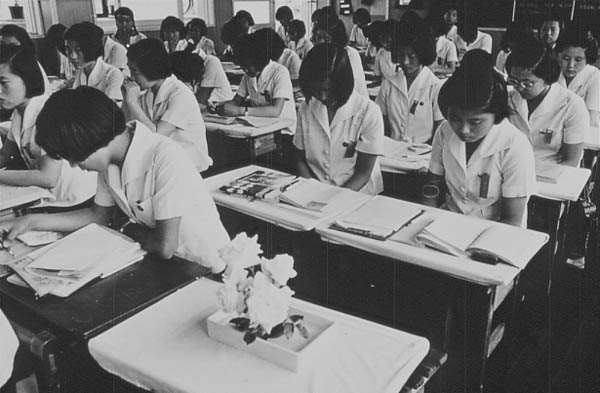
Memorial for dead classmate

Ahn Sung-ki's character, the former soldier, seems to be based on (if I remember correctly) a former drill sargeant who began to train some of the citizen's army on May 22. The movie, however, has little or no mention of the citizen's settlement committee, who were negotiating with the army, or the militant students who eventually took it over; as a result, Ahn Sung-ki's character seems to be, as leader of the citizen's army, the leader of the entire uprising, which isn't anywhere near the truth. If I wanted to be generous, I'd just say it's very simplistic. Also, it seems that, though a machine gun was mounted on the top of a building by the citizen's army, it was never actually fired.

Lee Yo-won's character, a nurse, is well used, allowing the story to go into hospitals full of wounded and dying citizens (an interview with her is here). She later moves into a different role, of the woman who drove around and used a loudspeaker to try to rouse the people into making a stand against the army on the night of May 26-27, before the military returned to retake the city. Here is how Henry Scott-Stokes described her:
Suddenly, the silence was shattered by a female voice. Someone up at the provincial government office was using the loudspeaker system. It was a young voice, with a hysterical edge. As the girl shrieked on--her voice resounding over the darkened city--her words merged into a continuum, one continuous shriek, a wail that lasted for perhaps l0 minutes, on and on and on. What was she saying? "This is the end!" That was, no doubt, the pith of it--plus a token appeal to the citizens to come out and join the students, a few hundred students at most? I wish I could convey to you the passion in that voice... imagine that famous painting by Munch, the Norwegian painter, called "The Scream", with the mysterious face and hollowed mouth, and imagine that painting suddenly wired for sound, at tremendous volume, in a black studio. Then you may have some idea of the power of that voice. There is no moment in Shakespeare's entire tragic oeuvre that calls for a "scream" of that power. I listened, I waited. There was no sound of doors opening, no scuffling of shoes in the street. Where were the people of Kwangju? Locked inside their homes, with their doors barred. There was no sound of doors being unbarred, no sound of steps in the street...nothing. All of a sudden the voice cut off.
In the movie, her calls have an effect, and most of the main characters (all male, except for two) come to the provincial hall to fight to the end. In reality, as described above, no one answered her call. In fact, the remaining defenders sent away many of the high school students (and women) who were still there. When the assault comes, the soldiers storm in the front doors, but that's not how Terry Anderson remembers it (not to say that it didn't happen):
Just before dawn, I watched paratroopers filter quietly around the hotel, then begin their assault on the headquarters building. In classic urban warfare tactics, one unit swarmed up the outside of the building to the top, then began working its way down, floor by floor. The soldiers threw stun grenades into each room, shooting at anything that moved.
There are little details in the final battle I noticed, like in one scene a stack of folding chairs can be seen in the background, reminding me of this footage taken on the morning of May 27, after the battle at the Provincial Hall:


Despite such details, I actually thought the final battle was a little too brutal and over the top, in that the soldiers are shown killing everyone they find, when in fact there were many survivors, and some surrendered, as related here:
Armed fighters in the provincial building with Yun were dispatched to the front of the building, but the military approached from the rear. The soldiers ordered the rebels to throw their weapons out into the hallway and crawl out to surrender, or they would be killed. Some complied with the order and surrendered.
Officially, 26 died in the final battle, out of perhaps 150 people who remained in the provincial hall - though it was likely higher. Terry Anderson, in an interview, thought perhaps more than 50 were killed (more on the official numbers here). Of course, surrendering isn't tragic, and tragic and dramatic was what the filmakers were going for. As the Korea Times reported two week ago,
The film was screened in special premieres in Seoul, Busan and the fateful city of Gwangju Sunday. According to Yonhap News, some 3,000 Gwangju citizens -- including family members of victims -- saw the film, and most were unable to suppress tears and gave a long applause. "It's a film that makes us look back to Gwangju," said Yun Seok-dong, 80, whose son Sang-won lost his life as a citizen soldier.
I wonder if the 30 second close-ups of characters crying onscreen contributed to people being "unable to suppress tears". The movie really, really goes for the tear ducts, almost sadistically so. I was starting to wish that I had a stopwatch to keep track of all the crying scenes. That's not to say that there shouldn't be sad scenes, of course, just that there's no need to hit people over the head with it. On the other hand, I didn't know how I felt about a lot of the comic relief in the movie. I doubt the demonstrators were performing a 'gag' show in front of the soldiers before they opened fire - a lot of it just seemed out of place, kind of like how I felt when I watched the foreign characters in Please Teach Me English, who were acting like a Korean would imagine a foreigner should act - very strange.

That said, I liked the final scene, which reminded me of this story by Norman Thorpe:
Some of my memories of Kwangju are like photographs. One is a moving photograph--a slow motion picture of a scene I saw. In it, a man, perhaps middle-aged, steadily pedals a bicycle down a Kwangju side street. Like most Korean bikes in those days, his bike had a strong cargo rack built over the rear tire. Strapped onto this rack and extending out behind his bike was a pine coffin. Someone in this man's family was dead--most likely the victim was one of the many people who had been killed by the soldiers--and the man had gone by bicycle to fetch a coffin.

It is this bicyclist's solitary journey that has stuck in my mind as one of the most poignant images. As the rider leaned forward to get leverage on his pedals, I was reminded how each family had had great hopes for whomever had died, especially for those who had been students. I had just met some of those students in hospitals - lucky ones whom the bullets had only wounded. But here was something I hadn't thought about. Some of the families were so poor that they could only bring a coffin by bicycle. And now in a wrenching upheaval, the focus of their hope was gone.
I was thinking of how the final scene made clear what had been lost, and then remembered Mark's comparison of this film to Titanic, which is a pretty good comparison, now that I think about it. In the end, it's an entertaining tragedy set during one of modern Korea's most tragic historical moments, and is a pretty typical movie made in Korea these days, what with the simplification of history, the ridiculous comedy, the scenes designed to make viewers cry, and well done action set pieces and strong production values. But it's not going to tell you much about the Kwangju Uprising other than lay out the barest outline.

I'm not sure how popular this film will turn out to be. The theatre was less than half full (at a 10 pm showing on a Wednesday (opening) night). When I brought this up in some of my classes, a number of students said they wanted to see the movie, but one told me that though she was interested in it, she didn't want to see it. When asked why, she said, "It'll be too sad."


(At the top of this search, below the poster at the top, are several photos. If you want to see a four minute encapsulation of the film, click on the one titled M/V. If you want to see night vision camera shots of viewers crying in the theatre during the movie, click on 'Making')

Jaws!

Oh, the things you find on Youtube. This is my favorite popsicle - here's an ad from the 1980s:


Just in case this doesn't work, here's a link to the youtube page.

Tuesday, July 24, 2007

Garibong-dong Redevelopment

Erasing the Guro Industrial Complex (from here)


The Guro Industrial complex was built in the mid-to-late 1960s and became one of the main areas in Seoul where textiles and wigs were made, mostly by young women, for export.


The photo above was taken in November of 1974 (more can be found here). The Garibong-dong area southwest of the industrial complex has changed somewhat since that time, however, in both appearance and residents:
After the blue-collar workers and democratization protesters who initiated the country’s labor movement in the area left to pursue better jobs, jjokbang, cage-like rooms built for the factory workers, became filled with migrant workers, mostly from China, looking for cheap rent and daily manual work. As of December last year, about 15,000 ethnic Koreans from China had registered at the district office, followed by 637 Chinese, 232 Taiwanese, 208 Malaysians and 153 Filipinos, according to district office data. If illegal aliens are added, the office said, there are about 20,000 foreigners in the area.
Another Joongang Ilbo story tells about the improving relations between the Koreans and Korean-Chinese living in the area (though there may be the odd incident). The only reason anyone outside of Korea might know about Garibong-dong would likely be due to the fact that it was the setting for the 2001 Im Sang-soo film Tears.

Below is an aerial shot of the area south of Yeouido and Yeongdeungpo station taken in 1966. The Guro Industrial Complex (which was about 500,000 square meters) is at bottom left. Notice the farmland still present at that time (click to enlarge).


Here is the same area today. It's a little more urban.


The area outlined in red needs some explanation. This 2003 article finishes with the following lines:
But many of the old textile factories and assembly lines have recently been replaced by high-tech start-ups and other cutting-edge industries. Most of the Korean- Chinese are unskilled, which means, some say, their days of working here are likely to be numbered.

The first-mentioned Joongang Ilbo article continues:

Joseonjok Town in Garibong-dong, Guro District, western Seoul is scheduled to be destroyed in 2009 as part of a city redevelopment project. Under the plan, the Garibong area will be transformed into business and residential centers to support 859 information technology start-up firms operating in the district.

“The area is designed to provide convenience to information technology businesses in the district. There will be hotels, convention centers and shopping malls, as well as a residential area,” said Jeong Woo-seok, an official at the Korea National Housing Corporation in charge of the redevelopment project.

A rendering of the new development. Bye Joseonjok Town.

The redevelopment project, which aims to be completed by 2012, targets 279,110 square meters (3 million square feet) of areas in Garibong that now contain cramped residential buildings, Chinese restaurants, bars, grocery stores, tour agencies and street markets.

On July 9, Guro’s district government announced that a city committee had approved its plans to change the name of the road in Guro 3-dong from Gongdan-ro to Digital Danji-ro, wiping away the name that evokes an industrial complex and replacing it with one that suggests shiny new technology. The subway station in the district was given a new name in 2005. Today, you can call it Guro Digital Complex Station. Its old name, Guro Industrial Complex Station, will be wiped off the map.

The district seems dedicated to covering up its unflattering past as the home of manual workers at textile, wig-making and printing plants from the 1960s to the 1990s.

Reading about the name changes, of the desire to wipe away the past, reminded me of Antti's post about the desire of residents in nearby Sillim-dong and Bongcheon-dong to change the names of these neighbourhoods, due to their association with the poor hillside neighbourhoods of the 1970s and 80s (or even later). In one bit of irony, he cited Guro's efforts to efface its past as precedent for such renaming. Also ironic is that Korean-Chinese are beginning to settle in Sillim-dong.
Sillim 4-dong, jammed with flats and small apartments, has two or three stores that specialize in ingredients for Chinese dishes. There are more than 10 traditional Chinese restaurants with Korean-Chinese chefs, and many of the customers are actually Korean-Chinese.

"The number of people coming to Korea from China has increased since 2003, and people favor working in the service field instead of manufacturing sectors," said Kim Yong-pil, the chief editor of "China-Korea Town News."

He explained that the Garibong or Guro areas were favored because they had cheap rooms and the Chinese first started working at factories in the areas. Since the Guro Industrial Complex became a digital complex, it doesn't attract that many Korean-Chinese anymore.

It's understandable that Guro's district office wants to create a new 'brand' for the district and move in a 'digital' direction (and wash away those memories of wig factories) but it's interesting that one of the best-known foreign enclaves in Seoul is being razed. Is this the typical redevelopment at the expense of the poor we see in Seoul regularly, or, with the central government resettling North Korean refugees in ways that discourage the formation of North Korean 'ghettos', is there more to it than that? This Chosun Ilbo article from a few months back lists a number of foreign enclaves in Seoul. What's interesting is that Changshin-dong, where 'Nepal town' is, will become a new town in the near future. The plans for the new town pre-date the influx of Nepalese restaurants, however, and are likely more a response to the remnants of the (still active) textile sweatshops there than anything else.

Friday, July 20, 2007

The Flood of 1925


A year ago this week, many of the areas next to the Han River were submerged (as can be seen here), though it may be worth remembering that 72 years ago this week, much of Yongsan was underwater, along with parts of Noryangjin, Yeongdeungpo (and likely all of Yeouido, I would guess), Ttukseom, Jamsil-do, and other areas next to ( and islands in) the river. This was due to the constant rain that had fallen between July 15 and July 18, 1925, and according to this, it killed "over 600 people [and] damag[ed] a good 17,000 houses". Beyond Seoul, it seems several villages were destroyed and crops were ruined, or so a glance at the snippets of US newspaper articles from the time available via Google tell us, such as the Chicago Daily Tribune, on Jul 19, 1925 :
Flood Engulfs Corean Capital - Hundreds Dead
Dikes Break - Sleepers in Homes Carried Away.

Hundreds of Coreans have perished and thousands more are threatend with starvation as the result of floods at Seoul following torrential rains which started Thursday and continued intermittently for two days, according to a radio message from there tonight.
A New York Times article from two days later is headlined "Korean Flood Recedes.; Rescue Work In Seoul Continues, but Crops Are Ruined."


Above is a photo of the Han River Railway Bridge and the Indogyo Bridge (like almost all of these photos, its from Seoul Through Pictures 2: Seoul under Japanese Aggression(1910~1945)). The railway bridge didn't fare so well in the flood:


Yongsan didn't fare well in the flood either:


The Tudor-looking building above is Yongsan Station. Here's a clearer view of it:


The location of the station can be seen on the map below, from around 1920:


Notice the location of the 'Railway Official Residences' above. Perhaps that's what we see in the photos below, which were all taken in Yongsan:


Noryangjin didn't fare well either:


Neither did Yeongdeungpo (which leads me to conclude Yeouido - which flooded so often that it was considered useless, reflecting it's name "You can have it" - also was submerged):


Here's a shot of Songpa after the flood receded (I'm not certain if Songpa would have been on Jamsil-do or not):


In the area not so far from Songpa, one of the positive effects of the flood can be found - the flood unearthed the prehistoric dwelling site in Amsa-dong. According to this (again), one of Korea's earliest documetaries was about the flood:
Films have always been in love with the [Han River], right from the industry's beginning: in 1925, one of the industry's first pioneers Lee Pil-Woo directed, edited and was DP for 한강 대홍수 (The Great Flooding of the Han River), a documentary about the 1925 Han River flood.
In the aftermath of the flood, the Japanese colonial administration set to work building retaining walls and better drainage systems in order to prevent such a disaster from occurring again (though it often took many years of improvements for them to accomplish this task - even today floods break through the walls, like they did in the Dangsan area of Seoul last summer). One interesting thing I found was that irrigation improvements and retaining walls were needed in order to make the plains in present-day Yangcheon-gu (especially the Mok-dong area) a viable rice-growing area. It was the fact that rice grew there that left Mok-dong undeveloped until the 1980s (while Hwagok and Sinjeong had been developed in the 1960s and 1970s), making it one of the more upscale areas in Seoul. Funny how the history of the city played out that way.

Thursday, July 12, 2007

Redevelopment in Banghwa-dong

My last post was just one example of many redevelopment projects in Banghwa-dong at the moment (many of which are within a five minute walk of my home).

Here's a map of developments that have occurred in Banghwa-dong between 1990 and the present; there have been quite a few of them (click to enlarge).


If you're wondering why the southern third of Banghwa-dong has very little development, it's because they're going to build a new town there:


The fields on the right will be developed under the Magok 'R&D City' plan. This is just one of many plans floating around, so I wouldn't trust it too much.


At top right is the Incheon Airport Railway bridge, next to Gungsan (I took photos of both here). Banghwa-dong can be seen at left (my neighbourhood is jutting into the Magok area at top left - I love how it's depicted as being nothing but apartment buildings). At bottom center is the Balsan development.

I thought I'd try to animate (sort of) my map above, but the results aren't great on Youtube...

Jaeil Jutaek Redevelopment shots

I've got a few new photos of this development, so I thought I'd just put all the shots from the same angle together to show how it's been coming along.


Jan. 30


Feb. 3


Feb. 15


Feb. 18


April 4


April 21


April 29


May 5


May 10


May 25


June 10


June 30


July 9


July 15


July 21


July 30


Aug. 8


Aug. 15


Aug. 31


Sept. 9


Sept. 22


Oct. 6


Oct. 12


Oct. 23


Nov. 8

The pace really began picking up in July, and now it's rising one floor per week. [Update, Sept. 20] As it's set to have 12 floors, it should be done in 3-4 weeks. [It was finished Oct 31].

Wednesday, July 11, 2007

Tears in Pyeongchang

The soon-to-be-crying children are at bottom left.


While working on another post, I'd planned on posting a photo of the kids crying in Pyeongchang after it was announced that Sochi, Russia, and not Pyeongchang, had gotten the 2014 winter olympics. As usual, a quick search for another photo or two led me in another direction. The photos below came from various sources (1, 2, 3, 4, 5). One source is a video, which I'll get to in a moment. A screenshot from that video (above) shows us the gathered citizens at 8:22 in the morning on July 5. As the Joongang Ilbo tells us:
Nearly 3,000 residents of Pyeongchang gathered to watch the announcement on a giant screen, but they walked away with tears of disappointment. Celebratory concerts and festivities were cancelled.
Giant screen? Combine that with the image below and you've almost got something akin the scenes we saw during the world cup last year (and in 2002), with perhaps civic pride being mixed in with the sports and nationalism this time.


Alas, it was not to be. The little girl below was seen crying in just about every Korean newspaper and broadcast, and even overseas. What happened? Did she realize that they were going to have to go to school that day after all?


Her friend on the right looks on with concern as she continues crying; then she begins to console her.


Then she starts to cry.


Now the boy on the right is crying. And what's that girl in the background (wearing the yellow bandana) on the left doing? Is she smiling? (Yes)


She's not smiling now.


Nope, she (yellow bandana girl) is looking decidedly sad. The girl on her left looks like she's either smiling or confused.


Yellow bandana girl is standing up and wiping her eyes now. Her friend on the left looks confused, but isn't smiling.


Unlike most of the others, we can actually see yellow bandana girl shedding tears. Now her friend is starting to wipe them away.


Yellow bandana girl has removed her bandana and now she and her friend are both using them as a hankerchiefs.


Now the girl on the right has moved to the left, and finally gotten around to removing her "Yes" bandana. She looks like she's about to cry.


Actually, if you watch the video below (from which the still above is taken), she looks like she's trying to cry, but isn't having much luck; the video cuts away from her before we can see the fruits of her efforts.


What could be motivating this contagious crying? It should be pointed out that it seems the crying doesn't begin until the man on the screen finishes a speech and begins wiping his eyes with a hankerchief.


One of the most important influences can be seen in the background of the photo below. What we don't see in the rest of these photos are the dozens of photographers who are taking photos of of these children.


The screenshot above (like all of the yonhap news screenshots) were taken from a video that can be found here (it's playable in Mozilla, but you may want to open it in a new window - it resizes your browser). It really is a must-see; watch to see how people act when cameras focus on them after the loss is announced. Also, listen for the sounds of cameras as the children cry - there are lots of them).

Whoever shot that video, you'll notice, filmed shots of the same people before the announcement, going for the obvious before and after effect. I've pointed out how it spread throughout the children, following the first girl's example as dozens of cameras were pointed at them. What really stood out for me were how the adults began to cry when cameras were put in their faces. Notice that because they've covered their faces with the banners-become-hankies, few tears can be seen.

Other photos can be found here.

One might be tempted, seeing as it was just over a year ago, to remember the crying fans after Korea was eliminated from the 2006 world cup.


The funny thing was, I was there, but I didn't see any crying, just disappointment. While it's possible that those in front of city hall were of a more patriotic breed, my guess would be that there were dozens of photographers there ready to record the outcome. Again, the person who took this photo probably was standing quite close to her, so she may have been compelled to act 'correctly'.

When I saw these images, I immediately thought of something I'd been looking into for another (unfinished) post, about funerals in Korea, and how the media deals with them. Funeral rituals here, traditionally, call for crying at appropriate times, though the relationship between the media and mourners is quite different than in North America. In North America you’d likely punch a photographer who tried to take photos during a funeral or a wake, but in Korea it seems to be accepted, judging by the number of such photos that can be found. I'd had no idea how realistic the cremation scene in Park Chan-wook's "Sympathy for Mr. Vengeance" was until I saw this photo:

Back in late April, the body of a girl who'd been raped and murdered was found in Jeju-do, and this is a photo of her parents at her cremation. I can think of lots of photos like this (and I'll deal with this in more detail in another post), and as someone from a completely different cultural background, I wonder why this occurs. Perhaps the concept of Korea being a shame society, where a person must "live up to [their] obligations and the expectations others have of [them]", is helpful. A camera carries the threat of thousands, or millions of people seeing your behavior, so perhaps that motivates people to act passively, even while mourning. A helpful comment on Lost Nomad's post about the crying children said, "When I saw that photo, I was reminded of news footage from North Korea after the death of Kim Il Sung." In North Korea, everybody is watching everyone else in a way which is quite oppressive. In Korea, perhaps it's the media that serves such a role.

In this case, it's not the death of a person, but the 'death of a dream', perhaps even a national disgrace. I found this article (via the Marmot) describing presidential hopeful Chung Dong-young, amusing: "
Pyeongchang was an unknown town. Now it is on the world stage, and it fought well and fought honorably," said Chung wiping away tears.
Doesn't sound like a politician at a funeral at all, does it?

In many ways, I find the reactions of the adults more interesting (because they 'know' how to act), but there were so many photos of the children it was possible to construct how the crying spread under the weight of the cameras pointed at them. The children are interesting as well because you can see how many of them didn't necessarily understand what was expected of them. This isn't to say, of course, that everyone acted this way. Many people in the video aren't crying at all, and I'm sure the ones that the photographers zoomed in on who didn't cry ended up on the cutting room floor. There were enough, however (there always are) to make you wonder just why it happens.

Other more material reasons may have been due to property speculation in what is now worthless land. As for reasons why Pyeongchang didn't get the Olympics, James Card has long list here.

Sunday, July 08, 2007

Fake stream, fake river, fake island

Yet another bone tossed to the construction industry (from here).

This is from a few weeks ago, on June 18:
Former Seoul Mayor Lee Myung-bak, the front-running opposition presidential aspirant in December's election, proposed Monday creating a "Manhattan-like" island near the border with North Korea and building an inter-Korean industrial park there to ease military tension.

Dubbed "Na-deul," which means a narrow waterway in Korean, the manmade island would be home to a 30- million-square-meter industrial park aimed at "combining North Korean labor and South Korean capital" and helping the communist country open up, Lee told a news conference at his Seoul office.

The island, proposed on the west sea of the peninsular, "would serve as an 'open square of unification' bringing the North out into the open," Lee said ahead of Tuesday's presidential policy debate within the Grand National Party (GNP).
Funny, last time I looked at a map of the west coast, there were lots of islands, so I don't really see the need to build a man-made island. Sure, people might live there already, but that never stopped Lee from booting merchants from the Cheonggyecheon area when it was redeveloped, or from pushing New Town redevelopments that have seen 76% of people forced to leave the Gileum New Town area, unable to afford the new apartments. Of course, pretty much every single endeavour Lee has undertaken has involved the construction industry, so simply moving everyone off their land may not be quite the handout of taxpayers' money that the industry was hoping for - best to build a fake island, to add to the fake stream downtown and the fake rivers his canal plan will create. In fact, he's linked the canal and the island together:
Lee suggested his proposed inter-Korean complex near the border with North Korea could serve as a gateway to the canal, adding the North would be open to the project. "There is nothing to worry about because the North wouldn't take it as a direct threat to its regime," Lee said.
A post on this topic over at One Free Korea touches on why it wouldn't be a threat:
Lee Myung-Bak wants to build another [Kaesong], even though the costs are so much more manifest than the gains. And if the idea isn’t stange enough, North Korea has about 300 miles of wasteland — just look on Google Earth – on which it could be built. Instead, Lee insists on helping Kim Jong Il isolate any reforming influence by building an island to put it on, which reveals just how insincere the reform-through-slave-labor theory really is.
Also to be found at One Free Korea is a very thorough look at Lee Myung-bak written two years ago, which also led me to an article criticising how much Lee spent on PR during Cheonggyecheon's construction and around the time of its opening (which may have helped it become the 'hit product' of 2005). Also worth mentioning is that Lee isn't doing anything new here, even for the GNP. I talked to someone in the planning department of the Gyeonggi-do government who told me that they had been planning for a few years (under Sohn Hak-kyu) to develop Paju into a transhipment area for goods from North Korea.

Of course, Lee may have other things to worry about these days, what with his reporting of fake residences coming to light, as well as his apparent selling of land to relatives in a district which was chosen as a New Town when Lee was mayor of Seoul. If the latter allegation turns out to be true, it will be interesting to see how he tries to weasel out of it.

As for Nadeul Island, I found this to be pretty funny:


Look closely at the Han River in Seoul. Notice the two islands? One is Nanji-do, which disappeared decades ago (after it became a dump, and is now World Cup Park), while the other is Jamsil-do. I was surprised to stumble onto this fact as well - that the Jamsil area was once an island, and was reclaimed before being developed in the 1970s. What's also interesting is looking at the west sea coastline around Incheon, because it no longer looks like that at all. The Songdo new city should be about a centimeter south, and much of the coast is now several kilometers further out into the sea (though for some reason, despite it being an old map, they chose to make Incheon Airport (also built on reclaimed land) look correct). I wonder if, by choosing such an old map, the paper was trying to say, "Ahh, the whole damn coast is fake - why not built another fake island?" More likely it was just a mistake, but the juxtaposition is a little odd.

Tuesday, July 03, 2007

"Fainting play"

That's the translation of my new word for the day: 기절놀이. For the unenlightened (as I so recently was), this Joongang Ilbo article provides an introduction.:
An elementary school boy in Gunsan, North Jeolla, was found unconscious around 9 p.m. on Thursday at home by his father. The boy appeared to have strangled himself with a cord used to carry a book bag, police said yesterday. The child was moved to a nearby hospital, but died Friday.

“He used to play the choking game, in which he strangled himself with a rope. I have scolded him many times,” the victim’s father was quoted as saying by the police. Police believe the boy killed himself while playing the dangerous game. Choking has become an increasingly popular schoolyard activity in Korea in recent years among some elementary and middle school students, educators say.

In the game, youngsters restrict the supply of oxygen to the brain, often by pushing hard on the chest or through strangulation. It is said to create a sense of euphoria.
Photo from here.
It is not the first time that the highly dangerous activity resulted in serious injury. In July last year, a middle school student in Iksan, North Jeolla, died after he passed out during the game and fractured his skull on the floor.
There are a few videos and photos to be found on Naver, but not many, though news articles referencing this pastime go as far back as June, 2004. The photo above dates from last year. The Chosun Ilbo also has a brief article about this most recent episode, while another photo, said to be of a boy holding a string intended for choking, can be found here:


A news report using the footage from a year ago can be found here. In it, a young student is asked by a reporter why they do it. The obvious reply? "It's fun."

Apparently, it's thought to be fun by kids from all over the world, at least according to wikipedia:
Practitioner demographics are strongly weighted towards juvenile males but includes females and adults of both genders. The activity has been responsible for a large number of juvenile deaths and permanent neurological disabilities almost entirely among the juvenile male cohort. There are estimates that as many as 250 to 1,000 young people die in the United States each year playing some variant of the choking game. Tracking the exact number is difficult because many of the cases are reported as suicides.
You learn something new every day.

Updates:

Oh, hold on, Lost Nomad has a post about this - the comments are worth reading. So does the Paint Roller blog, where Joe makes clearer the idea that this has come from the US (or elsewhere in the world) to Korea. Whether that was around 2004, when the first articles on Naver turn up, or earlier, I have no idea.

Monday, July 02, 2007

Balsan development video

I finally got around to putting this together.