Photo from the Chosun Ilbo
The passageway through Namdaemun has been opened to the public for the first time in 99 years. As the Chosun Ilbo tells us,
entrance to the national treasure had been forbidden since 1907, when the occupying Japanese government regulated traffic by removing the fortress walls on both sides and putting in a road and streetcar line.So now, you can see a long hidden painting on the ceiling. "But how do you get over to Namdaemun? Isn't it surrounded by a huge traffic circle?" you may ask. Not anymore! Seoul City, under mayor and presidential hopeful Lee Myung-bak, has not only uncovered Cheonggyecheon and built a grassy plaza in front of City Hall, but as of last May, it has also built a grassy knoll in front of Namdaemun, which allows people to walk up to the gate without fear of certain death. This article describes how Namdaemun came to be left adrift in a sea of traffic prior to the appearace of Sungnyemun Square:
Sungnyemun, built in the seventh year of the Chosun King Taejo’s reign (1398), is the oldest wooden structure in Seoul, but the surrounding fortress walls were removed in 1899 to build a streetcar route. After the destruction of much of the area as a result of Japanese colonial urban planning, the gate had stood on a desolate traffic island, unapproachable to visitors.So now, you - hold on. 1899? I thought it was 1907 when the walls came tumbling down. Oh well, anyways.... Robert over at From the Nakdong to the Yalu linked to a post about the re-opening of Namdaemun at Max Watson's photoblog. There are lots of photos of the re-opened gate, including the ceiling painting. Further down the page, he's also posted a few historical photos of Namdaemun, one of which I'll post here:
 Now, if the doors of Namdaemun have been closed since 1907, then obviously this photo must have been taken before then, as you can clearly see people walking through the gate. My first thought, however, was, "That's Seoul in 1907? Look at all those multi-storey brick buildings. It seems a little too modern looking for that time. I dug up a photo taken from Namdaemun's balcony around 1900:
 Only two buildings over one storey tall are visible. Still, it might be possible to build that much in such a short time (Kushibo's post on Incheon's modernization (take the quiz yourself!) helped convince me of this). Searching around some more, I turned up photos from the book Korea Through Australian Eyes, which is a collection of photos taken by Australian photographer George Rose in 1904. The latter link has several (sample) photos, including one of a newly created Tapgol Park. At any rate, the three photos at the top of this page are of Namdaemun and the city wall in the vicinity of the gate. Let's have a look: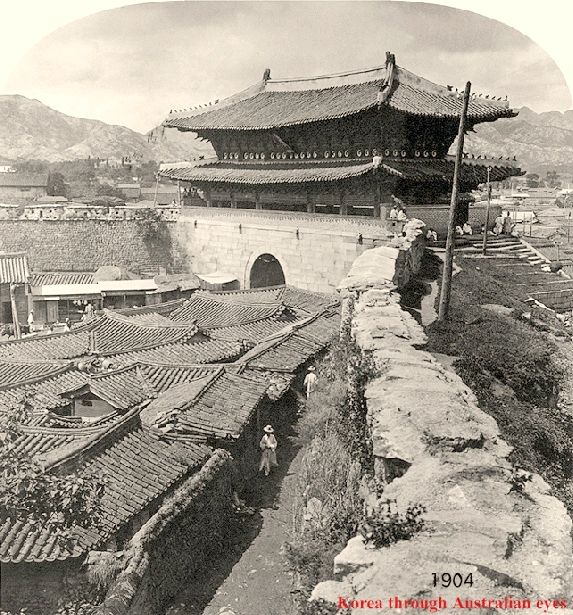
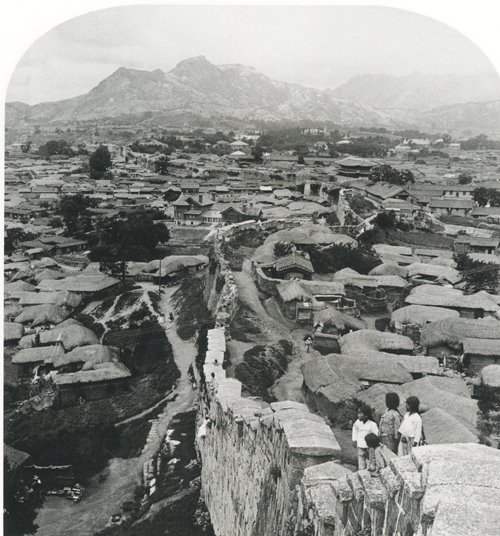
The first photo is easy enough to identify; the second is a view of the city wall snaking towards Seodaemun, taken from Namdaemun. [EDIT - Actually it's Namdaemun seen in the background, taken from Namsan - see comments] As these were taken in 1904, they raise some rather important questions:
Were the walls around Namdaemun torn down, the small houses razed, the entire area paved, and several multi-storey buildings built in the space of just 3 years? Or is the "1907 Photo" (again, below) actually from a later date, when the passageway through Namdaemun was still open? And if it was still open to the public at a later date, why is the city telling us it's been 99 years?
The Chosun Ilbo, above, showed that it was able to give two different dates (1899 and 1907) for the destruction of the walls around Namdaemun. Is the city government also making a mistake? Is it ignorant of its (possible) error, or does "99 years" make for better marketing? As Cheonggyecheon was voted as the best 'brand' of last year, it doesn't hurt to think this way. Is Seoul city playing fast and easy with historical facts to make a more compelling tourist attraction? Are they just dimwits and unaware of their mistake? Or is it I who is mistaken about the pace of Seoul's development between 1904 and 1907? Only time will tell!