Showing posts with label WWII. Show all posts

Tuesday, November 22, 2016

Korea Herald on HIV tests for English teachers

The Korea Herald published an article the other day titled "Controversy persists over HIV test for English teachers." The most important part of the article is this section:
This policy, introduced in 2007 after complaints from locals over “dangerous law-breaking foreigners,” including English teachers, may come to an end soon, as the government is considering a recent recommendation by the country’s human rights panel to do away with it.

“The Justice Ministry is collecting opinions from relevant ministries such as the Ministry of Education and the Ministry of Health and Welfare to decide whether to accept the recommendation,” it said in response to an inquiry by The Korea Herald.

A recommendation of the National Human Rights Commission of Korea is not legally binding, but the government must decide whether to accept it within 90 days. In this case, the deadline is Dec. 7.
Hmmm. While it's good to know when the deadline is, December 7 [or the 8th, in Asia] isn't a day in history which featured Westerners being particularly well-treated in Asia.

 Monument to Asia Rising...

...December 8, 1941.
(This is what replaced Horace Underwood's statue at Yonsei University; it now stands in the garden of Yonsei's museum. Hat tip to JiHoon for showing me this.

But back to the article:
"We made health checks mandatory for some foreigners through a revision of the AIDS Prevention Act in 2007 after some crimes by foreign language instructors and illegal drug use led to social problems," an official from the Justice Ministry said.
And I was just voted president of the United States. Seriously? How about: "We made health checks for HIV and drugs mandatory for some foreigners through a policy memo which, when challenged, we said was perfectly legal but meanwhile were quietly changing to an enforcement ordinance / regulation which was passed on April 3, 2009, almost a year and a half after we began testing teachers" (first result here; check cache for non-hwp version). The E-2 tests were not enforced by a revision of the AIDS Prevention Act.
"Even if we scrap the mandatory HIV testing, many are still subject to the testing according to the AIDS Prevention Act by the health ministry or Private Institute Management Act by the Education Ministry," the official said. "And we don’t send back foreigners or don’t refuse to issue alien cards when they are proven HIV-positive."
Again, there's nothing connecting E-2 visa-holders to the Aids Prevention Act, As for the Private Institute Management Act, have a look here. You won't see anything about HIV tests. Drug tests are mandated, yes, but not HIV tests. But hey, that's just two things completely wrong. I'm sure we can take the "And we don’t send back foreigners or don’t refuse to issue alien cards when they are proven HIV-positive" at face value.
In 2009, Lisa Griffin from New Zealand, who was then an English teacher at an Ulsan-based elementary school, filed a petition to the NHRCK as well as to the UN International Committee on the Elimination of Racial Discrimination after her school refused to renew her contract over her refusal to submit an HIV test result.

The UN committee ruled last year that HIV testing of teachers on E-2 visas is racial discrimination, saying the policy is not “justified on public health or any other grounds.” The committee urged the Korean government to compensate her for moral and material damages.

In September, the NHRCK also backed the UN decision, calling it "stigmatizing" and "discriminatory."
This muddles the chronology. Yes, a petition was filed to the NHRCK - which rejected it. A petition was also filed to the Korean Commercial Arbitration Board - which rejected it. The only reason it could be taken to CERD was because these "Local [or domestic] Remedies" failed to provide redress. The NHRCK only took up the case after CERD ruled in Griffin's favor.

Shall we pass by the assertion that "Without the HIV testing, there is no way to screen teachers from abroad and keep our children safe"? Like shooting fish in a barrel, so let's. Moving on:
But Lee Kyung-ja, who heads the parents’ rights group Student First, said that foreign teachers and Korean teachers alike should go through the HIV testing. "It is worrisome that more and more young people contract HIV-AIDS these days and we don’t know where they get it from," Lee said. "To ensure children’s health, all teachers -- whether they are foreign or local -- should prove that they are HIV-free."
To her question about where they get it from: having sex with someone who has HIV or sharing needles. Mind you, the drug arrest reports for foreign teachers tend to reveal busts for marijuana or perhaps ecstasy - not the kind of thing you inject intravenously. The article includes these statistics:
According to government data, the cumulative number of HIV and AIDS patients was 10,502 through last year, since the first case surfaced in 1985, with 92.7 percent of the patients being male. There were 1,152 newly registered cases last year, with 33.3 percent of them being in their 20s. Among them, 1,018 were Korean.
There are more statistics here (since 1985).
[T]he compulsory HIV testing of certain groups will only reinforce long-held stigmas and fear surrounding HIV and AIDS in the country, alienating and excluding people living with the disease, another expert said.

Patients living with HIV and AIDS are often subject to discrimination and have trouble accessing health care facilities, traveling and seeking employment.

"The government’s health polices for preventing HIV-AIDS come from ignorance," said Son Moon-soo, who heads an association of HIV and AIDS patients called KNP+. "The outdated measures create the wrong perception that HIV-AIDS is a foreign disease which foreigners brought into the country." [...]

"Rather than implementing discriminatory policies against foreigners, there should be more education on safe sex and how HIV-AIDS is transmitted and prevented to fight the disease," Son said.
As has been noted before, the stigma in Korea against HIV-AIDS is pervasive and has stark consequences for those who have been infected. In fact, the stigma is deadlier than the disease.

Sunday, November 13, 2016

Seoul's colonial-era 'Defense-of-the-Nation Shrine'


Korea Expose published an interesting article about the forgotten history of the above set of steps in Haebangchon. Especially interesting was the interview with a local woman who remembers going to the Shinto shrine which used to be at the top of these stairs. The article risks confusing this shrine with another, however.

The actual Gyeongseong [Keijo, or Seoul] Shrine was built on the slopes of Namsan south of what is now Myeongdong Station in 1898; a few stone remains can be seen behind Sungui Women's University. It stood not so far from the original Government General Building (built in 1907 before moving, famously, to the large building that stood behind Gwanghwamun until 1996). Also nearby was the Japanese ambassador's residence (built in 1893, before another was built on what is now Yongsan Garrison in 1909, before the final one was built in 1937 on the location of today's Blue House). Photos of all of these can be seen here.

The more famous Chosen Shrine was built in 1925 and almost became the location of a new national assembly in the early 1960s; it now has an Ahn Jung-geun museum and other monuments to Korean independence fighters. There was also a military-related shrine on what is now Yongsan Garrison (I've never seen any photos of it) as well as other smaller ones throughout the Japanese parts of the city and throughout the country. These did not survive past 1945.

The shrine in the Korea Expose article was the 경성호국신사 (more photos can be seen here). If we follow Norma Field's translation of  호국신사 (in In the Realm of a Dying Emperor: A Portrait of Japan at Century's End), this would be the Gyeongseong Defense-of-the-Nation Shrine. She writes that in 1939 a directive stated that each prefecture in Japan was to have one official such shrine. The souls of dead soldiers were to be enshrined there, and if this sounds familiar, it might be because these were essentially local branches of Yasukuni Shrine. Seoul's was built in 1943, and I'm not sure if Korea had only one such shrine in Seoul, or more than one (though I'd lean towards just one). They would have been used not just for enshrinement of Koreans (who were only being used by the Japanese military in small numbers as volunteers or POW guards up until 1944) but for Japanese who were living in Korea.

At any rate, it would be a shame to see those stairs disappear, which the article states is a possibility. Surely if some of the secondary stairways related to the main shrine on Namsan (now standing near memorials to independence fighters) can be allowed to remain, these can as well.

Monday, April 11, 2016

Interview with The Korea File on WW2 POWs in Colonial Seoul

Last year I posted links to an interview Andre Goulet did with me for his podcast, The Korea File (Part 1: "A History of Korean Social Movements," Part 2: "Korean Identity and Anti-Americanism," Part 3: "Weed, Counterculture and Dictatorship") and a few weeks ago he posted a the final part, "Prisoners and Propaganda: WW2 POWs in Colonial Seoul."

Thanks again to Andre inviting me to do this interview; have a look under "Episodes" here to look through the other interviews about Korean music, culture, and society he's done.

More about the WWII allied POWs in Korea can be found here.

Friday, February 28, 2014

Russian tiger hunters on the slopes of Baekdusan

I hadn't realized Andrei Lankov has a blog, which I discovered the other day. Lots of interesting things to be read there, but one not-well-known story is that of the White Russians who fled the Red Army's victory in the Russian Civil War in 1922 and ended up in Korea. There were in fact several thousand White Russians who spent the winter in Wonsan that year before most moved on to other places. The story of those who remained can be found in several places, most notably Donald Clark's Living Dangerously in Korea: The Western Experience, 1900-1950, a book well worth reading, as well as Mary Linley Taylor's A Chain of Amber. One of the more interesting families were the Yankovskys, who ran a resort near Baekdusan; Lankov tells their story here. (Mary Linley Taylor also wrote a book about the resort called The Tiger's Claw, but I've never read it.)  Their story didn't end so well; to run such a venture in colonial Korea required ties with the Japanese authorities, and this, along with the fact that they were White Russians, did not serve them well when the Red Army poured into Korea at the end of World War II.

I saw a old movie poster in a restaurant the other day with Yul Brynner on it, which reminded me of this story, since he visited the Yankovskys' resort in the 1930s, so it was a little odd to discover Professor Lankov's blog a few days later and see their story right near the top.


Sunday, October 13, 2013

Robert Capa Exhibition

I was reminded the other day that the Robert Capa exhibition is still on at the Sejong Cultural Center near Gwanghwamun and continues until October 28. The exhibition celebrates the 100th anniversary of Capa's birth and displays original prints of his war photography. More information can be found here (and in Korean here).

Here's a good documentary about his life:


I should note, though, that there's a continuity glitch in the video on youtube. At 29:50 (the sudden 'gambler' speech) you need to jump to 44:50 and watch until 59:50, at which point you need to jump back to 29:50 and watch to 44:50, and then jump to 59:50. Not really that confusing - jump 15 minutes ahead, watch for 15 minutes, jump 30 minutes back, watch for 15, and jump 15 minutes ahead. Or maybe it is confusing. Anyways, it's worth watching, even with a bit of myth making added in (though Capa himself cultivated his own myth throughout his life).

Wednesday, June 19, 2013

Some links related to Korea and WWII

[Update below]

A discussion at the Korean Studies List about why Korea was not bombed by the US during WWII led Bill Streifer, who runs the Flight of the Hog Wild website, to post a WWII bombing target map of Korea. It makes quite clear just how much Japan concentrated heavy industry and power generation in northern Korea.

The story of the flight of the Hog Wild B-29 bomber, about which Streifer is writing a book, is an interesting one. The bomber set out in August 1945 to deliver relief supplies to the allied POWs being held in Hungnam (now in North Korea) when it was shot down by Soviet planes - arguably the first shots of the cold war. He also tells the story of Operation Eagle, in which an American C-47 landed at Yeouido Air Base on August 18, 1945 in order to check in on the POWs in Seoul, and the rather interesting reception they got from the Japanese (download pdf here, starts on page 13).

On a related topic, the Korea Studies list also mentioned an article by Yong-ho Ch'oe which I found at Japan Focus titled 'Korean Prisoners-of-War in Hawaii During World War II and the Case of US Navy Abduction of Three Korean Fishermen' The story of Korean labourers captured on Pacific islands (in which at times only ten percent survived the battles which took place), of three Korean deserters from the Japanese army in Burma who joined the OSS, and of the three Korean fishermen abducted off the coast of Korea by a US submarine makes for interesting reading; the editorializing, not so much.

He actually compares the abduction of the three fishermen to North Korea's abduction of Japanese citizens:
Long before North Korea's kidnapping, the United States committed a similar act, equally outrageous and reprehensible. The American abduction of three Korean fishermen deserves no less condemnation by the American public. [...] They too were innocent victims of immoral and illegal acts perpetrated in the name of war.
Japanese civilians who were kidnapped and held for decades - or for the rest of their lives - in North Korea during peacetime and three fishermen kidnapped and held in a POW camp in Hawaii for six months during the biggest war in history? What an apt comparison!

And also on the WWII side of things was last night's RAS lecture by Czech ambassador Jaroslav Olša, jr. about Han Hŭng-su, who spent the early 1930s studying in Japan, and late 1930s and much of the 1940s studying in Europe before returning to North Korea and being purged shortly after the war:
His life and work made a lasting impact on South and North Korean archeology as well as on the study of Korean history and literature in Czechoslovakia and the knowledge of Korean literature in German-speaking countries in Europe. Multi-talented scholar, polyglot speaking at least six languages and author of numerous books and articles published in Korean, German, Czech, Polish and English, he is now being slowly rediscovered.
It was a fascinating lecture, and Ambassador Olša was an engaging speaker; I'll post a link to the video once it's available.

[Update]

Here's a map I made years ago of the cities the US bombed in Japan during WWII and the percentage of city area destroyed (sourced from 'The Fog of War'):


Tuesday, February 26, 2013

The Long-Forgotten World War II Prisoner of War Camps in Korea

[Update: Video of this lecture can be seen at the RAS-KB blog.]

Tonight Jacco Zwetsloot will be giving a lecture for the Royal Asiatic Society titled "The Long-Forgotten World War II Prisoner of War Camps in Korea." Here is a summary of tonight's lecture:
As an (unwilling) part of the Japanese Empire, Korea was involved in World War Two. We have all heard of the conscripts, the forced labor, and the comfort women. However, fighting did not actually occur on Korean soil. Soviet forces arrived in Korea from Manchuria in mid to late August, and US troops made landfall in Incheon on September 8, 1945 to receive the Japanese surrender and disarm and demobilize Japan’s military.

One aspect of Korean history during that period that has been forgotten – seemingly by all sides – is the approximately 1,500 Allied Prisoners of War who were held in Korea from September 1942, only a couple of months after the last non-Axis foreign civilians had been forcibly deported from Korea by ship. The first Allies to be imprisoned here were British and Australian troops from the fall of Singapore. They were joined towards the end of the war by American soldiers captured in the Philippines, after they were initially held in the notorious “hell ships,” as well as in Japan. In all, three camps were operated, run by Japanese officers and staffed by Korean conscripts and civilians. A few POWs died, but most were rescued and brought home in September 1945.
More details can be found here. The present day location of these camps in Seoul, Incheon, and Hungnam (North Korea) will be revealed, and I'll probably be speaking briefly about helping discover the location of Seoul's camp. Just for fun, here are a few photos:

Clockwise from top left: Konan (Hungnam) POW camp, 1945; Allied soldiers led into Keijo (Seoul) POW camp, 1942; Allied soldiers after liberation outside Keijo POW camp, 1945; Allied soldiers made to march in Busan, 1942.

The lecture will be held at 7:30 pm tonight (Tuesday) in the Residents' Lounge on the 2nd floor of the Somerset Palace in Seoul, which is north of Jogyesa Temple, and is 7,000 won for non-members and free for members.

Wednesday, February 13, 2013

1940s newsreels about Korea

I was looking around at archive.org and found some interesting videos taken at the time of Korea's liberation from Japan in 1945 and in the years following. Click the links to go to the page at the site and download the video.

The first is a newsreel of Korea's liberation by U.S. troops and the surrender of the Japanese in 'Yongsan, the capital of Korea.' Other than that mistake, it's got some interesting footage (jump to 2:10):


This video is raw, silent footage of U.S. soldiers disarming Japanese soldiers and marching through Seoul, along with other streets scenes and shots of Koreans. And in the screenshot we see below, is the man on the left with the camera dok1 (who's second from right in this photo, and who took this set of photos in Korea at that time)?


Next is this video of raw, silent footage of people in front of a train station in Seoul and shots of a train. I'm not sure if it's Seoul station or Yongsan or some other station. There are some disturbing shots of fly-covered children who are (one hopes) sleeping on the ground in front of the station.


Here is the first reel of a narrated 20 minute newsreel made in 1948 (but which uses footage from the above videos. There's some fascinating footage here on American aid to Korea, along with a dose of propaganda and falsehood.


Part 2 of this newsreel has an elementary school English class (outdoors) and scenes of a baseball game, as well as the training of police and nurses.


This video appears to be staged footage of the Korean War by, presumably, North Korea.

Tuesday, May 10, 2011

Guess that location

Can anyone guess what building's roof these men are exercising on?


There are at least two buildings which are still standing today in the background. The image is a panorama made from stills from the 1940 propaganda film 'Patriots Day in Chosen,' which can be found on this dvd.

Thursday, April 14, 2011

Photos of post-liberation Korea

While I've known that you could use Google to search Life Magazine's photo archives (these photos of communist murals in Pyongyang during the Korean War were linked to at the Marmot's Hole a few years ago) , I hadn't thought of doing more exploring until a few days ago. What turned up were dozens of photos taken by photographer George Silk in the fall of 1945 when US troops arrived in Korea after the end of World War II. These include aerial shots of the city (click on the source or other links to find the original, full size photos):


GIs were also photographed entering the town of Songdo, being led by a firetruck filled with local reporters...


...while being greeted by those watching the impromptu parade.


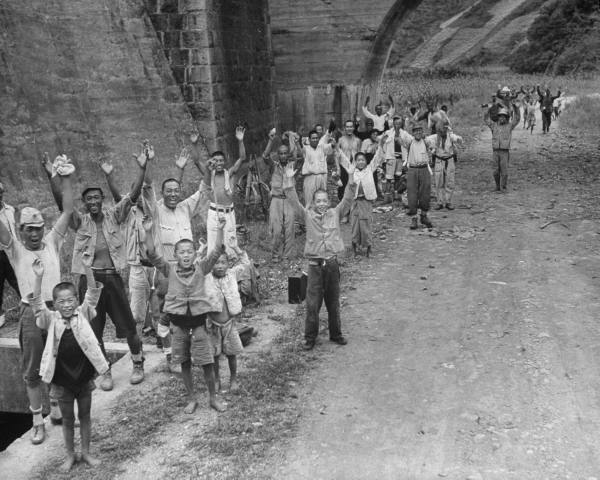
Photos were also taken of refugees "celebrating release from slavery in factories and returning to their farms," such as the one below and this one.


Other photos show buildings, such as the one below, decorated with signs welcoming soldiers and "displaying flags of occupying forces and portraits of the leaders of Allied countries" (note the use of the 'c' in Corea).


Some well known buildings, like the YMCA, also had such signs; Seoul Station apparently did not.

After signing the Japanese surrender, US troops disarmed Japanese troops before sending them home.

Source (see also here)

No doubt the Korean onlookers here were happy to see them go.


Seeing as a river is in the background, and the photo below shows the Hangang Rail Bridge at far left, the soldiers are likely walking across the present Hangang Bridge.


Of course, the Americans weren't the only troops who had entered Korea. Below is a photo of Russian troops (where exactly, I don't know):


Below is a photo of Russian and American soldiers gathering around a US jeep while Koreans watch.


Several photos, such as the one below, show the US soldiers and Russians interacting. The Americans seem especially taken with the female Russian soldier.


Other photos from this time period can be found here and here.

Tuesday, March 22, 2011

A preferred omission?

[Update]
This posting about the atomic bombings of Hiroshima and Nagasaki is also interesting:
Unlike many other bombing raids, the goal for this raid had not been a military installation but rather an entire city. The atomic bomb that exploded over Hiroshima killed civilian women and children in addition to soldiers. Hiroshima's population has been estimated at 350,000; approximately 70,000 died immediately from the explosion and another 70,000 died from radiation within five years.
I imagine the writer would be shocked to learn 67 cities had already gotten the same treatment.

Also, the Wikipedia page on the bombing of Tokyo has several photographs and maps.

[Original post]


There was an interesting omission in a Yahoo News article I read today:
Nuclear radiation is an especially sensitive issue for Japanese following the country's worst human catastrophe -- the U.S. atomic bombs dropped on Hiroshima and Nagasaki in 1945.
I'd tend to think that attacks on two cities - even atomic attacks - paled in comparison to the firebombing of 67 Japanese cities in the spring and summer of 1945. I was out with a Canadian and an American who were both nuclear refugees from Japan on Saturday night and the topic of how the firebombing of Japan had been pretty much forgotten in the west came up. My sister taught in Oita ten years ago and wondered if the city had been bombed during the war. I was never able to find out until I watched The Fog of War, which can be seen here. The firebombing of Japan is discussed for about 8 minutes starting around the 33:00 point. At one point it lists all of the cities bombed along with the percentage of the city destroyed (Oita's figure is 28.2%). Obviously having a lot of time on my hands, (predating this blog) I decided to make a map. It came up in discussion the other night, so I'd thought I'd post it - I just didn't expect the omission mentioned above to appear as I was doing so.


I wonder to what degree the firebombing is dealt with in Japan's memory of the war. As Michael Hurt reiterated recently, the memory of the atomic bombing of Hiroshima and Nagasaki - the only time nuclear weapons have been used on civilian targets - has allowed Japan to portray itself as a victim, so I'm curious if the firebombing has been downplayed at all in Japan, or in its presentation of its history to outsiders. Certainly, when westerners think of firebombing, Dresden or Hamburg come to mind - suffering firebombing wasn't a unique experience, even if was used to far more devastating effect in Japan.

This also brings to mind how the bombing of North Korea during the Korean War has been forgotten as well, though in the North's case, as Brian Myers has argued, it has also been omitted in North Korea's portrayal of the war to its own people, as massive bombing doesn't quite gel with the concept of Kim Il-sung being a protective leader and skilled general.

Tuesday, April 08, 2008

Those with blood on their hands, remembered and forgotten

[Update - the Korea Times tells us that in March Jang In-hwan was declared "Independence Fighter of the Month." It also tells us he "accidentally fired" at Stevens. Sure he did.]


In 1956, Korea's first president, Syngman Rhee, in a moment of modesty, had a statue of himself raised on Namsan.


After students protesting his tampering in the 1960 election were shot and killed, Rhee was forced to resign on April 26, 1960.


Needless to say, his statue didn't last very long:


By the end of 1960, the remains of two statues were stored in a backyard in Seoul.


On March 27, the Chosun Ilbo found out what had become of the statues:


As this editorial describes it,
In a corner of a backyard in a private residence in Myeongryun-dong, Seoul, sit two statues of Korea’s first president Syngman Rhee, rusting away. The statues were erected in the late 1950s during Rhee’s term and were pulled down during the April 19 uprising. Only the head is left of the statue that once stood on Mt.Namsan and is covered in blue rope, while the other statue that used to stand in Tapgol Park downtown stands right next to it gathering dust. The only reason these statues are kept in the backyard after spending years at a junk yard is because one high-ranking union official in the Rhee administration saved them during the late 1960s. The official emigrated to another country and sold the house, including the statue.
I'm sure you can imagine how the Chosun feels about a statue of Korea's first president being left to rust. It doesn't make the sound point that GI Korea makes, that Rhee ought to be remembered for his efforts in Korea's independence movement, (some of which can be found here) and not for the autocrat he became once he gained power.

Interestingly enough, March 26 was the 133rd anniversary of Syngman Rhee's birth, but it was also on that day in 1910 that An Jung-geun was executed for killing Ito Hirobumi. As long as we're noting numbers, he had fired the fatal shots five months to the day earlier. Also worth noting is that Park Chung-hee was killed on October 26, 1979, 70 years to the day after Ito was killed.

An Jung-geun

Ito Hirobumi

The Joongang Ilbo presented readers with this photo and caption describing the way in which An's death was commemorated:

A children’s choir sings yesterday at a ceremony marking the 98th anniversary of independence fighter Ahn Jung-geun’s death. He was executed for killing a Japanese diplomat in 1909.
A "Japanese diplomat"? While I realize it's the English language press, it seems a rather poor way to describe one of the founders of modern Japan and Japan's first prime minister. We're also told that "the Chinese government has promised “full cooperation” in the project to excavate Ahn’s remains from the site where the Lushun Prison, controlled by Japan, was located in the early 20th century." So whose bones are these exactly? They seem to belong to a man who shot and killed (let's use the word 'assassinate' instead of 'murder') a prominent former Japanese leader, and in doing so quite possibly hastened annexation. I'm not really sure this is a role model I'd want eight-year-olds singing hymns to. While I'm sure lots of nationalist heroes the world over have blood on their hands, it seems a further stretch to honor someone known only for assassinating someone.

I asked an Irish friend of mine if similar figures existed in Ireland, and he told me that Michael Collins is very popular, but in his estimation was often little more than a cold-blooded killer. The difference, however, is that Collins actually played a part in Irish independence, while An may well have played a part in speeding up the annexation process.

In remembering An, I can't help but remember two other patriots who I've written about before: Jeon Myeong-un and Jang In-hwan.


They, of course, killed Japan's American adviser in Korea, Durham Stevens, while he was visiting San Francisco in 1908. Oddly enough, the date he died was March 25.


When I wrote my post on Stevens months ago, there was no Wikipedia article about him, but within a few weeks one had appeared, helped greatly by the appearance of a book at archive.org with biographical information and the photo above, taken in 1903. That article is now full of information about him (kudos to the person or people who put it together). The article provides links to pages I'd never seen before. I'd pointed out before that the local Korean People's Hall in San Francisco has these busts of Jeon Myeong-un and Jang In-hwan (Pic from here):


As this article makes clear, however, they are not only remembered in San Francisco.
In January 1909, Chang was sentenced to 25 years in San Quentin. Chang said to the judge through his interpreter that he “preferred martyrdom by death rather than by imprisonment.” He served 10 years and was released in 1919. He died in 1930 at age 55 and was buried in a San Francisco cemetery. On Aug. 3, 1975, Chang’s remains were flown to Seoul to be buried in the National Cemetery of Martyrs and Patriots.
And so, it is there, every year, that this ritual takes place:


Of course, this year is the 100th anniversary. "Wait a minute," you're thinking. "It says above Jang died in 1930." That he did, but he and Jeon fired their fatal shots at Stevens on March 23, 1908. It's on that day that the two of them are memorialized. I wonder if they invited the U.S. ambassador.

I notice that there are no photos of those who these men killed at their memorials. I guess it's easier to believe that they were living up to abstract patriotic ideals when photos of their actual victims are not present. That's why, of course, Rhee has been vilified by many people - one need only visit the 4-19 cemetery in northern Seoul to see those who died under his orders on that day in 1960:


Because such photos are lacking in the memorials seen above, there is no reflection on the effect of the shots being fired, which might lead to empathy. There is only a celebration of the fact that shots - any shots! - were fired, with little thought as to what the consequences of those shots were. If you were to insert a photo of Ito behind that children's choir and they looked as they were being made to cheer his death, I'm sure they'd look slightly psychotic - to outsiders, at least. As long as there is no reflection on what happened after the shots were fired, it seems likely a group of assassins who did nothing to bring independence closer (and may have even hastened annexation) will continue to be held up as pinnacles of patriotism. Ironically, the one person whose efforts may have helped Korea's position as its fate was being considered towards the end of World War II now has his statues rusting in a backyard in Myeongryun-dong.