Showing posts with label Youth. Show all posts

Monday, May 02, 2016

Thoughts on the low age of consent and light sentences

While trying to find out more about this incredibly messed-up case - about a couple who beat their teenage daughter to death and then kept her body in the house for the better part of a year - I came across the following Joongang Ilbo news story by reporter Kim Min-gwan, from September 16 last year:
A man in his twenties who even received the motel fee from a 13-year-old schoolgirl found guilty of prostitution

A man in his twenties who met a 13-year-old runaway schoolgirl for sex but argued he wasn't guilty and said that "The schoolgirl paid more of the motel fee so it wasn't prostitution" was found guilty.

Seoul Eastern District Court announced on the 16th that is that it [sentenced] Mr. Lee (22), who had been charged with contravening the Law for Sexual Protection of Children and Youth, to a one-year sentence suspended for two years and ordered him to attend 40 hours of sexual assault treatment classes.

Mr. Lee came to know A (13) on June 10, 2015 via a smartphone chatting application. Learning that A had run away and needed a place to sleep he promised, "If you come to my house, I can put you up," and the next morning he called her out to the Uijeongbu Station area.

When he met A, Lee said, "It's hot right now, so let’s go and rest," and took A to a nearby motel. The motel fee was 20,000 won but Lee had only 8000 won in his pocket. Lee asked A, "Can you pay a little bit?" and got 10,000 won from her and, after getting a 2000 won discount, paid the motel fee.

After they had sex, Lee said, "My parents came home early so I can't put you put you up," and left A and returned home.

In court Lee claimed that "Since I had never promised to put her up at my house and I paid 8000 won of the motel fee but A paid 10,000 won, it wasn't buying sex."

Subsequently he protested that "Since A looked 20ish in her chatting program profile photo, in which she was wearing makeup, I didn't think she was a minor."

However, the court said, "It doesn't make any sense that you saw her face and didn't know she was 13." "Seeming to offer to put up a runaway victim at your house and meeting [her], you acted to buy sex to satisfy your sexual desire, and the fact that even after that you left her and ignored the fact that she was penniless because of you makes the nature of the crime very bad."

It added, "Because she expected that the defendant would give him a place to stay afterwards, she readily gave 10,000 won." "The defendant fully acknowledged the fact that he promised to provide payment for things like a place to stay and that, expecting this, A acceded to sex."

A court official said, "The amount of money when providing payment for prostitution does not matter; if it's true that payment is provided, then [the fact of] prostitution is established."
After moving on from my amazement at how someone could be that much of a scumbag, what I found interesting is that the defendant was content to suggest that he'd had consensual sex with a minor (though he did try to say "she looked 20ish"). Back in mid-2013 laws were changed regarding sex crimes (see here and here), particularly against minors, but these clearly did not affect age of consent, which is still 13, though there are certain limitations, as pointed out in this case, as well as its follow-up, higher-court appeal ruling, as described over at klawguru.com. As is noted there, having sex with someone between the ages of 13 and 18 is not a crime unless you did so "by authority/deception" (though not by "position of authority"), while having sex with someone 12 years old or younger is "a crime (unless you had no way of knowing)." Even the latter part seems to have wiggle room (as it did in a case in Gangneung a few years ago where an instructor in an elementary school was initially let off by police for having sex with a 12 year old student because they were "in love" - until they found out he was also "in love" with a 15 year old former student).

In the case I translated above, the man was only given a suspended sentence, and in this case, from 2009, a man was sentenced only to 6 months in prison for paying for sex with an 11 year-old girl (and that 6 month sentence was seen as 'severe' punishment, despite the maximum sentence being 3 years). Most famously, in the "Na-yeong case," where a man raped an 8 year-old girl who "lost 80 percent of her colon and genital organs," the defendant had three years knocked off the maximum sentence of 15 years because "I was drunk" was considered a defense. What we see in these cases is that there doesn't seem to be any desire to give out maximum punishment to men who sexually assault or exploit children. One possible reason for this is described in a Joongang Ilbo editorial written when sex crime laws were changed in mid-2013:
The revisions are only a step forward, although a significant one. A bigger problem is our society’s misperceptions about sex crimes. According to a survey of policemen in small and mid-sized cities in South Gyeongsang, a whopping 53.8 percent said that sexual violence occurs due to women’s sexy dressing. Thirty-seven percent said it’s a woman’s fault when she is sexually attacked while drunk. That clearly illustrates our society’s generosity toward men’s sexual impulses.
You know there's a problem when the police answer this way (though perhaps we won't be too surprised by such attitudes coming from "small and mid-sized cities in South Gyeongsang," considering what happened in Miryang in 2004 - but it's sad to see these attitudes hadn't changed ten years later.

Daniel Tudor pointed out something that has been overlooked:
There have been attempts to raise the age of consent, such as that of then-Grand National Party lawmaker Kwon Seong-dong, who tried to lift it to 16 in 2012. I am mystified as to why it is still 13. With the ever-increasing concern over child protection, I doubt any political party would have anything to lose by throwing its weight behind a legal change here.
And yet this attempt to raise the age of consent went nowhere. As one ponders this fact in the light of lenient sentence after lenient sentence for those who sexually assault or exploit minors, one might be tempted to reach some rather unpleasant conclusions.

Thursday, April 21, 2016

Modern day slavery in the 1970s, 1980s, and today

This story, about the decade or more of abuse of children and disabled people that went on at the Brothers Home in Busan, is pretty horrific. Almost as much as the government's attitude towards it:
The current government, however, refuses to revisit the case, and is blocking a push by an opposition lawmaker to do so on the grounds that the evidence is too old.

Ahn Jeong-tae, an official from Seoul's Ministry of the Interior, said focusing on just one human rights incident would financially burden the government and set a bad precedent. The Brothers' victims, he said, should have submitted their case to a temporary truth-finding commission established in the mid-2000s to investigate past atrocities. "We can't make separate laws for every incident and there have been so many incidents since the Korean War," Ahn said.
Well, we wouldn't want any more dirt on the president's father to be dug up, would we?
In 1975, dictator President Park Chung-hee, father of current President Park Geun-hye, issued a directive to police and local officials to "purify" city streets of vagrants. Police officers, assisted by shop owners, rounded up panhandlers, small-time street merchants selling gum and trinkets, the disabled, lost or unattended children, and dissidents, including a college student who'd been holding anti-government leaflets.

They ended up as prisoners at 36 nationwide facilities. By 1986, the number of inmates had jumped over five years from 8,600 to more than 16,000, according to government documents obtained by AP. Nearly 4,000 were at Brothers. But about 90 percent of them didn't even meet the government's definition of "vagrant" and therefore shouldn't have been confined there, former prosecutor Kim Yong Won told the AP, based on Brothers' records and interviews compiled before government officials ended his investigation.
The article makes a provocative claim:
Choi was one of thousands — the homeless, the drunk, but mostly children and the disabled — rounded up off the streets ahead of the 1988 Seoul Olympics, which the ruling dictators saw as international validation of South Korea's arrival as a modern country.
Except that Choi was arrested in 1982. Still, considering who was president at the time and the general 'clean ups' that take place in Olympic cities, it wouldn't be surprising. You'd think that the mass abuse of children would prompt more outrage, but keeping in mind the short sentences handed out for rape of children or the low age of consent, perhaps we shouldn't be too surprised. Maybe a movie needs to be made to draw attention, like 'The Crucible' or the one about the Burger King murder in Itaewon which resulted in the case being reopened.

Also related - since the children and inmates at Brothers House were made to work for free on goods made for export - is this story of modern day slavery on an island in southwestern Jeollanam-do; a video is here (hat tip to Gord Sellar).

This isn't anything new, however, as this November 28, 1971 Korea Times article makes clear:


Friday, January 30, 2015

Stigma prevents hero's welcome for Ebola medics

A column in the Chosun Ilbo criticized the lack of hero's welcome given to the first group of nine Korean medical workers who returned from treating Ebola patients in Sierra Leone for the last month. This is contrasted with America's response, where such workers were lauded as heroes by President Obama and selected as Person of the Year 2014 by Time Magazine. As is pointed out in the column, however,
Korea's medical workers were not just denied a hero's welcome -- they had to return home quietly due to fears that they and their family members would be treated as pariahs, shunned by a panic-stricken public, and asked for their identities not to be disclosed.
In fact, photos in articles about the doctors leaving for Africa in mid-December only show the doctors from behind. At first thought, this is very reminiscent of Korean attitudes towards people living with HIV/AIDS - see here, for example. But the more I think about it, I can think of other such examples, such as the way in which the children of people who were pro-North Korea were denied government jobs and other opportunities before the 1990s, or the way in which no student in school wants to associate with a child targeted as a "wangtta," fearing being tainted by the association, often leading to total isolation*, or - in a more humorous instance - the blogger Lost Nomad years ago wrote about how he could always get a great parking spot in his apartment building because no one wanted to park next to a particular, "dirty" car. Such stigma, and fear of "guilt by association," is troubling, to be sure.


* Years ago a student I got along well with one year became a wangtta the next year for several months, and though I talked to her previous and current home room teachers about the situation, and they knew who was responsible, they didn't seem to be able to do anything about it. It was heartbreaking to see the way in which she changed from a bubbly and outgoing to withdrawn and sullen.


Thursday, April 24, 2014

Some thoughts on Sewol

As of 1:38 this afternoon, of the 476 people on board the Sewol, 174 were rescued, 169 are confirmed dead, and 133 are still missing and presumed trapped inside the ferry. [Asian Correspondent has been providing regular updates.]

It's been reported that a "sharp turn made by an inexperienced sailor was the fundamental cause of the deadly capsizing of the Sewol ferry," though other theories exist (and are listed on the Wikipedia page). As well, even though the Captain should have been present on the bridge, he wasn't. As the Joongang Ilbo also notes,
The captain was also charged with fleeing the ferry and abandoning passengers, a violation of the Act on the Aggravated Punishment of Special Crimes, and negligence resulting in the death of passengers, a violation of the Criminal Act. If the captain is ruled guilty of all of those three charges, he could receive a life sentence.
The fact that the Captain and much of the crew - the able-bodied sailors at any rate - escaped from the ship and were among the first rescued has brought a storm of criticism down upon them. There is also criticism of the indecision which took place when the first distress calls were made (a transcript is here) as well as the other safety measures which failed:
The Sewol was equipped with 46 lifeboats that could each hold between 10 to 15 people. The lifeboats should inflate automatically once their pins are released. But only one of them functioned. 
This has led to a great deal of criticism and bitterness, with the Tokyo bureau chief of the JoongAng Ilbo penning an editorial comparing Korea's emergency preparedness unfavourably with Japan's and writing things like "In Korea, you die if you follow orders and save yourself if you don't" and "Let’s give up the title of "developed country" for now." As for blame, the current administration getting lambasted in some quarters, while elsewhere criticism falls upon the "opaque, undutiful and craven corporate" sector.

At the same time, stories of selflessness have been brought to light as well, including a crewmember and two teachers who died trying to save others.

Unsurprisingly, there have been many mentions in the (Korean) media about past accidents that resulted in great loss of life. A news search on naver (yesterday) turned up the following results for the following search terms:


489 results for 세월호 삼풍백화점, or the collapse of the Sampoong Department Store on June 29, 1995, which killed 501 people.


447 results for 세월호 대구지하철, or the Daegu Metro fire on February 18, 2003, which killed 198 people. [Photo.]


291 results for 세월호 성수대교, the collapse of the Seongsu Bridge on October 21, 1994, which killed 32 people, including students on their way to school. [I looked at it and the incident below here.]


40 results for 세월호 대구 지하철 가스폭발, the Daegu gas explosion, which took place during construction of the subway system, on April 28, 1995 killed 101 people, the majority of them students.  [Photo.]

[Out of interest, another disaster from that time period I came across was the Ahyeon gas explosion, which took place next to what is now Aeogae Station on December 7, 1994, and which killed 12 people.]

It's not surprising that collapse of the Sampoong Department Store in 1995 and the Daegu Subway fire are the most referenced, as they both resulted in a catastrophically high number of deaths and were both either immediately due to or greatly exacerbated by incompetence and negligence. These characteristics are also found found in the other tragedies, but the collapse of the Seongsu Bridge resulted in fewer deaths, while the Daegu gas explosion wasn't, I suppose, exacerbated by negligence, just caused by it. With so many students killed, however, I can't help but wonder if the reason it hasn't been referenced so much is because it took place in Daegu, and not Seoul, though the references to the subway fire there would seem to suggest that that isn't the case.

In addition to these more well-known disasters, two others have been referenced as well, for obvious reasons:

[Photo from here.]

241 results for 세월호 서해 페리호, the  October 10, 1993 sinking of the "passenger liner Seohae Ferry... off the southwestern coast of North Jeolla Province, killing 292" out of 362 passengers. The ferry was carrying 141 more passengers than the 221 it was meant to carry. Initial reports also stated that there were far less casualties than there actually were.

 [Photo from here.] 

160 results for 세월호 남영호, the December 15, 1970 sinking of the passenger liner Namyoung, sailing from Jeju to Busan, off the coast of Yeosu, killing 323 people out of 338 on board. According to this article, it was meant to carry 130 tons, but was actually loaded with 230 tons of cargo.

[Some information is from this Yonhap list of shipping accidents.]

Again, it's interesting that these ferry disasters aren't well remembered; I suppose they tend to involve people not from the capital region, and took place before the internet age and explosion of media, which allows for much more 'access' to the event. (To be sure, there were many, many train and bus accidents, as well as hotel fires and building collapses back in the 1970s in particular, which are not well remembered today, even though they took place in Seoul.)

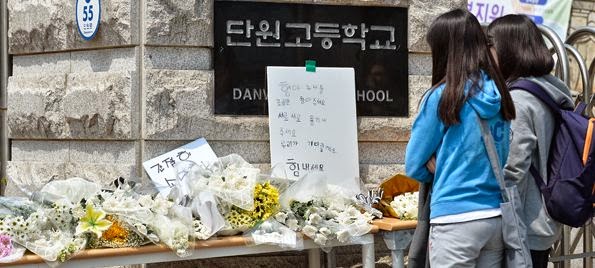
Something that weighs more on my mind is the effect so many deaths will have on the residents of Ansan, which is relatively small with a population of 76,000, as well as Danwon High School in particular. According to this article, 325 11th grade students went on the trip, and 13 stayed behind. As only 75 students have been rescued - and there's little hope at this point more will be - that leaves only 88 out of 338 students from that grade left in the school.


Last week the first funerals were held, marking the beginning of what will be hundreds of funeral processions. As well, only 3 out of 14 teachers were rescued, and one of them, the vice-principal, later committed suicide. To have 250 students and 12 teachers suddenly absent from a single grade is a loss that is almost unimaginable.

What happens when there are more empty desks with flowers on them than students, and not just in one classroom, but in ten or more?

Tuesday, April 15, 2014

Bits and pieces

A few articles in the Joongang Ilbo yesterday looked at how 'the system' is failing children (and single mothers) in various ways. First is an article with lots of adoption-related statistics:
Over the past decade, the number of children living in foster care has doubled, from 7,565 in 2003 to 14,384 in 2012. In most cases, children were cared for by grandparents (67.9 percent) or relatives (25.6 percent), and children living with another family accounted for just 6.5 percent.[...]

The ultimate goal of the foster home system is to send children back to their birth parents. However, only 12.9 percent came back to live with their birth parents in 2012, down from 19 percent in 2006. Most children living with foster families stay with them until they’re legally adults and sometimes even later.[...]

Though the number of domestic adoptions grew continuously until 2011 to 1,548, it abruptly dropped the following year to 1,125.[...]

In 2012, of more than 2,000 babies adopted in and out of Korea, 92.7 percent were born to single mothers.[...]

Many child care advocates insist that’s precisely why the government should establish a system in which single parents can raise their children without giving them up. According to research conducted in 2011 by the Ministry of Gender Equality and Family, 46 percent of unwed mothers had debts averaging around 13 million won ($12,514), with an average monthly income of about 785,000 won.[...]

Right now, the Ministry of Gender Equality and Family provides 150,000 won to unwed mothers 24 or under. But out of a total of 360,000 mothers, just 2,005 receive benefits.
Next is an article about the lenient sentences received by two stepmothers who beat their stepdaughters to death.
A court in Daegu sentenced one woman, surnamed Lim, to 10 years in prison for beating her 8-year-old stepdaughter so hard at their home in Chilgok, North Gyeongsang, that she died of an intestinal rupture. Lim then intimidated the victim’s 12-year-old sister into taking the blame.[...]

In the second case, an Ulsan court handed out a 15-year jail sentence to a stepmother who beat her 8-year-old stepdaughter so hard last October that 16 of her 24 ribs were broken. Some of them pierced her lungs, and she died from her wounds.
The first word that pops into my head is 'scum.'In the first case, ten years does not seem enough, especially with the added factor of intimidating the sister into taking the blame.

Another article looks at criticism of a private high school in Jinju after two fifteen-year-old students died less than two weeks apart in separate instances of violence at the school.

Tuesday, July 09, 2013

Daycare investigations

A week or so ago the Joongang Daily published a lengthy article about how the investigation into day cares came about. It all started with Songpa police looking into a case of abuse by a day care owner and coming across proof of fraud on her part. As they teamed up with the local district office to expand their investigation, politicians began to oppose them - for good reason (at least from their point of view):
The investigation was extended beyond Songpa District to Gangnam, Gwanak, Seocho and Gangdong Districts, even as far as the Seongnam and Uijeongbu areas. It was soon revealed that Lee, a current Songpa District Council Representative, embezzled several hundreds of millions of won by running five day-care centers.

"It became clear why some district council representatives have objected so fervently to the co-investigation by the police and the district office."
An op-ed on the topic looked further back at causes of the problem:
The number of day care centers has risen dramatically since authorities loosened licensing requirements in 1991. The market for buying and selling licenses grew quickly, and caregivers were able to find work after a short period of training without thorough evaluations. They easily obtained certifications even by taking online courses, inundating the industry with unqualified and cheap labor.

As a result, the day care industry turned into a profit-making business instead of an education field, and the quality of administrators at these facilities was called into question.

Without addressing these problems, the government pumped in public funds to subsidize the industry and worsened the problem. Competition became fierce to get more state funds, breeding accounting fraud and other irregularities.
Two other articles (here and here) from early May drew attention to these problems and called for the government to act, which it did in late May:
In response to a spate of child abuse and embezzlement practices at day care centers, which has shaken the country this year, the government yesterday announced a set of strengthened measures aimed at preventing such irregularities.
One of the aims of these measures was to improve working conditions of teachers at day care centers by raising their salaries. ("Day center teachers’ monthly wage is 1.45 million won ($1,286) on average, only 67.8 percent of the monthly wage for kindergarten teachers, who make 2.13 million won on average.")

I believe the only time I've mentioned day cares on this blog was this case from 2008.

One hopes that these new measures will actually be enforced.

Tuesday, June 25, 2013

Photos, City

Awhile ago the Culture Trip posted "The Ten Most Influential Contemporary South Korean Photographers." Some I knew, most I didn't. Some, such as the portraits done by , Hein-kuhn Oh (오형근) are worth checking out, such as portraits of people in Itaewon in 1993, in Gwangju in 1995, and a few series of high school girls. The 'Cosmetics girls' series I found interesting - though these days she'd probably have an interesting comparison of elementary and middle school girls - I've bumped into a few former female students that I hadn't seen in a year or so and have been unable to recognize them, partly due to all the makeup they now wear (and this is a rather new development - it was only within the last 5 years students were allowed to wear their hair as they like and wear makeup - at least in many schools).

Also of interest were Ahn Sekwon (안세권)'s photos of Wolgok-dong's destruction between 2003 and 2007, and the redevelopment of Cheonggyecheon, which can be seen here.

On the same topic, here's a shot of a 'daldongnae' from the mid 1940s (from "Korea," published by Troop Information and Education Section Headquarters, XXIV Corps).


And here are a few shots taken on or around rooftops in Jongno a month or two ago:


A few more photos taken at the same time are here.

Tuesday, May 14, 2013

Canadian - Korean child given a windpipe made from her own stem cells

[Update - Below, Kushibo links to a site for raising money for the girl's care.]

Here's a more upbeat story about a foreign English teacher than a lot of the stuff I've been posting recently:
A 2-year-old girl born without a windpipe now has a new one grown from her own stem cells, the youngest patient in the world to benefit from the experimental treatment.

Canadian-South Korean Hannah Warren has been unable to breathe, eat, drink or swallow on her own since she was born in South Korea in 2010. Until the operation at a central Illinois hospital, she had spent her entire life in a hospital in Seoul. Doctors there told her parents there was no hope and they expected her to die.

The stem cells came from Hannah’s bone marrow, extracted with a special needle inserted into her hip bone. They were seeded in a lab onto a plastic scaffold, where it took less than a week for them to multiply and create a new windpipe.

About the size of a 3-inch tube of penne pasta, it was implanted April 9 in a nine-hour procedure.[...]

Only about one in 50,000 children worldwide are born with the same defect. The stem-cell technique has been used to make other body parts besides windpipes and holds promise for treating other birth defects and childhood diseases, her doctors said.

The operation brought together an Italian surgeon based in Sweden who pioneered the technique, a pediatric surgeon at Children’s Hospital of Illinois in Peoria who met Hannah’s family while on a business trip to South Korea, and Hannah — born to a Newfoundland man and Korean woman who married after he moved to that country to teach English.

Hannah’s parents had read about Dr. Paolo Macchiarini’s success using stem-cell based tracheas but couldn’t afford to pay for the operation at his centre, the Karolinska Institute in Stockholm. So Dr. Mark Holterman helped the family arrange to have the procedure at his Peoria hospital, bringing in Macchiarini to lead the operation. Children’s Hospital waived the cost, likely hundreds of thousands of dollars, Holterman said.
There's more background on this story here. She seems like quite the little trouper in the photos in the articles (or these ones), and what science has been able to accomplish in this case is pretty amazing.

Wednesday, March 20, 2013

Crushing the competition


It's always nice to see ten year-old girls internalizing zero-sum attitudes in regard to competition.

This reminded me of another RAS lecture from last year by Chong-ae Lee titled "Has Korean Competition Reached its Limit?" It's well worth watching (at that link), as she works at SBS and had clearly worked on programs related to the topic. The lecture is full of survey results and statistics which show just how much Korean society - in particular the education system and job market - resembles the picture above.

Wednesday, March 06, 2013

Donga Ilbo reports on the french fry party

The other day I posted about a Korean french fry party that had made waves on the internet overseas. The Donga Ilbo is now on the story, having reported about the photo yesterday (hat tip to Kyle):
Foreign press 'astonished' at 270,000 won 'french fry party'


Around 20 teens ordered french fries at a fast food restaurant worth a whopping 270,000 won, and photos of their party posted on the internet have caused shock. The online editions of foreign newspapers such as the Guardian and Daily Mail have reported astonishment at the photos.

The Busan teens who enjoyed the 'French Fry Party' visited a McDonalds at Pusan National University Station on February 23 and had ordered around 150 medium french fries beforehand the day before and spread them across five tables and ate them. They didn't forget to take commemorative photos of things like what they looked like before they started eating and the empty cases afterward.

According to someone who works at the fast food restaurant, "The day before they called and ordered 150 french fries, but we thought it was a joke. It took seven calls before we officially accepted the order and we prepared the french fries beforehand." "The customers spent about two and a half hours eating without any disturbance and shared the leftovers with other customers in the store or wrapped them up and took them home."

In the photos the 270,000 won worth of french fries appears enormous. The trays piled with french fries turned the tables yellow like a mountain covered with gingko trees in the fall. If you're someone who likes french fries, it's something you can imagine doing once.

However, netizens were concerned that consuming french fries in large amounts at one time can lead to heart problems. How much sodium and how many calories were in the french fries they ate?

According to McDonalds' homepage, one pack of medium fries contains 379Kcal and 291mg of sodium. 150 packs would thus contain 56850Kcal and 43650mg of sodium. If there were 20 people, then each person would have consumed around 2800Kcal and 2182mg of sodium. The recommended daily amounts for teens are 1700~2400kcal and 2000mg of sodium.

The foreign press showed concern about the 'french fry parties' held by Korean and Japanese teens, saying that "Nutritionists would be astonished by the photo" and "Their stomachs would really not be happy."
That second last quotation is from the Daily Mail ("It's the new party craze that will make nutritionists despair"). Most of the photos above are from the party in Busan, but the top right photo isn't; as the Guardian noted, it's from Japan: "a group in Okayama upped the ante with a three-hour-long 60-pack feast, which they ate under a specially printed "60" balloon." The Donga Ilbo article also includes this video, which is from Japan. More about the Japanese parties are described here, though the complaints in Japan were that it difficult to meet such large orders in such a short time didn't seem to apply to the party in Busan, where, according to the Donga Ilbo, they called ahead of time. And unlike the foreign news reports which described the "brats" being told to get out by store staff, they apparently didn't cause problems and shared with other customers. Where exactly the 'kicked out' part of the story comes from, I don't know. The earliest source I can find is this one, which doesn't mention anything like that. Odd.

Oh, and I guess I was wrong about it taking place in Gangnam...

Wednesday, December 05, 2012

Guerrillas in the snow

While running errands yesterday, I remembered that I'd received a nice pair of thinsulate leather gloves last year for Christmas, and when I got home I dug them out and put them in my bag so they'd be on hand if I needed them. Good timing!


While the snowfall was only three inches, for Seoul that's quite a lot (an apparently has been for a long time). And it was certainly enough for the students to enjoy:


While I'd worn the gloves while hiking before, they'd never been in contact with snow much. As it turns out, after throwing 100+ snowballs and making a couple snowmen, they were still dry inside. I don't imagine the kids without gloves would have been very comfortable when they got inside and their hands began to thaw, though the more creative ones made due with dustpans which they used to scoop up and throw snow. I was impressed by the guerrilla tactics of a quartet of grade 3 girls who would wait until I had my back turned and then would close in and send off a volley of snowballs all together before running off in different directions, only to regroup for another sneak attack once my back was turned. Not bad for a bunch of 9 year olds, but then, considering the quasi-military drilling a gym class involves (and all the marching that is flawlessly executed at sports festivals), perhaps not so surprising, either. Give them the training these girls got and they'd be a formidable force...

Tuesday, November 20, 2012

Teenage Runaway articles update

As I noted in this post, the Hankyoreh has been translating a series of its articles about prostitution among teenage runaways, and several more have been added:

Part 1: Runaways flee abuse at home, end up in prostitution
Part 2: The lives of female runaways in Seoul
Part 3: Runaways' prostitution
Part 4: Runaways live with the pain of rape
Part 5: The exploitation of teen runaways

Al Jazeera also reported on this topic.

All of the articles are worth reading; Al Jazeera's starts out with a correction stating that it "first published this story quoting an estimation by a coalition of women’s groups that there are 1.2 million women in the sex trade in South Korea, and that 20 per cent of all South Korean women aged 15-29 were involved in prostitution. However, these NGO figures are not supported by any official data and are impossible to verify."

It's hard to know what the figures are (1 million was thrown around in reports before the 1988 Olympics), though 20% in the 15-29 age bracket seems too high - unless, according to this report, you happen to be a North Korean defector ("More than 30 percent of women from the North turned to prostitution as they tried to settle in the South, according to one study"). On the other hand, one study in 2008 found that one in every three female secondary school students in Busan had received sex trade proposals while chatting online, and 6.5% of the respondents said they had sold sex. So while 20% is too high, the actual percentage is still likely to be an uncomfortable figure.

Needless to say, with the first hand accounts in the articles, they're a pretty depressing read.

Wednesday, October 24, 2012

A look at prostitution among teen runaways

Back in June the Hanguk Ilbo published this article:
"1 out of 4 runaway teenage girls have experience selling sex"

A survey has found that 1 out of 4 runaway teenage girls have experience selling sex. On the 6th a survey done by the Seoul Happy Sexuality Human Rights Center of 175 teenage girls living at 25 shelters in Seoul and Gyeonggi-do found that 25.% of the girls answered "I have experience selling sex."

Those 14 to 17 years old made up 88.1% of those selling sex, while 'conditional meeting' arranged over the internet, was, at 83.7%, the most common type. As for why they sold sex (multiple answers), 44.2% said "I had no place to sleep," 30.2% answered "I was hungry" and "I was forced."

54.4% said they had experience earning money after running away from home, and among them 55.3% said they earned money in the 'sex industry or by selling sex.' Of those who said they earned money in the 'sex industry or by selling sex,' their experience involved conditional meeting (25.5%), noraebang(10.6%), bodobang (9.6%), Dallan jujeom and room salon (3.2%), kiss bang (3.2%), sex selling gathering place (2.1%), and ticket dabang (1.1%).

Among those who had answered as such, 40.7% had experience of suffering sexual violence, and among those, 37.7% had been sexually assaulted/molested by family members or relatives.

The average age of those who particpated in the survey is 16 years old, 70.8% first ran away from home between the ages of 12 and 15, with the average age being 13.

In order to protect teenaged female runaways who are easily exposed to dangerous situations like sexual violence and selling sex, Seoul will expand its year-round on-the-street nighttime counseling. In particular, 'Drop-in center' support facilities where they can stay temporarily in emergency situations will be established in July.
I'd forgotten I'd translated this at the time until I saw the Hankyoreh's 6 part series on the sexual exploitation of teen runaways. Part 1, titled "Runaways flee abuse at home, end up in prostitution," opens with this introduction:
Last year, more than 20,000 young people ran away from home. That total only represents the cases that were reported to police. As of now, an estimated 200,000 adolescents are living on the streets around the country. Over 60% of the runaways are girls, children who have fled poverty and abuse at home. Roughly half of these girls are believed to be surviving on the streets through prostitution. For all the shock the South Korean public shows when confronted with sex crimes, it turns a blind eye to the kind of sexual exploitation that disadvantaged teenage girls are exposed to on a daily basis.
It's interesting that the number of runaways is that high (200,000). As reported by the Korea Times in 1995, "According to Education Ministry's statistics, the number of runaway students increased to 11,363 [in 1994], a 23 percent hike from 1993. Among them, girls outnumbered boys 5,935 to 5,428." It was later reported that "In 2001, the number of runaways in South Korea reached 61319 youths (23577 males and 37742 females)." The increase at that time was likely due to the fallout from the 1997 financial crisis. In all these cases, the gender split was skewed towards females. (For more such articles from the 1990s, see here).

The Hankyoreh has translated parts one and two of this series, which illustrates pretty clearly why so many female teen runaways rely on prostitution to survive. Each part has several graphs based on the study described in the Hanguk Ilbo above.

 (That should be '13 and younger.')

Part 3 has the following graphs, the first from a survey of 96 female runaways in Seoul and Gyeonggi-do who had sold sex, March-April 2012, asking why they first sold sex:


(From top) No place to sleep, hungry, pressured, wanted to earn money, had no other job, entertainment expenses, as a favor to a friend, despair after being raped, curiosity, other.

The next 4 graphs are from a survey of 175 female runaways in Seoul and Gyeonggi-do, March-April 2012. The first asks what is the most difficult thing after running away:


(Clockwise from orange) Money, depresson/anxiety/frustration, family problems, finding a job, anxiety over the path they've chosen, senior-junior relationship among friends, other.

As for the graphs based on the same survey in part 4, 40% of runaway girls said they had been raped; asked who their first attacker was, 31.7% said friends or boyfriends, 25.7% said relatives or family, 11.9% said a stranger, 9.9% said a neighbour, 5% said someone buying sex, and 15.9% said something other.

Part 5 has a list of teen runaway prostitution by type (clockwise from orange): "Conditional meeting," bodobang/noraebang/kissbang/dallanjujeom, propositioned on street, brothel/massage parlour/ticket dabang, other.


Above is a graph showing the most common paths to prostitution (clockwise from orange): Chatting, introduced by a friend, propositioned on the street, business owner forced them, kidnapped/confined, other.

I should note above that jogeon mannam, or 'conditional meeting,' has basically become the new name for wonjo gyoje, or 'compensated dating', about which I talked a great deal here. Whereas wonjo gyoje was a euphemism specifically for (freelance, often organized through the internet) teen prostitution, 'conditional meeting' is a more general term (mentioned, for instance, here back in 2004). I'd come across an article discussing this shift some time ago but can't offhand remember which it was. It might be "A culture that cultivates the prostitution of teenage girls: based on the experiences of prostitution among teenage girls," the abstract of which is here.

Part 6 has the following two graphs; the first is titled "Assistance needed most by teenage runaways."


Clockwise from orange: Shelter or group home, job, schooling, job training, emotional support, medical aid.

Below is titled "Rape/indecent assault against children and youth 2007-2011."


Above is titled "Number prosecuted for breaking child/youth sexual protection law (via teen prostitution, etc), 2008-Aug. 2012."

Hopefully the Hankyoreh will continue to translate this series. I've been meaning to post about the proposed changes to sex crime laws which have been suggested in the wake of high profile sex crimes against children this year, but there's been so much information it's hard to know where to start. When you see the numbers above and read questions asking why sex crimes against children and teens are so common, well, I'm pretty sure the attitudes which make teen prostitution so common and the reasons children and teens are targeted by rapists are pretty closely related - as is how they are depicted in the media. But that's a post for another day.

Friday, October 05, 2012

New crime stats for teachers, both Korean and foreign

Yesterday Yonhap published the following report:
In 3 years 15 native speaking English teachers commit crimes...drugs most common

Among native speaking assistant English teachers placed in elementary, middle and high schools nationwide, 15 have committed crimes over the past 3 years.

According to material submitted by the Ministry of Education, Science and Technology to National Assembly Education, Science and Technology committee member  Rep. Lee Hak-jae (Saenuri party) during the parliamentary audit, from 2010 to June 2012 15 native speaking assistant English teachers were punished for various crimes, it was announced on October 4.

By year, 11 were caught in 2010, two in 2011, and two in the first half of this year.

Native speaking assistant English teacher crime involved drugs the most, with 5 caught for drug crimes; 2 were arrested and charged, while 3 were charged but not detained. One teacher was caught for assault, another for theft, and another for a sex crime, while 6 others [SIC] committed other crimes.

13 teachers had their contracts canceled by their schools, while two got warnings.
I would imagine that single sex crime to be the teacher who fled from Daegu in 2010 and was extradited back to Korea in April before being sentenced to 4 years in prison in September. This story was reported by three other outlets, with SBS adding this cute little photo:


The reason for these statistics coming out is because 'tis the season for parliamentary audits of government ministries. Here's another article from Yonhap, also published yesterday:
Rep. Kim Sang-hui: "65% of teachers with sex crimes on record continue to work"

It's come to light that more than 6 out of 10 teachers who have committed sex crimes are still in classrooms.

According to material submitted by the Ministry of Education, Science and Technology to National Assembly Education, Science and Technology committee member Rep. Kim Sang-hui (Democratic United Party), from 2008 to June 2012 135 teachers were punished for sex crimes, it was announced on October 4.

The number of crimes continuously increased from 21 in 2008 to 31 in in 2009, 33 in 2010, and 42 in 2011, and then decreased with only 8 crimes punished in the first half of this year.

Out of the 135 teachers punished for sex crimes, 41 were dismissed and removed from the classroom, while the remaining 81 (65%) faced demotions, suspensions, pay cuts, reprimands or cautions and are still working.

In particular, of 56 teachers who committed sex crimes against minors such as students, 20 faced disciplinary action such as suspensions, pay cuts or reprimands.

It was also found that among those who faced disciplinary action, 9 received pay cuts or reprimands when, in the case of those who commit sex crimes against minors, the lowest punishment is "suspension," in violation of regulations regarding displinary action against public education personnel.

Of 18 teachers caught for prostitution, they all received disciplinary action such as reprimands or pay cuts except for one who was sentenced to two years' imprisonment.

Rep. Kim insisted that, "In order to protect our children, we should strip soul-destroying, inhumane criminals who commit sexual violence against minors of their teaching qualifications, not wink at the problem with disciplinary measures."
That article is only talking about Korean teachers. The stats in the above article are a little different from those in a Chosun Ilbo article from October 2, in which Rep. Elisa Lee puts the number of sex crimes by teachers at 145 in total, with 22 in 2008, 31 in in 2009, and 33 in 2010, to 42 in 2011, and 17 crimes in the first half of this year.

It says that by region, Seoul had the most sex crimes committed by teachers (25), Gyeonggi-do and Incheon each had 15, Jeollabuk-do, 13, Jeollanam-do, 12, Gyeongsangbuk-do, Gyeongsangnam-do and Gangwon-do each had  9, Gwangju, 8, Chungcheongnam-do and Daegu each had 7, Daejeon and Busan each had 4, Chungcheongbuk-do and Ulsan each had 3, and Jeju had 2. While this is not a lot compared to other occupations, the article said that, considering their mandate to educate children, something needs to be done to deal with this growing trend of sex crimes.

By type of crime, there were many cases of sexual harassment of other teachers and parents as well as molestation and sexual assault of underage students. One teacher in Jeollabuk-do sexually assaulted an elementary school student with an intellectual disability. There were also teachers caught buying sex in illegal massage parlors. A high school teacher in Seoul was fired for raping his relative, and an elementary school teacher in Gwangju was caught red-handed secretly photographing women's private parts with his cell phone camera while on the subway. Even worse, there was also a high school teacher who indecently assaulted a female police officer but was only charged with unlawful interference with an officer on duty.

The punishment of teachers who committed sex crimes varied, however. An elementary school teacher in Gangwon-do who molested a student was fired, while a private middle school teacher in Gyeongsangnam-do who committed the same crime only had his pay cut for two months. Rep. Lee said that "It's a terrible thing that a teacher who committed a sex crime is teaching children." "There should be strong disciplinary action for teachers who commit sex crimes so that they cannot return to school."

I doubt few people would argue with that.

And yet in the fall of 2009 Rep. Choi Young hee (who authored a bill which was incorporated into the Hagwon law amendment last year) complained that teachers were being let off too easily for sex crimes, with nearly 60% getting only reprimands.
A total of 124 sexual crimes involving elementary and secondary school teachers were reported to the education authorities between 2006 and 2009. Among them, 47 involved prostitution, 43 were sexual harassment and five were rape cases. However, only eight teachers (6 percent) were given prison sentences, while 31 were not indicted and 28 received suspended sentences.

"It seems that teachers were exempt from punishment through out-of-court settlements with the parents of the victims," Rep Choi said. "Moreover, each city and provincial education offices, which were supposed to strictly punish those teachers, gave only verbal warnings. Only 21 teachers were fired for sexual violence."[...]


"We expect higher levels of ethics from teachers, but courts and education authorities are too merciful to problematic ones," Choi said.
Rep. Choi's comments in 2009 took place in the aftermath of the 'Nayoung incident,' which caused outrage at the lax sentence given to a man in his 50s  for brutally raping an 8 year old girl, so it's not like there wasn't a great deal of interest at the time (a time made more interesting by certain national assembly representatives who described foreign teachers as "especially potential child molesters"). And yet here we are, 3 years later, with still the same problem, with the majority of teachers who commit sex crimes still in classrooms. In fact, the statistics suggest it is a growing problem. A post about that problem in particular with have to wait for another day.

Tuesday, June 19, 2012

Juvenile Delinquency Up

Concerns about rising crime by teens is nothing new, as this May 24, 1970 Korea Times article about a rise in juvenile delinquency reveals:

Link
For the negative perceptions of youth in the 1990s, see this post.

Tuesday, April 03, 2012

The 2003 post that tarred foreign English teachers as child molesters

The 2005 English Spectrum Incident

Part 1: English Spectrum and 'Ask The Playboy'
Part 2: The Kimchiland where it’s easy to sleep with women and make money
Part 3: English Spectrum shuts down as Anti-English Spectrum is created
Part 4: How to hunt foreign women
Part 5: Did the foreigners who denigrated Korean women throw a secret party?
Part 6: The 'Ask The Playboy' sexy costume party
Part 7: Stir over ‘lewd party’ involving foreigners and Korean women
Part 8: The 2003 post that tarred foreign English teachers as child molesters


Perhaps the post should be titled "The 2003 post that was used to tar foreign English teachers as child molesters by Anti English Spectrum and the Korean media." But that's kind of long, right? At any rate, this series began with a look at the site English Spectrum before the incident began, and this post will look at one other key piece of the puzzle.

The 12th post (ever) at Anti English Spectrum (which can still be read today here (first result)), was posted at about 9am on January 13, 2005, and is titled "Some English instructor bastard's guide to hitting on Korean children - found by chance." It lists two links (now dead):

English: http://www.koreanesl.com/forumdsp.asp?ser=10259
Translation: http://www.koreanesl.com/forumdsp.asp?ser=10287

Here is the English version of the post (click photo to read - or open in it a new tab if Firefox automatically opens it in a photo viewer):

2003/07/11 (No. 10259)


To be clear, that was originally posted on July 11, 2003. The translation was widely passed around Korean cyberspace, and hundreds of Koreans left angry messages at the site. What was never translated were the messages left in response to the original by (presumably) other foreign teachers in July 2003. I dug through the hundreds of messages back in 2007 and saved those original responses:
_________________________________________

2003/07/11 (No. 10260)
Soon - how to get caught

Think you're so clever. Try to cover tracks with IP's. Post the innards of your sick brain so child protection can see just how twisted you are. Someone identifies you. You're watched. There's a knock at the door. You're busted! Not so smart anymore.
_________________________________________

2003/07/11 (No. 10261)
Lucky Guy - I think not!

I'm at a PC Bang in Itaewon. So many whities here. Could be anyone. Go fuck yourself self-righteous prick.
_________________________________________

2003/07/11 (No. 10263)
they'll get you - just keep goin'

I can't wait to be a fly on the wall when they bust you. You'll be cryin' like a baby. Can only get it off with little girls and boys huh? What a man.
_________________________________________

2003/07/11 (No. 10265)
Lucky Guy - Um OK buddy

More of a man then you'll ever be. At least I have the balls to be honest you sick fucking pedophile pretending to be all bent-nosed when you actually want to sink your dick into a tight litle pussy.
_________________________________________

2003/07/11 (No. 10272)
the big house - you're going to

Sexual misconduct with minors for starters, followed by at least 4 other charges for sexual assault. Don't bother with your details, they have them already.
_________________________________________

2003/07/11 (No. 10276)
Lucky Guy - What Do you Think?

Prove I did any of this stuff.

How do you know it's all just one big lie?
_________________________________________

2003/07/11 (No. 10273)
Citizen - school

Moderator! Please post some information!
Could you at least post the geographical location this predator is posting from? Pedophiles are a threat to the business, if ethical considerations are not deemed important by you. thank you
_________________________________________

2003/07/11 (No. 10277)
Webmaster web - Thank you for your useful information!

This'll be a really useful information for parents to protect their children from child abusive crime by someone like you.

I bet shortly I'll translate your message into Korean and list up on the 'Webmaster's Selection' for parents, employers and children.

Good luck(?) to you....

-Webmaster
_________________________________________

2003/07/11 (No. 10287)
Lucky Guy - 삭제 하였습니다...(내용무)
[The Webmaster above kept his word - what followed was, indeed, a translation into Korean - the same one linked to by Anti English Spectrum a year and a half almost to the day later. It had since been deleted.]
_________________________________________

2003/07/11 (No. 10304)
Pissed Off Guy - idiots [Note: This is 'Lucky Guy']

Well this is a bit lengthy and perhaps a bit of a test to see how censored this board is. If this gets censored, I'll know for sure how serious this website is about censorship.

Let's read the first fucking two sentences before we all start looking for a boogy man that doesnt even exist!

I didnt even write this piece of shit. I copy/pasted it you lynch mob morons!
_________________________________________

2003/07/11 (No. 10299)
Tom Sawyer - You were sucessful in your quest for attention!! Try taking Ridilin...

Whomever this is,

I congratulate you...I am very impressed with your attempts at causing people to be disgusted with your posting. I however don't care either way...I know Korea and I understand Koreans. My guess is that you are full of shit...If it was real then you would have been caught for sure...One word from a child to a mother and ohhh yes they do tell everything and you would not have had the time to write this posting. You would be somebody's Biaaatch in prison..But if you get off on this then hey what can we do...Good luck I pity you though...Having to look over my shoulder every time I see a police officer must be a stressful thing..
_________________________________________

2003/07/11 (No. 10305)
Lucky Guy - haha
having to look over my shoulder?

I committed no crime so bugger off buddy!
_________________________________________

2003/07/11 (No. 10300)
Bruce - Webmaster -- What are you thinking?

I know that you want to keep this form unmoderated, but sometimes you need to make an exception. How you could leave a thread like this up is beyond me, let alone appear on the index page of your site.

If I were an employer, I would never advertise here again after seeing some of the junk that appears on this page. Thank goodness, I am getting out of this country in 2 weeks. I won't ever have to be associated with these kind of lowlifes again.

Dave's might be moderated, but at least it keeps out most of the medically deranged.
_________________________________________

2003/07/11 (No. 10308)
Lucky Guy - thanks bruce

Bruce says it all. And that is the whole point of my post. Censorship needs to be applied in certain circumstances. Let's read the very first sentence of the post again shall we?

Sheesh. Another poster was right. If anyone did something as disgustingly described here they'd be behind iron bars in no short time.

Go find the real pervs and stop wasting your time running around tracing IP's. I would have used a anonymous proxy had the intent of it was really to provide some sick guide.

Common sense folks.
_________________________________________

2003/07/12 (No. 10316)
Vicky - STUDENTS

You sound like a really clever guy. I wish I could meet a guy like you, you sound so amusing, kind, generous and honest.
_________________________________________

2003/07/12 (No. 10335)
gang ah jee - word

Hahahhahahahahahha wow

you must be doing your phd in psychology or something. pretty amazing, seems like you know the exact buttons to push - how did you gain such amazing insight into the human condition? nice one, however you figured it out. You definitely managed to show that people find paedophilia disgusting, against all people's expectations. Can i be part of your next study?!!!

keep backpedalling pervert...
_________________________________________

2003/07/13 (No. 10375)
Lucky Guy - I'm not backpeddling

Back peddling?

like i said read first line you moron.

There is no back peddling when something was already writen.
_________________________________________

2003/08/07 (No. 10766)
a 15-year-old Korean - bastard
Wish I was your student - would pretend to fall for you and then cut your balls off at the moment you think you got it
_________________________________________

2005/01/13 (No. 16182)
heavy dick - one sick mufuckers...
E-mail Address mufuckerusa#fuckus.com

shut ur fucking mouth and go to hell..

or... i'll get you and whoop your ass...

you aint gonna be able to stay here.... nigg...

i hate all of ya.. so disgusting...

you fucking bastards
_________________________________________

2005/01/13 (No. 16199)
fuck this site - Your site is going down

This is so fucking sick Your site and you 'lucky guy' your going down cuz I'm disclosing all this shit on other portals

fuck you white trash

凸^0^凸
_________________________________________

One question that could be asked is whether 'lucky guy' did or did not write that post, and whether he was actually just testing the no censorship policy of the Korean ESL site. While westerners can do dumb things here (like, say, mail yourself a kilo of hash) because they think the rules don't apply to them (or for many other reasons), I think I'd tend to agree with this 2005 assessment of the post:
[I]t was initially surprising to me that so many Koreans would believe that this was a real how-to from a child molester. Disgusting as it was, it reads like something someone would write in order to be purposefully inflammatory...those engaging in real discussions of illegal activities tend to be a lot more subtle in their language.
At any rate, regarding the final posting from January 13, 2005 ("Your site is going down"), seeing this - 凸^0^凸 - we would have no reason to doubt that this was a netizen who meant business. To be sure, he followed through on his threat, and by 9am that day the post was copied at Anti English Spectrum, after sitting translated but unnoticed for a year and a half at Korean ESL. The next day [January 14, 2005], the negative things associated with foreign English teachers would expand from 'comments denigrating Korean women' [January 11] and 'photos of a secret sex party with Korean women' [January 13] to 'child molesters.'

Monday, April 02, 2012

NSET who fled molestation accusations in 2010 extradited to Korea

Yonhap reports that a "U.S. teacher [has been] arrested over suspected child molestation
DAEGU, April 2 (Yonhap) -- A U.S. language instructor who fled South Korea after being suspected of child molestation was recently arrested in his native country and extradited to the South, police here said Monday.

The 56-year-old teacher, whose identity was withheld, is accused of five counts of molestation of four boys between June and July 2010, the police said.
Korea Beat translated the Korean language Yonhap article, which adds that "On the 27th of last month police received Mr. M’s extradition through US authorities and detained him on the 29th." This MBN article confirms that he was repatriated on March 27th.

An article at the U.S. Immigration and Customs Enforcement website from February 29 reveals that he was arrested in the US on February 27 and was to face an extradition hearing in U.S. District Court on March 2, along with other information:
A local man who is wanted by Korean law enforcement authorities for allegedly molesting four young boys while he was working as an English teacher in Daegu, Korea, was arrested Monday by U.S. Immigration and Customs Enforcement's (ICE) Homeland Security Investigations (HSI) and the U.S. Marshals Service (USMS).

[] Burke, 56, of Chicago, is the subject of an international warrant issued on July 9, 2010, by the Daegu District Court of the Republic of Korea. The Republic of Korea has requested that Burke be formally extradited to face charges of indecent acts through violence or intimidation against children under age 13, as contained in the Korean Criminal Act.

According to the extradition complaint filed in federal court Feb. 24 in the Northern District of Illinois, an investigation by Korean authorities revealed that in the summer of 2010, Burke was working as an English teacher at an elementary school in Daegu, Korea. On July 3, 2010, two students reported to their homeroom teacher that they had been sexually fondled by Burke. On July 5, 2010, Burke was banned from teaching at the school, and he left Korea two days later.

Further investigation by Korean authorities revealed that Burke had allegedly molested four 11- and 12-year-old boys at the elementary school during June and July 2010. According to the complaint, the alleged acts against the boys involved improper sexual contact, including fondling and touching.[...]

The investigation leading up to Burke's arrest was conducted by HSI Chicago; HSI Seoul, South Korea; USMS; and the Daegu, Korea, Metropolitan Police Agency.
It's nice to see that he's finally been brought to justice. Left out of that description, however, was that the school apparently waited several days to alert the police (and that the school didn’t take the charges of sexual abuses seriously and tried to cover it up), and the suspect fled the country two and half hours before the Ministry of Justice requested a travel ban (or before said ban was to take effect), so there was quite a bit of dropping the ball there.

The result of this case for foreign teachers was an assurance by the Daegu office of education that the "native speaking teacher training course will involve an enhanced sex crime prevention program," (it's 'crime prevention tips' released a few months later can be read here), assurances by outlets like NoCut News that "Now deviant and criminal acts by foreign teachers have become common," and new E-2 visa requirements by the Ministry of Justice. Or as NoCut News put it,
Recently native speaking teachers have been committing various crimes such as molestation or drug use again and again, and amidst this the government has decided to strengthen visa requirements in order to filter out substandard 'troublemaker' native speaking teachers.
Translations of those articles can be found here. The new E-2 visa regulations included federal criminal record checks for Americans and Canadians, changes to diploma verification, and the inclusion of marijuana in the drug test needed to receive alien registration at immigration offices.

Oddly enough, while searching for more information on this case, I came across a Donga Ilbo article from February with this statistic:
In Korea, education offices found 58 teachers who committed sex crimes against juveniles from 2005 until August last year. Half of the teachers molested students in their own schools. Twenty-six teachers received light disciplinary action such as suspension, salary reduction and reprimand.
That figure is much higher and more specific than the statistics announced by Rep. Choi Young-hee back in 2009.
A total of 124 sexual crimes involving elementary and secondary school teachers were reported to the education authorities between 2006 and 2009. Among them, 47 involved prostitution, 43 were sexual harassment and five were rape cases.

However, only eight teachers (6 percent) were given prison sentences, while 31 were not indicted and 28 received suspended sentences.

“It seems that teachers were exempt from punishment through out-of-court settlements with the parents of the victims,” Rep Choi said.

“Moreover, each city and provincial education offices, which were supposed to strictly punish those teachers, gave only verbal warnings. Only 21 teachers were fired for sexual violence.”

According to data collected by the lawmaker, nearly 60 percent of the assailants were merely warned or reprimanded.
Those statistics were not very specific (especially since over 1/3 were for prostitution, which, as long as it didn't involve minors, is hardly something I'd describe as a sex crime). While sex crime against children has been the subject of furor in the media and online in response to horrific crimes over the years and laws have slowly been changing (see here and here), the fact that teachers can have consensual sex with students as long as they are 13 or older without legal repercussions (due to that being the age of consent and their being no legal prohibitions against teachers or others in positions of authority having sex with minors) is, perhaps, somewhat unhelpful. There were suggestions that the age of consent be raised after the case described in the link above (in October 2010), but little seems to have come of it.

Perhaps this seems to be a bit of a tangent from the original subject of this post, but then again, the fact that the case may have initially been covered up or minimized by the school (allowing the suspect to escape) is reflected in the attitudes towards sex crimes by teachers against students in general which result in the lax punishments described above.