Showing posts with label RASKB. Show all posts

Monday, September 19, 2016

RAS tour of 'Peace Corps in Korea' exhibit this Wednesday

This Wednesday evening the Royal Asiatic Society will lead a visit to the Special Exhibition at the National Museum of Korean Contemporary History commemorating the 50th Anniversary of the U.S. Peace Corps in Korea.


Please join us this Wednesday at 7PM in the lobby of the National Museum of Korean Contemporary History (see map below for directions) to take us back 50 years in time, to when the Peace Corps volunteers arrived to help in the aftermath of the Korean War. In the first part of the visit, you will go through the special exhibition hall to see over 340 items, documents, and video materials. The exhibit will proceed in the following order:

PROLOGUE: Foreigners help Korea
PART 1: The Peace Corps in Korea
PART 2: Their Activities
PART 3: The Friendship Lives On

The second part of the visit will be lead by Friends of Korea (Peace Corps) Vice President Suzanne Crowder-Han and other former Peace Corps volunteers, who will tell us about their experiences. Suzanne Crowder-Han is also RASKB's current vice-president and has been living in Korea since her arrival here as a Peace Corps volunteer. We will end with questions from the audience.

Refreshments will be served. Please send us a short email [to royalasiatickorea@gmail.com] indicating how many of you will be joining us for an approximate head count.
If not for the Pacific Ocean being in the way I'd love to attend this, both to see the exhibit and because Suzanne is a great storyteller and has lots of great stories from that time. Below is a map to the museum:


As well, the Korea Herald's recent interview with David Lassiter, a former PCV, is worth reading.

Friday, August 19, 2016

Comfort Women, nationalism, and the inculcation of anti-Japanese feeling

[Note: There are some disturbing images below.]


The image above was posted on Facebook along with a message in Korean asking for support for this to be the new 100,000 won bill; it received 31,000 likes last I looked at it (awhile ago now, admittedly). For me, the movie title 'How to lose friends and alienate people' comes to mind. Well, it's not the first time a "ruthless political terrorist" has been suggested for the 100,000 won bill (the difference being that the above An Jung-geun bill hasn't been officially suggested). Should something like this come to pass, however, it would be amusing if Japan issued a bill with Hideyoshi Toyotomi and the 'ear mound' that stands in Kyoto on it.

On a similar topic was this column by 'foolsdie' in the Korea Times, titled 'Are we still allies?' which complained about Donald Trump's comments on the US-ROK alliance before turning in another direction:
Then, Obama's recent visit to Hiroshima acted as a wedge. It's laudable for him to try to free the world of the fetters of nuclear weapons. But here, memories of Japan's brutal occupation remain fresh even after the passage of 70 years. Obama was perhaps too engrossed in the heat of the moment to say out loud that the nuclear attacks were the result of Japan's aggression and those killed and maimed were the victims of its failed leadership. Ironically, his visit has freed ultranationalist Prime Minister Shinzo Abe and his ilk from the atrocities it had committed. Human rights are one of two pillars of U.S. foreign policy, with nonproliferation being the other. For sure, Obama's visit didn't help much on human rights.
Regarding "memories of Japan's brutal occupation remain fresh even after the passage of 70 years" (and I wonder why that is?), perhaps it's worth noting that most countries don't dedicate their education system and media to instilling historical bitterness quite like the Koreas, and thus not everyone believes that any given Japan-related news item is an occasion to dredge up memories of suffering. But I'll concede that it's a great way to keep people's minds off more important things. The Korean government itself apparently had no such complaints; a foreign ministry official said, "In such a historic speech, it is meaningful that he clearly mentioned Koreans, putting them on par with American and Japanese victims." Which might suggest that confirming victim status is a diplomatic victory. The problem is that it seems like aspiring to victim status is part of the Korean national identity, and thus there are some who would insist that Koreans' suffering should be elevated above everyone else's.

Michael Breen touched on the topic of Korea-Japan relations when he wondered if the comfort woman statue in front of the Japanese Embassy should be moved to the exit of Gangnam Station near where a woman was murdered because of her gender in May by a man who had been rejected by women. (Of course, he was mentally ill. It's interesting how when someone commits a crime that could be construed as sexist or racist (like murdering a foreign English teacher or a military doctor) they're often described as 'mentally unstable' or 'deranged'.) Breen describes
an interview with a prominent expert on prostitution. When I asked what she thought of the comfort women issue, she asked me to put my pen down so that she could rant politically incorrectly off-the-record.

"It's a joke," she said. "Pure hypocrisy."

We all know Japan was guilty of terrible things up to 1945, but, she said, this chauvinistic focus on justice for a historical matter is popular with Koreans because it conveniently distracts us from the real issue and our own continued guilt.

The real issue is the attitude in Korea of men towards women and human trafficking in the sex industry that operates on the scale it does as a consequence of that attitude.

That explained for me the odd fact that the comfort women story did not surface until 40 years after the war. People in 1945 were of course angry about the Japanese occupation but the comfort women did not appear important­ then, few even knew about it ­because male attitudes toward women and the trafficking of young women to service them hadn't changed with national liberation.
In a Korea Times column, Maija Rhee Devine (who will give a lecture for the RAS in September on the comfort women) asks "Are comfort women lying?" Her ultimate answer is no, but she points to criticism of the Korean Council for Women Drafted for Military Sexual Slavery by Japan, who are suspected of having "coached" the comfort women in some of their testimony.

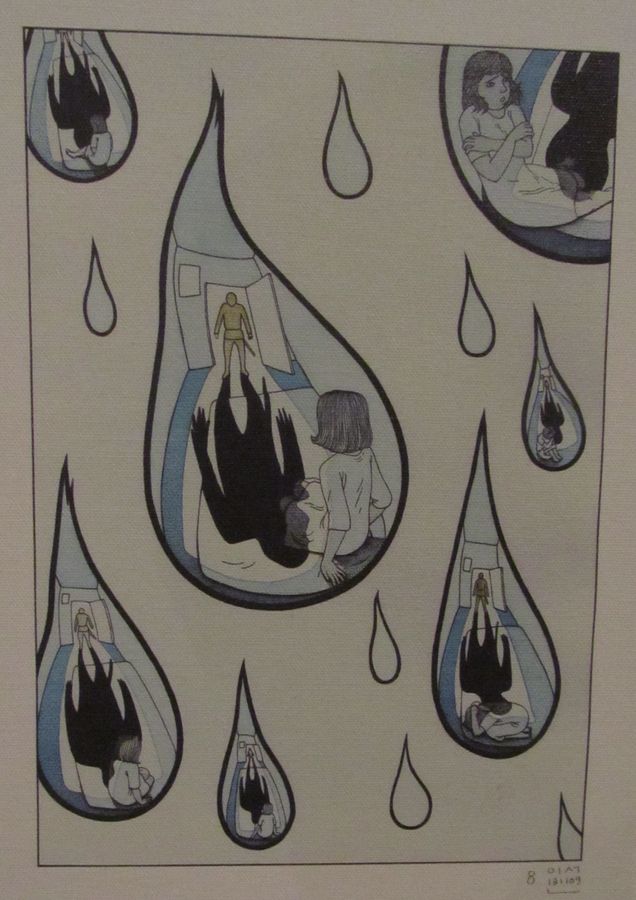
In the spring of 2014 I visited the Museum of Korean Modern Literature in Incheon and came across a large exhibit on the first floor about the comfort women. There were many comic books presented with each page as a poster affixed in order along the walls. One, below, was titled '70-year-long nightmare':


As always (as I've noted before regarding films here, and here, and here) it all begins with an overly simplistic tale of happy-go-lucky innocent children picking flowers (hell, even Peppermint Candy 'begins' this way) before history (or an evil invader) bowls them over.

Another was titled "Where are we going?" - I've posted a few pages below:


One has to admire the design of this work, though I couldn't help starting to feel that perhaps the artists were depicting the women's suffering a little too enthusiastically. And then I saw this comic:


What follows (I chose not to photograph it) is an incredibly graphic depiction of the rape of a child. That she was a child was made clear by the size of her breasts and lack of pubic hair - it was actually that graphic - and I was appalled that something like that was on display for people of all ages to view at the museum. That said, I wasn't particularly surprised by it, considering the apparent approval there is for such depictions of suffering, as well as the lack of concern there has been regarding raising the low age of consent in Korea. It also brought to mind this photo (of a foreign woman) posted in public as a photo contest entry at the Boryeong Mud Festival in 2011, at least in terms of female nudity being thoughtlessly allowed in a public forum. Also worth remembering is a blog post by Oranckay back in 2004 when the Korean government went out of its way to block its citizens from seeing videos of the beheading of Kim Sun-il in Iraq. In that post he referenced a Korean feminist website (perhaps Ilda) which criticized the government for trying to hide images of the death of a Korean male from the citizenry while letting images of the bodies of prostitute Yun Geum-i (killed by a G.I. in 1992) and the two girls run over by a U.S. bridge-layer (in 2002) proliferate without comment. These images were used to mobilize resistance to the U.S. presence in Korea, and in thinking of this - and of depictions of the comfort women - I'm reminded of a passage in Sheila Miyoshi Jager's 2003 book Narratives of Nation Building in Korea : A Genealogy of Patriotism which, while it refers to anti-USFK campaigns, is also applicable in some ways to the comfort women issue (and is very applicable to Anti-English Spectrum):
Like Sin [Ch'ae-ho], chuch'eron [the (supposedly) North Korean-influenced anti-imperialist 'philosophy' of leftist South Korean students popular from the mid-1980s to the 1990s] sees the entire history of the Korean people as an epic struggle to overcome foreign domination and feudal oppression. The historian's task, in other words, entails the examination of the experience and legacy of the Korean people's struggle to preserve their "core" identity. [...] Perceived as a significant threat to this core identity, miscegenation became associated with a whole host of related themes about the defense of the social body - the retrieval of a superior "core" Korean identity in the name of a phantasmic Korean essence. The ability of the foreign male to penetrate (literally) the inner and inviolable sanctum of Korean women and to establish conjugal alliances with them was perceived not only as a threat to the viability of the family, but as an act that undermined the fundamental cohesion and identity of the Korean nation. Thus we find in Korea that those women who formed marriage alliances across racial lines were popularly perceived as being women of "loose" morals: prostitutes, bar hostesses, or entertainers. In fact the were represented as the polemical inversion of the idealized virtuous female associated with Korea's traditional romance narratives. By allowing themselves to be appropriated by the West, these women were simultaneously perceived as being victims of Western imperialism and faithless profiteers of American capitalism. Both pitied and despised, the whore thus became the symbol of the nation's shame as well as the rallying point for national resistance. (Pages 71-72)
One can't help but notice the role women other than the comfort women play in depictions of the colonial era. Years ago I posted excerpts of children's books depicting the colonial era, which depict certain events the publishers thought were important, such as the murder of Queen Min by Japanese assassins;


The torture of Yu Gwan-sun by Japanese police;


The suppression of the Samil protests by Japanese police;


The assassination of D.W. Stevens in 1908;


The assassination of Ito Hirobumi in 1909;


Also included was Yun Bong-gil's bomb attack in Shanghai in 1932. What we see there, of course, is that the (passive) women serve as victims to motivate the (active) men to carry out acts of terrorism justifiable revenge. Likewise, images like these posted in a public space seem to promote or justify a continued antipathy towards Japan:


Having been reading about Canada's participation in World War I lately (in Marching As to War: Canada's Turbulent Years, 1899-1953 by Pierre Berton) I couldn't help but remember the final stanza of "In Flanders Fields":

Take up our quarrel with the foe:
To you from failing hands we throw
The torch; be yours to hold it high.
If ye break faith with us who die
We shall not sleep, though poppies grow
In Flanders fields.

As is noted in the poem's Wikipedia entry,
[Paul] Fussell criticized the poem in his work The Great War and Modern Memory (1975). He noted the distinction between the pastoral tone of the first nine lines and the "recruiting-poster rhetoric" of the third stanza. Describing it as "vicious" and "stupid", Fussell called the final lines a "propaganda argument against a negotiated peace".
Is the propagation of such images as those above (especially in a manner meant to communicate to the young) not, in its own way, similar propaganda? This is not to say Korea is the only side at fault, of course - political realities in both Japan and Korea militate against solving the Comfort Women and Dokdo issues, and Japan's apologies (listed here - to 2005 - by Konrad Lawson) have often fell short of the mark (though a cultural tendency towards indirectness plays a part in this). Another elephant in the room is the effect on Japanese attitudes towards the war of the U.S. occupation of Japan and the American decision to preserve the imperial institution and protect the Emperor from prosecution during the Tokyo trials; as John Dower has put it, if the Emperor, in whose name the war was fought, wasn't going to be held responsible, why should anyone else feel guilty? One can only hope that, much like an ascendant Germany pushed the UK and France into an alliance before WWI, China's rise will have a similar effect at some point in the future. But as long as the Korean Gordian Knot - its division - remains in place, other problems related to mid-20th century history will be difficult to solve. An insistence in Korea on allowing displays (and popular culture) to portray Korea as a historical victim to inculcate historical bitterness in order to distract the populace and/or encourage a nationalist belief in Korea's moral superiority strikes me as something that will be counterproductive in the long run - even if it has its uses in the short term.

Friday, April 29, 2016

First joint Korean-U.S. film "Northeast of Seoul" aka "Seoul Affair" aka "Katherine's Escape" to screen Saturday

On  October 3, 1970, James Wade's Korea Times column "Scouting the City" (written under the pen name Alf Racketts) revealed that an international film production - Korea's first - was about to start filming under the name "Seoul Affair" (or "Northeast of Seoul"):


Alan Heyman (more about whom is here) wrote a score for the film, but it was never used.

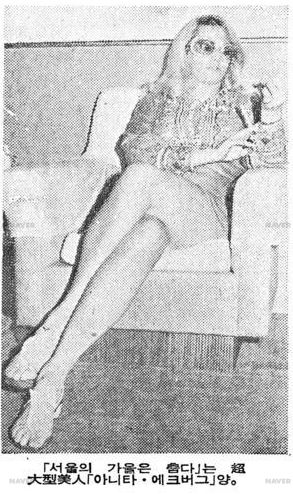
On October 6, 1970, the Donga Ilbo reported that actress (or, as they put it, "glamour fox") Anita Ekberg, best known for her role in the Federico Fellini film "La Dolce Vita" (not yet released in Korea), was in Seoul for a joint American-Korean production titled "The Seoul Affair," set to start filming with director David Rich and actors John Ireland, Jon Buono, and Sin Yeong-gyun and Choe Ji-hui on October 15.

The Kyunghyang Sinmun, on the same day, in an article titled "Seoul’s autumn is very cold," also reported on Anita Ekberg (a 39 year-old "sexy fox" with the measurements 42-28-40 wearing a skirt that ended 30cm above the knees), saying that she was best known to Korean fans for the omnibus film "Boccaccio '70."

On October 10 the Joongang Ilbo published an article about the production. On October 24, in an article titled "Film like water...", the Maeil Gyeongje reported that local directors seeing the progress of David Rich's film "Seoul Affair" were astonished at his unconventional way of directing the film. While local directors would use 9000자 of film (I'm not sure what that measures) to make a movie, David Rich wanted to use 70,000자, which made his staff turn pale in shock. From their point of view, the director was using too much film, doing seven takes and only using one shot, and wasting precious film like water.

On November 7, the Donga Ilbo reported on possible other joint projects with an Italian director but nothing seems to have come of these (perhaps not a bad thing - did we really need a "Nazi gold hidden in Korea" story? Well, maybe...).

On December 21 the Kyunghyang Sinmun showed this photo of Anita Ekberg with co-star Sin Yeong-gyun:


But then that was that. At least in Korea. IMDB has '1972' written next to it, and posters such as the one below can be found, but it's not clear if it was released in the U.S. or not (only a 1990 German release is recorded).


In Korea, however, years went by with no mention of this film, as James Wade notes in this March 16, 1974 column:


Two weeks later, however, on April 2, 1974, the Maeil Gyeongje announced that a joint Korean-American production titled "캐서린의 탈출" ("Katherine’s Escape"), was to open soon. This was, indeed, a renamed "Seoul Affair," as this poster from the April 4, 1974 Donga Ilbo reveals:


On April 9, 1974, the Maeil Gyeongje stated the nation’s first American-Korean joint production had been playing at the Scala Theater since April 5.

On April 13, James Wade weighed in with a review of the film:


Though he wasn't impressed, a week later, on April 16, the Maeil Gyeongje reported that it had brought in 34,000 viewers in the ten days between April 5 and April 14. Just to compare, it reports that a movie titled "Yu Kwan-sun" (about the national heroine of the Samil Protests in 1919 had brought in only 7,676 people in the same time period, while over 46 days the "Poseidon Adventure" had attracted 120,000 viewers. One wonders if this is correct, considering the Korean Film archive records there having been 31,291 viewers. Unfortunately, the Maeil Gyeongje's film listings section doesn't seem to be a regular feature, so nothing more is said about it.

Should you be curious to see the film, this Saturday, April 30, at 3pm, the Royal Asiatic Society Cinema Club and Seoul Film Society will have a free screening of the film at Seoul Global Center's Haechi Hall, on the 5th Floor of M Plaza in Myeong-dong.

Directions to Seoul Global Center's Haechi Hall can be found here and here, and more information about the film and screening is here.

Sunday, February 28, 2016

Colonial-era films discovered and will be screened next week (and a few other links)

The Joongang Daily reported the other day about the discovery and screening of colonial-era documentary films about Korea:
The [Korean Film Archive] announced Thursday during a press conference that the seven short films, found in Russia and Germany, expand upon cultural aspects of the time as well as Japan’s economic plan to breed sheep in the north of the country and plant cotton in the south - part of efforts by Tokyo at the time to produce industrial raw materials via cheap labor.[...]

The seven short films will be screened publicly in commemoration of the Independence Movement Day on March 1 in the Cinematheque KOFA, located in Sangam-dong, Mapo District, western Seoul.
Those films would appear to be the untitled films at the top of this schedule page.

Speaking of films, here are hundreds of Korean movie posters from the 1960s and 1970s (hat tip to Hamel).

And speaking of the colonial period, here are a couple dozen colorized photos from that time.

As well, the Seoul Metropolitan Government, the Ministry of Strategy and Finance, the Cultural Heritage Administration and Jongno-gu Office signed a memorandum of understanding for the restoration of Dilkusha on February 26 (hat tip to Robert Koehler). It was built by Albert Taylor, a gold miner who first reported the Samil Independence Movement to the world as a reporter for AP; more on the house and its history can be found at Brother Anthony's site here. It's to be opened in 1919 on the 100th anniversary of the Samil Movement (though the house itself was built in 1923). Mary Taylor's memoir 'Chain of Amber' is a fascinating read about her time in Korea from around 1916 to WWII. I think there may be reprints of it available at the RAS Office.

Wednesday, February 24, 2016

Glimpses of Korea Under American Occupation

A couple of weeks ago Jacco Zwetzloot gave a lecture for the Royal Asiatic Society entitled "Glimpses of Korea Under American Occupation," which can be watched below. The lecture explored "how Korea was seen and represented in US military newspapers and magazines during the period of American Military Government (1945-1948)," particularly in the weekly newspaper Korea Graphic. More information about the lecture can be found here.

Wednesday, February 17, 2016

From an elementary school in Daehangno to a temple bell in Deoksu Palace via Tapgol Park and 560 years of history

If you walk along Daehangno about halfway between Jongno 5-ga Station and Hyehwa Station you'll come upon the gates to Seoul Sadae Buseol Elementary and Girls Middle School.


These gate pillars originally stood at the entrance to Pagoda (now Tapgol) Park, Seoul's first modern park, built under the direction of John McLeavy Brown in 1897. [Hat tip to JiHoon for showing this to me.] About the only photo of the gates I've ever seen is this one from the time of the Samil Uprising in 1919:


I originally posted that photo in this post, which includes photos taken from this page, which has scans of a 1919 Korean Red Cross pamphlet about the suppression of the Samil independence movement. It includes the declaration of Korean independence, 34 photos (taken by Francis Schofield), and a statement from the Korean Red Cross. It was in this park, of course, that the declaration of independence was read on March 1, 1919.

Before the park was built, the ten-story pagoda it is named after stood surrounded by houses, as captured by Percival Lowell in 1884:


Many more photos of the pagoda from both before and after the area became a park can be found here, while Brother Anthony has posted a detailed history of the pagoda (and another that it was modeled after) here. 

I hadn't realized the fate of Wongaksa, the temple it was built to be a part of. As Wikipedia reveals, King Sejo had Wongak-sa temple built in 1465, followed by the pagoda 2 years later. on the site of an older Goryeo-period temple, Heungbok-sa. The temple was closed and turned into a kisaeng house by Joseon's most notorious king, Yeonsan-gun (who ruled from 1494 to 1506), and his successor, King Jungjong (ruled 1506–1544) turned the site into government offices.

This was actually part of a spate of temple building / improvements by King Sejo, as Gregory Henderson explained in his 1959 article for Transactions of the Royal Asiatic Society, "A History of the Chŏng Dong Area and the American Embassy Residence" (available as a .docx file here - more Transactions articles can be found here). He made a specific addition to Hŭngchŏn-sa, a temple which stood near present day Deoksu Palace:
In 1462, King Sejo, a devout Buddhist, deeply conscience-stricken over his murder of his own nephew Tanjong to attain the throne, repaired and built many temples, notably Wŏngak-sa in Pagoda Park with its pagoda; with these repairs he had a great new bell made for Hŭngch’ŏn-sa in the seventh year of his reign. For more than thirty years the temple continued with this embellishment and with its high tower. In 1495, however, there came to the Korean throne one of the most notorious tyrants of Korean history, Yŏnsan-gun, a man dedicated to sybaritic personal habits, malice and impetuousness. In July, 1504, he ordered the temple razed and built in its place an extra office for the care of his royal horses and their accoutrements. The next monarch, Chung-jong, after overthrowing Yŏnsan-gun, abolished this extravagance and built a public office here. Of the temple, only the five-story shari hall remained. 
Of that five-story hall, Henderson tells us that on
the night of March 28, 1510, the students of th[e] central Confucian college, firmly convinced by their instructors that Buddhism was heresy, marched on the shari hall and enthusiastically set fire to it. [...] The bell now alone remained and this, after many perigrinations through Seoul’s palaces, finally came to the grounds of the Tŏksu (Duksoo) Palace where it hangs today, the only remaining reminder of this temple’s colorful history.
And that's the history of the bell (this one, from this page) that you can see in Deoksugung Palace today, which was cast around the same time as the Wongagksa Pagoda in Tapgol Park was built, the park which saw its original gate pillars moved to an elementary school on Daehangno. A bit of a detour, but hopefully the ride was worth it.

I'll save the story of one of the architects of Yeonsan-gun's overthrow, and his tomb behind where I used to live in Banghwa-dong, for another day.

Tuesday, May 05, 2015

RASKB Excursion to Yangcheon Hyanggyo and Gaehwasan next Sunday, May 10

Next Sunday, May 10, I'll be leading a walk around the area of Yangcheon Hyanggyo Station and Gaehwasan Station for the Royal Asiatic Society. The former location was the seat of Yangcheon Hyeon, or prefecture, during the Joseon period and still sports the only remaining Hyanggyo, or Confucian Shrine, in Seoul, as well as a number of other historic landmarks. We will also visit a museum to the innovative Joseon Era landscape painter Jeong Seon (1676–1759), and look at paintings of the area that he made in the mid-1700s. I've mentioned the area before (here and here), and this post at Seoul Suburban covers some of the spots we'll visit.


(Yangcheon District in the 1870s)

From there we will take the subway to Banghwa Station to explore Mt. Gaehwasan. After passing through a park with a number of 400-year-old zelkova and gingko trees, we'll head up the mountain to see the numerous tombs, many with beautifully carved tombstones and flanked by stone civic official statues, of the Pungsan Shim clan, who for several generations served the Joseon kings and were memorialized for their meritorious deeds – one of which was taking part in the overthrow of the notorious king, Yonsan-gun.


We will also go to Yaksasa Temple and see a statue of the Buddha and a three-story stone pagoda which date back to the Goryeo Era.


We'll see an even larger such statue dating from the early Joseon period outside Mitasa Temple, on the other side of the mountain. The statue was found buried in the 1930s, when the temple was rebuilt. Both temples were destroyed during the Korean War, but the pagoda and statues survived.


Next to Mitasa is the Memorial to the Loyal Dead, which was erected to remember the 1,100 soldiers of the Korean 1st Army Division who died defending Mt. Gaehwasan - which overlooks Gimpo Airport - during the opening of the Korean War, which will provide an opportunity to learn more about the fighting which took place on the mountain during the war, as well as its military importance in the present. I'll also touch on the importance of the area during the Imjin War.


Being a mountain, of course, there will be lots of opportunities to take in views of the Han River and surrounding area and enjoy what nature has to offer.


If you feel like joining us, please do! The cost of the tour is W20,000 for RAS members and W25,000 for non-members. The excursion will set off next Sunday, May 10, at 1:00 pm from exit 3 of Yangcheon Hyanggyo Station (양천향교) #906 (subway line number 9). For more information, see here.