
Tuesday, January 15, 2013
Foreign teacher survey results being posted
Back in November I linked to a survey being carried out by reader Christian Thurston for foreign teachers in Korea to fill out. Now he's starting to post the results, beginning with a post which looks specifically at data on dating in Korea, and also provides access to a spreadsheet of the raw data. It should be interesting to see what turns up, and I'll certainly be keeping an eye out for future posts.


Friday, January 11, 2013
Growing pains for foreign academics in South Korea
On January 7, the Chronicle of Higher Education published an article titled "In South Korea, Foreign Professors Can Have a Hard Time Fitting In."
The article also tries to understand where the negative attitudes that foreign professors face come from:
And if it stems from the colonial period, how does that explain the Choryang Waegwan? This was a walled off compound built for Japanese traders and diplomats in 1678 which had a stone slab out front with rules such as "Whoever violates the boundary (wall) shall be punished with death" - a warning which was aimed at Koreans (and was even upheld after the walls came down in the late 1870s, when three Korean women were beheaded for having sneaked into the compound). At that time westerners were perceived as 'barbarians' who might infect morally upright, 'more Confucian than China' Koreans with their 'filthy' religion and "plunder our property and violate women at will," so this distrust of foreigners predates the colonial period, as I've noted before. When you're aware of this history, wanting to give HIV tests to every foreigner visiting Korea for the 1988 Olympics or developing English teaching robots so children don't have to interact with potentially 'unclean' foreigners starts to make a great deal of sense. The article continues:
It all began well enough. Michael Foster joined his wife, a South Korean, in Seoul in 2010 with a new doctorate in English literature and a three-year, tenure-track contract at prestigious Korea University. His aim was to build a life in a country that seemed increasingly cosmopolitan and vibrant. Two years later, Mr. Foster, an American, has abandoned his job and is involved in a bitter dispute with his former employer.In addition to intolerance of foreign criticism, Korea also has hot and humid summers and very fast internet. Is it really so difficult for people coming to Korea - especially foreign professors - not to know these things? As for what set the students off,
Now back in New York with his wife, he says that he felt unwelcome at the university from the start, and that his relationship with faculty members and others deteriorated over time. He says he was even accused of racism by one of his students. "One of the students in evaluations said that I insulted Korea," he recalls. "The student said, 'If America is so much better, you should go back.'"
Mr. Foster, the former professor at Korea University, thinks the student's accusation of racism against him began when he referred to homophobia in Korean culture during a course on the history of romance.While it's likely a knee jerk response on the part of the students, the professor may have been projecting contemporary homophobia into the past; as Richard Rutt pointed out in the late 1950s, in the past things were a little more complex.
The article also tries to understand where the negative attitudes that foreign professors face come from:
Distrust of foreigners is a nationwide issue and must be put in context, says Paul Z. Jambor, an assistant professor in English for academic purposes at Korea University. "It likely stems out of the Japanese colonial period, in which one of the main aims of the Japanese armed forces was to eradicate Korean culture and the Korean spirit."I didn't realize the Japanese armed forces were in charge of cultural policy in Korea. Snide remarks aside, that policy changed during the 35 years after annexation (which explains things like the publication of Korean language newspapers like the Donga Ilbo between 1920 and 1940 and the ability of language scholars to work on a Korean dictionary and standardize Korean orthograpy), though standard media depictions of that era tend to avoid complexity and reduce it to 'they tried to destroy our culture.'
And if it stems from the colonial period, how does that explain the Choryang Waegwan? This was a walled off compound built for Japanese traders and diplomats in 1678 which had a stone slab out front with rules such as "Whoever violates the boundary (wall) shall be punished with death" - a warning which was aimed at Koreans (and was even upheld after the walls came down in the late 1870s, when three Korean women were beheaded for having sneaked into the compound). At that time westerners were perceived as 'barbarians' who might infect morally upright, 'more Confucian than China' Koreans with their 'filthy' religion and "plunder our property and violate women at will," so this distrust of foreigners predates the colonial period, as I've noted before. When you're aware of this history, wanting to give HIV tests to every foreigner visiting Korea for the 1988 Olympics or developing English teaching robots so children don't have to interact with potentially 'unclean' foreigners starts to make a great deal of sense. The article continues:
Donald C. Bellomy, an American who teaches history at Sogang University, in Seoul, says foreign professors who want to work in South Korea must be prepared to adapt to a culture that has not always been welcoming toward outsiders, "and for good reason." The culture is, however, "in some respects more open than one would expect, given its history."That depends whether we're talking about 'history' as presented in the media and textbooks, or history as in 'actual facts.' Several years ago Andrei Lankov wrote an article which is mostly reproduced at the Marmot's Hole in which he debunked the idea that Korea has been invaded constantly and victimized by outsiders:
Rather than being a country with a uniquely turbulent history, Korea actually was a country which enjoyed stability undreamed of in most other parts of the world!If you do the math, the first 500 years of the Joseon dynasty featured three years of war during the Hideyoshi invasions (1592-3, 1598) and two Manchu invasions in 1627 and 1636. Needless to say, 5 years of large scale war out of 500 hardly compares to most countries in Europe during that same time period. But then, when it comes to nationalism, it's not what is true, but rather what one believes is true, which matters.
Monday, January 07, 2013
So it's come to this...
So at a restaurant near a town of 1,300 people in rural Ontario was this advertisement for fitness classes:
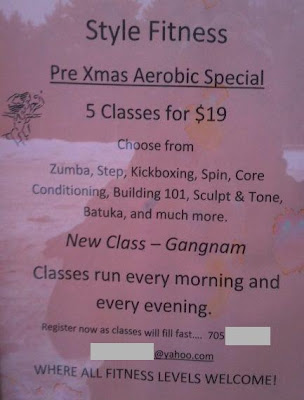
Just remember that it's pronounced 'gang-am' ('gang' as in 'gangster'). I did begin to say "It's actually ga--" but then remembered I'm not an employee of KOIS. Get in your 'hyun-die' and listen to 'gang-am style,' 'waygook'!
I hope everyone is having a good 2013 so far. I'll try to get back to more regular posting....
Tuesday, December 25, 2012
Blue eyed Santas galore
Last week there were reports of foreign teachers in Daegu donating and distributing gifts to children at welfare facilities: "Blue eyed santas in Daegu donate and share gifts":

"'Blue eyed santas' convey sweet love":

There are a few more from 2008 here and here. (And even the president of GM Korea is dressing up.)
And as I mentioned recently, James Wade wrote in 1965 a fictional piece about a USFK Christmas party for orphans which is well worth reading.
I'd like to wish all of my readers a Merry Christmas and a happy holiday season.
Monday, December 24, 2012
Journal of Korean Law article about HIV testing of foreign teachers
An article by Benjamin Wagner and myself titled HIV/AIDS Tests as a Proxy for Racial Discrimination? A Preliminary Investigation of South Korea’s Policy of Mandatory In-Country HIV/AIDS Tests for its Foreign English Teachers was published in the Journal of Korean Law Vol.11 No.2 in June of this year, and is now available on the internet. It can be read as a pdf here. Here is the abstract:
Over the past five years South Korea has enthusiastically recruited tens of thousands of foreign English teachers as part of its globalization efforts. Demanding parents and government promises of “a native speaker in every school” have seen the number of foreign teachers in public schools more than triple in that time. During the same period, however, there have been several notable incidents of xenophobia and discriminatory animus. Increased social contact, especially between foreign English teachers and Korean women, has triggered traditional fears of cultural contamination and miscegenation. The resulting hostility and suspicion, in their most extreme forms, have been expressed through the metaphor of AIDS. An influential citizens’ group has claimed that foreign teachers are infecting Koreans with HIV. Concomitantly, the South Korean government has instituted discriminatory HIV restrictions for foreign teachers that it claims are necessary to “ease the anxiety of citizens” and “assure the parents” of schoolchildren being taught by non-Koreans. The HIV restrictions against foreign teachers are both the most recent as well as the final remaining HIV restrictions against foreigners in South Korea, which has a history of HIV restrictions against foreigners dating back to the late 1980s. This Article traces the origins of the mandatory in-country HIV/AIDS tests for foreign teachers within this genealogy of restrictions and attempts to explain why the current measures were introduced and why they have remained in place even after all other HIV restrictions against foreigners have been removed.
Native speaking teacher cuts in Mokpo
After native speaking teacher cutbacks in Gyeonggi-do, Seoul, and Busan, it would seem elementary school teachers in Mokpo will not have their contracts renewed in 2013, as related in an email I received from a reader of this blog:
Worth noting, however, is that apparently native speaking teacher number are rising in Jeollanam-do. According to these statistics (posted here), in 2010 there were 365 teachers, or 742 students per teacher and a 74.7% placement rate (623 out of 834 schools) in Jeollanam-do. According to stats here, this year the number of students per native speaking teacher in Jeollanam-do was 567, which, if the number of students is about the same as in 2010, would suggest that there are around 477 NSETs, an increase of over 100 from 365 in 2010. (In the Seoul-Gyeonggi area, the numbers peaked in 2010.)
It's certainly interesting that NSETs are being removed from elementary schools in Mokpo but being kept in middle and high schools, which is the reverse of what has happened in Seoul, but apparently these cuts have been carried out by the Mokpo Office of Education, and not by the Jeollanam-do Language Program, which oversees many of the NSET positions in the province, and which is in a position to offer alternative positions to those teachers affected by the cuts.
In other news, Gangnam Elementary School now has two Filipino native speaking teachers as part of its "determination to cultivate world class talent." One wonders if we'll see more moves in that direction.
I'm an English teacher in Mokpo and a long-time reader of your blog. You've written about English teacher cutbacks and layoffs in the past, so you might be interested in some related news from Mokpo. No elementary school contracts will be renewed for native speaker instructors starting next year. Teachers in Mokpo were hired in two waves, one in April and the other one in August, so the first teachers to be let go will be those whose contracts started in April this year, followed by the ones who signed in August. I belong in the latter group. About 30 teachers will be let go in all.That's certainly a classy, well timed way to break the news, but then Seoul's cuts last year were also in December. And the cheering part is just... typically clueless. Perhaps a more apt would be the "misquot[e] from somewhere or other" mentioned in this James Wade Christmas story from 1965: "God help us, every one."
As for how the news was broken to us, I think we were told about it in a 2 minute announcement before a teaching workshop this past Thursday. I can't be sure because it was all said in Korean and my grasp of the local language isn't good enough to understand it spoken that quickly. I also teach without the benefit of a co-teacher, so there wasn't anyone to translate what was said to me. The workshop continued for another hour after that which is a little odd in retrospect. Why have a workshop for teachers when you're going to let them go in a few months? We were also asked to cheer "Have a Merry Christmas and a Happy New Year!" at the end of the workshop, which again in retrospect seems bizarre and in somewhat poor taste. Like I mentioned earlier though, I didn't find out about the cutbacks until I got home and checked my email where a message was waiting from our program coordinator (sent at 3:00 PM, the starting time of the workshop).
Please don't feel obligated to blog about this unless you think it's something worthwhile to write about. Whether your blog's readership knows about this or not probably won't change anything for us here in Mokpo but writing someone about this news was cathartic for me.
Worth noting, however, is that apparently native speaking teacher number are rising in Jeollanam-do. According to these statistics (posted here), in 2010 there were 365 teachers, or 742 students per teacher and a 74.7% placement rate (623 out of 834 schools) in Jeollanam-do. According to stats here, this year the number of students per native speaking teacher in Jeollanam-do was 567, which, if the number of students is about the same as in 2010, would suggest that there are around 477 NSETs, an increase of over 100 from 365 in 2010. (In the Seoul-Gyeonggi area, the numbers peaked in 2010.)
It's certainly interesting that NSETs are being removed from elementary schools in Mokpo but being kept in middle and high schools, which is the reverse of what has happened in Seoul, but apparently these cuts have been carried out by the Mokpo Office of Education, and not by the Jeollanam-do Language Program, which oversees many of the NSET positions in the province, and which is in a position to offer alternative positions to those teachers affected by the cuts.
In other news, Gangnam Elementary School now has two Filipino native speaking teachers as part of its "determination to cultivate world class talent." One wonders if we'll see more moves in that direction.
Sunday, December 23, 2012
Confrontation maniacs!
Who would have thought Korea would be colder than Canada right now? (We'll ignore the fact that it's supposed to drop down to -18 at night on Christmas Day here (northeast of Toronto).) At any rate, being abroad means I don't need a proxy to read North Korean news, and interestingly they have actually commented on the election fairly promptly (unlike how they failed to report Lee Myung-bak's election for quite some time). There's nothing at KCNA's English site, but in Korean there's this short article:
According to domestic and foreign journalists, after a fierce contest, the Saenuri party candidate was narrowly elected in the south Korean presidential election on the 19th.Not exactly a comprehensive report, but better than nothing, I suppose. More enjoyable is this piece of invective published in English on the day of the election:
KCNA Denounces "Saenuri Party" for Its Invectives against DPRKConsidering rhetoric like that above, and the fact that North Korea tried on several occasions to kill her father, and did kill her mother, I doubt relations between north and south under the future president Park will improve any time soon.
Pyongyang, December 19 (KCNA) -- The "the Saenuri Party" of south Korea has become more undisguised in its moves to escalate the confrontation with compatriots in the north.
"The Saenuri Party" in its recent "election campaign" at the plaza of Kwanghwamun in Seoul seriously defamed the dignity of the supreme leadership of the DPRK while criticizing the candidate from the opposition party.
Vicious elements of the "committee for great unity of people," an organization for "presidential election" of "the Saenuri Party," made no scruple of letting loose a string of unspeakable vituperation as regards the Kumsusan Palace of the Sun in the DPRK.
This was a desperate propaganda for fanning up extreme repugnance towards the fellow countrymen in the north among the south Korean people, another unpardonable hideous provocation against the DPRK.
The gentries of "the Saenuri Party" have been loud-mouthed about "contingency" and "unstable social system" in the DPRK since the great loss to the nation. However, the rapid progress made by the DPRK quite contrary to their day-dream and the south Korean public admiring it upset them very much.
As the atmosphere of commemorating the anniversary of demise of leader Kim Jong Il is running high among all Koreans from the beginning of December, the "the Saenuri Party" is much afraid that this atmosphere may have a certain impact on the "presidential election."
That is why the conservative group is deliberately linking opposition forces with the DPRK and going mad with false propaganda to dare hurt even the dignity of its supreme leadership.
Confrontation maniacs' mud-slinging is touching off towering indignation and denunciation among all Koreans as it is an unpardonable insult to the noble revolutionary careers and exploits of the peerlessly great men of Mt. Paektu who devoted themselves to the prosperity of the country and the nation.
All facts prove that "the Saenuri Party" is a group of traitors who stoop to any infamy to realize its ambition to seize power.
It is a bitter lesson drawn from the five-year office of traitor Lee Myung Bak that confrontation is bound to escalate the tension and increase the danger of war, driving the people's living to destitution.
All Koreans will never pardon the confrontation maniacs of "the Saenuri Party" putting Lee into the shade.
The army and people of the DPRK will deal resolute and merciless sledge-hammer blows at those who hurt the sacred dignity of the supreme leadership even a bit.
Good-for-nothings in south Korea should stop at once the reckless moves for confrontation with fellow countrymen, facing up to the situation.
Monday, December 17, 2012
'A Slow Walk through Jeong-dong' and 'Korean Straight Lines'
[Update: there's more about 'Korean Straight Lines' here.]
Anyone who has studied early modern Korean history knows well that many key events took place in and institutions were located in Jeong-dong. For an accounting of the historic buildings in the area which still stand, Robert Koehler's post here is a must-read. A map included in that post shows a 'Temple' northwest of Deoksugung (marked as 'New palace'), which was once actually a part of Deoksugung; the part of the wall around the temple that was next to the Russian legation can be seen in a photo here). In fact, the U.S. legation, 'Imperial library' and presumably 'customs' were also part of the palace, which is now quite a bit smaller than it once was (in part, as I argued here, because it was not considered an important palace and bits of it were sold off to foreigners, but their presence there eventually led King Gojong to choose Deoksugung as his main palace in 1897).
Covering all of this history is Michael Gibbs' book 'A Slow Walk through Jeong-dong.'

The book is a paean to 'slow travel,' spending a day walking around a single neighbourhood and soaking in all of its sights and history. While some of the area's sights - such as Deoksugung, the restored Appenzeller Hall, Simpson Memorial Hall, the Salvation Army, the Seoul Museum of Art, and many others - are well known, others are not. I'd had no idea that Yi Hwang (who is on the 1000 won bill) lived in a house that is memorialized in front of the Seoul Museum of Art, for example, or that there was an Overseas Chinese Christian Church with 100 years of history tucked away in an alley.
The stories related in the book range from recent events like the death of Roh Moo-hyun, back through the closing of the Kyunghyang Sinmun by president Syngman Rhee in 1959, the death of Ehwa student Yu Gwan-sun during the 1919 Samil protests, to the burial of Joseon Dynasty founder Taejo's wife, Queen Sindeok, in the area in 1397, which gave the neighbourhood its name. But I quite liked the starting point, both geographically and historically, of the book - at the more than 550 year old pagoda tree in front of the Canadian embassy:


The book touches on the history of, and stories associated with, each location as the narrator-traveler comes upon it, approaching the area's history in a more geographical manner. In some ways, it almost functions as a tour guide (and I've used it in that manner), but rather than photos, it's full of illustrations, some of which are more evocative or abstract rather than photo-like renditions. All in all, it's an enjoyable book which languidly explores a neighbourhood of Seoul which is steeped in history and allows the reader to soak it all in.
Full Disclosure: I received a copy of this book to review. It's available at Amazon, though for those in Korea Seoul Selection is probably a better choice (what with the postage cost being slightly more than the cost of actually taking the subway to a store and back).
As well, long term Korea resident and reader of this blog NB Armstrong asked me if I could mention the book he'd written 'Korean Straight Lines, joke lessons in South Korea,' "a humble Amazon upload. It's a short, humorously intended little introduction to a few aspects of life in Korea, including some tips on language and everyday culture." The introduction and first chapter can be read at Amazon, and the stories end with definitions of terms such as '친구,' or 'friend':
Friendship is rarely randomly struck up in Korea; it develops through affiliation and introduction and is formalized, after years of mistrust, by want of a loan.That just one of the many humourous descriptions in the available chapter; the book looks like a fun read.
Friday, December 14, 2012
Celadon and postcard exhibitions
There are a couple of interesting exhibitions on this month I thought I'd point out.
It was mentioned to me awhile ago that the National Museum in Yongsan was holding a large exhibition of Goryeo era celadon - its first in 20 years - and I sort of stumbled upon it this week. Here's some information on it:
Down at the Independence Hall in Cheonan is another exhibition, this one of colonial era postcards. If you like old photos and views of Korea's major cities (and of the countryside and daily life) from the 1910s to the 1930s, there are 150 postcards of such scenes on display there, and more collected in a slideshow. There's almost no information about this exhibition (in the media) in English, and though it's noted on the Korean language site, there's no information on the English language site (though there's useful information on how to get there). This page (I hope that link works) has links to a few examples, including this street scene and this postcard (one of ten or so which shows both sides at the exhibition) written by Ahn Chang-ho to his daughter while in the U.S. Rather annoyingly, that page has a link to a photo of the book on display there which collects all of the postcards, but it's not available to buy.
The exhibition is in Hall #7, to the right behind the large main hall. From Seoul, taking a train down to Cheonan and a ~30 minute bus ride to the hall, you could probably spend all day there. I only saw the exhibition, the remains of the old government general building (I'll put up photos of it another day) and the first two of seven halls and that took over three hours. The exhibition is on until the end of the year.
It was mentioned to me awhile ago that the National Museum in Yongsan was holding a large exhibition of Goryeo era celadon - its first in 20 years - and I sort of stumbled upon it this week. Here's some information on it:
This special exhibition is based on the research achievements on the peninsula's long ceramic tradition which have undergone a remarkable development since the 1990s. The purpose of the exhibition lies in outlining the development of Goryeo celadon wares such as its birth, and origin and application of inlay techniques. Furthermore, it is put together to take a closer look into the role, production, and circulation of the celadon, and its relationship with other metal crafts and lacquer wares during Goryeo Dynasty.It's well worth seeing, though this Sunday (December 16) is the last day. There's also a book with photos of the entire collection available for purchase.
The exhibition presents 350 intact celadon wares. They have been carefully selected from the collection in Korea and other countries in regards to the importance and quality. In terms of the scale, the exhibition is the largest of a kind in history. It includes 29 nation's designated cultural heritage(18 National Treasures and 11 Treasures) and two Japan's designated important cultural assets, making the exhibition an unprecedented case of bringing together top quality celadon wares.
Down at the Independence Hall in Cheonan is another exhibition, this one of colonial era postcards. If you like old photos and views of Korea's major cities (and of the countryside and daily life) from the 1910s to the 1930s, there are 150 postcards of such scenes on display there, and more collected in a slideshow. There's almost no information about this exhibition (in the media) in English, and though it's noted on the Korean language site, there's no information on the English language site (though there's useful information on how to get there). This page (I hope that link works) has links to a few examples, including this street scene and this postcard (one of ten or so which shows both sides at the exhibition) written by Ahn Chang-ho to his daughter while in the U.S. Rather annoyingly, that page has a link to a photo of the book on display there which collects all of the postcards, but it's not available to buy.
The exhibition is in Hall #7, to the right behind the large main hall. From Seoul, taking a train down to Cheonan and a ~30 minute bus ride to the hall, you could probably spend all day there. I only saw the exhibition, the remains of the old government general building (I'll put up photos of it another day) and the first two of seven halls and that took over three hours. The exhibition is on until the end of the year.
Thursday, December 13, 2012
E-2 population by region
In looking at the statistics released by Immigration for this post (regarding number of foreigners by visa type and region; look for 등록외국인 지역별 현황 on this page, released every June
and December, and use the 지역별 및 체류자격별 tab at the bottom of the excel
file), I also looked up the E-2 figures from
June 2012. Here are the number of E-2s by region:
Total 22,005
Seoul 5,364
Gyeonggi-do 4,645
Incheon 873
Gangwon-do 645
Gyeongsangnam-do 1,148
Busan 1,578
Ulsan 548
Gyeongsangbuk-do 1,143
Daegu 1,203
Gwangju 652
Jeollanam-do 714
Jeollabuk-do 638
Daejeon 860
Chungcheongnam-do 996
Chungcheongbuk-do 647
Jeju 351
It'd be interesting to compare these figures to the more recent past to see which areas have been gaining and which losing (the number of E-2s peaked in 2010 at more than 23,000), though obviously the big decreases would be in Seoul and Gyeonggi. I'll save that for another day.
No mention of Amanda Todd's ethnic background?
Last week I read an interview with Amanda Todd's mother somewhere and was surprised by her photo (see here, for example). Why? Because she looked Asian. In all the discussion of her suicide (Gord Sellar wrote a good piece here), I had heard nothing about her being mixed race. I only managed to find mention of it here
(it says she was of mixed Chinese and European heritage), where the
writer also expressed surprise at how the media hasn't focused on this
at all. While I know that in Korea someone's mixed race identity would
be overemphasized and brought up in the first paragraph of a news story,
the complete lack of mention of race in the case of a girl who
committed suicide due to bullying strikes me as more than a little odd.
Tuesday, December 11, 2012
Psy, slowly and painfully

I had to weigh in on this eventually, right? If you haven't already, it's worth reading the articles at Busan Haps, the Washington Post and Gord Sellar.
This isn't the first time Psy has attracted criticism, as this November 16, 2001 Hanguk Ilbo article notes:
Singer Psy being investigated on suspicion of 'marijuana'This would result in much criticism and his being banned from television for awhile, as well as apparently missing his grandfather's funeral, but in the end he escaped jail time. On January 11, 2002, the Segye Ilbo reported that Psy had been fined five million won, and quoted the judge: "Fans do not want to hear music made by relying on drugs." "Considering that the defendant is a young, first-time offender, I issued a fine."
[...] Psy, the singer famous for his peculiar dancing and singing has been caught by police on suspicion of smoking marijuana. Seoul Yongsan Police caught singer Psy (real name Park Jae-sang, 25) on the 15th for violating the Cannabis Control Act, and he is currently being investigated.
According to police, Psy is suspected of smoking marijuana with a composer several times since September at a friend's house in Bangbae-dong.
Psy, who studied overseas, stated to police, "In the US I smoked marijuana all the time, and earlier this year, after becoming popular my popularity ended, and in May while working on a new album I was unable to overcome stress and smoked marijuana."
A Kukmin Ilbo editorial spoke of the responsibilities entertainers have:
Of course, since entertainers are regarded as 'public figures,' there are many that demand a higher morality or sense of ethics, or social responsibility, in comparison to ordinary people.At which point I'll point you in the direction of the Metropolitician's post.
I'd tend to imagine that Psy's past anti-American performances will eventually disappear down the memory hole (President Obama eventually shook his hand the other night, though not everyone is happy), and this blast from Psy's past certainly isn't going to stop Gangnam Style from hitting a billion views (it's at 922 million, currently). In Korea, most people would hold his pot bust or his skipping out on his military service against him rather than what he sang in 2004 - unless, of course, this did become a kerfuffle in the US, in which case I can see people holding it against him for making Korea look 'bad.' Otherwise, I imagine a good many people here would agree with his views, since there are still people out there who believe a lot of dumb things about 2002 and 2008. And hey, if people could get over him skipping out on military service - and a drug bust - I don't think there's much he could do to turn the public here against him.
As for what he sang in 2004, I can't say I personally care all that much, though I have smiled at people saying that his apology is not "sincere enough," and at the idea of Lee Myung-bak having to call the White House to express regret. And what a particularly ironic tale of comeuppance it would be if the unlikely singer who achieved the long sought-after Korean dream of success in America was undone by his past participation in the periodically fashionable nationalist frenzies that lashed out at that very same country. And all in time for Christmas! Ho Ho Ho.
There is, however, more to say about the lyrics Psy sang in the N.E.X.T. song 'Dear America,' which he performed in 2004 (and can be listened to here). The thing is, the lyrics have been translated (and widely disseminated) as seen below:
싸이 rap : 이라크 포로를 고문해 댄 씨발양년놈들과The problem is, though, some things have been left out in that translation. While there's lots of profanity in the description '씨발양년놈들,' there's no outright '양키'('Yankee') to be seen (though it can certainly be argued that its implied). Literally, though, 양놈 could mean either western (서양) bastard or foreign bastard (see definition of the hanja 洋 here). Now, perhaps 양놈 would be taken by a great many Koreans to refer to Americans, like a reversal of how '미국인' often applies to all westerners - but if it refers to westerners in general, then '씨발양년놈들' would be 'fucking western bitches and bastards.' Also left out of the translation is the '코쟁이,' a derogatory term for white people referring to their noses (think of 'big nosed' as a cousin of 'slant eyed'). Not that Koreans think westerners all have big noses or anything like that.
고문 하라고 시킨 개 씨발 양년놈들에
딸래미 애미 며느리 애비 코쟁이 모두 죽여
아주 천천히 죽여 고통스럽게 죽여
Kill those —— Yankees who have been torturing Iraqi captives
Kill those —— Yankees who ordered them to torture
Kill their daughters, mothers, daughters-in-law, and fathers
Kill them all slowly and painfully


So if we put this all together and take into account the fact that, in Korean, the verb 'kill' is at the end of the 3rd sentence, perhaps this works better:
The fucking western bitches and bastards who torture Iraqi prisoners,Put it that way, and suddenly it doesn't seem to be about death wishes aimed at 'F--- Yankees' who torture (and their families) but rather more about death wishes aimed at racially defined big nosed westerners (who torture) and their families. And you know, when I think of propaganda which sees big nosed westerners - particularly Americans - as torturers (probably NSFW) and makes no distinctions between those who do wrong and all other members of their race, and I can't help but think of the Korea north of the 38th parallel. As B.R. Myers has pointed out, the beloved North Korean anti-American novella 'The Jackals,' by Han Sorya (translated in Myers' book Han Sorya and North Korean Literature) portrays even the child of the American missionary family as being evil.
the fucking western bitches and bastards who ordered them to torture,
their big-nosed daughters, mothers, daughters-in-law, and fathers - kill them all.
Kill them very slowly and painfully.

And thinking of killing all "their big-nosed daughters, mothers, daughters-in-law, and fathers [...] very slowly and painfully," that sounds quite a lot like taking rather brutal revenge against an enemy and all of their relatives:
 Let's take revenge a hundred thousand times on
the U.S. imperialist jackals!
Today's Korea Times has an article titled "Psy, Samsung push 'brand Korea' in 2012"; one wonders which Korea's brand is being pushed (and the KT reports that "Psy rapped lyrics calling for American soldiers to be killed "slowly and painfully," leaving out the big nosed family members). But I digress. It's not like the relationship between North and South Korean anti-Americanism is particularly obscure. As for the translation, the existing one probably serves the purpose of the person who did it well enough (ie. to make Americans angry). I'm pretty sure painting Psy (and Koreans) as 'anti-American' or 'anti US foreign policy' is likely something that communicates easily and clearly to Americans, rather than having to explain to (white) people that Koreans perceive them in a racist light as big nosers or lump all westerners together as one group (this Washington Post article does a pretty good job of discussing the political aspects of Korean anti-Americanism, but doesn't bring up racial or moral perceptions). Confronting Americans with a mirror image of 'typical' contemporary US (and western) perceptions of Asians might complicate things a little too much - better to stick with 'he hates America!'
Something else worth mentioning is that there seems to be confusion over the N.E.X.T. song and Psy's antics in 2002.
According to this Chosun Ilbo article (linked to at Busan Haps), Psy and Shin Hae-chul (frontman of N.E.X.T.) performed together at the 2002 MNET Music Video Festival where he smashed a tank (as seen in the photo at the top of this post). I can't find anything saying that Psy ever performed live with N.E.X.T. in 2004, only that he recorded his now infamous rap on the song 'Dear American' on the album they released that year. The article does mistakenly claim that 'Dear America' mentions the girls killed in the 2002 Yangju incident, however, which perhaps contributed to the confusion.
As for Shin Hae-chul, he's been recording music for more than 20 years (an interview with him is here)(and he has a pot bust in common with Psy, too), though he might be better known among English speaking foreigners in Korea for his hosting of the show Damage, one episode of which in 2009 portrayed foreign English teachers as gang rapists (the show can be watched here):

Their shocking barbarity without conscience!

The woman in her 20s who was gang raped!

The criminals were her foreign boyfriend's friends!
Funny how that mention of 'barbarity' by white men against a Korean woman reminds me of this:

"The entire world accuses the US Army of unpardonable barbarity
against south Korean women."
The aforementioned Chosun Ilbo article also notes that "American netizens who don't know much about the 'Hyo-sun-Mi-seon incident' are expressing anger at the song Psy sang." Forgetting the fact that the song isn't about that incident, even if it was, would an even-handed (though from the Korean point of view, probably "incorrect") perspective on the incident - that Koreans overreacted to a vehicle accident which left two middle school girls dead - help stop Americans from expressing their anger? Would reports like this and the images below help?
They also sang obscenity-laced anti-American songs and tore several huge U.S. flags to bits before unfurling a Korean flag to shouts of "We will recover our national pride."

 (From here.)

Really now, trying to calmly explain anti-Americanism in Korea to Americans is just going to dig stuff up ('Fucking USA' and its ranting over a 'stolen' Olympic medal, anyone?) that will just make things worse. Perhaps the same is true the other way around. As James Wade put it in 1964:
Koreans today seem materialistic and greedy, highly factional and inclined towards nepotism and violence. Yet they cherish an inflated notion of their national morality, and a somewhat mystical attitude about their racial superiority. This makes them very sensitive and thin-skinned about accepting either criticism or advice.In other words, never mind the bollocks; this kerfuffle will blow over soon enough, even if the sentiments which fed those lyrics in the first place still lie dormant.
Yes, the fact must be faced: the Koreans are actually "the Americans of the Orient." Perhaps this explains in part some of the frictions between the two countries, as well as their inextricably linked destinies.
Subscribe to:
Posts (Atom)