Wednesday, April 22, 2009

Britain's most important battle of the Korean War

Today marks the 58th anniversary of the beginning of the Chinese Spring offensive during the Korean War. On April 22, 1951, Chinese forces began the largest offensive of the war with the aim of recapturing Seoul. One of the battles where they were stopped was the Battle of Kapyong, which I mentioned in this post last week (more on it here). Another important battle was the Battle of the Imjin River, which is the focus of a new book by Seoul-based British journalist Andrew Salmon titled "To The Last Round: The Epic British Stand on the Imjin River, Korea 1951." As this Korea Times article relates,
"British forces have fought all over the world since the 1950s, but Imjin River remains the bloodiest battle since World War II. Of the brigade's 4,000 men, 1,091 were dead, wounded or captured… However, today in the United Kingdom this tragedy is almost forgotten," said the author. Back home, he said, military history is a popular genre but there are barely any books on the Korean War.
When I met the author a few weeks ago, he mentioned that this book would be coming out soon, and it sounded interesting; what I didn't know was that the book is being made into a documentary by Daniel Gordon, known for his documentaries about North Korea ('The Game Of Their Lives,' 'A State Of Mind,' and 'Crossing the Line'). I also found this interesting:
The filmmakers are seeking private investment because South Korean governmental bodies refused to fund the movie, reasoning that "the Korean War is not in line with the 'brand image' (they) want to promote," Salmon said. "I think if you want to understand how prosperous and free Korea is, you need to contrast it with the brutality and poverty of the war," he added.

"Korea is now a rich country, one of the richest countries in the world. To fully understand that, you have to contrast it with the way it was 50 years ago. That is a tremendous achievement by the Korean people. On a different angle, war is the greatest human drama. Much of the great poetry, literature and film are on the drama of war. I'm surprised Korea doesn't package its tourism toward the Korean War," he said.
Salmon has also written one of the more down-to-earth articles I've read about branding Korea (in this case, food) here. Back to the film:
The filmmakers hope the film will be ready to be screened by the 60th anniversary of the outbreak of the Korean War next year. "I truly hope the Korean government and society will unite to commemorate next year's 60th anniversary of the outbreak of the Korean War. For next year will be the last significant event that living witnesses will be able to participate in," said Salmon.
The article manages to mess up both the name of the book and the website, which is here. Be sure to read the introduction here - it looks like a promising beginning.

Monday, April 20, 2009

Minerva found not guilty

Though prosecutors wanted an 18 month sentence for Minerva, Seoul Central District Court found him not guilty today:
"When considering all the circumstances, it is hard to conclude that Park was aware the information was misleading when he wrote the postings," Justice Yoo Young-hyun of the Seoul Central District Court said in the ruling.

The judge also said that even if Park had realized that the information was false, it cannot be concluded that he had the intent to hurt public interest, considering the circumstances at the time or the special characteristics of the foreign exchange market.
Good news all around, but he never should have been arrested in the first place.

[Update: There's more on the case here.]

419, 49 years later

Today (well, okay, yesterday) was the 49th anniversary of the 1960 student revolution (known as 419 (사일구) in Korean, after the date). On this day in 1960 students rose up against the government of Syngman Rhee for election fraud after the discovery of the body of 16 year-old Kim Ju-yeol - who had been killed by police in an earlier protest - in Masan harbor. Upon attempting to march on the presidential mansion, police fired on students, killing 130 and wounding hundreds, removing any lingering legitimacy the Rhee regime might have had. I've looked at the events of the uprising here and here, and at its aftermath, when Syngman Rhee was forced to step down, here. Photos of the uprising can be seen in this video. This photo from the Korea Times reminds us that the events of this day 49 years ago are not as distant as we might think.

Kim Byeong-ji, 96 years-old, weeps in front of the tomb of her son, Choi Dong-sup, who was among those killed during the Students Uprising on April 19, 1960, at a national cemetery in Suyuri, Seoul, Sunday.
This article adds that "Her son was killed by gunshot while taking to a hospital student activists [who were] injured..."

Some beautiful photos of the cemetery can be found here.


Photos of the ceremony commemorating the 49th anniversary can be found here and here, while this article has photos of the president visiting the cemetery early in the morning; in the first he's standing in front of Kim Ju-yeol's grave. His speech, which was read at the ceremony (which he didn't attend) spoke out against corruption. While I can't disagree with the sentiment, the anniversary of the 419 uprising seems an odd time to bring up such a topic, other than to gloat over the fact former president Roh is being investigated for corruption. Call me cynical, but I have a hard time believing Lee Myung-bak will be the first president to break out of the very established pattern of presidential corruption.

[Update: Michael Breen writes about the Roh investigation here.]

Friday, April 17, 2009

An organic buffet near Mok-dong

A few weeks ago I went to Cheongmirae, a Korean-style organic food buffet restaurant in the very south of Sinjeong-dong (south of Mok-dong).


For 13,000 won, you can have all you can eat. There are numerous leafy/salad options...


...banchan style options...


...and 'meat' options. In the photo below is pork in the middle (which was very tasty), as well as mushrooms on the right and 'fake beef', made from tofu (written as 'kong gogi' in Korean) on the left.


At bottom right is 'fake fried spicy chicken' (which was quite good, even though I'm not much of a fan of bean-based attempts to approximate meat). There was also (real) fish, vegetables, and other interesting concoctions which were quite good, though I'd be hard-pressed to describe them (rice paper wrapped around... tasty brown stuff, for example).


Not seen in the photos are the soups (such as - yes! - chamggae juk, or sesame porridge (which I could happily eat just by itself, and ignore the rest), the fruit, small jeon, or the very tasty dongdongju.

Cheongmirae is ideal for vegetarians, though pork and fish options exist to sweeten the deal for carnivores. While dongdongju (and possibly other drinks - I didn't check) is served by staff, note that you should take your plates up to the kitchen area when you finish - it works more like a cafeteria in that aspect.

Cheongmirae is close to Yangcheon District Office Station (양천구청역) on the Line 2 spur that runs from Sindorim to Kkachisan Station on Line 5.


While technically in Gocheok-dong, Guro-gu, it's surrounded on three sides by Yangcheon-gu, and is across from the Seyang Cheongmaru Apartments (세양청마루 아파트); it's in the basement. It's possible to take bus 6617 from Yangcheon District Office Station, though a taxi might be easier. An even easier option, considering how out-of-the-way the Line 2 spur is, would be to take a taxi from Mok-dong station on Line 5.

I'm not sure of the hours, but we were there until 8:30 on a Sunday night.

(Crossposted at Hub of Sparkle)

Thursday, April 16, 2009

Like clockwork

Spring never arrives with subtlety in Korea. The second week of April always finds Seoul exploding in colour, especially due to the blooming cherry blossoms. These days the cherry blossom festival in Yeouido is always a big draw for crowds (at least for people in southwestern Seoul), though in the early 20th century, Changgyeonggung Palace - turned into Changgyeongwon park and zoo by the Japanese - was the place to go:

From Seoul Through Pictures Vol. 2

Here are a few photos taken over the past few years of mostly cherry blossoms (within a few hundred meters of my house, unless stated otherwise):

2006.04.08

The above shot is my only one of cherry blossoms on Yeouido. It was taken while driving by on the Olympic Expressway while heading out on this trip.


2001.03.25

Taken near Wolchulsan in Jeollanam-do, on my second trip into the countryside.


2002.04.07 (or 4.14)

The two photos above were taken in Gangneung, near Gyeongpodae and Gangneung's lake.


2007.04.11


2009.04.12


2009.04.12

The two photos above were taken south of Gimpo Airport, on the border between Seoul and Bucheon.


2008.04.14

The above photo was taken near Banghwa Station.


2008.04.06
Forsythia and azaleas on Gaehwasan.


2008.04.14


2008.04.08


2009.04.08


2007.04.12


2008.04.11


2005.04.11


2005.04.11

The shot above isn't so spectacular, but a cropped version of it did serve as the header of this blog for a few years.

2009.04.07 (벚꽃 or 불꽃?)


2009.04.07

Wednesday, April 15, 2009

From the Korean War to Bruce Lee via Pierre Berton

Update: ROK Drop has a good post on the Battle of Kapyong here. A new Joongang Ilbo article also looks at it.]


When I was home at Christmas I found several articles I'd clipped a few years earlier about Korea. One of them was an article about Canadian participation in the Korean War from Macleans, July 21, 2003. It was written by Pierre Berton (with sidebars featuring interviews with veterans by Benoit Aubin). There are several contemporary photos in the article, including one of Berton himself (in the center, above), who was sent to Korea as a correspondent for Macleans in March of 1951.

The text of the Berton article can be found here; scans of the article including the sidebars and photos are here: Pages 1 2 3 4 5 6 7. The time of year when he arrived was in spring, and his description of the flowers should be familiar to anyone who has stepped outside in the last two weeks - even if his description of Seoul itself is very different:
I remember rattling down the impossibly narrow road that followed the broad valley of the Han River en route to the ravaged South Korean capital of Seoul. It was spring -- the flanks of the valley ablaze with azalea and rhododendron, the soft mists rising from the river below half screening the peaks of the conical hills as in a Chinese scroll. But the spectacle of Seoul shattered that illusion. It was, as I reported in Maclean's, a "carcass of a city" without running water or electricity, looted of food and fuel, its pre-war population of 1.5 million reduced to one-seventh that number. [...]
In case you were wondering what happened to the animals in the zoo on the grounds of Changgyeong Palace, wonder no more:
One day, driving through the old Chang Gyeong Won Palace gardens, a public park and zoo, I came upon an odd spectacle. Every cage stood vacant; every animal had been eaten -- with one exception. There, picking its way through the debris was a lone and starving ostrich, the most bedraggled creature I've ever beheld. At my suggestion, the UN command made the big bird its mascot.
Another article I found was a Reader's Digest article about Canadian troops in Korea from September 1990 (Page 1 2 3). Both articles mention the shooting down and imprisonment of pilot Andy MacKenzie and the April 1951 Battle of Kapyong, in which Canadian and Australian troops held off a much larger Chinese force. When the Canadians alone were left, surrounded by the enemy, to hold Hill 677, they called artillery fire down on their own position to avoid being overrun. The battle is remembered here (clip 17), in a radio broadcast on the 25th anniversary of the battle (in 1976). In the radio clip, the soldiers who joined the special Canadian force being sent to Korea in the summer of 1950 give their reasons for signing up:
"I'll be damned if I know."
"I had a fight with my boss."
"The only reason I joined was for adventure, excitement; I wanted to see something."
"Unemployment, myself. I didn't even know where Korea was."
Any Canadian English teachers feeling down because of the ongoing 'English teachers are losers who are only in Korea because they have no life goals' meme in the Korean media might feel heartened by the fact that they are, in fact, part of a long tradition of Canadians coming to Korea.

Speaking of Canadian traditions, for those who don't know, the aforementioned Pierre Berton was a reporter, broadcaster, and Canadian historian. Shortly before his death, at the age of 84, in 2004, he appeared on the CBC giving tips on something else Canadians in Korea seem to be known for (at least according to this); a video clip is here.

Looking up information on Berton's life also led me to something I'd seen before (in a documentary on my VHS version of Enter the Dragon), but had no idea he was involved with this 1971 interview with Bruce Lee.

How cool is that? I love listening to Lee talk - as much for his intonation and delivery as for what he says. Watching this for the first time years ago after taking a Chinese philosophy class, it was obvious how influenced he was by Taoist philosophy, and I loved the way he applied it to martial arts and everyday life.

Friday, April 10, 2009

The state of the youth in 2009

[Update 3: Via Brian in Jeollanam-do's post on the high cost of education in Korea is this article about the percentage of students who go to hagwons:
According to research by the education ministry, 88 percent of elementary school students, 78 percent of middle school students and 63 percent of high school students attend private crammers [hagwons].
Also, this article looks at the porn watching habits of teenagers:
[A]ccording to a survey conducted last December on 338 people aged between 13 and 18 by the Korea Communications Standards Commission [...] 35.7 percent of respondents said they have watched online pornography. Of those, 95.8 percent did so at home, followed by at school (2 percent), in internet cafes (1.1 percent), and at friends' homes (0.6 percent). In terms of the daily time spent watching porn, 43.8 percent said 15 minutes or less, 27.7 percent 15 to 30 minutes, 19.3 percent a half to an hour, and 5.4 percent one to two hours.
It was obvious more than a decade ago that Korean teens needed better sex education, but they're still not getting it.]

[Update 2: The Joongang Ilbo reports on the higher addiction rates of poor children to online games:
In 2007, 4.6 percent of poor kids were hooked on gaming, whereas only 1.6 percent of middle-class kids were. Nine out of 10 of the poor children who get basic living expenses from the government have their own computer at home - computers provided by local educational offices and governments.
Another article also looks at how "National college entrance examination scores vary according to region, school type and gender, with students from larger cities often performing better than those from smaller towns."]


[Update: Via the Marmot's Hole, the Hankyoreh looks at statistics for teens giving birth (it's sad, considering the final story of this post, that "
87% indicated that they would like to continue their education but are unable to gain readmission to a secondary school"), while Brian in Jeollanam-do looks at the estimate that 50% of children born in the countryside will be biracial by 2020.]


At the end of February, the Korea Times looked at a study done of teens:
According to research [by the Ministry for Health, Welfare and Family Affairs] on 14,716 middle and high school students and 1,597 teenagers in correctional facilities, some children started to view pornographic material online or buy it when they were 11-12 years old. A study conducted five years ago had the age at 14, the ministry said.

About 19 percent of non-juvenile delinquents had smoked with 22 percent of these starting when they were 13 years old, or middle school juniors. About 37 percent had consumed alcohol with 17 percent starting at the age of 12.

About 5 percent of males and 2 percent of females had experienced sex ― the first experiences taking place at 13 for females and 14 for males. Sexual activity jumped to 44 percent for juvenile delinquents, half of whom said they smoked every day, almost double the smoking rate of adults.[...]
More than 52 percent of respondents said sex education at school has little or no effect on their ideas toward sex[.]
As for younger students,
according to Kid's Hankooki Ilbo, 63 percent of 286 elementary school seniors have boyfriends or girlfriends. More than 4 percent of the 11 year-olds said they had "French kissed'' with their friends, and said it helps them to feel less lonely and much more bonded.
Weeks later, the Korea Times again reported on this study, this time looking at sex:
According to the Ministry of Health, Welfare and Family Affairs, 544 out of 14,716 middle and high school students nationwide, or 3.7 percent, have had sexual intercourse. About 15 percent of them were involved in pregnancy, showing that sex education or campaigns aren't as effective as they should be.

About 8.6 percent of respondents said they had no problem with selling sex to adults. [...] About 5.3 percent said they were offered opportunities to participate in the sex trade, mainly in online chat rooms, and brokers were sometimes involved. Teenagers also sometimes made lewd calls to illegal "talking clubs'' but the Internet was the main attraction, the ministry said.
This made me chuckle:
Experts have been criticizing the government for not making sufficient efforts to prevent such sexual activity. [...] The ministry has set up a series of measures to deal with teenage sex and related crimes.
While I realize it's referring to teen prostitution, I find it amusing that some think the government should be out to put a stop to teen sex, and the phrase 'teenage sex and related crimes,' while obviously an awkward translation, is also unintentionally amusing ('Will the crime of teen sex ever end?' cries some distraught expert).

The Segye Ilbo reported on another survey and turned up some interesting results. South Korea's National Youth Policy Institute surveyed 2368 male and female students and found the following:

35% had had physical contact such as hugging with a friend of the opposite sex, and 20.1% said the experience was a kiss. The percentage of students who said they were sexually experienced was 4.1%. 1.6% had had sex forced upon them, while 2.3% of middle school students and 6.2% of high school students had been kissed against their will.

2.7% had the experience of forcibly demanding sex – 1.8% of male middle school students and 3.8% of male high school students.

65% of boys and 78% of girls said they should be virgins before marriage, but if they had promised to marry, then premarital sex was okay for 56.9% of boys and 42.8% of girls.
27.3% of middle school students and 30% of high school students agreed it was true that if a girl says she doesn’t want sex she’s just pretending and actually wants you to be forceful with her.

21% of female high school students agreed that the single way to make girls sexually excited is to use violence. 21.9% of middle school students and 24% of high school students agreed that women feel sexually stimulated when men handle them roughly.

Well, there you go then. The article blames the media and its images of men using violence for such responses. One wonders if these attitudes are related to this?

An article at Korea.kr looks at the use of "harmful media" by youth, and finds that 1 in 3 had had some experience with such media. 35.9% of youth used pornographic sites, compared to 32.7% in 2007. 37.3% had seen Adult videos or movies compared to 33.4% in 2007. 29.6% had read adult comics while 41.8% had watched over 19 broadcasting. 44.1% had used adult games, and 37% had used adult gambling sites, a rise of 8.6% and 5.0 % respectively. 47.3% had experienced trading game items online (though I'm not sure why this is bad). E-today also provided a chart, which I translated (click to enlarge):


It would seem the first year of middle school is when students really start getting up to no good, though loads of elementary school kids play over-19 computer games (like Sudden Attack), as the results show. I was curious what 'Pon-ting', or phone meeting/dating actually entailed, and this Hanguk Ilbo article takes a lengthy look at (the photos make it not safe for work). It's essentially phone sex, and the article estimates 1,000,000 men have been made 'victims' by using psychological tactics to take advantage of them. Video phone sex is also apparently growing.

The article at Korea.kr also mentioned that 10.8 % smoked, 53.7 % drank, and that the number of runaway youth increased 12.8 % this year. A January 30 Chosun Ilbo article titled "Runaway Teens Most Vulnerable to Youth Sex Trade" looked at runaways:
A sex trade report on teenagers revealed some 80 percent of those involved in the youth sex trade between July and December last year were runaway teens. The report was released by the Ministry for Health, Welfare and Family Affairs on Thursday. There is a pattern of hard-up runaway teens becoming engaged in the sex trade. The 36 incidences that occurred during the first half of 2008 increased to 69 during the second half.

A ministry official said, "About half, or 44.4 percent, of teens involved in the sex trade say they only do it to earn money for living expenses. Very few are engaged in the sex trade to earn bread for their family, but most of them do it to live after running away from home."

However, the government has nearly no countermeasures to prevent young runaways from getting involved in sex trade. There are only 77 welfare shelters for runaway teenagers nationwide. Moreover, those places only provide them with temporary accommodation and meals, but fail to offer solutions that help send them back home and to school.

The government's monitoring of web-based chat rooms is negligible, even though up to 95 percent of youth sex trade occurs online. Only three ministry officials monitor internet sites, hundreds of which appear and disappear every day.
Over a year ago I posted several Korea Times and Korea Herald articles about youth from the late 1990s. The first article looked at runaways (and the second article looked at rise in the number of (mostly runaway) girls working at unlicenced night spots). In the first article from August 1995 we were told that in 1991 the number of runaways crossed the 10,000 mark for the first time, and by 1994 the number was 11,363 (girls outnumbered boys 5,935 to 5,428). At the time the Times wrote that "the absence of proper facilities to protect teenage delinquents is cited as a serious problem in Korea, as proved by YMCA statistics, showing that 71.4 percent of runaway teenagers are making their living at adult entertainment facilities."

This article reads in Google that "In 2001, the number of runaways in South Korea reached 61319 youths (23577 males and 37742 females), an increase likely due to the fallout from the 1997 financial crisis. A great many girls taking part in wonjo gyoje (which I looked at here, here and here) were likely a part of this demographic. At any rate, Korea is once again the middle of an economic downtown, and once again the number of runaways is increasing. In January the Joongang Ilbo's English edition posted three articles about today's runaways, suggesting the number may be around 50,000.


The first article begins with the story of a 17 year-old girl named 'Seo-yeon' (above), whose mother left home after losing her job during the Asian financial crisis in 1997, leaving her to be raised by her uncle, who lost his job recently due to the most recent financial crisis, and whose violent behavior after this led her to run away. We're told that
The number of children in low-income families who had suffered economic hardship in the Asian financial crisis in the late 1990s are today facing new woes. Of 15 runaway teenagers that JoongAng Ilbo reporters interviewed, 12 had backgrounds similar to Seo-yeon’s. [...]

According to a Korea Youth Shelter Association survey conducted in December 2007 of 735 runaway teenagers who used its shelters that month, 50 percent said they had lived with a single parent after their parents divorced. Twenty-five percent said they lived with grandparents or relatives. The rest had lived with their parents.

The survey found common points - most respondents first ran away from home at age 14 and continued coming back and running away more than eight times on average. The main reason that drove them away from home was their families’ tough economic situation. Other reasons for leaving were family troubles, mostly violence or divorce.

In most cases, the kids slept in Internet cafes and jjimjilbang or 24-hour fast-food restaurants. In the worst cases, when they didn’t have money, they slept in parks, apartment boiler rooms, comic shops, public toilets and on apartment roofs. [...]

The government currently runs 77 children’s welfare centers across the country to support such teenagers. Those shelters accommodate some 13,000 runaway teenagers annually. But the facilities are not sufficient to meet the escalating number of runaway teenagers. Police estimate that there could be 50,000 runaways.

In theory, runaways can stay up to two years in each facility. In practice, stays are much shorter and many teenagers usually move from facility to facility. Such circumstances make it difficult for kids to remain in school. Most reportedly quit school regardless of their will to study. Their priority is finding a suitable place to stay and something to eat.[...]

As most are deprived of educational opportunities, life on the streets is tough, they said. They are not able to find permanent work as they lack both sufficient education and skills. They instead work part-time at gas stations, fast-food restaurants, coffee shops or delivering newspapers and leaflets. Some girls start working at room salons (hostess bars). [...]

According to a survey conducted by Nam Mi-ae, a social welfare studies professor at Daejeon University, 78 percent of teenagers who used the welfare facilities said they at one time or another begged for money from strangers. Thirty-one percent said they had stolen money. And 8.5 percent responded that they had sold sex.
The next article, "Some teens prefer shelters to home," begins with the story of a 14 year old girl in Geumcheon Youth Center, and quotes Lee Ki-yeong, director of Seoul Children’s Welfare Center:
It takes them one to two months to fully recover and settle into the new environment, she said. “As their guardian keeps changing from mother to grandmother, and then grandmother to shelter counselor, it hurts their self-esteem,” she said. The center serves as a gateway connecting such children and teenagers to orphanages supported by the city. The center takes care of them for up to three months until it finds them suitable orphanages that will care for them until they turn 18.

In these troubled times, a growing number of parents who have lost their jobs or businesses leave their children with the center. The number of children being cared for at the center between October and December last year skyrocketed to 188 from 74 during the same period in 2007, according to Seoul Children’s Welfare Center run by the Seoul Metropolitan Government. [...]

Lee said many parents send children to the facility promising the counselors that they will take their children back when the economy improves. However, she said cases where that actually happens are extremely rare. “It’s better for children to quickly adapt to a new environment, so we normally send children to long-term childcare facilities [orphanages] after they’ve spent about one to two months here,” Lee said.
The article looks at some children who say they are living more comfortably in the orphanage than they did with their parents, as well as experts who call for such long-term care facilities to be expanded. The third article looked at the mental health of teens:
Lee Kyeong-yeong, a social welfare worker at the Seoul Child and Adolescent Mental Health Center, which is supported by the Seoul Metropolitan Government and operated by the Seoul National University Hospital, said nine out of 10 parents with mentally ill children reject [offers for free counseling].

“For a full recovery, children need to receive treatment for more than six months. But the parents can’t afford to pay, as it costs hundreds of thousands won per month,” said Lee.

According to a study conducted by the Community Childcare Center Association last year, the 15,709 children from low-income families who were tested were more likely to suffer from uneasiness, depression, delinquent behavior and aggression than children from families without serious money problems. [...]

“Failure to receive proper treatment in time will lead such children to lag behind in class and become juvenile delinquents, which will later become an object of public concern,” said Professor Kim Bung-nyeon of Seoul National University Hospital’s child psychiatry department.
To be sure, underage crime has been on the rise, with a number of shocking cases making news in recent months. Several teens in Seongnam tortured and beat their mentally handicapped friend to death and secretly buried her last month. Another group of runaway teens were arrested last month in Gimpo:
The adolescents, seven male and two female, are accused of forcing two teenage girls to take their clothes off and filming them naked. The suspects allegedly threatened to upload the videos to the Web if the girls tried to run away or refused to participate in prostitution. They were not forced to sell sex, however. Last month, the suspects lured [the] two runaway teenagers, surnamed Lee and Ahn, both 16, to a motel by offering them a place to sleep via the Internet. They then locked the victims in.[...]

All nine suspects were captured on March 9. They are accused of committing the same crime on a 14-year-old middle school girl, identified only by the surname Paik, in October last year. Paik was held captive for two months, sexually assaulted and forced to prostitute herself 60 times.

News photos and clips are here. They didn't just film them naked - the two girls involved forced the two victims to bow before them and chant and hit each other with their fists and shower shoes, conducting it like some kind of twisted symphony. In reading the accounts of it, it's hard not to be reminded of punishment students receive in school. The Korea Times tells us that
Internet users were shocked by the case, and the rage increased after one of the accused girls said about making the two girls hit each other, "If I hit them, my hands hurt.’’

Bloggers are calling for harsh punishments, saying that lenient penalties on teenagers are resulting in repeated serious crime among them.
That story was also looked at by Korea Beat. Another video which got a lot of attention recently was that of a group of girls in Incheon who repeatedly kicked a classmate in the face.


I've looked at this kind of youth group violence before. The Korea Times related more of the story, noting that the girls were barely punished by the school for the beating, and that it was now only an issue since the video was spread online:
The case shocked Internet users. However, the offender responded with hostility. On her Web site, she said, "You don't know me at all, who do you think I am? Why do you bring up things that happened in February?'' She added, "There's nothing you can do anyway. I'm only 13 years old and they can't send me to juvenile reformatory.''
What a charming young lady. Korea Beat also translated a few other stories related to teenagers. In one, three teenaged boys were arrested along with a 15 year-old girl in Busan. The reason was because the girl asked the boys to rape her 14 year-old classmate as a favor, which they did. In another, a 16 year-old teen from the provinces was caught working at a massage parlor when police busted the place. Prostitution was her way of funding her move to, and life in Seoul.

Korea Beat also translated a Yonhap article about sexual misconduct by teachers in Chungcheongbuk-do (here)
; another article(in Korean) looks at recent youth crime in the province, focusing on Cheongju. On February 26 two female teens were gang raped by a group of teenage boys. 16 year old Kim and 4 others were arrested; one other was booked without detention.

The article mentions two other cases in which female students were raped by male students, with a 17 year-old arrested in one case, and a 15 year-old arrested in the other (along with 3 others being booked). In the latter case the victim’s attackers were classmates who had also molested her in front of other classmates at school. The article then mentions the boy beaten to death by classmates in Chungju last November.

The number of juvenile offenders on Chungcheongbuk-do has risen from 2,853 in 2006, to 3261 in 2007 to 3887 in 2008. Violent crimes increased 16% from 780 in 2007 to 908 last year.

To end on a happier note, the Joongang Ilbo tells us that the story of Seo-yeon, the 17 year-old runaway mentioned in their first article on runaways, has, at the time of publication, ended on a hopeful note.
After the JoongAng Ilbo’s three-part special report series, “Suffering teenagers,” was released in January reporters got a rush of inquiries from readers wanting to help Seo-yeon. Of them, a 41-year-old mother of two daughters, Kim Mi-yeong, an alias, made a tearful telephone call to a reporter. Choking up, she said she wanted to meet Seo-yeon and take care of her as her own child because Seo-yeon’s story reminded her of difficult days she encountered when she was around Seo-yeon’s age.

The reporter looked for Seo-yeon at the readers’ request, but later realized that she has vanished a day after her story was published. Her friends told the reporter that Seo-yeon was last seen at Seoul’s youth shelter on Jan. 15 and that had not heard from her since.[...]

Two weeks after, Seo-yeon managed to escape from runaway teenagers who had locked her in their one-room studio and beat her.
I really hope those teens weren't the ones mentioned above. Of course, if it wasn't them, then it was a group of teens who are starting to fit a rather unpleasant pattern of 'messed-up things done by runaway teens.' When Seo-yeon met her new guardian, and told her she wanted to go to school, it wasn't easy to find a school willing to take her.
Most principals turned down Kim’s request citing concerns that “she may be a bad influence to other students.” Being rejected for several times, Kim sometimes asked school officials why they could not accept a student who is really eager to study.

As the last ditch effort, Kim visited a school that her daughters had graduated from. That school, too, was reluctant to accept Seo-yeon. Kim, however, did not give up and tried again. Police officers who took charge of Seo-yeon’s missing person case accompanied her and pleaded with the school principal. Officers and Kim assured the principal that they will intervene at any time if Seo-yeon causes trouble. Seo-yeon was accepted.
I'm glad she was accepted in the end, but the attitudes of the principals who rejected her were unhelpful, to say the least.

Thursday, April 09, 2009

I want to see this movie


That's Shin Jung-Hyun and the Yup-juns playing in a 1975 movie titled "Miin", or 'Beautiful woman'. According to this review, it stars Shin Jung-hyun and Kim Mi-yeong, and was directed Lee Hyeong-pyo. In the film the band, and Shin, play struggling musicians who are helped out by a young woman who Shin fantasizes about (leading to several fantasy scenes where he admits his love to her). I had no idea Shin had made a movie. Too bad it came out just before he was arrested during the "marijuana crisis" of 1975, along with dozens of other musicians, and forced to stop performing.

Prompted in part by this interview with Mark Russell, (funny how the English version leaves out all the interesting bands and singers mentioned in the interview, as (perhaps?) it's assumed foreign readers wouldn't know who they are) I've been listening to Shin Jung-hyun and Kim Jung-mi a lot the past few days. A few tracks from Kim Jung-mi's 1973 album Baram ('wind') can be heard here (just be certain to turn off the two tracks you don't want to listen too, as all three players start playing automatically). The first, unnamed track is 'Baram,' followed by 'Areumdaun Gangsan' and 'Dangsini.' They're all good examples of Kim's psychedelic folk music at the time. It's too bad there isn't more like it today.

Oh, and thanks to orienkorean, who uploaded the Miin video above (along with 1500 other Korean rock/indie/electronic/classic rock videos). Thanks to him, you can also enjoy a 1971 movie clip with the Pearl Sisters (more of them here) and Kim Chu-ja, as well as two videos of Kim Jung-mi, among many others.

More sexual misconduct by non-'miserable failure' teachers

[Update 2: Be sure to read Ben Wagner's comment here.]

[Update: Korea Beat translates the Yonhap article mentioned below here.]

One of the highlights of this rant was seeing
a Korean American student attending a university in Virginia, bemoaning the epidemic of '"native English speakers" who miserably fail in their own lives' overrunning Korea, use the phrase - referring to said epidemic - "it doesn't shoot up the death toll." It's about as advisable as a "native English speaker" telling assembled Korean parents, "Your children have touched me, as I'm sure I've touched them." How was she to know it would be published on the same day as this?

In other news, the Korea Times reports that a temporary teacher in Chungcheongbuk-do was arrested for raping and molesting female teens, and that "He had previously been convicted on seven counts of sexual assault and other crimes." While not a "native English speaker" of the sort derided in the first article, the obvious question arises as to how someone with seven counts of sexual assault was able to get a job teaching students. The answer?
Currently, criminal records of those sentenced to less than three years in prison are removed after five years. As such, schools can't always ascertain the criminal record of would-be teachers.
Lovely. This essentially means that anyone convicted of rape or, say, paying an 11 year-old for sex would be free to teach after five years, because sex crimes aren't severely punished in Korea. It would be interesting to see just how many sex offenders have gotten a sentence over 3 years (and how many are teaching now - surely this is a more pressing issue than the next 'native English speaker' scandal). Yonhap has an article in Korean looking at this case as well as recent cases of sexual misconduct by Korean teachers here (which Korea Beat translated here). On the bright side, at least you can be a little more certain of where non-Korean teachers on E-2 visas stand.

Speaking of E-2 visas, in an article about how the government plans to fingerprint and photograph all foreigners coming into Korea, we're told that
The bill also aims to ease the regulations governing foreign workers. Under the current law, all foreign workers are required to gain approval from the immigration authorities before they can make any change to their employment status. The bill is seeking to allow foreigners staying on E-1, E-3, E-4 and E-5 visas to alter their status without prior authorization, though they will still have to report the amendment.
According to the list here, these visas apply to professors, research, technology transfer, and professional employment, respectively. Unsurprisingly, the bill skips out on a run by not applying this easing of regulations to E-2 visa holders (or entertainers or foreign workers, for that matter).

Wednesday, April 08, 2009

Six months for eleven years

I was researching an almost-finished post and looked up 'wonjo gyoje' (the name for freelance teen prostitution, which I've looked at here, here and here) at the Chosun Ilbo's website and found this story from March 27. In it we're told that at the Seoul Southern District Court 29 year-old Mr. Hwang was sentenced to 6 months in prison for breaking the Act on Protection of Youth from Sexual Crimes by paying for sex with... an elementary school student. You see, last year Hwang met 12 year-old Jeong via internet chatting (wait, it gets worse) and through her he was introduced to 11 year-old A. He met A at 10pm last November 15 and had sex with her in his car in return for 100,000 won.

It was noted that most first-time prostitution offenders get a fine or probation, but that the unusual circumstances of this case called for something more severe. According to this article, three years is the maximum penalty in such cases, so he seems to have gotten off pretty easy. Twelve year-old girls have made the news several times before (three examples are here) in these kind of cases, but eleven years old... I teach kids that age, and that is just beyond creepy. One wonders if this is the youngest case that has been dealt with in the courts here, or if even younger girls have been involved in this sort of thing.

On an unrelated note, Brian posted this video yesterday.

Tuesday, April 07, 2009

George Foulk's photos of Korea in the mid 1880s

Via the Marmot's Hole, we learn that UW Milwaukee has posted numerous old photos of Korea on its website, including 43 taken by George C. Foulk between 1884 and 1887. I've written about Foulk (who accompanied part of the Korean entourage who visited the U.S. in 1883 back to Korea) before. Before Foulk arrived in Korea, Percival Lowell (who had accompanied the Korean group to the U.S.) spent a few months here, taking photos (which can be found here; click 'search'), and writing a book about his experience, which I mentioned the other day here.


Above can be seen members of the party that traveled to (and within) the U.S. Lowell is in the center and Foulk is on the right. I'll have to add a few of Foulk's photos to the post about the city wall, as he took several photos of it, especially near Namdaemun, which can be seen in all of the photos below (the ones with no borders can be clicked to enlarge):


This photo from April 1885 includes Horace Allen and his wife, and is taken in Biwon, the secret garden of Changdeok Palace:


What's remarkable about his photos is the fact that he took several from high vantage points in the city and provides some incredible shots of the cityscape. Below, in a photo taken from the U.S. legation (near present day Deoksu Palace) you can see Gwanghwamun and the throne hall at Gyeongbok Palace, as well as Bugaksan (at left).


The following two photos actually seem to go together to form a panorama, and seems to be taken from the lower slope of Inwangsan. The wall in the photo is not the city wall (it's too small and is going in the wrong direction (down when it should go up)).


Visible above is Gyeongbok Palace - you can see Gwanghwamun and the throne hall, as well as the southwest corner guard tower (Dongshipjagak's counterpart), long since destroyed. Below at left you can see in the distance the forested area that is Jongmyo, as well, in the center of the photo, a white streak that is Jongno.


Below is Yeongeunmun, where diginitaries from China were met (before it was replaced by Dongnimmun and Seodaemun Prison was built behind it).


What I really found interesting about the photos was that they exist at all. In his presentation on Foulk, Samuel Hawley mentioned that Foulk's photos were stolen, but apparently some survived. I'd love to read the books Hawley edited of Foulk's letters and his travel journal, but they're a little too highly priced (at the moment).

Monday, April 06, 2009

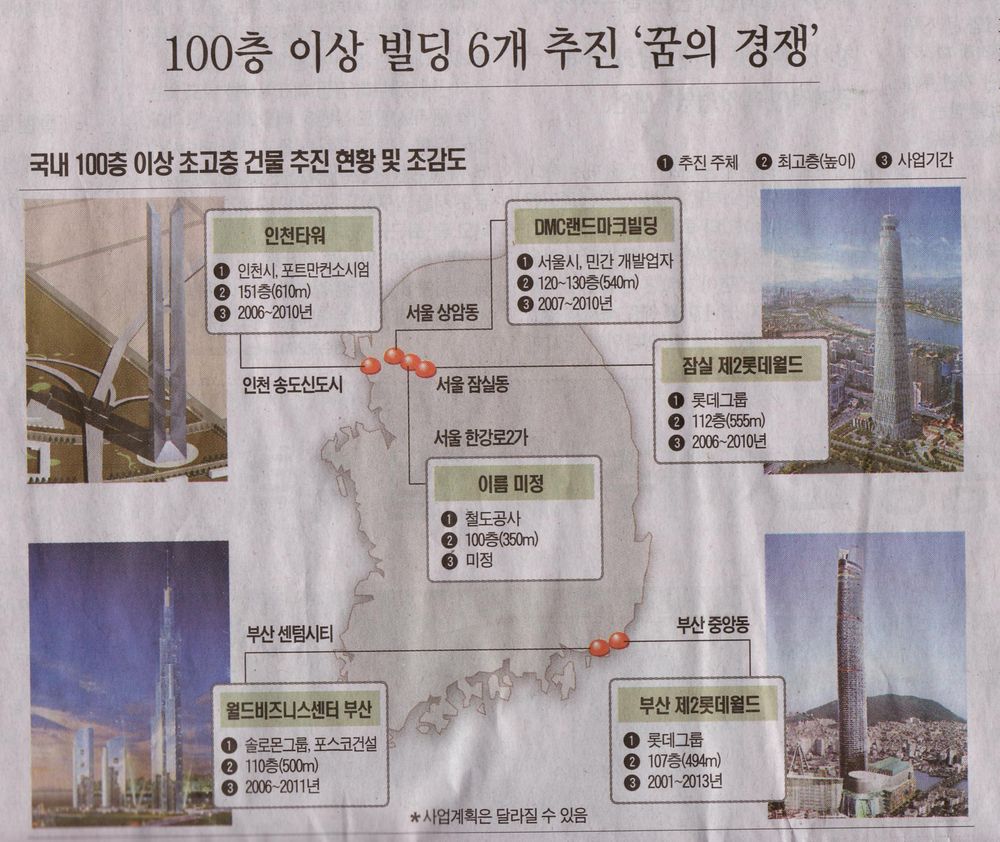
Seoul's skyline to change. Again.


The Chosun Ilbo has an article titled "Seoul's skyline about to be transformed:"
Seoul's skyline will undergo a major transformation, with five skyscrapers in the works that will be more than 100 stories tall, while a rash of building 60 stories or taller are being built. The 63 City building, once the tallest building in Korea, will soon be dwarfed by these new developments.
The 63 building hasn't been the tallest building for six years now, though I find many people don't know that. Surely it's not because the media often refers to the building this way? Anyways, I found this article funny because it looks much like a similar article from three years ago:


I've looked at some of the projects in the top photos, like numbers 2 and 3, here (ahem) as well as number 7 here.