Sunday, January 28, 2007

To dream of beauty (and better English)

Still from "Michuhwanmong"

I walked into class earlier this week and asked one of my ten-year-old students why she had been absent the previous class. She told me she had gone to the dentist, but her classmate quickly added, "She cut her tongue". I asked her why and she told me it would help her speak English better, and insinuated that my Korean co-teacher had said it would help her pronounce 'S' better. This student has never had any noticeable problem pronouncing English words (it's her shyness that hampers her more than anything), so the fact her parents would do something so unnecessary left me shaking my head in disgust. Actually disgust was what I felt after I asked to see the result (she was pretty blase about the whole thing, saying it had only hurt for a day or two) and saw the stitches under her tongue. If (and only IF) you want an idea of how this looked, there's a screenshot from Park Jin-Pyo's short film "Tongue Tie", (which I mentioned here) that has documentary footage of a frenectomy (specifically, the tongue being stitched) here (it's not for the squeamish).

The LA Times article about this procedure (from 2002) can be found here:
Linguists sneer at the idea that South Koreans' tongues are too short to speak English properly, pointing to the unaccented speech of hundreds of thousands of Korean Americans.

"O.K., since Westerners are taller they might have longer tongues. But this operation lengthens the tongue by only a millimeter or two and that has nothing to do with it," said Lee Ho Young, a linguist at Seoul National University. [...]

Jung said the operation takes as little as 10 minutes and can be done as outpatient surgery with local anesthetic. It usually costs $230 to $400.
Actually, though I didn't ask, she responded to a classmate's comment saying that it cost 120,000 won. Who knew that dentists were doing it?

On the topic of plastic surgery, an article about plastic surgery in which women have their calves sliced to give them thinner legs can be found here.

Also on this topic, Gord over at Eclexys, when describing his girlfriend's (a nurse in training)
"feeling that anyone considering plastic surgery should be required to see a surgery, be present for one and really experience how gross it is to cut open a human body and fiddle with it", reveals an unpleasant fact about plastic surgery. Also related to this is an excellent post he wrote about the "kind of absolute horseshit that female interns have to deal with" within the medical culture here.

The Hankyoreh has a pertinent article on the topic of eyelid surgery and the concern girls have with their appearance:
A high school student, Yu Na-yeong, 18, shot an 18-minute drama called "Michuhwanmong" ahead of graduation. It is the story of a girl worrying over the fact that she has "single-lidded" eyes, or without a crease in the lids when she opens them fully.

The film, loosely translated as "Dream of Beauty", can be seen here (it opens with 2 minutes of behind the scenes shots). The still above is from the film. The article continues:
Yu had watched the mainstream movie "200 Pound Beauty" with some of her friends. In the movie, an obese woman was reborn into a beauty after undergoing full-body plastic surgery. Then she managed to reconcile with the "past" and succeeded in work and love. About the movie, Yu commented, "The movie has received some favorable criticism that it does a good job of addressing the social problem of an appearances-first attitude, but I felt that it encouraged plastic surgery."
Worth mentioning is the fact, as related by Mark over at Korea Pop Wars, that "200 Pound Beauty is now officially the 10th-biggest Korean movie of all time, beating out JSA for the No. 10 spot."Almost 6 million people have seen the film, a poster for which is here, while the music video for Kim Ah-jung's cover of Blondie's 'Maria', (which has become pretty annoying due to its sudden ubiquity here) serves as a preview of the movie (here). At 6 million viewers, 12% of the population has watched a film that "encourages plastic surgery", according to a high school senior, who continues:
For young girls, plastic surgery is not extreme, said Yu. It is considered natural that teenage girls would undergo a surgery to obtain "double eyelids," she explained. "After taking the college entrance examination, many girls got plastic surgery, at least to get double eyelids. Teenage girls have a strong desire to overcome their appearance-related complexes, instead of valuing their individuality."

The Korean Womenlink, a women’s rights organization, conducted a survey of 1,648 South Korean female middle and high school students about how they evaluated their appearance. According to the survey, just one out of 10 respondents, or 13.7 percent, was satisfied with their appearance. About 43.6 percent, or 718 girls, were totally unhappy about theirs.
It's one thing for these girls to feel inadequate themselves; it's another when their parents project this onto their children, as they certainly do with the tongue operations, and which they must have done when I saw a ten-year-old student with bruised eyes who had just had eyelid surgery, something that made me feel pretty nauseous. And yet she treated it like a joke, saying, "Look into my eyyees" in an exaggerated voice and giggling. In response to my post about Gang Hye-jung's plastic surgery, Iceberg commented, "She used to be so pretty. Now she's just...ordinary." I think that hits the nail on the head. In Korea, plastic surgery-enhanced faces are ordinary, and getting plastic surgery is "considered natural." It's as Korean as kimchi, the four distinct seasons, cyber terror, and cakeboxes full of money.

Friday, January 26, 2007

Dinner in Jongno, Redevelopment in Hongdae

Last Saturday I met up with my friend Scott Bug and was taken through the back alleys of the Jongno area, where he's lived for many years, to a restaurant where I had a chance to try Chueotang (Mudfish soup) for the first time. Below is a shot of the outside of the restaurant, which dates back to 1932, and the alley it was situated in:


Inside, it's not a large restaurant; there's only room for six tables. In the picture below, the mirror on the opposite wall helps to give an idea of the space inside.


And here's the chueotang itself, which was delicious, before I added the noodles on the left and the green onions just off to the right. The mudfish were essentially the consistency of paste, with the soup also consisting of mushrooms and tofu. It was tasty and filling, and something I look forward to having again in the near future.


After dinner we headed north of Jongno into the narrow alleyways hidden away there. On weekdays Jongno's office workers keep this area busy, but on weekends it's very quiet.


We stopped in for a drink in a cosy place tucked away at the end of an alley and were entertained by a poet and artist in his sixties with no front teeth who showed us the examples of his work which were displayed all over the walls of the establishment. He took it upon himself to be our host, whether we wished it or not, but it was all good fun, and the music, much of it Korean rock music from the '60s and '70s, was great (I'm still trying to track down the original version of Lee Jang-hee's "Geugeonneo" that we heard there, but all I can find is a horrific synth version from the 1980s). Though he was intent on continuing to entertain us, we politely extricated ourselves and headed off to Cafe Sukara in Hongdae to see an exhibition put on by someone we'd met a few weeks previously:


The name of the exhibition was "Seogyo-dong 365 - I think this building is beautiful." The building and address in question refer to a narrow strip of buildings which essentially run down the middle of the street in Hongdae which runs between (and parallel to) the street the subway station is on and the street which runs in front of the entrance to Hongik University. I've been told that this is essentially the last strip of these older buildings in the area. When I first saw them over five years ago, they contained a lot of restaurants and tiny, almost anonymous "Soju-beer-hof" places. Over the past three years dozens of tiny clothing shops have taken over the southern part of this strip of buildings, but despite this gentrification the area still retains its charm (and in fact one of my favourite haunts in Hongdae can be found here).


Above is a photo taken on the west side of the strip of buildings (which are on the right) near its southern end. The exhibition has a number of interesting photographs of these buildings from many different angles, as well as some that show the changes of the past few years. Most remarkable, however, is a series of photos taken facing each building running down the entire length of both sides of the strip. The result can be seen in the postcard for the exhibition I showed above, or, more clearly, here:

Keep in mind that this excerpt shows only a quarter of the composite photo (a tiny version of the exhibition can be seen here). What's remarkable is the way in which the two long photos, one for each side of the strip, generate an identity for these buildings by allowing us to see them all at once, as a whole. The viewer is given both a sense of space and place, and it certainly gave me a new appreciation for these buildings. More can be found out about this at their website, http://www.seokyo365.wo.to/ (which seems to work best with IE), which also helps to give a sense of the community surrounding these buildings. There you can find pages with photos which help to give you a sense of where these buildings are, while this page gives directions to the cafe where the exhibit is being held.

Of course, there's another reason for displaying photos about these buildings: they might not be with us for much longer. A look at the map below where help give you a sense of where everything is so I can talk about it more clearly (I also note, just right of center, the location of Cafe Sukara):


In the bottom left corner in yellow are the aformentioned buildings; notice how that strip is dwarfed by all of the surrounding buildings. Across the street, in white, is the wide 'pedestrian' street (created through a previous redevelopment - note the 'swirly' design of the streets there). At the northern end it connects to the wide swath running from northwest to south east, outlined in red. This area is being excavated so that the Incheon Airport Railway and the Seoul-Sinuiju Railway can run underground. The ultimate plan for this area is shown in the promotional posters below:


They plan to turn it into a 5 km long park, a "New Daehangno" (note the swirly design of the park, and the fact that the previously mentioned pedestrian street of meandering design is to merge with this park. Extend the logic of the park space displayed in this poster to the other end of that pedestrian street and, of course, the strip of buildings at Seogyo-dong 365 has to go - it'll get in the way of these grandiose plans. The picture above doesn't give much of a sense of scale (these advertisements for developments never do, as they exaggerate the size of whatever is being built to rediculous proportions - hell, some would knock Namsan out of the way to make some lego-block officetel look more spectacular on the poster), but the one below suggests that the park will be widened quite a bit beyond the current width of the railway tracks:


Now, it seems to me this could be another version of Cheonggyecheon: an 'environmental' development (hey, it's park space, not parking spaces!) which will lead to massive redevelopment in the area around it (the Ahyeon new town will be built quite close to this future park, to begin with). Most of the housing in the area is quite old; for example, this photo taken back in May of the construction begun near Hongdae station shows at least one hanok (care to bet if it's still there?):


Is the city, with its massive redevelopment plans (Cheonggyecheon, 50 New Towns, it's new park corridors) really going to let a 5 km long park touted as the 'New Daehangno' sit surrounded by villas and houses dating from the 1970s and 1980s? I think not. What do you think they mean by New Daehangno, anyways? I don't think of parks when Daehangno comes to mind, I think of cafes and bars (ok, and theatres) and consumption. I imagine this park space will be surrounded by loads of commercial space and perhaps a few officetels (okay, maybe a lot of them). I'm rather certain this is going to become another cash-cow for the developers, and the scene below is only the beginning.


Of course, every day in Seoul is the beginning of a new development, so it's nothing to get too excited about. I just wish this future monster of a development could keep it's tentacles off of the Seogyo 365 buildings. Will the city ever get a clue and realize that the part of Hongdae surrounding that strip of buildings is one of the more unique areas in the city, and doesn't need to be improved by razing it to the ground and replacing it with a concrete pedestrian street? (watch out for the cars!)

Hongdae is one of those places that gets touted for its club scene in magazines and newspapers catering to foreigners (while providing fodder for the local tabloids due to the mix of Koreans and foreigners, but that's another story). Does the city really think Hongdae will become more attractive to the eyes of foreign tourists (or even its own residents) by making it look exactly like something they'd see back home? At some point people will look back at some of these lost neighbourhoods and regret their disappearance - all too late. Many people have, of course, but it's just not a point of view that gets much airtime or sympathy from those with the power to knock things down and build them back up, and those people have too many dollar signs in their eyes to see beyond them. Kudos to those responsible for the Seogyo 365 exhibit, which exists at an intersection of art, architecture and protest.

I linked to the directions to Cafe Sukara above, and also pointed it out on the satellite map. The exhibit finishes next Monday (the 29th), but if you have a chance, do stop in, grab a coffee, and have a look around.

Oh, it turns out the Hankyoreh has an article about this exhibition (in Korean).

Thursday, January 25, 2007

Bullying

The Joongang Ilbo often posts long articles in English which are quite good, and one I just read one titled 'The silent, deadly curse of bullying'. It looks at a 21 year-old woman who was bullied for years in middle and high school, and who is now a councellor for bullied children.

I could dig up lots of other articles about bullying in Korea, but I'm sure anyone familiar with Korea has a pretty good idea of how nasty it can be here. Contributing to this is the fact that, unlike many children who are bullied in the west, who have at least a friend or two, childen in Korea who are bullied are often totally ostracized, as no one wants to be associated with them for the fear that they, too, will be targeted by bullies. Another factor is the institutionalized violence prevalent here, especially in the school system, which lead the victims to simply 'shut up and take it,' and often not even try to fight back.

I'll be delving into this topic more in the near future. The article is here.

Sunday, January 21, 2007

Panoramania in Banghwa-dong


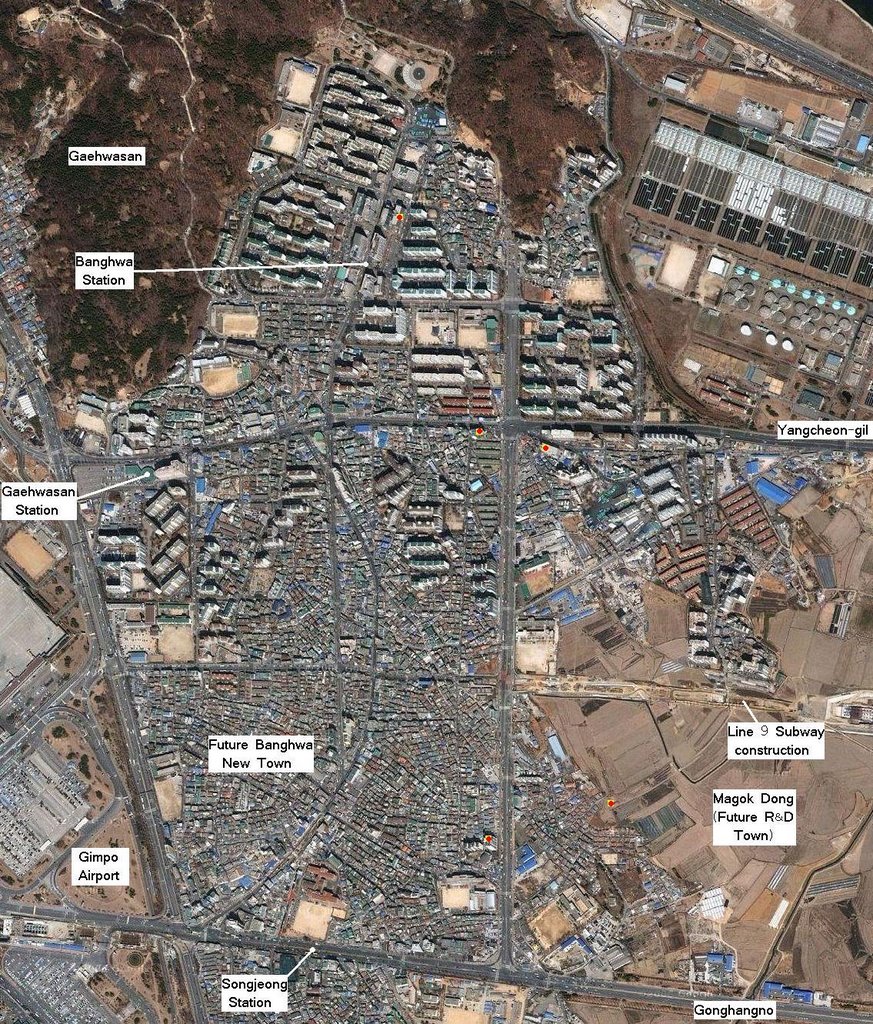
I've been looking into the development of Banghwa-dong, where I live, for awhile now, but I've amassed so much information it's hard to know where to start. Banghwa-dong is in Gangseo-gu, and is located next to Gimpo Airport; Banghwa is also the last stop on subway Line 5. Its northern part is nestled between Gaehwasan and Chihyeonsan, which overlook the Han River to the north.

I'd taken a lot of photos over the past few years but one thing I'd never looked into much, even though I quite like them, was how to turn them into panoramic photos. Well, kudos to Lost Nomad, who mentioned a little program called ptgui, which I've been using to make panoramas out of dozens of older photos, as well as pushing me to great heights (literally) to try to capture the cityscape I call home by taking some new ones.

Here is the neighbourhood as cobbled together from Google Earth. A few landmarks as well as the vantage points for the following photos are marked on the map (in yellow and red). Like any photo here, it can be clicked on to enlarge it.


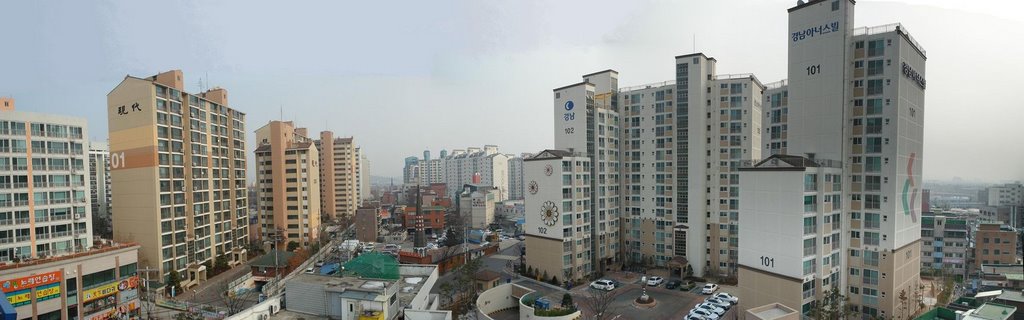
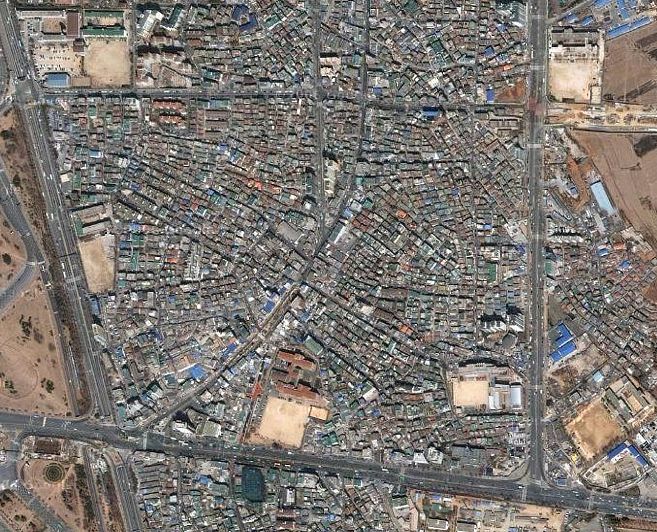
Banghwa-dong can essentially be divided into three sections: The area north of Yangcheon-gil, the street running across the northern part of the map, which was mostly a large planned development; and the middle and southern sections which lie south of this street, and which are divided obviously enough by a large street. The southern section is bounded to the south by Gonghangno, the wide street running to the airport. The middle section has seen quite a few new apartments scattered across it, but the southern section has remained untouched, as it will all be razed to make way for the Banghwa New Town. The main crossroads near the center of the map are where the following two photos were taken. The first pans from northwest to southeast:


In the foreground at left is an apartment complex dating from the late 198os (as many in the area do), while the taller (rebuilt) complex behind them is three years old. To the north of those, and including the large complex in the center of the photo, are the apartments completed in the mid 1990s, which were built on former farmland (these were finished in anticipation of the completion of subway Line 5). To the south of the street running away from the intersection at the center of the photo is a neighbourhood dating from (likely) the early 1980s. A great many 'pocket' developments (where an apartment complex is built amidst older housing) can be found there; beyond it is Magok-dong, the four square kilometers of fields which lie between Banghwa-dong and the rest of Seoul. Those fields resemble what the northern part of Banghwa-dong would have looked like 15 years ago.

The next photo is taken from one of the taller buildings on the left side of the above photo. The panorama is bounded between the tall apartment building in the center of the above photo and the last tall apartment on the left. It pans from southwest to slightly northwest:


Across the horizon are more examples of pocket development, with the visible apartment complexes dating from between 1993 and the present. More than a third of Banghwa-dong's 'middle section' has been replaced with apartment complexes. The area in the foreground on the left gives an idea of what the non-apartment complex dwellings generally look like, and how they are laid out (the area was based on farming roads, explaining the curved, non grid-like arrangement of the streets). The street running across the photo was only connected to Gonghangno, to the south (left) a few years ago (in an attempt to impose a grid on the area). The apartment building at far left can be seen on the right of the following photo, which looks east from the same vantage point as the photo above:


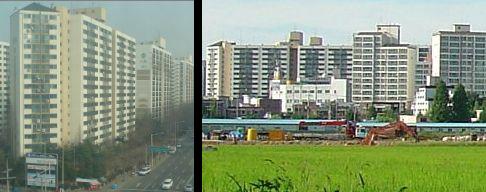
This apartment (the one on the right) was a hole in the ground when I first moved here, but quickly sprouted up to block out the view (it's interesting to look at my older photos and see what a different landscape was visible before). Now, this apartment complex can also be seen on the right hand side of the right hand photo below, while to its left is the apartment building which appeared in the center of the first wide panorama above (as seen below in the left hand photo).


The photo above on the right is a close-up of the one below, which was taken from about 700 meters to the south on the other side of the fields that make up the Magok-dong area. The line of construction running in front of the buildings is for the new subway line.

To the right of the apartment buildings a small mountain, Gungsan, can be seen, and behind it, Bukhansan. To the right of the mountain is Gayang-dong, which is full of apartment buildings also built around the same time as those in the northern part of Banghwa-dong. In front of Gungsan (a former Baekje-era fortress) is what was once the center of the area, Yangcheon; the elementary school there dates back to 1900.

I often go for bike rides around the Magok area, which is often a peaceful place (though you can still hear the traffic in the distance on Gonghangno). These fields, along with the two mountains to Banghwa-dong's north, make Banghwa a place where nature is less than a half hour's walk away. It's too bad that these fields will soon disappear to make way for the Magok research and development city. They've been on the chopping block since Kim Young-sam's presidency, and at this point the land has long since been bought up by the government. It'll likely be over a decade before it's all developed.

A more pressing development is the Banghwa New Town project, which is supposed to start this year. I've already shown before and after plans for the project, and below is a photo taken from the southeast corner of the new town area (about 300 meters west of the last photo's vantage point), panning from west to north showing the area to be developed (I nabbed the photos from here):


The 'peak' at the far left is the top of Gimpo Airport's international terminal (now mostly a shopping center), while the peak at center is Gaehwasan; Chihyeonsan is visible at right (it's currently having a tunnel bored through it to connect the (new) street at right to the Banghwa Bridge and the Gangbyeong expressway). At top right is an apartment building that should be familar by now. This photo should give an idea of the appearance of the area to be developed. There are numerous villas built across this area, as well as several low apartments dating to the early 1980s. There are also a lot of houses, and some of the owners I know aren't very pleased at having to move. Across the horizon in the distance are the newer apartment complexes; prior to their building in the early 1990s, most of Banghwa-dong looked like what we see in the foreground, or like the fields we saw above.


Above is a photo taken by my friend Matt in the area near Banghwa station, looking east (Gungsan is actually visible on the horizon, two kilometers away). What's interesting is that you can see Chihyeon Maeul (village), which was the town that once sat nestled between Chihyeonsan and the fields these apartments overtook. There's been a few pocket developments within the village, and I imagine the area will disappear over the next decade. Of course, once the new town is finished in 5 or so years, in that time even more 'pocket redevelopment' will have occurred, making most of Banghwa-dong unrecognizeable from how it looked in the early 1990s. Of course, there are many areas in Seoul which will be able to say the same, especially once the 25 new towns are finished (with 25 more to come, some of which will be massive). Another planned new town is in Sillim-dong, and Antti's post about visiting Sillim-dong and taking photos in the area to be redeveloped has convinced me of the need to do the same in southern Banghwa-dong before it's gone.

Wednesday, January 17, 2007

Haejangguk!


Maybe it's the economy, but I've noticed more and more restaurants, bars, and other stores in my area changing ownership in the past few months. The makkeoli place above appeared a few months ago (it's a franchise, and there are now three within a 15 minute walk of my house), while the 'Cool Hof' that used to be just down the street from it was replaced recently. Cool Hof had its charms, including a wooden statue of a disembodied sax player out front (I'll dig up a photo eventually), and an interior straight out of the '80s (according to a friend). It's dark interior has been replaced by the bright lights of the haejangguk restaurant below:


For those who may be curious as to what exactly 'Cheongjin-dong Haejangguk' is, this Joongang Ilbo article gives a lot of information about Haejangguk, giving us this helpful bit of information: "Haejang means to eat or drink something in the morning to relieve a hangover," and guk means soup, and it can be eaten at night after drinking or the next morning. As for what Cheongjin-dong Haejangguk is, we're given this description:
Seoul blood soup: This is made of blood jelly and ox bone.
The most well-known neighborhood for haejang soup restaurants in Korea is Cheongjin-dong, in Jongno district, Seoul. Despite its fame, now there are only a few haejang soup restaurants open. A blood soup restaurant called Cheongjinok is the oldest establishment. Some customers slice the blood jelly and eat it while drinking alcohol.

According to Choi Jun-yong, 38, a third-generation restaurateur, when Cheongjin-dong was at its peak in the 1970s and '80s, there were over 10 blood soup restaurants there. The area sees more customers in the early morning than late at night. Cheongjin-dong's haejang soup neighborhood was created in the late Joseon Dynasty. There was a market selling firewood nearby, and restaurants opened to serve the buyers and sellers.

Above is a photo of Cheongjinok, where I tried some blood soup awhile ago. I can't say I was too fond of it, however. Part of the reason can be found in this paragraph:
To make the soup, ox bones are first boiled for 24 hours to make a stock, then rice, blood jelly, outer cabbage leaves, green onions and pig's intestines are added. The soup is usually served in an earthenware bowl.
I can't say I'm a big fan of intestines, or of congealed blood, so this particular haejangguk wasn't exactly to my liking. The article mentions several other kinds of haejangguk, however:
Goesan marsh snail soup: A refreshing green soup made of chewy snail meat.
Marsh snails are called olgaengi (marsh snail) in the Chungcheong provinces dialect. They are called godi in the Gyeongsang provinces and daseulgi in Seoul. The marsh snail lives in fresh water and usually hides under rocks.
I went hiking in Goesan awhile ago (I wrote about it here) , and tried this kind of soup in nearby Cheongcheon. As I said at the time (yes, I am lazy enough right now to quote myself):
Of course, every town has to have its specialties, and Cheongcheon's are olgaengi, a soup made of tiny shellfish, maeuntang, corn, and mushrooms. I didn't get a chance to try the last two, but had the Olgaengi soup that night. It wasn't bad (it contained a bit of deonjang and vegetables), but the flavour didn't really endear itself to me.

Just in case it sounds like I have a dislike for all things haejangguk, I can assure you I do not. One of my favourite foods in Korea is Byeodagui (뼈다귀) haejangguk, or as a friend likes to call it, 'neckbone soup'. There are four of these restaurants within a ten minute walk (of course, the best place is furthest away), and not a few long nights have ended lazing about on the warm ondol floor eating this hearty, mouth-watering soup. For the life of me, I can't understand why this wasn't mentioned in the article.


Something else worth mentioning about haejangguk restaurants is that they're open 24 hours, so they can be enjoyed at any time.

Since I'm on the topic of food, the best news of the month in that regard has been that a barbeque chicken place has opened nearby, and serves a yangnyeom (spicy) chicken dish that tastes exactly the same as the best chicken restaurant in Korea, a similar place near Bucheon station which I sometimes visit just to eat the chicken - and now I can get it two minutes from my house.


Yes, there it is, along with some smoked duck and complimentary (and tasty) gochu-jeon. Not meaning to quote LG's north american ad campaigns, but when you're sitting in front of this, Life's Good.


(Yes, there are posts coming about history, internet-fueled 'gusts', and urban redevelopment - I've just been busy)

Wednesday, January 03, 2007

Redevelopment Projects

I watched Invisible Waves awhile ago and was impressed to see Gang Hye-jeong had a small role in it, speaking English with Asano Tadanobu (easily my favorite young (er) Japanese actor) on several occasions. Gang pulled it off well, and made me think that these kind of roles in arty films with pan-Asian casts (made in varying quantities by Hong Kong, Chinese, Thai, Korean and Japanese filmmakers) might be something she could do well, allowing her to become more familiar to audiences in other countries.

'Invisible Waves'

I was first captivated by Gang Hye-jeong when I saw her in her first film, the science fiction/art film Nabi (Butterfly), back in 2001. She's not 'beautiful' in the way that most Koreans would define it, but that's precisely why she stood out.

'Butterfly'

It might be time to mention, again, that I don't watch tv, so I was a little surprised to read about Gang in the comments to a post over at the Marmot (about KTF's bid to show the sexy side of Moon Geun-young - didn't she do that already? - in an ad (note to KTF: Tina Turner's fashion in Mad Max Beyond the Thunderdome is not 'sexy')). One commenter noted that Gang Hye-jeong had undergone a little bit of plastic surgery, so I googled about and found the gallery where this photo came from:


Shock and disbelief where quickly followed by disappointment; she's given up her own brand of beauty so she could look just like the typical pretty faces you see peering out of magazines, billboards and tvs everywhere. Her most marketable asset - her uniqueness - is gone. What a complete and utter waste. I didn't realize how far behind I was on this until I saw this post (from April) over at Psychedlic Kimchi, appropriately titled, "The miseducation of Gang Hye-jeong". That title gets to the point, as being overly self-conscious about their bodies is something I've seen among even young elementary school girls. Unfortunately, I know a "You're not fat" from me is going to be drowned out by several dozen messages that day from various other sources, some of whom are their teachers or even their parents.

I haven't seen it, but the movie "200 Pound Beauty", about a women who has massive plastic surgery in order to become slim and beautiful, has been attracting moviegoers and media attention. I couldn't help notice, in this article, what was said about the main actress (in a role turned down by many others) and the reactions to the latex costume which made her appear overweight:
Kim Ah-jung says that it was easy to throw herself into the character when she heard people on the street murmur they felt sick looking at her with the special disguise on.
Nice. (Apparently, being an extra wasn't much fun either). This article gets all sociological on us and tells us that
The movie confirms what a lot of surveys say _ good looks can open a lot of doors in this society. One recent survey shows 80 percent of 1,133 Korean employees nationwide would be willing to consider getting plastic surgery for that reason.
Coincidently, the government just announced this week "a set of measures to guard against the practice of attaching importance to women’s appearance in hiring." The article tells us that
About 80 percent of public agencies and 85.4 percent of private companies required job applicants to submit a photo and personal information _ including their height and weight.

The regulations will target government ministries and public servants first, followed by private companies.

"We will also make efforts to change people’s basic attitude toward women. Patriarchal stereotypes and the widespread ``lookism’’ aggravated by the mass media are the major reasons for the discriminatory recruitment practice,’’ the official said.

Perhaps the desire to "change people’s basic attitude toward women" is part of what led to this campaign?

Anyways, getting back to plastic surgery and the film '200 Pound Beauty', in this article, surgeons were asked to provide figures in order to ascertain the cost of the movie's full body makeover:
First of all, a facelift alone costs from 21.5 to 24.5 million won _ this includes fixing jaw, chin and nose for 14 million won and eyelid surgery for 3.5 million won. Also, getting rid of a double chin or under-chin fat costs 4 million won.

The other makeover, from the chin down costs at most 35.5 million won. Liposuction of the abdomen, thighs and arms would generally cost 1.6 million won _ taking up the largest portion of the surgery. Then comes a 9 million won operation to make the body smooth and elastic.

After all this is through, it will take at least three months to recover from these sort of operations and start one’s life as a thin and glamorous woman, doctors say.
I have no idea if the movie, a comedy, criticizes this idea. For a film that challenges unnecessary surgery, do watch Park Jin-pyo's short film "Tongue Tie", which is about cutting the flap of skin under the tongue so as to allow children to 'speak English better.' This is something I saw in one of my kindergarten students years ago (living in Jung-dong, in Bucheon, one of the first 'new satellite cities' around Seoul), something a friend described as 'rich people mutilating their children'. The film uses actual footage of a tongue operation, and is not for the squeamish; it ends with quotes from children about how much they hate learning English. The short film can be found in the omnibus film "If you were me", which was funded by the national human rights commission.

While Park's film would likely make someone think twice about the idea, I have to wonder if '200 Pound Beauty' helps contribute to a greater normalizing of the idea of a 'full' makeover. Koreans already have a worrying attachment to the idea that plastic surgery is a perfectly normal way to fix their 'flaws', and I doubt that the government measures mentioned will do much to change this in the short term (though changing the hiring guidelines is a good idea regardless). Of course, 'full body makeovers' can be seen in other aspects of Korean society, and these makeovers are often fully supported by the government:


Above is the plan for the Banghwa New Town project, which will see 490,616㎡ (half a square kilometer) of older housing demolished and rebuilt from the ground up. It's just one of 25 planned new towns (with 25 more to come). Among the inhabitants, I wonder how many more people who have undergone plastic surgery will be living in the completed new town, as opposed to those living there now?

Made-over neighbourhoods for made-over people keep the clinics and construction companies very, very happy.

Friday, December 22, 2006

The Russo-Japanese War and the Invasion of Korea

One of the more interesting collaborative websites I've seen is the Russian and US governments' "Meeting of the Frontiers", which features a great many primary documents and other texts about the expansion of Russia eastward and the US westward (and their meeting in Alaska). A few years ago I discovered it and found some incredible colour photos of Russia taken in the 1910s. Since then many more photos and documents have been added, including many on the Russo Japanese War (1904-1905). For example, you can find numerous photos (for those taken in Korea, look here), as well as several books:

The Japan-Russia war; an illustrated history of the war in the Far East, the greatest conflict of modern times, by Sydney Tyler. Philadelphia, P. W. Ziegler co. [c1905] can be found here.

The Russo-Japanese war; a photographic and descriptive review of the great conflict in the Far East, gathered from the reports, records, cable despatches, photographs, etc., etc., of Collier's war correspondents: Richard Harding Davis, Frederick Palmer, James F. J. Archibald, Robert L. Dunn, Ellis Ashmead Bartlett, James H. Hare, Henry James Whigham, Victor K. Bulla.
New York, P. F. Collier & son, 1905, can be found here.

These books are available as scanned images, but also can be read as text (generated via OCR, but it's pretty faithful to the source). The latter book is filled with images, however, so it's well worth looking at for its photos. A timeline of the conflict can be read here [dead link; just head to Wikipedia].

I'm intending to do another post[s, as it turned out] about the foreign correspondents who covered the war (Jack London and Robert Dunn, especially) and the Japanese army, its efficiency, and its march through northern Korea. For now I'm just going to look at, as the title above puts it, the Invasion of Korea.

-----

That war would break out between Japan and Russia was, by early 1904, a bygone conclusion, so much so that foreign newspapers began sending correspondents to Japan in early January. On January 23, Korea declared its neutrality. Russia and Japan's need to send troops into Korea was due to other reasons besides their desire to control Korea, as Sydney Tyler explains:
Within the triangle of which Harbin is the apex, of which the [rail] lines to Port Arthur and Vladivostock are sides, and of which the course of the Yalu River is the base, the sphere of immediate military operations practically had to be confined, as the icebound condition of the coast to the west of Port Arthur made a landing in force there impossible till the spring. The necessity of maintaining communications tied the Russian forces very largely to the railway lines. But for either belligerent the helpless kingdom of Korea, which lies south of a line drawn between Port Arthur and Vladivostock, for aggressive operations, afforded the most convenient line of advance. Through Korea Russia could menace Japan, and through Korea Japan could most easily march against Port Arthur. Naturally, therefore, Russia's first care was to mass her available troops on the line of the Yalu, and concentrate reinforcements at Harbin ready to be moved to whatever point might prove the objective of the Japanese attack.
 Map from the Colliers book.
But the command of the sea was the essential condition to attack by land by either combatant. With the Russian fleet masked or destroyed, Japan could choose as a landing-place for her armies any of the numerous ports on the western coast of Korea, and so approach in force the Yalu River, which divides Korea from Manchuria and the Liao-tung Peninsula. With imperfect command of the sea, Japan would have a second resource. She could land her troops at Masampo, separated only by a hundred miles of sea from her own ports, or she could, at a push, land her forces on the east coast of Korea, at Yuen San or Gensan.
Thus the importance of the first naval battles. The best known of the early battles, Japan's surprise attack on the Russian fleet at Port Arthur (just after midnight on Febrary 9), was actually preceded by a smaller, mid-afternoon engagement on Febrary 8 near the Korean port of Chemulpo (present day Incheon), when the Russian gunboat Korietz exchanged fire with the Japanese squadron which had approached the harbour. The Korietz quickly retreated back to harbour, and, along with the larger cruiser Variag, had no choice but to watch as the Japanese began landing troops nearby just after 6pm.


 Japanese troops at Chemulpo

As Tyler continues:
The Japanese took no further notice of the Russian ships until the disembarkation of their troops had been carried out, a process which was commenced immediately and was carried out through the night with great celerity and in the most perfect order. [...] This force belonged to the 12th Infantry Division under General Inouye, and consisted of 2,500 men.

By four o'clock on the morning of the 9th the process of disembarkation had been successfully completed, and the-soldiers had all found their pre-arranged billets on shore. The Japanese squadron then put out to sea once more, and waited for daylight before taking any action. At seven o'clock, however, the captain of the Varyag was served with an ultimatum from Admiral Uriu declaring that hostilities had broken out between Russia and Japan, and summoning him to leave the harbor by midday. Should he refuse to do so, then the Japanese fleet would be compelled to attack the Varyag and the Korietz within the harbor. A correspondent of a London paper who was present on the spot states that the commanders of the other warships stationed at Chemulpo namely, the British cruiser Talbot, the Italian Elba and the French Pascal, held a meeting and drew up a strong protest addressed to the Japanese Admiral against his proposal to attack the Russian vessels in a neutral port.
The Variag taking fire from the Japanese squadron

In the end, the Russian cruiser and gunboat decided to sail out to engage the Japanese, even though they were hopelessly outnumbered and outgunned, facing as they were "two battleships, six cruisers, and twelve torpedo craft." The battle began at 11:30 am, and within an hour a crippled Variag limped back to port. The Variag was set on fire, and, as the Japanese admiral had threatened to attack at 4:00 pm, it was decided to scuttle the gunboat Korietz as well, as Colliers reported:
At precisely four o'clock, two deafening explosions came from the "Korietz" and a cloud of thick gray and black smoke billowed upward. As the smoke cleared on the hissing, boiling water, where the "Korietz" had been, only bits of wreckage and about four feet of her after funnel could be seen.

 The Korietz exploding, captured by a US sailor, whose photo was stolen
by the Japanese photoshop owner charged with developing it.

After this battle, the Japanese landed the rest of the 12th division.


These would be only the first Japanese troops to land at various points in Korea. As Tyler writes,
By the middle of March, as far as can be estimated, at least 80,000 men had landed in Korea ready to advance northwards as soon as the weather would permit.

 The 46th Infantry regiment marching in Taedong, near Pyongyang

The source of all of the troops landing in Korea is also mentioned:
Before the end of February over forty transports sailed from Nagasaki, and a still larger embarkation went on at Ujina, near Hiroshima, where a great force of horse, foot, and artillery were steadily detrained every day and sent on board.
Reflecting on the fact that it would be decades before Japanese troops would leave Korea, I couldn't help but be reminded of the events of 1945 when I read the above paragraph. While Nagasaki had long been an important port and logical departure point for troops leaving for the Asian mainland, the Japanese government had placed the Imperial General Headquarters in Hiroshima prior to the Sino-Japanese War (1894-1895). That war saw Japan acquire land outiside of its traditional sphere of influence for the first time (Taiwan), and ten years later the Russo-Japanese War laid the foundations for Japan's empire, namely the annexation of Korea and the eventual takeover of Manchuria. It's hard not to notice that the cities that proved to be important in the building of their empire also played an important role in the ending of it.

As for how that empire came to be built, it's worth remembering that not all of the Japanese troops marched north. Colliers tells us that
A large force was sent to occupy Seoul, and within two days Japan was in complete control of the most advantageous strategic bases of Korea.
 Japanese troops arriving at Seoul's train station, Feb 12

Tyler writes that
a strong force, under General Inouye, marched upon Seoul, and without difficulty overawed the feeble Emperor and his corrupt Court. [...] The Emperor hastened to congratulate the Mikado on the victory of his fleet, and assured him that in view of Korea's position her satisfaction equalled that of the Japanese. At the same time the Korean local officials were ordered by the central Government to give every facility to the invading troops.
 Captioned "Japanese army entering Seoul through the
great east gate," (though I think it may be Namdaemun)
But a more definite acknowledgment of Japanese supremacy followed. On February 23rd an important agreement was signed at Seoul by M. Hayashi, the Minister of A Japanese Protectorate the Mikado, and General Yi Chi-Yong, the Korean Minister for Foreign Affairs. By the terms of this Protocol, Korea, "convinced of Japan's friendship," undertook to adopt the advice of the Japanese Government in regard to administrative reform "with a view to consolidating the peace of the Orient." On the other hand, Japan guaranteed the safety of the Imperial family and the independence and territorial integrity of Korea.
 Japanese troops in the Japanese quarter of Seoul

Woonsang Choi's "The Fall of the Hermit Kingdom" describes this zeal to support the Japanese somewhat differently. Speaking of the Japanese troops that arrived in Seoul, he wrote
They immediately took possession of the city of Seoul and surrounded the palace. Japanese Minister Hayashi Gonsuke, with the support of the Japanese army, proposed to the Korean government a treaty of alliance with Japan. Yi Chi-yong, Korean foreign minister, and Ku Wan-hui, his councellor and interpreter, were intimidated, but the cabinet resisted the pressure for one week. Finally, they were induced to sign a protocol with Japan on February 23, 1904, by the terms of which Korea practically allied herself with Japan. Korea granted the Japanese transit rights to Manchuria and engaged to give them every possible facility for prosecuting the war.
Tyler describes the treaty further, mentioning that, "encroachment by a third Power, or an internal disturbance [...] could force Japan to occupy strategical points in Korea if necessary." If that sounds like the Japanese military weren't planning on leaving, there were also other projects to keep them busy in Korea. Tyler describes the
granting of a concession to the Japanese under Article 4 of the Protocol, for the construction of the projected railway between Seoul and Wiju, on the Yalu River, while at the same time arrangements were made for the completion of the southern portion of the line between Seoul and Fusan, a port at the southern extremity of Korea.

All the preparations for acting upon this concession had already been made. [...] On March 8th a body of 8,ooo men started work on the line between Seoul and Wiju, and the enterprise was conducted at high pressure, the material being conveyed with all possible speed by steamers from Japan. The value of this railway for strategical purposes will be obvious to anyone who studies the map;[...] The completion of the whole line as far as Fusan would make them practically independent of sea transport for men as well as supplies, except, of course, as far as the narrow Korean Channel is concerned.
The Gyeong-bu line (Seoul to Pusan) was finished on January 1, 1905, while the Gyeong-ui line (Seoul to Sinuiju) was finished on April 3, 1906. The influence of the Russo-Japanese war upon the construction and layout of Korea's train system should be quite obvious.

This agreement, which left Japan able to place troops throughout the country, thus also allowed them to build the means to quickly move those troops about (something that would prove useful in the suppression of the 'righteous armies' a few years later). In addition to this agreement, another agreement in August 1904, allowed the Japanese to place advisers of their choosing in the ministries of foreign affairs and finance. With the end of the war, both Britain and the US gave their assent to Japan's control of Korea, made formal by the protectorate treaty in November 1905. Two years later, Gojong would be dethroned, and the Korean army (such as it was) disbanded. While the invasion of Korea in February 1904 was not where the slippery slope leading to annexation began, it was most certainly the point at which the slope suddenly became very steep.

Friday, December 15, 2006

The Minyeodeului Suda Video Clip

Update:
Do read Oranckay's post about all of this.


I'm sure everyone is well aware of the controversy caused by the KBS2 program "Minyeodeului Suda", when, during a performance by an African-American woman, comedian Cheon Myeong-hun pranced around the stage wearing a rasta wig and began chanting “sikameos, sikameos,”, which, as the Marmot tells us, is a reference to a black-face routine made famous by another Korean comedian. For those not in the know, The Marmot's post about it can be found here, while the Metropolitician's reaction (with many links to his previous posts putting the event in context) can be found here. He also has a petition demanding an apology from the network which can be signed here.

I tracked down the program on emule and edited it down to the essential 1:12 clip showing the performance of the song and uploaded it to Youtube. Here it is (you'll need to turn the sound up, for some reason):

Tuesday, December 05, 2006

One degree of separation for all

A co-worker asked me before I left work today, "Did you hear about the porn actress English teacher?"
"Yup."
"Oh, so you know all about this then."
"About...what exactly?"
"Oh, you don't know? She worked with Julie*."
"Really? She worked at Superenglish Academy*?"
"Yes!"
[* obviously fake names]

Turns out the Korean teacher busted for starring in porn videos filmed in Canada worked (until last week) at my former employer's academy (where a former co-worker also works). As may be already clear, the porn star on staff was fired immediately, and her name removed from the school's webpage, which was just one of the measures taken as the media attempted to visit the school or bombard it with phone calls. Obviously, for the entire staff, the answer to any question is "I don't know." I feel bad for my former boss, who would certainly be much happier if there wasn't a porn star on staff putting the school at the center of a media circus. While I could see a number of the students' fathers suddenly taking a keen interest in meeting with their childrens' teacher as being a good thing for the school, I think Korea has a ways to go before people will accept porn stars as public servants; it's not Italy, after all. [This quip would work much better if hakwon teachers were actually public servants, but whatever.]

It seems the Ministry of Information and Communication has lifted the block on her overseas website (it wasn't viewable a few days ago - I'm assuming it was the MIC). A search with her stage name makes it clear that this woman has gotten a lot of exposure (ahem) on various overseas websites, so there are numerous chances for Korean netizens to view her work. While I imagine this may all be very embarrassing for her, what may be even more embarrassing is her exposure by netizens in Korea.

Curious to see what the netizens had been able to dig up about her, I searched for her real name, and found a cached page posted on a message board yesterday (it's been removed since then) which is little frightening due to how much personal information it contains. As her cyworld address is revealed at the end of the post, it is the likely source of the information, which leads us to one of the more obvious lessons that the netizens can teach us (if the dog poop girl hadn't already brought it to the world's attention): In cyberspace, anyone can be a single degree of separation from anyone else, depending how many digital crumbs they scatter about. It took a half hour conversation with someone who had met this woman for me to learn a few details about her, but it only took whoever found her cyworld page a few minutes to cut and paste private details of her life and post them all over the internet. Too many digital crumbs allow netizens to make a meal out of you.

Tuesday, November 28, 2006

Good sports

Kim Deuk-gu
January 8, 1959 – November 18, 1982


Watching an old fight film last night
Ray Mancini vs. Duk Koo Kim
the boy from Seoul was hanging in good
but the pounding took to him
and there in the square he lay alone
without face, without crown
and the angel who looked upon
she never came down

As usual, one of my posts is set off by something that catches my attention and then I proceed to track down as much information about it as possible. I have to say, I never thought I'd be posting about a boxing match, but it's all due to a song by Sun Kil Moon, Mark Kozelek's latest band, titled "Duk Koo Kim". Sun Kil Moon is named after a Korean boxer named Sung-Kil Moon, and when asked about two obvious dead boxers written about on their album "Ghosts of the Great Highway", Kozelek replied
There are actually more mentions than that: Pancho Villa was a Filipino boxer who died in the 1920s; Sal Sanchez; and Benet Paret, who was killed by Emile Griffith in the '60s. Sonny Liston also died relatively young. And Duk Koo Kim, as well. Boxing has been a fascination of mine for about 10 years now. I never thought any of these guys would find a way into my songs, but they all died young and tragically, and deserve the tribute. Their lives were very colourful, so it's easy to write about them.
Listening to this song led me to try to find out more about Kim Deuk-gu. My first introduction to him had been, like most people, through the 2002 Korean film Champion.
Director Kwak Kyung-taek was a teenager when he saw this fight on TV. Like many Koreans who lived through that era, the event left a strong impression on him, and years later he decided to make a film in memory of Kim's determination and courage. "That was during an era when Korea was trying desperately to escape the poverty of the 60s and 70s, to cast off our reputation as a third world country," Kwak says. "For Koreans who remember him, Kim represents the last image of that generation and their hunger to succeed."
Having seen the movie before, I decided to have a look on emule and see if there were any video files of Kim's last fight, against defending lightweight world champion Ray "Boom Boom" Mancini. There were, in fact, several files floating around, and screenshots from the actual fight follow. What's interesting are the differences between the actual fight and how it was portrayed in the film. For example, let's compare the film version of Kim (played by Yoo Oh-sung) and actual footage of him, for example, before the fight begins:

"Champion"

Kim Deuk-gu

"Champion"

Ray Mancini

Did anyone else notice that they seem to have switched outfits? I have no idea why this change occurred, and I'm often confused by filmmakers who change details of recent history that has been filmed, when a visual record of the event still exists. It's not an important detail, true, but I still find it a bit odd.

The details of the fight come from Wikipedia's entries on Duk Koo Kim and Ray Mancini, as well as this article about the fight by Vaughn "Bigboscoe" Featherstone (from whom most of the match commentary is taken), who writes that
Having won 17 of 18 fights, Kim was assigned the number one ranking by the WBA against World Champion Ray "Boom Boom" Mancini although the caliber of competition he (Kim) had faced was nowhere near the Championship level that most challengers would have had to have in order to receice such an opportunity. Mancini was a rising star who had just come off two spectacular victories over World class fighters. Many saw Kim as undeserving and way over his head having fought only one fight outside his native South Korea with a 8th round TKO over Tony Flores in the Phillipines.
Mancini and Kim met in an arena outside Caesar's Palace on November 13, 1982.


While it is obvious that the crowd is cheering for Mancini, Kim does have a small contingent of vocal supporters in the audience, who are often caught on camera cheering and waving Korean flags.


Kim had to lose several pounds before the fight to make the weight (135 pounds), and may have been dehydrated.

Tragic Triumvirate: Kim, referee Richard Greene, and Mancini
Through all of the media ridicule, the fight turned out to be very entertaining with Kim proving that he was a worthy challenger regardless of what his lack of big fight experience showed. Throughout the first 12 rounds, Mancini and the southpaw Kim went toe to toe landing big shots with neither fighter taking a step back.

Myself, as I viewed the fight, I thought that throughout most of it both men appeared to be evenly matched, with Mancini having a slight edge. Whenever he seemed to have the upper hand, however, Kim was usually able to match him, finishing the 8th round, for example, landing a series of blows to Mancini's head. By the the 10th round, however, the fight began to tilt in Mancini's favour.


At the start of round 13, Mancini charged Kim and battered him with a barrage of unanswered punches. Referee Richard Greene could have very well stopped the fight because of Kim's lack of defense. However, the round shifted midway through as Kim began to pound Mancini inside. What began as a one-sided round for Mancini ended up being closer than anyone could have expected. Walking back to his corner after the 13th round, Kim looked battered but not yet ready to pack it in.


This is dramatized in the film:


However, is it just me, or does Kim, in the film, look far more battered than he did in real life at that moment? Kim did not appear to be bleeding in the actual video of the match, and, as described above, Kim seemed to regroup after a rather sustained pounding by Mancini. In fact, it seemed to me that, had the bell not rung ending the 13th round, Kim might well have inflicted some more damage, as he seemed to have momentum behind him at that moment. However, in the film, there is no hint of this regrouping by Kim. He is simply beaten mercilessly, and then wanders around the ring, dazed for several seconds (rendered in slow motion) before sitting down in his corner. This bears little resemblence to how Kim actually acted in the last few minutes of his conscious life, but I guess it seems much more dramatic and tragic.
Round 14 began with both fighters charging out to center ring and looking to land a surprising shot. As Kim feinted a left hook, Mancini stepped to his right and countered with a left-right hook combination. Kim threw a two left hooks to the body. Mancini landed a chopping right hand that caught Kim flush on the bridge of the nose followed by a vicious left hook to the chin. Kim wobbled defenseless. Mancini then followed with another right-left hook combination with the straight right that sent Kim reeling backwards and flat on his back.
This all took place in six seconds.

Kim rose with the assistance of the ropes but was in no shape to continue.
Minutes after the fight was over, Kim collapsed into a coma, and was taken to a hospital. Emergency brain surgery was done there to try to save his life, but that effort proved to be futile, as Kim lost his life 5 days after the bout, on November 18.
Mancini went to the funeral in South Korea, but he fell into a deep depression afterwards. He has said that the hardest moments came when people approached him and asked if he was the boxer who "killed" Duk Koo Kim.

Unfortunately, the tragic effects of the fight affected others beyond Kim and Mancini:
Referee Richard Greene committed suicide months after the fight, while Kim's mother did the same four months later. Mancini had a tough time continuing his career. Although he eventually stepped back into the ring, he was never the same fighter going 4-4 in his final 8 bouts. Possibly, had Greene stopped the fight in the 13th round, Kim may have lived. But hindsight is 20/20 and who knows? Kim's fateful injuries may have already been acquired. What could be described as eerie, Kim wrote on his hotel room's mirror, "Kill or be Killed."
An image of the fight made the cover of Sports Illustrated weeks later under the title "Tragedy in the Ring", and Kim Deuk-gu's death ended up (inadvertantly) changing the sport of boxing, as title bouts were shortened from 15 rounds to 12 rounds, and more health checks were introduced.

Ray Mancini and Champion director Gwak Gyeong-taek

I can't imagine what Mancini's experience at the funeral must have been like, or what the media reaction to his visit here would have been at the time (a few newspaper front pages about Kim's injuries after the fight can be found here). He did act as an advisor on Champion, however, (and reflected upon the fight and its effect on him, briefly recounted here and here), which seems like a very conciliatory thing to do on both the director and Mancini's part.


As I imagined the reaction in Korea at that time to the fight, another seemingly tragic sports moment came to my mind - when Son Gi-jeong won the gold medal in the marathon at the 1936 Olympics in Berlin, but was unable to celebrate his victory as a Korean, as Korea was under Japanese control at the time. Several photos of Son during that marathon, as well as other parts of his life, can be found here. You might compare those photos with the one the Donga Ilbo published:

Notice anything missing?

As wikipedia tells us about that article,
One of Korea's domestic newspapers, Dong-a Ilbo, published a photograph of Sohn at the medal ceremony, but had altered the image to remove the Japanese flag from Sohn's uniform. This act so enraged the Japanese regime that it imprisoned eight persons connected with the newspaper and suspended the publication's operations for nine months.
And this was during the more 'liberal' phase of Japan's control over Korea, and an example I should have mentioned here. At any rate, in August of this year a ceremony was held in Yokohoma to commemorate the 70th anniversary of Son's gold medal. At the ceremony,
Former Olympian and winner of the 1953 Boston Marathon, Keizo Yamada, said he decided to take up the marathon after watching Son's performance in Berlin. ''He was my idol,'' Yamada said with tears in his eyes.

Son made contributions to the world of South Korean sports after the war, and made efforts to improve relations between Japan and South Korea through sports.
Son's son, Jong-in, said, ''I want the young generation to understand the history of the past and hope Japan and South Korea build a bright future upon it.''

I think that Keizo Yamada's idolization of Son is fascinating. Son did not just win glory for Korea, as is remembered today, he won glory for Japan, and, from Yamada's words, it seems Japanese people respected and even idolized him for it, which says interesting things about the intersection of sports and nationalism, wherein even 'problematic' ethnicity can be erased (witness the media circus in Korea after Hines Ward's performance in the Superbowl this year). But whereas Son tried to bring Korea and Japan closer through sports, and his son hopes for a brighter future between the two countries, it seems sports these days which involve Korea and Japan seem to invite a desire to create nationalist-fueled rivalries between the two countries.


A recent example of this would be the winning of the Bompard Figure Skating Trophy by Korean figure skater Kim Yu-na in Paris (you can watch her performances here and here). As the Chosun Ilbo tells us,
She scored 184.54 points in the fourth round to beat her Japanese and U.S rivals Ando Miki (174.44 points) and Kimmie Meissner (158.03 points). Kim became the first Korean figure skater to win the title.
A good background article on Kim by the Joongang Ilbo can be found here; it reveals that, as of early 2005, her country had done next to nothing to help her, and that her considerable training costs (hell, her current coach is Brian Orser) and transportation/entry costs for competitions have been born by her family. Yet when she won the World Junior Figure Skating Championship earlier this year, the media went wild:
Figure skating princess Kim Yu-na (16) on Friday accomplished a brilliant feat in Korean figure skating history by capturing the crown in the 2006 ISU World Junior Figure Skating Championship in Ljubljana, Slovenia. This is the first major win for a Korean since the sport was introduced here 111 years ago.
In the lead up to the competition she just won, the Chosun Ilbo had an article titled "Korean Skater Up Against Massed Japanese Force", which, while true (Japanese skaters have been doing very well in figure skating for the past several years), seems to be putting a nationalist slant on the competition. While I could say, "The Korean media, putting a nationalist slant on a sporting event? Never!" it would only be fair to point out that this would describe media responses in many countries, and TV shows in both Korea and Japan have looked at (and propagated, of course) the Kim Yu-na / Mao Asada rivalry that exists in the minds of the media and netizens, but which may not exist in the minds of the two atheletes (other than in a "I want to win" sort of way).


This photo may be enough to make some ultra-nationalists froth at the mouth, but I have to say I'd much rather see this photo plastered on subway station walls and displayed at protests than photos of two teenaged girls run over by a tank...