
Almost ten years ago, in the summer of 2016, I wrote this post (titled "Comfort Women, nationalism, and the inculcation of anti-Japanese feeling") that focused mainly on an exhibition of comics about the comfort women that I had seen two years earlier. Not long after posting it I was asked if I could write a piece for another website based on the post, which I did eventually (I was busy doing my MA at the time), adding more background on how the comics came to be made, but it never got published. It popped into my mind the other day and, I realized it was still gathering dust in my draft posts, so I decided I might as well publish it (with updated links and some cosmetic revisions). Relations between the ROK and Japan have since worsened (2019 was a pretty dire year, though nothing compared to 1974; a story for another day) and then more recently improved to their best in years, but I don't think these attitudes have gone that far away, at least for those over the age of 30. I've been meaning to look through the newest elementary school history books to see how they portray the colonial period, but that's a project for another day.
In 2007, while working at an English hagwon in Seoul, I asked a class of grade five and grade six students where (or rather, when) they would go if they had a time machine. One boy did not hesitate to give an answer: "To Hiroshima in 1945 to see Japan get nuked." While one can profess shock at hearing an eleven-year-old express bitterness toward Japan with such intensity, the mere fact of such an expression is not surprising considering the pervasiveness of anti-Japanese sentiment in South Korea.
Relations between South Korea and Japan have long had their ups and downs, but controversies rooted in the colonial period, such as the comfort women issue and the territorial dispute over Dokdo / Takeshima, have worked to raise tensions over the past two decades. While attention has been directed to the omissions of Japanese history textbooks, the depiction of Japan within South Korea's education system is also worthy of scrutiny. The portrayal of the colonial period in South Korea has long highlighted the brutality and rapacity of Japan and the victimization of Korea, punctuated by the heroic deeds of independence fighters, As a study of depictions of World War II East Asian and American history textbooks by Daniel Sneider describes it,
The narrative of the wartime period offered to South Korean students is focused almost entirely on the oppressive experience of Koreans under Japanese colonial rule and on tales of Korean resistance to their overlords. The larger wartime context for Japan’s increasingly desperate and forced mobilization of Koreans for the war effort—namely the quagmire of the war in China and the mounting retaliatory assault of the Americans after 1942—is not provided. South Korean textbooks barely mention the outbreak of war in China in 1937 or the attack on Pearl Harbor, and in the case of the main textbook published by the government there is no mention at all of the atomic bombing of Hiroshima and Nagasaki.Considering these omissions, it is less difficult to be surprised by textbooks (which I've examined but was first informed about by Scott Burgeson) which make assertions such as "the steadily unfolding independence movement at home and abroad formed the basis of liberation," or, "Ultimately, liberation was the fruit of our nation's independence struggle, which constantly fought the Japanese empire at home and abroad." The focus on homegrown resistance to Japanese oppression is not only found at the middle or high school level, however. Similar messages are aimed at young children, and one of the primary means of encouraging historical bitterness is tied to the need to defend South Korea's sovereignty over the Dokdo islets. At the elementary school in Seoul I taught at in the early 2010s, Dokdo Day (October 25) was, in the words of the vice-principal, "a day to sing a Dokdo song and impress upon the children once again that Dokdo is our land." While not an official holiday, the military has, in the past, greeted the day with military maneuvers around the islets. It was approached in a softer manner for children, who were encouraged to sing songs like "Dokdo Is Our Friend":
From ancient times Dokdo has been our friend
From the days of my ancestors Dokdo has been our friend
A place where white seagulls go to rest
A place where waves beckon
A place where fluffy clouds sing
A place where love dreams
Don't be lonely, we are there,
Our precious friend
We'll be together forever
Friend of the nation
In addition to this, Dokdo Studies is a part of the curriculum, while at the sports day held every other year, where entire grades took part in choreographed mass dances, grade two students performed a flag dance to the song "Dokdo is Our Land." Some schools have "Dokdo learning centers" featuring various maps, displays, and even scale models of the islets.

The school I worked at, after years without one, opted for a "Dokdo video learning center" which featured a television screen set to a special KBS channel which broadcasts live video of the islets, offering students a constant reminder of the islets' existence.

That schools (in some cases constantly) "impress upon the children" from a young age "that Dokdo is our land" may help explain why there is such an emotional component to this territorial dispute in Korea.
In addition to material critical of Japan within the education system, well-known children's book publisher Nobelgwa Gaemi has a series of books titled Hanguk Uiin Jeonjip (Complete Series of Great Korean People) with books focusing on different Korean heroes such as Kim Ku or Yu Gwan-sun. In addition to biographical information and photos, the books contain illustrations of events in Korean history designed to make an impression upon a young audience. One such event is the murder of Queen Min by Japanese assassins;

Another is the torture of Yu Gwan-sun by Japanese police;

The suppression of the Samil protests by Japanese police;

The assassination of D.W. Stevens in 1908;


The assassination of Ito Hirobumi in 1909;


In fact, An Jung-geun's assassination of Ito has been depicted numerous times, such as at the Independence Hall of Korea:

This illustration aimed at children depicts the assassination at an exhibit on An Jung-geun held at the Seoul Museum of Contemporary History in 2015.

The captions transform an image which, devoid of context, would resemble a thug shooting an elderly man into a "noble soul" and great patriot.
In addition to violent acts against Korean victims or by Korean patriots, far more controversial topics related to the colonial era have been depicted in sequential art that would appeal to children. In February 2014, a South Korean exhibit about the comfort women, entitled "Flowers that Never Wilt," was held at the Angouleme International Comics Festival in western France, where 17,000 visitors attended the exhibit. South Korea's Gender Equality and Family Minister Cho yoon-sun attended the opening, though festival director Franck Bondoux said that "The subject was proposed by the South Korean government but the artists were completely free to evoke the subject independently," Not everyone was happy with this exhibit:
Japan's ambassador to France, Yoichi Suzuki, said he "deeply regrets that this exhibition is taking place," saying it promoted "a mistaken point of view that further complicates relations between South Korea and Japan."In addition, according to the Joongang Daily, extremist Japanese civilian organizations sent a petition to the local press signed by 16,000 people calling for the exhibition's cancellation. The event organizers also "shut down a Japanese publishing booth, which displayed a banner that read, 'Comfort women do not exist,' claiming the booth was politicizing the event." As a KBS article described it,
the special exhibition of Korean comic strips and cartoons about the wartime sex slaves told their heartbreaking stories and exposed the ruthless savagery of the Japanese military to the world. Koreans are still angered by the fact that young, innocent Korean women were taken from their homes and forced to satisfy the sexual urges of Japanese troops. However, this heinous incident is little known outside of Korea. [...]As comics artist Kim Gwang-seong described it,
At the special exhibition the stories of Korean comfort women took the forms of comic strips, cartoons, installation artwork, animated films and documentaries. Seventeen comic works, four videos and three installations displayed at the 41st Angouleme International Comics Festival were so revealing and heart-wrenching that visitors were outraged at the extent of cruelty inflicted on innocent people during the war.
"The reactions were hotter than I expected. People left so many encouraging messages, telling us how outraged they were. The reason they were so shocked and infuriated is that teenage girls were dragged from their homes and forced into sexual servitude for years.[...] I was surprised to see older French women get teary as they saw our comics."Much like high school textbooks that omit the international dimensions of World War II and obscure how Korea's liberation was achieved in order to highlight Korean heroism and Japanese repression, the description of teenage girls being "dragged from their homes and forced into sexual servitude" obscures the role Koreans played in facilitating this comfort women system and in enforcing their silence for over four decades.
This exhibition did not only appear in France, however. Encore exhibitions "testifying to the barbarity of the Japanese Army's comfort women" system, as the Donga Ilbo put it, have been held throughout Korea since, in places such as the Korean Comics Museum in Bucheon. the Incheon Korean Literature Museum, Seoul's Seodaemun Prison Museum, Daejeon Artists' House, the Wonju Hanji Museum, and the National Memorial Museum of Forced Mobilization under Japanese Occupation in Busan, among others; it has also been shown in the US, China, Germany, and Algeria. As well, a statue and permanent installation related to this exhibition were installed in Ahn Jung-geun Park in Bucheon in 2016.
In the spring of 2014 I visited the Museum of Korean Modern Literature in Incheon and came across this exhibit on the first floor, where each page of the comics was printed as a poster affixed in order along the walls. One, below, was titled '70-year-long nightmare':


The comic above tells the story of a former comfort woman in a symbolic way, but also reduces it to an overly simplistic tale beginning with a happy-go-lucky innocent child picking flowers before history overtakes her. This is common to many popular Korean historical films of the first decade of the twenty-first century, such as Taegukki or May 18, which portray innocents happily going about their lives before the events of the Korean War and the Kwangju Uprising, respectively, wash over them like a force of nature. This lack of political commentary stands in comparison to many films of the 1990s which examined the roles the Korean state or ordinary people played in the tragedies of the twentieth century. In Park Kwang-su's To the Starry Island (1994), for example, internal village squabbles contribute to a massacre during the Korean War. Park Kwang-hyun's Welcome to Dongmakgol (2006), on the other hand, depicts a village as a utopia untainted by division which faces destruction at the hands of outsiders, in this case the American military.
While the above comic made use of symbolism and refrained from depicting the sufferings of the comfort women in a graphic manner, other artists were not so reticent, as excerpts from another comic, titled "Where are we going?" reveal:


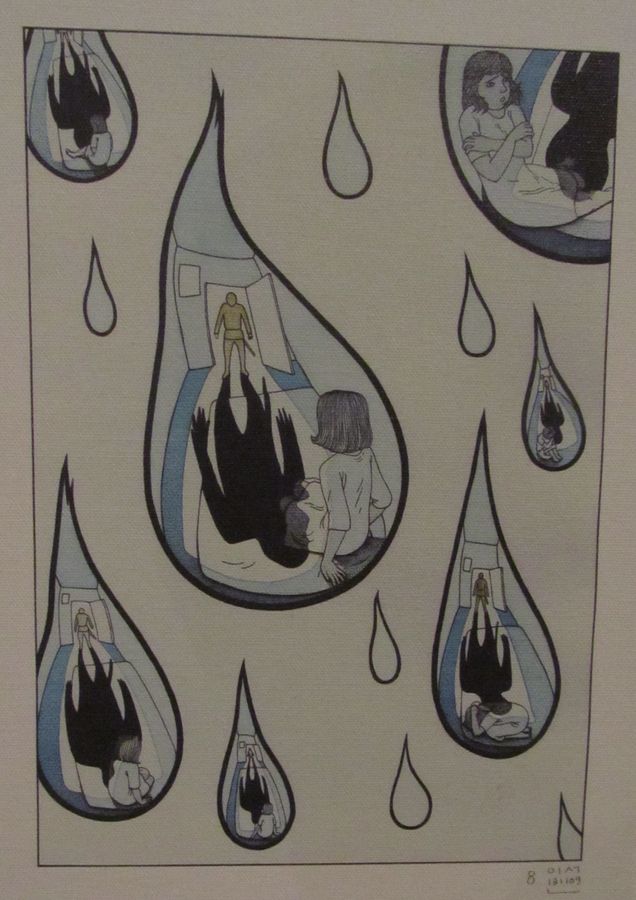

While the above comic also uses symbolism to articulate the way in which these girls were stripped of their youthful innocence, it also is far more graphic in depicting the exact nature of their sexual exploitation and rape. Beyond encouraging bitter feelings regarding the colonial era and Japan, these depictions of female suffering are in accord with gendered representations of the colonial era in Korea. According to this nationalist division of labor, women such as Queen Min, Yu Gwan-sun, or the comfort women are victims:

Men, on the other hand, are heroes who actively stand up to Japan:

The division between these spheres of remembrance can be defended quite vigorously. In 2008, when it was suggested by the Korean Council for the Women Drafted for Military Sexual Slavery by Japan that a museum devoted to the comfort women be built in Independence Park (the location of Seodaemun Prison History Hall), former independence fighters and their descendants harshly denounced these plans:
"The proposed museum denigrates the independence movement and the men who gave their lives as patriotic martyrs for the liberation of Korea," said Kim Yeong-il, the [Korea Liberation] Association’s president, at the Nov. 3 press conference. "The museum will surely create a false image about our history by highlighting our suffering rather than our many military achievements," Kim added.This is all quite ironic, considering that the Seodaemun Prison History Hall at the time featured wall-sized photos of mutilated people and depictions of torture featuring animatronic mannequins accompanied by screams on an endless loop. A guide map described one of the highlights of the exhibition: "Torture Room (experiencing nail picking and tortures with boxes and electricity)." Though the museum has since been changed, for over a decade countless students were guided through these exhibits.
One wonders if Sheila Miyoshi Jager's description (in Narratives of Nation Building in Korea : A Genealogy of Patriotism (2003), pgs 71-72) of reactions to the plight of sex workers who served American soldiers could also be applied to the comfort women. She describes them as "both pitied and despised...[and] thus [they] became the symbol of the nation's shame as well as the rallying point for national resistance." That they are a source of "national shame" may explain why descendants of independence fighters would feel the presence of a museum for the comfort women would "denigrate" the memory of the (mostly male) independence fighters, It may also explain in part why these women were rarely spoken of in Korea for over forty years.
This was also highlighted by an unnamed prominent expert on prostitution, interviewed by Michael Breen, who described (off the record) the comfort women issue as "Pure hypocrisy":
We all know Japan was guilty of terrible things up to 1945, but, she said, this chauvinistic focus on justice for a historical matter is popular with Koreans because it conveniently distracts us from the real issue and our own continued guilt. The real issue is the attitude in Korea of men towards women and human trafficking in the sex industry that operates on the scale it does as a consequence of that attitude.These gendered attitudes have revealed themselves in other ways, such as when Kim Seon-il, a Korean contractor in Iraq, was beheaded in 2004 and the Korean government went to great lengths to ensure the video could not be seen in Korea. While this may have been intended to prevent political criticism of the Korean government's decision to send Korean troops to Iraq, Kim-Yun Eun-mi, writing in Ilda, perceived other reasons. The government's suppression of the video stood in contrast to the display of photos by anti-American protesters of the mutilated bodies of Yun Geum-i, a sex worker killed by an American soldier in 1992, and "Mi-seon and Ho-sun," two middle school girls who were crushed by an American bridge layer in an accident north of Seoul in 2002. Wondering why the photos of these women and Kim Seon-il's beheading video were treated so differently, Kim-Yun wrote:
No matter how you think about it, there is no other conclusion than that this situation reflects the social gaze upon women's bodies. If you look Yun Geum-i's photo, it causes resentment in men whose nationalistic sensibilities have been stimulated. If you are a woman, most look at the photo and feel fear and pain wondering if they could suffer such violence, not react like men thinking "We must protect our sisters."The same can be said for images like this, in which the artists were depicting the women's suffering perhaps a little too enthusiastically.
Furthermore, the effect aroused by Yun Geum-i's photo and internet porn with a rape motif have something in common. They both aim to arouse an intense impression of violence inflicted upon women's bodies.


What follows (I chose not to photograph it) is the graphic depiction of the rape of a child. That she was a child was made clear by the size of her breasts and lack of pubic hair (which were on display in the images), but while it might seem surprising that illustrations of this nature were on display for people of all ages to view at the museum, in Korea posting photos, some of them gruesome, of colonial-era Japanese repression in public places like subway stations is not unknown. As well, large images of the bodies of Shim Mi-seon and Shin Ho-sun, the two middle school girls crushed by an American bridge layer, were common sights in subway stations in 2002. Judging by this YTN report, it appears the above final, graphic image of "Where are we going?" and the comic described above were not displayed at the French festival at all.

If adults in France felt "outrage" when viewing the comfort women comics, one wonders what effect seeing them - without the self-censorship practiced overseas - would have on Korean children, who most certainly made up a portion of the audience at the exhibitions in Korea. A Korea Times columnist criticizing President Obama for his visit to Hiroshima may have unwittingly provided an answer when he wrote that in Korea "memories of Japan's brutal occupation remain fresh even after the passage of 70 years." Popular culture, media, and the education system work to refresh these bitter memories on a regular basis, suggesting that aspiring to victim status at the hands of Japan (or the U.S., depending on one's political leanings or geographical position in relation to the 38th parallel) is an important element of Korea's national self conception. While sites such as the Seodaemun Prison History Museum have toned down the visual and auditory assaults on visitors in recent years, the depictions of suffering in the comfort women comics reveal that the cultivation of outrage still has a role to play in cultivating anti-Japanese sentiment, which, judging by the degree to which Korean history textbooks dwell on resistance to Japanese imperialism, plays an incredibly important role in modern Korean national identity.
An insistence in Korea on allowing displays like these to portray the nation as a historical victim may encourage a nationalist belief in Korea's moral superiority or, more cynically, serve to distract the populace from more pressing issues, but despite these short-term benefits (if they can be called that), considering its geopolitical position and the fact that the Korean Gordian Knot - its division, and all of the complications associated with it - will remain in place for some time to come, it would seem that inculcating such historical bitterness is something that could prove to be counterproductive in the long term.